
Your Cold Email Click Through Rate Is Probably Fake - Here's What Actually Matters
You're staring at a 3.5% cold email click through rate on your latest sequence. Looks decent. Except you booked zero meetings from it.
That gap between "good metrics" and "actual pipeline" isn't a copy problem - it's a measurement problem, and most teams don't catch it until Q2 pipeline reviews expose the damage. We've watched SDR teams optimize for a number that was mostly bot noise, burning weeks of effort on a phantom signal.
Here's what you need to know upfront: real CTR sits between 0.5% and 3% after filtering bot clicks. Reply rate and inbox placement matter far more than link clicks. And if your bounce rate is above 3%, fix your data before you touch a single word of copy.
What Is Cold Email CTR?
Click through rate measures how many recipients clicked a link relative to how many emails landed: (Unique Clicks / Emails Delivered) x 100.
Don't confuse it with CTOR, which divides clicks by opens instead of deliveries. CTOR looks better on dashboards but tells you even less, especially since Apple Mail Privacy Protection inflates opens and makes open tracking unreliable. The distinction matters because the average CTR for cold outreach looks very different depending on which formula you use - and which one your tool defaults to.
2026 Benchmarks Worth Knowing
Cold outbound doesn't have the same large-scale benchmark studies that marketing email does. But we can triangulate from the best available data.
| Email Type | CTR | Source |
|---|---|---|
| All marketing email | 2.09% median | MailerLite 2026 |
| E-commerce (marketing) | 1.07% | MailerLite 2026 |
| Non-profits (marketing) | 2.90% | MailerLite 2026 |
| Software/web apps | 1.15% | MailerLite 2026 |
| Cold outbound (estimate) | 0.5-3% | Industry consensus |
That MailerLite benchmark covers 181,000 accounts and 3.6 million campaigns - one of the largest recent datasets available. But those are opted-in recipients. Cold outbound skews lower because nobody asked to hear from you. A realistic human engagement rate is 0.5-3%, with most campaigns landing around 1-2%.
For context, marketing email across all industries hovers around 2%, so cold outbound performing at 1-2% is closer to parity than most people assume.
Why Your CTR Is Probably Inflated
Here's the thing: a significant chunk of your "clicks" aren't human.
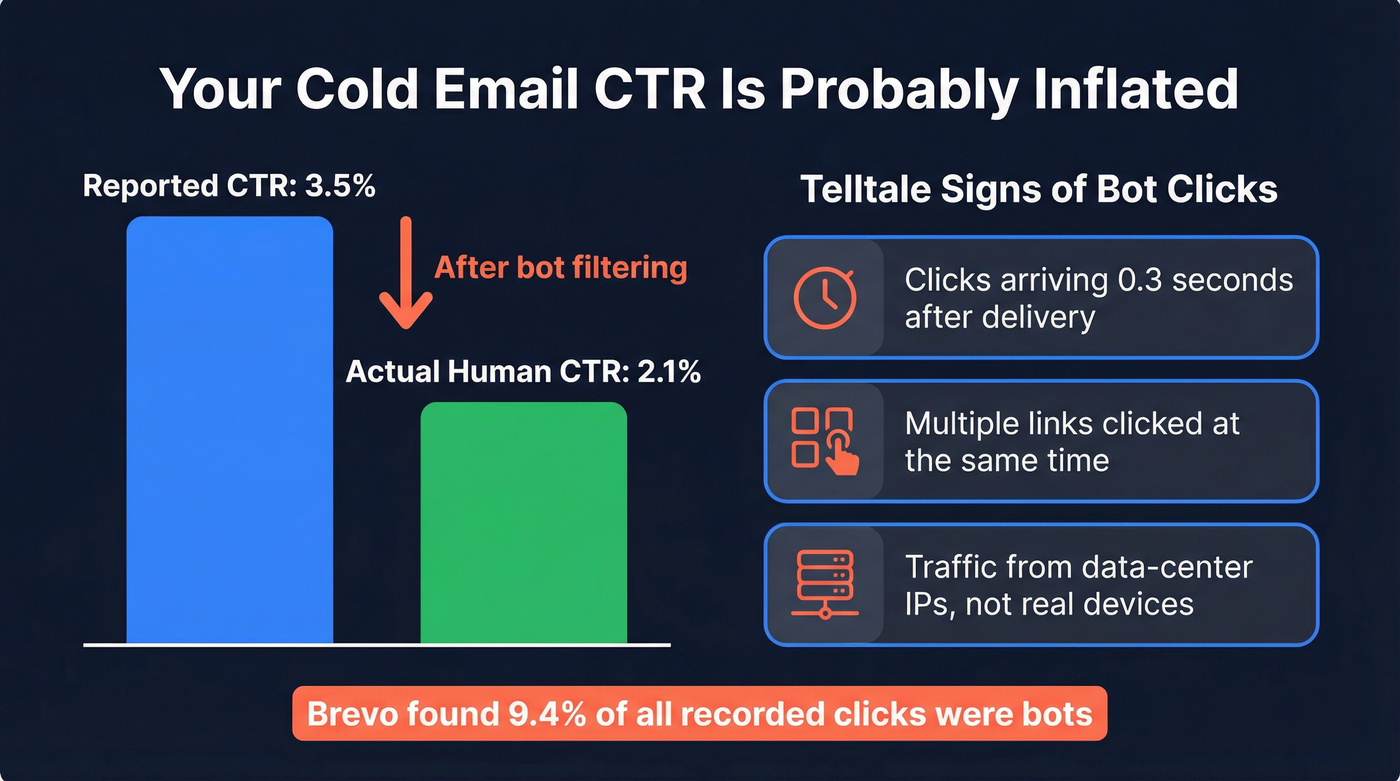
B2B security scanners deployed by Microsoft, Barracuda, Mimecast, and corporate IT teams automatically open emails and test every link before the recipient sees anything. These show up in your analytics as clicks, making your benchmarks completely unreliable. When Brevo enabled bot filtering, reported CTR dropped by 9.4%. Nearly a tenth of all recorded clicks were fake.
We've seen teams celebrate "great engagement" on enterprise-targeted campaigns where half the clicks came from data-center IP ranges - not a single human among them. The telltale signs are obvious once you know what to look for: clicks arriving 0.3 seconds after delivery, multiple links clicked simultaneously, traffic from data-center IPs rather than residential or mobile networks. In B2B environments with aggressive security stacks, 5-15% of recorded clicks are non-human.
The practical fix is a honeypot link. Embed a hidden link that no human would click. If it registers clicks, you've got bots. Filter those IPs and your "3.5% CTR" might turn into a more honest 2.1%. That's still fine. It's just real.

Bot clicks inflate your CTR. Bounces destroy your sender reputation. The fix isn't better copy - it's better data. Prospeo's 5-step email verification delivers 98% accuracy and keeps bounce rates under 3%, so every metric you track reflects real human engagement.
Stop optimizing for phantom clicks. Start with verified emails.
Metrics That Actually Matter
Let's be honest: CTR is a distant fourth in the cold email KPI hierarchy. Most SDR teams care about reply rate and meetings booked - not what their dashboards display.
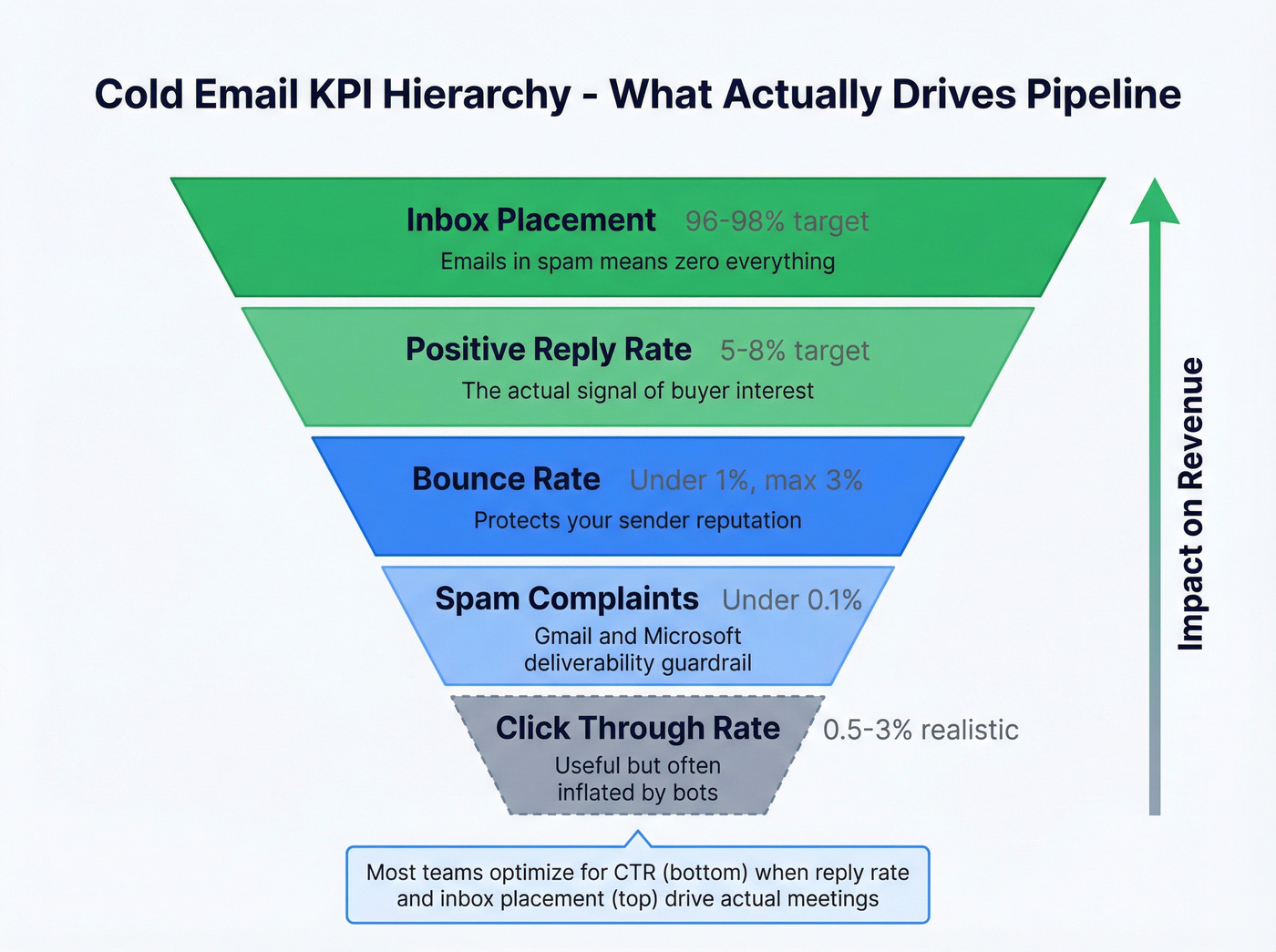
| Metric | Target | Why It Matters |
|---|---|---|
| Inbox placement | 96-98% | Emails in spam = zero everything |
| Positive reply rate | 5-8% | The actual signal of interest |
| Bounce rate | <1% (max 3%) | Protects sender reputation |
| Spam complaints | <0.1% | Gmail/Microsoft deliverability guardrail |
| Meeting conversion | 30-50% of replies | Revenue, not vanity |
An analysis of 16.5 million cold emails across 93 domains found an average reply rate of 5.8%. Elite campaigns exceed 10%. Those are the numbers worth chasing.
How to Actually Improve CTR
If you still want to optimize clicks, it comes down to three levers: CTA design, personalization depth, and data quality.
Single CTA Per Email
One clear CTA per email can increase clicks by up to 371% versus multiple asks. Question-form CTAs like "Would it be worth a 15-minute call?" double reply rates compared to statements.
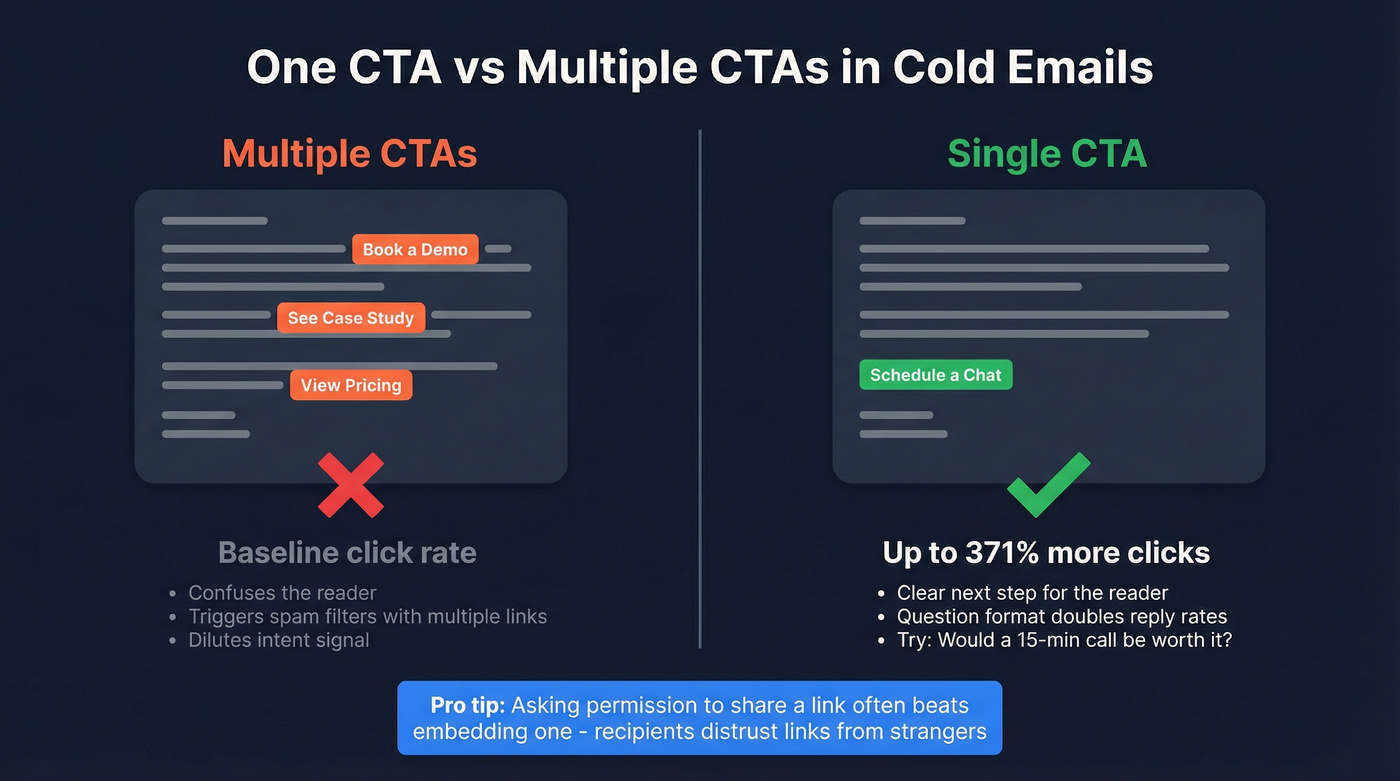
In cold email, asking permission to share a link often outperforms embedding one. Recipients distrust links from strangers - and honestly, they should. Track CTA metrics for each variant: click rate, reply rate, and meeting conversion. The variant that books meetings wins, even if another variant gets more clicks.
Personalize Beyond {first_name}
Data across 20M+ sales emails shows advanced personalization drives a 17% response rate versus 7% without it. That means referencing a specific initiative, a recent funding round, or a tech stack signal - not just merging a first name.
Keep emails to 6-8 sentences. This kind of optimization has a far bigger impact than tweaking button colors or link placement. The consensus on r/sales backs this up: personalization that proves you did homework consistently outperforms clever subject lines or fancy formatting.
Fix Your Data First
Bad data leads to bounces, which tank sender reputation, which sends future emails to spam, which means zero clicks. The chain is that simple.
Proper SPF/DKIM/DMARC authentication alone can boost inbox placement by 5-10 percentage points. Keep bounce rate under 2%, limit emails to 1-2 links max, and run your list through a real-time email verification before launching any sequence. Skip this step and nothing else you do will matter.
A/B Testing Done Right
That same 16.5M-email dataset showed 3% higher response rates when tracking pixels were turned off entirely. Tracking redirect domains can also be a deliverability risk. If you must track clicks, use a custom tracking domain that's warmed and authenticated.
When A/B testing CTAs, test one variable at a time with at least 1,000 recipients per variant for statistical significance. Anything less and you're reading tea leaves.
Clean Data Is the Real CTR Lever
In our experience, your click through rate problem is almost always a data problem in disguise. Bad addresses cause bounces, which tank sender reputation, which sends future emails to spam. Fix the root cause and engagement improves across every metric.
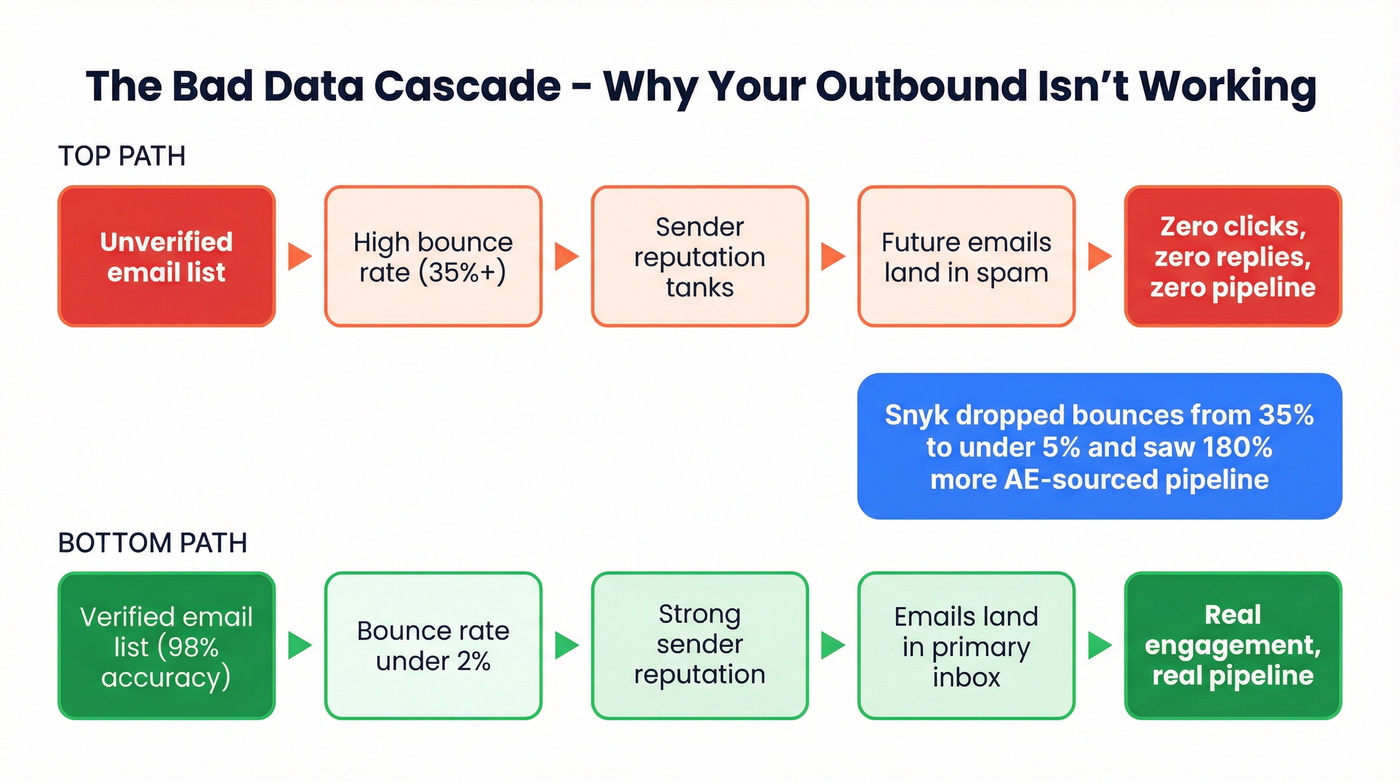
When Snyk's 50-person AE team switched to Prospeo for email verification, bounce rates dropped from 35-40% to under 5%, and AE-sourced pipeline jumped 180%. That kind of improvement comes from a 98% email accuracy rate built on a 5-step verification process with catch-all handling, spam-trap removal, and a 7-day data refresh cycle. I've seen teams go from "our outbound doesn't work" to "we need more SDRs" just by fixing the data layer.
Snyk's 50 AEs dropped bounce rates from 35% to under 5% with Prospeo - and AE-sourced pipeline jumped 180%. When your list is verified on a 7-day refresh cycle at $0.01/email, CTR stops being a vanity metric and starts correlating with booked meetings.
Clean data is the only CTR hack that actually scales.
FAQ
What's a good cold email click through rate?
A realistic CTR is 0.5-3% after filtering bot clicks. Marketing email benchmarks sit higher because recipients opted in, so most cold campaigns land around 1-2%. Focus on a positive reply rate of 5-8% as your primary performance indicator instead.
Should I track link clicks in cold emails?
Tracking pixels hurt deliverability - response rates jumped 3% without them in a 16.5M-email study. If you must track, use a warmed custom tracking domain. Measure replies and meetings booked as your primary success signals.
Why is my CTR high but I'm not booking meetings?
Bot clicks from security scanners are likely inflating your numbers. Use a honeypot link to detect non-human clicks, and verify your contact list before sending to ensure emails reach real inboxes rather than spam folders. Once you filter the noise, you'll have an honest baseline to actually optimize from.