

Cold Email Closing Lines: What the Data Says (And What Matters More)
A SaaS founder posted his full cold email funnel on Reddit last year: 2,847 emails sent, 891 replies, 183 calls booked, 47 customers closed. His early closing line - "Would love to chat, do you have 15 minutes this week?" - generated unsubscribes and complaints. The version that worked? "Worth a quick call? If not, no worries." Same email body, same subject line, same list. The only change was the cold email closing line.
Here's the thing most guides won't tell you: your closing line is rarely the actual problem. The upstream variables - data quality, personalization, timing - matter far more.
Quick distinction: your sign-off word ("Thanks," "Best," "Cheers") is a rounding error. The closing line - the CTA sentence right before that sign-off - what drives replies.
What 350,000 Emails Reveal
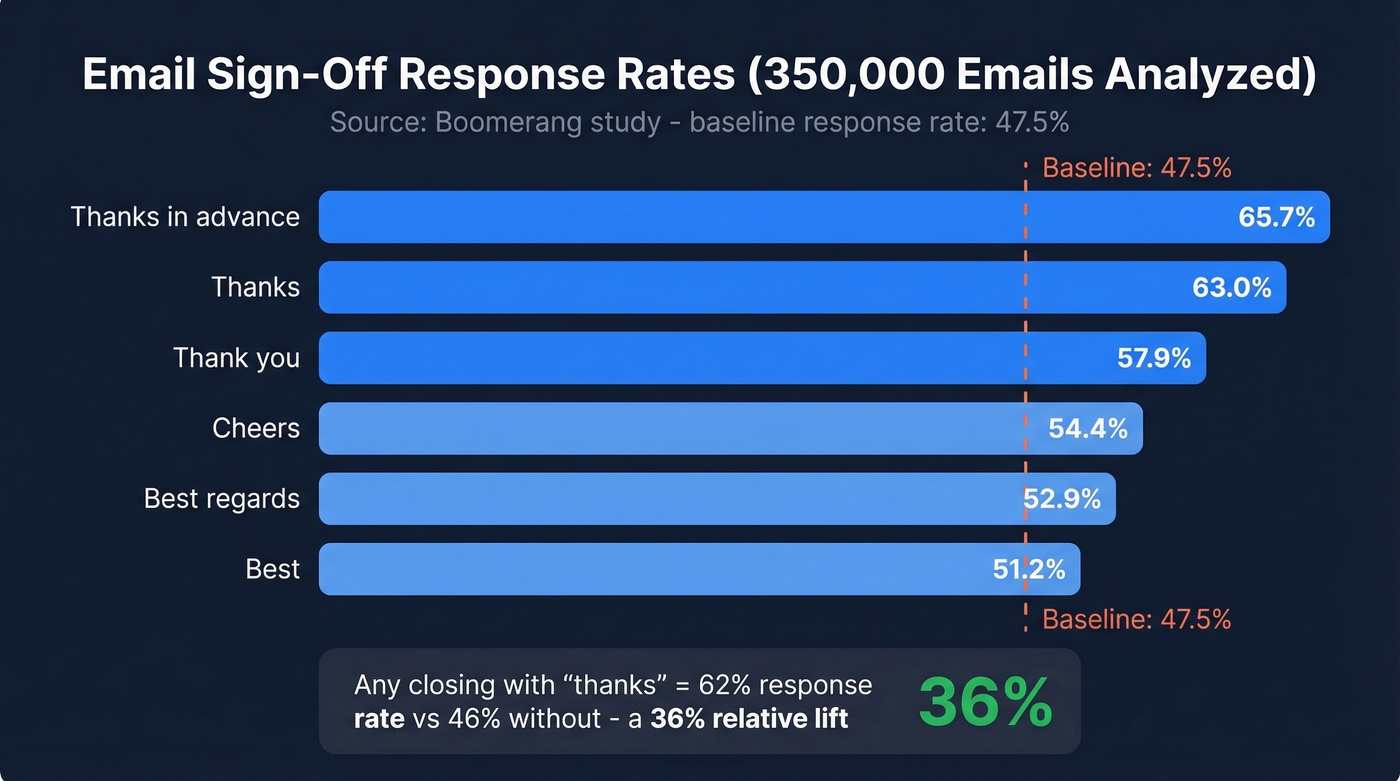
Boomerang analyzed 350,000+ email threads and found that sign-off choice moves the needle modestly. Against a 47.5% baseline:
| Sign-off | Response Rate |
|---|---|
| Thanks in advance | 65.7% |
| Thanks | 63.0% |
| Thank you | 57.9% |
| Cheers | 54.4% |
| Best regards | 52.9% |
| Best | 51.2% |
Any closing containing "thank" pulled a 62% response rate vs. 46% without - a 36% relative lift. But that's general email data, not cold outreach. Instantly's 2026 benchmark report puts the average cold email reply rate at 3.43%, with 58% of all replies coming from step one. The gap between average and elite isn't the sign-off. It's everything else.
Closing Lines That Drive Replies
Here's what actually performs, organized by where each line fits in your sequence (see our B2B cold email sequence guide for the full structure).
Low-Pressure Interest Checks
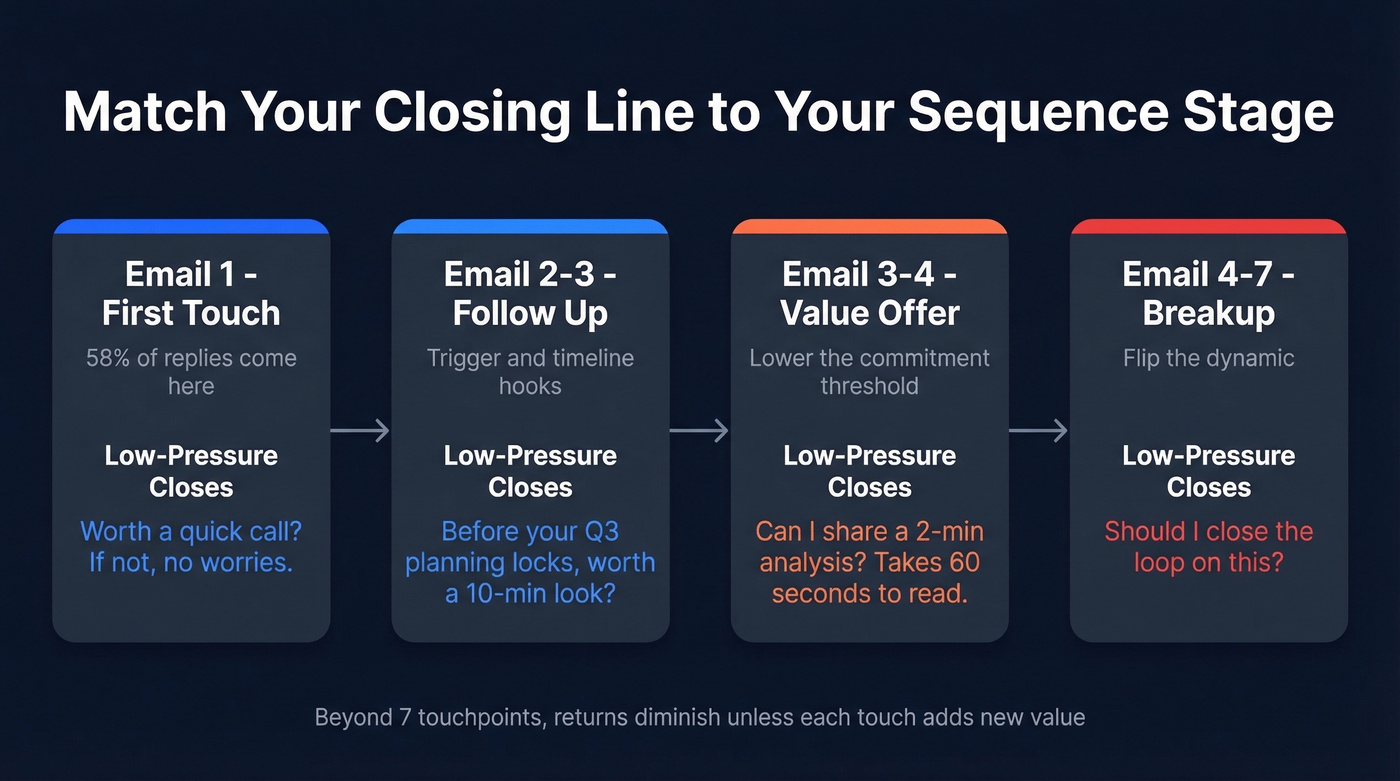
These belong in step one, where 58% of replies come in. Make saying "yes" effortless and saying "no" painless.
- "Worth a quick call? If not, no worries." - The Reddit founder's winner. Removes pressure entirely.
- "Open to exploring this?" - Four words. No time commitment implied.
- "Curious if this is on your radar?" - Frames it as their priority, not your ask.
In our experience, low-pressure closes consistently outperform assumptive ones. The difference is presumption. "Do you have 15 minutes?" assumes the prospect's time is yours. "Worth a quick call?" asks if it's worth theirs.
Skip calendar links in your first touch - they presume a meeting before you've earned one. If you're wondering how to end a cold email at this stage, keep it simple: a soft CTA followed by your first name is all you need (more examples in our email call to action breakdown).
Trigger and Timeline Closes
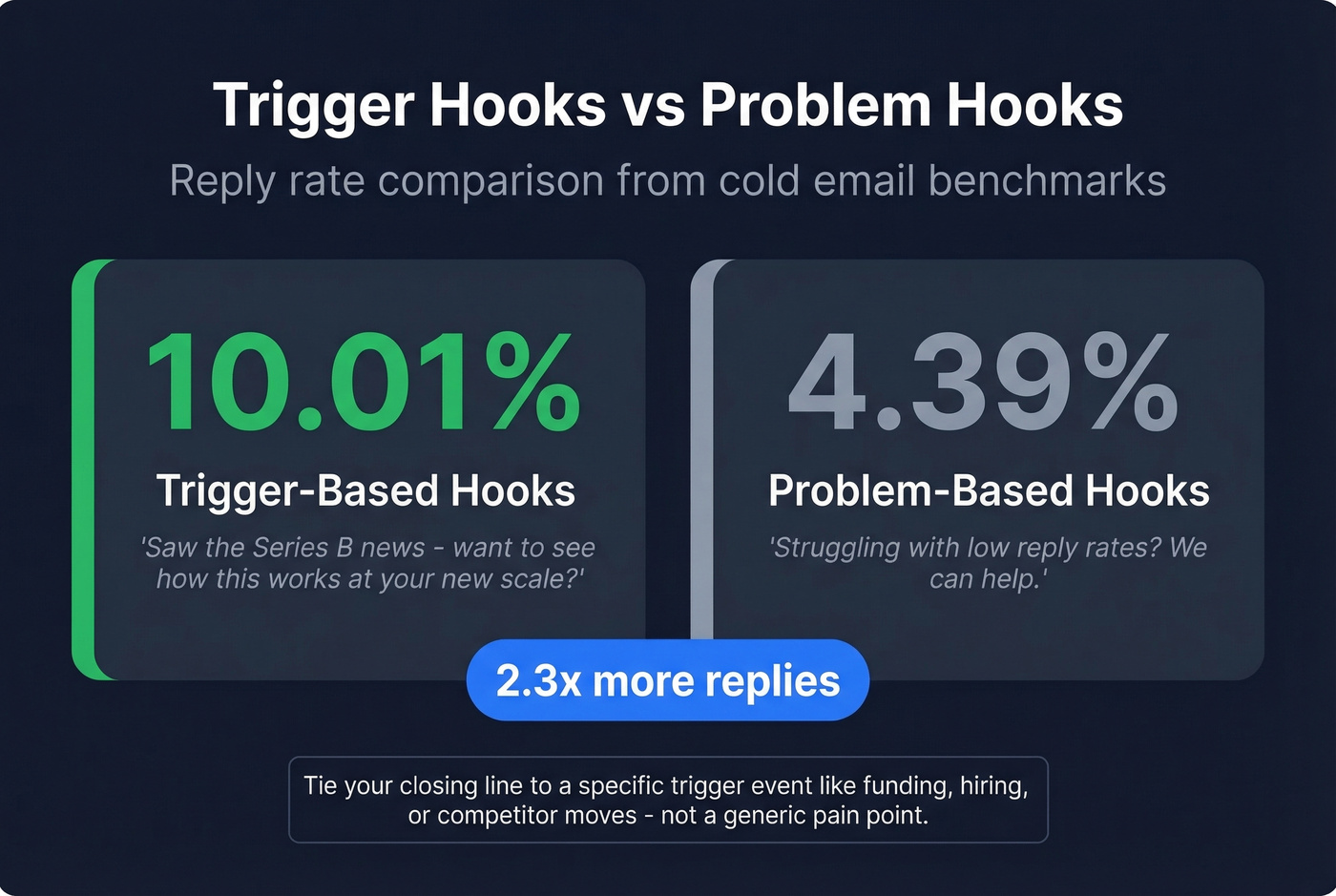
Timeline-based hooks generate a 10.01% reply rate vs. 4.39% for problem hooks - a 2.3x gap. If you opened with a trigger event, close with urgency tied to that trigger (here’s how to operationalize it with how to track sales triggers).
- "Before your Q3 planning locks, worth a 10-min look?"
- "Saw the Series B news - want to see how [outcome] works at your new scale?"
- "Your [competitor] just rolled this out. Quick call to compare notes?"
Value-Offer Closes
When your first touch didn't convert, offer something that isn't a meeting. These email endings work because the prospect can say yes without blocking 30 minutes on their calendar, and that lower commitment threshold is exactly what makes them effective in follow-up sequences where you've already been ignored once (use these cold email follow-up templates to plug-and-play).
- "Happy to send a 2-min breakdown of how [Company] could [outcome] - want it?" Turns the ask from a calendar hold into a quick read.
- "I put together a quick analysis for [Company], want me to send it over?" Implies work already done.
- "Can I share what we did for [similar company]? Takes 60 seconds to read." Pairs social proof with low effort.
Breakup Lines
These go in emails 4-7 of your sequence. Beyond 7 touchpoints, returns diminish unless each touch adds new value (see sequence management for a clean way to structure touches).
- "Should I close the loop on this?"
- "Not the right time? No problem - just let me know and I'll stop reaching out."
- "Want me to check back in Q2 instead?"
Permission-to-close lines are clean and direct. The consensus on r/sales is that a well-timed breakup email often gets more replies than the three follow-ups before it, because it flips the dynamic - suddenly the prospect realizes the conversation is ending.
Bad to Better Rewrites
Match your closing to the prospect's communication style. A "Cheers" closer to a Fortune 500 CFO reads as careless; sign-offs for cold outreach should mirror the formality of the person you're writing to (more on tone and structure in our email copywriting guide).
| Bad | Better | Why |
|---|---|---|
| "Let me know your thoughts" | "Worth a quick call?" | Dead-end becomes a clear next step |
| "I'd love to pick your brain" | "Can I share a 2-min analysis?" | Vague ask becomes a specific offer |
| "Are you free Tuesday at 3?" | "Open to 10 minutes this week?" | Presumptive becomes flexible |

The article says it plainly: most teams obsessing over closing lines should be obsessing over bounce rates. Prospeo's 98% email accuracy and real-time verification mean your carefully crafted CTA actually reaches the inbox - not a spam folder or a dead address.
Stop perfecting closes that bounce. Start with verified data.
What Kills Your Closing Line Before It Lands
None of these lines matter if the email never reaches the inbox (start with the fundamentals in our email deliverability guide).
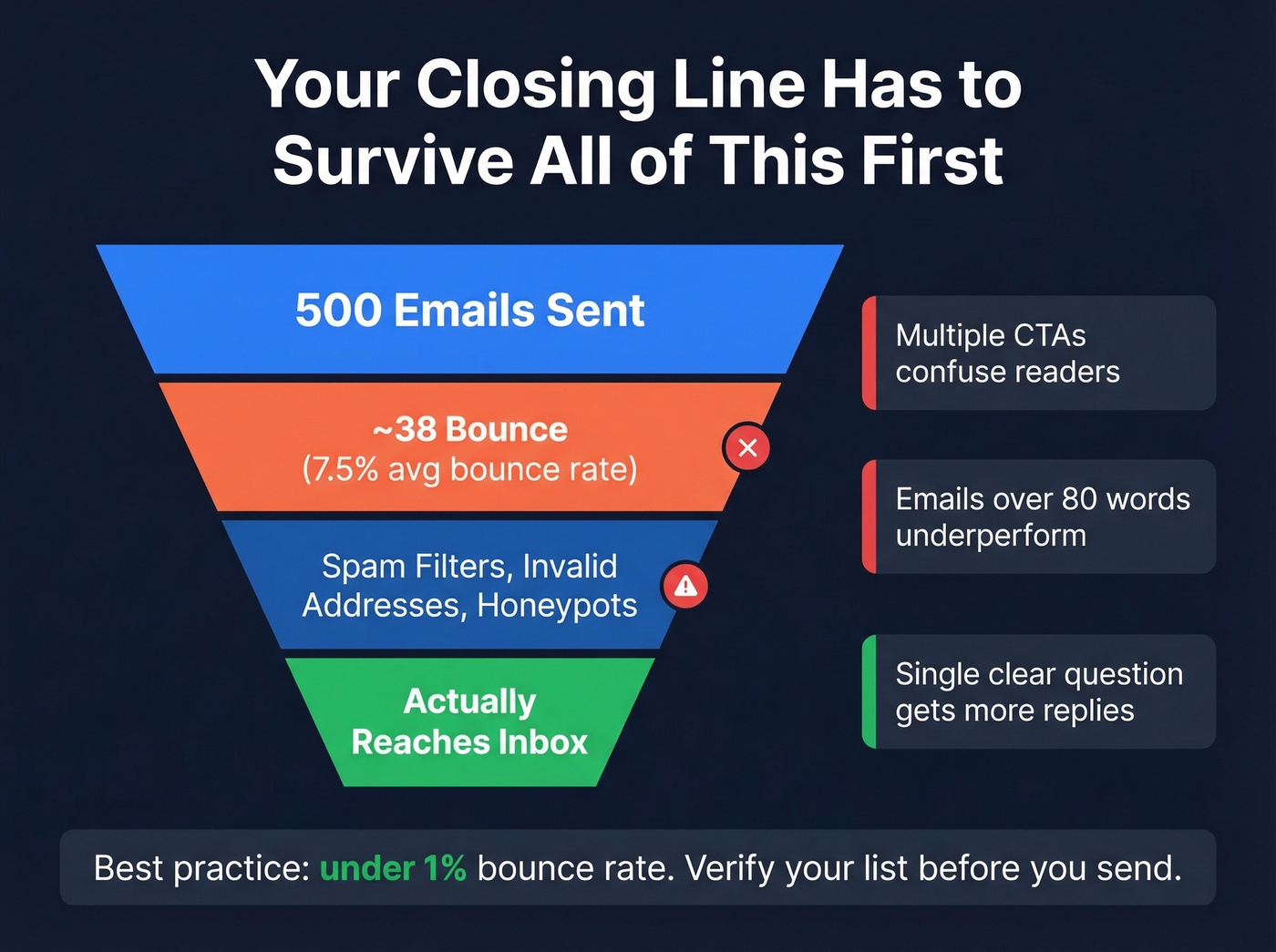
Emails with multiple CTAs confuse the reader. Long emails underperform - keep first-touch emails under ~80 words. And your closing line should be a question, because cold emails that ask a single clear question tend to get more responses than those that don't.
Let's be honest: most teams obsessing over closing line copy should be obsessing over bounce rates instead. The average cold email bounce rate sits around 7.5%, and best practice is under 1%. If you're sending 500 emails and 38 bounce, you're already at the average - and we've seen lists where 30%+ bounce, meaning your closing line never reaches the inbox and your domain reputation takes the hit (benchmarks + fixes in our email bounce rate guide).
Verify your list before you send. Prospeo checks emails in real time with 98% accuracy, and the free tier covers 75 verifications a month - enough to validate a test batch before you burn a domain.
How to A/B Test Your Closes
Keep it disciplined. Use 250+ contacts per variant minimum - anything less is noise. Measure positive reply rate, not opens. Change only the closing line; keep subject, body, and send time identical. Test 2 variants at a time, not 5 (pair this with email preview text A/B testing if you’re optimizing the whole send).
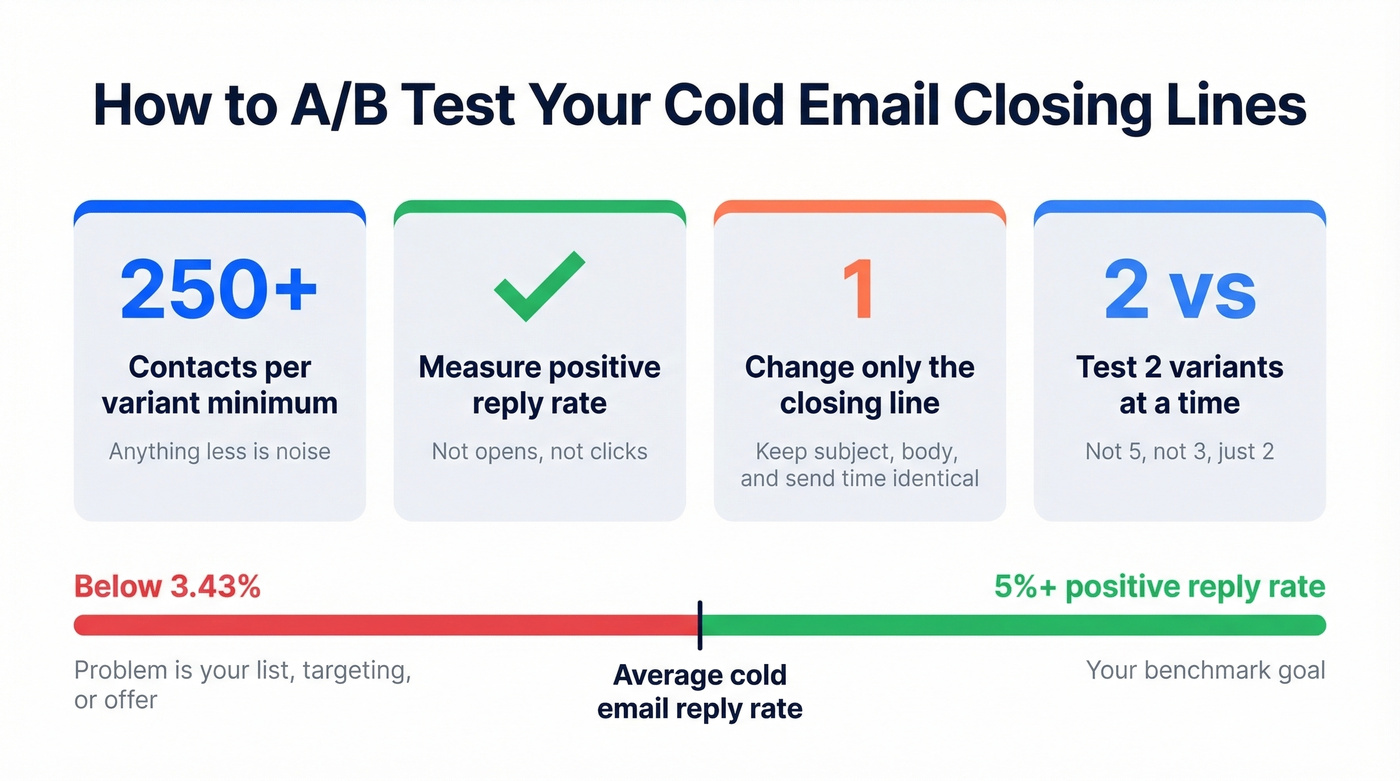
Aim for 5%+ positive reply rate as your benchmark. If you're below 3.43%, the problem isn't your sign-off - it's your list, your targeting, or your offer. Even the best cold email closing lines can't rescue a message sent to the wrong person at the wrong time (use these sales prospecting techniques to tighten targeting).
Frequently Asked Questions
What's the best closing line for a first cold email?
Low-pressure CTAs like "Worth a quick call? If not, no worries" consistently outperform assumptive asks. They make saying "no" painless - which paradoxically makes "yes" easier.
How many CTAs should a cold email have?
One. Emails with a single, clear CTA outperform multi-CTA emails because they eliminate decision fatigue. Your closing line should contain exactly one question or one request.
Does the sign-off word matter in cold outreach?
Marginally. Boomerang's 350,000-email study found closings with "thanks" lifted replies by 36% relative to no sign-off. But in cold outreach where baseline reply rates are 3-5%, the CTA sentence matters 10x more than whether you write "Best" or "Cheers."
How do I make sure my closing line actually reaches the inbox?
Verify every email address before sending. Lists with 7.5%+ bounce rates damage sender reputation, which means even perfect copy never gets read. Real-time verification catches invalid addresses, spam traps, and honeypots before they tank your deliverability - and that's a problem no amount of copywriting can fix.
Trigger-based closes pull 2.3x more replies - but only if you're reaching the right person at the right time. Prospeo's 30+ filters including job changes, funding events, and buyer intent signals let you match your closing line to a real trigger, not a guess.
Find prospects with live trigger events for $0.01 per verified email.