

7 Cold Email Samples That Actually Get Replies From Potential Clients
The average rep sends 344 cold emails to book a single meeting. That's what Gong found analyzing 28M+ outbound emails. Meanwhile, the average reply rate dropped from 6.8% to 5.8% year-over-year across 16.5M emails tracked by Belkins.
If you're hunting for a cold email to potential client sample you can actually use, templates alone won't close that gap. What separates the teams booking meetings from the ones burning domains is data quality, deliverability hygiene, and copy that respects the reader's time. One operator runs their entire cold email stack for $420/month and generates 16 qualified leads monthly - proof that the channel works when the foundation is right.
What You Need (Quick Version)
- Templates don't matter if your data is bad. Verify every email before sending - bounce rate must stay under 3%, or your domain reputation tanks.
- Keep emails under 100 words, use an interest CTA ("Worth a conversation?"), and send on Thursdays.
- Below: 7 copy-paste samples organized by scenario, plus 2 complete 3-email sequences you can deploy this week.
What the Data Says in 2026
Here's what actually moves the needle, based on several of the largest published cold email datasets available.
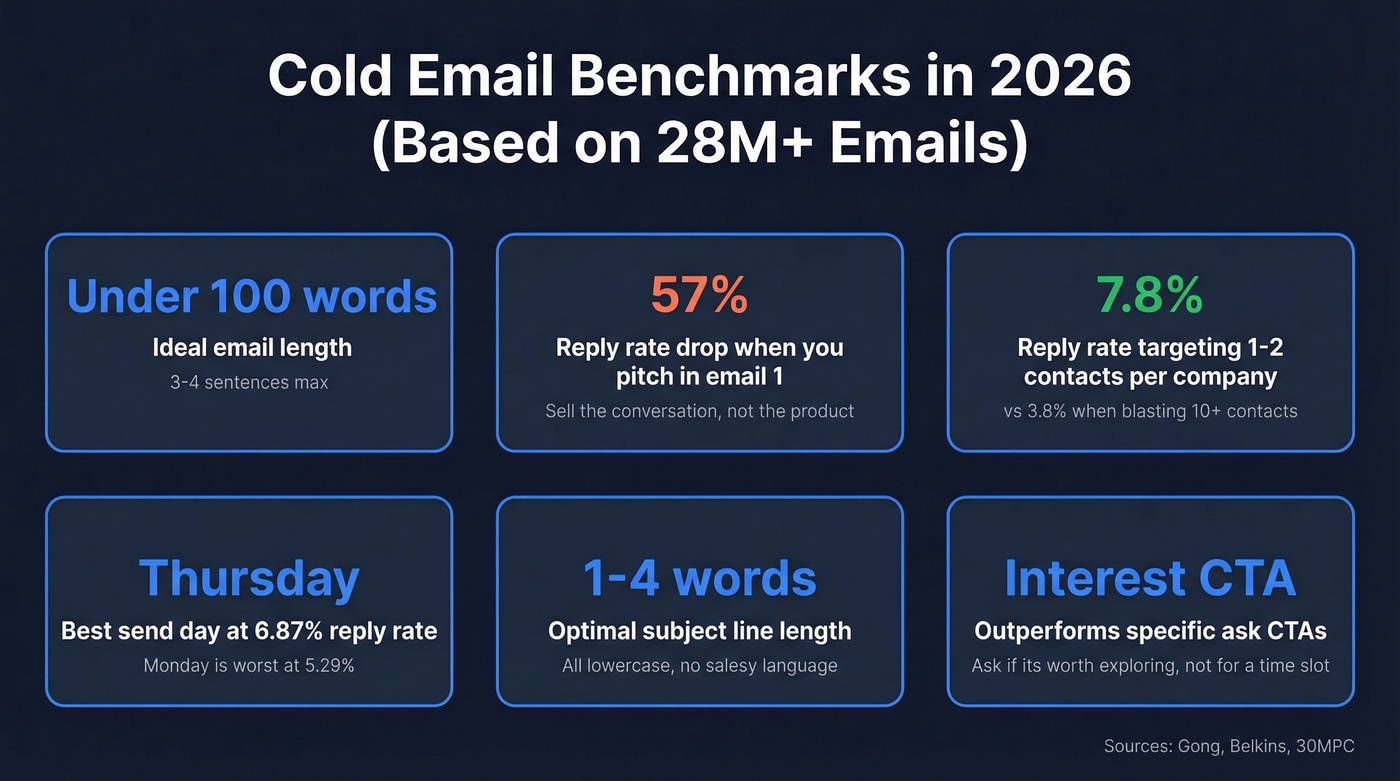
Short emails win. Gong recommends under 100 words in 3-4 sentences. Belkins found 6-8 sentence emails hit a 6.9% reply rate, and that emails under 200 words outperform longer ones. One Reddit operator cut their emails from 141 words to under 56 and watched reply rates double.
Don't pitch in the first email. This is the single biggest mistake we see. Gong's 28M-email analysis found that pitching your product drops reply rates by up to 57%. Your first email sells the conversation, not the product.
Target narrow, not wide. Emailing 1-2 contacts per company yields a 7.8% reply rate. Blast 10+ contacts at the same company and you're down to 3.8%. Executives typically need 8-9 touches before responding, while mid-level contacts convert in 3-4.
Thursday is your best send day at 6.87% reply rates, beating every other day of the week. Monday is the worst at 5.29%. The playbook that consistently works: send Tue-Thu between 8-11am in the recipient's timezone. (If you want the full breakdown, see our best send windows guide.)
Interest CTAs outperform everything else. Across 304,174 emails analyzed, asking "Is this worth exploring?" books more meetings than asking for a specific time slot. Save the specific CTA for once you're in a deal. (More CTA patterns here: email call to action.)
Subject lines should be short and lowercase. Data from 85M+ cold emails shows 1-4 word subject lines perform best. All-lowercase gets the highest open rates, though proper nouns are fine. Salesy subject lines reduce opens by 17.9%. For more ideas, pull from these cold email subject line examples.

Before You Write - The Prerequisites
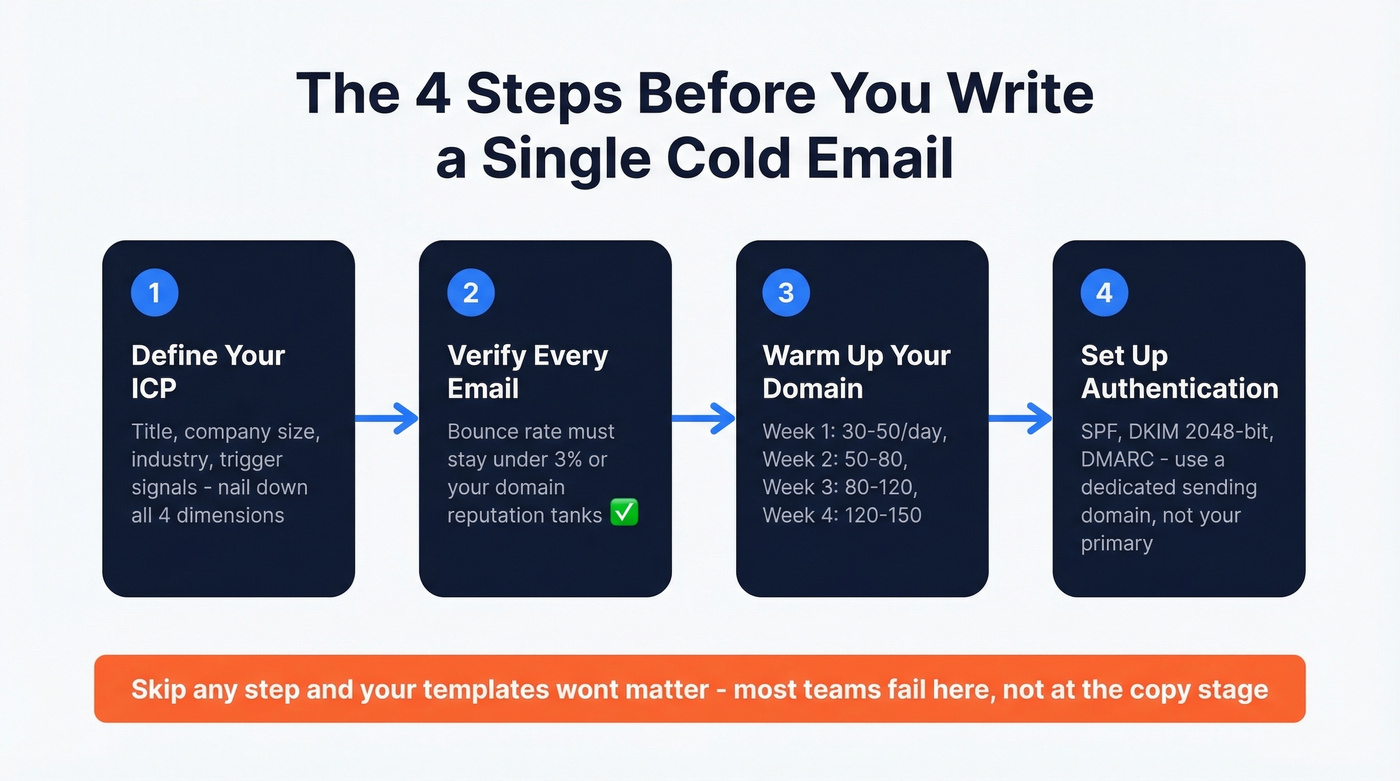
Every cold email guide jumps straight to templates. Here's the thing: none of those templates work if your infrastructure is broken. (If you need a full checklist, start with an email deliverability guide.)
Define Your ICP First
The 7.8% reply rate from targeting 1-2 contacts per company only works if those are the right contacts. Before you write a word, nail down these four dimensions (or use an ideal customer profile template):
| ICP Dimension | What to Define | Example |
|---|---|---|
| Title / Role | Decision-maker who owns the budget | VP Sales, Head of Growth |
| Company Size | Revenue or headcount range | 50-500 employees, $5M-$50M ARR |
| Industry | Verticals where you have proof points | B2B SaaS, fintech, e-commerce |
| Trigger Signals | Events that create urgency | New funding, leadership change, hiring spree |
Verify Every Email Address
One operator on Reddit reported their bounce rate was 11% before they rebuilt their process. After they stopped buying lists and switched to manual verification, it dropped below 2% - and reply rates doubled. Bounce rates above 3% trigger spam filters and damage your sending domain. This is where most teams cut corners and pay for it later. (Benchmarks + fixes: email bounce rate.)
Prospeo runs every email through a 5-step verification process with proprietary infrastructure - catch-all handling, spam-trap removal, honeypot filtering - and delivers 98% accuracy on verified addresses. Stack Optimize built their agency from $0 to $1M ARR using that verified data: bounce rates under 3%, zero domain flags, deliverability above 94% across every client campaign.
Warm Up Your Domain
Week 1: 30-50 emails per day. Week 2: 50-80. Week 3: 80-120. Week 4: 120-150 - but only if your metrics stay clean. Monitor these thresholds during warm-up: bounce rate under 2%, spam complaints under 0.1%, open rate above 15%. After warm-up, keep bounce rates under 3% as an ongoing guardrail. Track your sending reputation with Gmail Postmaster Tools and Microsoft SNDS - both are free. (More on safe sending limits: email velocity.)
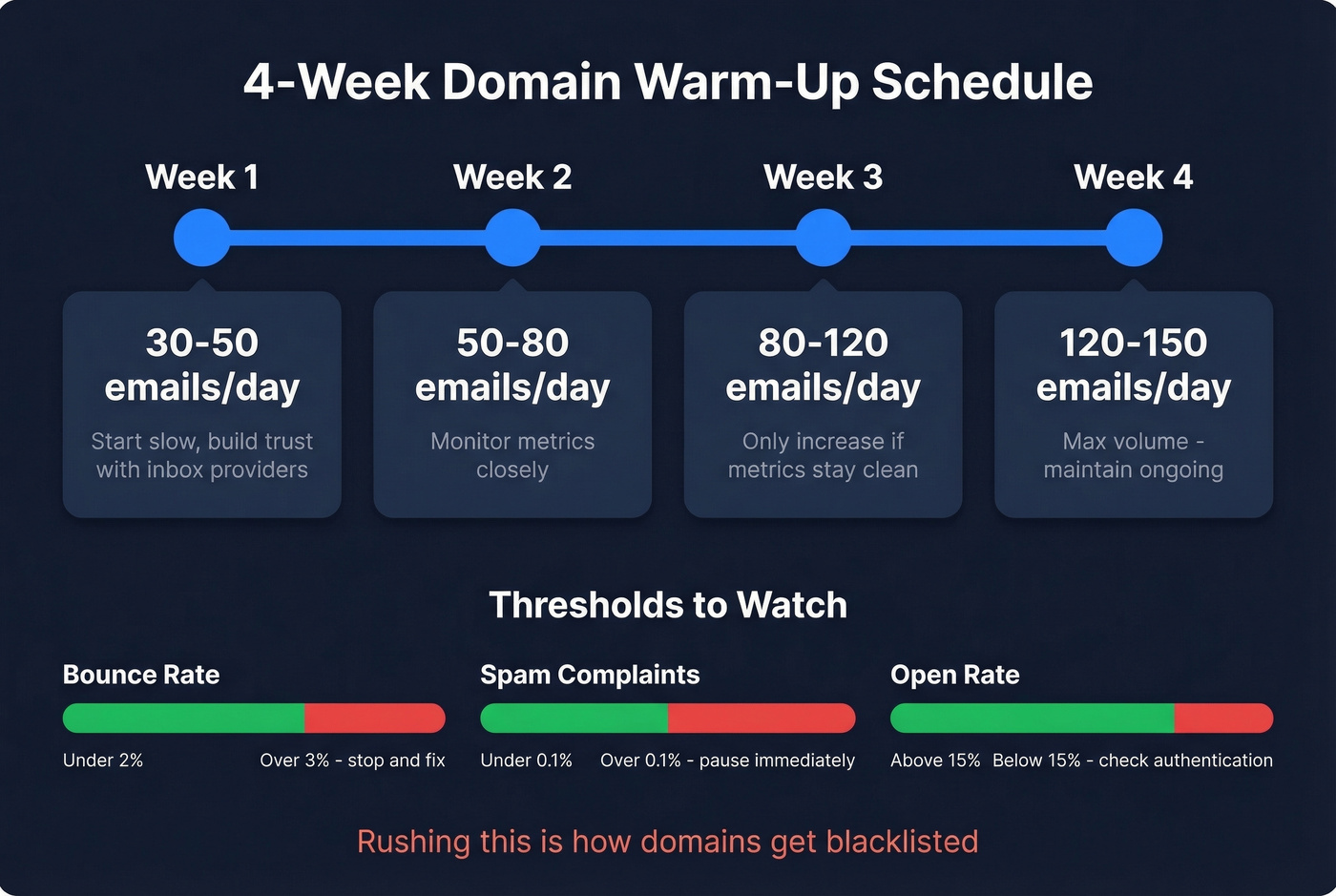
Rushing this is how domains get blacklisted.
Set Up Authentication
SPF, DKIM (2048-bit), and DMARC are non-negotiable. Start DMARC at p=none with reporting, then move to quarantine once alignment is clean. Use a dedicated sending domain - not your primary - and a custom tracking domain. Shared tracking domains pool your reputation with every other sender and will tank your deliverability. (Deep dive: DMARC alignment and tracking domain.)

Bad data kills cold email before templates can save it. Prospeo verifies every address through a 5-step process - catch-all handling, spam-trap removal, honeypot filtering - delivering 98% accuracy. Stack Optimize built a $1M agency on that data: bounce rates under 3%, zero domain flags.
Start with 75 free verified emails - no contracts, no sales calls.
Subject Lines That Get Opened
Your email is worthless if it never gets opened.
| Subject Line | When to Use |
|---|---|
| quick question | First touch, any scenario |
| {first name} | Personalized outreach |
| {company name} + {your company} | Partnership angle |
| thoughts? | Follow-up emails |
| one quick ask | Referral requests |
Keep it to 1-4 words. Use all-lowercase, though proper nouns are fine. Avoid anything that sounds like marketing - "Partnership opportunity" pulled under 19% opens in one operator's testing. And don't try the empty subject line trick: it boosts opens by 30% but drops replies by 12%. That's a net loss. (More patterns: prospecting email subject lines.)
These 7 templates target 1-2 decision-makers per company for a reason - the data says that's where 7.8% reply rates live. Prospeo's 30+ search filters let you pinpoint the exact VP or Head of Growth at companies showing buying intent, then deliver their verified email at 98% accuracy.
Find the right contact before you write a single word of copy.
7 Templates for Client Acquisition
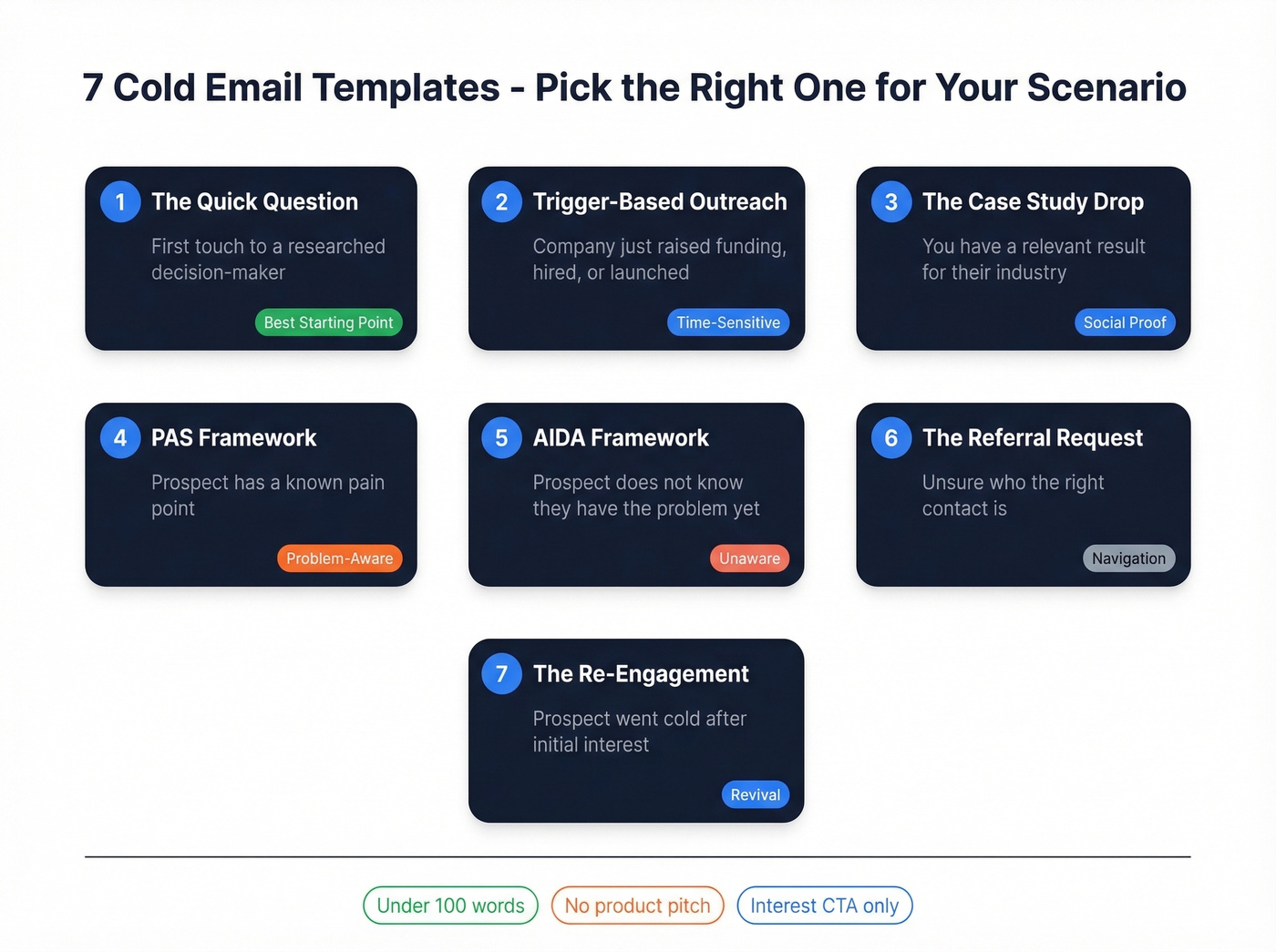
Every template below follows the data rules: under 100 words, no product pitch, interest CTA. We've tested dozens of cold email frameworks over the years, and these structures consistently outperform clever one-liners and gimmicky approaches. Treat each sample as a starting point - personalize the opening line and problem statement for every prospect. (If you want more angles, see these sales prospecting techniques.)
1. The Quick Question
When to use: First touch to a decision-maker you've researched.
Subject: quick question
Hi Sarah,
Noticed Relay just expanded into the DACH market - congrats on the growth.
Curious: how are you handling localized payment processing for those new regions?
Worth a quick conversation, or bad timing?
Best, James
Opens with a specific observation rather than flattery, connects to a relevant problem, and closes with a low-pressure interest CTA. If you only test one cold email to potential client sample, start with this one.
2. The Trigger-Based Outreach
This format works best when the prospect's company just raised funding, hired, or launched something. The timing makes the email feel relevant rather than random - and timing is half the battle.
Subject: congrats on the news
Hi Marcus,
Saw the announcement - big milestone.
After moments like this, teams often ramp outbound quickly, and list quality becomes a bottleneck fast.
Want me to send over a simple checklist we use to keep bounce rates under control while volume ramps?
- Priya
Don't do this: Reference a trigger event from three months ago. If the funding round was announced in January, emailing about it in April feels lazy. Set up alerts so you catch these within the first week. (Operationally: how to track sales triggers.)
3. The Case Study Drop
When to use: You have a relevant result for their industry. Strong approach when social proof matters more than personalization.
Subject: quick thought
Hi David,
We recently helped a company with a similar setup to yours improve a key conversion metric by fixing a few issues in their checkout flow.
Would it be useful to see the exact changes they made? Happy to share the breakdown.
Cheers, Anika
Leads with a specific outcome. Doesn't pitch the product - offers to share the story. The CTA asks about interest, not a meeting.
4. The PAS Framework
Problem-Agitate-Solve works when the prospect has a known pain point. The agitation step is what separates this from a generic pitch - it makes the cost of inaction feel real.
Subject: {company} deliverability
Hi Rachel,
When outbound volume ramps, inbox placement often drops for one simple reason: unverified data feeds bad addresses into warm domains.
Once bounce rates climb above 3-5%, inbox placement falls and recovery can take weeks - which means pipeline slows down in the meantime.
We built a verification workflow that keeps bounce rates under 2% at scale.
Worth exploring?
- Tom
5. The AIDA Framework
When to use: The prospect doesn't know they have the problem yet. This format educates before it sells, making it ideal for top-of-funnel outreach to new markets.
Subject: your EMEA outbound
Hi Laura,
When teams expand outbound into new regions, the same sequence can suddenly underperform - even if the copy is solid.
The usual culprit is list quality and deliverability: outdated contacts, role changes, and higher bounce rates.
If you're running outbound into EMEA, I can share a quick before/after breakdown of what changed once we switched to fresh-verified data.
Open to it?
- Kai
Attention, Interest, Desire, Action. Educates before it sells. (Framework breakdown: AIDA sales funnel.)
6. The Referral Request
When you're unsure of the right contact:
Subject: can you point me?
Hi Jordan,
I'm trying to reach whoever handles outbound sales infrastructure at Vantage. Would that be you, or could you point me to the right person?
Appreciate it either way.
- Sam
People are surprisingly willing to redirect you when you don't ask them to do anything else.
7. The Re-Engagement
When a prospect went cold after initial interest:
Subject: still relevant?
Hi Megan,
We chatted back in March about your team's data quality issues. Totally understand if priorities shifted.
Is this still on your radar, or should I close the loop on my end?
- Alex
The "close the loop" framing gives the prospect an easy out, which paradoxically increases replies. Skip this template if the original conversation was more than six months ago - at that point, treat them as a new prospect and start fresh.
Complete 3-Email Sequences
Single templates are a starting point. Here are two complete sequences with spacing based on a 2-4 business day cadence. (If you want more follow-up copy, use these cold email follow-up templates.)
Let's be honest about sequence length: Belkins found that adding a third email can drop reply rates by up to 20%. By the 5th email, response rates drop 55%. And by the 4th email, spam complaints rise from 0.5% to 1.6%. We've never seen a team improve results by adding a 6th or 7th touch - you're just training inboxes to filter you.
Sequence 1: New Prospect Outreach
Day 1: Use "The Quick Question" template. Personalize the opening line to something specific about their company - a recent hire, a product launch, a conference talk. Generic openers get generic results.
Day 3: Reply to your own thread. Add one new piece of value - a relevant stat, a short case study result, or a link to a resource. Keep it under 50 words. "Wanted to add one thing - [relevant insight]. Still happy to chat if the timing works."
Day 7: Final touch. Acknowledge you're following up, offer an easy out. "Totally understand if this isn't a priority. If it ever is, I'm here. Either way, no more emails from me on this."
Sequence 2: Trigger-Based With Case Study
Day 1: Use "The Trigger-Based Outreach" template. Reference the specific event.
Day 4: Reply to your thread. Drop the case study. "Since I mentioned [result], here's the quick version of how [similar company] did it: [2-sentence summary]. Worth 10 minutes to compare notes?"
Day 8: "I'll assume the timing isn't right. If [trigger-related challenge] comes up down the road, happy to pick this back up."
How to End Your Cold Email
Your CTA determines whether someone replies or archives.
| CTA Type | Example | Best For |
|---|---|---|
| Interest CTA | "Worth exploring?" | Cold outreach (highest reply rate) |
| Specific CTA | "Does Thursday at 2pm work?" | In-deal follow-ups (+37% meetings) |
| Open-ended CTA | "Want to set up a call?" | Warm introductions |
For outreach to new prospects, interest CTAs win. They lower the commitment threshold - you're asking if they're curious, not asking them to block 30 minutes on their calendar for a stranger. Save the specific CTA for after the first reply, when you've earned the right to ask for time.
Mistakes That Kill Reply Rates
These are the errors we see tank campaigns before copy even matters. Whether you're sending a single prospecting email or running sequences at scale, avoiding these matters more than perfecting your subject line.
- Sending to unverified emails. Mistake #1. Unverified lists lead to bounce rates above 5%, which damages your domain reputation and tanks inbox placement. You only get one shot at domain reputation.
- Pitching in the first email. Drops reply rates by up to 57%. Your first email earns the conversation. The demo pitch comes later.
- Blasting 10+ contacts at the same company. Reply rates drop from 7.8% to 3.8%. Pick 1-2 decision-makers and write them something relevant.
- Loading emails with links and images. Stick to plain text and one link max. HTML-heavy emails trigger spam filters and scream "marketing blast."
- Using shared tracking domains. These pool your reputation with every other sender on that domain. Set up a custom tracking domain - it takes 10 minutes.
- Skipping domain warm-up. Sending high volume on day one from a fresh domain is a fast way to land in spam. Don't do it.
- No opt-out link. Beyond being legally required in many jurisdictions, missing opt-outs trigger spam filters. One line at the bottom costs you nothing.
Compliance Essentials
Cold email is legal - if you follow the rules.
CAN-SPAM (US) carries penalties of up to $53,088 per email violation. The seven requirements: truthful headers, non-deceptive subject lines, identify the message as an ad, include your physical address, provide a clear opt-out, honor opt-outs within 10 business days, and take responsibility for third-party senders. This applies to B2B, not just B2C.
GDPR (EU) allows cold email under legitimate interest, but you must explain who you are, how you got their information, and provide an easy opt-out. Penalties reach EUR 20M or 4% of global annual turnover. PECR (UK) caps penalties at GBP 500,000 with similar rules.
The practical version: include your real name, company, physical address, and an unsubscribe link in every email. Don't use deceptive "Re:" subject lines to fake a reply thread. And honor every opt-out immediately.
FAQ
Is cold emailing potential clients legal?
Yes, cold email is legal in the US, EU, and UK when you follow the rules. CAN-SPAM requires truthful headers, a physical address, and a clear opt-out. GDPR requires legitimate interest and easy unsubscribe. Violations carry penalties up to $53,088 per email (CAN-SPAM) or EUR 20M (GDPR).
What's a good cold email reply rate?
The industry average is 5.8% across 16.5M emails analyzed. Above 8% is strong performance. If you're below 3%, fix your data quality and deliverability infrastructure before rewriting templates - bad data is almost always the bottleneck.
How many follow-ups should I send?
Two to three follow-ups spaced 2-4 business days apart is the sweet spot. By the 5th email, response rates drop 55%, and spam complaints rise from 0.5% to 1.6% by the 4th. Three well-timed touches maximize replies without burning your domain.
What's the best day and time to send?
Thursday has the highest reply rate at 6.87%, while Monday is the worst at 5.29%. Send Tue-Thu between 8-11am in the recipient's timezone. Mid-week morning sends consistently outperform other windows across every dataset we've reviewed.
How do I find verified email addresses for prospects?
Use a verification tool that runs multi-step checks before you send. Unverified lists push bounce rates above 5%, which damages domain reputation and tanks inbox placement. Prospeo delivers 98% accuracy with a 7-day data refresh cycle, and the free tier gives you 75 verified emails per month to start.