

Your Cold Messages Aren't Failing Because of Your Copy
You've rewritten the subject line four times. You've A/B tested the opening sentence. You've swapped "quick question" for something clever. And your reply rate still dropped 15% year over year.
A cold message is inherently hard - no relationship, no real-time feedback, no reason for a stranger to care. But the reason yours are failing in 2026 isn't the words. It's everything underneath them.
Here's the thing: most teams spend 80% of their time on copy and 20% on infrastructure. Flip that ratio and your reply rate doubles. We've seen it happen repeatedly.
What Is a Cold Message?
A cold message is any unsolicited outreach to someone who doesn't know you and hasn't asked to hear from you. The channel varies - email, direct message, phone call, SMS - but the core challenge is identical: you're interrupting a stranger and asking for attention.
The line between cold messaging and spam is intent plus compliance. Spam is bulk, untargeted, and ignores opt-out requests. A targeted cold message is relevant and respects the recipient's right to say no. Warm outreach involves some prior touchpoint - a mutual connection, a webinar signup, an inbound lead. This applies beyond sales, too. Recruiters message candidates daily. Founders pitch investors cold. Creators reach out to potential collaborators. The principles below work across all of these.
| Channel | Strengths | Weaknesses |
|---|---|---|
| Scalable, trackable | Crowded inboxes | |
| DM | Personal, high visibility | Low volume, platform limits |
| Phone | Immediate, two-way | Intrusive, low pick-up |
| SMS | High open rates | Strict consent rules (TCPA) |
Email gives you the most control over deliverability and scale. DMs work best when you've got a warm-adjacent angle - a shared group, a comment thread, a mutual connection. Phone still wins for urgency and senior buyers. SMS is powerful but legally risky without explicit consent.
If you use InMail-style outreach, keep it short: messages under 400 characters get 22% more replies, while ~800-character messages average around a 3% reply rate.
Cold Message Benchmarks in 2026
Belkins analyzed 16.5 million cold emails across 93 business domains and the headline is sobering: average reply rate dropped to 5.8%, down from 6.8% the year before. That's a 15% decline in twelve months.

The data gets interesting when you dig into what separates top performers from everyone else. Single-email campaigns - one well-crafted message, no follow-up sequence - hit an 8.4% reply rate. That's counterintuitive until you realize it's a proxy for targeting quality: if you're only sending one email, you're probably sending it to the right person.
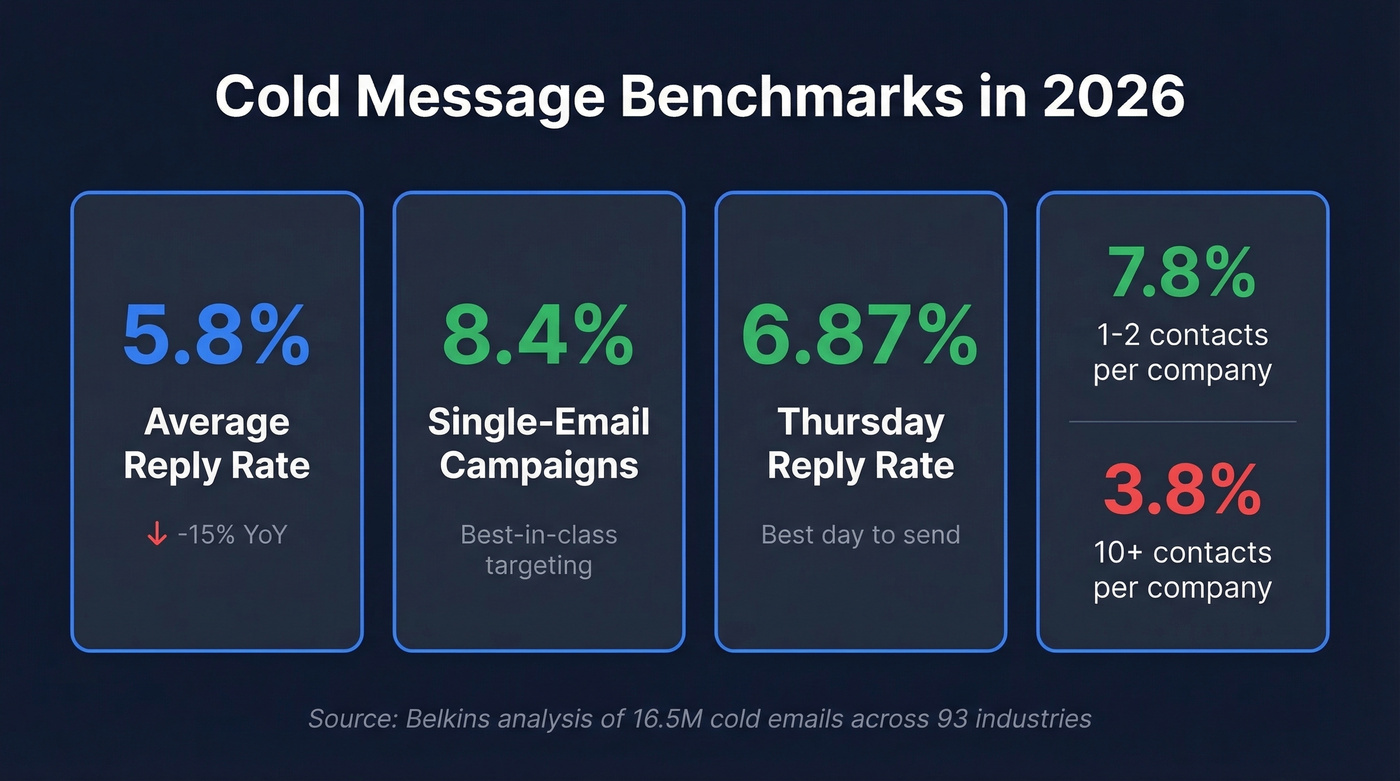
Thursday outperforms every other day at 6.87% reply rate. Monday sits at the bottom with 5.29%.
And here's the targeting stat that should change how you build lists: contacting 1-2 people per company yields a 7.8% reply rate. Spray 10+ contacts at the same company and you drop to 3.8%. Precision beats volume, every time. The teams beating those averages aren't writing better copy - they're sending to better lists with cleaner infrastructure.
The 4-Part Framework That Gets Replies
Every effective cold message follows the same underlying structure, whether it's a 40-word DM or a 180-word email. The goal isn't to close a deal. It's to earn permission for a conversation.
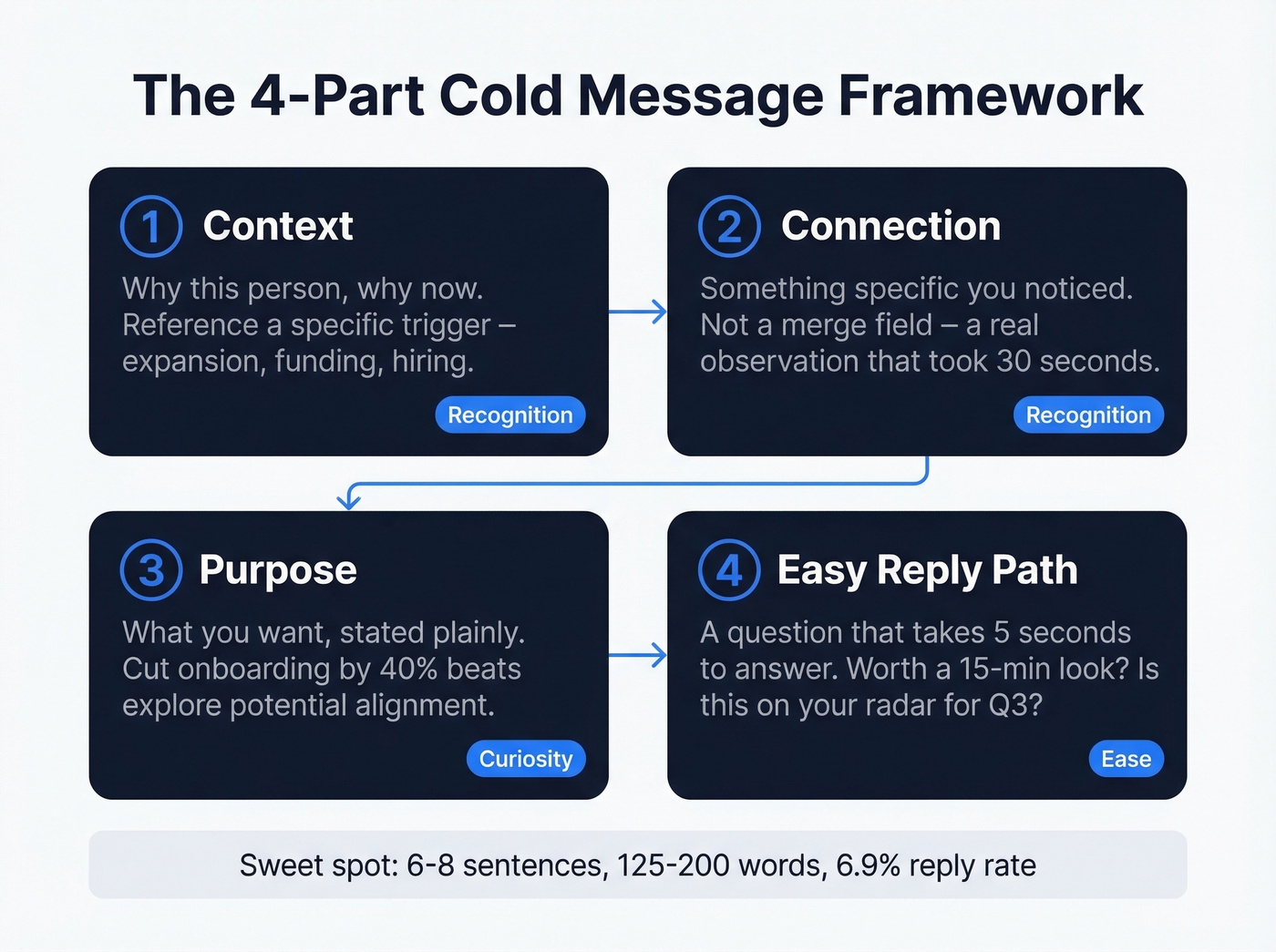
1. Context - Why this person, why now. "I saw your team just expanded into DACH markets" beats "I'm reaching out to leaders in your space." Context proves you didn't pull their name from a random list.
2. Connection - Something specific you noticed about them or their company. Not a merge field. An actual observation that took 30 seconds of research. Prospeo's Chrome extension returns 40+ data points per contact from any website or professional profile, which makes this step fast - you're looking for a recent job change, a funding round, a tech stack signal, anything that makes the outreach feel written for them. With 65% of B2B sales teams now using AI for personalization, the bar for "personal" keeps rising. Generic merge fields don't clear it anymore.
3. Purpose - What you want, stated plainly. "We help Series B teams cut onboarding time by 40%" is clear. "I'd love to explore potential alignment" is not.
4. Easy Reply Path - A question that takes five seconds to answer. "Worth a 15-minute look?" or "Is this on your radar for Q3?" The lower the friction, the higher the reply rate.
Three psychological triggers drive whether someone responds: Recognition (they feel seen), Curiosity (you said something unexpected), and Ease (responding costs them nothing). Every element of the framework maps to at least one of these.
One thing people overlook: before you send anything, optimize your own profile. Recipients will check who you are. A blank profile or a headline that screams "I sell stuff" kills your reply rate before the outreach is even read.
On length: for email, the optimal range is 6-8 sentences - roughly 125-200 words. That range pulls a 6.9% reply rate, meaningfully above average.
Templates That Work
Each template maps to the 4-part framework. Use them as starting points, not scripts.
Sales Prospecting
Subject: [Company]'s DACH expansion
Hi [Name],
Noticed [Company] just opened a Berlin office - congrats. When teams expand into DACH, compliance onboarding usually becomes the bottleneck.
We helped [Similar Company] cut that from 12 weeks to 4. Would it be useful to see how?
Best, [You]
Context (DACH expansion), connection (specific event), purpose (compliance onboarding), easy reply (yes/no question). ~58 words.
Partnership Outreach
Subject: Your audience + our data
Hi [Name],
Your newsletter reaches 15K revenue leaders - I read the piece on pipeline forecasting last week. We've built a dataset on outbound benchmarks that your audience would find useful.
Open to co-publishing something together?
[You]
Recognition (you read their content), mutual value framing, low-commitment ask. ~52 words.
Cold DM
The best DMs are ruthlessly short. Something like: "Hey [Name] - saw your post on scaling SDR teams without burning domains. We solved that exact problem for [Company]. Mind if I share what worked?" That's 28 words. Curiosity-driven, references their own content, and "sure" is all they need to type.
Breakup Email
Most people write breakup emails that sound passive-aggressive. Don't.
Bad: "I've tried reaching you multiple times and haven't heard back. I'll assume this isn't a priority."
Good: "Hi [Name], I've reached out a few times and haven't heard back - totally fine. If [problem] isn't a priority right now, I'll stop here. If it is, happy to pick this up whenever timing works."
The good version respects their time, applies zero guilt, and leaves the door open. ~45 words.
Why Most Follow-Ups Fail
Most cold messages fail not because the first email was bad, but because there was no second one. 44% of salespeople quit after a single follow-up. Meanwhile, 80% of sales require at least five touches to close.
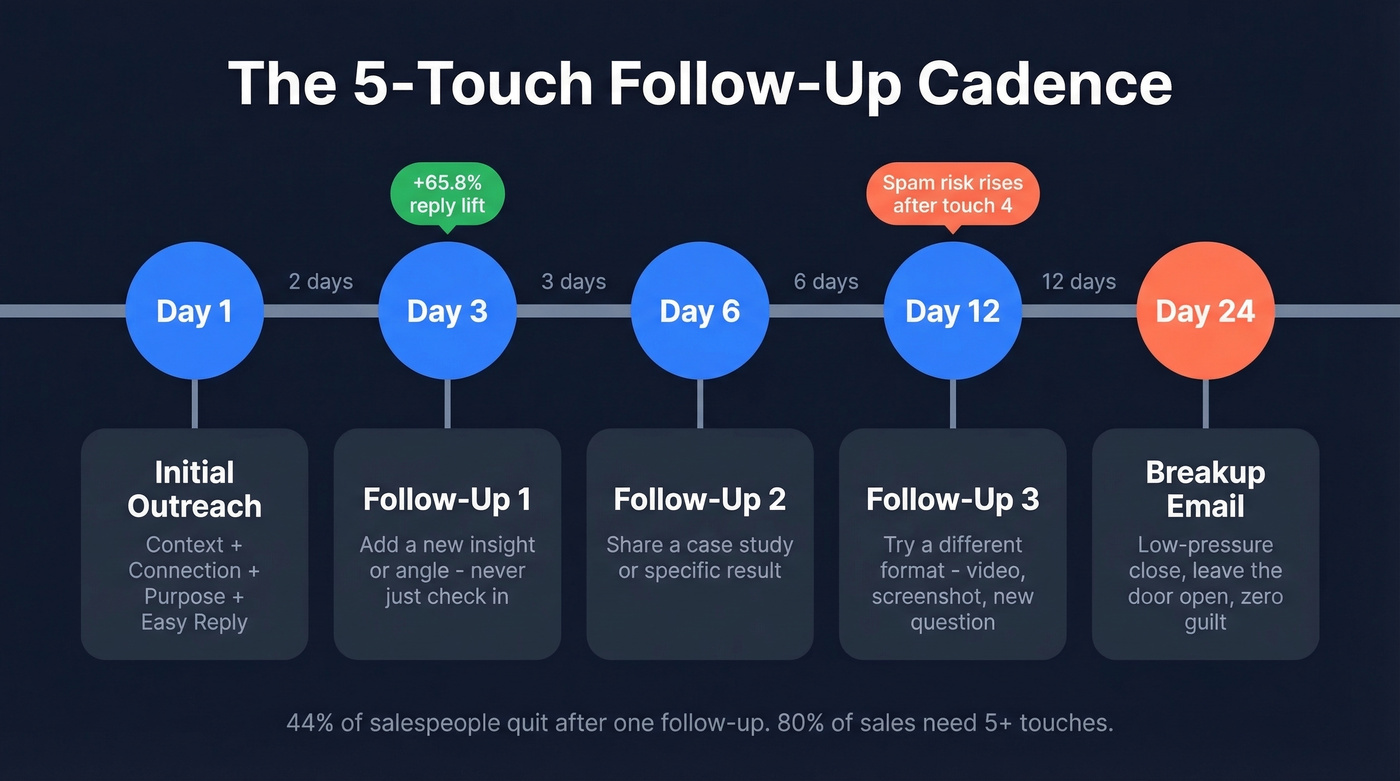
The first follow-up alone lifts reply rates by 65.8%. That's the single highest-leverage action in your entire outbound workflow. But there's a ceiling - by the fourth email, spam complaint rates jump from 0.5% to 1.6%, and reply rates drop 55% compared to earlier touches. For most teams, 3-5 total emails hits the right balance.
Here's a cadence that works:
- Day 1: Initial outreach (context + connection + purpose + easy reply)
- Day 3: Follow-up #1 - add a new insight or angle, not just "checking in"
- Day 6: Follow-up #2 - share a case study or specific result
- Day 12: Follow-up #3 - try a different format (short video, screenshot, different question)
- Day 24: Breakup email - low-pressure close
Space early touches 2-3 days apart, then stretch to 4-7 days for later ones. Teams running omnichannel sequences - email plus DM plus phone - see up to 287% higher response rates than single-channel outreach. And never send a follow-up that just says "bumping this to the top of your inbox." Add value or don't send it.

The article says it: contacting 1-2 people per company gets 2x the reply rate of spraying 10+. Prospeo's 30+ search filters - buyer intent, job changes, tech stack, funding - let you find the exact right person. 98% email accuracy means your cold message actually lands.
Stop rewriting subject lines. Start sending to better lists.
The Infrastructure Nobody Talks About
You can write the perfect cold message and it won't matter if it never reaches the inbox. Infrastructure is the unsexy foundation that separates teams getting 6%+ reply rates from teams wondering why nobody responds.
Domain & Sending Setup
A practitioner on r/Entrepreneur documented rebuilding their entire outbound infrastructure over 62 days. Their reply rate went from 3% to 6%. The biggest change wasn't copy - it was domains.
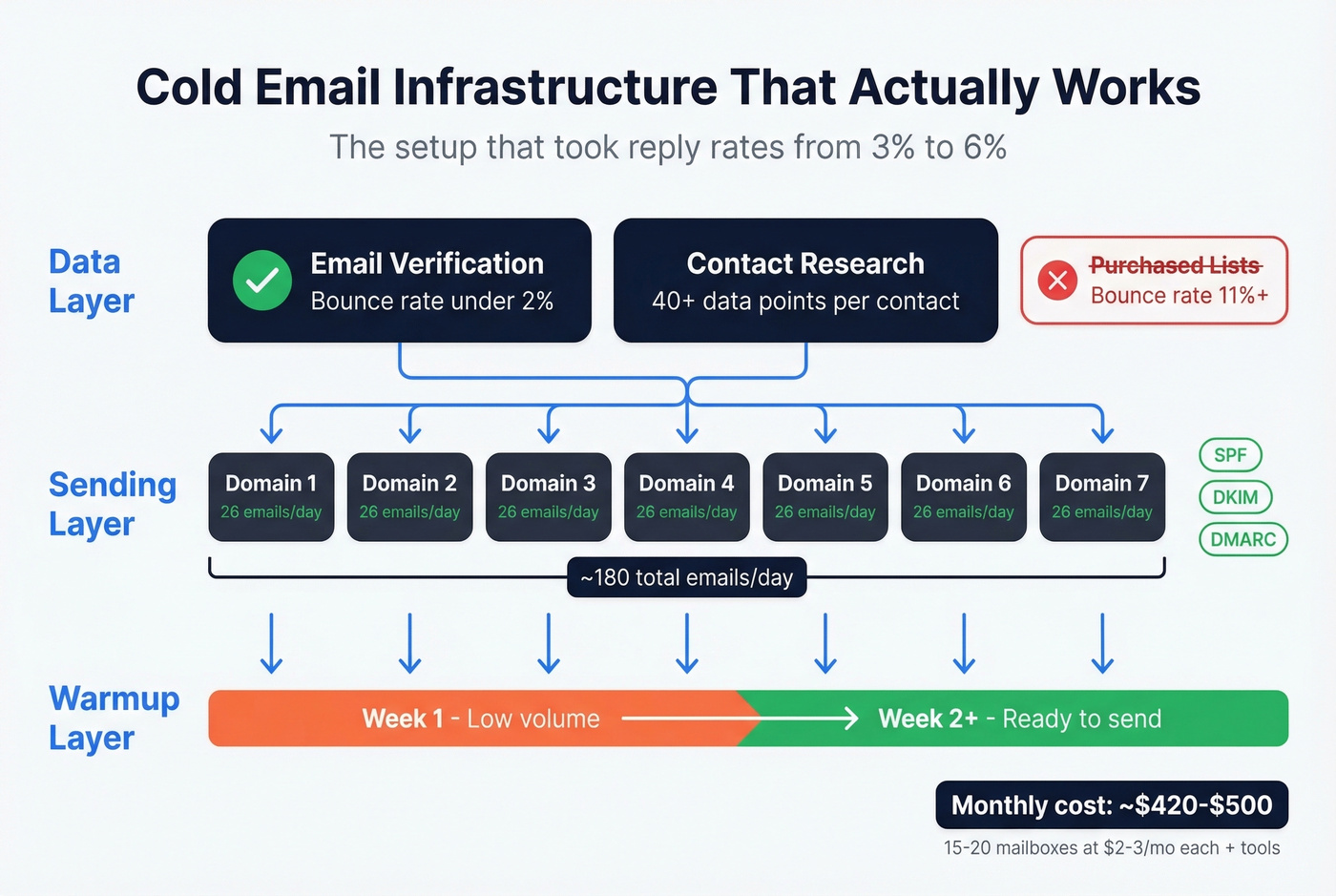
They moved from 3 sending domains to 7, each capped at 26 emails per day. That's roughly 180 emails daily across all domains, with enough headroom that no single domain triggers spam filters. Every domain needs SPF, DKIM, and DMARC configured correctly. New domains need warmup before you send cold email through them - around two weeks of gradual ramp is a solid baseline.
If you want a deeper deliverability checklist, see our Email Deliverability Guide and the practical Email Velocity limits teams use to avoid spam filters.
Data Quality - The #1 Variable
Bad data creates a death spiral. You send to unverified emails, bounces spike, your domain reputation tanks, inbox placement drops for everyone on your list including valid addresses, reply rates crater, and you blame your copy and rewrite the email instead of fixing the actual problem.
That Reddit practitioner cut their bounce rate from 11% to under 2% by stopping purchased lists and manually verifying contacts. The reply rate doubled. We've tested this ourselves - data quality consistently moves the needle more than any subject line tweak.
If your bounce rate is creeping up, start with Email Bounce Rate benchmarks and a Spam Trap Removal process before you scale.
Meritt, an outbound agency, saw their bounce rate drop from 35% to under 4% after switching to Prospeo's email verification - and their pipeline tripled from $100K to $300K per week. That's what happens when you pair 98% email accuracy with a 7-day data refresh cycle instead of the industry-standard 6 weeks.
Stack Economics
Running proper cold outbound infrastructure isn't free. That same Reddit practitioner reported ~$420/month - covering domains, sending tools, verification, and warmup. Mailboxes run $2-$3/month each, and you'll need 15-20 across your domains. Add verification credits, a sending tool like Instantly or Smartlead, and warmup services, and $400-$500/month is realistic for a solo operator. That's a fraction of what most teams spend on a single SaaS seat at a major data provider.
If you're evaluating tooling, compare options in our guides to SDR tools and follow up email software.
The 4-part framework needs real context - not generic merge fields. Prospeo's Chrome extension gives you 40+ data points per contact so every cold message feels written for one person. 15,000+ companies use it to turn strangers into replies.
Get the data that makes personalization take 30 seconds, not 30 minutes.
Mistakes That Kill Your Outreach
Targeting too broadly. Emailing every VP in your ICP isn't targeting - it's hoping. The data proves it: 1-2 contacts per company outperforms 10+ by more than double. If you need a tighter definition, use an ideal customer profile scoring rubric.
Fake personalization. "{First_name}, I noticed {company_name} is growing fast" fools nobody. Reference something specific or don't personalize at all. For a systemized approach, see Personalized Outreach.
No clear CTA. "Let me know if you're interested" isn't a call to action. Ask a question that takes five seconds to answer. More examples in Email Call to Action.
Stale data and bounces. Every bounce chips away at your domain reputation. If your bounce rate is above 3%, fix your list before you scale volume.
One-and-done. A single email with no follow-up leaves up to 65% of potential replies on the table. If you want plug-and-play sequences, use these cold email follow-up templates.
A few more that we see constantly: pitching the wrong persona (your champion and your decision-maker need different messages), salesy subject lines ("partnership opportunity" pulls under 19% open rates while "quick question" hits ~39%), messages that scroll on mobile (stay under 200 words for email), no testing or measuring (if you aren't tracking reply rates by template and segment, you're guessing), and ignoring compliance (one TCPA violation costs $500-$1,500 per incident).
Compliance - What Gets You Fined
Cold messaging is legal. Cold spamming is not. Three frameworks define the line.
CAN-SPAM (US)
Every commercial email must include accurate sender information, a visible unsubscribe link, and a valid physical address. No deceptive subject lines. Honor opt-outs within 10 business days. Penalties run up to $53,088 per email.
GDPR (EU)
B2B cold email in Europe operates under "legitimate interest" - you can email someone if your outreach is genuinely relevant to their professional role. You must identify yourself, explain how you got their data, and provide a clear opt-out. Fines reach up to 4% of global revenue or EUR 20M, whichever is higher.
TCPA (SMS & Calls)
This is where the real money is at risk. SMS and automated calls require prior express written consent. Violations cost $500-$1,500 per incident. A 1,000-contact campaign without proper consent creates $500K-$1.5M in exposure. If you're doing cold SMS, get a compliance lawyer involved before you send a single message.
When Cold Messaging Doesn't Work
Let's be honest - cold outreach isn't always the answer.
One founder on r/SaaS described sending 2,000 cold emails, getting six replies, and converting zero customers. They deleted Apollo, stopped optimizing subject lines, and pivoted entirely - showing up in small niche communities, answering questions without selling, publishing long-form SEO content. Six months later they'd hit $4.7K MRR with stable, inbound-driven growth.
Cold messaging works when the infrastructure is right, the targeting is precise, and the offer matches the audience. For some products - especially early-stage tools with undefined ICPs - community-led growth and content can outperform outbound entirely. The teams that win usually run both channels in parallel: cold outreach for immediate pipeline, content for compounding returns over time. Skip cold outreach if you don't have a clear ICP yet or can't invest in proper sending infrastructure. You'll burn domains and waste months.
If you're building a repeatable outbound motion, start with a B2B cold email sequence and layer in sales prospecting techniques that match your market.
Cold Message FAQ
Is cold messaging illegal?
No. Cold emailing and direct messaging are legal in most countries for legitimate business purposes. You must follow CAN-SPAM (US), GDPR (EU), and TCPA (SMS/calls) rules - including unsubscribe options, accurate sender info, and consent requirements for automated SMS.
What's a good reply rate?
The 2024 average across 16.5 million emails was 5.8%. Top performers with clean data and proper infrastructure consistently hit 8%+. Anything above 6% is strong by current benchmarks.
How many follow-ups should I send?
Three to five total touches for most teams. The first follow-up lifts replies by 65.8%, but spam complaints rise sharply after the fourth email. Diminishing returns aren't worth the reputation risk beyond that point.
How do I verify emails before sending?
Use a dedicated verification tool before every campaign. Prospeo's free tier covers 75 verifications per month with 98% accuracy - enough for small teams to test. For larger volumes, bulk upload a CSV and remove invalids before they ever hit your sending tool.
Cold email vs cold DM - which works better?
Email gives you more space, better deliverability control, and easier scaling. DMs work for warm-adjacent outreach on professional platforms where you share context. Best results come from combining both channels in a coordinated sequence.