

Cold Selling in 2026: The Multi-Channel System Guide
You sent 3,000 cold emails last month and booked four meetings. Pipeline is flat, your manager wants answers, and you're staring at a spreadsheet of bounced addresses and "not interested" replies. Your cold selling system isn't broken because of volume - it's broken because of bad data and single-channel thinking.
The Short Version
Cold selling is a three-channel system: phone for momentum, email for scale, social for credibility. The single highest-leverage fix is data quality - verified contacts outperform bulk lists every time. Everything below gives you the benchmarks, the cadence, and the strategy to make it work.
What Is Cold Selling?
Cold selling isn't cold calling. Cold calling is one tactic - the phone. Cold selling is the full multi-channel system: phone, email, and social outreach working together in a coordinated cadence to generate pipeline from prospects who haven't raised their hand.
Most guides treat the concept as synonymous with cold calling. That's half the picture. If you're only dialing, you're leaving pipeline on the table. If you're only emailing, you're invisible to prospects who screen their inbox but pick up the phone.
Outbound can generate pipeline in 30-60 days, compared to 6-12 months for inbound SEO to compound. That speed is why cold outreach remains the primary pipeline engine for high-growth teams. The key shift in 2026: bulk blasting without targeting is dead. What works is trigger-based, multi-channel, and built on clean data.
Does Outbound Still Work?
The data says yes - emphatically. 82% of buyers accept meetings from proactive outreach, and 69% accepted at least one cold call in the past year, per RAIN Group benchmarks. The problem isn't that prospects don't want to hear from you. It's that most outreach is lazy, irrelevant, or sent to the wrong person.
The environment is harder, though. 42% of salespeople say prospecting is the most challenging part of their job, buying committees now average 7 individuals at companies with 100-500 employees, and the typical B2B buying cycle runs 11.5 months. You're not selling to one person. You're navigating a committee over nearly a year.
One poster on r/sales described rewriting their cold call script for a month straight - just to avoid actually picking up the phone. We've all been there. But avoidance doesn't build pipeline. A system does.
The Three Channels
Cold Calling
Cold calling gives you real-time feedback. You control the tempo, you hear objections live, and you stand out in a world where most reps hide behind email. The tradeoff is effort: 209 calls per appointment on average, 80% of calls go to voicemail, and it takes an average of 8 attempts just to connect with a prospect.
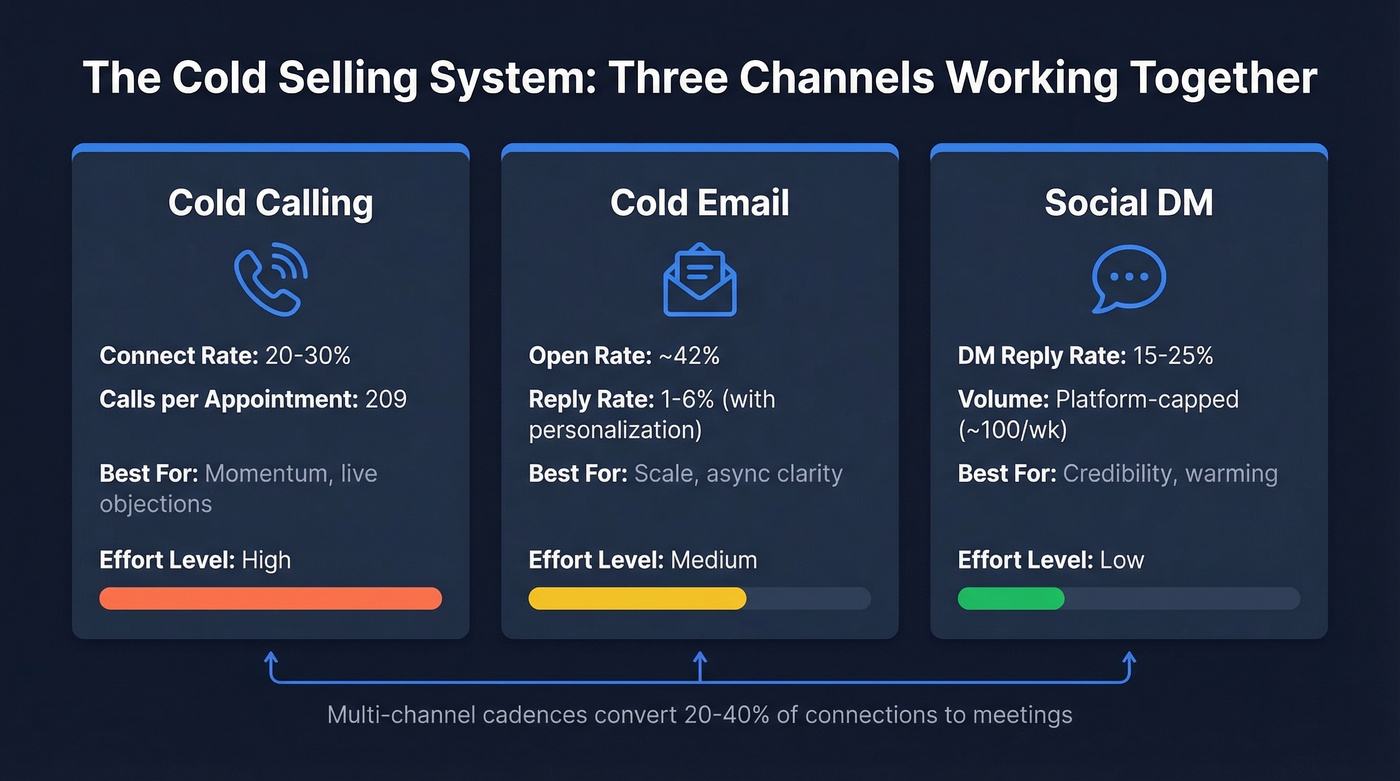
Parallel dialers have changed the math. Legacy telemarketing connect rates sit at 5-10%, but teams using parallel dialers hit 20-30%. That's a 2-4x improvement in the same number of hours.
Talk-track data from Gong backs up what good callers already know: explaining why you're calling increases success by 2.1x, while asking "Is this a bad time?" decreases meeting rates by 40%. Mentioning a mutual connection increases meeting chances by 70%. Best days are Tuesday through Thursday, with 11am-12pm and 4pm-5pm as the sweet spots.
Structure your opener around three beats: reason for calling, relevance hook tied to their business, and a specific ask. Skip the "How are you today?" - nobody believes you care, and it burns your first five seconds. If you want more frameworks, borrow a few proven talk-track examples.
Use this if: You're selling to mid-market or enterprise and your deal size justifies the time investment.
Skip this if: Your entire ICP is inbound-first founders who screen every call.
Cold Email
Cold email is where you get scale. Across 14.3 billion cold emails analyzed in Smartlead dataset summaries, the averages look like this: ~42% open rate, ~3% reply rate, ~1% meetings booked, and a 7.5% bounce rate. Well-targeted campaigns with relevance-based personalization can push reply rates to 15-25% (and a solid B2B cold email sequence makes that repeatable).
Subject lines are the first gate - 47% of recipients open based on subject alone, so keep it to 6-10 words. If you need inspiration, pull from these cold email subject line examples. Personalization increases opens by 23.6%, but only when it's relevant. Mentioning a recent funding round or a job posting that signals a pain point beats "Hey {first_name}, I noticed you work at {company}" every time. Keep body copy between 50-125 words.
The consensus on r/sales is clear about what kills cold emails: saying "I" more than "you," opening with who you are instead of why you're reaching out, no clear CTA, and unsupported claims like "we're the industry leader." If you're tightening copy, use a simple email call to action checklist.
Here's the thing: if your bounce rate is above 7%, stop sending and fix your data before touching a single word of copy. No subject line on earth saves you from spam folders (use these email bounce rate benchmarks to sanity-check your numbers).
Social Outreach
Social outreach is the credibility layer, not the volume channel. Platform invite limits cap you around 100 connections per week, and DM reply rates run 15-25% - notably higher than email, but at a fraction of the volume.
The real value is warming prospects before phone and email touches. A connection request with a thoughtful note, followed by engagement on their content, makes your cold call less cold and your email less ignorable. Don't treat social as your primary pipeline channel. Treat it as the layer that makes your other two channels work harder. (If you want a broader playbook, start with sales prospecting techniques.)
| Metric | Cold Calling | Cold Email | Social DM |
|---|---|---|---|
| Connect/Open | 20-30% (parallel) | ~42% open | N/A |
| Reply/Meeting | ~1-2% to appt | 1-3% generic, 3-6% personalized | 15-25% DM reply |
| Effort/Meeting | 209 calls / 7.5 hrs | ~12K emails -> ~120 mtgs | Platform-capped |
| Best For | Momentum, objections | Scale, async clarity | Credibility, warming |
Building a Multi-Channel Cadence
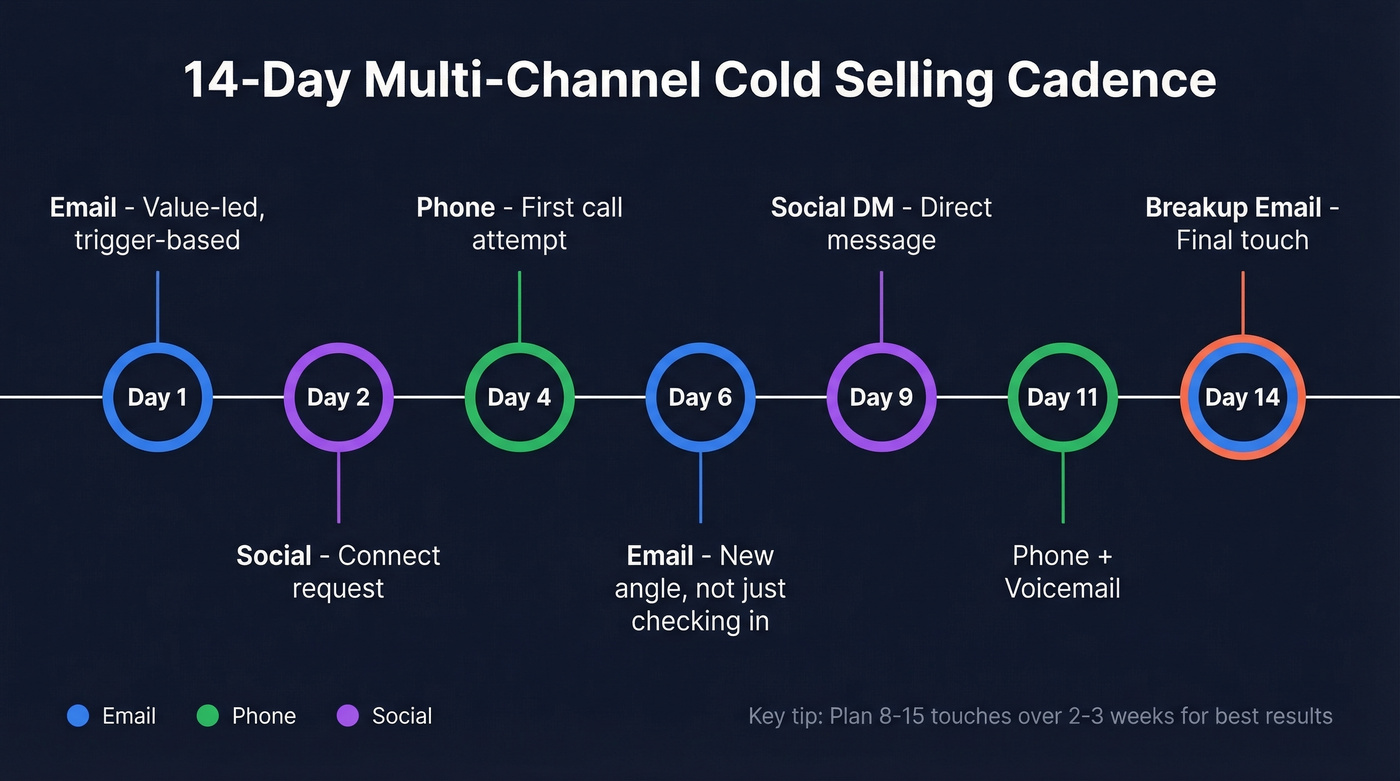
The rhythm is straightforward: email for clarity, phone for momentum, social for context. Plan for 8-15 touches over 2-3 weeks. The connect-to-meeting conversion for teams running multi-channel cadences sits at 20-40%, meaning once you get someone on the phone or in a reply thread, the cadence has done its job.
Build your lists from triggers, not bulk scrapes. Job changes, funding rounds, new tech installs, and hiring surges all signal timing. Layer in buyer intent data to time outreach to when prospects are actively researching your category - these are the opportunities most teams miss entirely. (If you need an ops-level process, see how to track sales triggers.)
Here's a cadence we've seen consistently outperform single-channel sequences:
- Day 1 - Email, value-led and personalized to a trigger
- Day 2 - Social connect request
- Day 4 - Phone call
- Day 6 - Email follow-up with a new angle, not "just checking in" (use these cold email follow-up templates to keep angles fresh)
- Day 9 - Social DM
- Day 11 - Phone plus voicemail
- Day 14 - Breakup email
If your team spans time zones, make sure you've got reply coverage during the prospect's business hours. A reply that sits for 24 hours kills the momentum you just built.
Prioritize meetings held and next steps created as your north-star metrics. Opens and clicks are directional at best - they tell you something's working but not whether it's generating pipeline. When you book, go calendar-first. Propose two specific times and include an inline scheduler. Don't make the prospect do the work of finding a slot.

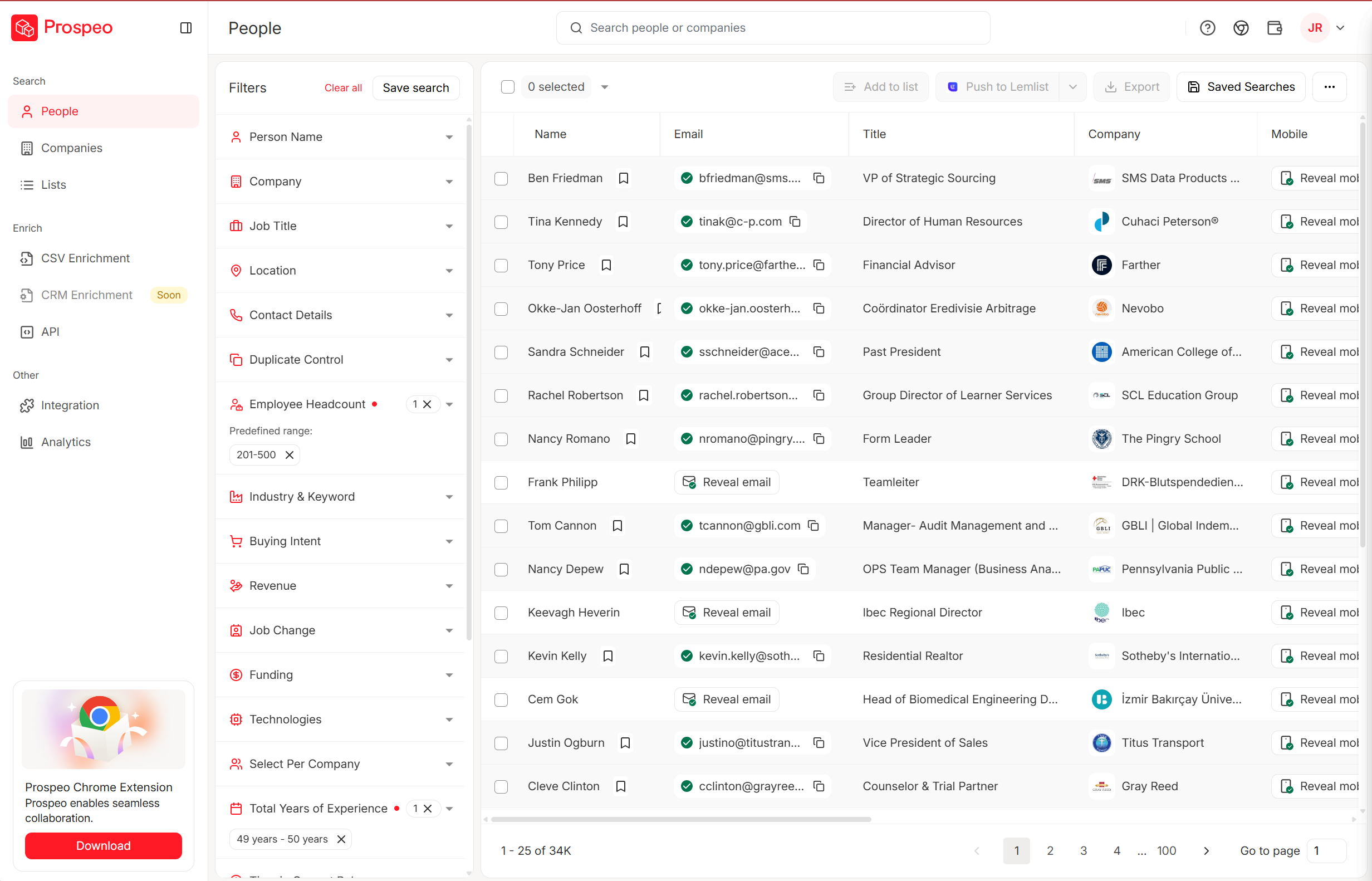
You just read it: bounce rates above 7% kill cold selling campaigns before copy even matters. Prospeo's 5-step verification delivers 98% email accuracy and 125M+ verified mobile numbers - so every touch in your multi-channel cadence actually reaches a real person.
Stop burning cadence touches on bad data. Start with contacts that connect.
Data Quality Is the #1 Lever
Let's be honest: if your average deal size is under $10K, you probably don't need a $30K/year data platform. But you absolutely need verified data. The difference between a $0.01/email provider and a bulk-scraped list is the difference between a functioning pipeline and a burned domain.
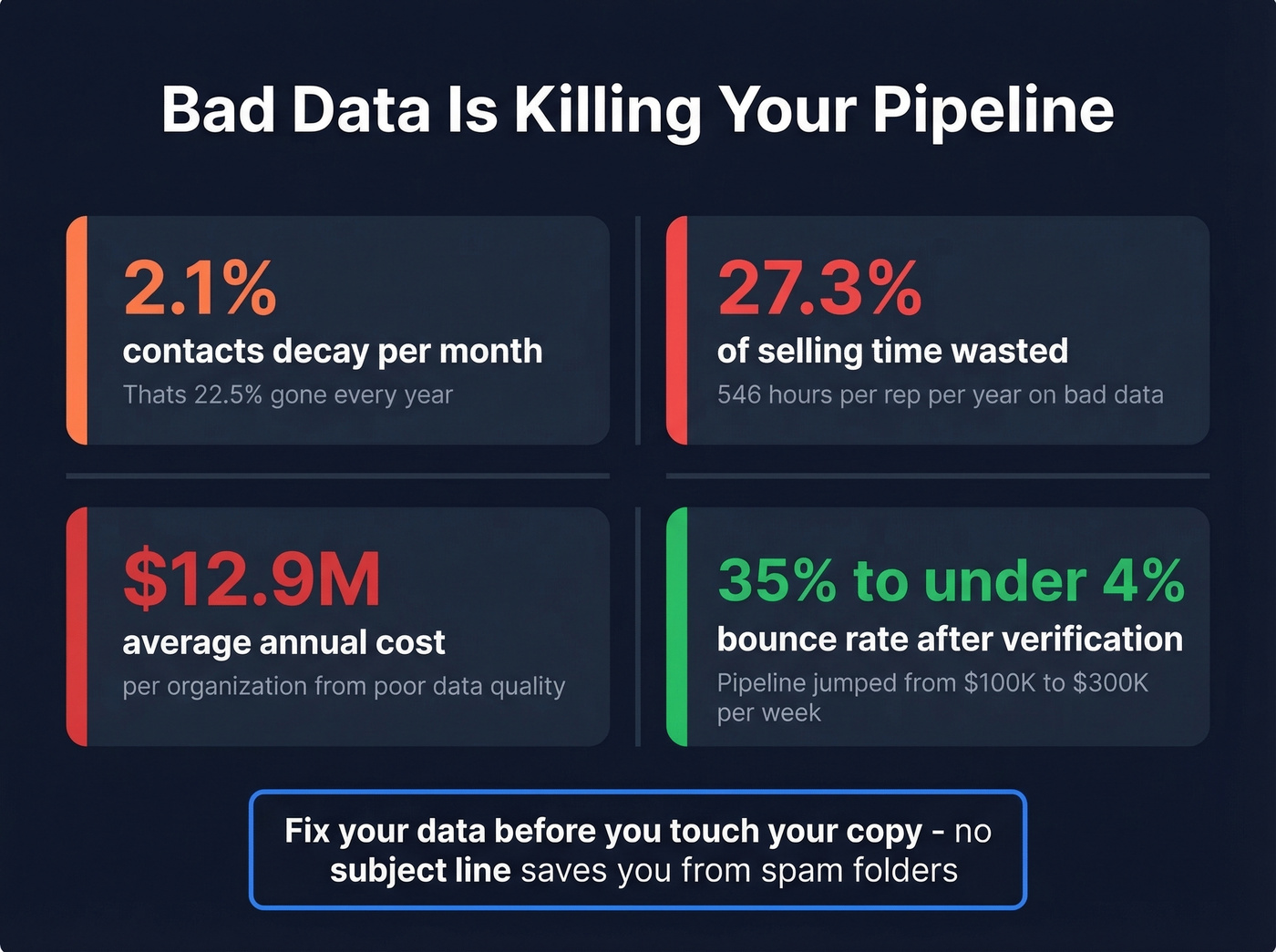
B2B contact data decays at ~2.1% per month - that's 22.5% annually. If you're working a list that's six months old, about one in eight contacts has already gone stale. This is also why data enrichment services and verification workflows matter more than list size.
The cost is staggering. Reps waste 27.3% of their selling time on bad contact data: 546 hours per year per rep spent dialing dead numbers and emailing bounced addresses. Across an organization, poor data quality costs an average of $12.9M annually.
We saw this firsthand with Meritt, an outbound agency running a 35% bounce rate before switching to Prospeo's verified data. After the switch, their bounce rate dropped under 4% and pipeline tripled from $100K to $300K per week. That's not a marginal improvement - it's a completely different business.
Cold Email Infrastructure
Your sending infrastructure matters as much as your copy. If you’re troubleshooting, start with an email deliverability guide before you touch templates.
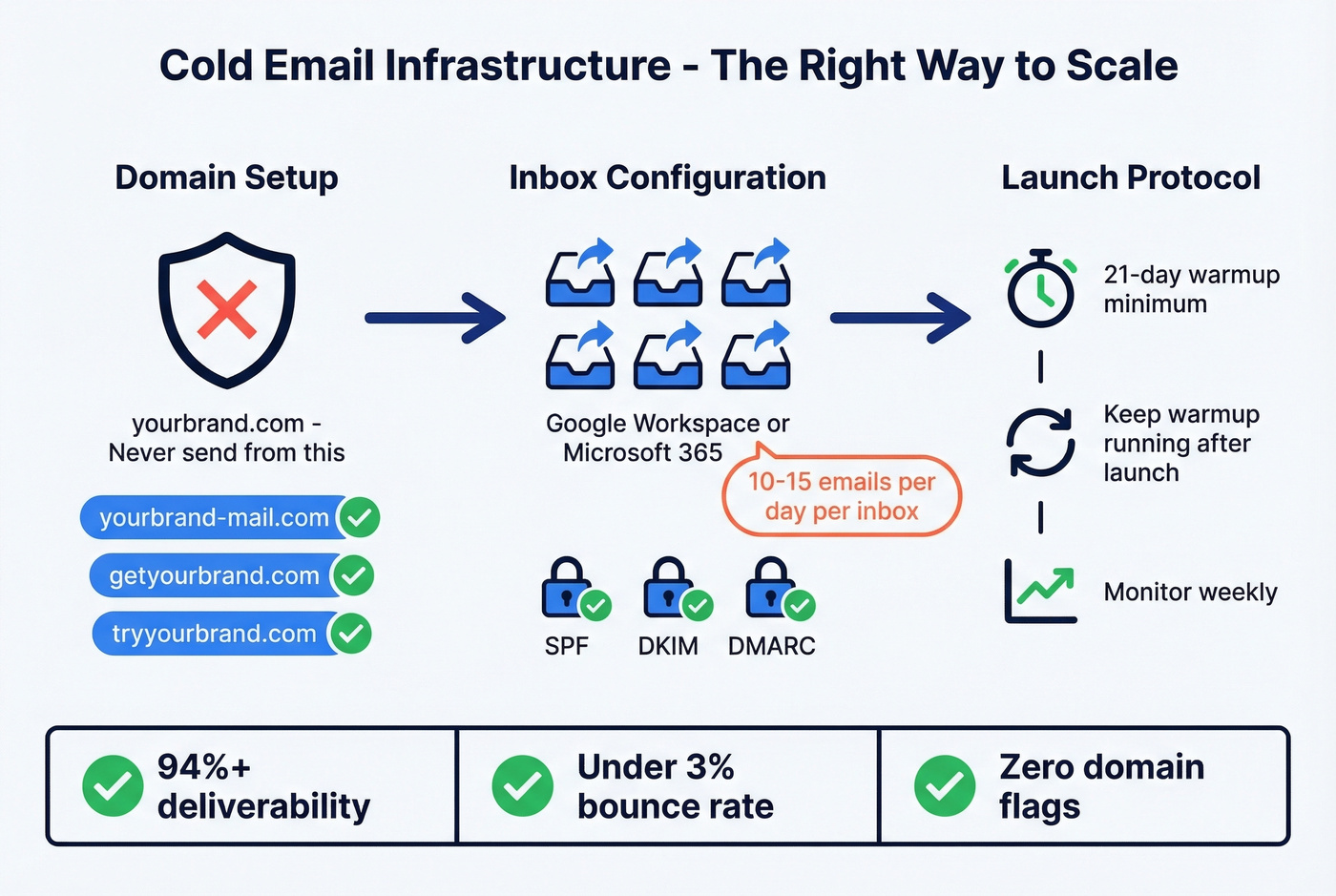
Never send from your main domain. Buy secondary domains - variations of your primary - and set up 2-3 inboxes per domain. Cap volume at 10-15 emails per day per inbox. Scale by adding domains and inboxes, not by cranking up volume on one account.
Configure SPF, DKIM, and DMARC for every sending domain. Non-negotiable. Use Google Workspace or Microsoft 365 for inboxes, not cheap SMTP providers. If you’re validating setup, follow this quick how to verify DKIM is working checklist.
Warm up for 21 days minimum before sending any cold email, and keep warmup running after launch. Monitor deliverability weekly. The benchmark to aim for: 94%+ deliverability, bounce rates under 3%, and zero domain flags. Stack Optimize, an outbound agency, built to $1M ARR running client campaigns at those numbers consistently.
Mistakes That Kill Cold Selling
The fastest way to waste your outbound effort is to make these errors repeatedly without realizing they're connected:
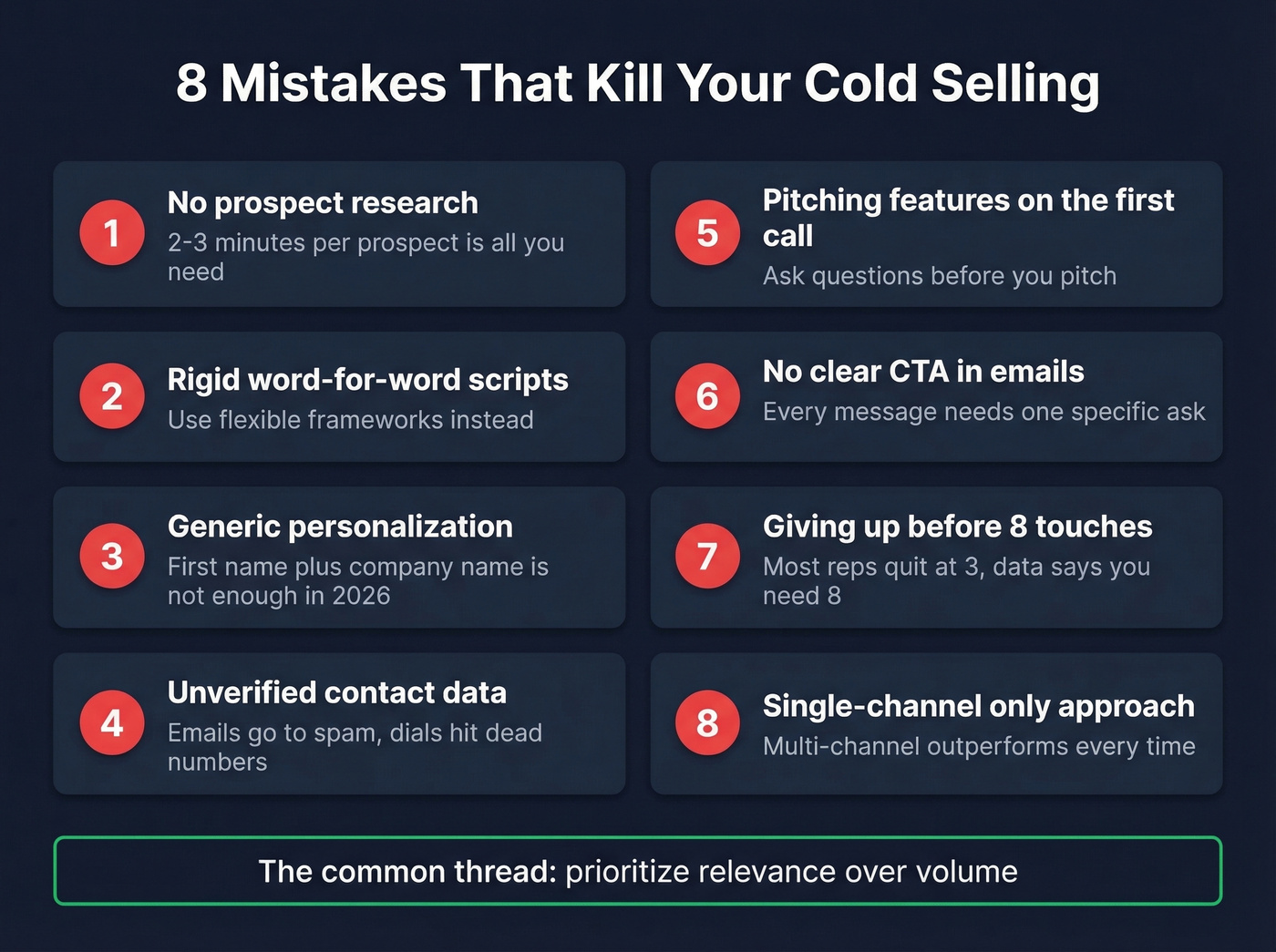
- No prospect research. Spend 2-3 minutes per prospect gathering role context and company news. That's it - you don't need a thesis, just enough to prove you're not mass-blasting.
- Rigid scripts on calls. Use flexible frameworks, not word-for-word scripts that crumble at the first objection.
- Generic personalization. First name plus company name isn't personalization in 2026.
- Bad data without verification. Your emails are going to spam and your dials are hitting disconnected numbers. Fix the source.
- Pitching features on the first call instead of asking questions.
- No clear CTA in emails. Every message needs one specific ask.
- Giving up before 8 touches. Most reps quit at 3. The data says you need at least 8.
- Single-channel approach when multi-channel outperforms it consistently.
The best cold selling techniques share a common thread: they prioritize relevance over volume. Every touch should demonstrate that you understand the prospect's world, not just that you found their email address.
Compliance Quick Reference
Cold selling has real legal guardrails. The penalties aren't theoretical - they're per-violation, and they add up fast.
| Regulation | Scope | Penalty | Key Rule |
|---|---|---|---|
| TCPA | US phone/SMS | $500-$1,500/violation | Prior consent for auto calls |
| CAN-SPAM | US email | Up to $53,088/email | Must honor opt-out in 10 days |
| GDPR | EU residents | Up to 20M EUR / 4% revenue | Consent or legitimate interest |
| CCPA | California | $2,500-$7,500/violation | Data rights + disclosure |
In the EU, you need explicit consent or legitimate interest to contact prospects. In the US, CAN-SPAM doesn't require prior consent but mandates honoring opt-outs within 10 business days. Cold calling is prohibited before 8am or after 9pm in the recipient's local time.
The Cold Selling Stack
For contact data: Prospeo - 98% email accuracy, 125M+ verified mobiles, free tier at 75 emails/month, ~$0.01/email on paid plans. Native integrations with Smartlead, Instantly, Lemlist, HubSpot, and Salesforce mean your data flows straight into your sending and CRM without manual exports.
For cold email sending: Smartlead (from ~$39/mo) or Instantly (from ~$30/mo). Both handle inbox rotation, warmup, and multi-inbox sending.
For CRM: HubSpot (free CRM, Sales Hub from ~$20/user/mo) or Salesforce ($25-300/user/mo depending on edition).
Trigger-based cadences need fresh data. Prospeo refreshes every 7 days - not the 6-week industry average - and layers buyer intent across 15,000 topics so you time outreach to prospects actively researching your category. At $0.01 per email, scaling your multi-channel system doesn't require enterprise budgets.
Build trigger-based lists with intent data and weekly-fresh contacts.
FAQ
What's the difference between cold selling and cold calling?
Cold calling is one channel - the phone. Cold selling is the full multi-channel system combining phone, email, and social outreach in a coordinated cadence. Cold calling is a single tactic; the system that ties all three channels into a pipeline-generating sequence is what separates modern outbound teams from legacy dialers.
How many touches does it take to book a meeting?
Plan for 8-15 touches across channels over 2-3 weeks. It takes an average of 8 cold call attempts just to connect with a prospect, and most deals require multiple channels before someone responds. Reps who quit at 3 touches leave most of their pipeline on the table.
What's a good cold email reply rate?
Across 14.3 billion cold emails analyzed, the average reply rate is about 3%. Well-targeted, personalized campaigns reach 15-25%. If you're below 1%, check your data quality and deliverability infrastructure before blaming your copy.
How do I fix high bounce rates?
Switch to a provider with real-time verification and a refresh cycle measured in days, not weeks. A 7-day data refresh with multi-step verification keeps bounce rates under 4% for most teams, compared to the 6-week industry average that lets data decay between updates. Most teams see improvement within their first send after switching.
Is cold selling effective for B2B?
Cold selling remains one of the fastest ways to build B2B pipeline, especially for teams that can't wait 6-12 months for inbound to compound. Teams running verified data through a multi-channel cadence consistently outperform those relying on volume alone - Meritt tripled pipeline from $100K to $300K per week after fixing their data source.