

Consultative Selling Principles That Win in 2026
A rep on r/sales shared a story that stuck with us. He opened a discovery call with "What's keeping you up at night?" - the line his company's $15K consultant taught the whole floor. The prospect laughed and said, "Are you reading from a script?" Then hung up.
That's the gap between knowing consultative selling principles and actually executing them.
The Quick Version
Three things separate top performers from everyone else. RAIN Group's research across 1,000+ sellers found top performers carry a 72% average win rate vs. 47% for the rest, and they're 58% more likely to lead thorough needs discoveries. Second, data-backed preparation before the call, not during it. Third, follow-up questions over scripted ones.
Why It Matters Now
Your prospects aren't waiting for you to educate them. 96% research your company before they'll even take a call, and 71% prefer doing their own homework over talking to a rep.
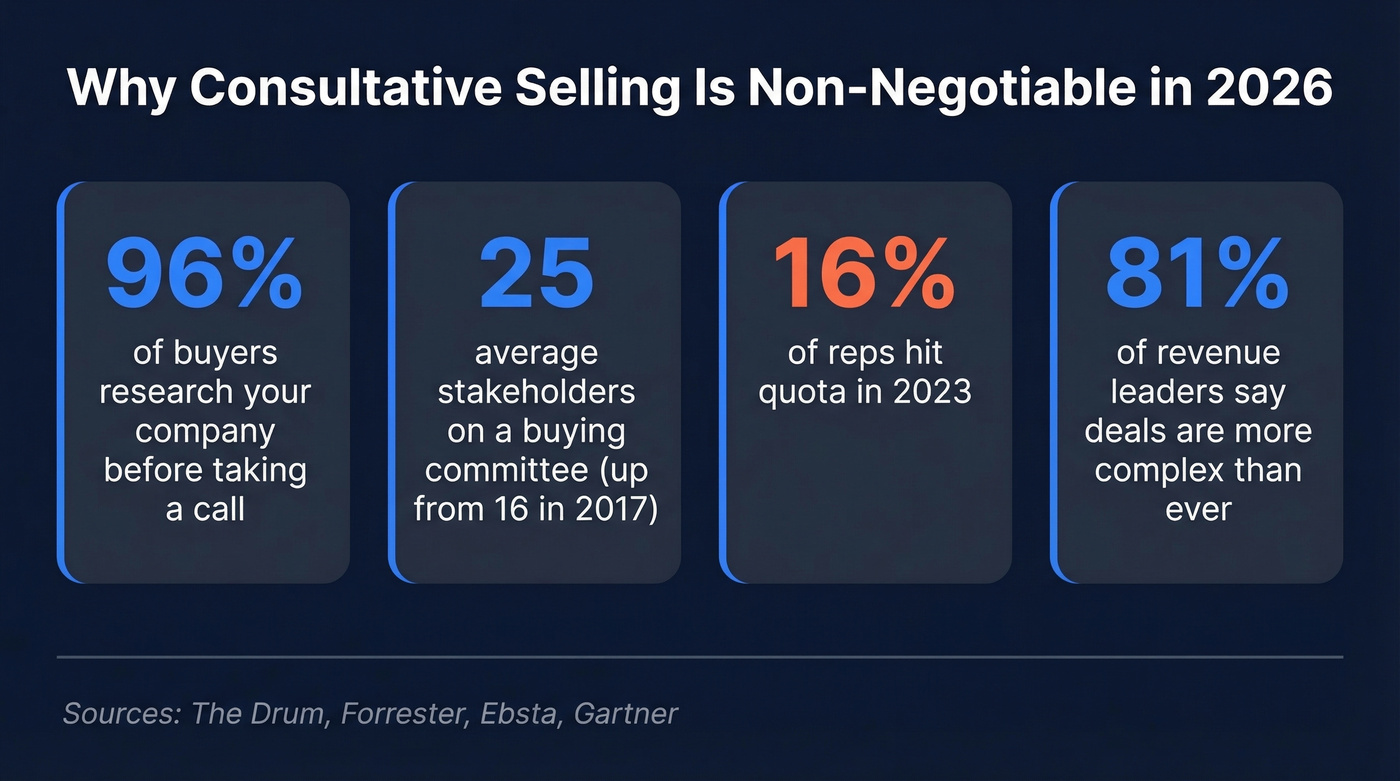
The buying environment has gotten harder across every metric. Average buying committees now include 25 stakeholders, up from 16 in 2017. As recently as 2023, only 16% of reps hit quota. And 81% of revenue leaders say their team's deals are more complex than they've ever been. A ResearchGate study across five IT firms confirmed what practitioners already know: higher application of consultative techniques correlates with shorter cycles and better conversion. When deals are this complex, the rep who diagnoses best wins - and learning to sell consultatively isn't optional anymore.
What Is Consultative Selling?
Consultative selling is a customer-needs-centered approach where the seller acts as an advisor, not a pitcher. You diagnose before you prescribe. You ask questions you genuinely don't know the answer to. You sometimes recommend solutions you don't even sell.
It's often confused with solution selling, but there's a meaningful distinction. Solution selling can drift into pushing a pre-built fix once a pain point surfaces. A consultative approach considers the buyer's full situation - internal politics, competing priorities, organizational constraints - before any recommendation takes shape. That mindset shift means prioritizing the buyer's outcome over your own pipeline metrics in every interaction.
7 Core Principles to Master
1. Research Before You Call
Consultative selling starts before the conversation. If you're walking into a discovery call without knowing the prospect's tech stack, recent funding, or org chart, you're wasting their time and yours.
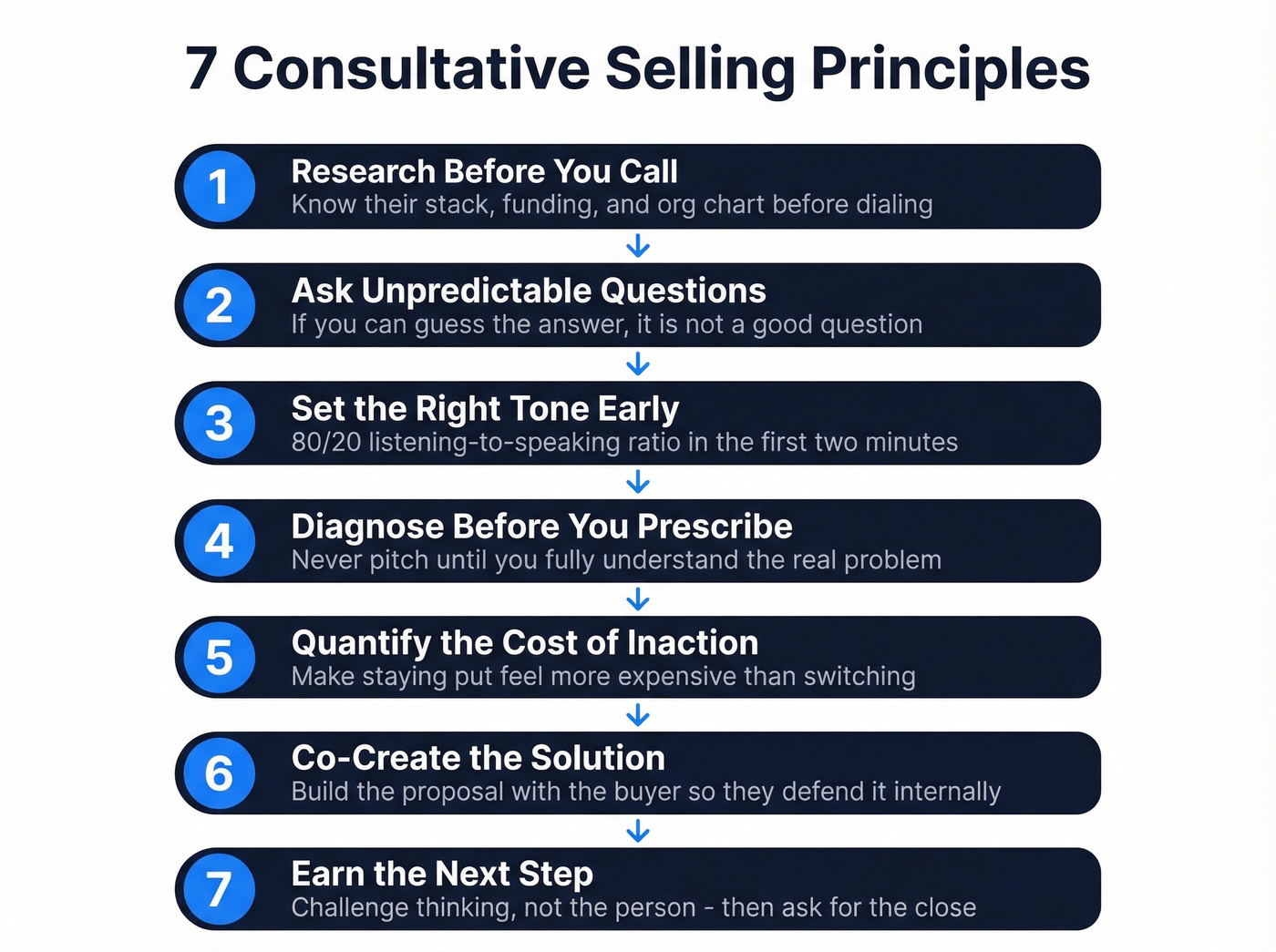
Contact data decays 30% within a year, so your prep is only as good as your data. Prospeo's 300M+ professional profiles with 98% email accuracy and a 7-day refresh cycle mean reps reach the right stakeholder on the first attempt, not the third. If you're building lists at scale, it also helps to understand lead enrichment and when to use data enrichment services.

2. Ask Questions You Can't Predict the Answer To
Scripted discovery questions telegraph that you're running a playbook. The best consultative sellers ask questions where the answer genuinely surprises them.
"Why now?" is powerful precisely because you can't predict the response. Neither is "What's changed since the last time you tried to solve this?" These questions force the prospect to think, not recite. And when a prospect is thinking out loud with you, you've already won half the battle. If you want a deeper library, start with these discovery questions.
3. Set the Right Tone Early
Aim for an 80/20 listening-to-speaking ratio. Most reps listen just long enough to find an opening for their pitch. Top performers listen for what's not being said - the hesitation, the political subtext, the priority that didn't make the official requirements doc.
When you catch yourself about to respond, count to three first. The tone you establish in the first two minutes - curious, unhurried, genuinely interested - sets the ceiling for how much the prospect will share. Rush it, and they'll give you surface-level answers for the rest of the call.
4. Diagnose Before You Prescribe
A doctor who prescribes before examining you is malpracticing. Same principle applies here.
Don't jump to your solution the moment you hear a familiar pain point. RAIN Group found top performers are 58% more likely to lead thorough needs discoveries - that's the diagnosis phase doing its work. We've seen reps lose deals they should've won because they heard "we need better reporting" and immediately launched into a demo of their analytics dashboard, missing the real issue entirely: the buyer's team didn't trust the underlying data. This is also where a clear sales process keeps teams from skipping steps.
5. Quantify the Cost of Inaction
Buyers don't change because your product is better. They change because staying put costs more than switching.
Help them calculate what the current problem costs in revenue, time, or risk. I've watched reps transform stalled deals by simply asking "What does this cost you every month it goes unsolved?" That one question reframes the entire conversation from "should we buy this?" to "can we afford not to?" RAIN Group data backs this up: top performers are 63% more likely to communicate strong ROI cases. If you're trying to tighten your numbers, track pipeline health alongside your sales conversion rate.
6. Co-Create the Solution
Don't present a finished proposal - build it with the buyer. When stakeholders co-author the solution, they defend it internally. Top performers are 59% more likely to collaborate deeply with buyers.
This is how you survive a 25-person buying committee: your champion isn't selling your product, they're selling their idea. For complex accounts, this pairs well with account-based selling best practices.
7. Earn the Next Step
Here's the thing: consultative doesn't mean passive. A common misconception is that consultative sellers are too deferential to close. Wrong. You challenge the buyer's thinking without challenging the person. You earn the right to propose next steps by delivering value in every interaction. If you've done the first six principles well, asking for the close feels natural - not pushy. When you do follow up, having solid sales follow-up templates helps you stay consultative without sounding scripted.

Principle #1 says research before you call. But research is useless if your contact data is wrong. Prospeo's 98% email accuracy and 7-day refresh cycle mean you reach the right decision-maker on the first try - so your discovery call actually happens.
Stop diagnosing the wrong person. Start with verified data.
Discovery Questions That Work
Great consultative sellers don't run discovery like an interrogation. The best question is always the follow-up to whatever the prospect just said. Here's a starting repertoire that practitioners on r/sales and experienced reps consistently recommend:
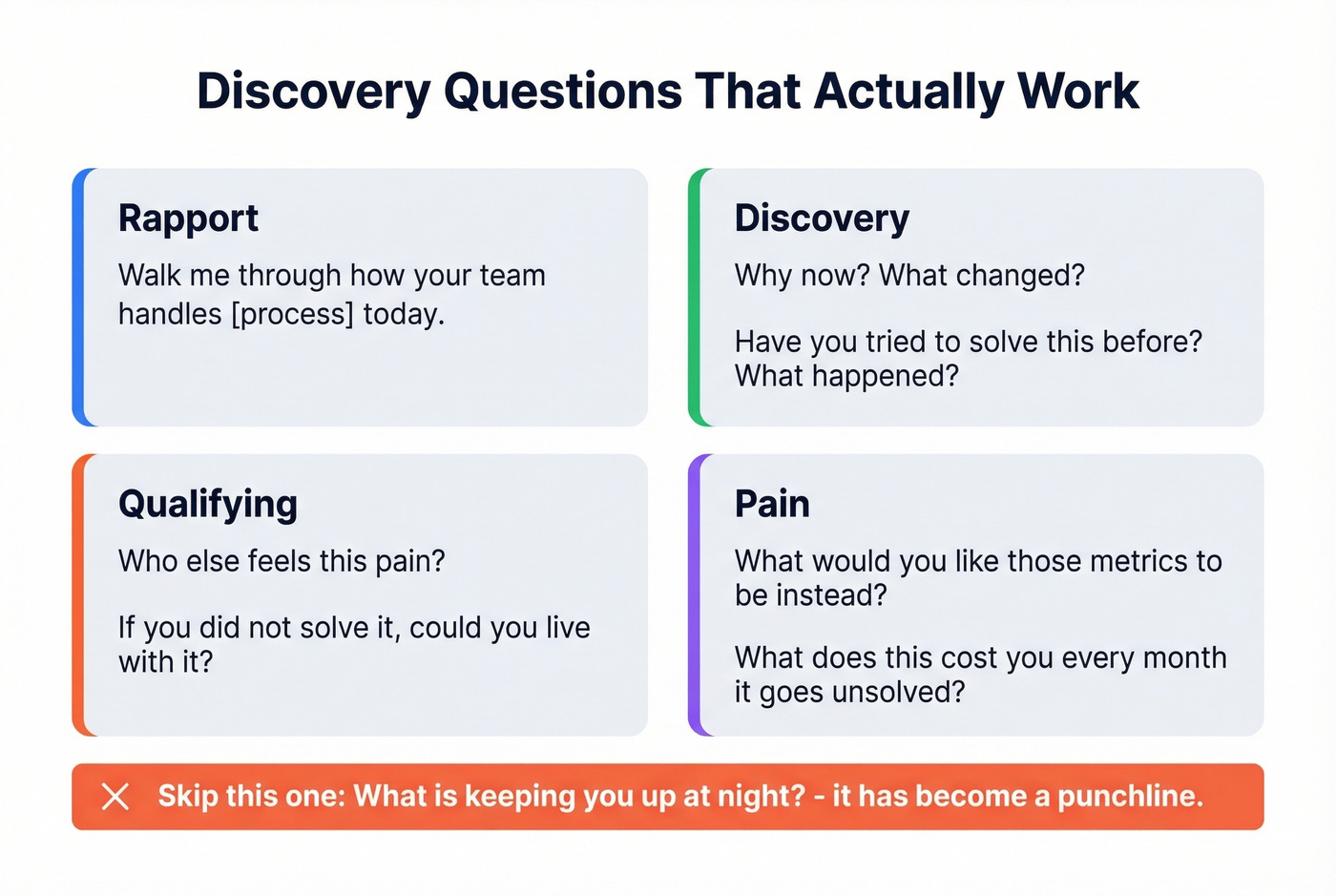
Rapport: "Walk me through how your team handles [process] today."
Discovery: "Why now? What changed?" - "Have you tried to solve this before? What happened?"
Qualifying: "Who else feels this pain?" - "If you didn't solve it, could you live with it?"
Pain: "What would you like those metrics to be instead?" - "What does this cost you every month it goes unsolved?"
Notice what's missing: "What's keeping you up at night?" That question has been so overused it's become a punchline.
Mistakes That Kill It
Do this: Internalize the principles, then have a human conversation. Not that: Memorize a framework and run it like a checklist.
Do this: Read emotional cues - hesitation, enthusiasm, deflection - and adjust in real time. Not that: Barrel through your discovery script because you have seven questions to get through.
Let's be honest: most consultative selling training is counterproductive. It teaches a rigid system, calls it "consultative," and then wonders why reps sound robotic. The framework should be a scaffold, not a cage. If your average deal size is modest - say under $10K - you probably don't need a heavy methodology rollout. Just nail the seven principles above and you'll outperform most of your floor. Becoming a great consultative seller is less about memorizing techniques and more about genuinely caring whether the buyer's problem gets solved.
Methodology Comparison
Consultative selling isn't the only game in town:
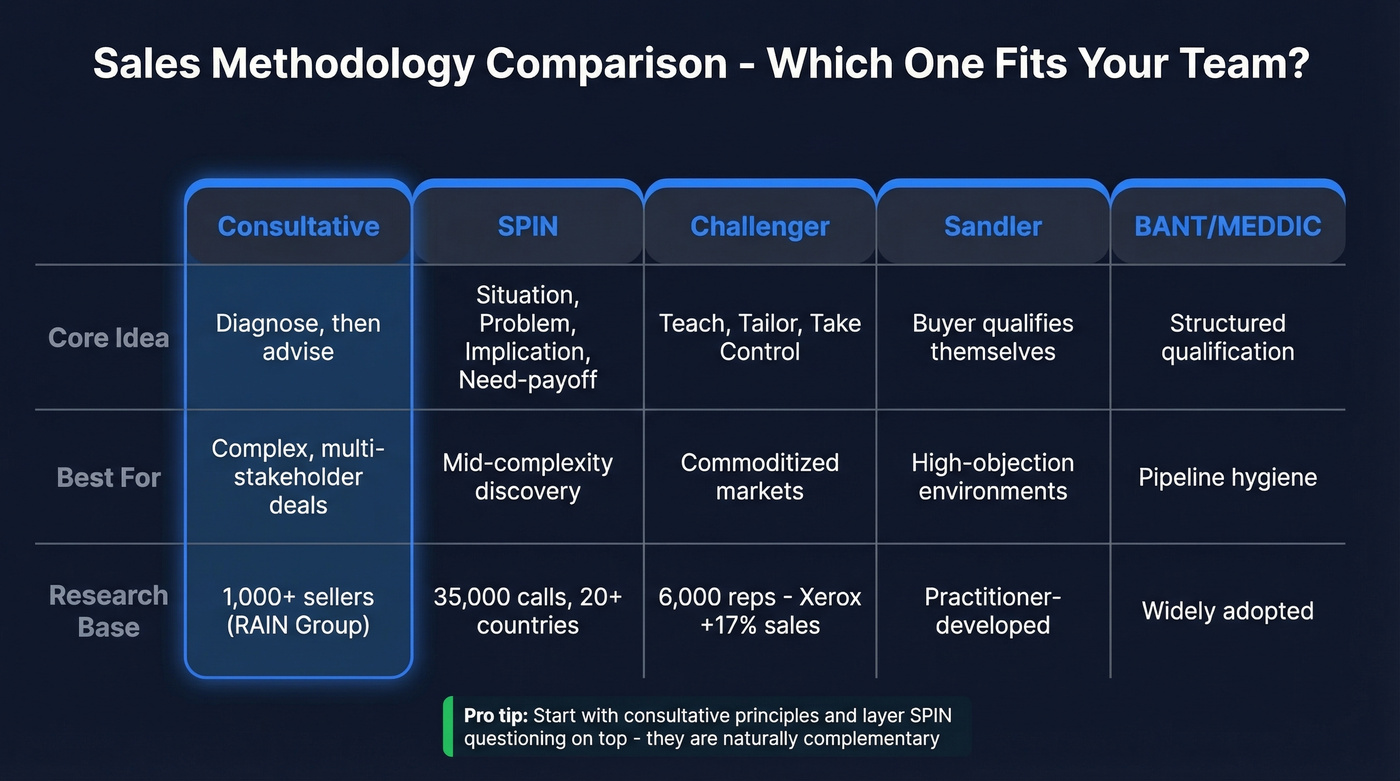
| Methodology | Core Idea | Best For | Research Base |
|---|---|---|---|
| Consultative | Diagnose, then advise | Complex, multi-stakeholder | RAIN Group (1,000+ sellers) |
| SPIN | Situation, Problem, Implication, Need-payoff | Mid-complexity discovery | 35,000 calls, 20+ countries |
| Challenger | Teach, Tailor, Take Control | Commoditized markets | 6,000 reps; Xerox +17% sales |
| Sandler | Buyer qualifies themselves | High-objection environments | Practitioner-developed |
| BANT/MEDDIC | Structured qualification | Pipeline hygiene | Widely adopted |
Start with consultative principles and layer SPIN questioning on top - they're naturally complementary. Teams commonly blend methods: BANT for qualification gates, consultative for discovery, Challenger for competitive deals. Companies with a defined sales process are 33% more likely to hit high-performance benchmarks. The specific methodology matters less than having one and reinforcing it consistently.
Tools That Support It
Consultative selling without data is just guessing. Two tool categories matter most.
Meeting intelligence frees you to actually listen instead of scribbling notes. Fathom ($19/user/mo) is the best value we've found - clean transcripts, AI summaries, CRM sync. Read AI ($19.75/user/mo) adds async meeting analysis. Otter ($8.33/user/mo) works if you just need transcription. Skip Otter if you need CRM integration though; it's bare-bones on that front.
Contact data ensures your prep work doesn't go to waste. If reps walk into discovery calls with outdated info or bounce on the first email, the best questions in the world won't help. Prospeo's real-time verification and 7-day data refresh cycle mean you're reaching current stakeholders with accurate data, not chasing ghosts from a six-month-old export. If you're evaluating options, compare best sales prospecting databases and free lead generation tools before you commit.
Surviving a 25-person buying committee means mapping every stakeholder before you pitch. Prospeo's 30+ search filters - including department headcount, org charts, and job changes - let you identify the full committee at $0.01 per email.
Know the entire buying committee before your competitor finds the first name.
FAQ
Is consultative selling the same as solution selling?
No. Solution selling often pushes a pre-built fix once a pain point surfaces. Consultative selling diagnoses the buyer's full situation - politics, priorities, constraints - first and may recommend solutions the seller doesn't even provide. The distinction matters most in complex, multi-stakeholder deals.
How long does it take to become a consultative seller?
The principles take an afternoon to understand. Executing them naturally on live calls takes 3-6 months of deliberate practice with call reviews and coaching. Most training fails because there's no reinforcement after the initial workshop - reps revert within two weeks.
What tools help with pre-call preparation?
Meeting intelligence tools like Fathom handle note-taking so you can focus on listening. For pre-call research, a platform with verified, frequently refreshed contact data ensures you walk into every conversation with current stakeholder info - not bounced emails and dead phone numbers.