

How to Build a Consulting Sales Pipeline That Actually Works
It's Thursday afternoon. The engagement just wrapped, the client's happy, the invoice is sent - and your pipeline is empty. You're back to scrambling.
This feast-or-famine cycle is the defining problem of consulting sales, and it's almost always a pipeline problem, not a demand problem. Referrals feel great when they arrive, but they come in waves, and you can't build a business on waves. With 80% of B2B interactions happening digitally and up to 50% of sales going to the first vendor who responds, a structured consulting sales pipeline is how you stop reacting and start compounding.
The Short Version
- Use a 6-stage pipeline (Lead → Conversation → Scope → Proposal → Negotiation → Closed) - not 13 stages you'll ignore.
- Review weekly. Firms that do see 34% revenue growth vs. 11% for ad-hoc reviewers.
- Benchmark proposal conversion. Above 50% is healthy. Professional services median: $8,900 deal, 28% win rate, 51-day cycle.
- Fix your contact data before adding more leads. Bounced emails are invisible pipeline leakage.
Pipeline Stages for Consultants
You don't need 13 stages. You need six that you actually use. The biggest improvement we've seen in consulting pipelines comes from reducing friction - a simple system used daily beats an elaborate one gathering dust in a spreadsheet.
| Lean Pipeline (Solo) | Full Pipeline (Firms with BD) | |
|---|---|---|
| Stages | 6 | 10-13 |
| Adds | - | Qualified gate, Long-Term Nurture, Post-Loss |
| Best for | Solo consultants, small teams | Firms with dedicated BD staff |
| Risk | Too simple for complex sales | Complexity nobody maintains |
The Lean Pipeline
Six stages with clear exit criteria:
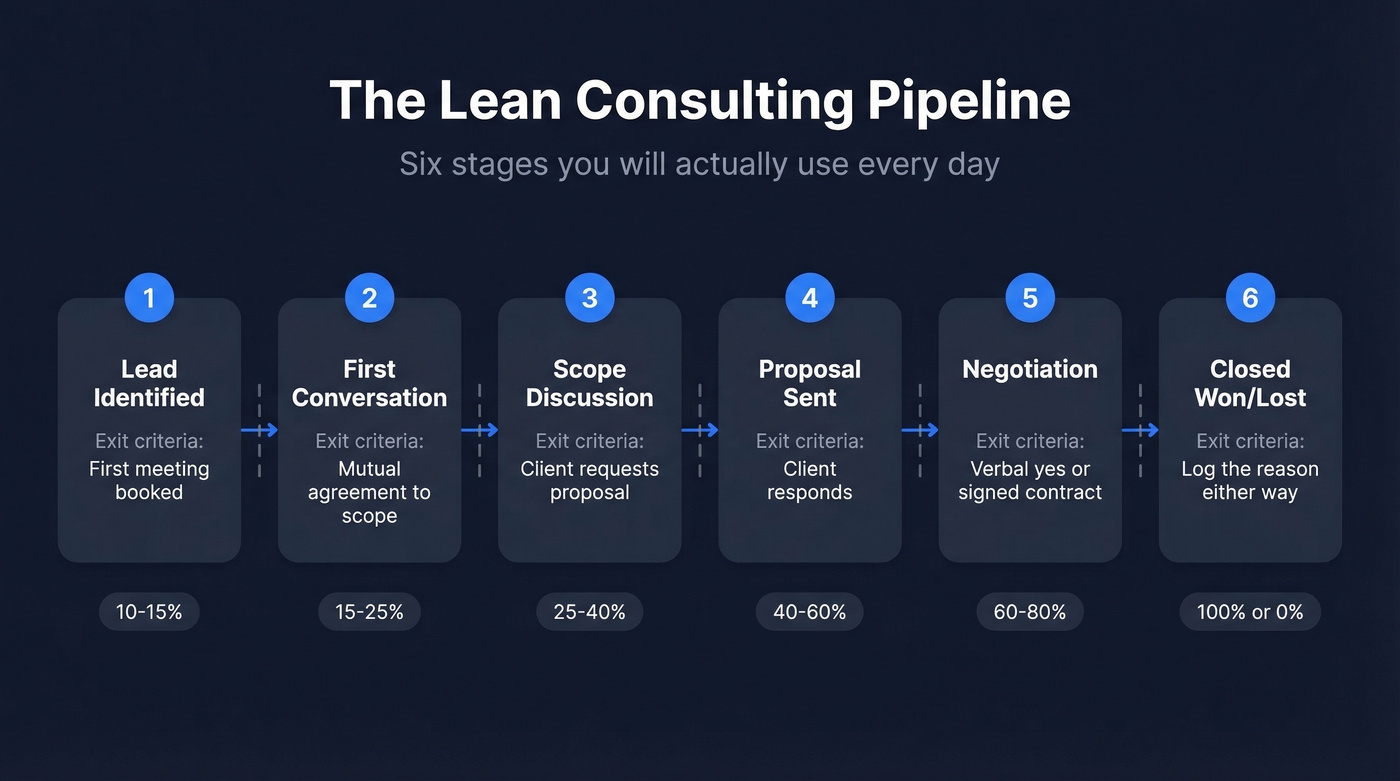
- Lead Identified - You know who they are and why they'd buy. Exit: first meeting booked.
- First Conversation - Discovery call completed. Exit: mutual agreement to scope.
- Scope Discussion - Requirements defined, budget range confirmed. Exit: client requests a proposal.
- Proposal Sent - Written proposal delivered. Exit: client responds.
- Negotiation - Terms or pricing under discussion. Exit: verbal agreement or signed contract.
- Closed (Won/Lost) - Deal done or explicitly lost. Log the reason either way.
A solo consultant on Reddit described the pain perfectly: their pipeline "lived everywhere" - email, notes, Excel, calendar. The fix wasn't a fancier tool. It was a simpler system they'd actually update daily.
If you want a deeper breakdown of common failure points, see pipeline challenges that quietly kill revenue.
The Full Pipeline
Keap's model runs 13 stages. That's overkill for most firms, but two additions are worth borrowing: a Qualified gate between first contact and scoping, and a Long-Term Nurture bucket for prospects who'll be ready in 90-180 days. Skip the rest unless your CRM admin loves complexity.
Benchmarks That Actually Matter
Pipeline velocity is the single number that tells you whether your consulting sales pipeline is healthy or just full. The formula: (Deals x Average deal size x Win rate) / Sales cycle length.
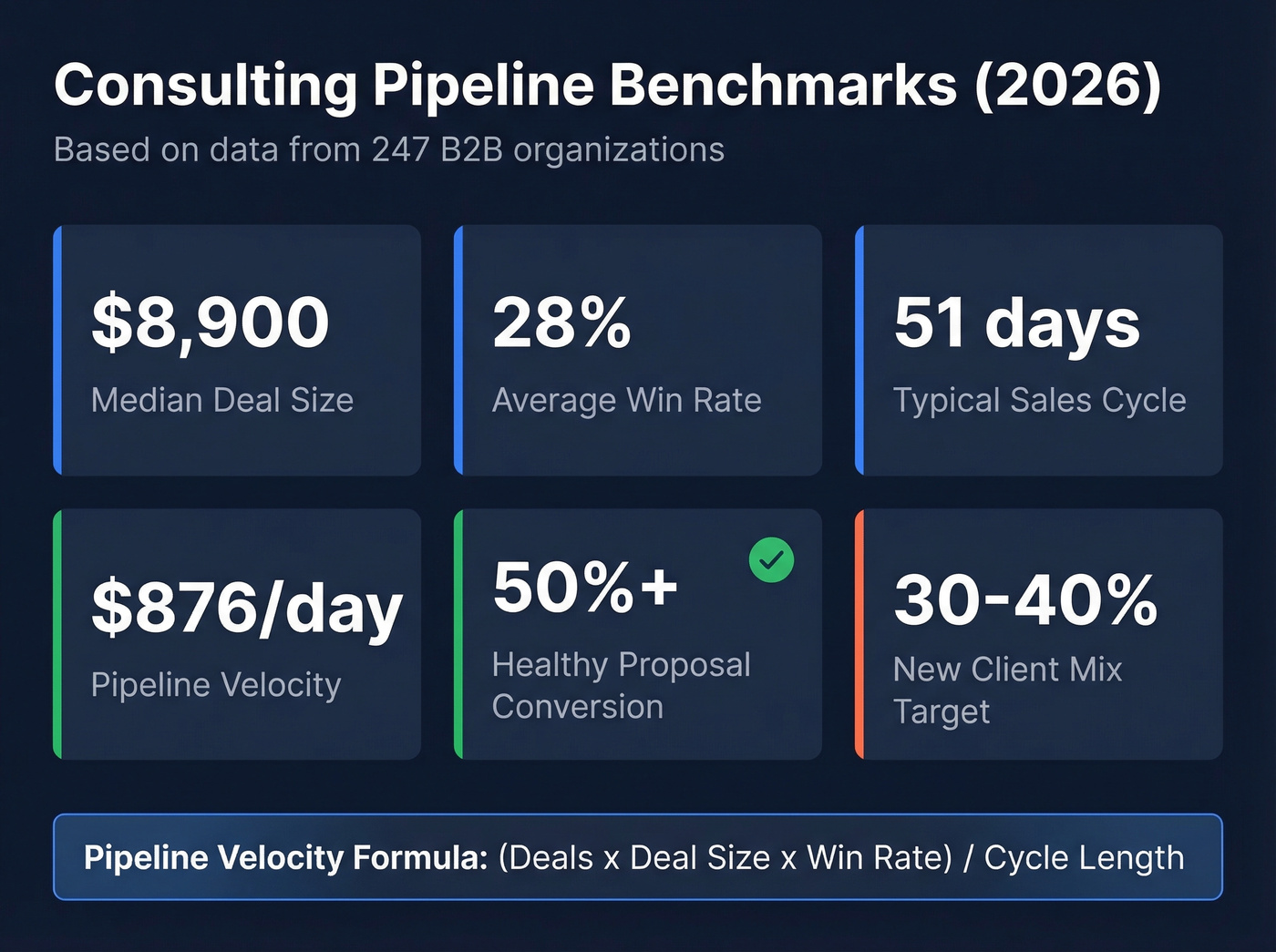
A 2026 study of 247 B2B organizations found these professional services benchmarks:
| Metric | Pro Services Benchmark |
|---|---|
| Median deal size | $8,900 |
| Average win rate | 28% |
| Typical sales cycle | 51 days |
| Pipeline velocity | $876/day |
| Proposal conversion | >50% is healthy |
| New client mix | 30-40% |
For more context on what “good” looks like across industries, compare against broader sales pipeline benchmarks.
If your proposal conversion is below 50%, the problem is almost always qualification - you're writing proposals for prospects who aren't ready to buy. Stage-by-stage, expect roughly 10-30% probability early on, 40-60% at proposal, and 60-80% in active negotiation. Use those ranges to diagnose where your pipeline leaks: if most deals cluster in early stages, you have a qualification problem; if they cluster late, you have a closing problem.
If you need a repeatable way to qualify, a simple lead scoring model can prevent “proposal spam.”
Here's the thing: most solo consultants don't have a pipeline problem. They have a qualification problem dressed up as a pipeline problem. They write 10 proposals a quarter and win two. The fix isn't more leads - it's fewer, better-qualified proposals.

Your consulting pipeline leaks every time an email bounces. 12 out of 50 emails failing means 24% of your outreach dies before a single decision-maker reads it. Prospeo delivers 98% email accuracy across 300M+ profiles, refreshed every 7 days - so the VP you're targeting actually gets your message.
The free tier gives you 75 verified emails a month. Enough to fill a lean pipeline.
How to Fill Your Pipeline
Five steps, in priority order:
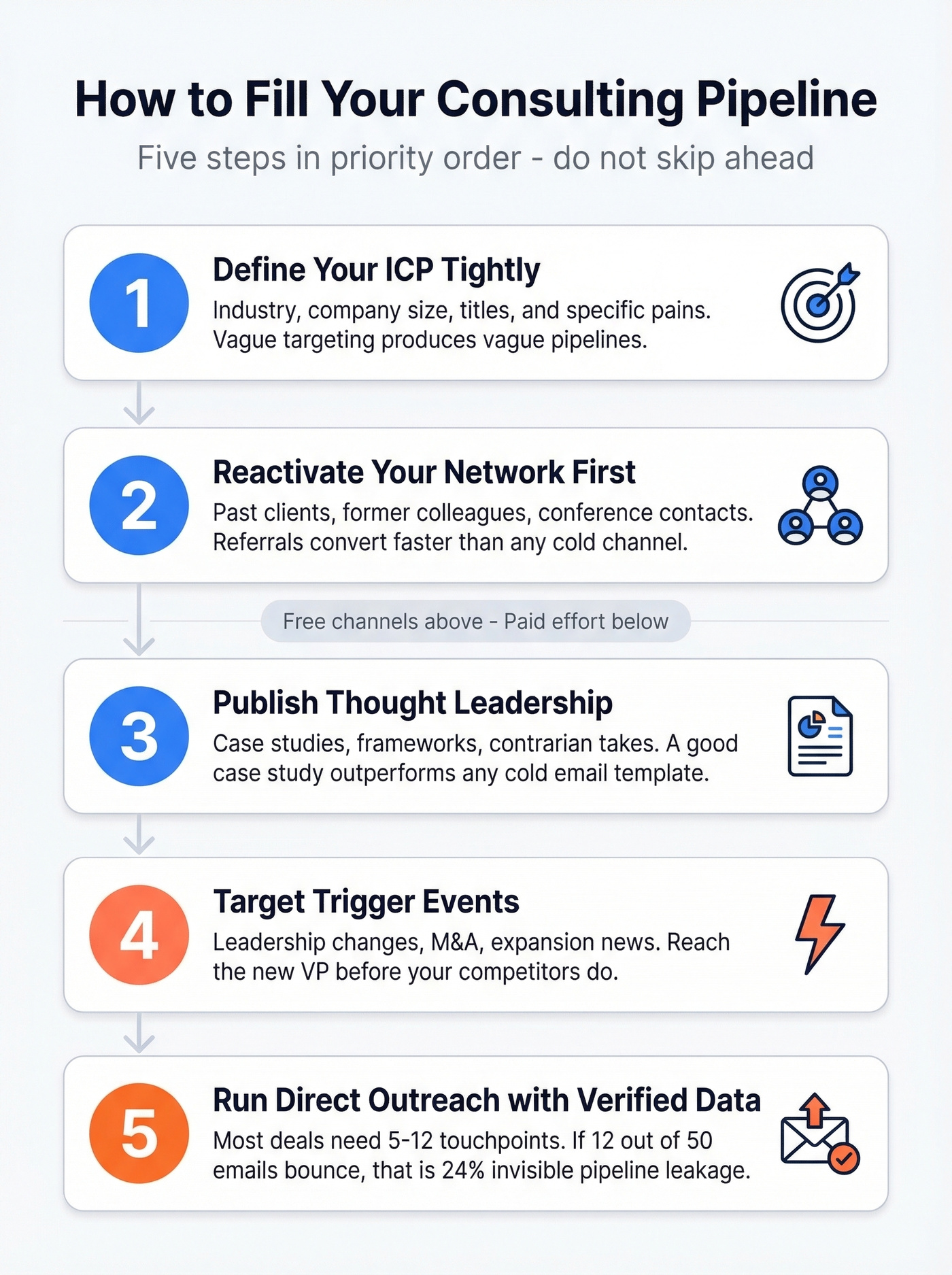
- Define your ICP tightly. Industry, company size, titles, pains. Vague targeting produces vague pipelines. (If you want a quick structure, use an ideal customer profile template.)
- Reactivate your network first. Past clients, former colleagues, conference contacts. Referrals convert faster than any cold channel, and they cost nothing.
- Publish thought leadership. Case studies, frameworks, contrarian takes. This builds inbound and gives you something to share in outreach - the consensus on r/consulting is that a good case study outperforms any cold email template. If you're leaning on outbound, borrow proven sales prospecting techniques.
- Target trigger events. Leadership changes, M&A, expansion announcements. A consultant who reaches out the week a new VP starts has a fundamentally different conversation than one who cold-emails into a stable org. (More on operationalizing this in how to track sales triggers.)
- Run direct outreach with verified data. Most deals require 5-12 touchpoints. If you're sending 50 emails and 12 bounce, that's invisible pipeline leakage eating your results before anyone reads a word. To protect deliverability, follow an email deliverability guide and monitor email bounce rate.
Data quality is where most outreach breaks down. We've watched consultants burn weeks of effort on lists full of dead addresses. Prospeo covers 300M+ professional profiles with 98% email accuracy on a 7-day refresh cycle, and the free tier gives you 75 verified emails per month - enough to test outreach to decision-makers before committing budget.

Mistakes That Kill Consulting Deals
The most common pipeline killer is vague next steps. "I'll follow up next week" isn't a next step - it's a hope. Every conversation should end with a mutual, calendarized action and a named owner. If you need wording that gets replies, keep a set of sales follow-up templates handy.
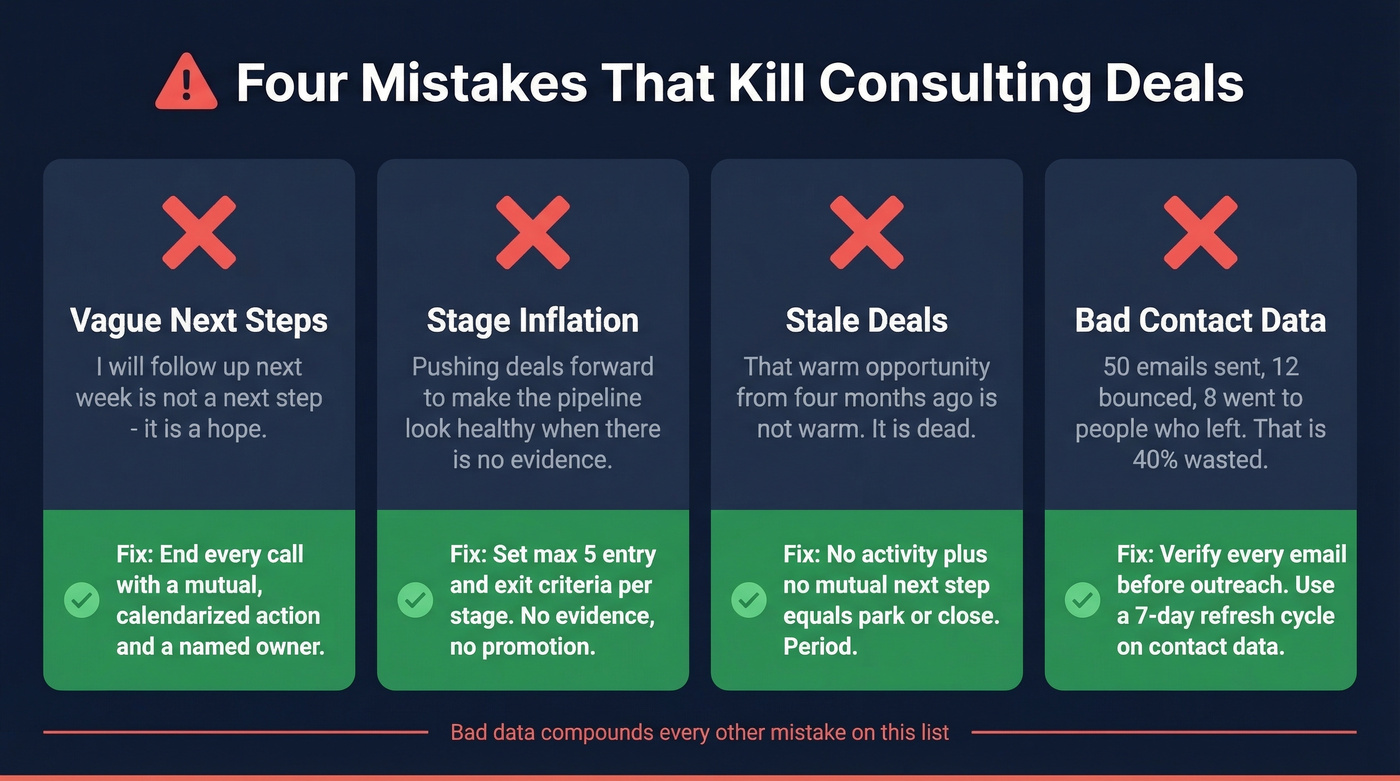
Right behind that is stage inflation: pushing deals forward to make the pipeline look healthy. If you don't have evidence a deal belongs in a stage, it doesn't belong there. Set a maximum of five entry/exit criteria per stage and enforce them ruthlessly.
Stale deals are the silent killer. That "warm" opportunity from four months ago? It isn't warm. No activity plus no mutual next step equals park or close - period. Let's be honest: keeping dead deals in your pipeline doesn't make you feel better. It makes your forecasts worse and your weekly reviews useless. I've seen consultants carry the same "almost ready" deal for six months, and it never closes. Cut it loose.
Bad contact data compounds all of these problems. You sent 50 emails, 12 bounced, 8 went to people who left the company. That's 40% of your outreach wasted before anyone reads a single word. If you're cleaning lists at scale, consider dedicated data enrichment services.
Tools Worth Considering
The tool matters less than the habit. A spreadsheet you update daily beats a $150/month CRM you ignore.
Solo or 1-3 people: Start with a Google Sheet tracking company, contact, value, expected start, next action, and stage. Move to Pipedrive (around $15-$30/user/month) or Less Annoying CRM ($15/user/month) once you're managing 15+ parallel conversations. Skip anything fancier until you've outgrown the basics - if you're spending more time configuring your CRM than selling, you've gone wrong. If you're comparing options, see examples of a CRM.
Small firm (5-15): HubSpot CRM's free tier handles basic pipeline tracking; Starter plans run around $15-$25/user/month for light automation. Firms using professional services automation tools report 19% higher gross margins and 40% higher operating profit versus spreadsheet-only firms. That's a real gap.
Larger firm (15+): Salesforce (from around $25/user/month for entry tiers) with dedicated data tools for outbound. At this size, invest in setup and training or you'll end up with an expensive database nobody trusts. Prospeo integrates natively with both Salesforce and HubSpot, so enrichment data flows directly into whatever CRM you choose. If you're budgeting, use a current salesforce pricing breakdown.
Trigger-based outreach only works if you can reach the new VP before your competitors do. Prospeo's 30+ search filters - including job changes, company growth, and funding signals - let you build targeted consulting prospect lists in minutes, not hours. At $0.01 per email, a quarter's outreach costs less than one billable hour.
Stop writing proposals for the wrong people. Start reaching the right ones.
FAQ
How many pipeline stages should a consultant use?
Six is the sweet spot for most solo consultants and small firms. More stages add overhead without improving close rates. Scale to 10+ only when you have dedicated BD staff maintaining the extra granularity.
What's a good proposal conversion rate for consulting?
Above 50% is strong - the professional services median win rate sits around 28%, so clearing 50% at the proposal stage means your qualification is working. Consistently below that usually signals you're scoping too early. Tighten your discovery criteria before investing in better proposals.