Conversational Marketing Sales: The Operator's Playbook (2026)
Most conversational marketing sales programs fail for a boring reason: nobody owns the handoff.
Marketing launches chat, sales ignores it, and the "AI agent" quietly turns into a glorified FAQ.
Conversational marketing sales works only when you run it like revenue infrastructure: speed-to-lead, qualification, routing, meeting booking, and follow-up measured like pipeline, not "engagement."
Conversational marketing for sales (in one minute)
Conversational marketing is the strategy: use real-time conversations (web chat, in-app messaging, SMS, WhatsApp, AI agents, live reps) to move a visitor from "curious" to "qualified" without forcing them through a dead-end form.
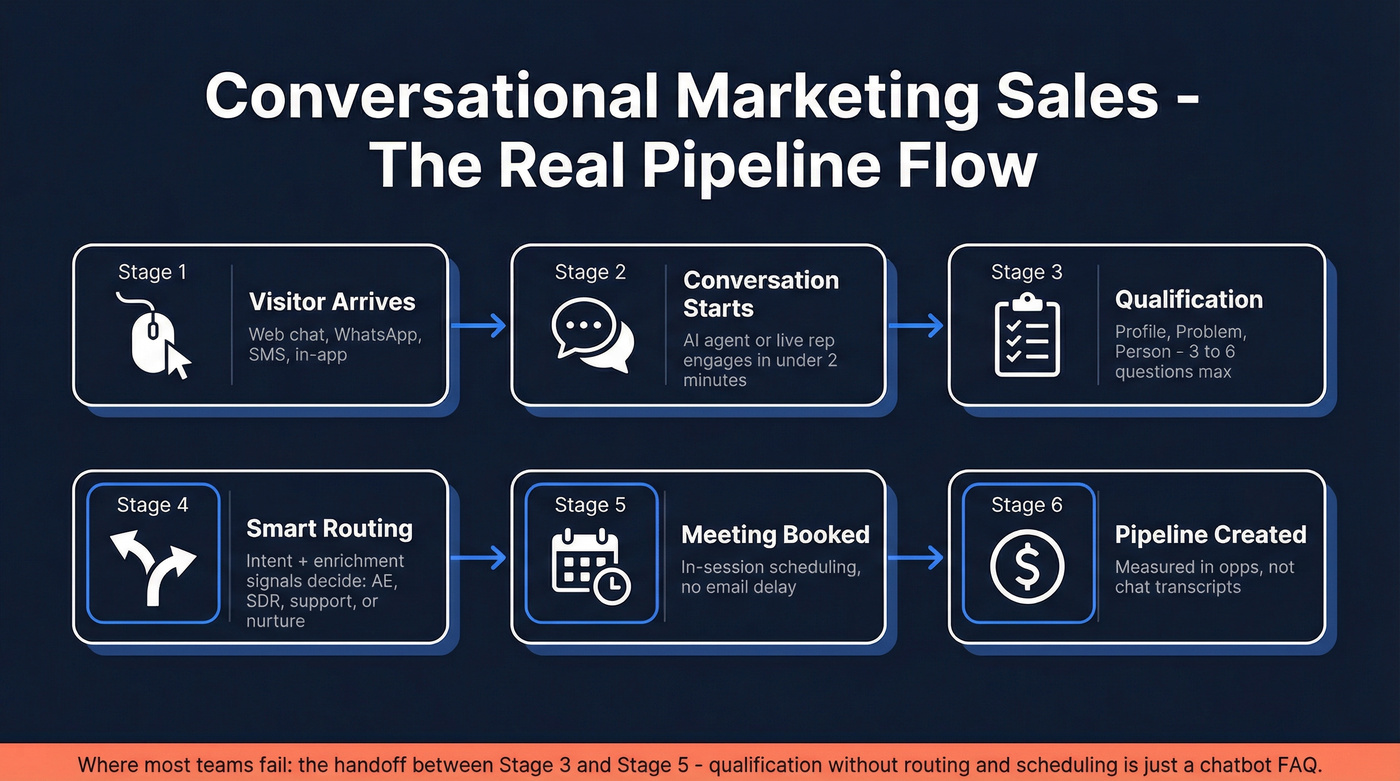
Conversational sales is the execution layer: reps (or an AI SDR) use that conversation to qualify, route, and book meetings, then progress the deal.
The operator's POV is simple: it's a speed-to-lead + qualification + routing + meeting booking system. If any one of those pieces is weak, the whole thing underperforms.
A lot of teams get stuck thinking "chat widget" or "bot." That's the wrong mental model. The widget's just the front door; the real product is what happens after the first message: who responds, how fast, what gets asked, where the lead goes, and whether the meeting gets booked in-session.
Definition (useful, not academic): Conversational marketing for sales is the process of capturing demand on your site (or messaging channels), qualifying it in real time, routing it to the right human or workflow, and booking the next step while measuring outcomes in meetings, opportunities, and pipeline.
Conversation continuity is the underrated advantage. A buyer can start on web chat, disappear, and resume later via email, SMS, or WhatsApp with the context preserved, which is exactly why teams that pair chat with tight follow-up (including conversational email AI for drop-offs) tend to see fewer "ghosts" after a seemingly good interaction.
I've seen teams buy a premium chat platform and still lose deals because the follow-up email bounced or the lead got routed to the wrong territory. The "conversation" is the easy part. The ops is the hard part.
What you need for conversational marketing sales (quick version)
Do this if you want conversational marketing sales to create pipeline (not just transcripts):
- Implement a 2-minute SLA + instant scheduling. If a human needs to step in, target under 2 minutes to respond. If you can't staff that, route to instant meeting booking (or a callback) instead of "we'll email you."
- Qualify with Profile -> Problem -> Person. Ask 3-6 questions max. You're not running discovery; you're deciding whether to route, book, or disqualify.
- Route using intent + enrichment signals. Use page context (pricing/security/integrations), firmographics, and known account lists to decide: AE vs SDR vs support vs partner vs "nurture."
- Escalate to humans on purpose. Drift research shared via Demand Gen Report found bot-only conversations were 66% less likely to convert than conversations that route to a human.
- Measure pipeline KPIs, not chat vanity metrics. Meetings booked, opps created, pipeline influenced, response time, disqual rate, handoff rate.
- Build compliance in from day one. EU AI Act bot disclosure, TCPA quiet hours + consent, WhatsApp consent + category costs.
Skip this (it's where teams burn quarters):
- Skip "bot-only" as your default. It deflects questions; it doesn't create revenue.
- Skip routing based on one field (like company size). You'll misroute enterprise buyers and annoy SMBs.
- Skip launching without staffing coverage. After-hours is where a huge chunk of conversations happen.
- Skip "chat as a form replacement" if you won't change follow-up. If the next step's still "we'll get back to you," you've rebuilt the same delay with a friendlier UI.
Hot take: if your average deal size is small and your sales cycle's simple, you don't need a fancy "AI SDR." You need instant scheduling, clean routing, and ruthless follow-up hygiene.
The sales math: why conversations beat forms (when run correctly)
Forms aren't "bad." They're just fragile.
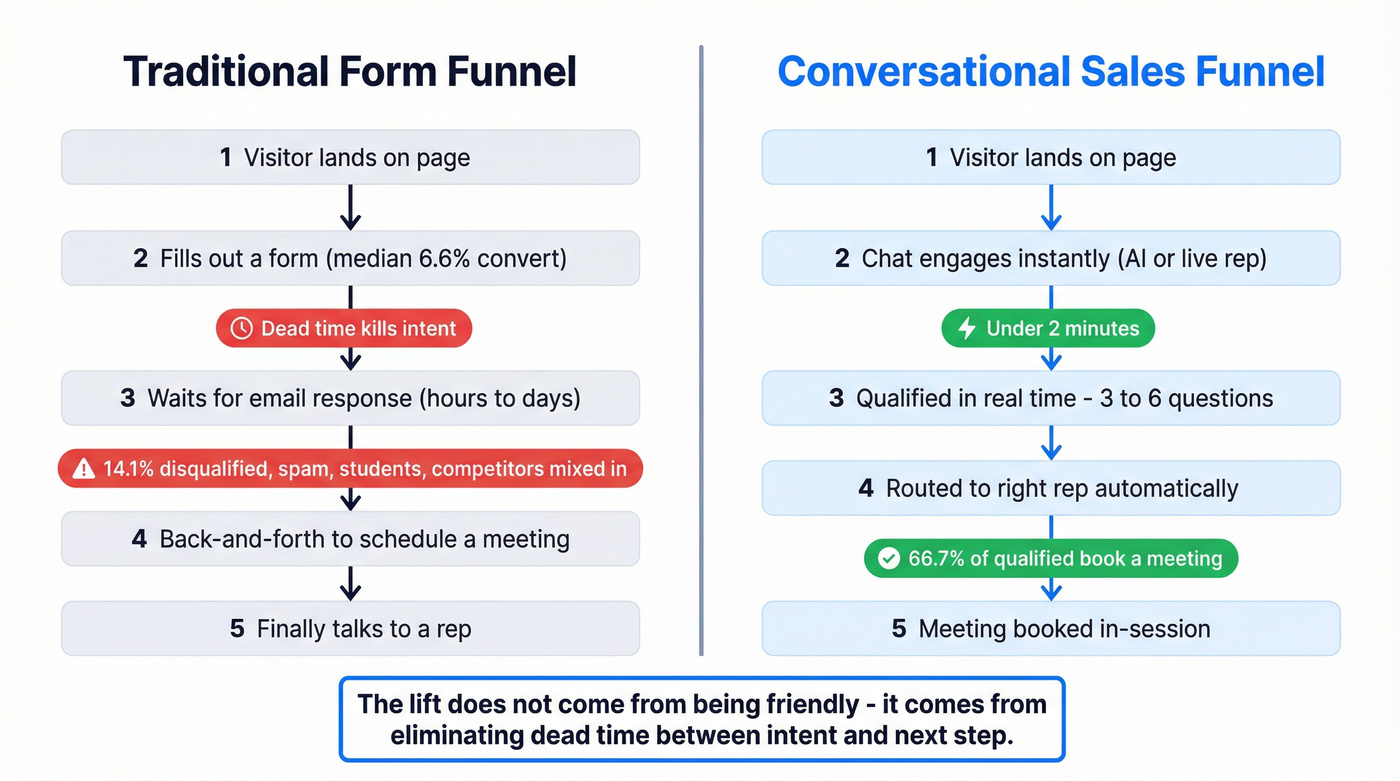
Unbounce's 2026 conversion benchmark report puts the median landing page conversion rate at 6.6% across industries, based on 41K+ pages, 464M unique visitors, and 57M conversions. That's your baseline: most of your traffic doesn't convert, even when the page's decent.
Now layer in what happens after the form. This is where the wheels come off: spam, personal emails, students, competitors, and "just browsing" all land in the same bucket, then you email them later, then they ghost, and your team starts treating inbound like a chore instead of a gift.
Chili Piper's benchmark report (4M submissions) is the cleanest look we have at the handoff mechanics: 14.1% of form fills get disqualified, and 66.7% of qualified submissions book a meeting. That's not a chat stat, but it's the same system: capture -> qualify -> schedule.
The big win of conversational is that it compresses time and removes friction:
- Instead of: visitor fills form -> waits -> gets emailed -> maybe schedules
- You get: visitor asks -> gets qualified -> gets routed -> books now
Real talk: the "conversion lift" doesn't come from being friendly. It comes from eliminating the dead time between intent and next step.
A simple ROI model you can run in 5 minutes
Use this to sanity-check payback before you buy anything:
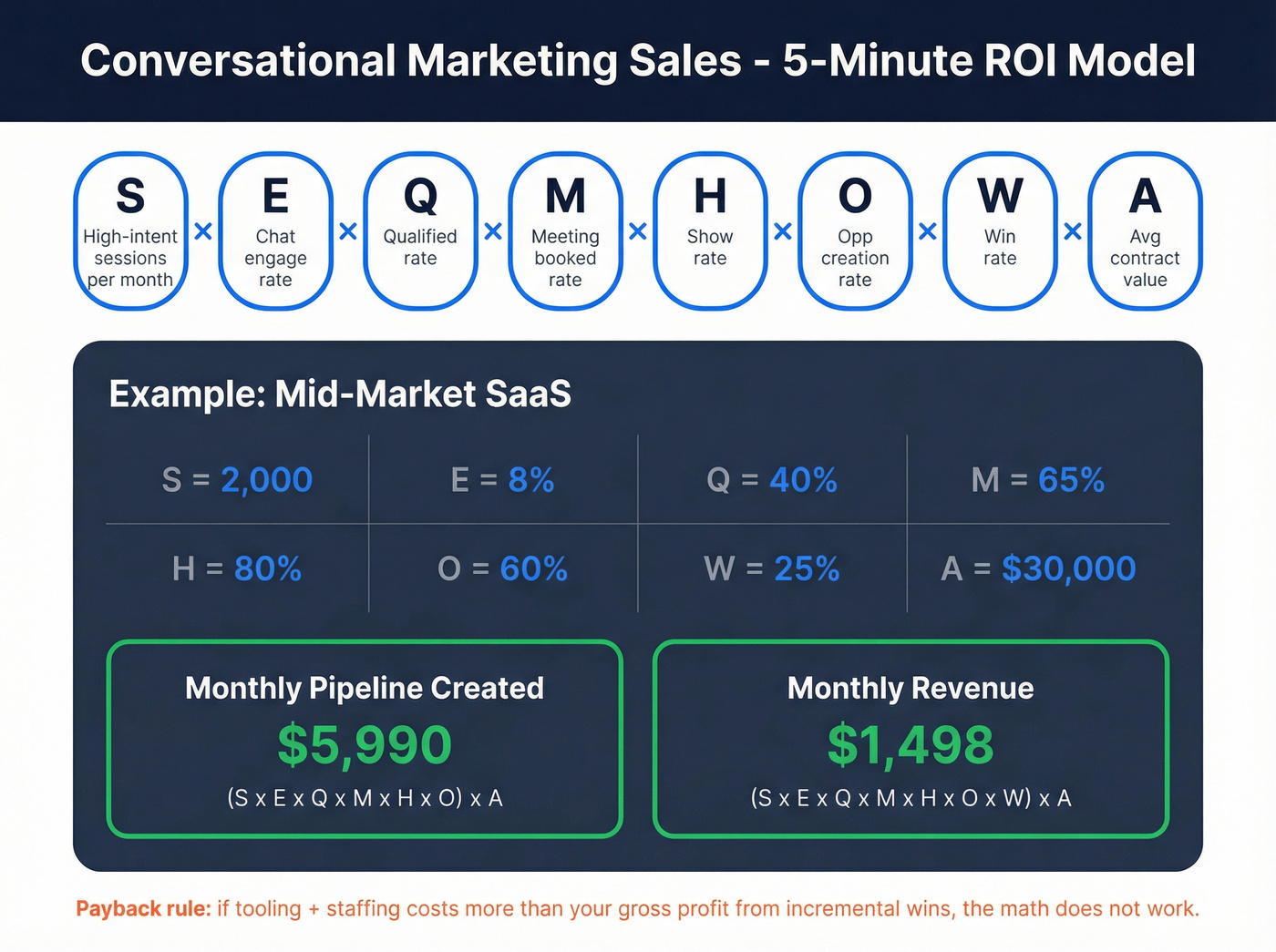
- Monthly high-intent sessions (pricing/security/integrations):
S - Chat engage rate on those pages:
E - Qualified rate from engaged chats:
Q - Meeting booked rate from qualified:
M - Show rate:
H - Opp creation rate from held meetings:
O - Win rate:
W - Average contract value (ACV):
A
Monthly pipeline created ~= S x E x Q x M x H x O x A
Monthly revenue ~= S x E x Q x M x H x O x W x A
Payback threshold is blunt: if your tooling + staffing costs $C/month, you need monthly gross profit from incremental wins to beat $C. If you can't make the math work on high-intent pages, you won't make it work anywhere.
Speed-to-lead benchmark (use it carefully)
A commonly cited benchmark in sales is that responding within 5 minutes makes leads far more likely to convert; Martal references this "within 5 minutes = 9x" idea as a practical speed-to-lead target. Treat it as directional. The point's still the same: time kills intent, and conversations are the easiest way to remove time.

Your conversational marketing stack qualifies leads in real time - but bad contact data kills the handoff. Prospeo's 98% email accuracy and 125M+ verified mobiles mean your routed leads actually connect. Enrich every chat-qualified prospect with 50+ data points before they hit your AE's queue.
Stop losing qualified conversations to bounced emails and wrong numbers.
SLA + staffing model (the 2-minute rule and after-hours reality)
The Salesloft-hosted Drift report analyzing 30M+ conversations (2023 data) makes the SLA point painfully clear: the best meeting outcomes happen when a live agent responds in under 2 minutes after bot engagement. Wait 5 minutes and the visitor's 10x more likely to leave. Wait 10 minutes and it's 100x.
Also: your buyers don't care about your office hours. 39% of conversations and 41% of meetings booked happen outside 9-5. If you staff only "business hours," you're choosing to lose demand.
SLA coverage options (use/skip table)
| Model | Use this if | Skip this if | Typical cost |
|---|---|---|---|
| SDR live coverage | High inbound, mid-market+ | Tiny inbound volume | $70k-$140k/yr fully loaded |
| AE live coverage | High-intent ABM pages | AEs hate interrupts | $0 cash, high opportunity cost |
| After-hours vendor | Global traffic, lean team | Strict brand control | $2k-$10k/mo |
| AI-first + human | Need 24/7 triage | No KB/governance | $1k-$8k/mo |
| Schedule-first | Low staffing, high intent | Complex qualification | $1k-$6k/mo |
The 2-minute rule (how to operationalize it)
If you can staff it:
- Route pricing/security/integrations to a live SDR/AE queue.
- Give reps a real "chat shift" schedule like support, not "answer when you can."
- Set a hard SLA alert at 90 seconds and treat misses like dropped inbound calls.
If you can't staff it:
- Don't pretend. Route to instant scheduling with the right rep, plus a "request callback in 5 minutes" option.
- Staff a smaller "rescue queue" for escalations only (security, procurement, enterprise accounts).
The handoff template that stops the bleeding
Most programs fail in the last 10 yards: the rep gets the conversation, but not the context. Use this handoff payload every time:
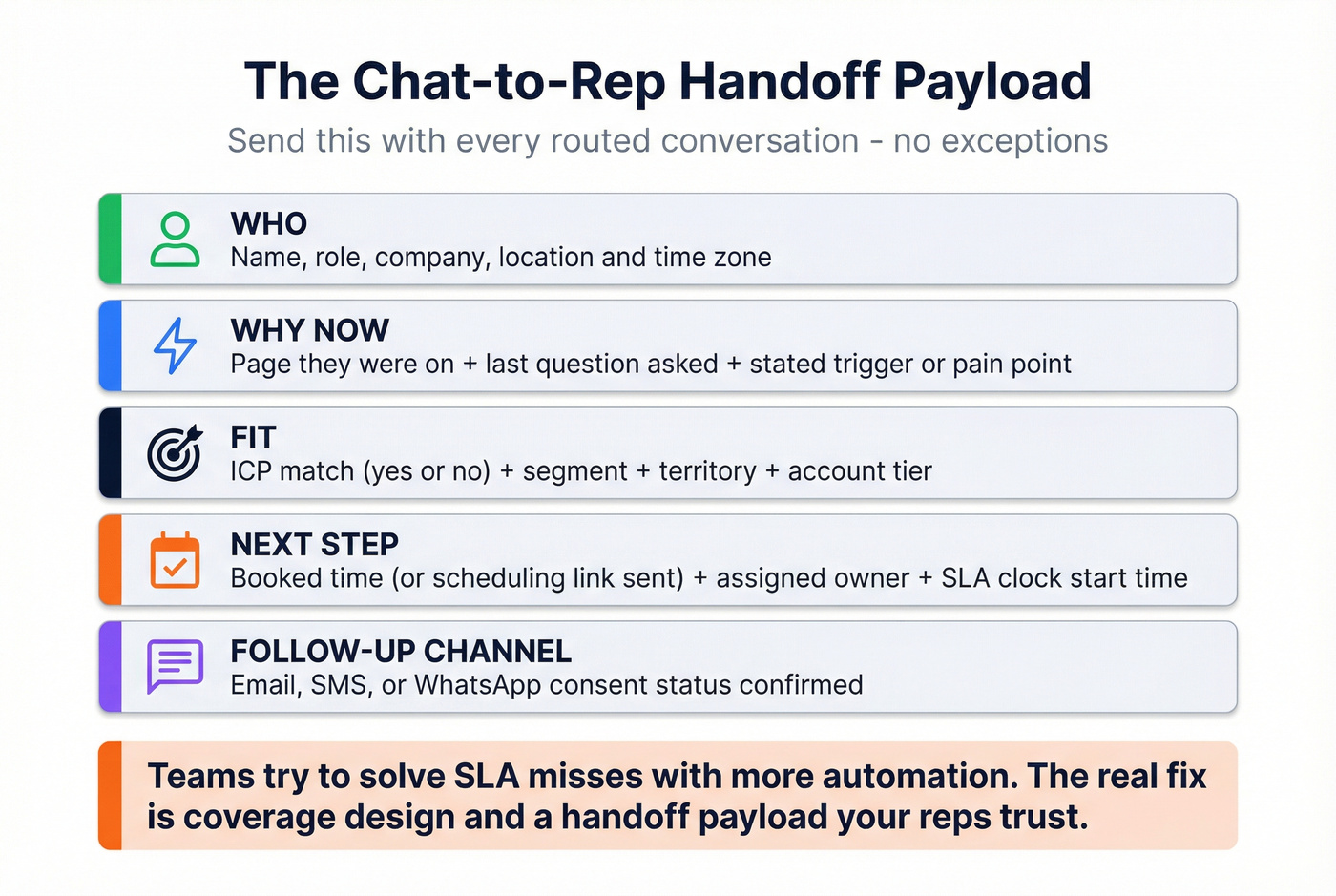
- Who: name, role, company, location/time zone
- Why now: page + last question asked + stated trigger
- Fit: ICP match (yes/no) + segment + territory
- Next step: booked time (or link sent) + owner + SLA clock start
- Follow-up channel: email/SMS/WhatsApp consent status
Here's the thing: teams try to solve SLA misses with more automation. The real fix is coverage design and a handoff payload your reps trust.
Qualification playbook: Profile -> Problem -> Person (with scripts)
Highspot's Profile -> Problem -> Person framework is a clean way to qualify in chat without turning it into an interrogation.
You're trying to answer three questions fast:
- Profile: Are they the right kind of company and role?
- Problem: Do they have a real use case (realized or latent pain)?
- Person: Are we talking to someone who can buy, influence, or implement?
How chat changes MQL/SQL/PQL (signal thresholds that work)
Chat shouldn't dump "leads" into your CRM. It should promote people based on signals.
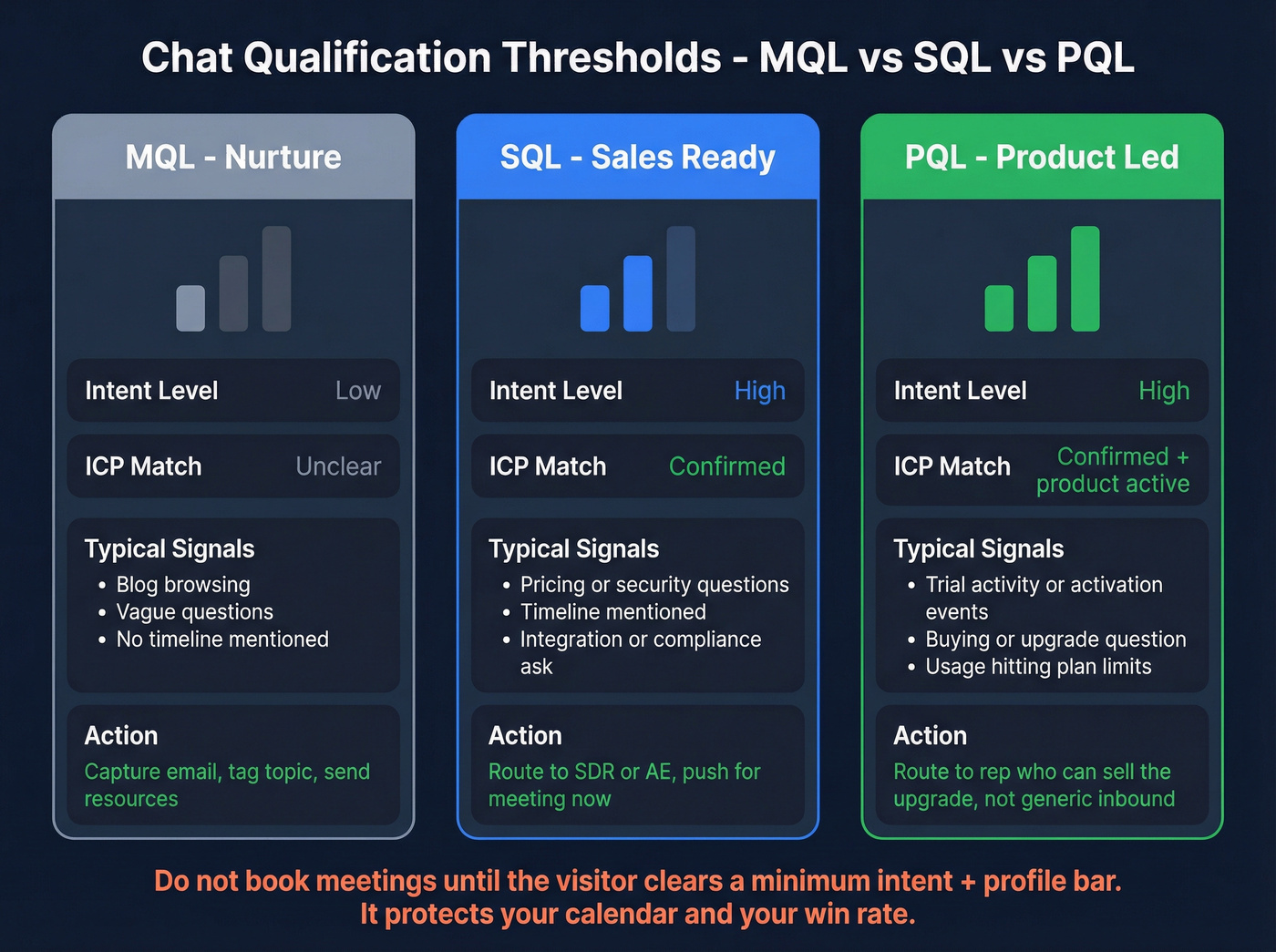
Use this simple thresholding:
- MQL (nurture): ICP is unclear or intent is low (blog browsing, vague questions). Capture email, tag topic, send resources.
- SQL (sales-ready): ICP match and intent is high (pricing/security/timeline/integration questions). Route to SDR/AE and push for a meeting now.
- PQL (product-led): product signals (trial activity, activation events) plus a buying question. Route to a rep who can sell the upgrade, not a generic inbound queue.
If you do nothing else, do this: don't book meetings until the visitor clears a minimum intent + profile bar. It protects your calendar and your win rate.
Branching chat script (copy/paste)
Opening (always): "Happy to help, mind if I ask 3 quick questions so I can route you to the right person?"
1) Profile questions (pick 2)
- "What's your company size? (1-50 / 51-200 / 201-1,000 / 1,000+)"
- "Which industry are you in?"
- "Which team are you on? (Sales / RevOps / Marketing / Support / Other)"
- "Are you evaluating for one team or multiple regions?"
Routing note: If they're on a target account list or match ICP firmographics, treat as high priority even if they're vague.
2) Problem questions (pick 2)
- "What triggered you to reach out today?"
- "Are you trying to fix an existing workflow, or set up something new?"
- "What's the impact if this doesn't get solved this quarter?"
Interpretation:
- Realized pain = "We're missing inbound leads / routing is broken / reps aren't following up."
- Latent pain = "We're exploring / curious / benchmarking." Latent is fine, it just routes differently.
3) Person questions (pick 1-2)
- "Are you the person who'd own this project, or should we loop in someone else?"
- "Who else will weigh in, Sales leadership, RevOps, IT/security?"
Goal: avoid the late-stage stall where you booked a meeting with someone who can't move anything forward.
Explicit disqualification rules (yes, you need them)
Chili Piper disqualifies 14.1% of submissions. That's not harsh, that's healthy. Your chat program needs the same spine.
Disqualify (politely) when:
- Personal email + no company + vague intent
- Students/job seekers/vendors
- Competitors fishing
- Out-of-geo/out-of-segment (if you truly can't serve them)
Disqual script: "Looks like we're not the best fit for what you're trying to do. I can point you to a couple resources, what's the main outcome you're after?"
I've seen teams refuse to disqualify because they want "more leads." Then sales stops trusting chat entirely. Protect sales trust first.
Routing blueprint that actually books meetings
Routing's where conversational marketing turns into revenue, or into chaos.
Drift's benchmark is blunt: high-intent messages are 5x more likely to convert into an opportunity than low-intent ones. And "high-intent playbooks" drive 2x meetings and 3x opportunities versus other playbooks.
High-intent triggers (B2B pages that matter)
Treat these as "priority routing" pages:
- Pricing
- Security / Trust / Compliance
- Integrations
- Implementation / onboarding
- Competitor comparison pages
- Product documentation (for PLG-ish motions)
Treat these as "nurture routing" pages:
- Blog posts
- Generic homepage browsing
- Careers page (usually not sales)
Decision tree (simple enough to run)
Step 1: Identify intent
- If they're on a trigger page or ask a buying question ("pricing," "SOC 2," "timeline"), mark High Intent.
- Else mark Low/Medium Intent.
Step 2: Identify account value
- If target account / enterprise firmographics -> Enterprise.
- Else -> Commercial/SMB.
Step 3: Route
- High Intent + Enterprise -> AE live (or AE meeting booking)
- High Intent + Commercial -> SDR live + instant scheduling
- Low Intent + Enterprise -> SDR qualify + book, or ABM concierge
- Low Intent + Commercial -> bot qualify + meeting link + nurture
Routing matrix (what happens next)
| Segment | First response | Goal | Fallback |
|---|---|---|---|
| Ent + high intent | Live AE | Book meeting | Schedule now |
| Com + high intent | Live SDR | Qual + book | Callback |
| Ent + low intent | SDR/ABM | Create opp | Nurture |
| Com + low intent | AI/bot | Capture + route | Email follow-up |
The stack detail most teams miss: data quality
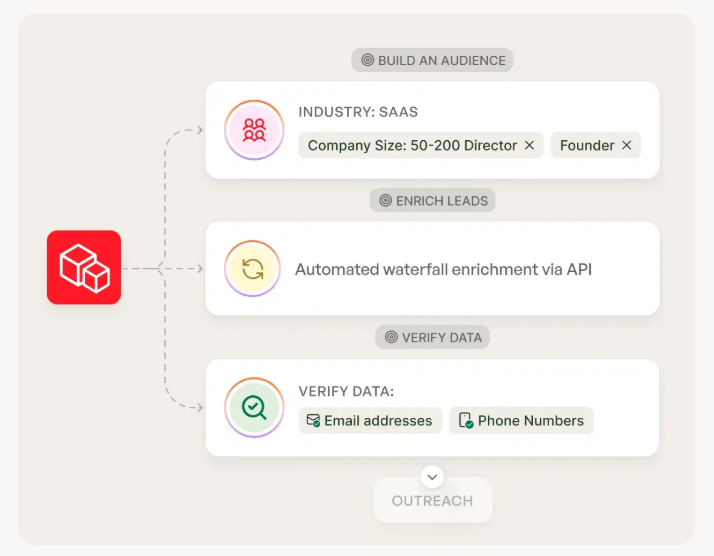
Routing fails when the system doesn't know who the person is, what account they're from, or how to reach them after the chat.
In our experience, this is usually an enrichment + verification problem, not a routing-logic problem: if half the emails bounce, your "speed-to-lead" is fake because you can't actually reach the lead you just qualified, and the rep's going to blame chat even though the real culprit is data hygiene.
Prospeo fits here as the data layer that keeps routing honest: it's the B2B data platform built for accuracy, with 300M+ professional profiles, 143M+ verified emails, 125M+ verified mobile numbers, 98% email accuracy, an 83% enrichment match rate, and a 7-day refresh cycle so the contact details you hand to sales are current when the buyer's still in the mood to talk.
I've run bake-offs where the "best" routing logic still lost because follow-up emails bounced and the first call went to a dead number. That kind of failure is infuriating because it looks like a rep problem, then a chat problem, then a "marketing and sales alignment" problem, when it's really just bad contact data.
Measurement for conversational marketing sales that doesn't lie (KPIs, attribution, and AI metric traps)
If you measure conversational like marketing, you'll optimize the wrong things.
KPI checklist (track weekly)
- Speed KPIs: median first response time, % within 2 minutes, after-hours coverage rate
- Funnel KPIs: conversation -> qualified rate, qualified -> meeting rate, disqual rate
- Revenue KPIs: meetings held, opps created, pipeline sourced, pipeline influenced, win rate of chat-sourced opps
- Ops KPIs: handoff rate to humans, misroute rate (reassigned owner), duplicate rate in CRM
The attribution model that keeps everyone honest
Pick one primary model and stick to it for 90 days:
- Sourced pipeline (strict): chat is "sourced" only if the meeting's booked in the conversation (or within a short window, like 24 hours, from the chat link).
- Influenced pipeline (fair): chat is "influenced" if the account had a conversation within X days before opp creation and the topic matches the opp use case.
My recommendation: run both, but comp your team on sourced. Influenced is for strategy; sourced is for behavior.
QA scorecard (so you improve, not just report)
Sample 10 conversations per rep/agent per week and score 0/1 on:
- Asked Profile -> Problem -> Person (at least 1 question in each)
- Correct route (right segment/territory)
- Next step secured (meeting booked or clear follow-up)
- Compliance met (AI disclosure/consent where required)
- Notes captured (why now + objections + stakeholders)
If you don't QA, you'll keep "optimizing playbooks" while the real issues are human: weak qualification, sloppy routing, and no next step.
AI metric traps (Intercom community pain is real)
Two failure modes show up repeatedly in Intercom community threads:
- Hallucinations: the agent confidently answers with something not grounded in your docs or policy. In sales, that becomes "yes we integrate" or "yes that feature exists," which is a trust-killer.
- "Assumed resolved" confusion: AI resolution metrics get weird when humans jump in early. That distorts reporting and can even change behavior ("don't intervene yet so the metric looks good"), which is backwards.
Treat AI metrics as operational signals, not success metrics. Your success metrics are pipeline outcomes and response time.
Look, if your dashboard can't answer "how many opportunities did chat create last week?" you don't have measurement. You've got vibes.
Governance & compliance checklist (EU AI Act, GDPR, TCPA, WhatsApp)
Conversational programs touch personal data, messaging rules, and now AI transparency laws. You need guardrails that are easy to follow on a random Tuesday.
Compliance checklist (practical)
EU AI Act (Article 50): bot disclosure
- Disclose that the user is interacting with AI when an AI agent's involved.
- Make it visible at the start of the conversation, not buried in a policy.
Sample disclosure script (works in chat and messaging): "Hi, I'm an AI assistant. I can help answer questions and route you to a specialist. If you'd rather talk to a person, type 'human' anytime."
GDPR basics
- Collect only what you need (data minimization).
- Have a DPA with vendors processing chat data.
- Define retention: how long transcripts are stored, who can access them, and how deletion requests are handled.
- Treat transcripts like customer data: role-based access, audit logs, and a deletion workflow.
TCPA (US SMS)
- Enforce quiet hours: 8am-9pm in the recipient's local time.
- Penalties are $500-$1,500 per violation.
- The quiet hours rule is in 47 C.F.R. 64.1200(c)(1).
- Require prior express written consent for marketing texts, include opt-out ("Reply STOP"), and keep records.
WhatsApp + consent
- Use the WhatsApp Business Platform (API) for compliant, scalable workflows.
- Get explicit consent for proactive messaging, and document it.
- Use an EU-friendly BSP and sign DPAs when needed.
WhatsApp pricing model (the part finance will ask about)
- Charges are per delivered message, not per sent message.
- Pricing varies by country and message category (marketing, utility, authentication, service).
- Service messages are free within the 24-hour service window after the user messages you (and some entry points can create additional free windows, depending on how the user starts the chat).
AI agent guardrails (enterprise-ready, not "prompt-and-pray")
If you deploy an AI agent in a revenue motion, these are non-negotiable:
- Grounding: answers must be limited to approved sources (docs, KB, pricing policy, security FAQ).
- No-evidence rule: if the agent can't cite an internal source, it must say "I don't know" and escalate.
- Restricted claims list: block or force escalation for pricing promises, security commitments, legal terms, and roadmap.
- Escalation triggers: "SOC 2," "DPA," "SLA," "procurement," "discount," "timeline," "integration," "data residency" -> human.
- Conversation logging: store transcripts with timestamps, agent version, and source references for auditability.
- Red-team testing: weekly tests for hallucinations, prompt injection, and policy bypass.
- Incident playbook: define who gets paged, how you correct the user, and how you prevent repeat failures.
- Change control: treat prompt/KB updates like releases (owner, review, rollback).
If you can't run those guardrails, don't run an AI agent in sales. Use AI for triage and routing only.
Tooling & pricing reality (what to buy for conversational sales in 2026)
Tool choice matters less than ops design, but pricing models change behavior. Seat-based tools push you to limit access. Per-resolution AI pricing pushes you to over-optimize deflection. Quote-based enterprise tools push you into longer implementations.
Also, "conversational" doesn't stop at the chat window. If your follow-up motion is weak, even the best chat experience won't convert, especially once you start layering in conversational email AI to keep context, personalize next steps, and reduce drop-off after the session ends.
Buying calls (non-negotiables)
- Enterprise ABM + Salesforce-heavy routing: buy Qualified. It's built for control, governance, and account-based routing at scale.
- Support + sales in one inbox: buy Intercom. It's a strong single system when lifecycle conversations matter.
- Your only goal is meetings from high-intent pages: buy Drift + Chili Piper and stop overcomplicating it.
- If your biggest issue is "we can't reach people after chat": fix data first. Tools don't save you from bounces.
Conversational tooling pricing snapshot (2026)
| Tool | Best for | Pricing signal | G2 signal (where available) |
|---|---|---|---|
| Drift | B2B chat -> meeting on high-intent pages | $2,500/mo+ (often $30k-$120k/yr) | 4.4/5 (1,256) |
| Intercom | Support + sales hybrid inbox | $29-$132/seat/mo (billed annually) + $0.99/Fin resolution | Not listed here |
| Qualified | Enterprise routing + AI SDR governance | Commonly $2k-$8k/mo (quote-based) | 4.9/5 (1,426) |
| Chili Piper | Instant scheduling + routing | $25-$60/user/mo (often $10k-$50k/yr) | Not listed here |
| WhatsApp Business Platform | Messaging channel | ~$0.005-$0.09 per delivered msg (country/category dependent) | Not listed here |
Outbound links worth using while you evaluate:
- Drift benchmarks: Salesloft's Conversational AI Marketing Trends Report
- Intercom cost model: Intercom pricing page
- Qualified packaging: Qualified pricing page
- WhatsApp economics: WhatsApp Business Platform pricing

Drift (Tier 1)
Buy it if: your north star's meetings from pricing/security/integration traffic. Why it wins: the playbook model plus the SLA benchmarks push you to run chat like a revenue channel. Watch-outs: if you won't staff coverage or offer instant scheduling, you'll pay premium dollars to collect transcripts. Pricing: $2,500/month+; most serious B2B deployments land $30k-$120k/year.
Intercom (Tier 1)
Intercom is pricing-model-first, whether you like it or not.
What you're really buying: a shared inbox + automation where cost scales with seats and Fin resolutions. Where teams get burned: they start optimizing "resolution" instead of pipeline, and they tolerate AI answers that should've escalated. Buy it if: you need one place where support, onboarding, and sales can hand off context cleanly. Pricing: $29-$132/seat/month (annual) plus $0.99 per Fin resolution; $500-$5,000/month for small teams and $20k-$150k/year once you scale seats, channels, and AI volume.
Qualified (Tier 1)
Qualified is governance-first.
Why it wins: enterprise routing accuracy, account segmentation, and the control surface you need when multiple teams touch the same buyer. Best fit: ABM-heavy orgs that care about who gets routed and why, with auditability. Pricing: quote-based; $2,000-$8,000/month is a realistic range for B2B teams, and $50k-$200k/year when you scale sites, routing complexity, and AI SDR volume.
Prospeo (Tier 1 for follow-up accuracy)
If you're serious about conversational marketing sales, you can't treat "contactability" as an afterthought. The fastest SLA in the world doesn't matter if the email's wrong, the mobile number's missing, or the record's stale by the time the rep follows up.
Prospeo is the B2B data platform built for accuracy, and it's built for this exact gap between "we had a great chat" and "we actually reached them": 98% verified email accuracy, 125M+ verified mobile numbers with a 30% pickup rate, 92% API match rate, and enrichment that returns 50+ data points per contact, refreshed every 7 days. It also tracks 15,000 intent topics (powered by Bombora), which is useful for routing and for writing the first follow-up that doesn't sound like it came from a template.
Chili Piper (Tier 2)
Chili Piper is the scheduling engine that stops intent from decaying.
Use it when: your chat ends in "book now" and you need routing, round-robin, and fast scheduling that doesn't drop mobile users. Pricing: $25-$60 per user/month; $10k-$50k/year for larger teams with routing rules and integrations.
WhatsApp Business Platform (Tier 2)
WhatsApp belongs in your motion when buyers actually want to message you there: international markets, high-velocity inbound, and post-demo follow-up where email's dead.
Rule: if you don't have consent and templates sorted, don't launch. Pricing: roughly $0.005-$0.09 per delivered message depending on country and category; marketing categories cost more.
Stack connectors (Tier 3)
- Zapier / Make / n8n: glue for routing and alerts (chat -> Slack -> CRM). $20-$100/month for light use; $200-$800/month when you scale volume.
- Salesforce: system of record for ownership and pipeline attribution. $25-$330/user/month depending on edition.
- HubSpot: strong SMB all-in-one (CRM + chat + lifecycle). $0-$3,600+/month depending on hubs, contacts, and seats.
- Salesloft / Outreach: sequences and calling for chat-sourced leads. $120-$220/user/month.
- Gong: QA for meetings and coaching loops. $100-$160/user/month plus platform fees in larger deals.
If you want enrichment and routing to stay clean across your stack, start with integrations that don't require duct tape. Prospeo's native and workflow integrations are here: https://prospeo.io/integrations.
One more ops note: if you're layering sequences on top of chat, treat it like sales engagement in practice. Your routing, timing, and message relevance improve only if you feed back outcomes (bounces, replies, meetings held, opp creation) into the system.
You just read that 39% of conversations happen after hours. When your bot qualifies a lead at midnight, the follow-up data needs to be flawless. Prospeo refreshes every 7 days - not 6 weeks - so your enrichment and routing rules always hit real inboxes and live phone numbers.
Real-time conversations deserve real-time data. Start at $0.01 per email.
FAQ
What's the difference between conversational marketing and conversational sales?
Conversational marketing is the strategy to engage and qualify buyers via real-time chat or messaging, while conversational sales is the execution layer that routes, books meetings, and progresses deals. Marketing owns demand capture and experience; sales owns qualification rigor, SLA coverage, and pipeline outcomes.
What response-time SLA should sales teams use for website chat?
Use a human response within 2 minutes for high-intent conversations. The Salesloft-hosted Drift report analyzing 30M+ conversations shows meeting outcomes are best under that threshold and drop sharply after 5-10 minutes. If you can't staff it, route to instant scheduling or callback workflows so intent doesn't decay.
Should you run a bot-only conversational program?
No. Bot-only programs convert worse and break trust when they can't handle nuance, objections, or edge-case routing. Use AI for triage and qualification, then escalate aggressively on high-intent pages and buying questions.
How do you stay compliant with AI disclosure, SMS, and WhatsApp rules?
Disclose AI interactions up front (EU AI Act Article 50), minimize and govern transcript retention under GDPR, and enforce TCPA consent plus quiet hours (8am-9pm local time; 47 C.F.R. 64.1200(c)(1)) with $500-$1,500 penalties per violation. For WhatsApp, use the Business Platform, capture explicit consent, and understand per-delivered-message category pricing with a free 24-hour service window (plus additional free windows depending on entry point).
Summary: make conversational marketing sales a pipeline machine
Conversational marketing sales works when it's owned like a revenue channel: a 2-minute SLA (or instant scheduling), tight qualification, routing you can explain, and follow-up that actually lands.
Get the ops right, measure meetings and pipeline (not "engagement"), and keep enrichment clean so the lead you just qualified is reachable five minutes later.