

Customer Acquisition and Retention Strategy for 2026
Brands now lose $29 for every new customer acquired - up from $9 in 2013. CAC has climbed 220%+ over the last eight years, and a Gartner survey of 243 CSOs and senior sales leaders found 73% prioritizing growth from existing customers heading into 2026. We've watched this play out across hundreds of outbound teams: acquisition and retention aren't two strategies. They're one customer acquisition and retention strategy, and most companies are running it with the pieces completely disconnected.
The Short Version
- Know your industry's CAC and retention benchmarks. You can't optimize what you haven't baselined.
- Track LTV:CAC as your north-star metric. Below 3:1 means you're overspending on acquisition or leaking customers too fast. Probably both.
- Fix your prospect data quality before scaling spend. Bad data doesn't just inflate CAC - it poisons onboarding and creates downstream churn.
What Acquisition and Retention Actually Cost
These CAC benchmarks from FirstPageSage break down organic vs. paid - a split most guides ignore:
| Industry | Organic CAC | Paid CAC | Combined |
|---|---|---|---|
| B2B SaaS | ~$205 | ~$341 | ~$273 |
| E-commerce | ~$87 | ~$81 | ~$84 |
| Legal Services | ~$584 | ~$1,245 | ~$915 |
| Financial Svcs | ~$644 | ~$1,202 | ~$923 |
| Higher Ed | ~$862 | ~$1,985 | ~$1,423 |
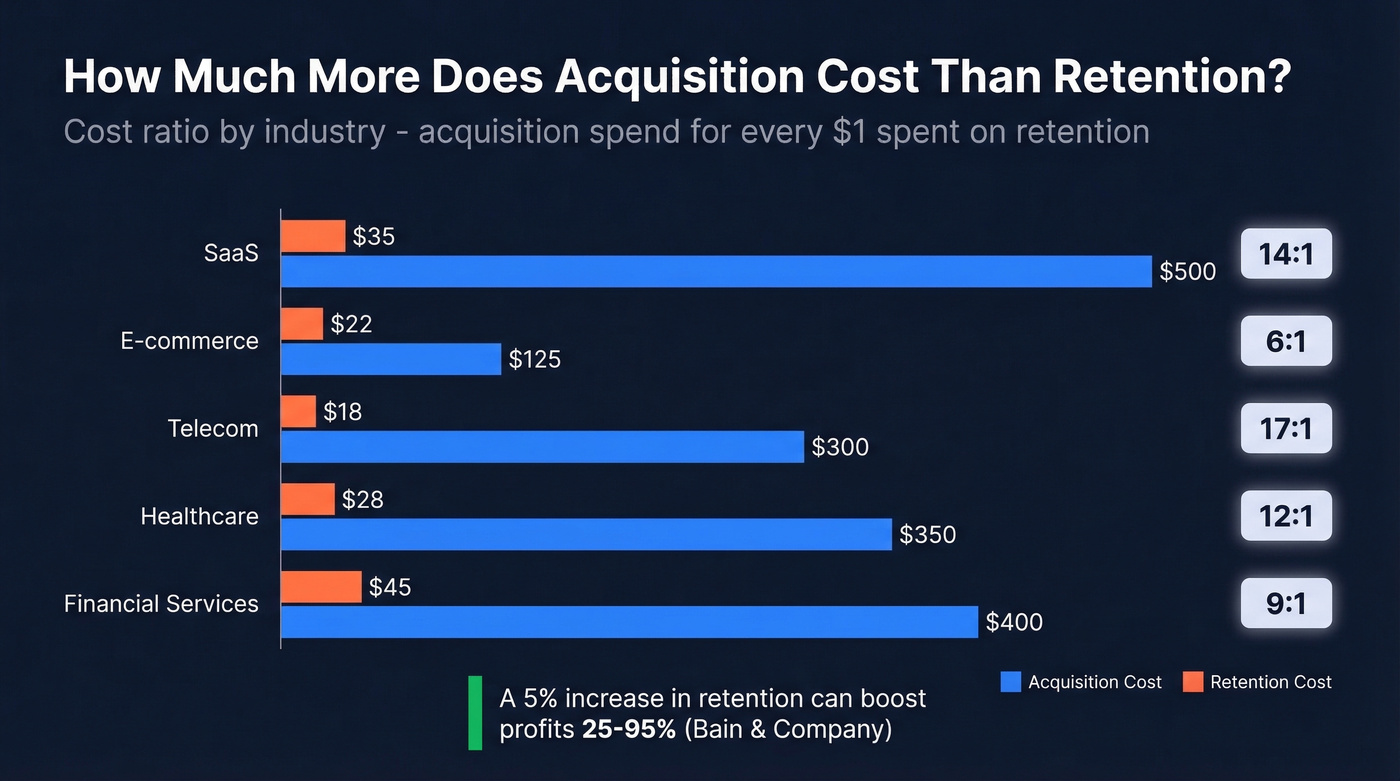
Now compare those numbers to what it costs to keep a customer:
| Industry | Acquisition | Retention | Ratio |
|---|---|---|---|
| SaaS | $500 | $35 | 14:1 |
| E-commerce | $125 | $22 | 6:1 |
| Telecom | $300 | $18 | 17:1 |
| Healthcare | $350 | $28 | 12:1 |
| Financial Svcs | $400 | $45 | 9:1 |
The 5-25x cost gap between acquiring and keeping customers is structural across every industry. Telecom's 17:1 ratio alone should change how you allocate budget. And Bain & Company research found that a 5% increase in retention rates can boost profits by 25-95%. That's not a rounding error - it's the strongest argument for rebalancing spend toward your existing base.
The Metric That Connects Everything
LTV:CAC is the single ratio that tells you whether your economics work. Here's the formula:
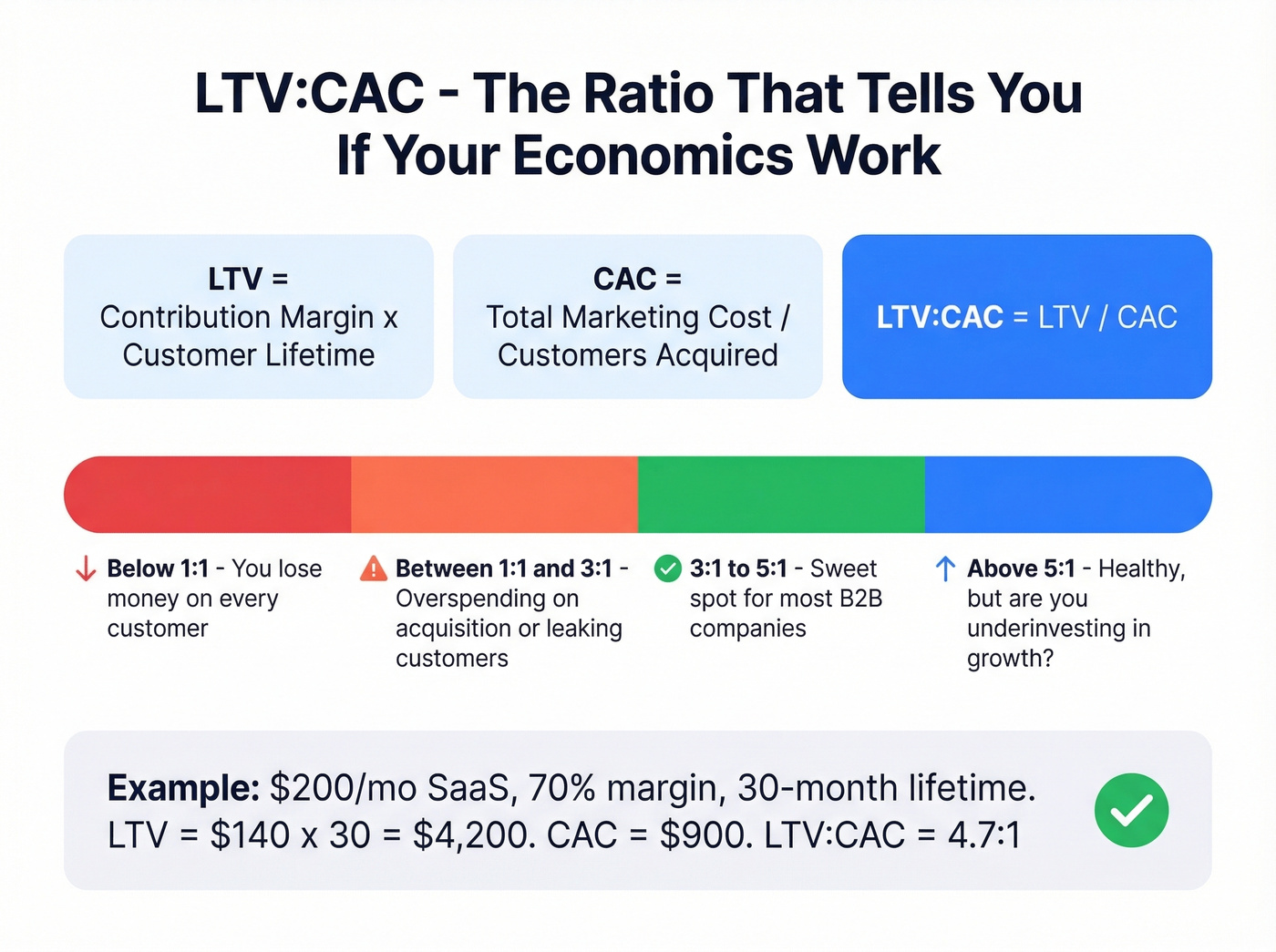
LTV = contribution margin x customer lifetime CAC = total marketing cost / customers acquired LTV:CAC = LTV / CAC
Let's run a quick example. A SaaS company charges $200/month with 70% gross margin and an average customer lifetime of 30 months. LTV = $140 x 30 = $4,200. If CAC is $900, LTV:CAC = 4.7:1 - healthy. Below 3:1, you're in trouble. Below 1:1, you're subsidizing every customer who signs up.
Here's the thing: if your average deal size sits below $10K, you almost certainly don't need a $30K/year data platform to hit a 3:1 ratio. You need accurate data at the right price point. Prospeo delivers verified emails at ~$0.01 each vs. $1 per lead on enterprise platforms - a difference that directly moves the LTV:CAC needle. If you're pressure-testing your acquisition math, start with your cost to acquire customer baseline.

Every dollar you waste on bad data inflates your CAC and starves your retention budget. Prospeo delivers verified emails at ~$0.01 each with 98% accuracy - compared to $1/lead on enterprise platforms. That's a direct improvement to your LTV:CAC ratio without touching your pricing or churn rate.
Fix your unit economics at the source - start with better data.
What Good Retention Looks Like
A FirstPageSage study covering 10,214 firms gives us the clearest retention benchmarks available:
| Industry | Retention Rate |
|---|---|
| Commercial Insurance | 86% |
| B2B SaaS | 74% |
| Financial Services | 74% |
| eCommerce | 62% |
| Hotels & Hospitality | 55% |
26% of consumers leave after a single bad interaction, and customers with positive past experiences spend 140% more than those with poor ones. That stat alone should reframe how you think about post-sale investment. To quantify the leak, run a simple churn analysis alongside your retention rate.
Retention isn't a loyalty program. It's the cumulative quality of every touchpoint after the sale. Amazon Prime proves this at scale: the program costs Amazon billions, but it materially increases purchase frequency and basket size. When the experience is good enough, retention becomes acquisition through referrals - and that's the cheapest pipeline you'll ever build. If you need a clean definition and benchmarks, start with what is churn.
Building a Lifecycle Framework
Stop thinking in terms of "acquisition team" and "retention team." Think in stages:
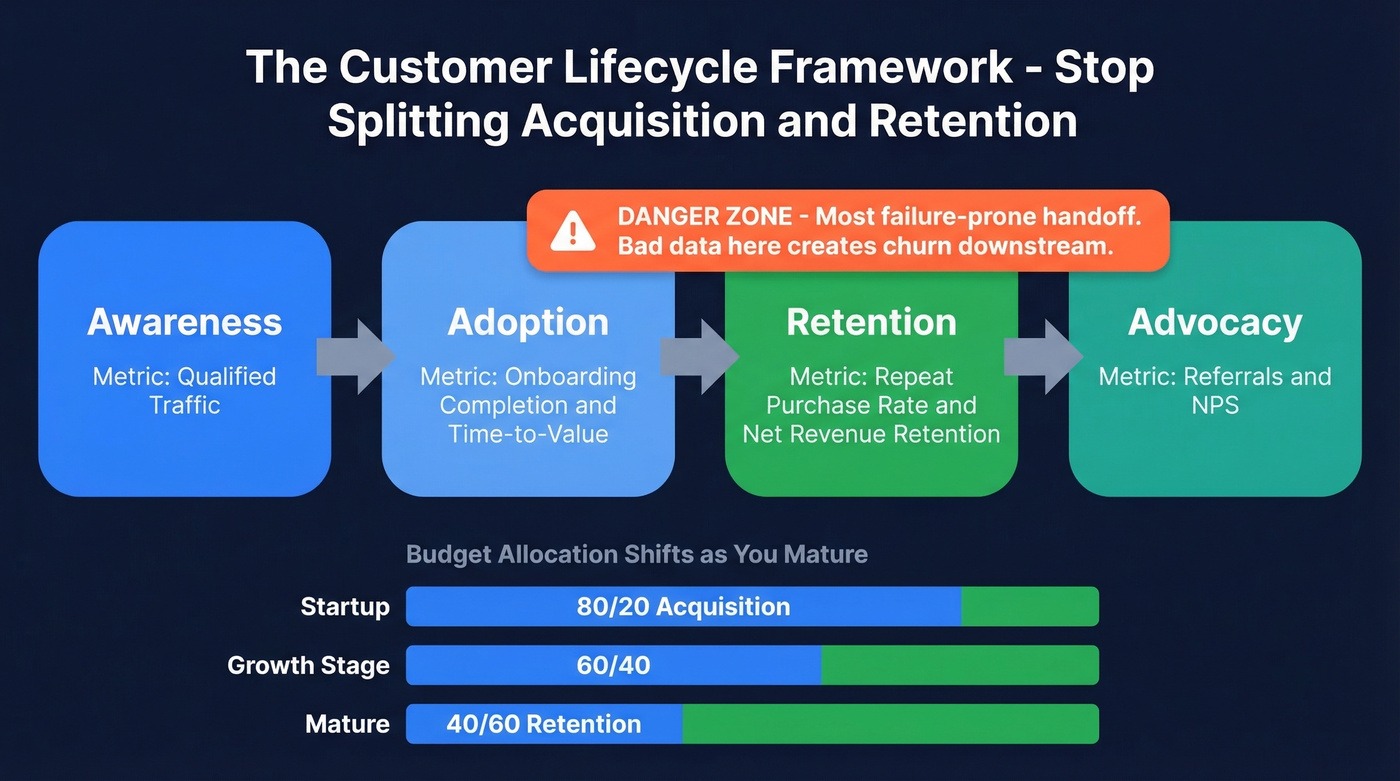
Awareness -> Adoption -> Retention -> Advocacy
Each stage has its own metric. Awareness tracks qualified traffic. Adoption measures onboarding completion and time-to-value. Retention watches repeat purchase rate and net revenue retention. Advocacy captures referrals and NPS. If you want a tighter measurement layer, map these to your funnel metrics.
The most failure-prone transition is adoption to retention - where bad acquisition data creates a broken handoff that no amount of CS effort can fix. If your SDRs are enrolling the wrong contacts because the data was stale, onboarding emails bounce, and customers who do convert start with a sour impression before they've even logged in. This is also where lead enrichment and data enrichment services pay for themselves.
Budget allocation shifts as your company matures. Startups typically run 80/20 toward acquisition. Growth-stage companies move to 60/40. Mature businesses flip it: 40/60 favoring retention and expansion. This is a perennial debate on r/SaaS and r/ecommerce - acquisition vs. retention - and the answer isn't either/or. It's fixing the handoff between them. In our experience, teams that keep pouring 80% into acquisition at scale don't have a growth problem. They have an allocation problem, and they blame churn instead. If you're building the outbound side, align this with your go-to-market strategy.
Retention Mistakes That Inflate CAC
Think of your customer base as a bucket. Acquisition fills it. Churn is the leak. Here are the five holes we see most often:
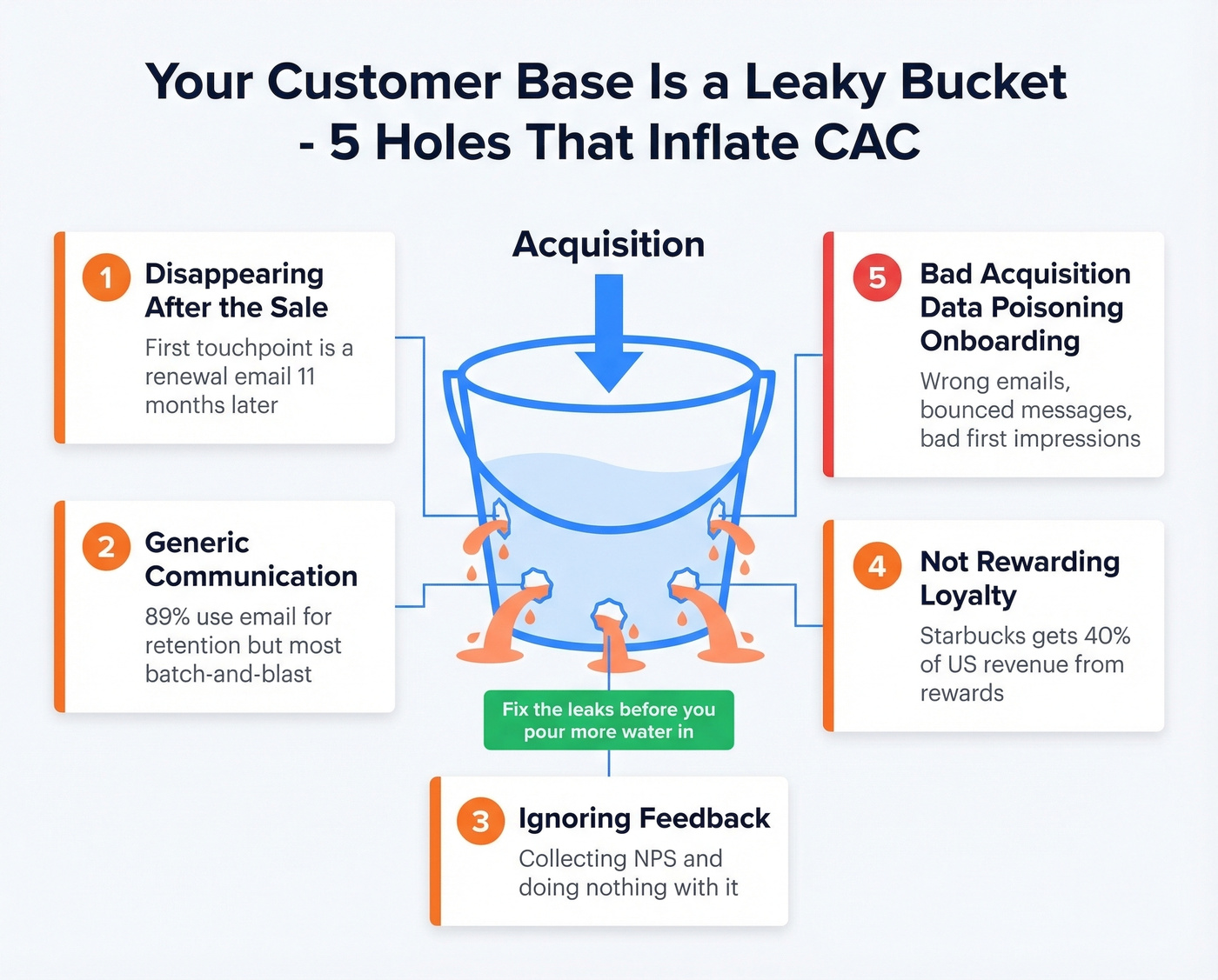
1. Disappearing after the sale. If your first post-sale touchpoint is a renewal email 11 months later, you've already lost. That silence tells the customer they only mattered during the buying process. A structured QBR cadence helps; start with QBR questions to ask.
2. Generic communication. Email remains the top retention channel - 89% of businesses use it - which makes batch-and-blast messages even more damaging. Segment by usage, industry, and lifecycle stage. The bar isn't high; most companies just don't clear it. If your team needs a system for the post-demo and post-onboarding touches, use these sales follow-up templates.
3. Ignoring feedback. Collecting NPS scores and doing nothing with them is worse than not asking. Customers notice when their input vanishes into a spreadsheet.
4. Not rewarding loyalty. Starbucks generates roughly 40% of U.S. revenue through its rewards program. Your program doesn't need to be complex - it needs to exist.
5. Bad acquisition data poisoning onboarding. This one's underrated. Dirty prospect data - wrong emails, outdated titles, bad phone numbers - doesn't just inflate CAC. It creates a cascade: wrong contacts get enrolled, onboarding emails bounce, and the customers who do convert start with a bad impression. Snyk saw this firsthand. Their bounce rate sat at 35-40% before switching to Prospeo's email finder, which dropped it under 5%. AE-sourced pipeline jumped 180%, generating 200+ new opportunities per month. At 98% email accuracy with a 7-day data refresh cycle, that's the kind of data quality enterprise platforms charging $15-40K/year still struggle to match. If you're troubleshooting bounces specifically, benchmark against email bounce rate.
Bad prospect data doesn't just inflate acquisition costs - it poisons onboarding and accelerates churn. Snyk cut their bounce rate from 35-40% to under 5% with Prospeo and saw AE-sourced pipeline jump 180%. With a 7-day data refresh cycle, your contacts stay current while competitors work with 6-week-old records.
Stop letting stale data sabotage your acquisition-to-retention handoff.
FAQ
What's a good LTV:CAC ratio?
3:1 or higher - you're earning three dollars for every dollar spent acquiring a customer. Between 3:1 and 5:1 is the sweet spot for most B2B companies. Below 1:1, you lose money on every acquisition and need to cut CAC or improve retention immediately.
How do you calculate customer retention rate?
((Customers at end of period - new customers acquired) / customers at start) x 100. Starting with 200, gaining 40, ending with 210 gives you 85% retention. Track this monthly and quarterly to spot trends before they become churn crises.
How does data quality affect acquisition cost?
Bounced emails, wasted SDR hours, and damaged sender reputation all inflate CAC directly. Teams using verified data with 98% accuracy typically see bounce rates drop below 5%, which means more budget goes toward conversations instead of waste.
Should startups prioritize acquisition or retention?
Early-stage companies should allocate roughly 80% toward acquisition to build a customer base, then shift to 60/40 by growth stage. But even at day one, a basic customer acquisition and retention strategy matters - acquiring customers you immediately lose is just expensive churn. Skip retention entirely and you're filling a bucket with no bottom.