

Customer Follow-Up Email Templates for Every Stage
A CS manager stares at a blank compose window for the third time this week. The customer onboarded six weeks ago, hasn't logged in since day four, and the renewal is in 90 days. Every customer follow up email template she finds online is about cold prospecting - "just following up on my last email!" - which is useless when you already have the customer's money and need to keep it.
That's the gap we're filling here. A follow-up after a demo is a completely different animal than a follow-up after a failed onboarding, a missing invoice, or a renewal conversation. Below you'll find 20+ templates organized by where the customer actually is in the relationship - sales, onboarding, success, and service - backed by data from millions of analyzed emails.
Three Things You Can Act on Right Now
Before you scroll through templates, three quick wins.
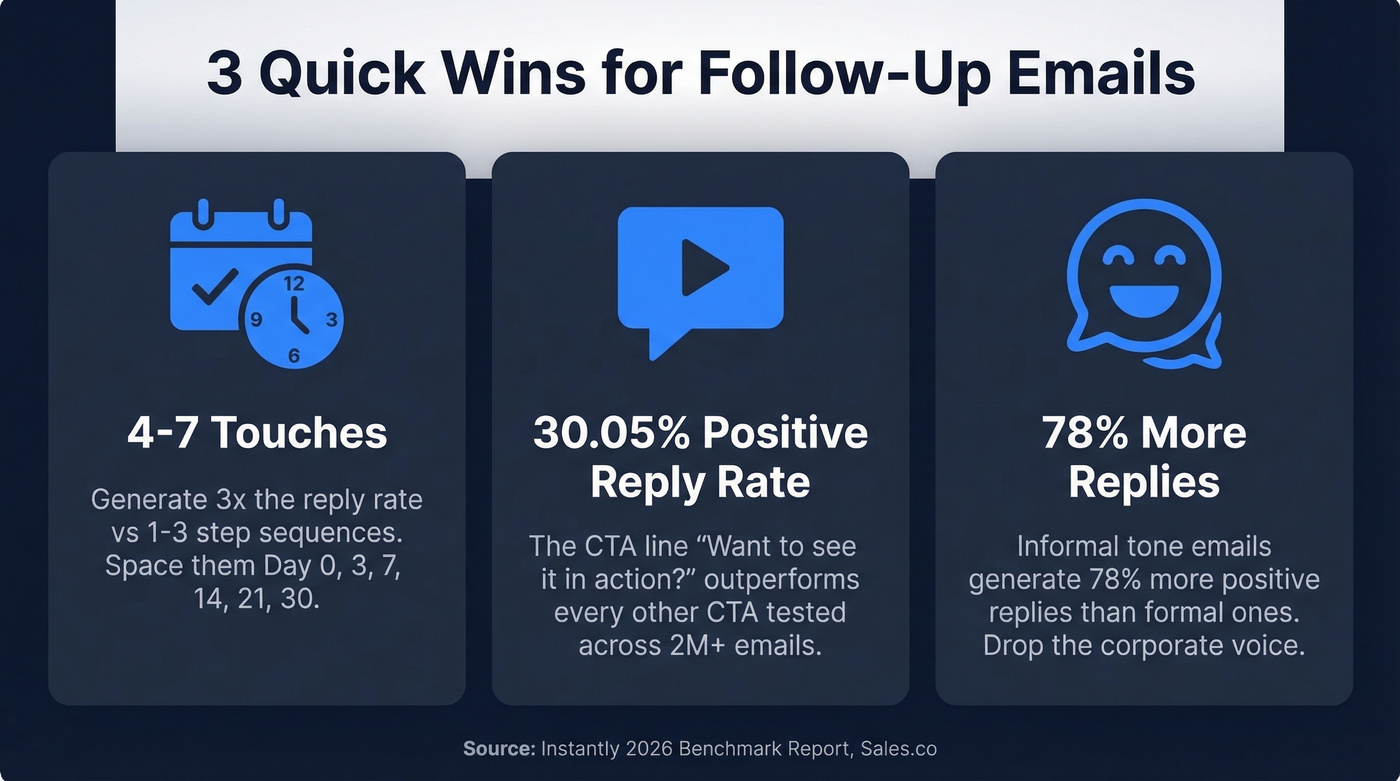
Cadence - Day 0, Day 3, Day 7, Day 14, Day 21, Day 30. This spacing, based on Instantly's benchmark data, balances persistence with patience. Four-to-seven touchpoints generate 3x the reply rate of one-to-three step sequences.
The single best CTA line - "Want to see it in action?" drives a 30.05% positive reply rate, the highest of any CTA tested across 2M+ emails. That's not a typo.
Tone - Informal emails generate 78% more positive replies than formal ones. Drop the corporate voice.
Why Follow-Ups Matter
Here's the thing: your first email does most of the heavy lifting, but it doesn't do all of it. Instantly's 2026 benchmark report found an average reply rate of 3.43%, with 58% of replies coming from the first touch and 42% from follow-ups. That 42% is pipeline you leave on the table if you send one email and quit.
Sales.co's dataset of 2M+ emails adds a sobering layer: only 14.1% of replies are actually positive. Roughly 1 in 157 contacts you email will express genuine interest. Every follow-up that nudges that number up is worth writing well.
Returns diminish if each touch doesn't add new value. That's why having a reliable customer follow up email template for each stage matters - it ensures every touch earns its place instead of just cluttering someone's inbox.
Subject Lines That Get Opened
A Belkins study of 5.5 million emails gives us hard numbers. Personalized subject lines hit a 46% open rate versus 35% without, and reply rates jumped from 3% to 7%.
If you want more options to swipe, pull from these subject lines and adapt them to your stage.
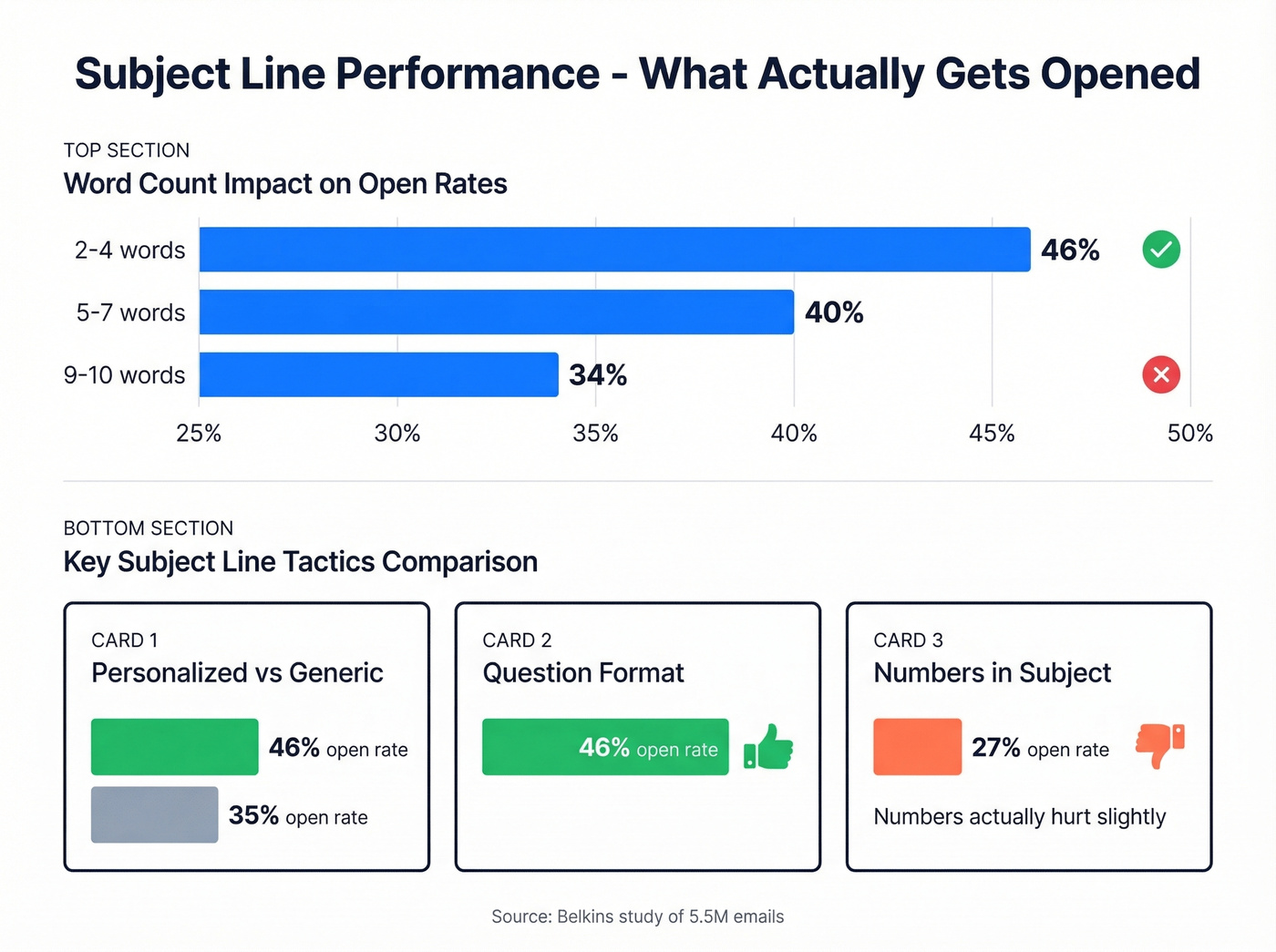
The sweet spot is 2-4 words. Performance drops noticeably past seven words, falling to around 34-35% at nine or ten words. Question-format subject lines topped the charts at 46% open rate, while numbers in subject lines actually hurt slightly - 27% versus 28% without.
Keep them short. "Quick question" beats "Following up on our conversation about your Q3 marketing budget." Personalize with a name, company, or specific detail. And for replies in the same thread, your subject line is already set - don't overthink it.
The Exact Follow-Up Cadence
| Step | Day | Purpose |
|---|---|---|
| Email 1 | Day 0 | Initial outreach |
| Email 2 | Day 3 | Add new angle |
| Email 3 | Day 7 | Social proof |
| Email 4 | Day 14 | Address objection |
| Email 5 | Day 21 | New value hook |
| Email 6 | Day 30 | Breakup email |
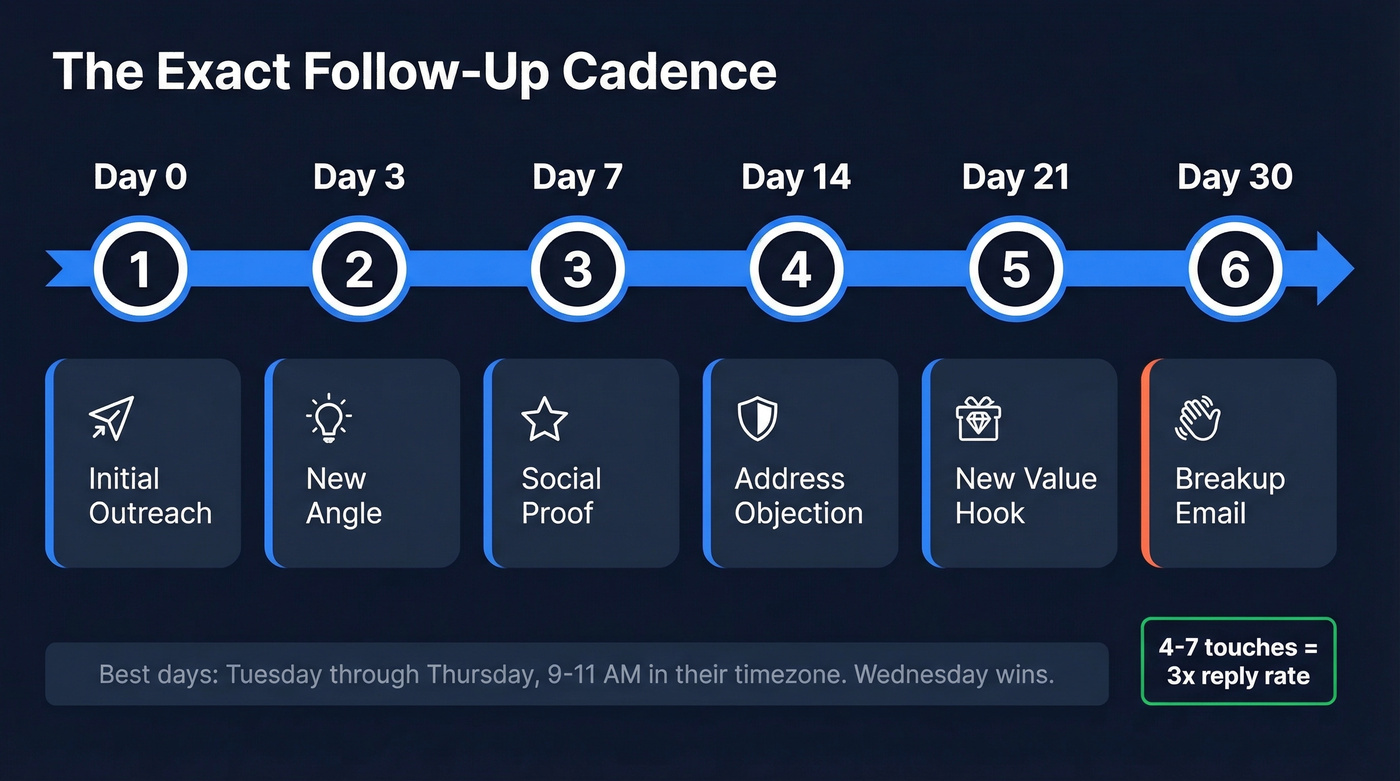
Send Tuesday through Thursday, 9-11 AM in the recipient's timezone. Wednesday consistently shows the highest reply rates.
Sybill recommends a compressed 8-touch, 12-day plan mixing email, calls, and social touches for high-value accounts. The principle: timing to a trigger beats timing to a calendar day. For enterprise deals, a 60-second screen recording is a strong alternative to plain text.

Before Day 0: Verify Your List
None of this matters if your emails bounce. A bounce rate above 1% tanks your sender reputation and kills deliverability for every email that follows. Prospeo's 5-step verification process handles catch-all domains, spam traps, and honeypot filtering to deliver 98% email accuracy. When Meritt switched, their bounce rate dropped from 35% to under 4%. Verify before you send - it's the step most teams skip and the one that costs them the most.
If you’re troubleshooting bounces and inboxing, start with this email deliverability breakdown and the benchmarks in email bounce rate.

Every template above assumes one thing: your email actually lands. A bounce rate above 1% tanks your sender reputation and kills the entire sequence. Prospeo's 5-step verification delivers 98% email accuracy with catch-all handling, spam-trap removal, and honeypot filtering - so your follow-ups reach real inboxes, not dead ends.
Verify your list before Day 0. Start free at $0.01 per email.
Sales Follow-Up Templates
After a Meeting or Demo
You had a great conversation. Lock in the next step within 24 hours, while the energy is still fresh.
If you want more stage-specific options, use these sales follow-up templates as a swipe file.
Subject: Next steps from [day]'s call
Hi [Name],
Great talking through [specific pain point discussed]. As promised, here's [resource/recording/proposal link].
Two things stood out: [pain point 1] and [pain point 2]. I've mapped out how we'd tackle both - want to walk through it on [specific day]?
[Your name]
After Sending a Quote
The #1 fear on r/sales about post-quote follow-ups? Sounding desperate. The classic "Hey, just following up - did you receive our quote?" screams neediness. Instead, anchor to a scheduling constraint.
Subject: Timing for [project/initiative]
Hi [Name],
I'm locking in my implementation calendar for [month]. If you want to hit [their stated deadline], we'd need to kick off by [date].
Any questions on the proposal, or should I pencil you in?
[Your name]
This works because it shifts the frame from "please respond" to "I'm managing my availability." The prospect feels urgency without pressure.
No-Response Sequence
Each follow-up must add something new. "Bumping this to the top of your inbox" is the fastest way to get archived. Here's a three-touch sequence where every email earns its place.
For more on building multi-touch sequences that don’t burn your list, see sequence management.
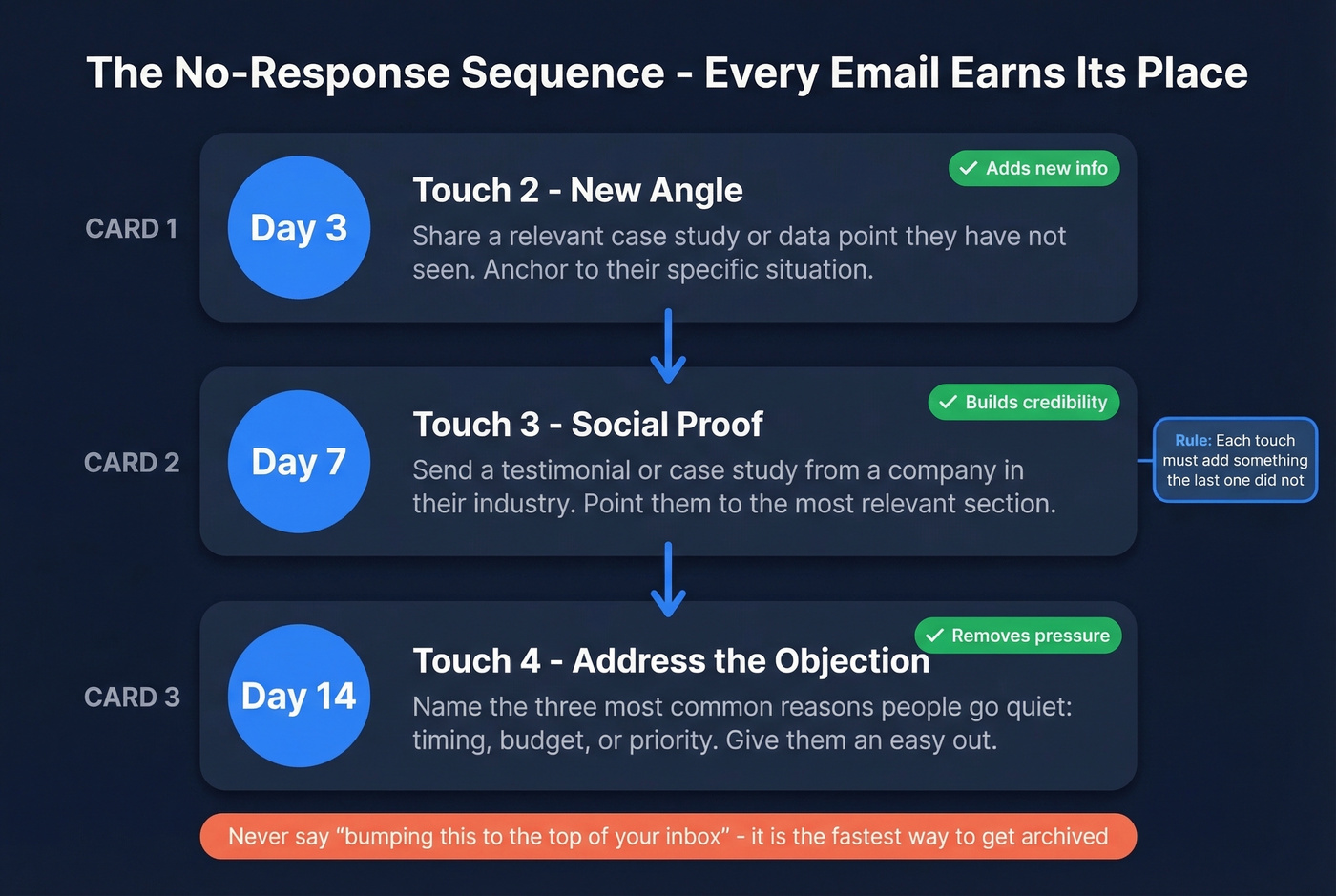
Touch 2 (Day 3) - New angle:
Subject: Re: [original subject]
[Name], one thing I didn't mention - [Company similar to theirs] cut [metric] by [number] using this approach. Thought it might be relevant given [their specific situation].
Worth a 15-minute look?
Touch 3 (Day 7) - Social proof:
Quick one - here's a [case study/testimonial] from [relevant company in their industry]. The results section on page 2 is the interesting part.
Touch 4 (Day 14) - Address the objection:
[Name], when people go quiet at this stage, it's usually one of three things: timing's off, budget's tight, or it's not a priority right now. Any of those ring true? Happy to revisit in [timeframe] if that's better.
Trigger-Event Follow-Up
Subject: Congrats on the [funding round/new role/expansion]
Hi [Name],
Saw the news about [specific event]. That usually means [relevant challenge that comes with the event] - which is exactly what we help with at [Company].
Want to see how [similar company] handled it?
For content-download triggers, swap the opener: "Noticed you grabbed our [guide name] - most people who download that are wrestling with [specific problem]. Worth a quick chat?"
If you’re building a system around these moments, this guide on how to track sales triggers is the operational playbook.
Breakup Email
Subject: Should I close your file?
[Name], I've reached out a few times and haven't heard back - totally fine. I'll assume the timing isn't right and close this out on my end.
If things change, just reply to this thread. I'll be here.
Breakup emails often pull replies because they remove pressure. The consensus on r/sales is that this format outperforms every "one last try" variation.
Customer Success Follow-Up Templates
Onboarding emails hit open rates up to 83% with 3x higher engagement than standard marketing emails - yet most follow-up guides skip post-sale entirely. Customers who hit their first value milestone in the opening days retain at significantly higher rates. These templates are designed to accelerate that "time to first value."
If you’re tying these touches to retention outcomes, map them to your renewal rate targets and your churn analysis.
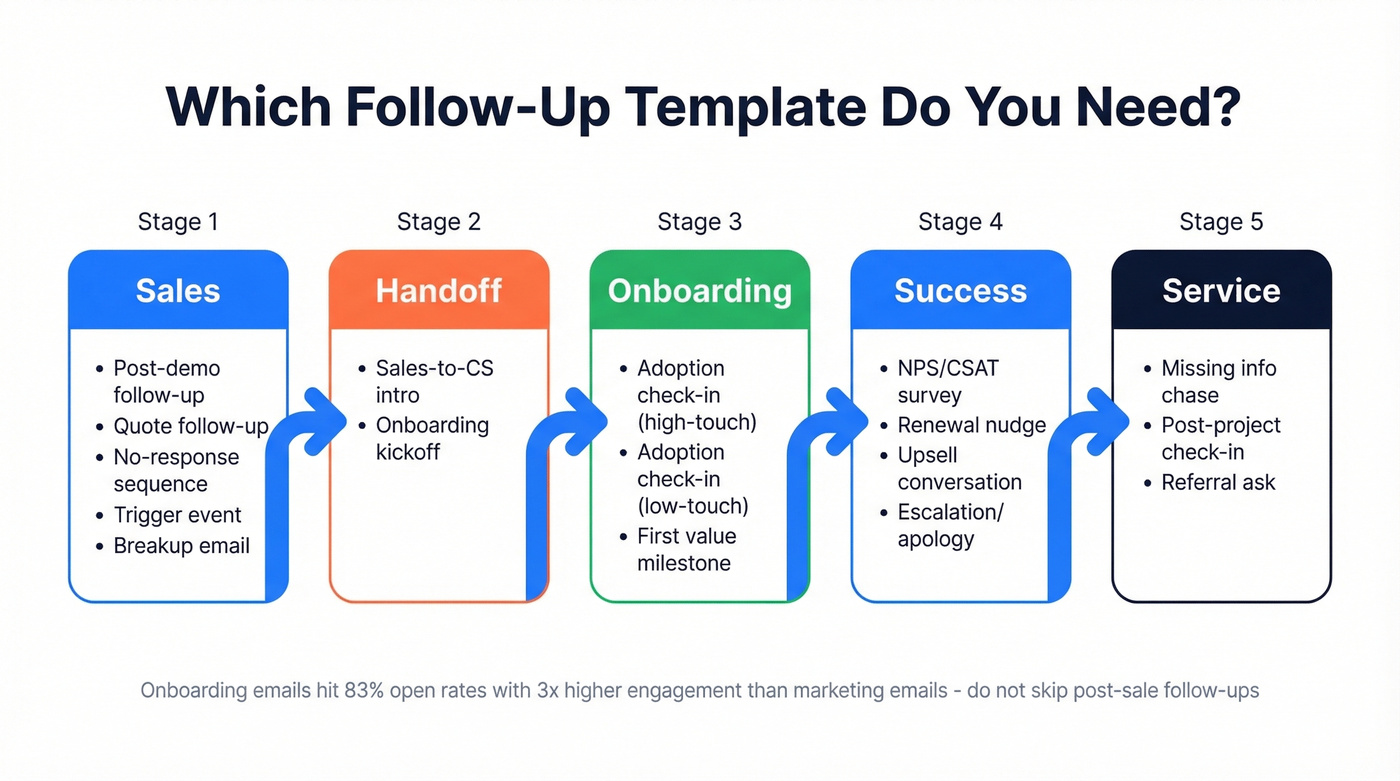
Sales-to-CS Handoff
Subject: Welcome aboard - meet your success team
Hi [Name],
I'm [CSM Name], your customer success manager. [Sales rep] filled me in on your goals: [goal 1] and [goal 2].
I've set up your onboarding plan [link]. Let's kick things off - does [day/time] work for a 30-minute walkthrough?
Looking forward to it.
If you need a few variations for different deal types, use these handoff examples.
Adoption Check-In
High-touch (usage-based):
Hi [Name],
I noticed your team hasn't logged into [Product] since [date]. Totally normal during busy weeks - but I want to make sure nothing's blocking you.
Want to hop on a quick call? I can walk through [specific feature they haven't used] - it's usually the thing that clicks for teams like yours.
Low-touch (resource-based):
Hi [Name],
Quick check-in: is [Product] meeting your needs so far? Here are two resources that might help:
- [Setup guide link]
- [Best practices video link]
Reply if anything's unclear - happy to help.
Skip the high-touch version for customers on self-serve plans. It'll feel intrusive. The low-touch template is better when you don't have a dedicated CSM assigned.
NPS / CSAT Survey Request
Subject: 30-second favor?
Hi [Name],
We're working on making [Product] better for teams like yours. Would you take 30 seconds to rate your experience? [Survey link]
Your feedback directly shapes our roadmap. Thanks in advance.
Escalation / Apology
Subject: Update on your [issue type]
Hi [Name],
I understand how frustrating [specific issue] has been - it's not the experience you should be having. Here's where we are:
What happened: [brief explanation] What we've done: [action taken] What's next: [resolution timeline]
I'll send another update by [date]. If you need anything before then, reply here - I'm on it.
Renewal / Upsell Nudge
Subject: Your renewal is coming up
Hi [Name],
Your [Product] renewal is on [date]. Before we process it, I wanted to flag something: your team's usage of [feature] has grown [X]% since onboarding. Teams at your stage usually benefit from [higher tier/add-on] - want me to model what that looks like?
Either way, happy to jump on a call to review.
Service Business Follow-Up Templates
Chasing Clients for Missing Info
The r/Accounting crowd nailed this pain point: clients who take six months to send one document, and follow-ups that feel "too polite, doormat-ish." The fix is adding a consequence without burning the relationship.
Subject: Need [document] by [date] to stay on schedule
Hi [Name],
We're still waiting on [specific item]. Without it by [date], we won't be able to [complete filing/deliver project/meet deadline] - which pushes your [outcome] to [later date].
Can you send it over this week? If someone else on your team has it, feel free to loop them in.
Name the consequence. "We can't file without this" is always stronger than "just checking in on that document."
Post-Project Check-In + Referral Ask
The best time to ask for a referral is immediately after a successful engagement. Don't wait three months - the goodwill fades faster than you think.
Subject: How's everything holding up?
Hi [Name],
It's been [timeframe] since we wrapped [project]. How's everything working? Any issues I should know about?
Also - if you know anyone dealing with [similar challenge], I'd appreciate an introduction. No pressure at all.
Set a quarterly cadence for past clients. A simple "thinking of you, here's something useful" email keeps you top of mind without being pushy.
Re-Engagement with Past Clients
Subject: It's been a while, [Name]
Hi [Name],
We haven't connected since [project/timeframe]. I wanted to share [relevant update, seasonal prompt, or industry insight] - thought it might be useful for you.
If [original service] is on your radar again, I'd love to catch up. Coffee's on me.
Mistakes That Kill Reply Rates
Look, if your deal size is under five figures, you probably don't need a seven-step sequence. Three well-timed, well-written emails will outperform seven lazy ones every time. The problem is never "not enough follow-ups." It's follow-ups that don't earn their place.
"Bumping this" with no new info. Every follow-up needs to add something - a case study, a new angle, a relevant stat. "Just making sure you saw this" is a delete trigger.
Ignoring the real objection. There are five reasons people don't reply: no need, cost concerns, no urgency, don't want it, or don't trust you. Your follow-up sequence should address different buckets, not repeat the same pitch louder. (If you want a framework for this, use how to add value in sales.)
Emails that look mass-sent. HTML templates, banner images, and "Dear Valued Customer" formatting scream automation. Plain text, short paragraphs, and a conversational tone win. We've seen this firsthand - stripping HTML from a client's sequence increased replies by over 40%.
"Just checking in" as your opener. It's the single most overused and most ignored phrase in follow-up emails. Lead with value, a question, or a constraint. Anything else. If you need alternatives, here’s how to say just checking in professionally.
Sending too many emails too fast. Respect the cadence. Back-to-back emails in 24 hours signals desperation, not persistence. When you follow up with customers too aggressively, you train them to ignore you.
Personalizing at Scale
Personalization is one of the biggest levers for moving from average reply rates to top-performer results of 10%+. But researching every prospect for 10-15 minutes doesn't scale. In our experience, the teams that get the best results use a three-layer approach: company intelligence covering industry, funding stage, and tech stack; person intelligence covering role, tenure, and recent activity; and timing intelligence tracking job changes, funding rounds, and content engagement.
You need all three layers working together. Company and person data tell you what to say. Timing data tells you when to say it. Prospeo's enrichment returns 50+ data points per contact - from job title and department to tech stack and funding stage - so you can personalize beyond first name without manual research. Upload a CSV or push contacts through the API, and the intelligence layer is handled before you write a single word.
If you’re comparing vendors for this, start with these data enrichment services.
Keep emails under 80 words. Use a single CTA. And please - retire "I hope this finds you well." It's the email equivalent of a limp handshake.
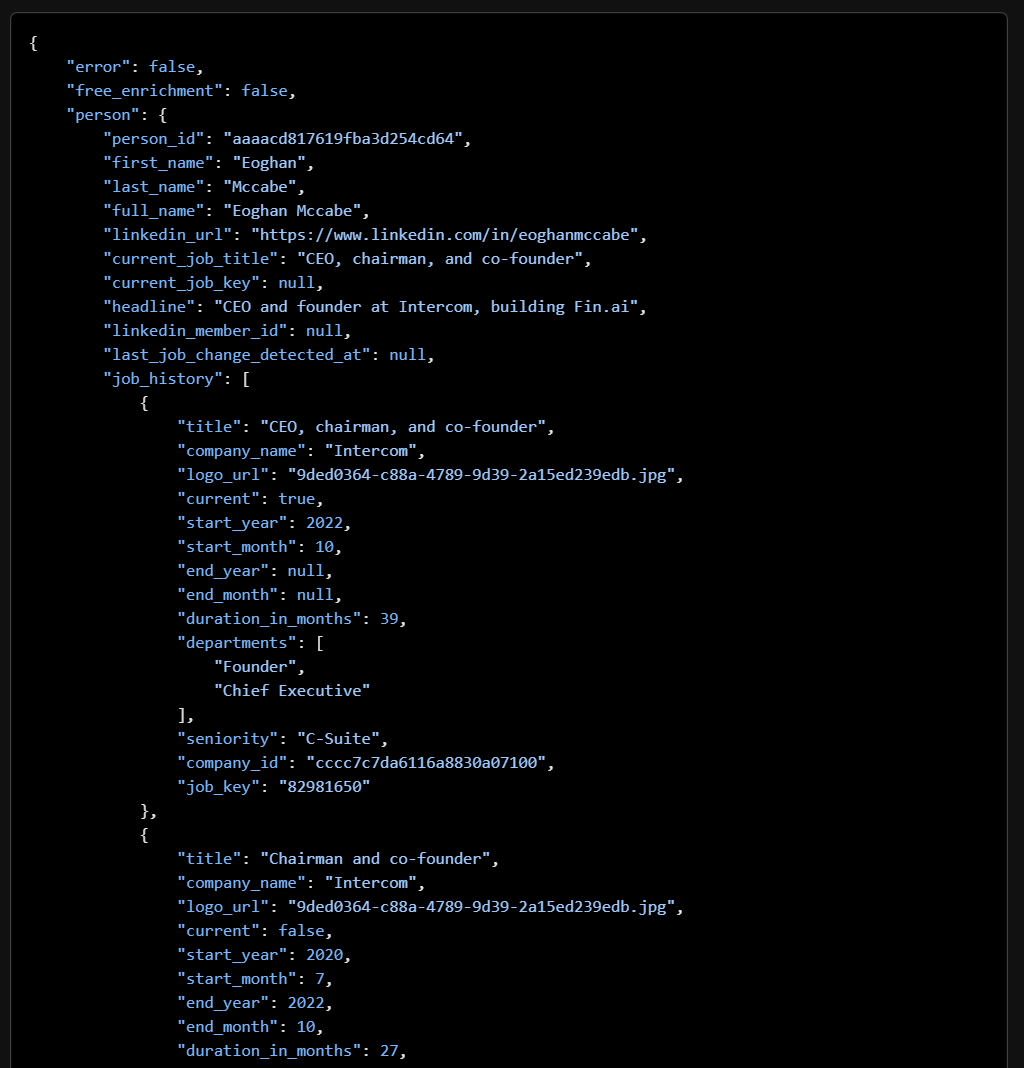
Trigger-event follow-ups only work when you have the right contact data the moment the trigger fires. Prospeo refreshes 300M+ profiles every 7 days - not every 6 weeks - so you're reaching buyers with current emails and direct dials while the news is still fresh.
Stale data kills timely follow-ups. Get contacts refreshed weekly.
FAQ
How many follow-up emails should I send?
Four to seven touchpoints is the sweet spot, generating 3x the reply rate of one-to-three step sequences according to Instantly's 2026 benchmarks. Beyond seven, returns diminish sharply - each additional touch adds noise without new value.
What's the best day and time to send follow-ups?
Tuesday through Thursday, 9-11 AM in the recipient's timezone consistently outperforms other windows. Wednesday shows the highest reply rates. Avoid Monday mornings and Friday afternoons.
How long should a follow-up email be?
Under 80 words for sales and prospecting follow-ups. Customer success emails can run slightly longer, but if your message requires scrolling on mobile, cut it in half. One CTA per email, always.
Should I use the same thread or start a new email?
Reply in the same thread for sales follow-ups - it provides context and boosts open rates. For customer success lifecycle emails like onboarding check-ins and surveys, start a new thread with a clear, short subject line.
What free tools help with follow-up email deliverability?
Prospeo offers 75 free verified emails per month with 98% accuracy, which keeps bounce rates under 1% - the threshold for healthy sender reputation. Hunter provides 25 free searches monthly. Mail Tester is useful for checking your email's spam score before launching a sequence. Verify your list before sending anything; bad data ruins deliverability for every email that follows.