10 Data-Driven Sales Tips Backed by Real Numbers
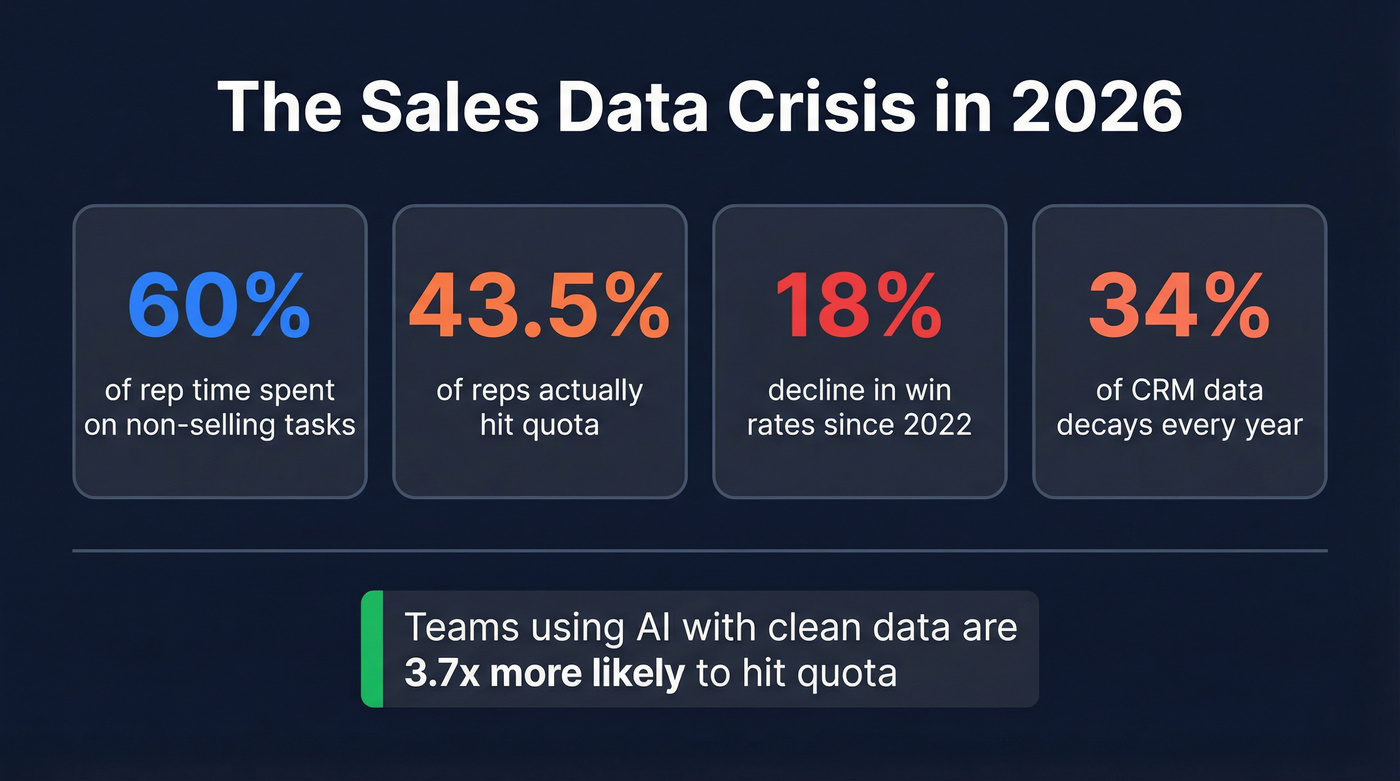
Sales reps spend 60% of their time on non-selling tasks - admin, manual data entry, internal meetings, CRM hygiene. Only 43.5% of reps hit quota. Win rates have declined 18% compared to 2022, and sales cycles keep stretching longer. The gap between teams that use data well and teams that drown in it has never been wider.
Here's the thing: the problem isn't a lack of data. Most sales orgs collect everything, act on almost nothing, and wonder why their forecasts are off by 20-50%. These data-driven sales tips aren't theoretical - they're backed by benchmarks, and each one maps to a specific action you can take this quarter.
The Short Version
Fix your data foundation first. CRM data decays roughly 34% annually. Every metric, forecast, and AI model downstream depends on the records feeding it. Verify emails before they enter your CRM - Prospeo's 5-step verification process catches bad addresses before they corrupt your pipeline.
Track 2-3 metrics obsessively instead of 15 casually. Dashboards with thirty charts create noise, not insight. Pick win rate, pipeline velocity, and one conversion metric. That's it.
Use AI for lead scoring and forecasting - after steps 1 and 2. Reps partnering with AI tools are 3.7x more likely to meet quota. But AI outputs are only as good as data inputs, and 84% of data and analytics leaders agree on that point.
1. Fix Your Data Before Anything Else
Every data-driven initiative fails at the same point: dirty CRM records. CRM data decays roughly 34% per year, and nearly half of companies estimate they lose more than 10% of annual revenue from poor data quality. For a $50M company, that's $5M+ walking out the door.
You can't layer AI, predictive scoring, or behavioral analytics on top of a CRM full of duplicates and dead emails. 91% of data leaders say they can't successfully adopt AI without a reliable data foundation, yet only 55% are confident they actually have one. We've seen teams spend $200K+ on AI tooling while their CRM held 47,000 duplicate records. The AI worked perfectly - on garbage inputs. Duplicate records and stale contacts are two of the most common CRM hygiene failures, and without proper data management, decay compounds silently until every downstream system is compromised.
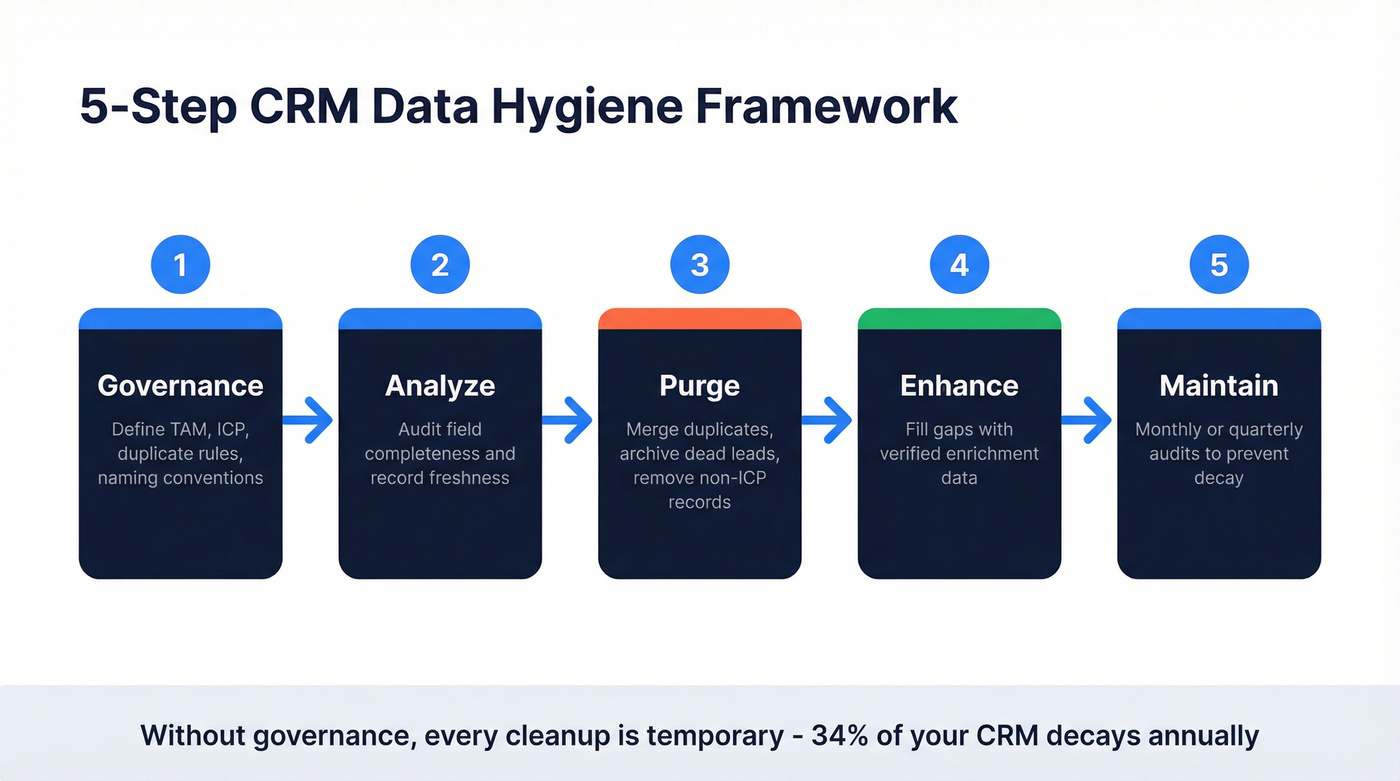
The fix is a five-step framework:
- Governance - define your TAM, ICP, duplicate survivorship rules, and naming conventions
- Analyze - audit field completeness and record freshness
- Purge - merge duplicates, archive dead leads, remove records outside your ICP
- Enhance - fill gaps with verified data from enrichment tools
- Maintain - schedule monthly or quarterly audits so decay doesn't compound
Start with governance. Without clear rules about what a "good" record looks like, every cleanup is temporary. Define ownership for data hygiene the same way you'd define ownership for a territory - someone has to be accountable, or it won't happen.
2. Verify Contact Data Before Outreach
Picture this: you launch a 5,000-contact outbound campaign. Within 48 hours, 12% of emails bounce and another 20% land on catch-all domains where you have no idea if they reached a real inbox. Your sender reputation takes a hit, deliverability drops across your entire domain, and the next campaign performs even worse.
That spiral kills outbound programs. We've watched it happen to teams with great messaging and solid ICPs who simply skipped verification.
The guardrails are clear: keep your bounce rate under 2% and spam complaint rate below 0.01%. Anything above those thresholds and inbox providers start throttling you. Prospeo runs a 5-step verification process at 98% accuracy across 143M+ verified emails, with data refreshed every 7 days instead of the 6-week industry norm. Snyk's team of 50 AEs went from a 35-40% bounce rate to under 5%, generating 200+ new opportunities per month. Meritt tripled their pipeline from $100K to $300K per week after switching. Upload a CSV, run bulk verification, and push clean contacts straight to your sequencer.

CRM data decays 34% per year. Prospeo's 7-day refresh cycle and 5-step verification keep your records accurate - so every lead score, forecast, and AI model runs on data you can trust. 98% email accuracy, 92% API match rate.
Stop feeding your sales stack garbage data. Start with a clean foundation.
3. Track 2-3 Metrics, Not 15
The biggest mistake isn't tracking too little - it's tracking too much. When you show reps a dashboard with fifteen metrics, they look at none of them. The better approach: surface 2-3 critical metrics at a time and enable drill-down sequences from summary to root cause to action.
We've all sat through the QBR where someone pulls up a 40-slide deck of charts and the VP of Sales says "so are we on track or not?" That's data theater. It looks analytical but produces zero behavioral change. 42% of sellers feel overwhelmed by their tools, and overwhelmed sellers are 45% less likely to hit quota.
Let's be honest: the best sales dashboards are boring. Win rate, pipeline velocity, conversion rate by stage. Every other metric is either a vanity number or a diagnostic you pull up when one of those three goes sideways. The teams that outperform aren't the ones with the most data - they're the ones acting on the right data. (If you need inspiration, see these sales dashboards with real KPIs.)
4. Know Your Funnel Benchmarks
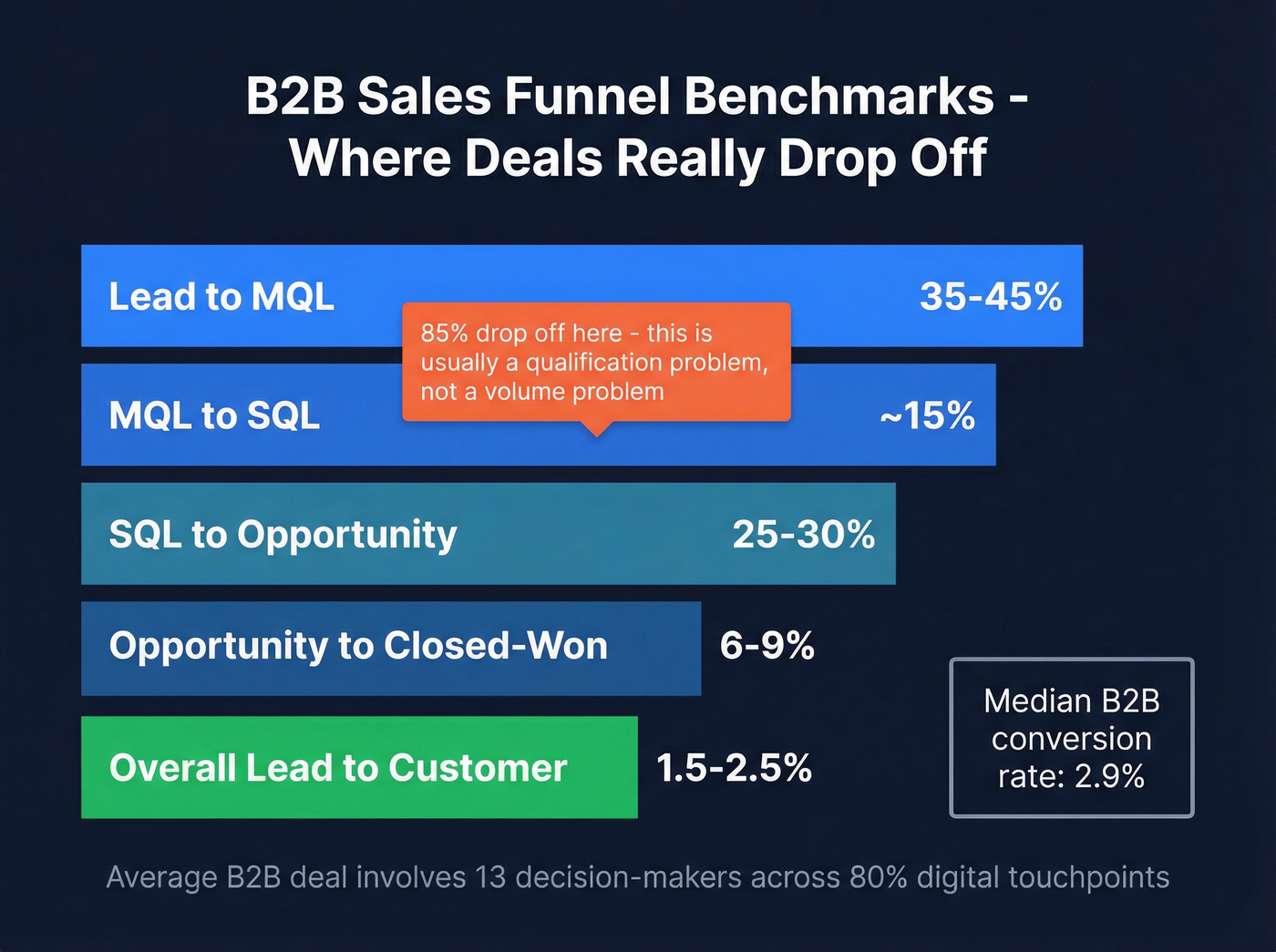
You can't diagnose a leaky funnel if you don't know what "normal" looks like. Here are the stage-by-stage B2B conversion benchmarks your team should measure against:
| Stage | Benchmark |
|---|---|
| Lead to MQL | 35-45% |
| MQL to SQL | ~15% |
| SQL to Opportunity | 25-30% |
| Opportunity to Closed-Won | 6-9% |
| Overall Lead to Customer | 1.5-2.5% |
The median B2B conversion rate is 2.9%. If you're above that, you're doing something right. Below it, the table tells you exactly where to look.
Two numbers that change how you think about these stages: the average B2B deal now involves 13 decision-makers, and 80% of buyer interactions happen digitally. Your funnel isn't a neat linear path - it's a web of stakeholders consuming content, attending demos, and comparing you to competitors simultaneously. The MQL-to-SQL drop (about 85% fall off) is the biggest leak in most funnels, and it's usually a qualification problem, not a volume problem. Tightening your ICP definition and scoring criteria at that stage will do more for revenue than doubling top-of-funnel leads.
Skip the 13-touchpoint enterprise sales process if your average deal size is under $10K. Shorten the cycle, automate qualification, and let the data tell you which leads deserve human attention. Most teams over-engineer their funnel for deals that don't justify the complexity.
5. Build Predictive Lead Scoring
Manual lead scoring - assigning points for job title, company size, email opens - worked in 2018. In 2026, predictive scoring uses machine learning to analyze historical conversion patterns and score leads based on signals humans would never catch.
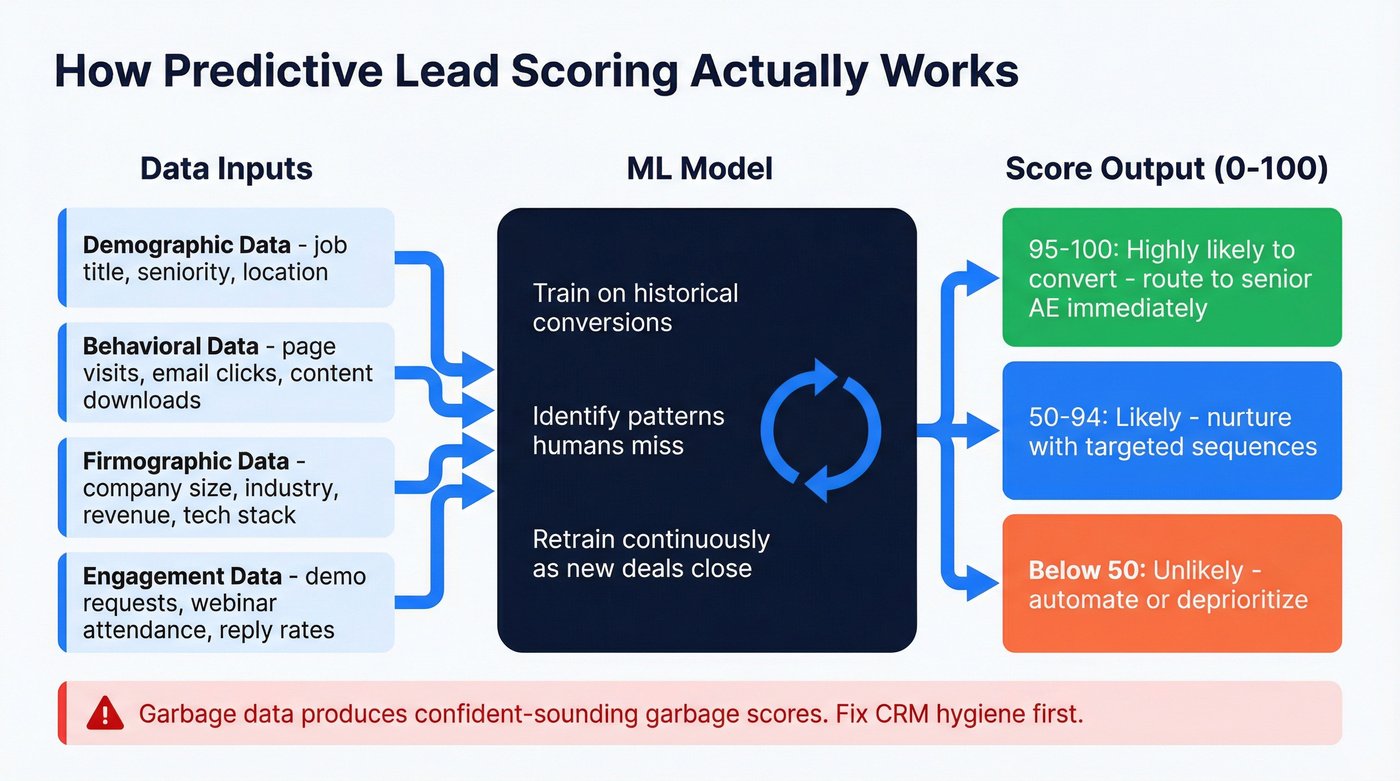
Demandbase outlines a practical five-phase process that works regardless of which tool you use:
- Data collection and integration. Pull demographic, behavioral, firmographic, and engagement data from your CRM, marketing automation, website analytics, and email platforms into one place.
- Data cleaning and feature engineering. Deduplicate records, standardize fields, and identify which variables actually correlate with closed-won deals.
- Model training. Train on historical conversions so the model learns which combinations of attributes and behaviors predict a deal.
- Scoring on a 0-100 scale. Each lead gets a score. A reasonable starting framework: 95+ is highly likely to convert, 50-94 is likely, below 50 is unlikely.
- Continuous learning. The model retrains as new deals close or don't - skip this step and the model degrades as your market shifts.
The inputs matter more than the algorithm. Garbage data produces confident-sounding garbage scores. Get your CRM hygiene right (tip #1) before investing in predictive scoring infrastructure.
Snyk cut bounce rates from 35% to under 5% and generated 200+ opportunities per month. Meritt tripled pipeline to $300K/week. The difference wasn't strategy - it was verified contact data at $0.01 per email.
Every data-driven sales tip fails without accurate contacts. Fix that first.
6. Fix Your Forecasting
Only 45% of sales leaders and sellers have high confidence in their organization's forecasting accuracy. More than half of sales orgs are making hiring, spending, and territory decisions based on numbers they don't trust.
We've all seen the pattern: the VP of Sales submits a forecast that's 30% off because reps sandbagged their pipeline, stale opportunities inflated the total, and nobody had a consistent methodology for what "commit" actually means. Traditional forecasting - weighted pipeline, rep judgment, moving averages - breaks down because it relies on humans being honest and consistent. They're neither. (If this sounds familiar, sandbagging is usually part of the problem.)
AI-driven forecasting reduces errors by 20-50% according to McKinsey's research on AI in sales, using ensemble methods like XGBoost and Random Forest that analyze deal velocity, engagement patterns, and historical close rates simultaneously. The catch is concept drift. When your market shifts - new competitor, pricing change, economic downturn - the model needs retraining. Teams that deploy AI forecasting and forget about it end up with the same garbage forecasts, just produced faster.
7. Personalize With Behavioral Data
Personalized emails achieve roughly 14% higher open rates and 10% higher click-through rates than generic blasts. Across a 10,000-email campaign, that's the difference between 2,100 and 1,800 opens - and the gap compounds through every downstream conversion.
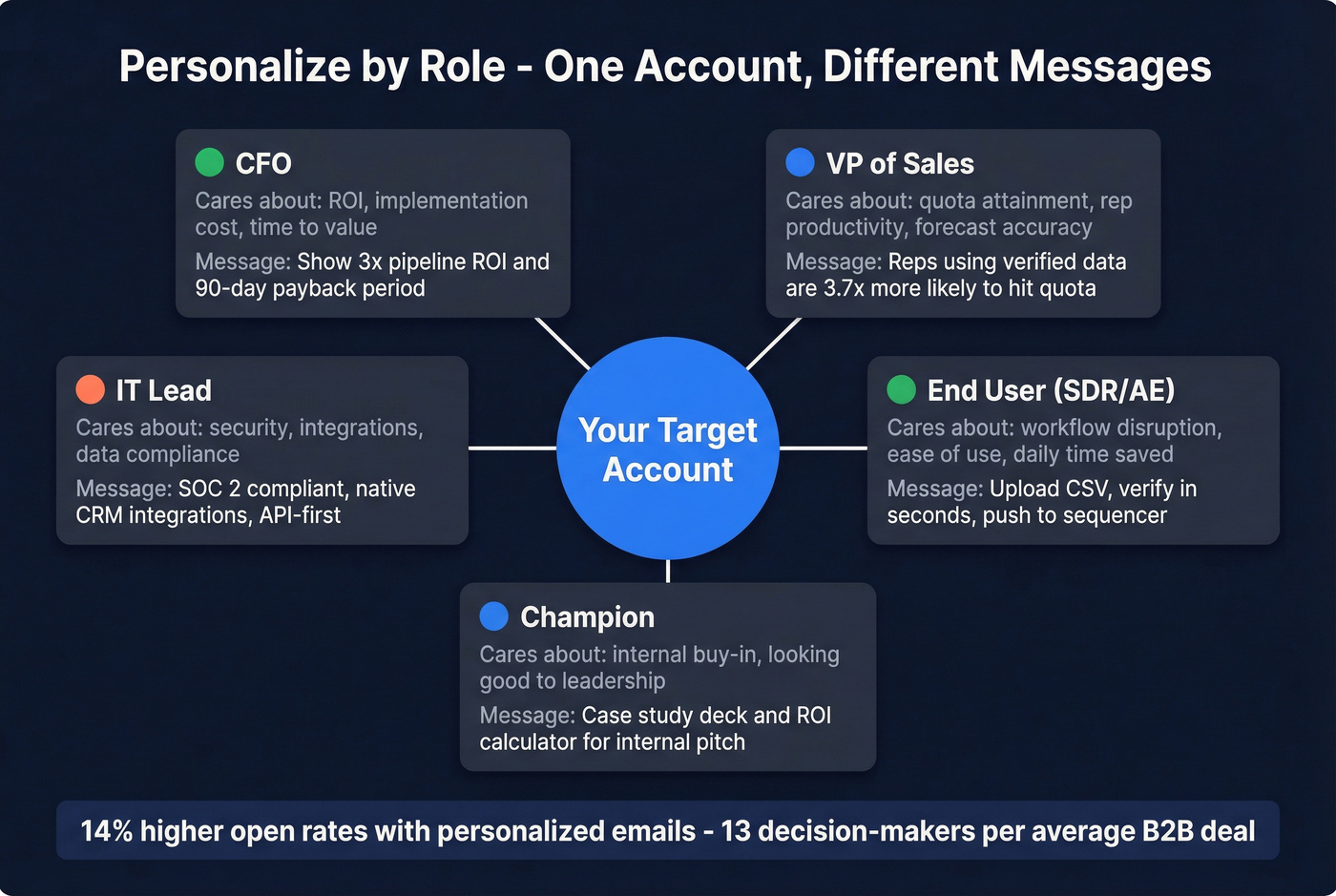
With 13 decision-makers involved in the average B2B deal and 80% of interactions happening digitally, personalization goes far beyond first-name merge tags. It means multi-threading the buying committee with messages tailored to each stakeholder's role. The CFO cares about ROI and implementation cost. The end user cares about workflow disruption. The IT lead cares about security and integrations.
Intent signals make this actionable. When a target account starts researching your category - downloading competitor comparisons, attending relevant webinars, spiking on review sites - that's behavioral data telling you when to reach out and what to say. The consensus on r/sales is pretty clear: reps who combine intent data with role-specific messaging close deals while competitors are still sending "just checking in" follow-ups. If you want to operationalize this, start with a clear B2B intent data workflow.
8. Consolidate Your Tool Stack
Sellers use an average of 8 tools to close deals. 42% feel overwhelmed. Overwhelmed sellers are 45% less likely to hit quota.
The tool stack isn't helping - it's creating friction.
| Category | Tool | Starting Price | Best For |
|---|---|---|---|
| CRM | Salesforce | $25/user/mo | Enterprise |
| CRM | HubSpot | Free / ~$20-$90/user/mo | SMB / startup |
| CRM | Pipedrive | $14/user/mo | Solo reps |
| BI / Analytics | Tableau | $15/user/mo | Advanced viz |
| BI / Analytics | Zoho Analytics | $24/mo | Budget teams |
| Revenue Intel | Gong | ~$1K-5K/mo | Call coaching |
| Revenue Intel | Clari | ~$1.5K-4K/mo | Forecasting |
| B2B Data | Prospeo | Free / ~$0.01/email | Accuracy + value |
| B2B Data | ZoomInfo | ~$15K-40K/yr | All-in-one enterprise |
| Engagement | Outreach / Salesloft | ~$100-150/user/mo | Sequences |
The goal isn't minimalism for its own sake - it's eliminating overlap and ensuring data flows bidirectionally between systems. For teams already paying $30K+ for a data platform and still running a separate verification tool, that's redundancy worth cutting. 19% of company data is inaccessible and 70% of valuable insights are trapped in unstructured formats. Tool consolidation helps, but only if the tools actually share data. (A good north star is a unified sales data platform approach.)
9. Embed Analytics Into Daily Workflows
Building great dashboards that nobody uses is the most common failure mode in data-driven selling. If reps have to leave their CRM, open a separate BI tool, navigate to the right dashboard, and interpret the data themselves, they won't do it. Ever.
The fix is embedding insights where reps already work. CRM-native dashboards that surface the right metric at the right moment - a deal health score on the opportunity record, a pipeline velocity alert in Slack, a conversion rate trend on the team's morning standup screen. That's what data-driven sales development looks like in practice: analytics woven into the daily rhythm, not bolted on as an afterthought.
Design your analytics as drill-down sequences. Start with a summary view (are we on track?), enable one-click drill-down to root cause (which stage is leaking?), and connect directly to action (here are the 12 stale opportunities to update or close). Every dashboard element should answer "what do I do next?" If it doesn't, it's decoration.
10. Coach With Data, Not Gut Feel
17% of reps generate 81% of revenue. That's not a bell curve - it's a cliff. (This is the 80/20 rule in sales playing out in real life.)
The gap between top performers and everyone else is enormous, and it's widening as rep turnover climbs from 22% to 36%. Teams using AI saw 83% revenue growth compared to 66% for teams without it. But the AI isn't replacing coaching - it's making coaching specific. Win/loss analysis, call recordings scored for talk-to-listen ratio, deal progression patterns that reveal where individual reps stall. These inputs turn a vague "you need to improve your discovery calls" into "you're spending 4 minutes on pain discovery when closed-won deals average 11 minutes."
Data-driven coaching isn't about surveillance. It's about giving managers the evidence to coach effectively and giving reps a clear path to improvement instead of subjective feedback they can't act on.
Mistakes That Kill Data-Driven Selling
Three patterns destroy data-driven initiatives faster than anything else.
Confusing data with insights. Pulling a report isn't analysis. If your dashboard can't answer "is this good or bad?" through benchmarking and trend context, it's just numbers on a screen. Every metric needs a comparison point - peer average, historical trend, or target threshold.
Building dashboards nobody opens. Beautiful Tableau dashboards that require three clicks to reach are expensive screensavers. Embed the top 2-3 metrics into the tools reps already use daily. If it's not in the CRM, it doesn't exist.
Ignoring compliance guardrails. GDPR penalties run up to EUR 20M or 4% of global annual revenue. Deliverability thresholds are equally unforgiving - bounce rates above 2% and spam complaints above 0.01% will tank your sender reputation. Verify every contact before outreach and maintain opt-out compliance across every market you sell into. (If you're scaling outbound, build around compliant B2B data from day one.)
FAQ
What are the best data-driven sales tips for 2026?
Start by fixing CRM data - 34% of records decay annually, poisoning everything downstream. Then track only 2-3 core metrics (win rate, pipeline velocity, stage conversion rate), build predictive lead scoring on clean data, and embed analytics into daily CRM workflows so reps actually use them.
What metrics should a sales team track?
Focus on win rate, pipeline velocity, and conversion rate by funnel stage. These three tell you whether you're closing enough, moving fast enough, and converting efficiently. Add diagnostics only when one of these three signals a problem - tracking 15 metrics casually is worse than tracking 3 obsessively.
How often should you clean your CRM data?
Quarterly at minimum, monthly for high-volume teams. CRM data decays roughly 34% per year, so waiting longer lets bad records compound. Follow the governance-analyze-purge-enhance-maintain cycle each time. Enrichment APIs that return 50+ data points per contact can automate the enhance step at scale.
Does AI actually improve sales forecasting?
Yes - McKinsey data shows AI-driven forecasting reduces errors by 20-50%, and AI-partnered reps are 3.7x more likely to hit quota. The critical caveat: models trained on dirty CRM data produce confidently wrong forecasts. Clean your records first, then layer on AI.
What's a good free tool for verifying sales data?
Prospeo offers a free tier with 75 email credits and 100 Chrome extension credits per month - enough to validate a small campaign. It runs a 5-step verification process at 98% accuracy with catch-all handling and spam-trap removal. For larger volumes, credits cost roughly $0.01 per email with no contracts required.
Only 43.5% of reps hit quota. The other 56.5% aren't lazy - they're flying blind. Every tip above comes back to the same principle: collect less data, verify what you have, and act on the metrics that actually move deals. Start with your CRM. If the foundation is rotten, nothing you build on top of it will stand.