

Demand Generation Best Practices That Actually Build Pipeline
Cold email reply rates are down. Paid ads are expensive and inconsistent. And your marketing team just shipped another eBook that generated 400 MQLs and zero pipeline.
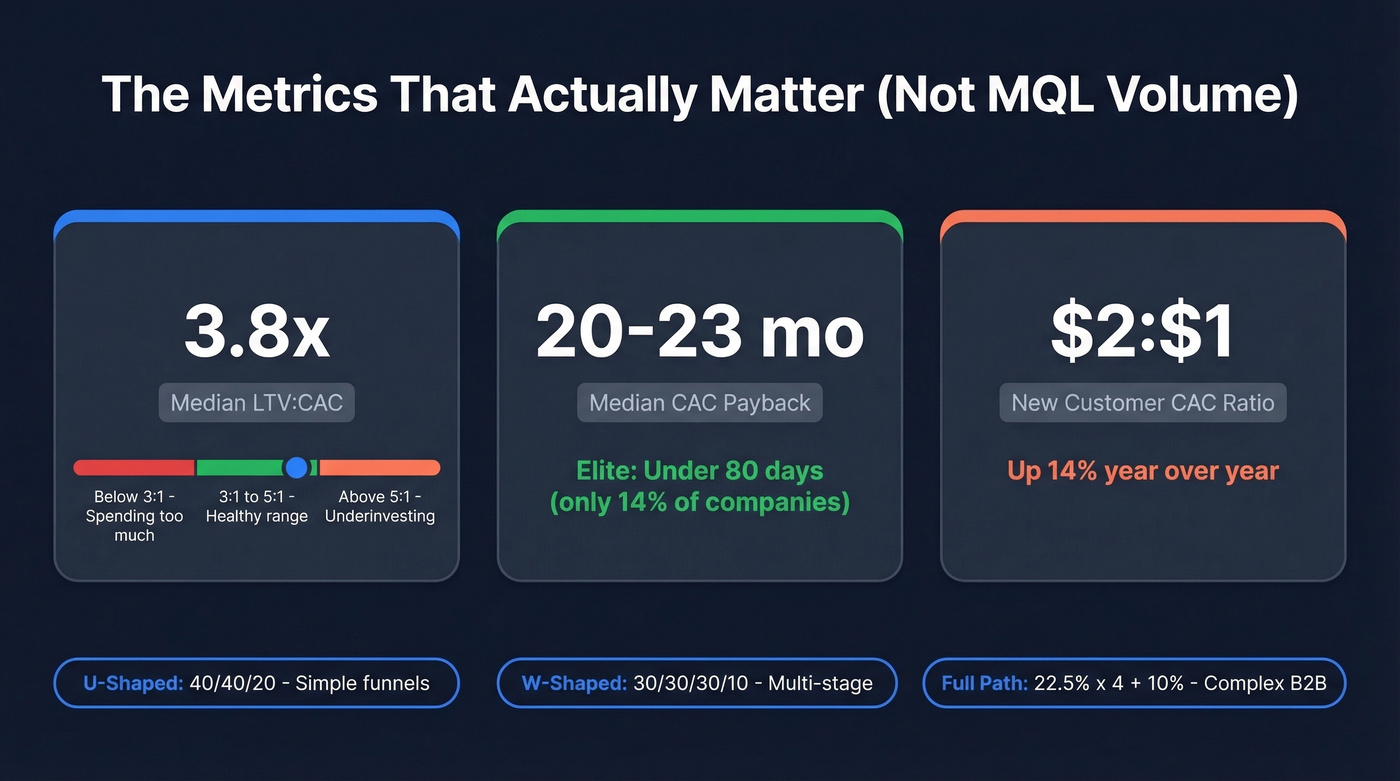
You don't need another demand generation best practices listicle - you need to fix the data and measurement problems nobody wants to touch first. Median new-customer CAC has climbed to $2 for every $1 of new ARR, up 14% year over year. Efficiency isn't optional anymore.
The Short Version
Three things matter more than any tactic: pipeline math that works backward from revenue, data clean enough to actually reach your buyers, and measurement tied to dollars - not MQL dashboards that make everyone feel good while the CFO sharpens the budget axe.
Let's break it down.
12 B2B Demand Generation Practices That Work
1. Start with Pipeline Math, Not Tactics
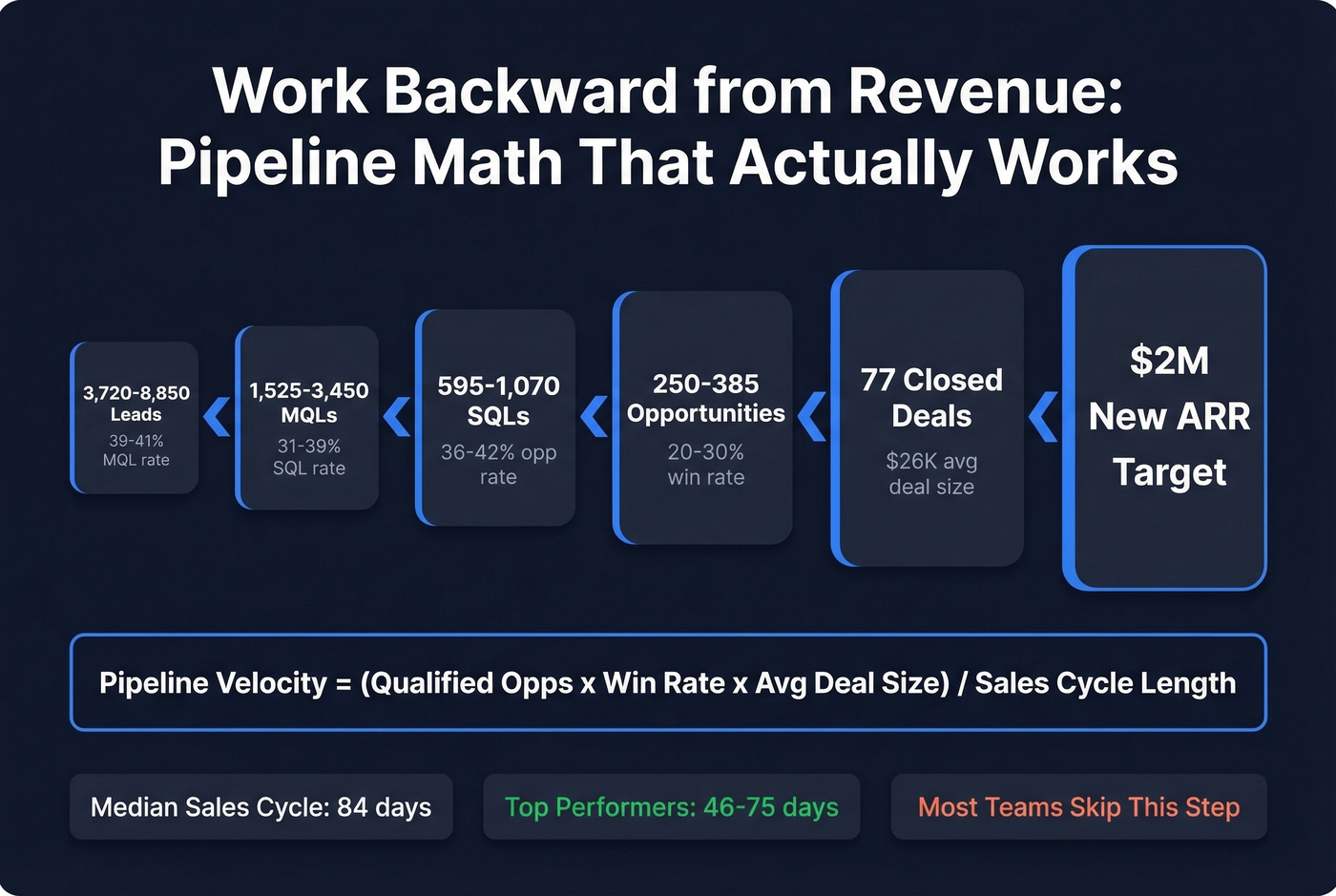
Every demand gen program should begin with a spreadsheet, not a campaign brief. Work backward from your revenue target: if you need $2M in new ARR this quarter with a $26K average deal size, that's roughly 77 closed deals. At a 20-30% win rate, you need 250-385 opportunities. Keep walking the math upstream through SQL, MQL, and lead stages.
Here's what the funnel actually looks like by segment:
| Stage | SMB/Mid-Market | Enterprise |
|---|---|---|
| Visitor -> Lead | 1.4% | 0.7% |
| Lead -> MQL | 41% | 39% |
| MQL -> SQL | 39% | 31% |
| SQL -> Opportunity | 42% | 36% |
| Opp -> Close | 39% | 31% |
The pipeline velocity formula ties it together: (Qualified Opps x Win Rate x Avg Deal Size) / Sales Cycle Length. Median sales cycle runs 84 days, with top performers hitting 46-75. For planning, use Net New ARR per Lead targets of $1,500+ for SMB, $5,000+ for mid-market, and $15,000+ for enterprise.
Here's the thing: most teams skip this step and jump straight to "let's run LinkedIn ads." Then they're 40% short on pipeline at quarter-end. Do the math first. Every channel decision, budget allocation, and headcount request flows from these numbers.
2. Define Your ICP Before You Spend a Dollar
Your ICP isn't "mid-market SaaS companies." That's a category, not a profile. A real ICP layers three signal types:
- Firmographic: industry, headcount, revenue range, geography, tech stack
- Behavioral: website visits, content engagement, product usage signals
- Intent: active research on topics that map to your solution
The consensus on r/b2bmarketing is blunt: "Clean data + tighter ICP filtering. Fewer leads, but way better conversations." That's the 2026 playbook in one sentence.
When building lists, use 30+ filters - job title alone isn't enough. Layer in department headcount, funding stage, technographics, and headcount growth signals. The tighter your ICP, the less you spend on leads that never convert.
3. Fix Your Data Before Your Funnel
This is the most underrated demand gen practice, and it's not close.
You can have the best content, the sharpest ICP, and a perfectly designed nurture sequence - and it all falls apart if 15% of your emails bounce. B2B contact data decays fast. People change jobs, companies restructure, email domains shift. The industry average refresh cycle is 6 weeks, and in that window, a meaningful chunk of your list goes stale.
That decay compounds in ugly ways. Bounced emails tank your sender reputation, which drags down deliverability on the emails that are valid, which craters reply rates across your entire outbound program. We've watched teams troubleshoot messaging and subject lines for weeks when the real problem was a rotten list the whole time. (If you’re seeing this, start with email bounce rate benchmarks and root causes.)
Prospeo was built for exactly this: 300M+ professional profiles with 98% email accuracy, refreshed on a 7-day cycle. That accuracy holds in production - Meritt switched and watched their bounce rate drop from 35% to under 4%, while pipeline tripled from $100K to $300K per week.

The fix: verify every contact before it enters a sequence, enrich at the point of capture, and re-verify on a weekly cadence. Treat data quality as a continuous process, not a quarterly cleanup project. (If you need a vendor shortlist, start with data enrichment services.)

You just did the pipeline math. Now make sure your data doesn't break it. Prospeo delivers 300M+ contacts at 98% email accuracy on a 7-day refresh cycle - so your demand gen campaigns actually reach real buyers instead of dead inboxes.
Stop losing pipeline to bad data. Start with 75 free credits.
4. Build Content for the Buying Group
The average B2B purchase now involves roughly 13 stakeholders, and 74% of those buying teams experience what Gartner calls "unhealthy conflict" during the decision process. When teams do reach consensus, they're 2.5x more likely to rate the decision as high-quality. And here's the stat that should reshape your content calendar: 42% of decision-makers invited an organization to bid after engaging with valuable thought leadership content.
Stop writing for a single persona. Your CFO cares about ROI and payback period. Your VP of Ops cares about implementation timelines. Your end users care about whether the tool actually works day-to-day. Build role-specific content: executive guides for the C-suite, process documentation for ops, competitive comparisons for the champion building the internal business case. Supplement with social proof - customer reviews, case studies, and third-party validation the buying group can circulate internally without your sales team in the room.
Track buying-group engagement at the account level. When 5+ people from the same company are active, that's a signal worth acting on immediately.
5. Design for the Self-Serve Buyer
75% of B2B buyers prefer a rep-free sales experience. Three-quarters. Your prospects don't want to talk to your SDR team until they're ready.
But buyers who use supplier digital tools with a sales rep are 1.8x more likely to complete a high-quality deal than those going fully independent. The answer isn't "fire your sales team" - it's "build digital-first experiences with human escalation paths."
That means ungated product tours, transparent pricing, self-serve trials, ROI calculators that don't require a form fill, and live chat that answers questions in real time without forcing a demo booking. Then make it dead simple to book a call when the buyer is ready. The companies winning right now let buyers control the tempo.
6. Allocate Budget by Channel Economics
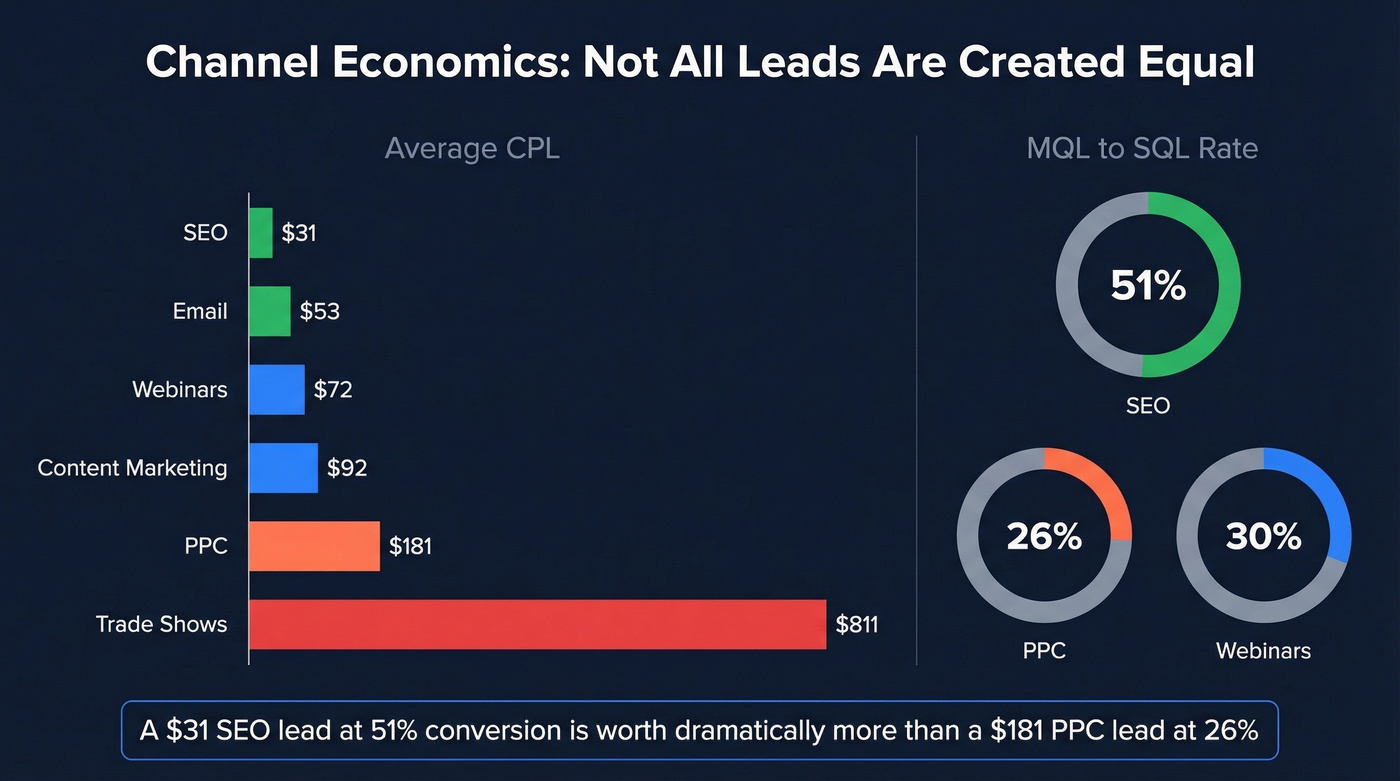
Not all leads are created equal. The CPL gap between channels is enormous:
| Channel | Avg CPL | MQL -> SQL | Best For |
|---|---|---|---|
| SEO | $31 | 51% | Long-term pipeline |
| $53 | - | Nurture + re-engage | |
| Webinars | $72 | 30% | Mid-funnel education |
| Content Mktg | $92 | - | Brand + TOFU |
| PPC | $181 | 26% | Quick volume |
| Trade Shows | $811 | - | Enterprise deals |
Benchmarks from Understory Agency's 2026 report.
Look at the MQL-to-SQL column. SEO leads convert at 51% - nearly double PPC's 26%. That's not just a CPL difference; it's a quality difference that compounds through every downstream stage. A $31 SEO lead converting at 51% is worth dramatically more than a $181 PPC lead at 26%.
If your average deal size is under $15K, you probably can't afford trade shows as a primary channel. The math just doesn't work. Put that $811 per lead into SEO and email, where the conversion economics actually compound.
We've seen teams blow 60% of their budget on paid channels because they're easy to scale, then wonder why their cost per SQO is through the roof. Channel economics should drive allocation, not convenience.
7. Kill the MQL-to-SQL Handoff Problem
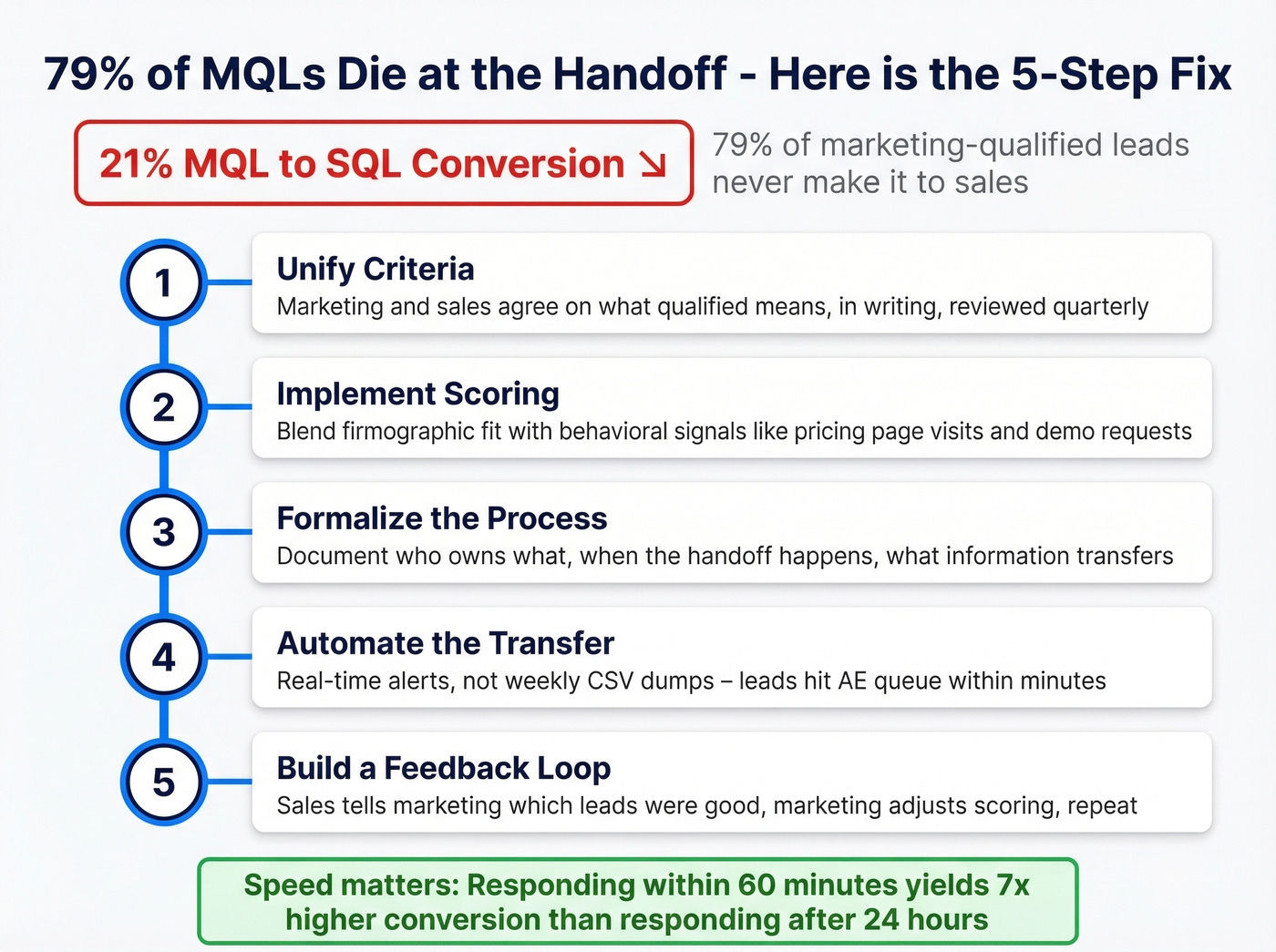
The MQL-to-SQL conversion benchmark sits at roughly 21%. That means 79% of your marketing-qualified leads die at the handoff. The #1 complaint on r/b2bmarketing is that MQLs create "friction between sales and marketing when handoffs happen too early."
Five-step fix:
- Unify criteria: Marketing and sales agree on what "qualified" means - in writing, with specific signals, reviewed quarterly.
- Implement scoring: Blend firmographic fit with behavioral signals like pricing page visits, demo requests, and content depth. (If you need a framework, use a lead scoring model.)
- Formalize the process: Document who owns what, when the handoff happens, and what information transfers.
- Automate the transfer: Real-time alerts, not a weekly CSV dump. The lead should hit the AE's queue within minutes.
- Build a feedback loop: Sales tells marketing which leads were actually good. Marketing adjusts scoring. Repeat.
Speed matters more than most teams realize. Responding within 60 minutes yields 7x higher conversion than responding after 24 hours. If your speed-to-lead is measured in days, you're losing deals to competitors who measure it in minutes. (If you need copy that actually gets replies once you do respond, use these sales follow-up templates.)
8. Measure Revenue, Not Vanity Metrics
MQL volume is the metric that makes marketing feel good and makes the CFO suspicious. The shift toward pipeline velocity, SQL conversion, and actual revenue impact isn't a trend - it's a correction.
The metrics that matter:
- LTV:CAC: Healthy range is 3:1 to 5:1. B2B SaaS median sits at 3.8x. Below 3:1, you're spending too much to acquire. Above 5:1, you're probably underinvesting in growth.
- CAC payback: Median for private SaaS is 20-23 months. Elite companies hit payback in under 80 days - only 14% of companies reach that level.
- Pipeline velocity: The formula from the Pipeline Math section. This single number tells you whether your engine is accelerating or stalling. (More on what to track in a pipeline health dashboard.)
For attribution, build three layers: a unified data layer (CRM + MAP + ad platforms), an attribution layer for weekly channel optimization, and a media mix modeling layer for quarterly planning.
| Model | Weighting | When to Use |
|---|---|---|
| U-Shaped | 40/40/20 | Simple funnels |
| W-Shaped | 30/30/30/10 | Multi-stage |
| Full Path | 22.5% x 4 + 10% | Complex B2B |
9. Operationalize Intent Data
Intent data moves you from "who might buy" to "who is buying now." Track which companies are actively researching topics related to your solution, then prioritize those accounts in your outbound and ad targeting. (If you want a practical setup, use intent based segmentation.)
Use intent data to trigger, not just to score. When a target account spikes on a relevant topic, that's a signal for immediate SDR outreach - not a score adjustment that sits in a queue for a week. The gap between "they're researching" and "they've already shortlisted a competitor" can be days.
10. Automate TOFU Validation and Routing
Every minute between form fill and sales follow-up is a minute your competitor could be engaging that same prospect. Target speed-to-lead under five minutes - not as an aspiration, but as an SLA.
That means real-time lead routing, automated de-duplication, and enrichment at the point of capture. Don't wait for a weekly enrichment batch. Enrich in real time and pipe directly into Salesforce, HubSpot, or Clay. The goal is zero manual steps between "lead captured" and "lead in the right rep's queue with full context." (If you’re building the process end-to-end, map it as a lead generation workflow.)
11. Build a Privacy-First Data Foundation
GDPR regulators have issued over EUR 2.8B in fines since 2018. Privacy isn't a compliance checkbox - it's a data quality strategy. Clean consent practices mean cleaner data, which means better deliverability and engagement. (If you’re buying lists, read Is It Illegal to Buy Email Lists? first.)
Your consent logging should capture IP addresses and timestamps for every opt-in, form versions with exact consent language shown, preference change history with a full audit trail, and opt-out processing within 72 hours. Build preference centers that let contacts choose what they receive and how often. Invest in first-party data collection - owned events, gated tools, community engagement - so you're less dependent on third-party sources that are getting harder to use legally every year.
12. Use ABM for High-Value Accounts
For your top-tier accounts, demand gen and ABM converge. Identify 50-200 accounts that match your ICP perfectly, then multithread 3-5 roles per account with role-specific messaging and retargeting. (If you want the sales-side motion, follow account-based selling best practices.)
The CFO sees ROI content. The ops lead sees implementation guides. The champion sees competitive comparisons. When 5+ people from the same company are engaging with your content, ads, and sales outreach, that's a signal to accelerate.
97% of B2B marketing organizations report ABM delivers higher ROI than other strategies. The tradeoff is that it doesn't scale the same way. Use it for your highest-value segments, not as a replacement for your full-funnel engine. Skip this entirely if your average deal size is under $25K - the per-account investment won't pay back.
Tighter ICP filtering needs a database that can keep up. Prospeo gives you 30+ search filters - buyer intent, technographics, funding stage, headcount growth - across 300M+ verified profiles at roughly $0.01 per email. No contracts, no sales calls.
Filter smarter, reach decision-makers, build pipeline that converts.
90-Day Demand Gen Launch Plan
Days 1-30: Foundation
- Define your ICP with firmographic, behavioral, and intent criteria
- Align marketing and sales on MQL/SQL definitions and SLAs
- Publish one executive guide and two case studies (minimum viable content)
- Set up real-time lead routing - target speed-to-lead under 5 minutes
- Build your measurement stack: CRM + MAP + attribution layer
- Verify and clean your existing contact database
Days 31-60: Launch
Activate your top 2-3 capture channels - SEO, paid, and events are the typical starting trio. Track cost per SQO by channel from day one, not just CPL. Set an SDR follow-up SLA of 24 hours for inbound and same-day for intent-triggered leads. Launch at least one ABM pilot on your top 25 accounts and begin tracking event-sourced pipeline separately from digital.
Days 61-90: Optimize
Reallocate 20-30% of budget from underperforming channels to top performers. Cut low performers quickly - don't wait for "more data" if the signal is clear after 60 days of spend. Build your exec reporting narrative around pipeline velocity trends, LTV:CAC, and cost per SQO by channel. Document what's working so it doesn't live in one person's head, and set a quarterly review cadence for ICP refinement and scoring model updates.
In our experience, a team that runs this playbook enters Day 91 with a clear picture of which two channels drive 70%+ of their qualified pipeline, a working lead scoring model with at least one feedback cycle completed, and an exec dashboard that tells a revenue story instead of an MQL story. That's when demand gen stops being a project and starts being an engine.
Common Demand Gen Mistakes
Five failure patterns that stall pipeline - treat this as a diagnostic checklist:
Misaligned handoffs. Marketing and sales disagree on what "qualified" means. Leads sit in limbo. Follow-up is late. Nobody owns the gap.
Low-quality placements. Cheap content syndication inflates MQL volume but collapses downstream. Your dashboard looks great; your pipeline doesn't.
Fragmented data and attribution. CRM, MAP, and intent tools aren't aligned. You can't tell which channel actually drove the deal. Budget decisions become political instead of analytical.
Slow lead activation. Manual routing means competitors engage your prospects first. If your speed-to-lead is measured in hours, you've already lost.
No real nurture. Generic drip sequences don't count. Interest decays fast. If your nurture isn't role-specific and behavior-triggered, it's just noise in someone's inbox.
FAQ
What's the difference between demand generation and lead generation?
Demand gen creates awareness and desire across the full funnel - from brand recognition through purchase intent. Lead gen captures contact info from already-interested buyers. Demand gen is the strategy; lead gen is one tactic within it. The best programs treat lead capture as one output of a broader engine, not the engine itself.
What's a good MQL-to-SQL conversion rate?
The industry benchmark is 15-21%. Below 15% means your scoring or handoff process needs work. Above 25% means your criteria are too restrictive and you're leaving pipeline on the table.
How do you measure demand generation ROI?
Track pipeline velocity, LTV:CAC (healthy range 3:1-5:1), and CAC payback period. Stop measuring MQL volume - measure revenue impact by channel using a three-layer attribution architecture combining CRM data, multi-touch attribution, and media mix modeling.
What tools help with demand gen data quality?
For contact data, Prospeo provides 98% email accuracy with a 7-day refresh cycle, starting free with 75 credits/month. For automation, HubSpot or Marketo handle nurture and routing. For intent signals, layer buyer research data with firmographic filters to prioritize in-market accounts before your competitors reach them.