

Digital Marketing for B2B: Strategies, Benchmarks, and What It Actually Costs in 2026
A marketer on r/DigitalMarketing summed it up perfectly: ten years of B2C performance marketing experience, one year of B2B at a staffing agency, and "miserable failure" across every channel. Cold calls went unanswered. Cold emails got ignored. ABM display ads generated clicks but zero form fills. The post title? "Does digital marketing for B2B businesses actually work?"
It does. But the reason nothing works for most teams isn't the channels - it's the data underneath them. Cost per lead ranges from $25 to $840 depending on channel, and knowing those numbers before you commit budget is the difference between a strategy and a money pit.
Before You Touch a Single Channel
Nail three things. Define your ICP with enough specificity that a stranger could identify a qualified account in under 30 seconds. Get verified contact data - emails and phone numbers that actually connect, not "enriched" records from providers that refresh on a 4-6 week cycle. Then pick one sustainable channel and commit to it for 12 months. Not three channels. Not five. One.
Most B2B marketing failures aren't strategy failures. They're data failures dressed up as strategy failures. When your email list bounces at 35%, every channel looks broken. When your SDRs dial wrong numbers all day, outbound looks dead. Fix the foundation and the channels start working.
What Is B2B Digital Marketing?
B2B digital marketing is every online activity that moves a business buyer from unaware to closed-won. The structural differences from B2C make it a fundamentally different discipline.
The average B2B buying cycle runs 10.1 months. Buying committees - not individuals - make decisions. A single deal might involve six to ten stakeholders across procurement, IT, finance, and the business unit. That's why a Facebook ad strategy that crushes it for a DTC brand falls flat the moment you point it at enterprise software buyers.
Here's the stat that should reshape how you think about all of this: 95% of the time, the winning vendor is already on the buyer's Day One shortlist. The "pre-contact favorite" wins roughly 80% of deals. Your marketing doesn't just need to generate leads - it needs to build enough awareness that you're on the list before the buyer ever fills out a form.
Why It Matters More in 2026
The buyer journey is compressing, and buyers are doing more evaluation through AI-assisted research. That's a double squeeze on teams still running playbooks from 2022.
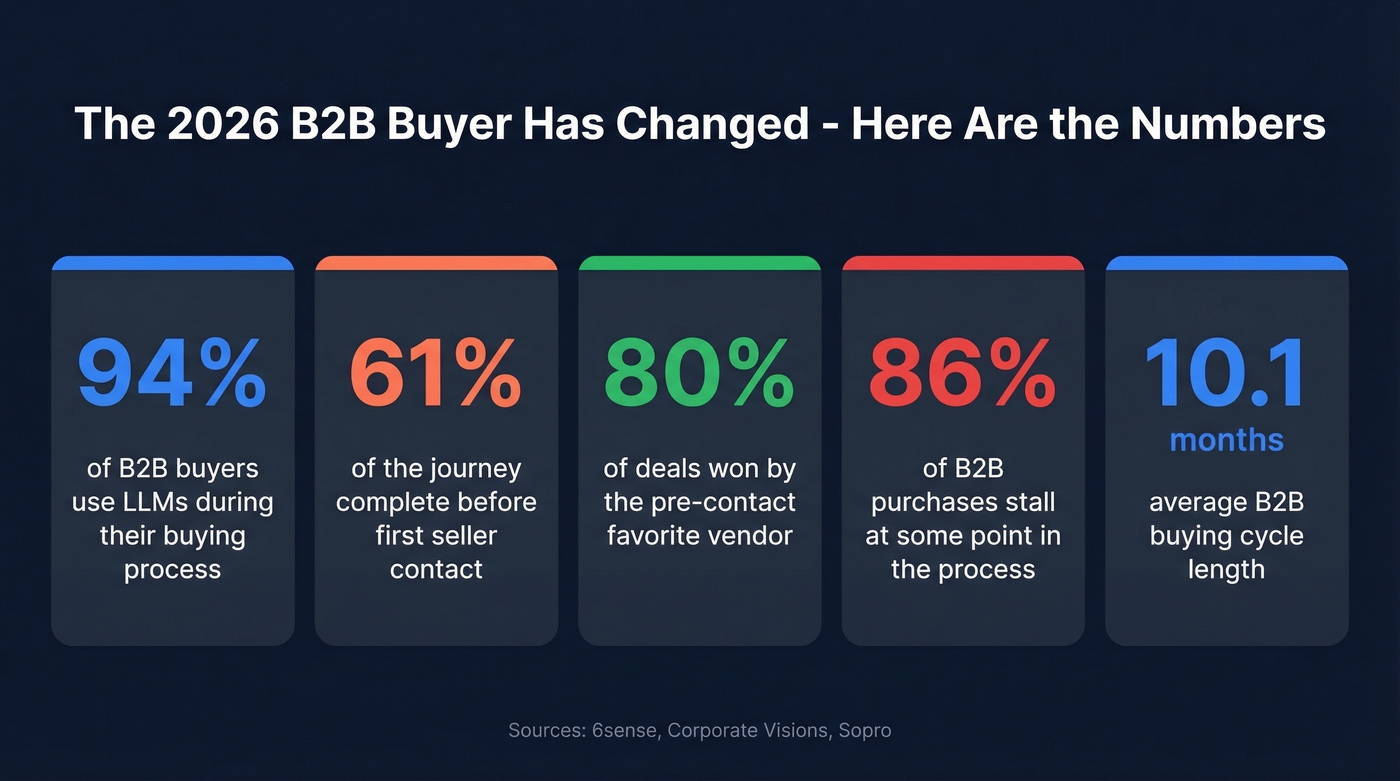
First contact between buyer and seller now happens at 61% of the journey, compared to 69% just a year earlier - roughly six to seven weeks earlier in the process. 94% of B2B buyers use LLMs during their buying process. 72% encounter Google's AI Overviews, and 90% of those click at least one cited source.
Meanwhile, 86% of B2B purchases stall, and 81% of buyers end up dissatisfied with the provider they chose. That's a market full of friction - and friction is opportunity for teams that show up earlier with better content backed by accurate data.
If you're not visible during the first 60% of the buyer's journey, you're not on the shortlist. And if you're not on the shortlist, you don't win.

The article says it plainly: most B2B marketing failures are data failures in disguise. When your list bounces at 35%, every channel looks broken. Prospeo's 5-step verification delivers 98% email accuracy and refreshes every 7 days - not the 4-6 week cycle that's silently killing your CPLs.
Stop bleeding budget on bad data. Fix the foundation for $0.01 per email.
What It Actually Costs
This is where most guides get vague. We won't.
CPL by Channel
| Channel | Avg CPL | Low | High |
|---|---|---|---|
| Referrals | $25 | - | - |
| Affiliate Marketing | $73 | $54 | $92 |
| Multi-Channel Prospecting | $188 | $80 | $296 |
| SEO | $206 | $14 | $397 |
| Cold Email | $225 | $150 | $300 |
| Direct Mail | $250 | - | - |
| Webinars | $267 | $33 | $500 |
| Cold Calling | $300 | - | - |
| LinkedIn Ads | $408 | $15 | $800+ |
| PPC | $463 | $175 | $751 |
| Trade Shows | $840 | $180 | $1,500+ |
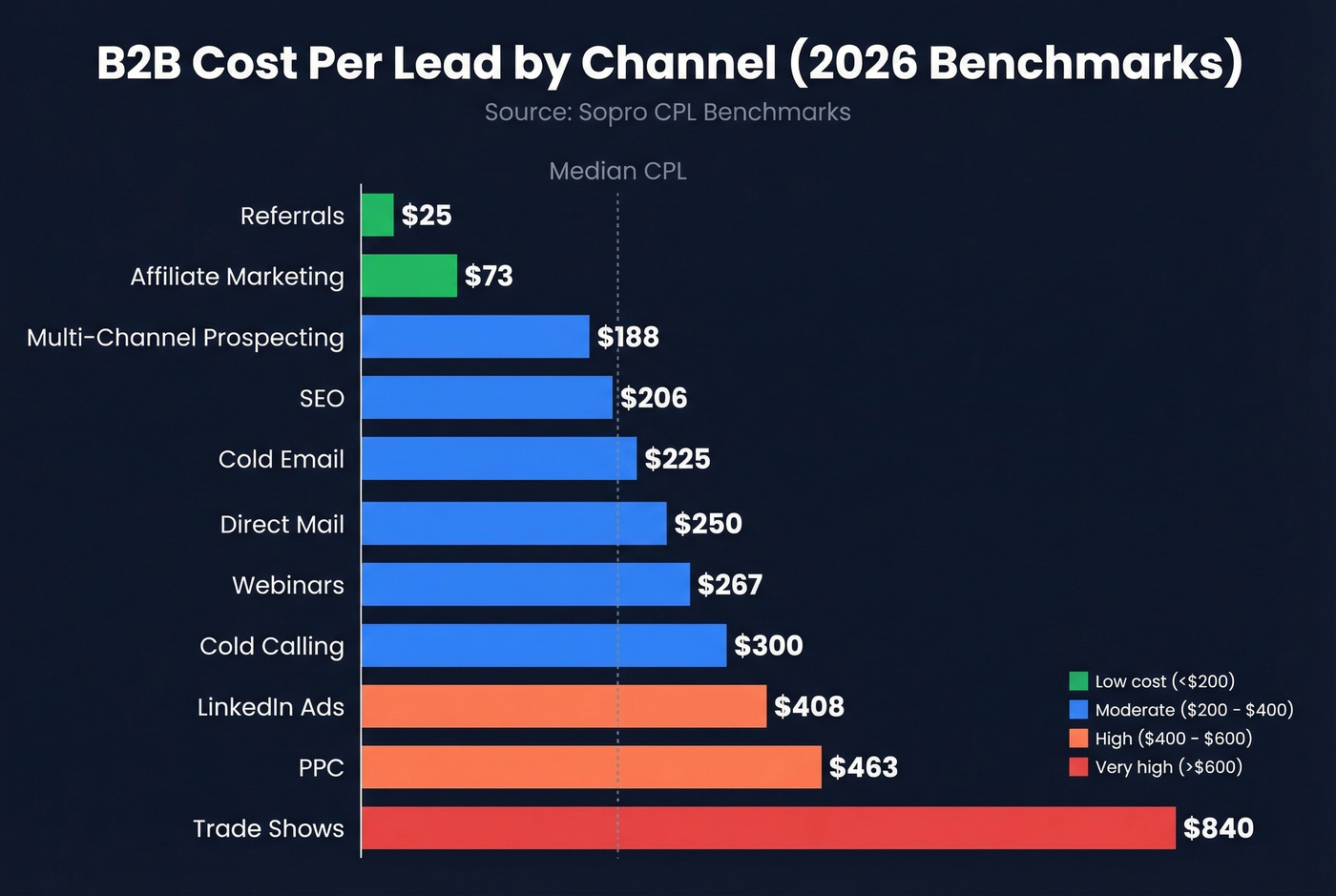
Data from Sopro's CPL benchmarks.
CPL by Industry
| Industry | Paid CPL | Organic CPL | Blended |
|---|---|---|---|
| B2B SaaS | $310 | $164 | $237 |
| Cybersecurity | $411 | $404 | $406 |
| IT & Managed Services | $617 | $385 | $503 |
| Software Development | $680 | $510 | $591 |
| Financial Services | $761 | $555 | $653 |
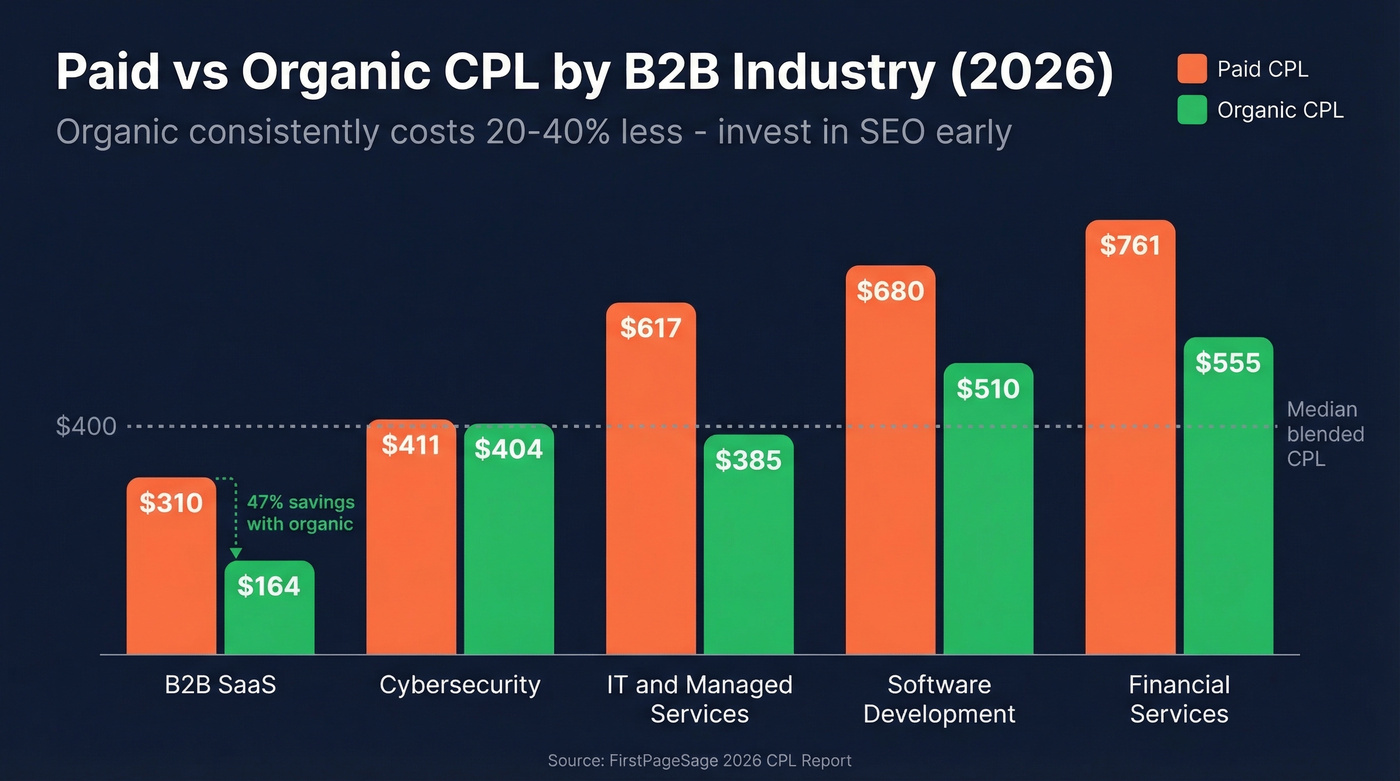
Data from FirstPageSage's 2026 CPL report.
CPL by Company Size
Company size changes the math dramatically. Small businesses under 50 employees average $146 per lead. Mid-market companies land around $250-$350. Enterprises pay $429 or more.
If you're a 30-person startup benchmarking against enterprise CPL data, you'll either overspend or convince yourself nothing works.
Funnel Conversion Benchmarks
We're genuinely baffled that no SERP result for this topic includes these numbers - you can't plan a budget without them.
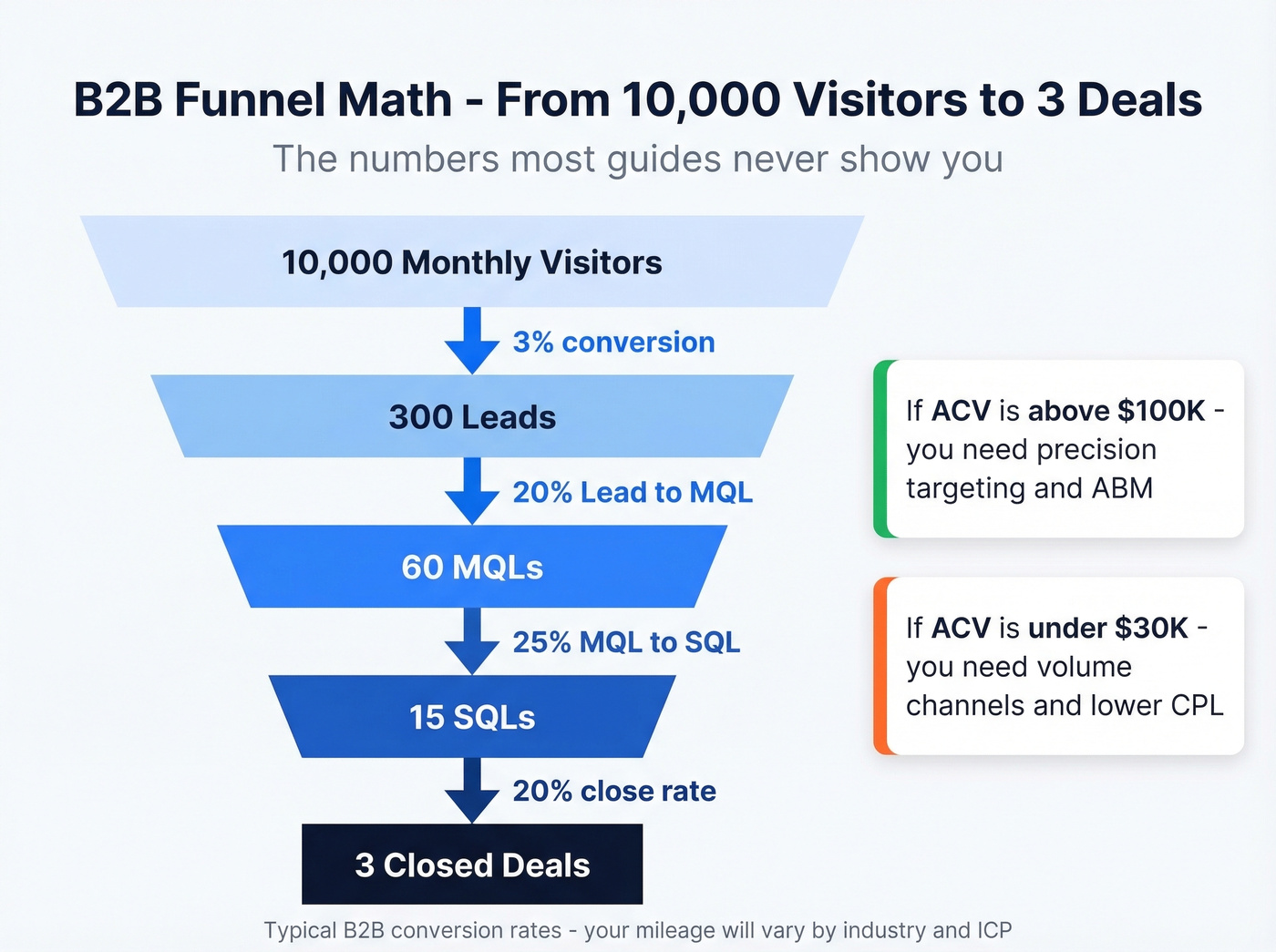
| Stage | Typical Conversion Rate |
|---|---|
| Visitor to Lead | 2-5% |
| Lead to MQL | 15-25% |
| MQL to SQL | 20-30% |
| SQL to Closed-Won | 15-25% |
Let's run the math: 10,000 monthly visitors at 3% conversion gives you 300 leads. At 20% lead-to-MQL and 25% MQL-to-SQL, that's 15 SQLs. At 20% close rate, that's 3 deals. If your average deal size is under $30K, you need volume channels. If it's above $100K, you need precision targeting. Teams that don't model this funnel before budgeting waste a huge chunk of their first-year spend.
The gap between organic and paid CPL is striking. A $10K/month SEO investment generating 50 leads at $200 CPL can keep producing leads for months even if you pause spending, with much lower marginal cost than paid. A $10K/month PPC campaign producing the same 50 leads stops the day you turn it off. This is why any B2B online marketing strategy should include a significant organic component.
For budget framing: B2B companies spend an average of 8.4% of revenue on marketing. That splits roughly 42% to programs, 35% to personnel, and 23% to technology. A $10M company should budget around $840K, with ~$353K going to actual campaigns.
Top Strategies That Work
SEO & Generative Engine Optimization
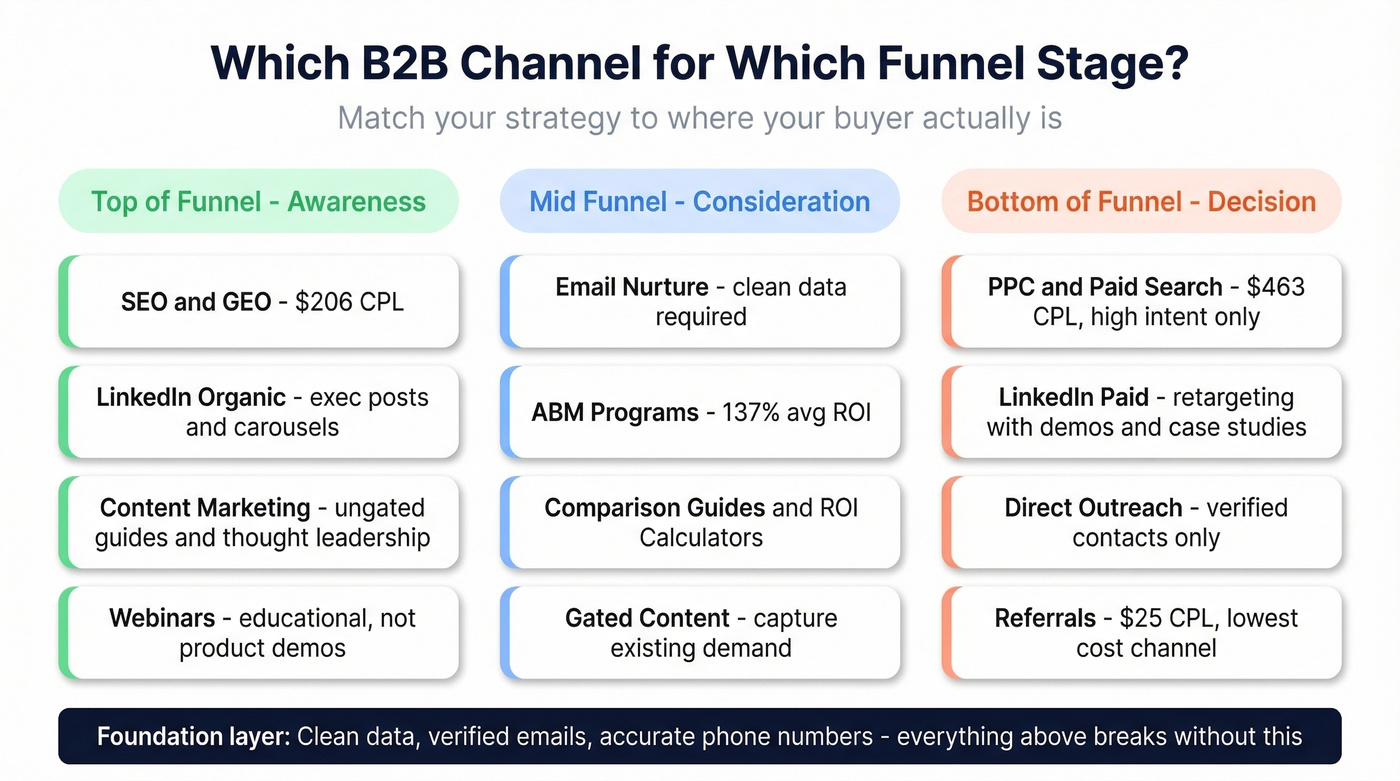
Average CPL: $206. SEO remains the lowest-cost scalable channel in B2B, but the game has shifted. With 72% of buyers encountering AI Overviews, you now need to optimize for both traditional search and generative engines. Structure content with clear, quotable answers to specific questions. The trap: writing 3,000-word guides that never directly answer the query in the first 100 words.
If you're building an organic engine, it helps to treat conversion rates as a first-class metric - not an afterthought. (See: conversion rates benchmarks by stage.)
Content Marketing
The most common content marketing failure in B2B isn't producing too little - it's producing the wrong content. Teams over-invest in top-of-funnel awareness and completely neglect mid-funnel nurture. With a 10-month buying cycle, you need comparison guides, ROI calculators, and implementation playbooks that keep prospects engaged between first touch and purchase decision. Ungated content builds trust; gated content captures demand. You need both, and the ratio should skew heavily toward ungated if you're still building brand awareness.
If you want a tighter definition and examples, start with content marketing in a B2B context.
Email Marketing
Skip this channel if your data isn't clean. Seriously.
Email is one of the highest-ROI channels - often cited at ~$44 for every $1 invested - but deliverability is entirely dependent on data quality. Send to a list full of invalid addresses and your sender reputation tanks fast. Every subsequent campaign performs worse. Verify every email before it enters a sequence. 42% of B2B companies cite lead quality as their top marketing challenge, and bad email data is a common culprit. For teams running outbound at scale, email hygiene isn't optional - it's the prerequisite that makes everything else possible.
If you're troubleshooting bounces and inboxing, use an email deliverability checklist and track your email bounce rate by provider and campaign.
Account-Based Marketing
71.2% of organizations now run ABM programs, with an estimated average ROI of 137%. What's changed in 2026 is the AI layer - 78.7% of ABM practitioners incorporate AI for personalization and predictive targeting.
One practitioner on r/b2bmarketing described building an internal tool that scraped 100K+ B2B reviews to extract lead challenges, then funneled those leads into a community for nurture. That's the direction: data-driven identification, community-based nurture, personalized outreach at scale. ABM isn't a campaign type. It's an operating model.
If ABM is a priority, align it with account-based selling best practices so sales and marketing run the same playbook.
LinkedIn (Organic + Paid)
LinkedIn CPCs run 3-5x higher than Google Ads, so you can't treat it like a search channel. Stage the funnel: TOFU campaigns push ungated value like trend reports and benchmarks, MOFU uses lead gen forms for webinars and calculators, BOFU retargets with demos and case studies. On the organic side, executive accounts outperform company pages consistently - narrative posts and carousels that drive dwell time beat corporate announcements every time.
PPC / Paid Search
Average CPL: $463. PPC works for high-intent, bottom-funnel queries where someone is actively searching for a solution. "Enterprise CRM software pricing" is a great PPC keyword. "What is CRM" is a waste of money.
For low-volume B2B niches - the staffing agency marketer's exact problem - search volume is often too thin for PPC to be viable at all. Know your search volume before you commit budget.
Webinars & Virtual Events
45% of B2B marketers say events are their top lead source, and webinars are the scalable version. They work especially well for mid-funnel engagement - the prospect knows they have a problem but hasn't committed to a solution category. Teach something genuinely useful and the pipeline follows. Treat webinars as product demos and watch your registration rates collapse.
Marketing Automation & CRM
Here's the thing: most teams don't need more martech. They need to actually use what they have. Marketers use just 33% of their martech stack's capability. Most teams buy HubSpot or Salesforce, set up basic email sequences, and never touch lead scoring, workflow automation, or attribution reporting. Define your lifecycle stages, scoring model, and handoff criteria before buying another tool.
If you're formalizing lifecycle stages, a practical starting point is lead scoring and a consistent lead status model.
Data Quality & Enrichment
Every strategy above depends on one invisible foundation: the accuracy of your contact data. Bad data doesn't just cause bounced emails - it wastes SDR time on wrong numbers, tanks sender reputation, and makes every channel look broken when the real problem is the list.
If you're comparing vendors, start with a shortlist of data enrichment services and how they handle refresh cycles and verification.

We've seen this pattern play out dozens of times. One customer, Meritt, was running outbound with a 35% bounce rate. After switching to Prospeo's verified data - 98% email accuracy on a 7-day refresh cycle - their bounce rate dropped to under 4% and pipeline jumped from $100K to $300K per week. The channels didn't change. The data did.
AI-Powered Personalization
Daily AI tool usage is up 233% in six months. The practical use cases are already here: using AI to identify which 200 accounts are surging on intent signals this week, then writing 5 personalized sequences for those accounts - not 500 generic ones for everyone. Where teams go wrong: using AI to generate more content instead of using it to generate better-targeted content.
If you're operationalizing this, pair personalization with intent based segmentation so the AI is aiming at the right accounts.
Why B2B Marketing Efforts Fail
We've seen teams try everything and conclude that none of it works. It almost always comes down to one of five failure modes.
No ICP clarity. The Reddit marketer who tried cold calls, cold emails, ABM display, SEO, and events - all with "miserable failure" - was selling staffing services to a broad market. Without a tight ICP, every channel underperforms because the targeting is too diffuse. Narrow your ICP until it feels uncomfortably specific. You can always expand later.
If you need a concrete starting point, use an Ideal Customer Profile scoring rubric.
Bad contact data. When your email list bounces at 35%, your sender domain gets flagged, your cold email CPL skyrockets, and your SDRs waste hours dialing disconnected numbers. Run your list through a verification tool before launching any campaign. Any verification step is better than none.
Vanity metrics. Measuring website traffic, social impressions, and email open rates instead of pipeline contribution and revenue. A campaign that generates 500 MQLs and zero closed deals isn't working. Align metrics to revenue from day one.
If you want a clean measurement layer, define your funnel metrics before you scale spend.
No mid-funnel content. Teams produce awareness content and bottom-funnel content but nothing in between. With a 10-month buying cycle, the middle is where deals are won or lost. Comparison guides, ROI frameworks, and implementation case studies fill this gap.
Sales-marketing misalignment. Marketing measures MQLs. Sales measures closed revenue. Nobody agrees on what a "qualified lead" means. The fix is a shared pipeline definition and joint accountability for pipeline creation. As one r/b2bmarketing practitioner put it: more conversations with real people lead to better audience understanding, which leads to better marketing.
You just saw the math: 10,000 visitors, 300 leads, 3 closed deals. At those conversion rates, every lead matters - and every bounced email is wasted spend. Prospeo gives you 300M+ verified profiles with 30+ filters to target the exact buying committee members your campaigns need to reach.
Reach real decision-makers instead of dead inboxes. Build your first list free.
B2B Marketing Trends for 2026
AI agents at scale. Automated customer interactions via AI agents are projected to grow from 3.3 billion to 34 billion by 2027. Expect AI agents to increasingly handle initial qualification, meeting scheduling, and basic nurture as adoption accelerates through this year and next.
GEO alongside traditional SEO. With 94% of buyers using LLMs during research, getting cited in AI-generated answers is becoming as important as ranking on page one. The best teams in 2026 are optimizing for both search engines and generative engines simultaneously.
Buyer journey compression continues. The shift from 11.3 to 10.1 months happened in a single year. Teams that show up earlier in the journey win.
ABM 2.0 investment. 40.3% of marketers plan to invest in next-generation ABM capabilities in the next 12 months - moving from campaign-based ABM to always-on, AI-driven account engagement.
Data freshness as competitive advantage. When your data provider refreshes weekly instead of monthly, you're reaching prospects with current titles, current companies, and current email addresses. That gap compounds across every campaign you run.
FAQ
How long does B2B digital marketing take to show results?
SEO takes 6-12 months for consistent organic pipeline. Paid channels produce data within 2-4 weeks but need 2-3 months to hit target CPL. Email outbound can produce meetings within weeks - if the data is clean and verified before launch.
What's a good cost per lead in B2B?
It depends on your industry. B2B SaaS averages $237 blended. Enterprise IT and financial services run $500-$650. SEO ($206) and cold email ($225) are the most cost-efficient scalable channels for most teams.
How much should a B2B company spend on marketing?
The benchmark is 8.4% of revenue, split roughly 42% to programs, 35% to personnel, and 23% to technology. A $10M company should budget around $840K total, with ~$353K going to actual campaign spend.
What's the difference between demand gen and lead gen?
Demand gen creates awareness before a buyer is ready to engage - brand content, events, thought leadership. Lead gen captures existing demand through forms, gated content, and outbound. Most teams under-invest in demand gen because it's harder to measure, but it's what gets you on that Day One shortlist.