

How to Drive Pipeline: The 2026 Playbook for B2B Revenue Teams
Only 16% of B2B sales reps hit quota last year. Meanwhile, 92% of buyers already have a vendor in mind before they start evaluating - and the vendor on the Day One shortlist wins 95% of the time. If you don't know how to drive pipeline early and accurately, you're competing from behind before a single call gets made.
The average B2B buying cycle now stretches to 10.1 months, and buyers don't make first contact until they're 61% through their journey. Pipeline isn't a sales problem or a marketing problem. It's a revenue architecture problem that starts months before a deal shows up in your CRM.
The short version: Fix your data first - if your bounce rate is above 5%, fix deliverability before anything else (use these email bounce rate benchmarks to sanity-check). Align marketing and sales on shared pipeline definitions and a coverage ratio of 3-5x. Layer in intent signals and invest in the two most under-funded levers: brand and partner/channel.
What Pipeline Generation Actually Means
Pipeline marketing - as Adobe's framework defines it - is the evolution of lead gen that ties every activity to revenue, not just MQL volume. Simply generating more leads won't create more customers. Generating more qualified leads will (and the right lead generation metrics make that visible).
A funnel describes the buyer's journey. A pipeline describes your revenue system - the collective group of known opportunities with real potential to convert, tracked by stage, velocity, and value. When someone says "drive pipeline," they mean generating and advancing those opportunities toward closed revenue.
Marketing-sourced pipeline should contribute 30-60% of total revenue targets. If your marketing team is measured on MQLs alone, you've got a measurement problem masquerading as a pipeline problem.
Five Levers That Boost Pipeline in 2026
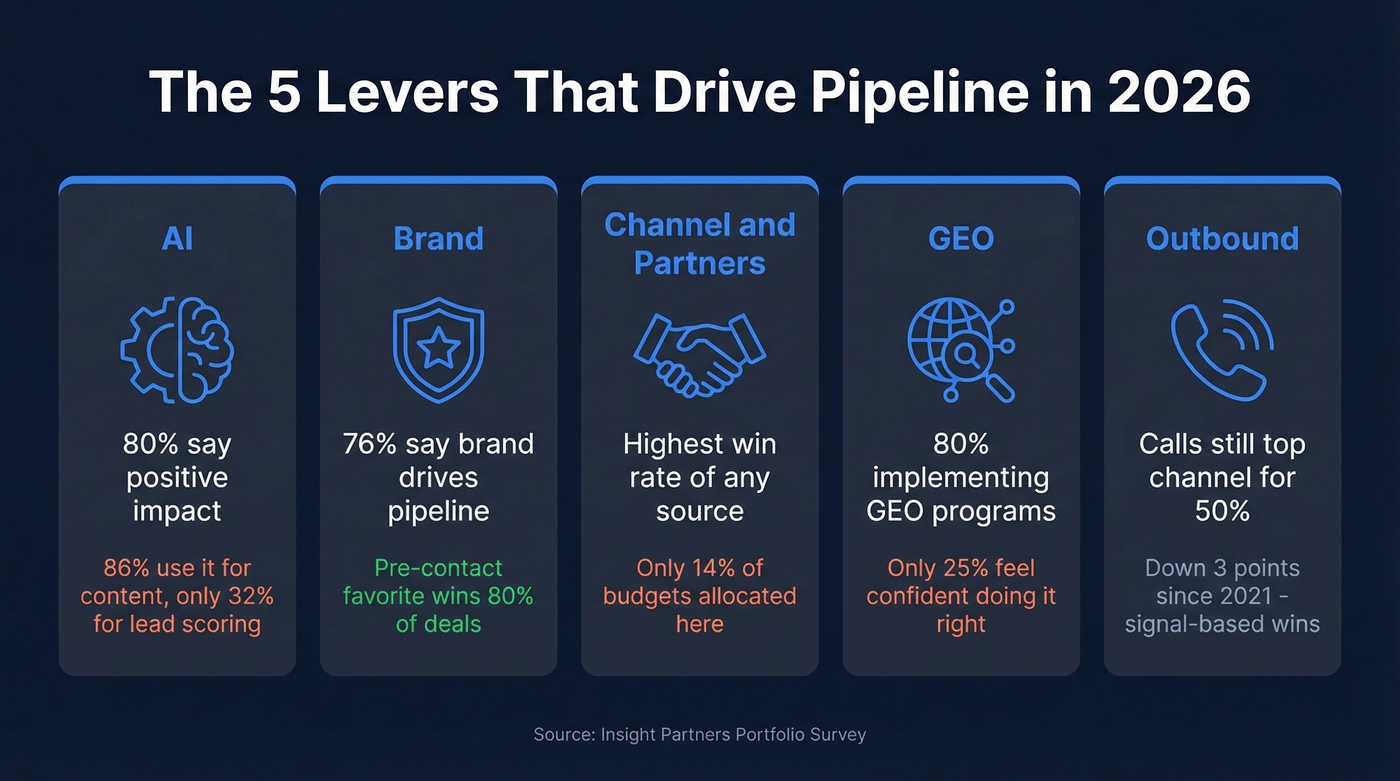
An Insight Partners survey across their portfolio companies frames the 2026 playbook as five levers: AI, Brand, Channel, GEO, and Outbound. Here's what's actually working - and what isn't.
AI
About 80% of respondents said AI had a positive impact on pipeline generation, but 86% use AI for content creation while only 32% use it for predictive analytics or lead scoring. Most teams are using AI to write faster, not to target smarter.
The teams pulling ahead use AI to score accounts, prioritize outreach timing, and personalize across hundreds of accounts simultaneously (see B2B predictive analytics for what “target smarter” looks like in practice). AI-powered RevOps teams close deals 25% faster and see 15% higher win rates. That's the gap between "AI for blog posts" and "AI for revenue."
Brand
Here's the thing: 76% of leaders say strong brand awareness directly impacts pipeline. The pre-contact favorite wins roughly 80% of deals. Connect that to the Day One shortlist stat and brand stops being a vanity metric - it's pipeline insurance. If you're not investing in brand, you're hoping to win from behind every time (start with B2B brand positioning).
Channel & Partners
Partner and channel programs have the highest win rate of any booking source. Yet only 14% of marketing budgets go to partner/channel - a massive misallocation that shows up in the numbers quarter after quarter. With 71% of companies now implementing ABM, the smart play is combining partner intros with account-based targeting to multi-thread into buying committees (use these account-based selling best practices as your baseline).
GEO (Generative Engine Optimization)
80% of teams say they're implementing programs to appear in AI-generated search results, but only 25% feel confident they're doing it right. GEO already accounts for about 4% of marketing-sourced pipeline - a number that didn't exist in prior-year data. The trajectory is clear: if your brand doesn't show up when a buyer asks ChatGPT or Perplexity for vendor recommendations, you're invisible during the research phase.
Outbound
Outbound's share of pipeline is down 3 points since 2021, but calls are still cited as the most impactful channel by 50% of companies. Cold sequences to purchased lists are dead. Signal-based outbound still books meetings. The shift isn't away from outbound - it's away from spray-and-pray (build your motion around these sales prospecting techniques).
Pipeline Benchmarks Worth Knowing
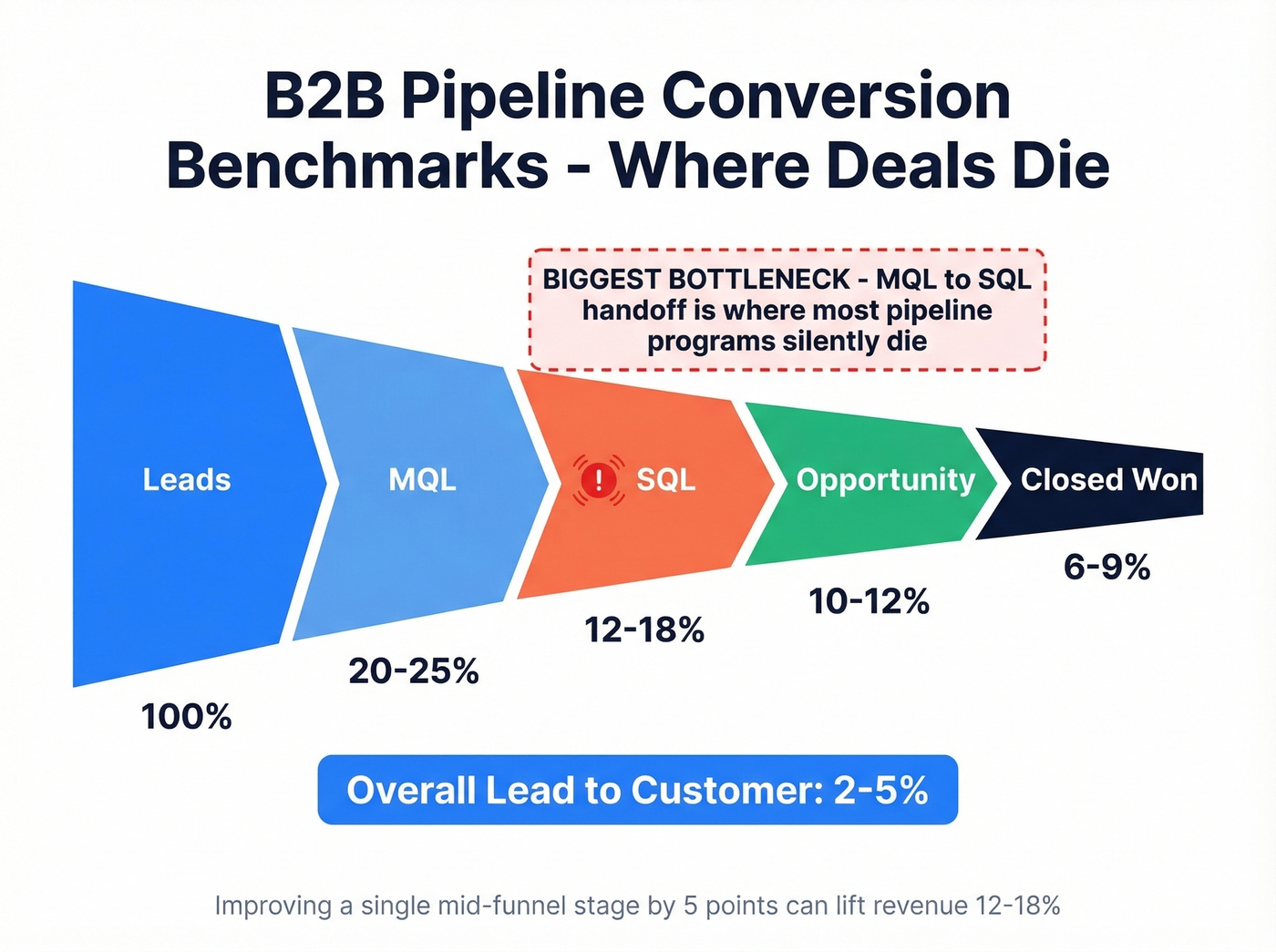
Numbers without context are useless. Here's what "good" looks like across the funnel (compare against broader sales pipeline benchmarks if you need more ranges):
| Stage | Benchmark Range |
|---|---|
| Lead to MQL | 20-25% |
| MQL to SQL | 12-18% |
| SQL to Opportunity | 10-12% |
| Opp to Closed-Won | 6-9% |
| Overall lead-to-customer | 2-5% |
The biggest bottleneck is consistently MQL to SQL. That's where marketing hands off leads that aren't sales-ready, and sales rejects them. Fix that handoff and everything downstream improves.
Channel performance varies dramatically:
| Channel | Visitor to Lead | MQL to SQL | Opp to Close |
|---|---|---|---|
| SEO | 2.1% | 51% | 38% |
| 1.8% | 46% | 32% | |
| Webinars | 2.2% | 30% | 33% |
| PPC | 0.7% | 26% | 35% |
| Events | 1.0% | 24% | 40% |
Events have the highest close rate at 40%, but SEO dominates mid-funnel with 51% MQL-to-SQL conversion. Email marketing delivers $36-40 per $1 spent, and SEO/content ROI often exceeds 700%. For cost context, the average B2B cost per lead sits around $200, with demo request CPLs running $600-$800.
Improving a single mid-funnel stage by just 5 percentage points can lift revenue 12-18%. Most teams obsess over top-of-funnel volume when the real leverage is in the middle. In our experience, the MQL-to-SQL handoff is where most pipeline programs silently die.

The MQL-to-SQL handoff dies when sales dials disconnected numbers and emails bounce. Prospeo's 7-day data refresh, 98% email accuracy, and 125M+ verified mobiles mean your reps spend time selling - not chasing dead leads. Teams using Prospeo book 26% more meetings than ZoomInfo users.
Stop losing pipeline to bad data. Start at $0.01 per verified email.
Metrics That Actually Matter
Pipeline velocity is the single most useful metric for diagnosing pipeline health (pair it with a weekly pipeline health review):
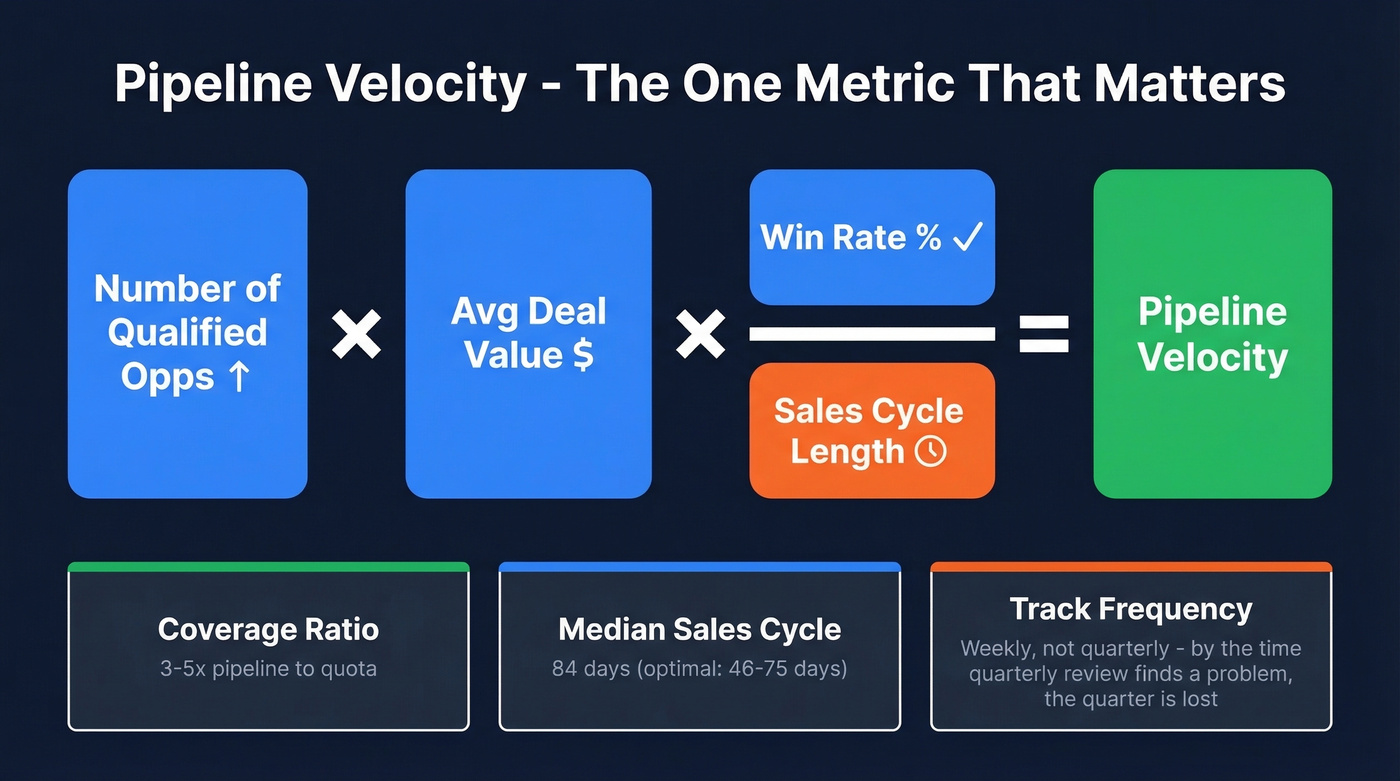
(Number of Opportunities x Average Deal Value x Win Rate) / Sales Cycle Length
Every element is a lever. You can increase velocity by adding more qualified opportunities, increasing deal size through better targeting, improving win rates with stronger sales enablement, or shortening cycles with faster follow-up and clearer buying processes.
High-growth B2B teams maintain a 3-5x coverage ratio - $3-5M in active pipeline for every $1M in quota. Below 3x, you're relying on heroics to hit the number. The median sales cycle runs 84 days, with optimal performance in the 46-75 day range. Track these numbers weekly, not quarterly - by the time a quarterly review surfaces a velocity problem, you've already lost the quarter.
Roadblocks to Building Pipeline
It's Monday morning. Your SDR team opens their prospecting tool and starts dialing. By 10 AM, 35% of the numbers are disconnected, 20% of the emails bounced, and the team has burned through half their daily energy on dead contacts. This isn't a motivation problem. It's a data problem (and it’s one of the most common sales pipeline challenges).
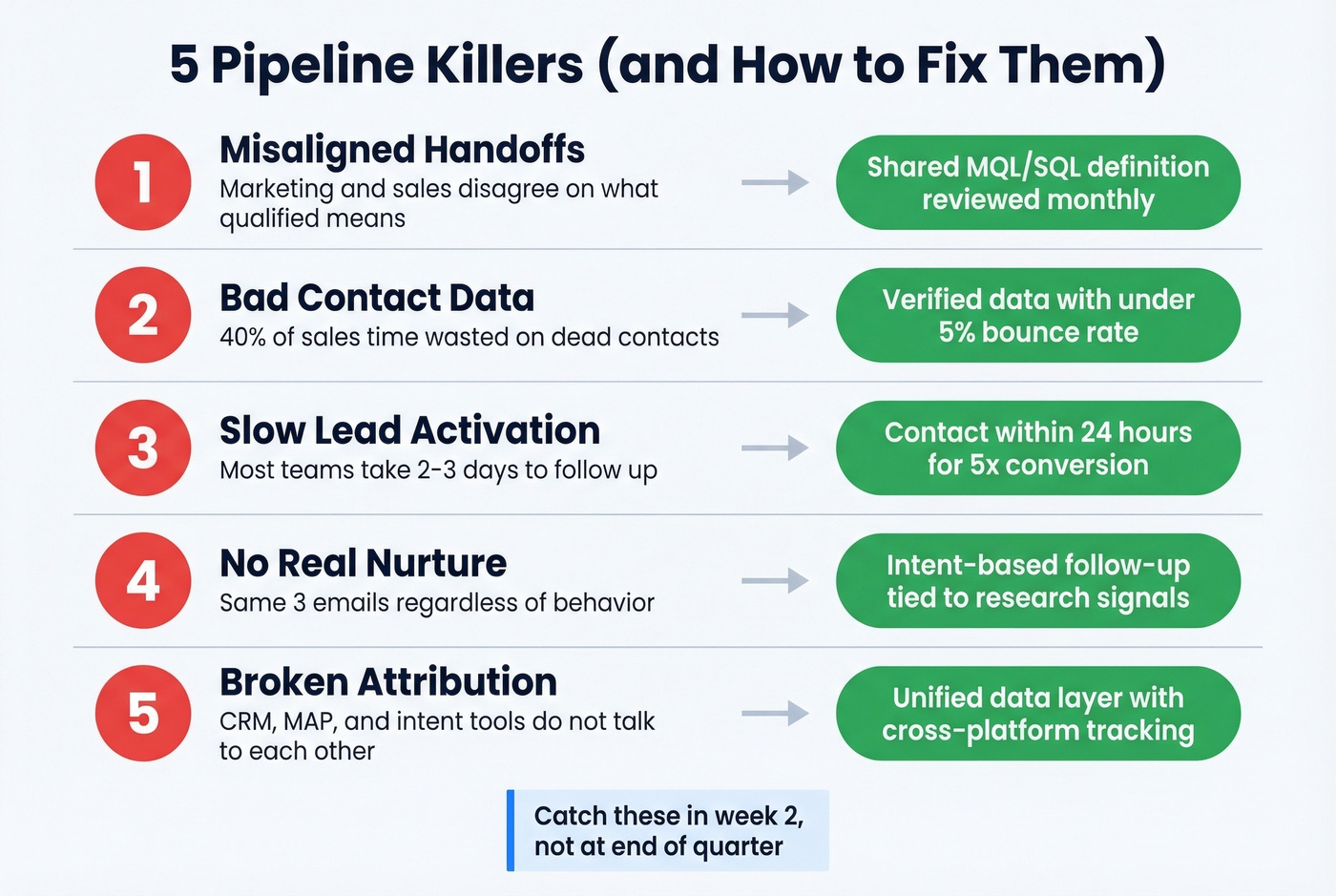
Five failure modes kill pipeline before it has a chance:
Misaligned Handoffs
Marketing and sales don't share a definition of "qualified." MQL volume goes up, SQL volume goes down, and both teams blame each other. The fix is a shared MQL/SQL definition reviewed monthly - not a quarterly slide deck, an actual working agreement with teeth.
Bad Contact Data
Sales teams waste up to 40% of their time dealing with inaccurate or incomplete contact data. Bounced emails destroy domain reputation. Disconnected numbers destroy rep morale.
We've seen teams triple pipeline just by fixing their contact data - before changing a single piece of messaging. When Snyk rolled out Prospeo across 50 AEs, their bounce rate dropped from 35-40% to under 5%, AE-sourced pipeline jumped 180%, and they started generating 200+ new opportunities per month. That's not a tool story. It's a data quality story (if you need options, start with these data enrichment services).

Slow Lead Activation
Contacting leads within 24 hours increases conversion by 5x. Most teams take 2-3 days because of manual routing and approval workflows. Speed-to-lead SLAs aren't optional.
No Real Nurture
Generic drip sequences don't qualify as nurture. Intent-based follow-up - adjusting messaging based on what accounts are actually researching - is what moves leads through the funnel. If your "nurture" is the same three emails regardless of behavior, it's not nurture. It's noise.
Broken Attribution
When your CRM, MAP, and intent tools don't talk to each other, you can't tell what's working. You end up funding channels based on gut feel instead of data. Understanding these pipeline generation challenges early is the difference between diagnosing a problem in week two and discovering it at the end of the quarter.
Tools That Accelerate Pipeline
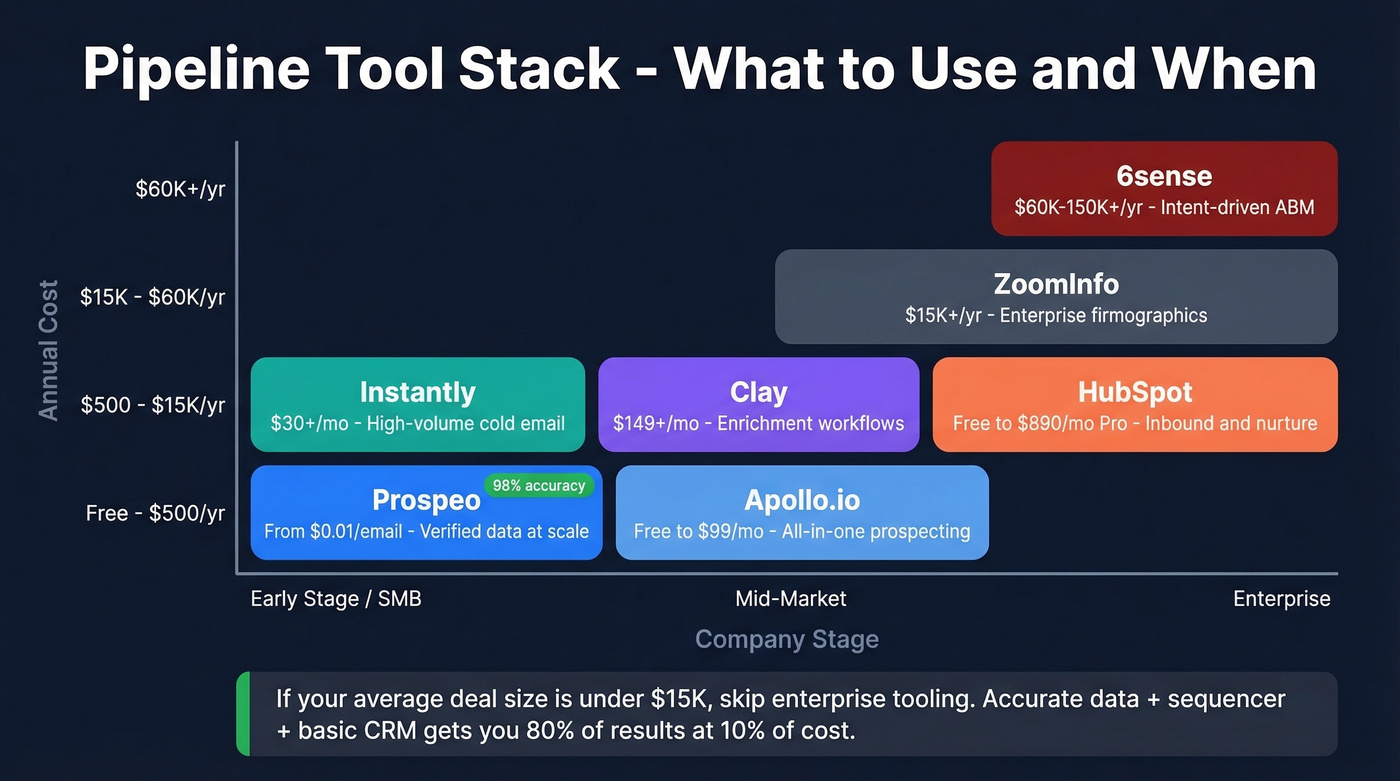
Let's be honest: a lot of pipeline tooling is cheap to start, but the big-ticket systems - data, intent, ABM - can run from $15K/year into the $150K+ range depending on seats and modules. Here's what the landscape looks like (if you're building the stack from scratch, start with these free lead generation tools):
| Tool | Starting Price | Best For |
|---|---|---|
| Prospeo | Free; ~$0.01/email | Verified data at scale |
| Apollo.io | Free; $49-99/mo | All-in-one prospecting |
| ZoomInfo | ~$15K+/year | Enterprise firmographics |
| 6sense | ~$60K-150K+/year | Intent-driven ABM |
| Clay | $149+/month | Enrichment workflows |
| Instantly | $30+/month | High-volume cold email |
| HubSpot | Free; $890/mo Pro | Inbound + nurture |
Bad emails and disconnected numbers upstream corrupt every metric downstream - that's why data accuracy is the foundation layer. When Meritt switched their data source, pipeline tripled from $100K to $300K per week while bounce rates dropped from 35% to under 4%.
Apollo is the best all-in-one option for SMB teams that want prospecting, sequencing, and a 275M+ contact database in one platform. The free tier is genuinely useful. ZoomInfo remains the default for enterprise teams needing deep firmographic data and org charts, though many mid-market teams end up in the $30-60K/year range once you add seats and intent modules.
6sense is for enterprise ABM teams with budget to match. Clay is for RevOps teams building automated enrichment workflows - powerful but technical. Instantly handles high-volume cold email delivery, and HubSpot covers inbound lead capture and nurture automation.
Skip ZoomInfo-level tooling if your average deal size is under $15K. A combination of accurate contact data, a sequencing tool, and a basic CRM will get you 80% of the way there at 10% of the cost. The consensus on r/sales backs this up - most reps in the SMB space say they're over-tooled and under-data'd.
Signal-based outbound beats spray-and-pray - but only if you can actually reach the buyer. Prospeo layers intent data across 15,000 Bombora topics with 30+ filters like job changes, headcount growth, and technographics so you target accounts that are actively in-market.
Reach buyers while they're still building their Day One shortlist.
The 90-Day Pipeline Acceleration Plan
Days 1-30: Foundation. Run a pipeline health audit. Clean your contact data. Align marketing and sales on shared MQL/SQL definitions. Set a coverage ratio target of 3-5x. Refine your ICP using actual closed-won data, not assumptions - we've found that most teams' ICPs drift 20-30% from reality within six months if they're not recalibrated against wins (use an ideal customer profile template to keep it tight).
Days 31-60: Activation. Launch prospecting campaigns against your refined ICP. A/B test messaging across at least two channels. Establish baseline metrics for every funnel stage. Implement a speed-to-lead SLA - 24 hours maximum for inbound leads, same-day for high-intent signals.
Days 61-90: Optimization. Analyze stage conversion rates to find your biggest bottleneck. Build a stalled-deal playbook for opportunities that go dark for 14+ days. Review channel ROI and double down on what's working. Kill what isn't - and be ruthless about it, because the sunk cost fallacy kills more pipeline programs than bad strategy does.
When GreyScout followed this approach - fixing their data foundation first, then scaling outbound - pipeline increased 140% and rep ramp time dropped from 8-10 weeks to 4 weeks.
Pipeline isn't a quarterly initiative. It's a system you build once and optimize continuously. Get the data right, align the teams, and the math takes care of itself. The teams that drive pipeline consistently are the ones that treat it as infrastructure - not a campaign.
FAQ
What does "drive pipeline" mean in B2B sales?
It means generating and advancing qualified opportunities through your sales funnel toward closed revenue - not just filling the top with leads. It's measured by pipeline value, velocity, and stage conversion rates, with a target coverage ratio of 3-5x quota.
How much pipeline coverage do you need?
High-growth B2B teams maintain 3-5x coverage: $3-5M in active pipeline for every $1M in quota. Below 3x, you need nearly every deal to close - which statistically never happens.
What's a good MQL-to-SQL conversion rate?
Industry benchmarks range from 12-18%. Below 10% signals a lead quality problem, a sales-marketing alignment gap, or both. SEO-sourced leads convert at 51%, the highest of any channel.
Which channel drives the most pipeline?
Events close at 40%, SEO converts MQL-to-SQL at 51%, and partner/channel has the highest overall win rate - yet gets only 14% of budget. Diversify across all three rather than betting on a single channel.
How does data quality affect pipeline generation?
Sales teams waste up to 40% of their time on bad contacts. Verified data with bounce rates under 5% improves pipeline velocity by ensuring reps spend time selling, not chasing dead leads. Teams that fix data quality first routinely see pipeline lifts of 100%+ before changing anything else about their process.