

Email Closers: Sign-Offs and Closing Lines That Actually Get Replies
You just spent 20 minutes crafting a cold email to a VP of Sales. The opener's sharp, the value prop's tight, and then you end it with "Best regards" and "Let me know if you're interested." That email is now sitting unread alongside 200 others that end exactly the same way. With 392.5 billion emails expected daily in 2026, your closing line isn't etiquette - it's the difference between a reply and the archive folder.
Here's what most guides get wrong: they treat email closers as one thing. They're actually two. The sign-off ("Best regards," "Thanks") sets tone. The closing line ("Worth a quick chat next week?") drives action. One is a handshake, the other is the ask. You need both working together, and they serve completely different purposes.
What Works (Quick Version)
If you're short on time, here's the cheat sheet:
- Best sign-off for response rate: "Thanks in advance" - 65.7% response rate across 350K+ email threads
- Best cold email closer: "Worth a quick chat?" - low friction, question-based, closes on interest rather than commitment
- The single-CTA rule: Every email gets exactly one ask. Multiple CTAs confuse readers and kill reply rates
- Emails with 1-3 questions get 50% more responses than emails with none - end with a question, always
That's the 80/20. The rest of this piece breaks down exactly why these work and gives you 50+ options for every scenario.
Sign-Offs vs. Closing Lines
Most email advice conflates these two things. Let's separate them.
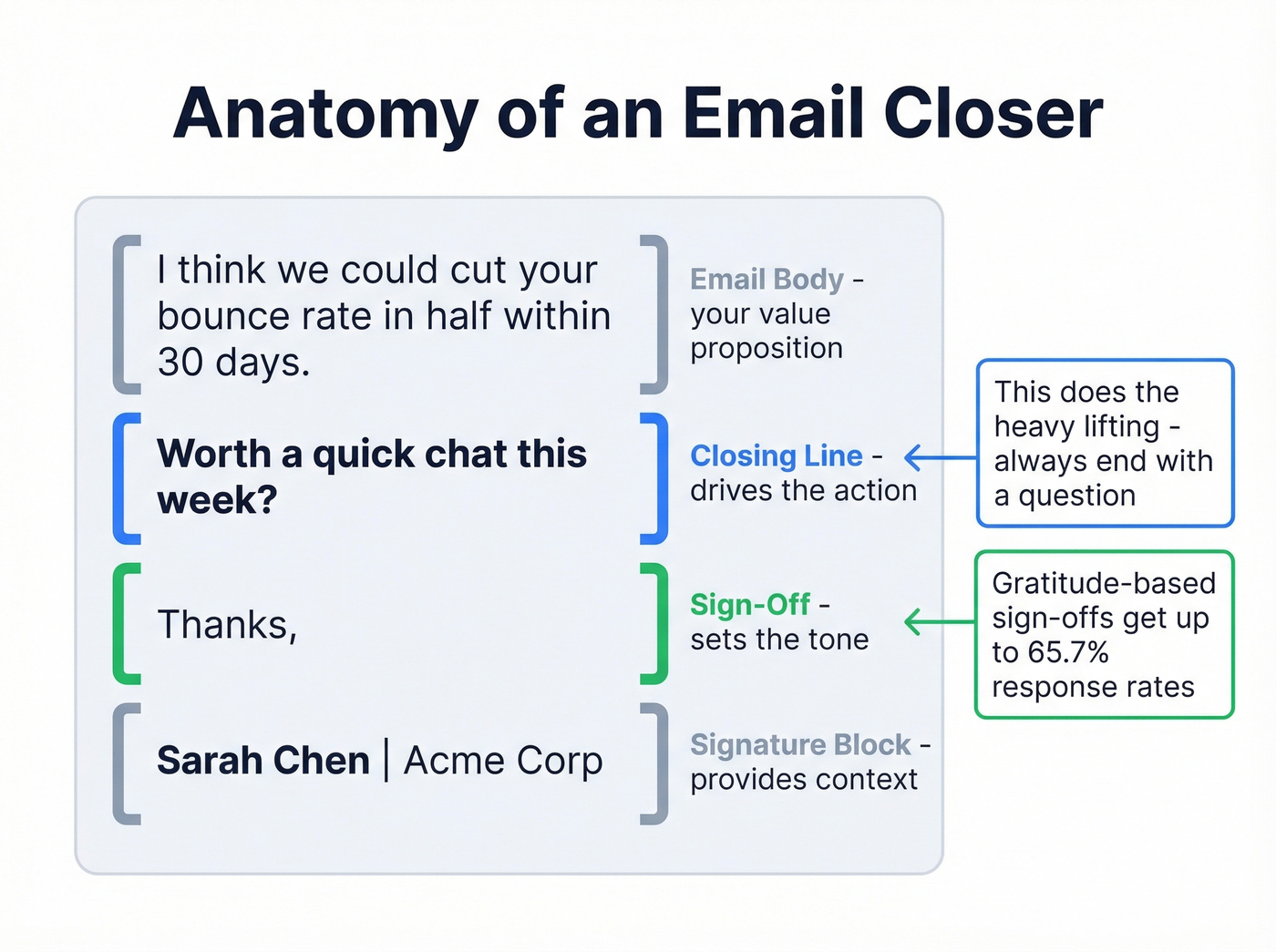
A closing line is the final sentence of your email body - the action you want the reader to take. "Would Thursday work for a 15-minute call?" That's a closing line.
A sign-off is the farewell word or phrase that sits between your closing line and your signature block. "Best regards," "Thanks," "Cheers." It sets emotional tone but doesn't ask for anything.
Here's how they stack in a real email:
...I think we could cut your bounce rate in half within 30 days. ← body
Worth a quick chat this week? ← closing line
Thanks, ← sign-off
Sarah Chen | Acme Corp ← signature block
Three distinct components. The closing line does the heavy lifting, the sign-off reinforces your tone, and the signature provides context. When you optimize all three independently, replies go up - and understanding this anatomy is the first step toward better response rates.
Sign-Offs Ranked by Response Rate
An analysis of 350,000+ email threads by Boomerang found that what you write after your last sentence materially affects whether people reply. Gratitude-based sign-offs outperform neutral ones, and skipping a closing performed worst of all.
If you want a deeper breakdown of closings, see our data-backed guide to email sign-offs.
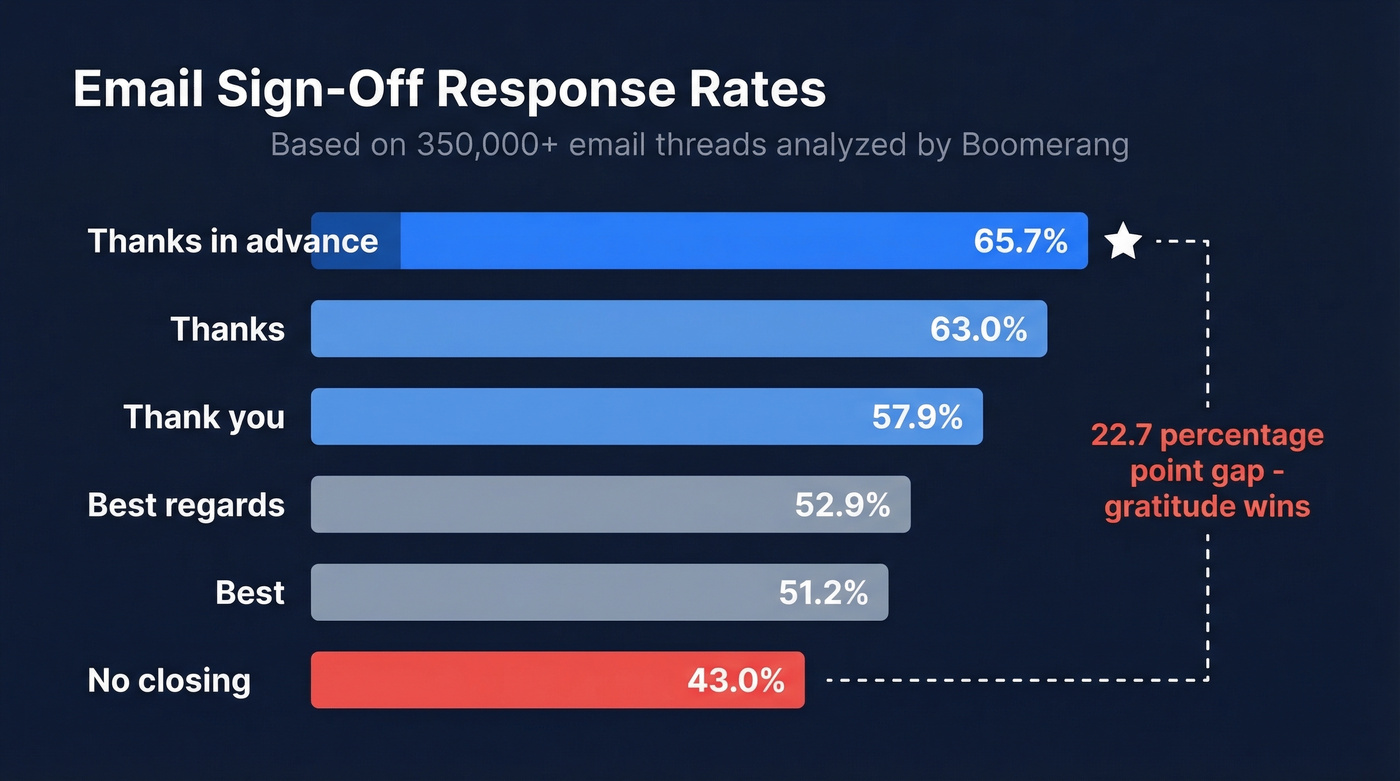
| Sign-Off | Response Rate | Best For |
|---|---|---|
| Thanks in advance | 65.7% | Requests, follow-ups |
| Thanks | 63.0% | General professional |
| Thank you | 57.9% | Formal appreciation |
| Best regards | 52.9% | All-purpose safe choice |
| Best | 51.2% | Casual professional |
| No closing | 43.0% | Never recommended |
The gap between "Thanks in advance" and no closing at all is 22.7 percentage points. That's not a rounding error. Expressing gratitude before someone has even helped you creates a subtle social obligation. It just works.
Formal Sign-Offs
Use these for job applications, executive-level emails, client proposals, and any context where you'd wear a blazer.
- Best regards - The safest all-purpose choice at 52.9%. Works everywhere, offends nobody. If you're unsure, default here.
- Sincerely - Reads as traditional and slightly stiff. Reserve it for cover letters and formal correspondence where warmth isn't the goal.
- Respectfully - Signals deference. Use when you're asking for someone's time or making a request up the chain.
- Kind regards - More deferential than "Best regards." Good when you're requesting a favor or reaching out to someone senior.
- With appreciation - Warmer than "Sincerely" but still buttoned-up. Works well after someone's made time for you.
- Regards - The stripped-down version. Formal without being warm. Fine for routine business correspondence.
If you're emailing executives, the nuance matters - this pairs well with our guide on how to email C-level executives.
Semi-Formal Sign-Offs
The sweet spot for most professional email. You know the person, or want to sound like you do, but it's still a work context.
- Thanks - 63% response rate and feels natural in almost any professional email. Hard to go wrong.
- Thank you - Slightly more formal than "Thanks." Use when you're genuinely appreciating something specific.
- Warm regards - Implies real rapport. It can feel forced if you've never spoken to the person, so save it for established relationships.
- All the best - Friendly without being casual. Works well for networking emails and warm introductions.
- Many thanks - A shade more emphatic than "Thanks." Good when someone's gone out of their way.
- Looking forward - Implies momentum. Use it after scheduling a meeting or confirming next steps.
Casual Sign-Offs
For colleagues, repeat contacts, and contexts where formality would feel weird. A thread on r/sales debated whether "Best" was the laziest sign-off in professional email - the consensus was that it's become so default it registers as nothing. That tracks with the data.
- Cheers - Common in UK/Australian business culture, increasingly accepted in the US. Reads as upbeat and approachable.
- Talk soon - Implies the conversation will continue. Good after a meeting or when you've already established next steps.
- Best - The most overused sign-off in professional email. It's become so default that it registers as wallpaper. If you're going casual, pick something with personality.
- Thanks again - Reinforces gratitude from earlier in the email. Use after someone's already helped you.
- Onwards - Energetic, forward-looking. Works in startup culture and internal emails.
- Take care - Warm and human. Better for people you've met than cold contacts.
- -- [First name] - No sign-off at all, just your name with a dash. Works when you've exchanged 5+ emails in a thread and formality would be absurd.
Cold Email Closers That Book Meetings
Sign-offs set tone. Closing lines drive action. One benchmark library of closing-line templates puts interest-based CTAs at a 30% success rate - roughly double aggressive closing lines. The less commitment you ask for, the more replies you get.
For more options, you can also pull from these meeting request email examples.
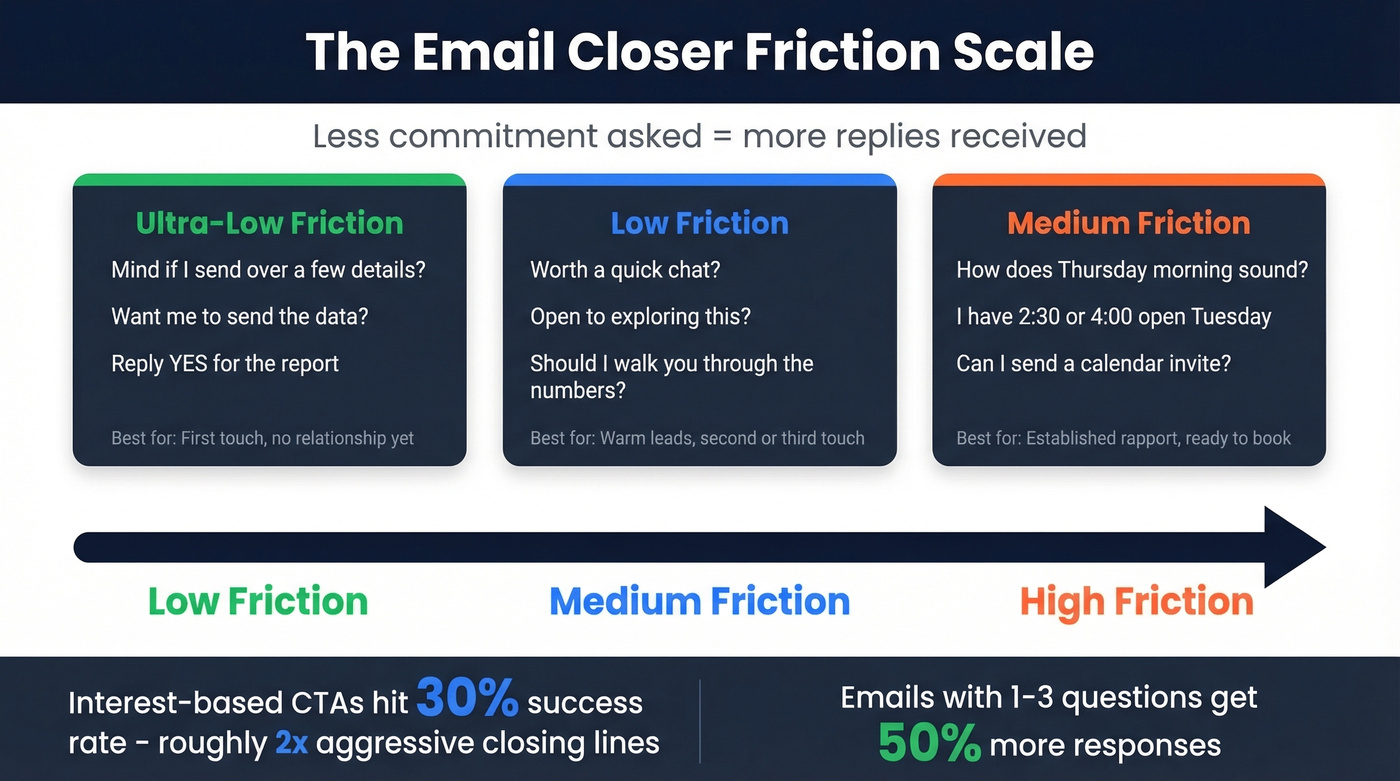
Here's a stat that should shape every cold email you write: emails containing 1-3 questions get 50% more responses than emails with zero questions. Your closing line should almost always be a question.
The most recent large-scale benchmark - Belkins' analysis of 16.5 million cold emails across 93 business domains - found the average reply rate was 5.8%. The best-performing emails ran 6-8 sentences, and single-email campaigns hit 8.4% reply rates. Readability matters too: one widely shared benchmark found a 3rd-grade reading level performed 36% better on open rate than college-level writing. Keep your closer simple enough for a 9-year-old to understand.
Look, a tight 50-125 word email with one killer closing line can outperform elaborate multi-touch campaigns. That word-count range ties to 50%+ response rates in practitioner tests we've seen. Stop overcomplicating it.
If you want to tighten the whole message (not just the ending), start with these outreach email template frameworks.
Ultra-Low Friction
These ask for almost nothing. Perfect for first touches where you have no relationship.
- "Mind if I send over a few more details?"
- "Would you like me to send your ranking heatmap? Just reply 'YES.'"
- "Curious to hear your thoughts on this?"
- "Would a 2-minute case study be useful?"
- "Want me to send the data?"
The "reply YES" variant works because it reduces the response to a single word. No calendar checking, no commitment evaluation - just one keystroke.
Low Friction
A small step up. You're asking for interest, not a meeting.
- "Worth a quick chat?"
- "Worth a 15-minute call next week?"
- "Open to exploring this further?"
- "Would it make sense to connect?"
- "Interested in seeing how this works?"
- "Should I walk you through the numbers?"
"Worth a quick chat?" is the closer we've seen work most consistently across industries. It's short, it's a question, and it lets the prospect say yes without committing to a specific time.
Medium Friction
These propose a specific action. Use them when you've already established some context or rapport.
- "How does Thursday morning sound?"
- "Can I walk you through this in 15 minutes?"
- "Would [date] work for a quick demo?"
- "I have 2:30 or 4:00 open Tuesday - either work?"
- "Can I send a calendar invite for next week?"
Situational Closers
Not every email is a cold outreach. Here are closing lines for the scenarios that don't get enough attention.
Apology / service recovery:
- "What can I do to make this right?"
- "Would a call help sort this out faster?"
- "I want to fix this - what's the best next step?"
Thank-you / post-meeting:
- "Anything else I can pull together before our next call?"
- "Want me to send a summary of what we discussed?"
- "Should I loop in [colleague] to keep things moving?"
Networking / relationship-building:
- "Open to grabbing coffee sometime?"
- "Would love to swap notes - interested?"
- "Any chance you'll be at [event]?"
If you’re doing relationship-first outreach, these networking email templates help keep it natural.
Internal / cross-team:
- "Can everyone drop their numbers in the doc by EOD Thursday?"
- "Any blockers I should know about?"
- "Who else should be in the loop on this?"
Before/After: Close on the Outcome
The biggest response-rate killer in cold email is focusing on your service instead of the prospect's outcome.
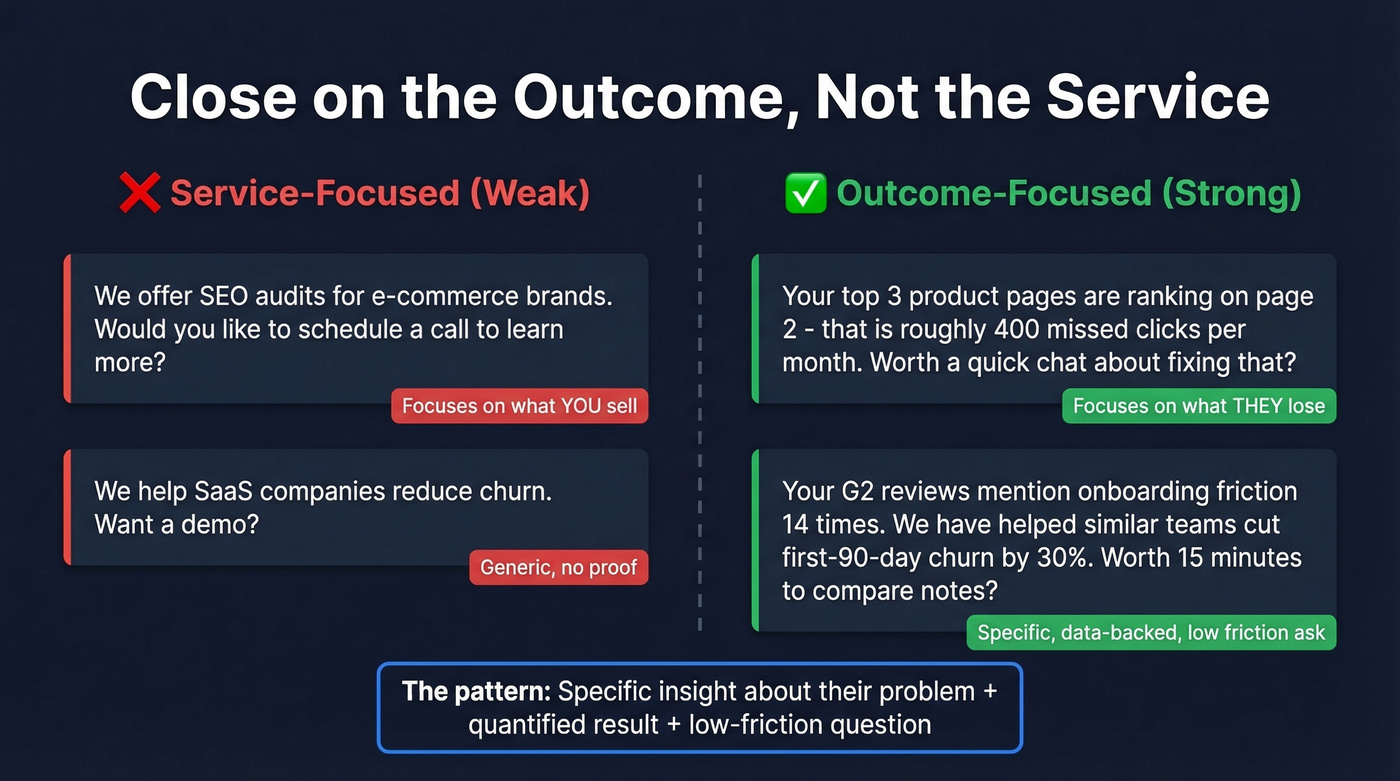
Service-focused (weak): "We offer SEO audits for e-commerce brands. Would you like to schedule a call to learn more?"
Outcome-focused (strong): "Your top 3 product pages are ranking on page 2 - that's roughly 400 missed clicks/month. Worth a quick chat about fixing that?"
Service-focused (weak): "We help SaaS companies reduce churn. Want a demo?"
Outcome-focused (strong): "Your G2 reviews mention onboarding friction 14 times. We've helped similar teams cut first-90-day churn by 30%. Worth 15 minutes to compare notes?"
The strong versions give the prospect a reason to care before asking for anything. Close on what they get, not what you sell.
To sharpen the ask itself, borrow from these best email call to action examples.

The perfect closing line is worthless if it lands in the wrong inbox - or bounces entirely. Prospeo's 98% email accuracy and 7-day data refresh mean your carefully crafted closers actually reach decision-makers. At $0.01 per verified email, bad data stops killing your reply rates.
Stop perfecting closers for emails that never arrive.
How to End a Follow-Up Email
90% of buyers respond within two days of their most recent message, yet only 8% of sales reps follow up more than five times. Most deals require 5-12 touchpoints before closing. The math is obvious: follow up more, and your closing lines get more chances to work.
If you need full sequences, these follow-up email examples make it easy to swipe and adapt.
First Follow-Up
The first follow-up can lift replies up to 49%, so don't overthink it. Keep it short and reference your original email.
Hi [Name], wanted to bump this up in your inbox. The short version: [one-sentence value prop]. Worth a 15-minute conversation this week?
Thanks, [Your name]
Second and Third Follow-Up
Escalate the value, not the pressure. Add a new data point or angle - don't just resend the same email. The third email can drop reply rates up to 20%, so make it count.
Hi [Name], one more thought - [new insight or relevant trigger event]. I think there's a quick win here for [their company]. Open to a brief call, or should I send over the details in writing?
Best, [Your name]
The "or should I send details in writing" gives them a lower-friction alternative to a call. Options reduce resistance.
The Breakup Email
When you've exhausted your sequence, the breakup email creates urgency through finality. The way you close this final email should feel definitive - that's what triggers the response.
If you want more “final touch” language, see these last chance emails.
Hi [Name], I haven't heard back, so I'm going to assume you're all set for now and will close your file. If anything changes, just reply to this email and I'll pick things back up.
All the best, [Your name]
"Close your file" implies a door shutting. We've seen breakup emails pull replies from prospects who ignored four previous touches. The finality triggers loss aversion in a way that polite persistence never does.
Five Rules for Better Email Closers
1. One CTA per email - period. Multiple CTAs confuse the reader and dilute your ask. "Would you like a demo, or I can send a case study, or we could do a quick call" gives the prospect three things to evaluate instead of one. Pick the single most important next step and close on that.
2. Close on the outcome, not the service. "Want to see how we reduce churn?" beats "Want a demo of our platform?" The prospect cares about their problem, not your product.
3. Keep it under one sentence. Your closing line should be 8-15 words. If it takes two sentences to make your ask, you're overcomplicating it. "Worth a quick chat this week?" is 6 words. That's plenty.
4. Match formality to the relationship. A first cold email to a C-suite exec gets "Would next Tuesday work for a brief call?" A follow-up to someone you've already spoken with gets "Want to pick this back up Thursday?" Assess relationship warmth, email context, and industry norms - then pick accordingly. The right way to end an email depends entirely on who's reading it.
5. Verify before you send. Your closing line is irrelevant if the email bounces or lands in spam. Unverified lists often produce double-digit bounce rates, which destroy domain reputation and tank deliverability for every future email. Tools like Prospeo verify emails with 98% accuracy on a 7-day refresh cycle, so your carefully crafted closer actually reaches the inbox instead of getting rejected by the server.
If you want the numbers behind list cleaning, see the benefits of email verification.
You now have 50+ closing lines that drive replies. The next bottleneck is reaching the right people. Prospeo gives you 300M+ verified contacts with 30+ filters - buyer intent, job changes, tech stack - so every crafted email hits a real prospect who can say yes.
Pair better closers with better contacts. Start free today.
Email Closers to Avoid
Multiple CTAs. The number one closer killer. Every additional ask reduces the likelihood of any action. One email, one ask. Always.
"Let me know." You've probably sent hundreds of emails ending with "Let me know" and wondered why nobody ever did. It's vague, passive, and gives the reader nothing specific to respond to. Replace it with a concrete question. Someone on r/sales put it well: "Let me know" is the email equivalent of ending a conversation by staring at someone.
If you catch yourself writing “looking forward” filler, use these alternatives to "Looking Forward to Hearing From You".
Passive-aggressive closings. "Per my last email" and "As previously discussed" signal frustration, not professionalism. If someone missed your point, restate it clearly instead of punishing them for it.
No closing at all. The data shows emails with no sign-off get a 43% response rate - 22.7 points below "Thanks in advance." Skipping the closing feels abrupt and signals you didn't care enough to finish the email properly.
Overly long signature blocks. A signature with your name, title, company, phone, email, address, three social links, a legal disclaimer, and an inspirational quote buries your closing line. Keep signatures to 3-4 lines max.
If you’re rebuilding your footer, here’s what to include in an email signature.
Bonus: turn off open-tracking pixels. Emails without tracking pixels see roughly 3% higher response rates. Prospects and spam filters both notice them. If you're optimizing your closer, don't let a tracking pixel undermine the effort.
Full Email Ending Examples
Five complete email endings - closing line, sign-off, and signature - for different scenarios.
Cold outreach to a VP:
Your team's running 40+ outbound sequences with a 2% reply rate - we've helped similar teams hit 6%+ by fixing targeting upstream. Worth a 15-minute call next week?
Thanks, Jordan Lee | RevOps Lead, Acme
Follow-up after a proposal:
I know budgets are tight this quarter. Happy to adjust the scope to fit - how does a quick call Thursday morning sound?
Best regards, Jordan Lee | Acme
Customer support reply:
I've escalated this to our engineering team and you should see the fix within 24 hours. If anything else comes up, just reply here and I'll jump on it.
Thanks, Alex Rivera | Support, Acme
Networking / warm intro:
Really enjoyed your talk at SaaStr - your point about PLG metrics resonated. Would love to swap notes over coffee sometime. Open to it?
Cheers, Jordan Lee
Internal team email:
Let's lock in the Q3 targets by Friday so we can brief the team Monday. Can everyone drop their numbers in the shared doc by EOD Thursday?
Thanks, Jordan
The pattern across all five: exactly one clear ask, a sign-off that matches the relationship, and a signature that's only as long as it needs to be.
FAQ
What are the best email closers for cold outreach?
Low-friction, question-based closers outperform everything else. "Worth a quick chat?" is the single best all-purpose cold email closer - it's short, non-committal, and easy to say yes to. Interest-based CTAs hit a 30% success rate, roughly double aggressive closing lines. Pair it with "Thanks" or "Thanks in advance" as your sign-off.
What's the most effective email sign-off?
"Thanks in advance" leads at 65.7% response rate across 350,000+ email threads. Gratitude-based closings consistently outperform neutral alternatives. If you only remember one thing from this article: say thanks before they've done anything.
How many CTAs should an email have?
One. Multiple CTAs confuse the reader and dilute your ask. Every email should end with exactly one clear next step. If you're torn between two asks, pick the one with lower friction and save the other for a follow-up.
Does deliverability affect whether my closer works?
Completely. Every bounce damages your sender reputation, making future emails less likely to land - even the ones sent to valid addresses. Verifying your list before you hit send is the bare minimum. We've seen teams go from 35% bounce rates to under 4% just by cleaning their data, and the reply rate difference is night and day.
What's the best closing for a senior executive?
Match formality to the stakes. For C-suite outreach, pair a specific, outcome-focused closing line like "Would next Tuesday work for a brief call?" with "Best regards" or "Thank you." Executives respond to brevity and relevance, not familiarity - keep it under 15 words.