

Email Icebreakers: 7 Openers Backed by Data, Not Vibes
The average cold email reply rate across 16.5 million emails is 5.8% - down from 6.8% in 2023. With roughly 362 billion emails sent daily in 2026, your opener has to earn a read fast or get archived.
Every guide says "personalize your opener." None of them explain where to find the signals or what to do when you don't have one. You don't need 35 templates. You need three core frameworks - signal-based observation, pain-point question, and direct value-first - that cover most situations. Keep emails under 200 words. And verify your list before you write a single opener, because a brilliant icebreaker sent to a dead address gets zero replies.
Where the Icebreaker Fits
Every cold email follows the same skeleton:
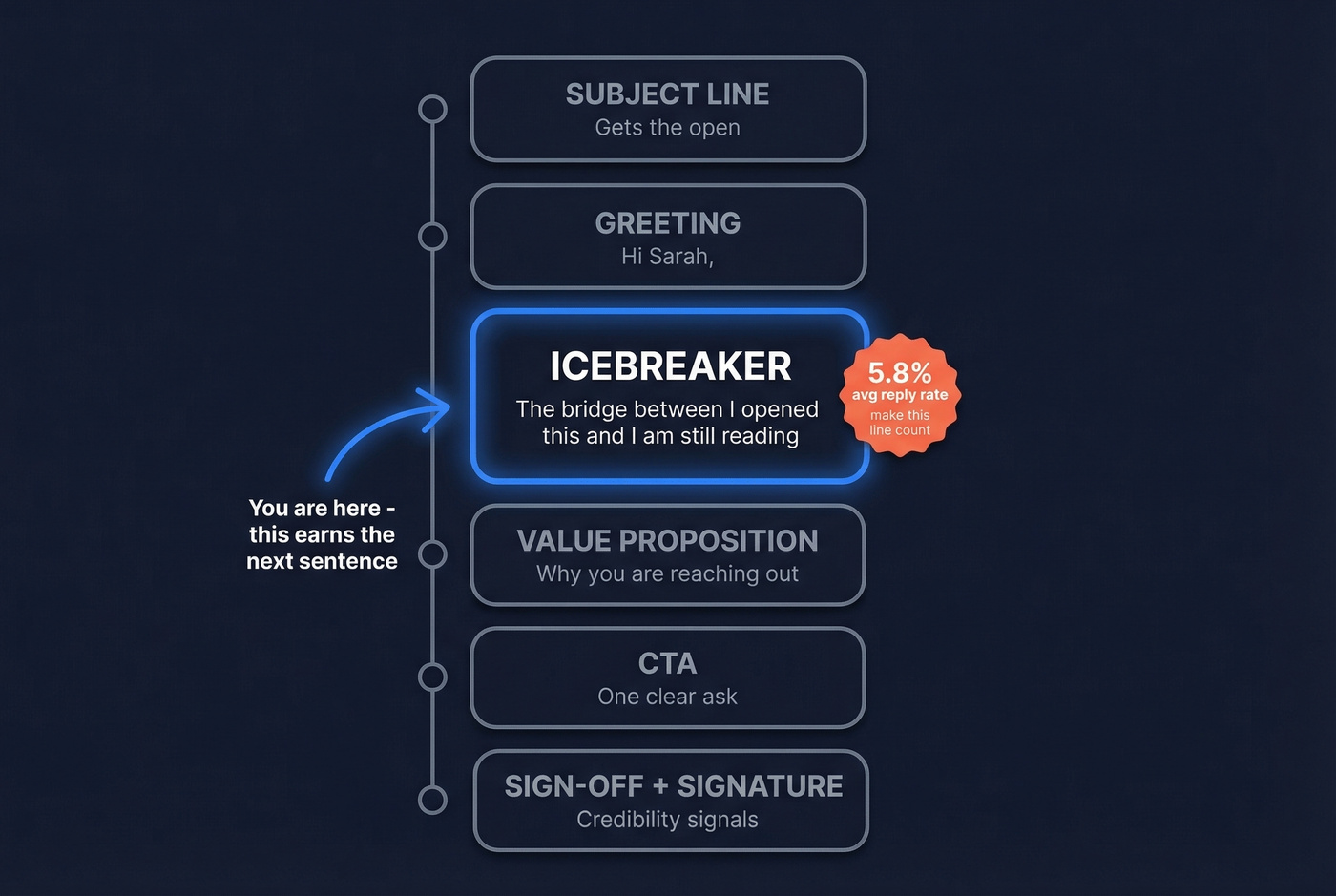
- Subject line - gets the open
- Greeting - "Hi Sarah,"
- Icebreaker - first 1-2 sentences after the greeting
- Value proposition - why you're reaching out
- CTA - one clear ask
- Sign-off + signature - credibility signals
The icebreaker is the bridge between "I opened this" and "I'm still reading." It's not the pitch. It's not the CTA. It's the sentence that earns the next sentence - a line that makes the reader want to keep going.
If you want the full structure, see our guide to a B2B cold email sequence.
7 Cold Email Openers That Work
1. Signal-Based Observation
Reference a specific, verifiable data point the prospect can't dismiss as generic. One DTC practitioner on r/coldemail scraped the Facebook Ad Library and opened with: "Noticed you're running around 40 ads but most of them sending traffic to your homepage." That's not flattery - it's a diagnostic.
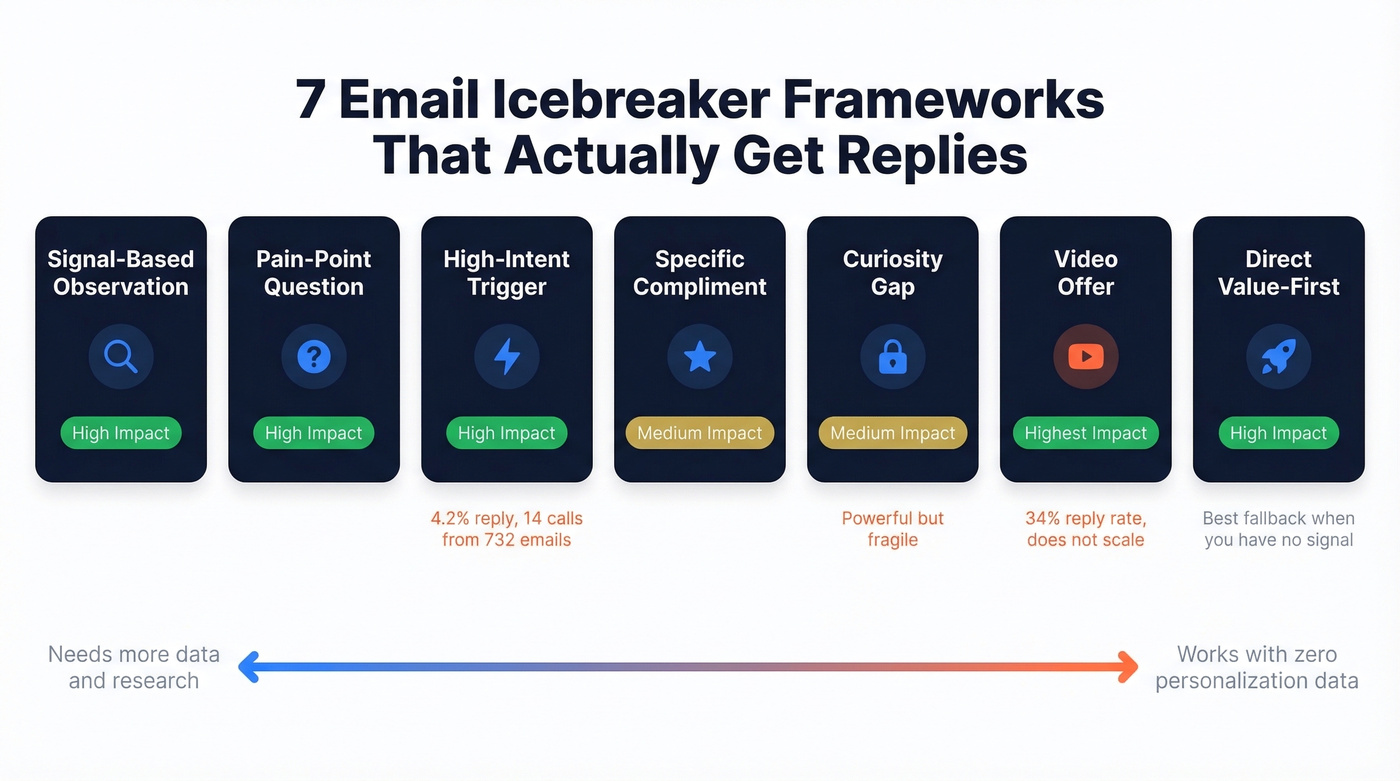
Here's the thing most people miss: from 9,000 scraped domains, only 42 met his ad threshold. Personalization at scale is a filtering game, not a writing game. The icebreaker was easy once the targeting was tight.
This is also why personalized outreach works best when it’s driven by real signals, not guesswork.
2. Pain-Point Question
Lead with a problem the prospect likely has, framed as a question. "Are your SDRs spending more time cleaning CRM data than actually calling?" The question format is disarming - it invites a mental "yes" before the prospect even reads your value prop. We've found pain-point questions work best when they name a specific, measurable frustration rather than something vague like "struggling with growth?"
3. High-Intent Trigger
Monitor job posts, funding rounds, or expansion signals, then reference them directly. A recruiting agency tested this on a 732-email campaign: an opener built around a real hiring trigger plus an immediate offer to send candidates for review. Results: 33 replies (4.2%), 19 positive, 14 booked calls, 3 paid conversions.
The icebreaker worked because it offered immediate value tied to a real, time-sensitive event. Trigger-based outreach beats any AI-generated opener when the signal is strong. (If you need a system for this, use a sales triggers workflow.)
4. Specific Compliment
Generic compliments get deleted. Specific ones get replies.
Reference a podcast episode, a product launch, a campaign you actually saw. "Your breakdown of attribution modeling on the RevOps podcast was the clearest I've heard - especially the bit about last-touch bias." The specificity is the proof. If you can't name a detail, skip the compliment entirely and use a different framework.
5. Curiosity Gap
George Loewenstein's Information-Gap Theory says people feel compelled to close the gap between what they know and what they don't. "I found something in your checkout flow that's likely costing you 8-12% of conversions. Happy to share if useful." Be specific enough to be credible, vague enough to require a reply. This one's powerful but fragile - if you can't actually deliver on the tease, you'll burn trust permanently.
6. Video Offer
A practitioner tested a simple "I recorded a video for you" opener on 150 e-commerce brands and hit a 34% reply rate. The email was short: "I saw your ad on Facebook... I shot a special strategy video breaking down what I'd change. Want me to send it?" No link, no pitch, just a Loom screenshot.
After someone replied "yes," he sent a 3-5 minute Loom breakdown - and about 60% of people who received the video booked a call. The tradeoff is obvious: this doesn't scale to thousands of prospects. But for high-value accounts, nothing we've seen comes close.
If you want to operationalize this, build a repeatable Loom video cold email workflow.
7. Direct Value-First
If you don't have a genuine personalization signal, skip the forced opener and lead with what you can do. "We help Series B SaaS companies cut CRM enrichment costs by 40%. Here's how."
A direct opener beats a fake one every time. I'd rather send a clean value-first email than a "loved your post!" opener that fools nobody.
What NOT to Write
Kill these from your templates immediately:
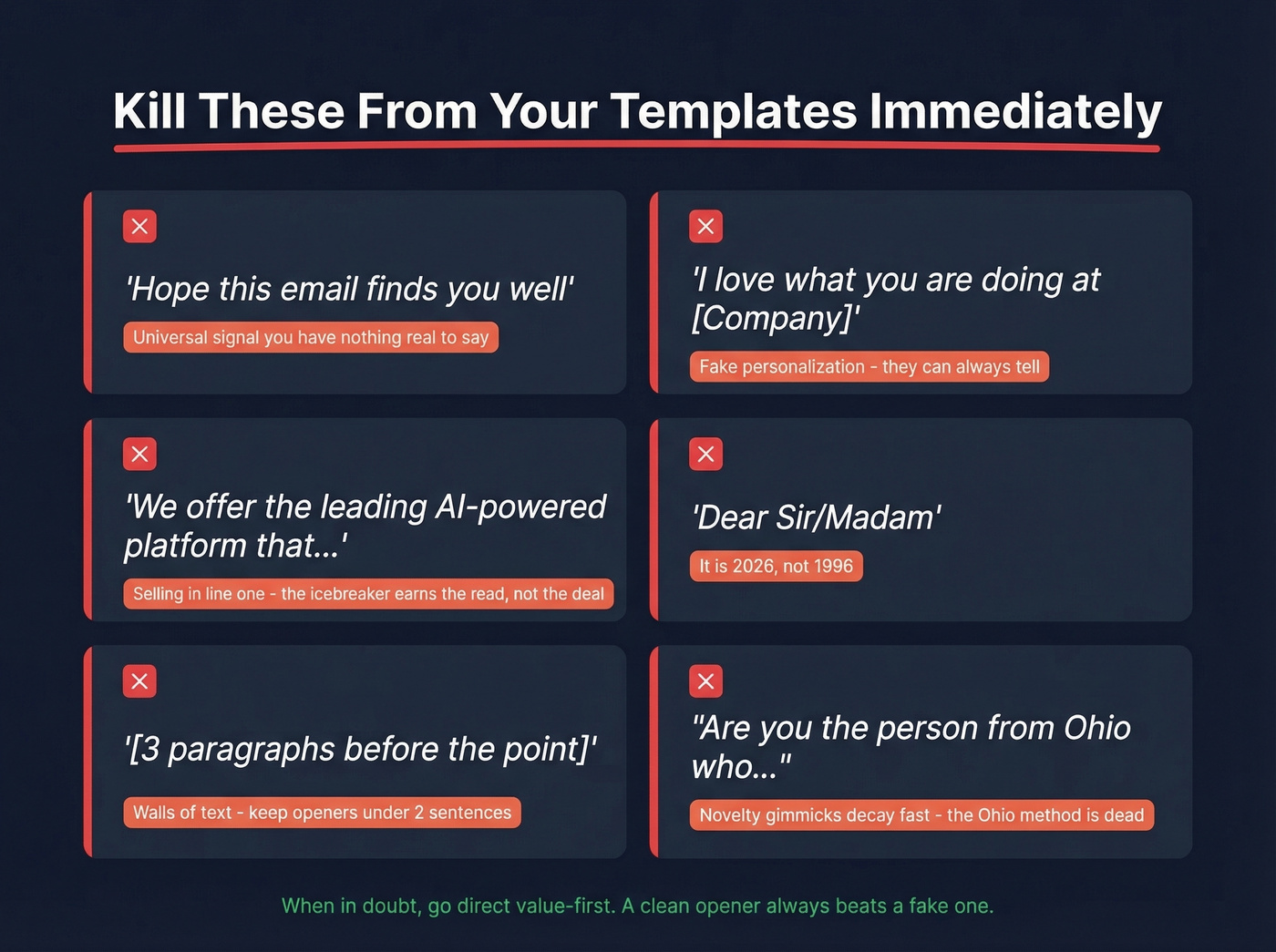
- "Hope this email finds you well" - the universal signal that you have nothing real to say
- Fake personalization - "I love what you're doing at [Company]" with no specifics. As one r/coldemail commenter put it: "Don't fake the personalization. They can tell."
- Selling in line one - the icebreaker earns the read, not the deal
- Walls of text - anything over 150 words in the opener section and you've already lost
- "Dear Sir/Madam" - it's 2026, not 1996
- Multiple links or attachments - spam filters and humans both hate these
- The Ohio method email - a meme opener that circulated in sales communities. It was novel for about a week, then became the new "Hope this finds you well." Novelty gimmicks decay fast.

Signal-based icebreakers need real signals. Prospeo gives you 50+ data points per contact - job changes, funding rounds, tech stack, and buyer intent across 15,000 topics - so you always have something specific to open with. At $0.01 per email with 98% accuracy, your brilliant opener actually reaches a real inbox.
Stop writing icebreakers for email addresses that bounce.
The Numbers Behind Great Openers
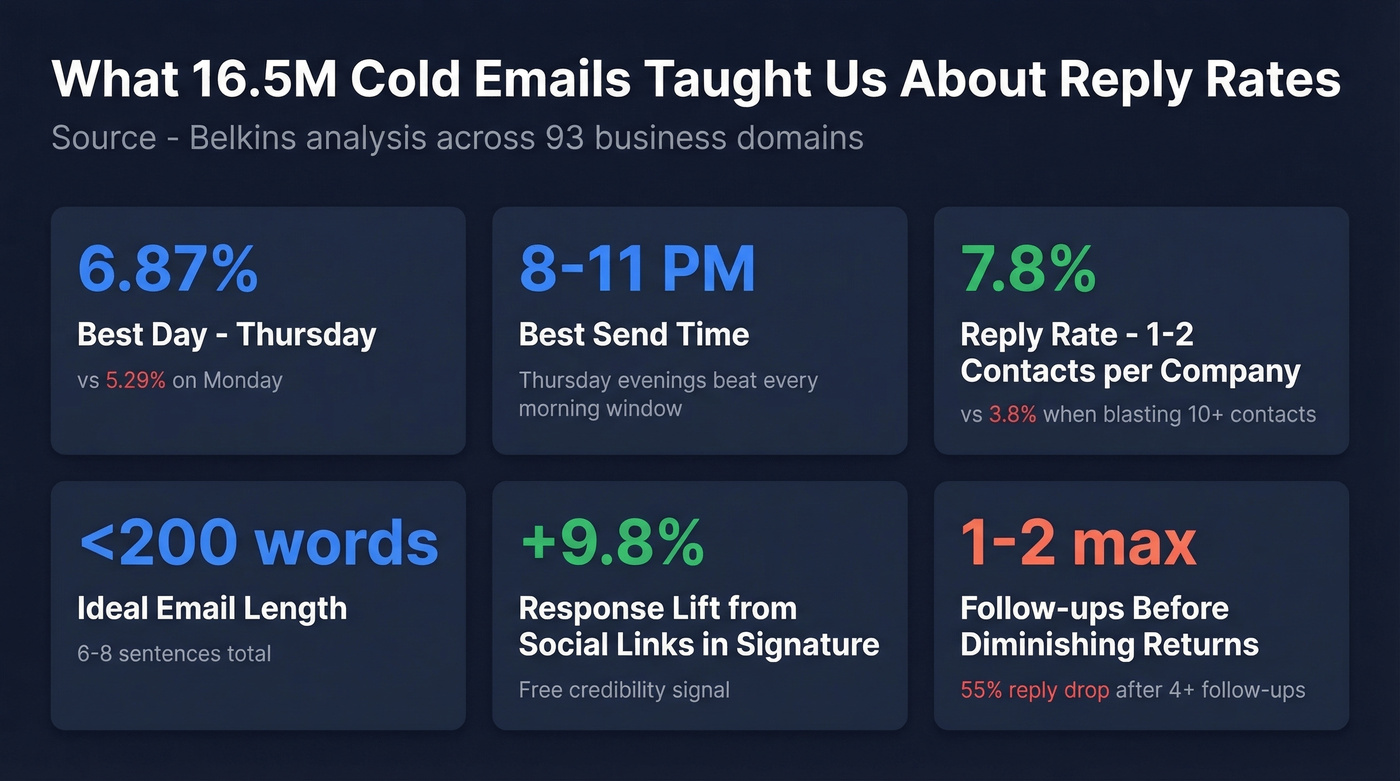
Belkins analyzed 16.5 million cold emails across 93 business domains. Here's what the data says:
| Factor | What Works | What Doesn't |
|---|---|---|
| Length | 6-8 sentences, <200 words | 10+ sentences, 300+ words |
| Best day | Thursday (6.87%) | Monday (5.29%) |
| Best time | 8-11 PM (6.52%) | Morning windows |
| Targeting | 1-2 contacts/company (7.8%) | 10+ contacts/company (3.8%) |
| Follow-ups | 1-2 follow-ups | 4+ (55% reply drop) |
| Tracking | Pixels off (+3% response) | Open tracking on |
The targeting stat is the one most teams ignore. Blasting 10+ people at the same company doesn't just halve your reply rate - it doubles your spam complaint risk. Complaint rates jumped from 0.5% on email #1 to 1.6% by email #4.
One free win: adding social profile links to your signature lifts response rates by 9.8%. It's a credibility signal that costs nothing.
The evening timing surprised our team too - Thursday nights between 8-11 PM outperformed every morning window in the dataset. Let's be honest: most of us assumed mornings were king. The data says otherwise. (If you want a deeper breakdown, see the best time to send cold emails data.)
Bad Data Kills Good Openers
Here's what every icebreaker guide ignores: none of this matters if the email bounces.
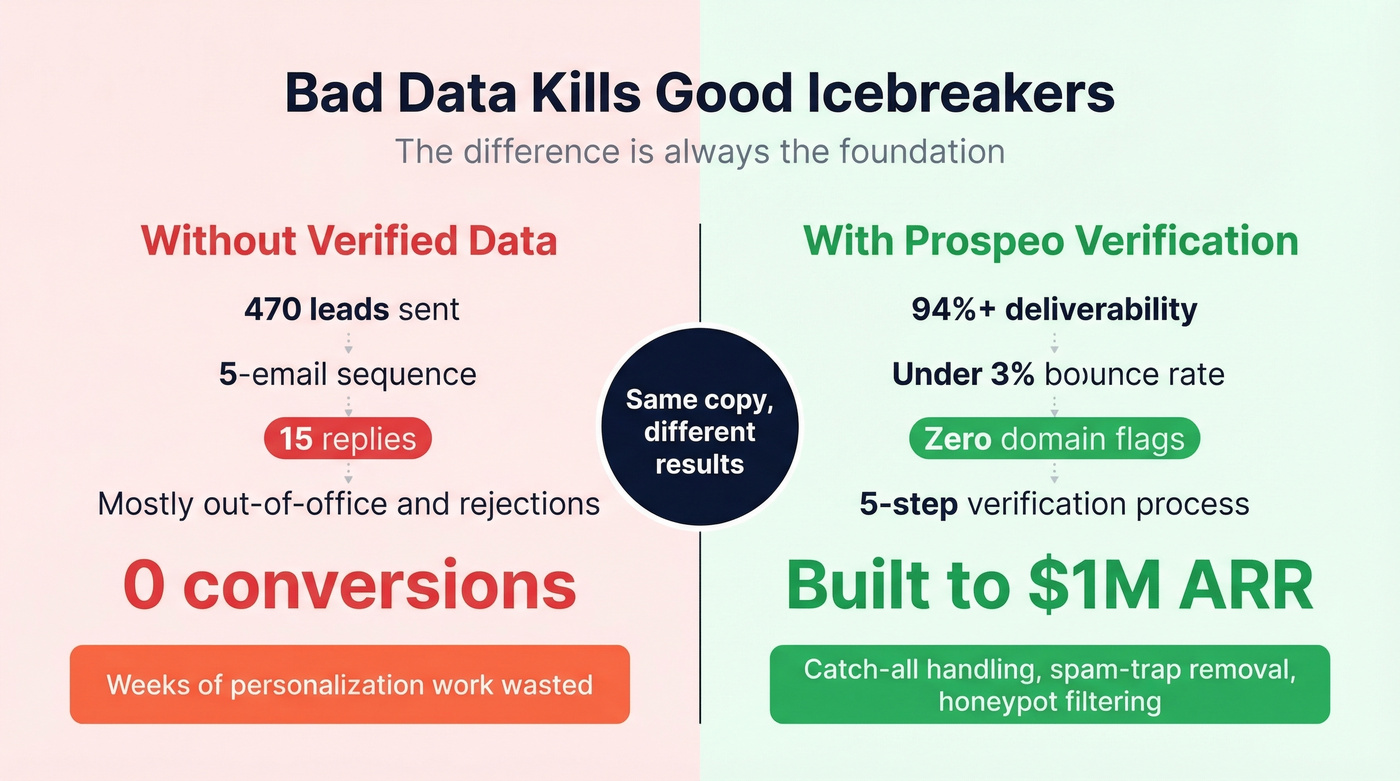
That same DTC practitioner ran a 470-lead, 5-email sequence and got 15 replies - mostly out-of-office and rejections - zero conversions. The problem wasn't the copy. It was unreliable enrichment data that led to bad qualification and dead addresses. Frustrating doesn't begin to cover it: weeks of personalization work, wasted because the foundation was rotten.
If you’re diagnosing this, start with email bounce rate benchmarks and fixes, then work backward into list quality.
Contrast that with Stack Optimize, which built to $1M ARR while maintaining 94%+ deliverability and under 3% bounce rates across every client campaign. Zero domain flags. The difference was running every contact through Prospeo's 5-step verification - catch-all handling, spam-trap removal, honeypot filtering - before sending a single email. At roughly $0.01 per lead with a free tier of 75 emails per month, the data layer is the cheapest insurance you'll buy.
For the full technical checklist, use an email deliverability guide and a dedicated email spam checker before scaling volume.
AI Icebreaker Tools
The tool matters less than the signal you feed it. Here's the current lineup:
| Tool | What It Does | Starting Price |
|---|---|---|
| SmartWriter | AI-generated personalized openers | $49/mo |
| Lemlist | Outreach + AI icebreaker credits | $55/mo |
| Reply.io | Outreach + AI opener generation | $49/mo |
| Instantly | Outreach + deliverability infra | $30/mo |
| Saleshandy | Outreach + AI personalization | $25/mo |
| Woodpecker | Outreach automation | $20/mo |
All of these tools assume you already have verified contact data. A personalized AI opener sent to a bounced address is wasted compute and wasted domain reputation. In our experience, teams that verify contacts first and then layer on AI copy consistently outperform those who do it the other way around. Skip the AI step entirely if your list isn't clean - you're just automating failure.
If you’re comparing options, start with our roundup of SDR tools and then narrow down to an AI email checker for list + copy QA.
The data above proves it: targeting 1-2 contacts per company gets 7.8% reply rates. Prospeo's 30+ search filters - buyer intent, department headcount, technographics, job changes - let you find exactly the right person before you write a single word. 300M+ profiles, refreshed every 7 days, so your signals are never stale.
Great icebreakers start with knowing exactly who to email.
FAQ
What's a good cold email reply rate?
Anything between 5-10% is solid, 10-15% is excellent, and 15%+ is best-in-class on tightly targeted segments, per Instantly's 2026 benchmarks. The average across the 16.5M-email dataset was 5.8%. If you're below 3%, fix your list or deliverability before touching the copy.
How long should an icebreaker be?
One to two sentences, max. The full email should run 6-8 sentences and stay under 200 words. The opener's job is to earn the next sentence, not tell your life story. If your icebreaker is longer than your value prop, you've lost the plot.
Should I use AI for cold email openers?
AI tools save real time on personalization at scale, but they're only as good as the data you feed them. Common failure modes include hallucinated details, wrong role references, and generic compliments that sound automated. Verify your contact list first, then let AI handle the copy.
What are the best email icebreakers for cold outreach?
Signal-based observations and high-intent triggers consistently outperform everything else when you have the data to back them up. For teams that don't have a genuine personalization signal, go direct value-first. The worst thing you can do is fake it with a vague compliment - prospects spot those instantly, and you burn trust before you've earned any.
What makes a good opener different from a bad one?
Good openers earn the next sentence without asking for anything. Bad ones either sell too early or fake familiarity. The simplest test: read your opener out loud. If it sounds like something you'd actually say to someone you respect, keep it. If it sounds like a template, rewrite it.