

Email Marketing Lead Generation: What Actually Works in 2026
You send your first campaign to 5,000 contacts. Within hours, 750 bounce. That's a 15% bounce rate, and your sender reputation tanks before you've generated a single lead. The instinct is to blame the copy, the subject line, the offer. But the real problem is upstream. Email marketing lead generation starts with data quality, not copywriting.
The channel itself isn't the issue. 73% of B2B decision-makers prefer sellers to contact them via email, and 86% of marketers rate email ROI as good to excellent. Email works. Bad data, lazy list building, and batch-and-blast tactics don't.
What You Need (Quick Version)
You don't need 23 tactics. You need three things working together:
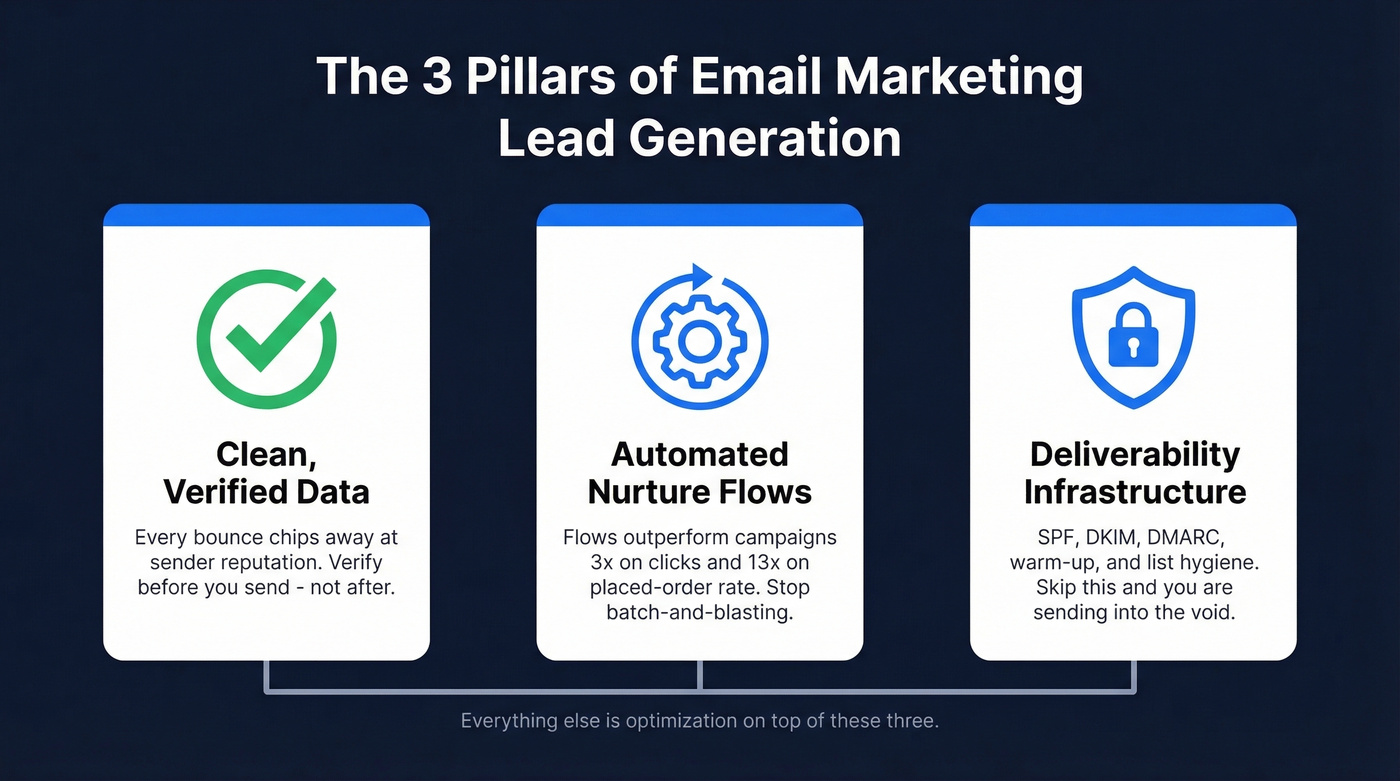
Clean, verified data before you send anything. Every bounced email chips away at your sender reputation. Get this wrong and nothing else matters. (If you’re troubleshooting bounces, start with bounce rate benchmarks and fixes.)
Automated nurture flows, not batch newsletters. Klaviyo's data across 183,000+ brands shows automated flows outperform campaigns roughly 3x on clicks and 13x on placed-order rate. Triggered emails represent just 2% of send volume but drive 41% of email revenue. If you need a framework for building these, use personalized drip campaigns.
Deliverability infrastructure. Authentication (SPF, DKIM, DMARC), proper warm-up, and ongoing list hygiene. Skip this and you're sending into the void. For a deeper checklist, see our email deliverability guide.
Everything else is optimization on top of those three pillars.
What's Changed for Email Lead Generation
The rules have shifted in the last 18 months:
- Apple MPP broke open rates. Mail Privacy Protection pre-loads tracking pixels, inflating open rates across the board. Click and conversion metrics are now the only reliable signals. (If you still rely on opens, review email tracking pixels.)
- Big databases are decaying. The consensus on r/b2bmarketing is blunt: bulk databases like Apollo and ZoomInfo are producing dropping reply rates and deliverability hits. One practitioner put it plainly - "70% of phone numbers are wrong."
- Intent-based sourcing is replacing bulk scraping. Smart teams track job changes, funding rounds, and competitor engagement as timing signals rather than blasting static lists. (If you want a scoring approach, use identifying buying signals.)
- AI raised the bar. 64% of marketers now use AI in email for personalization, subject line optimization, and send-time tuning. "Personalized" means something different than it did two years ago. If you’re upgrading your workflow, start with AI for sales emails.
Here's the thing: if your deal sizes sit below the $10k mark, you probably don't need ZoomInfo-level data spend. A lean stack - verified data, a solid ESP, and three or four automated sequences - will outperform an enterprise suite you're using at 20% capacity.
Benchmarks Worth Tracking
Two benchmark sets matter: one for marketing email, one for automated flows.
Campaign Benchmarks
| Metric | All Industries | Ecommerce | Business & Finance |
|---|---|---|---|
| Open Rate | 35.63% | 29.81% | 31.35% |
| Click Rate | 2.62% | 1.74% | 2.78% |
| Unsub Rate | 0.22% | 0.19% | 0.15% |
Mailchimp benchmarks, billions of emails scanned.

Flows vs. Campaigns (Klaviyo, 183K+ Brands)
| Metric | Campaigns | Flows | Top 10% Flows |
|---|---|---|---|
| Click Rate | 1.69% | 5.58% | 10.48% |
| Placed Order | 0.16% | 2.11% | 4.30% |
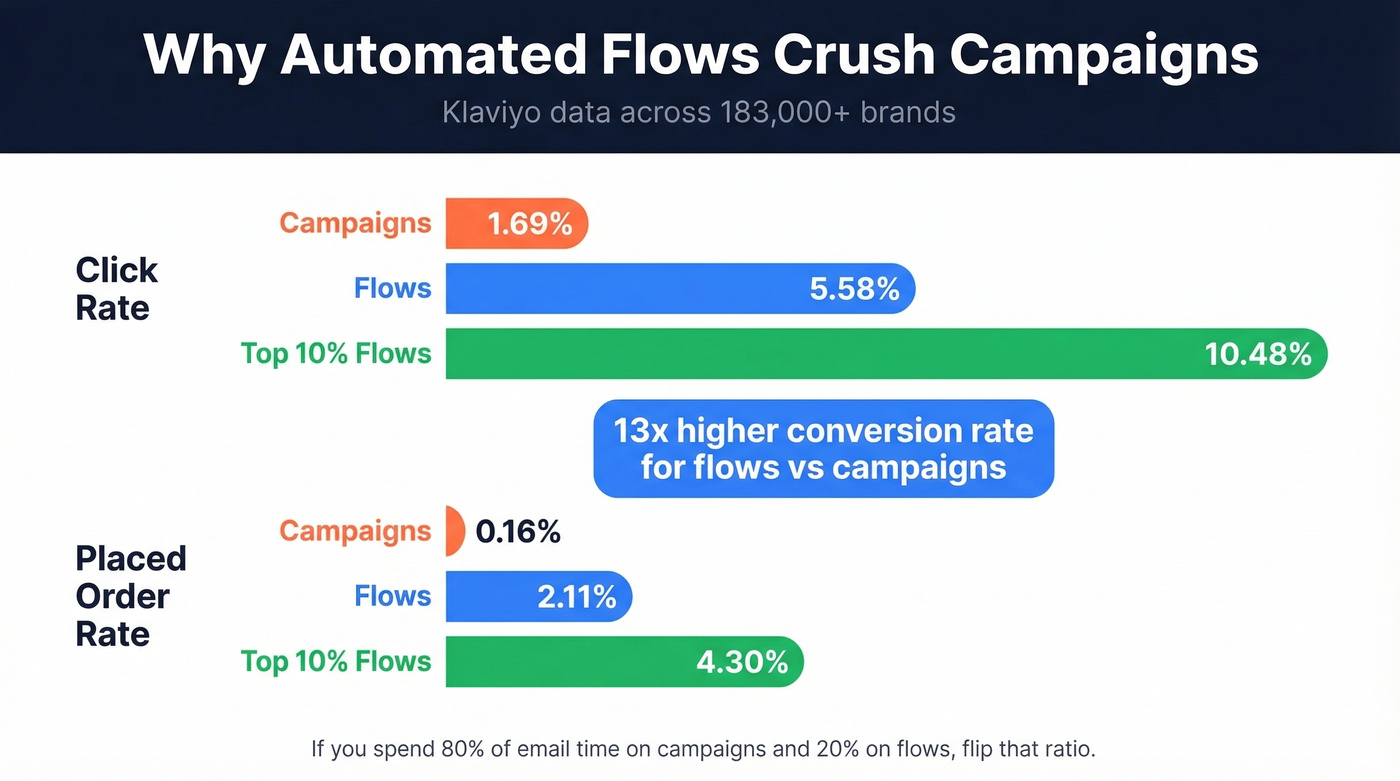
Automated flows convert at roughly 13x the rate of campaigns on placed-order rate. If you're spending 80% of your email time on campaigns and 20% on flows, flip that ratio.
Open rates in both datasets are inflated by Apple MPP - track clicks, replies, and revenue per subscriber instead. Brevo's benchmark roundup, based on analysis of 44B+ emails, also points to Monday and Tuesday as the best send days, with Saturday and Sunday the worst. (For cold outreach timing, see best time to send cold emails.)
Techniques That Actually Work
Most "email lead gen strategy" articles list 15-20 tactics. We've found three methods cover 90% of results.
Lead Magnets + Double Opt-In
Use this if you're building an inbound list from scratch or your opt-in rate is below 2%.
Skip this if you're running pure outbound with no content engine.
The lead magnet itself matters less than the value exchange. Templates, checklists, and "what not to do" guides consistently outperform 47-page ebooks nobody reads. Double opt-in adds friction but dramatically improves list quality and keeps spam traps out. Email converts best when paired with at least one other channel - social touches, retargeting, or direct mail amplify everything. Match the magnet to a specific pain point, not a broad topic, and you'll see opt-in rates climb.
Automated Nurture Sequences
Use this if you have any list over 500 contacts and aren't running triggered sequences yet.
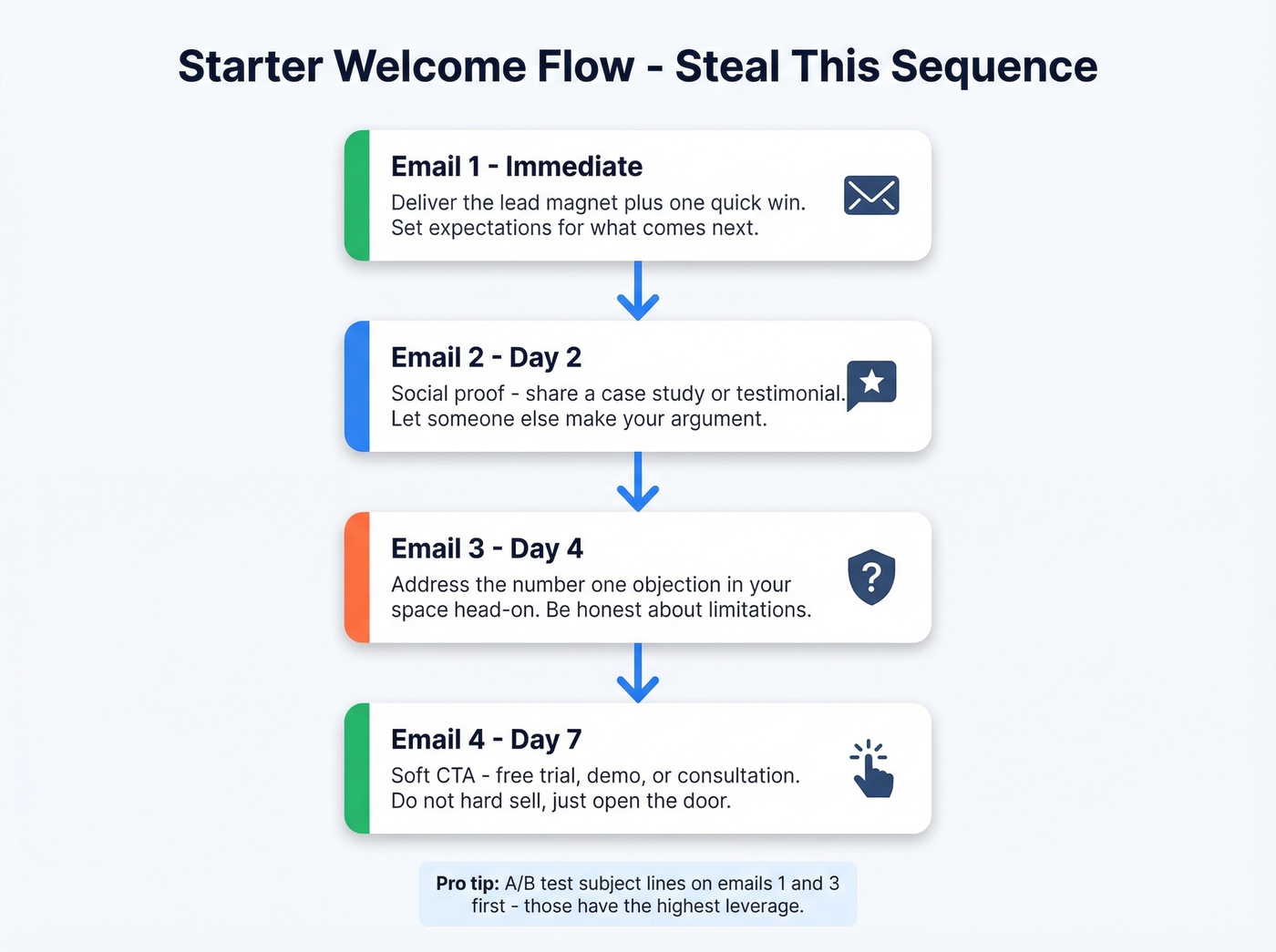
Here's a starter welcome flow skeleton you can steal:
| Timing | Purpose | |
|---|---|---|
| 1 | Immediate | Deliver the lead magnet + one quick win |
| 2 | Day 2 | Social proof - case study or testimonial |
| 3 | Day 4 | Address the #1 objection in your space |
| 4 | Day 7 | Soft CTA - free trial, demo, or consultation |
This 4-email sequence will outperform months of weekly newsletters. It works because each message has a clear job. Start by A/B testing subject lines on emails 1 and 3 first; those have the highest leverage. (If you need ideas, pull from email subject line examples.)
Intent-Based Outbound
Use this if you're doing B2B outbound and reply rates have dropped below 2%.
The old playbook - scrape a big list, blast a sequence - is dead. The new playbook: identify prospects showing buying signals like job changes, funding rounds, or competitor engagement, verify their contact data, and reach out with relevant context. This shift from volume to precision is what separates effective lead generation emails from messages that get ignored. If you want a full build, use a B2B cold email sequence.
We've tested this approach extensively. Prospeo's 30+ search filters include buyer intent signals powered by Bombora, covering 15,000 topics, and with 98% email accuracy and a 7-day data refresh cycle, you're reaching real people at real addresses - not bouncing off stale data from a database that refreshes every six weeks.

Quick CPL math: If you spend $99/month on verified data and generate 40 qualified leads, that's $2.48 per lead. Compare that to the $50-200 CPL range common in B2B paid search. Email outbound with clean data is still the cheapest channel for qualified pipeline.

Bad data is the #1 reason email lead gen campaigns fail. Prospeo's 5-step verification delivers 98% email accuracy with a 7-day refresh cycle - so you're never blasting stale lists. At ~$0.01 per email, clean data costs less than a single bounced opportunity.
Stop tanking your sender reputation with unverified contacts.
The Deliverability Playbook
None of the strategies above matter if your emails land in spam.
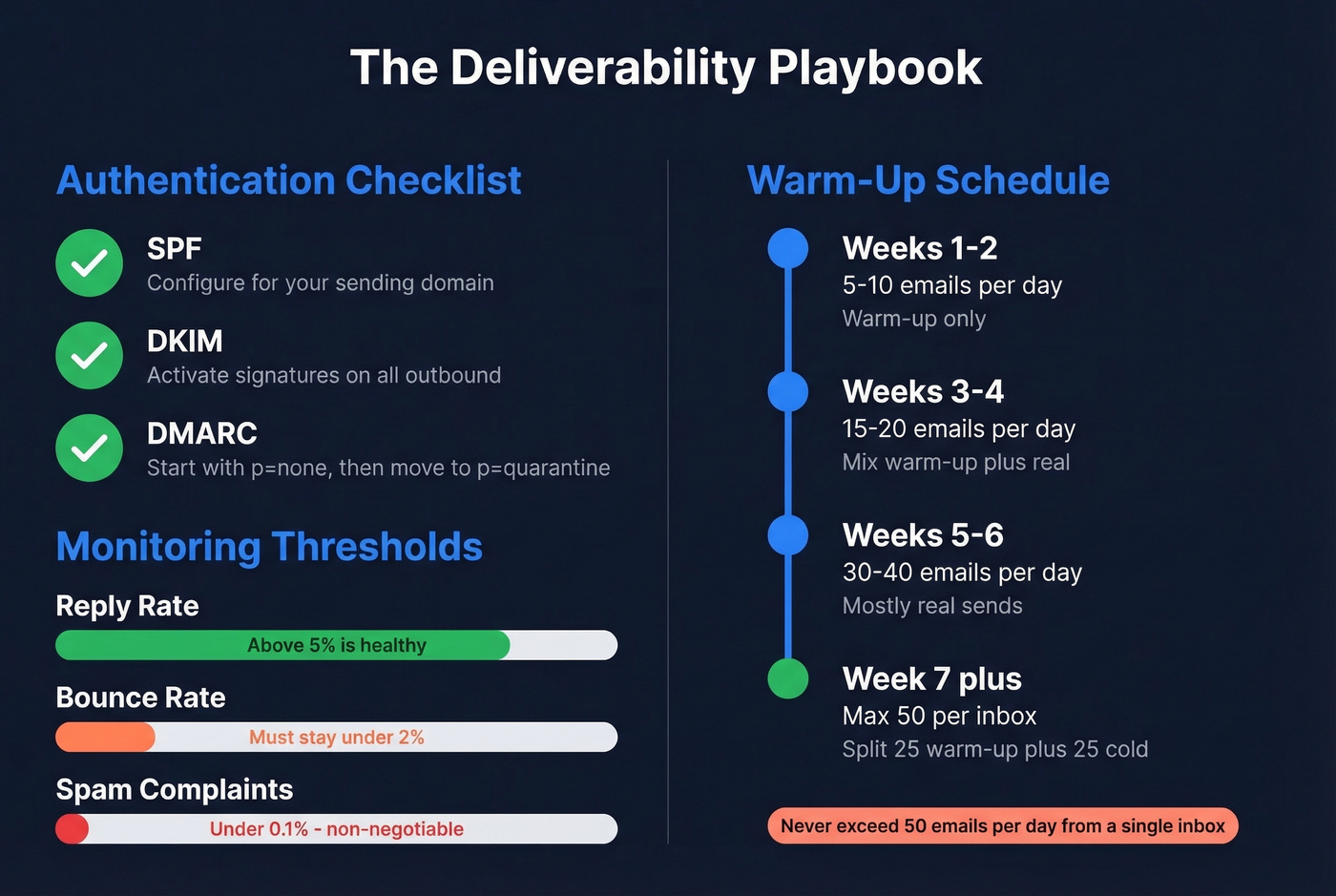
Authentication is non-negotiable. SPF record configured for your sending domain, DKIM signatures active, DMARC policy set. Start with p=none, then move to p=quarantine.
Warm-Up Schedule:
| Timeframe | Emails/Day | Notes |
|---|---|---|
| Week 1-2 | 5-10 | Warm-up only |
| Week 3-4 | 15-20 | Mix warm-up + real |
| Week 5-6 | 30-40 | Mostly real sends |
| Week 7+ | Max 50/inbox | Split 25 warm-up + 25 cold |
Never exceed 50 emails per day from a single inbox. Need more volume? Add inboxes and rotate. (For safe limits, see email velocity.)
Monitoring thresholds: Reply rate above 5% is healthy. Bounce rate must stay under 2%. Spam complaints under 0.1% - that's non-negotiable. Avoid open tracking pixels in cold email; they hurt deliverability more than the data is worth. Use Google Postmaster Tools to monitor domain reputation.
Bad data is the fastest way to destroy sender reputation. Snyk cut bounce rates from 35-40% to under 5% after switching to a 5-step verification process - across 50 AEs prospecting daily. That kind of cleanup isn't optional; it's the difference between inbox and spam folder.
Intent-based outbound only works when you can reach the right people at verified addresses. Prospeo combines 15,000 Bombora intent topics, job change signals, and 30+ filters with 143M+ verified emails - refreshed every 7 days, not every 6 weeks.
Build intent-targeted lists that actually connect you to buyers.
CAN-SPAM and GDPR Essentials
CAN-SPAM applies to all commercial messages, including B2B. Penalties reach $53,088 per email in violation. Requirements: valid physical postal address, clear opt-out mechanism that works for 30 days, opt-outs honored within 10 business days, no deceptive subject lines. You're liable even if a third party sends on your behalf.
For EU contacts, GDPR requires explicit consent or legitimate interest. In practice, B2B cold email to EU prospects needs a clear legitimate interest justification, easy opt-out, and documented compliance. Don't treat this as a checkbox exercise - one complaint to a data protection authority can trigger an audit.
Mistakes That Kill Results
Blasting without segmentation. Segmented campaigns drive up to 760% more revenue than unsegmented blasts. Even basic segmentation by industry or engagement level makes a measurable difference.
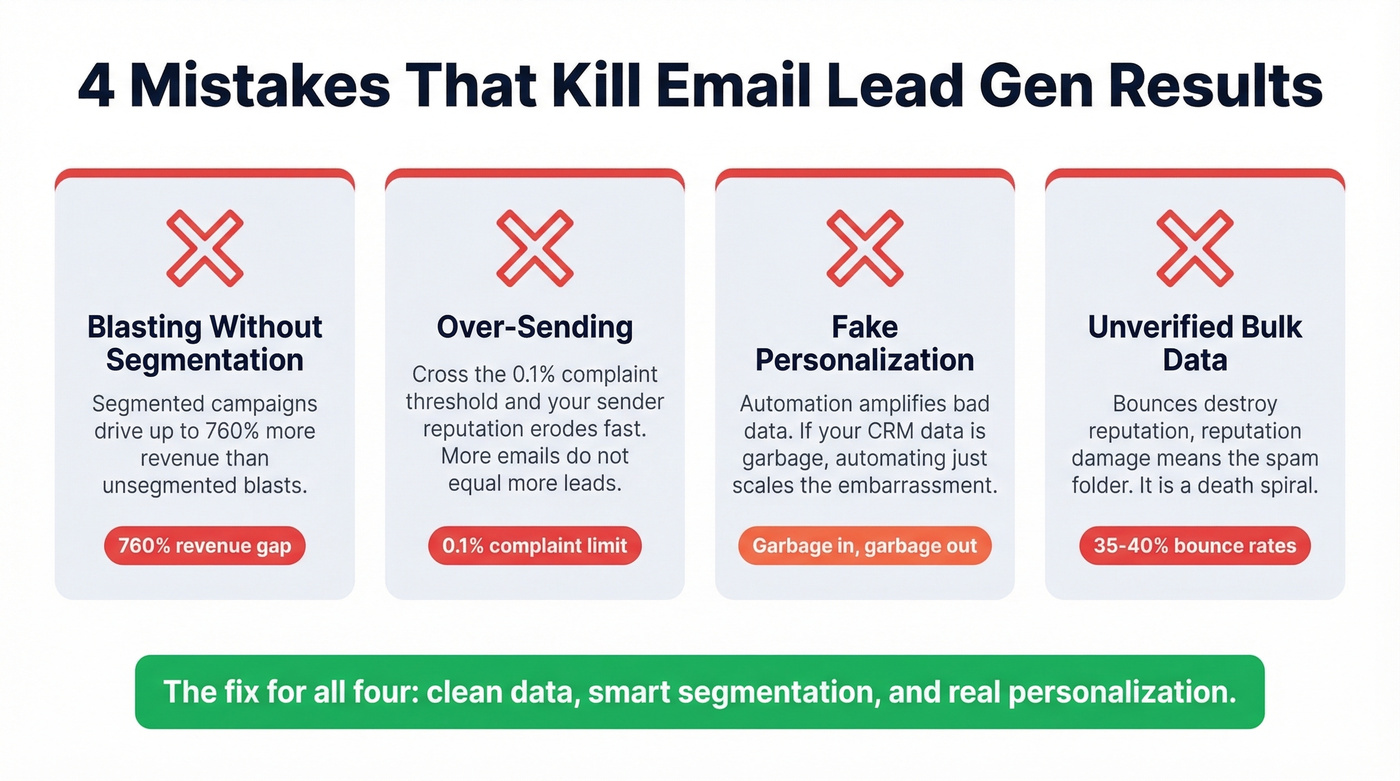
Over-sending. Once you cross the 0.1% complaint threshold, your sender reputation erodes fast. More emails don't equal more leads.
Automation without real personalization. We've seen teams set up elaborate flows that send confidently wrong recommendations - products the recipient already bought, industries they don't work in. Automation amplifies bad data. Let's be honest: if your CRM data is garbage, automating on top of it just scales the embarrassment.
Using unverified bulk data. Unverified lists mean bounces, bounces mean reputation damage, reputation damage means the spam folder. It's a death spiral that starts with lazy list building.
Tool Stack
| Tool | Category | Starting Price | Best For |
|---|---|---|---|
| Prospeo | B2B data + verification | ~$0.01/email, free tier | Verified outbound lists |
| HubSpot | CRM + email | Free CRM, paid from ~$20/mo | CRM-first teams |
| Brevo | ESP | Free 300/day, ~$25/mo paid | Budget teams |
| ActiveCampaign | ESP + automation | ~$29/mo | Automation workflows |
| Klaviyo | ESP | Free tier (limited contacts) | Ecommerce only |
| Apollo.io | B2B data | Free tier, $49/user/mo | Free-tier volume |
| Clay | Enrichment | $134/mo | Personalization workflows |
Pick your data layer and your sending layer separately - trying to do both in one tool usually means compromising on one. Apollo's free tier is useful for getting started, but data quality drops fast at scale. Clay is excellent for enrichment workflows but isn't a standalone data source. (If you’re comparing providers, start with B2B company data providers.)
The Reddit consensus on r/MarketingAutomation is that ActiveCampaign has a brutal learning curve and Klaviyo is overpriced outside pure ecommerce - choose your ESP based on your actual use case, not feature lists.
FAQ
Is cold email legal for B2B lead generation?
Yes, under CAN-SPAM. Every commercial email must include a physical address, clear opt-out, and honest subject lines. Penalties reach $53,088 per violation. For EU contacts, GDPR adds consent or legitimate interest requirements.
What's a good click rate in 2026?
Average campaign click rate is 1.69% across industries. Top 10% hit 3.38%. Automated flows average 5.58%. If you're consistently below 1.5%, revisit segmentation and list quality before tweaking copy.
How do I warm up a new email domain?
Start at 5-10 emails per day for weeks one and two, ramp to a maximum of 50 per day by week seven. Monitor bounce rate (under 2%) and spam complaints (under 0.1%). Never skip warm-up - it protects your sender reputation from day one.
What free tools help with email lead generation?
Prospeo's free tier includes 75 verified emails and 100 Chrome extension credits per month - enough to run a real outbound test. HubSpot offers a free CRM with basic email, and Brevo lets you send 300 emails per day at no cost. Start with these before committing budget.
What's the best day to send marketing emails?
Monday and Tuesday consistently outperform other days, with Saturday and Sunday performing worst. That said, test your own audience - B2B SaaS buyers and ecommerce shoppers have different inbox habits.