

Enterprise Selling: What It Takes to Close 6-Figure Deals in 2026
You just got promoted from mid-market to enterprise. The deals are bigger, the cycles are longer, and the buying committee has more people than your last team offsite. 81% of revenue leaders say deals are more complex than ever, and 76.6% of sellers missed quota last year. Welcome to enterprise selling, where everything you learned in mid-market gets stress-tested.
Here's our take after watching a lot of teams move upmarket: enterprise is a data-and-methodology game. MEDDIC isn't optional for qualification, and your stack should be four or five tools you actually use, not fifteen tools you "have."
And yes, the boring part matters most. If your contact data's wrong, you don't just waste a few dials - you burn weeks, spook champions with sloppy follow-up, and drag a deal into the danger zone where it quietly dies.
What enterprise selling is
Enterprise selling means closing deals with large organizations, but size isn't the real divider. Complexity is.
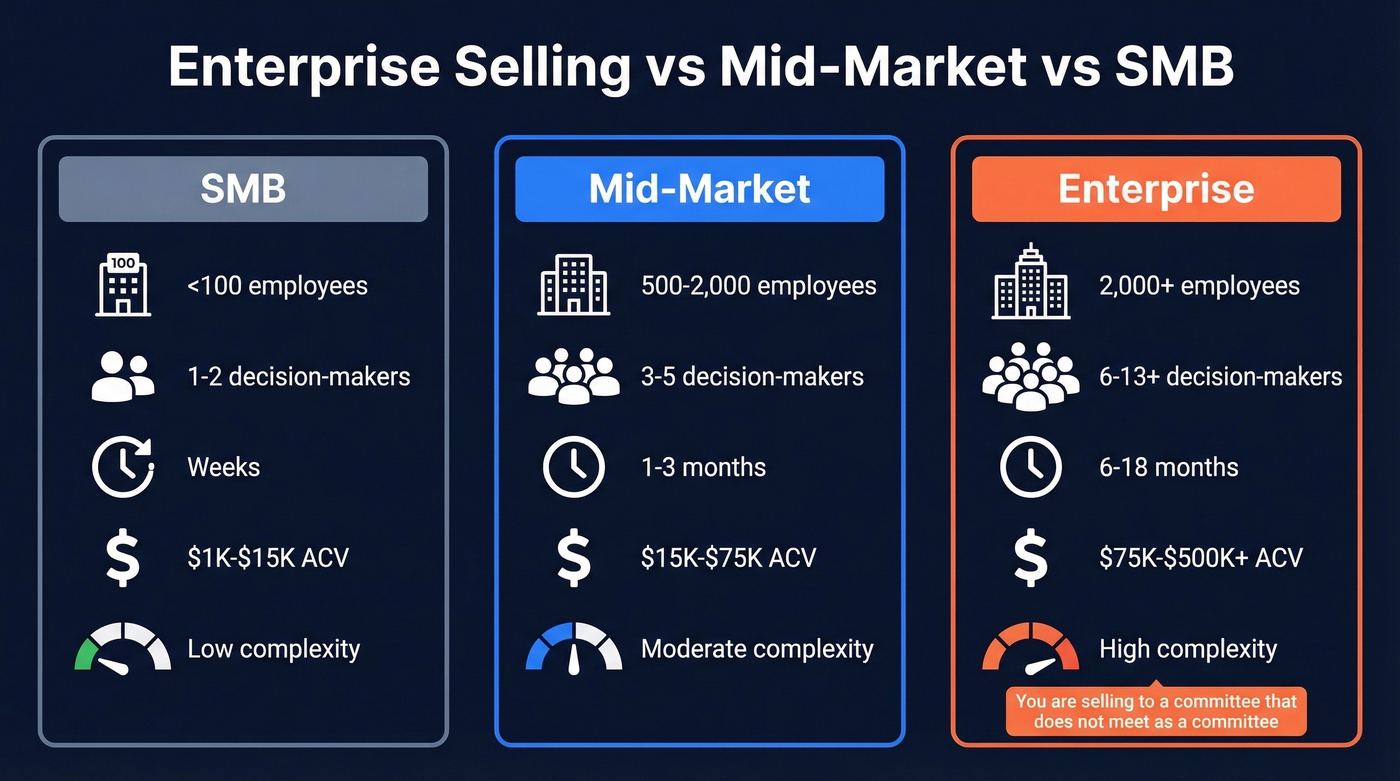
Many teams draw the line at 1,000+ employees and $1B+ in annual revenue, while others use 2,000+ employees for "true enterprise." Either way, the defining trait is the buying system: procurement, legal, security, IT, the economic buyer, their boss, and the end users who'll live with the decision. Forrester puts the average B2B purchase at 13 stakeholders, and 89% of buying decisions cross multiple departments.
You're not selling to a person. You're selling to a committee that doesn't meet as a committee.
A quick scenario we see all the time: in mid-market, you demo to a VP, send a proposal, and close in two weeks. In enterprise, that same VP loves the product, but security needs a review, procurement wants three bids, legal redlines your MSA for six weeks, and the CFO's EA keeps moving the final approval meeting because "budget season." The product didn't change. The process did.
| Segment | Company size | Decision-makers | Cycle length | ACV range |
|---|---|---|---|---|
| SMB | <100 employees | 1-2 | Weeks | $1K-$15K |
| Mid-market | 500-2,000 | 3-5 | 1-3 months | $15K-$75K |
| Enterprise | 2,000+ | 6-13+ | 6-18 months | $75K-$500K+ |
The jump from mid-market to enterprise isn't linear. It's a different sport.
Sales cycle benchmarks
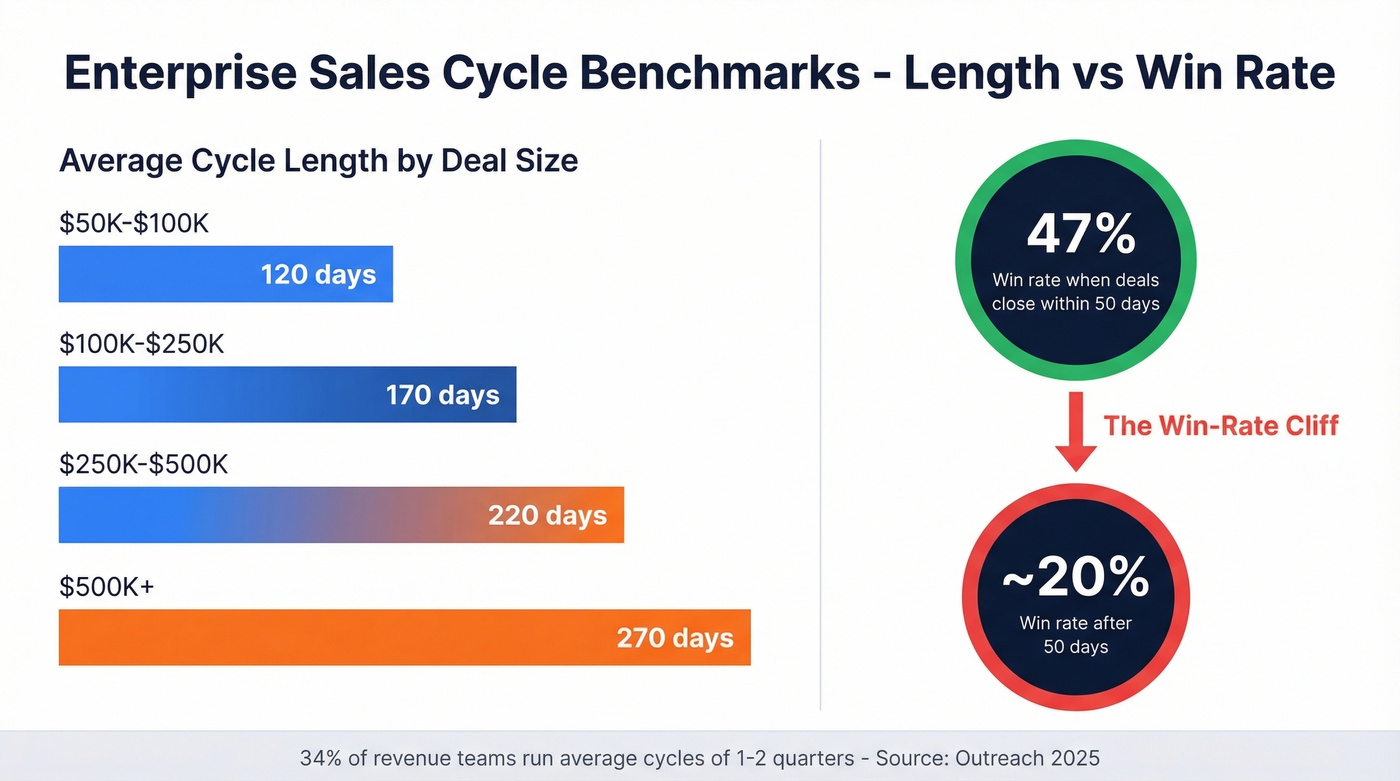
Cycle length scales with both company size and deal value. These benchmarks come from Focus Digital's analysis and match what we've seen in the field.
By company size
| Employees | Avg. cycle (days) |
|---|---|
| 501-1,000 | 115 |
| 1,001-5,000 | 135 |
| 5,001-10,000 | 158 |
| 10,001+ | 185 |
By ACV
| Deal size | Avg. cycle (days) |
|---|---|
| $50K-$100K | 120 |
| $100K-$250K | 170 |
| $250K-$500K | 220 |
| $500K+ | 270 |
The win-rate cliff is the part that should make you a little paranoid. Outreach found deals closed within 50 days hit a 47% win rate; after 50 days, win rates drop to roughly 20%. That's not "be patient." That's "every stall is expensive."
And if you're thinking, "Our deals are always longer than that," you're not alone. Outreach also reports 34% of revenue teams run average cycles of one to two quarters, which means most enterprise deals are already fighting gravity from day one.
MEDDIC vs Challenger
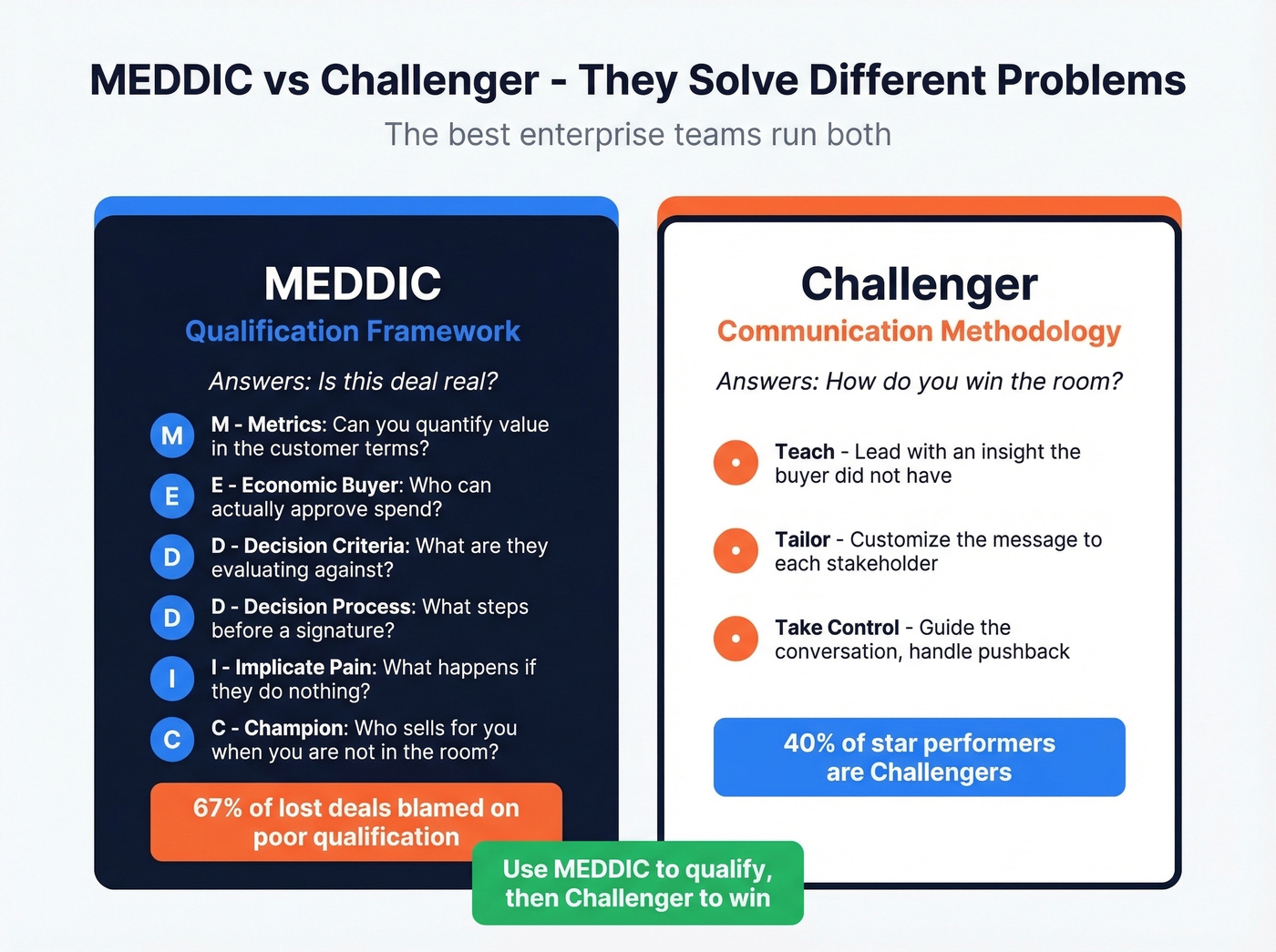
These two frameworks aren't rivals. They solve different problems, and the best enterprise teams run both.
MEDDIC: qualification you can defend
MEDDIC is a qualification framework: Metrics, Economic Buyer, Decision Criteria, Decision Process, Implicate Pain, Champion. The extended version, MEDDPICC, adds Paper Process and Competition. It originated at PTC, where it fueled 40 consecutive quarters of growth.
MEDDIC is a qualification framework tells you whether a deal is real:
- Can you quantify the value in the customer's terms?
- Do you know who can actually approve spend?
- Do you have a champion who'll sell internally when you're not there?
- Do you understand the paper process before legal shows up with a surprise?
If you can't answer those, you don't have a deal. You've got a friendly thread.
This isn't academic. Outreach found 67% of lost deals get blamed on poor qualification. MEDDIC exists to kill bad deals early so you can spend your time where it pays.
If you want to go deeper, start with MEDDIC and keep a bank of MEDDIC discovery questions for multi-stakeholder calls.
Challenger: how you win the room
Challenger is a communication methodology: teach, tailor, take control. The research behind it (originally CEB, now Gartner) found nearly 40% of star performers are Challengers, while Relationship Builders produce just 7% of top performers in complex sales. One insight worth stealing: 53% of customer loyalty is driven by the sales experience itself, not product, price, or brand.
MEDDIC takes a couple hours to learn. Challenger takes real practice, because it forces you to lead with a point of view and handle pushback without getting defensive.
Let's be honest: most teams do this backward. They train "messaging" first, then wonder why the pipeline's full of deals that were never qualified.
Team structure models
Enterprise sales orgs usually organize around one of four models, per Frank Cespedes at HBS: geography, product line, customer size, or industry vertical. Inside those, you'll see three execution patterns.
- Island (full-cycle): one rep owns everything from prospecting to close. Rare in true enterprise.
- Assembly line: SDR -> AE -> CSM handoffs. The default for most scaling orgs.
- Pod: cross-functional teams (SDR + AE + CSM) aligned to a segment or vertical. This is the best setup for strategic accounts.
Most enterprise orgs we've worked with run assembly line for volume accounts and pods for their top 20-50 targets. It's not just org-chart theater: outbound tends to justify heavier coverage because it produces larger deal sizes, and pods reduce the "telephone game" that happens when discovery, security, and procurement get handed off three times.
One frustration we keep seeing: leaders talk about alignment, but they don't build for it. You can't expect clean handoffs if marketing, SDRs, AEs, and CS all run different definitions of ICP, qualification, and "what good looks like" in a first meeting.

You just mapped 13 stakeholders across procurement, security, and the C-suite. Now you need verified emails and direct dials for every one of them. Prospeo gives you 98% accurate emails and 125M+ verified mobiles - so your multi-threaded outreach actually lands.
Stop burning 6-month cycles on bad contact data.
The enterprise tech stack
You need four to five tools, not fifteen. If your stack's so big that reps need a Notion page to remember where things live, you're paying for confusion.
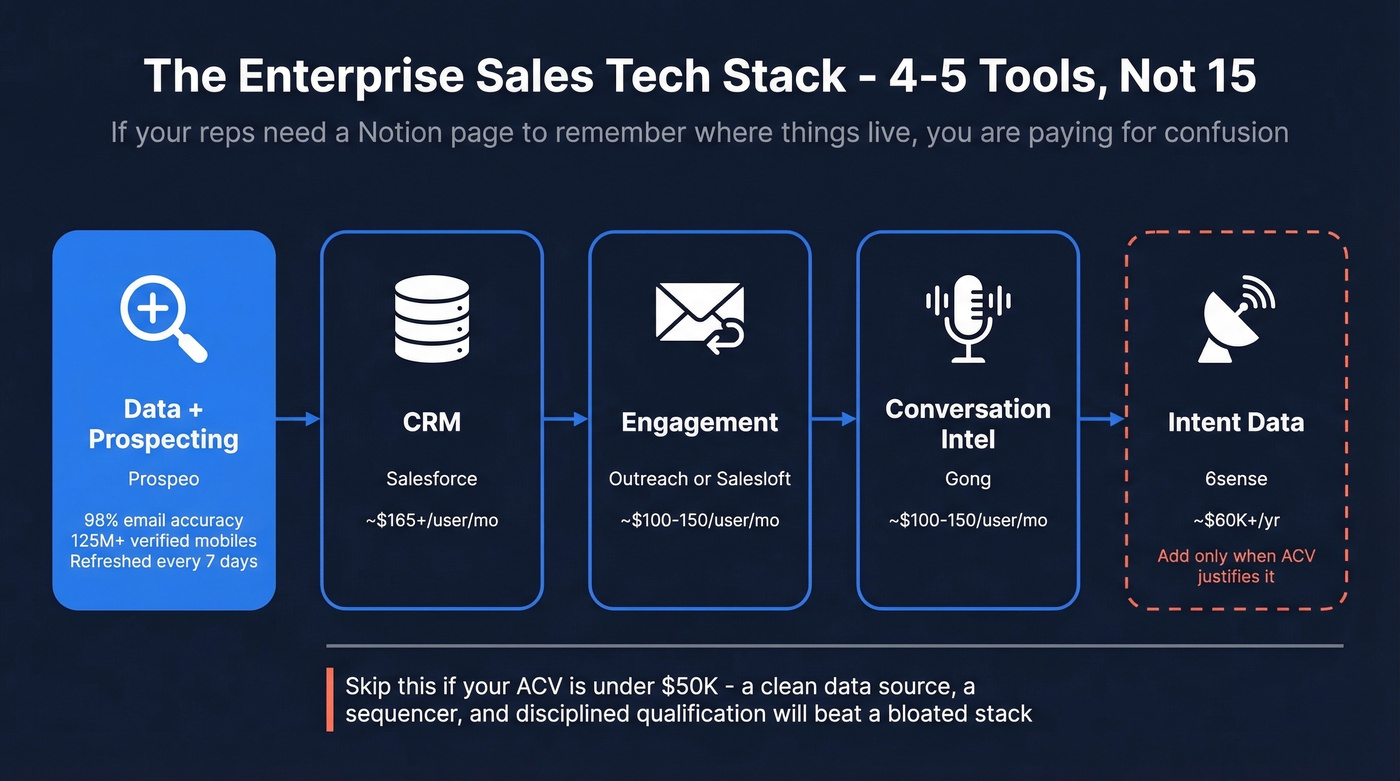
Here's the opinionated stack we recommend for most enterprise teams:
- CRM: Salesforce (enterprise plans commonly start around $165+/user/mo). It's the default for a reason. (If you're comparing options, see examples of a CRM or contact management software.)
- Engagement: Outreach or Salesloft (often ~$100-150/user/mo). Pick one and commit. If adoption is messy, use a simple sequence management standard.
- Conversation intelligence: Gong (often ~$100-150/user/mo). Teams using conversation intelligence consistently tighten execution because managers coach from real calls, not vibes.
- Data + prospecting: Prospeo. It's built for accuracy and freshness: 300M+ professional profiles, 143M+ verified emails, and 125M+ verified mobile numbers, refreshed every 7 days. Email accuracy is 98%, and mobile pickup rate is 30% across regions. You also get 30+ search filters (intent, technographics, job changes, headcount growth, department headcount, funding, revenue) so reps can map buying committees by title, department, and seniority instead of guessing. (For more options, compare sales prospecting databases and data enrichment services.)
- Intent data: 6sense (often $60K+/yr). Add this only when deal sizes and volume justify the spend.
Anecdote time: we watched one AE spend three weeks "working" a Fortune 100 account that looked perfect on paper. The problem wasn't messaging. Half the contacts were outdated, two key stakeholders had changed roles, and security never got looped in early. The deal didn't stall because the product wasn't good; it stalled because the rep was operating with a bad map.
Data quality is that map. If your champion's email bounces, your methodology doesn't matter.
Skip this if your ACV's under $50K: you probably don't need enterprise intent tooling or a heavyweight CRM plan. A clean data source, a sequencer, and disciplined qualification will beat a bloated stack that nobody adopts.

Enterprise AE compensation
Comp data tells a story about where the market is, and where it's broken.
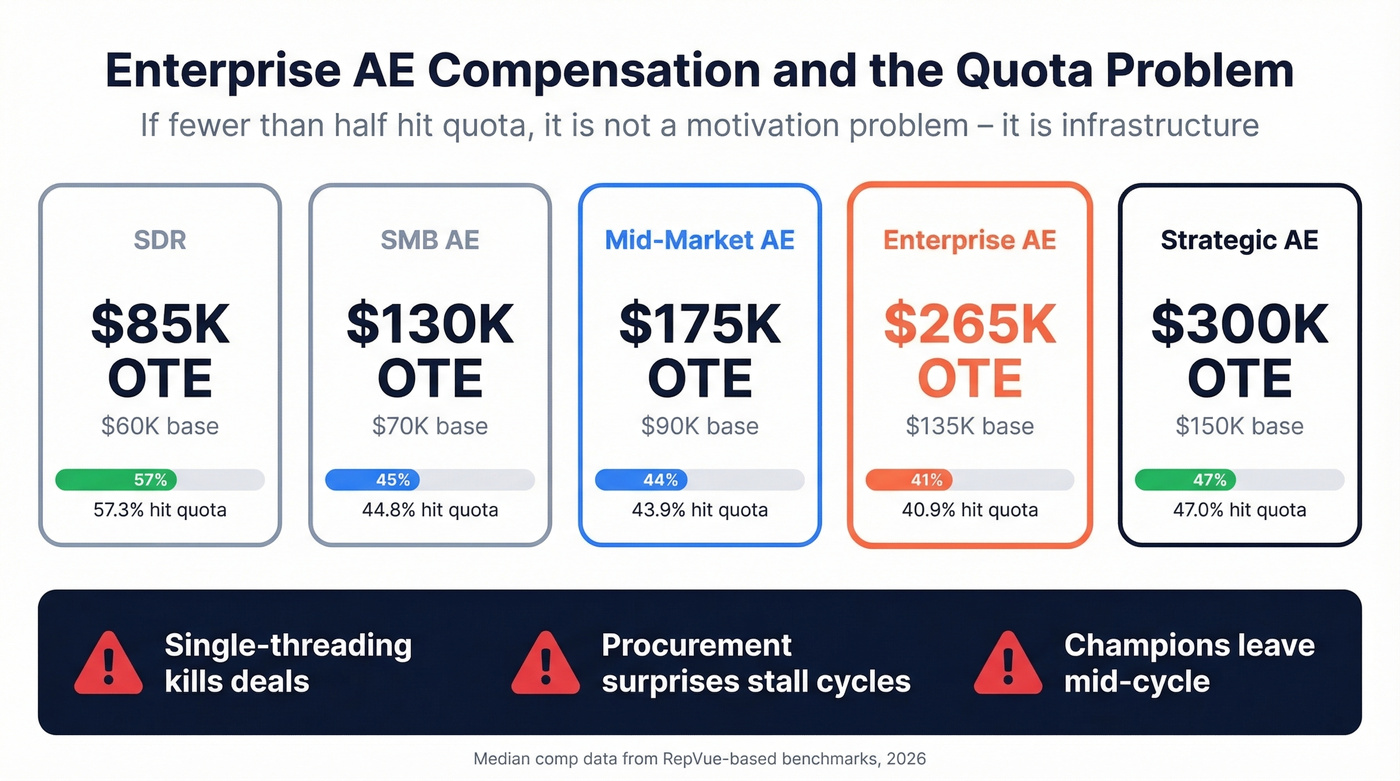
| Segment | Base (median) | OTE (median) | Quota attainment |
|---|---|---|---|
| SDR | $60K | $85K | 57.3% |
| SMB AE | $70K | $130K | 44.8% |
| Mid-market AE | $90K | $175K | 43.9% |
| Enterprise AE | $135K | $265K | 40.9% |
| Strategic AE | $150K | $300K | 47.0% |
Commission often runs 5-20% of contract value, with SaaS hovering around 10% for standard deals. Data is sourced from RepVue-based medians. (If you need the math, see OTE in sales.)
Look, if fewer than half of enterprise AEs hit quota, it's not a "motivation" problem. It's usually infrastructure: fuzzy ICP, weak qualification, poor multi-threading, and data that's stale enough to make outbound feel like gambling.
If you want the unfiltered version, browse a few threads on r/sales. The same deal-killers come up over and over: single-threading, procurement surprises, and champions who leave mid-cycle.
How AI is reshaping the process
AI's already changing how teams prospect and execute. Outreach reports 45% of high-performing teams use hybrid AI-SDR models, and the productivity gains are real: LivePerson cut per-prospect research from 20 minutes to 2 minutes and saw a 35% engagement lift.
Where AI earns its keep in enterprise isn't "write my email." It's execution across a long cycle: surfacing buying signals from calls, catching risk in deal notes, and making coaching consistent across a team. Over a 185-day cycle, small improvements compound fast, especially when managers stop relying on memory and start relying on evidence. (If you're building the workflow, start with generative AI sales tools.)
The trend to watch is buyer-side AI agents. Your first interaction with a prospect might be their AI screening vendors before a human ever joins the process, which means your security posture, documentation, and proof points need to be ready earlier than you're used to.
AI Ops - the function sitting between RevOps, data governance, and AI management - is turning into a real role, not a slide-deck buzzword.
Common mistakes that kill deals
1) Single-threading to one champion
Enterprise deals require far more touchpoints than standard sales. If your champion leaves or loses influence, the deal dies. Multi-thread or lose.
A line we saw in a sales community thread stuck with us: "Every deal I've lost in the last two years died because my champion changed jobs." That's not drama. That's Tuesday.
2) Chasing low-value RFPs without access
If you can't get a conversation with the economic buyer before responding, you're often just filling a column so procurement can say they "ran a process." Qualify hard, even when the logo's tempting.
3) Over-serving one whale and starving pipeline
The opportunity cost is brutal. One account can soak up your best AE's calendar for months, and if it slips, the quarter's gone. Structure beats heroics, especially in complex B2B sales.
4) Ignoring data quality
Bad emails and dead phone numbers waste months in a cycle that's already long. If you're serious about enterprise selling, treat data as production infrastructure, not a nice-to-have.
Winning complex deals comes down to avoiding these mistakes consistently, not just knowing about them.
Your MEDDIC scorecard is tight, your champion is engaged, and legal is moving. Don't let stale data stall the deal. Prospeo refreshes every 7 days - not every 6 weeks - so you're always reaching the right person at the right title, even when reorgs hit mid-cycle.
Enterprise data that's as current as your pipeline demands.
Enterprise selling FAQ
How long is a typical enterprise sales cycle?
Enterprise sales cycles run 115-270 days depending on company size and deal value. Deals over $500K ACV average 270 days. Speed matters: deals closed within 50 days win at 47% versus roughly 20% after that window.
How much do enterprise AEs earn?
The median enterprise AE earns $135K base and $265K OTE, though only 40.9% hit quota. Strategic AEs see $150K base and $300K OTE with slightly better attainment at 47%.
What's the best methodology for enterprise deals?
MEDDIC for qualification. It tells you whether a deal is real and forces you to map the economic buyer, process, and internal champion. Layer Challenger for how you run discovery, teach a point of view, and handle pushback once MEDDIC is habit.
What tools help new AEs ramp faster?
A clean three-tool foundation works: accurate contact data, a sequencer, and call coaching. In practice, that often looks like Prospeo for mapping buying committees and verified contacts, Outreach or Salesloft for sequencing, and Gong for call review and coaching.