

Enterprise Technology Sales: What It Takes, What It Pays, and How to Win
Your VP just pulled you into a room and said the company's moving upmarket. No more $15K deals with a single decision-maker who signs on a Zoom call. Starting next quarter, you're in enterprise technology sales - six-figure contracts to companies with procurement departments, security review boards, and buying committees that outnumber your entire sales team. Nobody handed you a playbook. So let's build one.
The Short Version
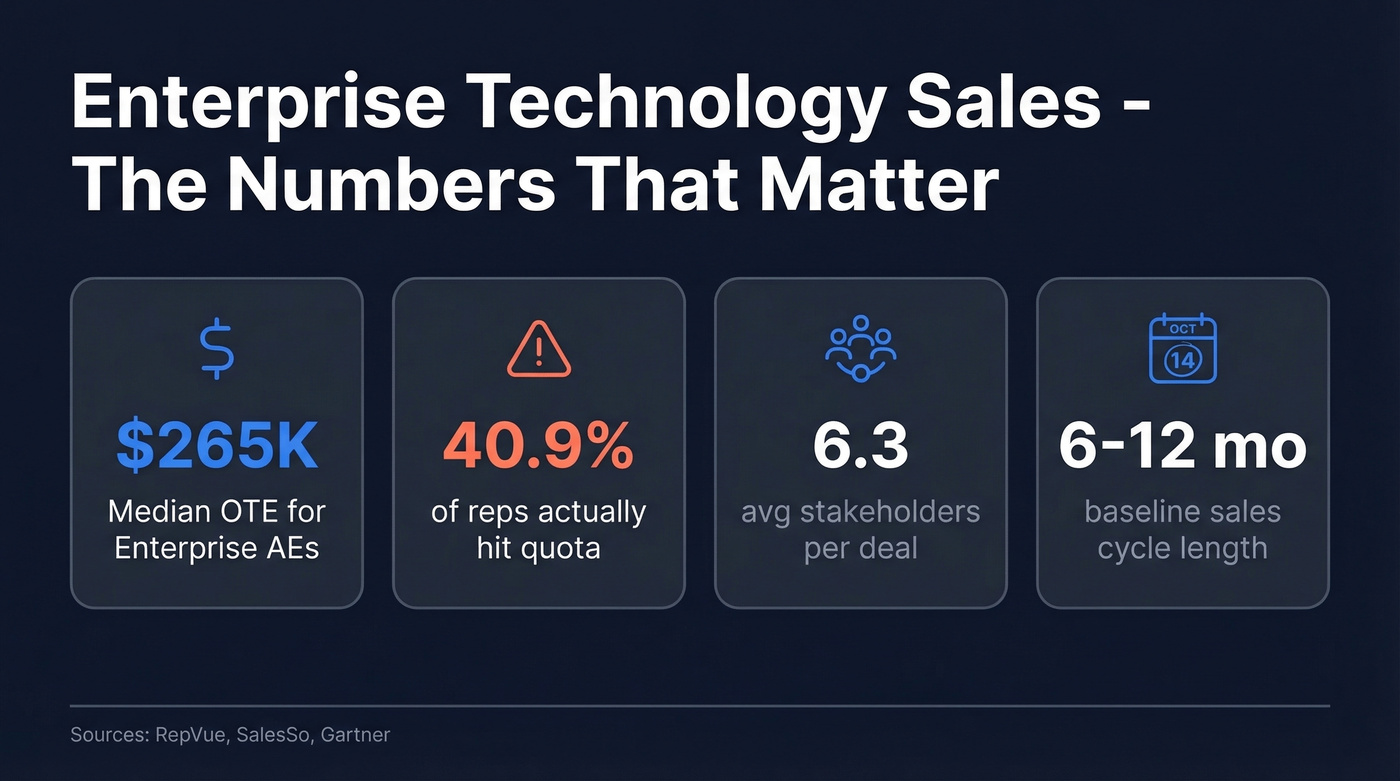
Enterprise technology sales means deals north of $100K, 6.3 stakeholders on average, and cycles that stretch 6-12 months as a baseline. The median OTE for an enterprise AE sits at $265K, but only 40.9% of reps actually hit quota - so that number's a ceiling, not a floor.
MEDDPICC is the non-negotiable qualification framework. If you're not running it (or something equally rigorous), you're guessing on deals that take half a year to close. That's expensive guessing.
The #1 deal-killer isn't price, and it isn't a competitor. It's procurement. Security reviews, legal redlines, and compliance gates have ended more "sure things" than any rival vendor ever has.
The career path is straightforward even if it isn't fast: SDR for 12-18 months, AE for 2-3 years, then enterprise AE. Each jump roughly doubles your earning potential and doubles the complexity of every deal you touch.
What Is Enterprise Tech Sales?
It's the practice of selling software, infrastructure, or technology services to large organizations through complex, multi-stakeholder buying processes. The deals are big. The cycles are long. The stakes are high on both sides of the table.
One distinction worth making early: this discipline is about the pre-purchase process - prospecting, discovery, negotiation, close. It's different from IT sales or IT services, which often focus on post-sale implementation and support. If you're evaluating career paths, these are separate tracks with different skill sets.
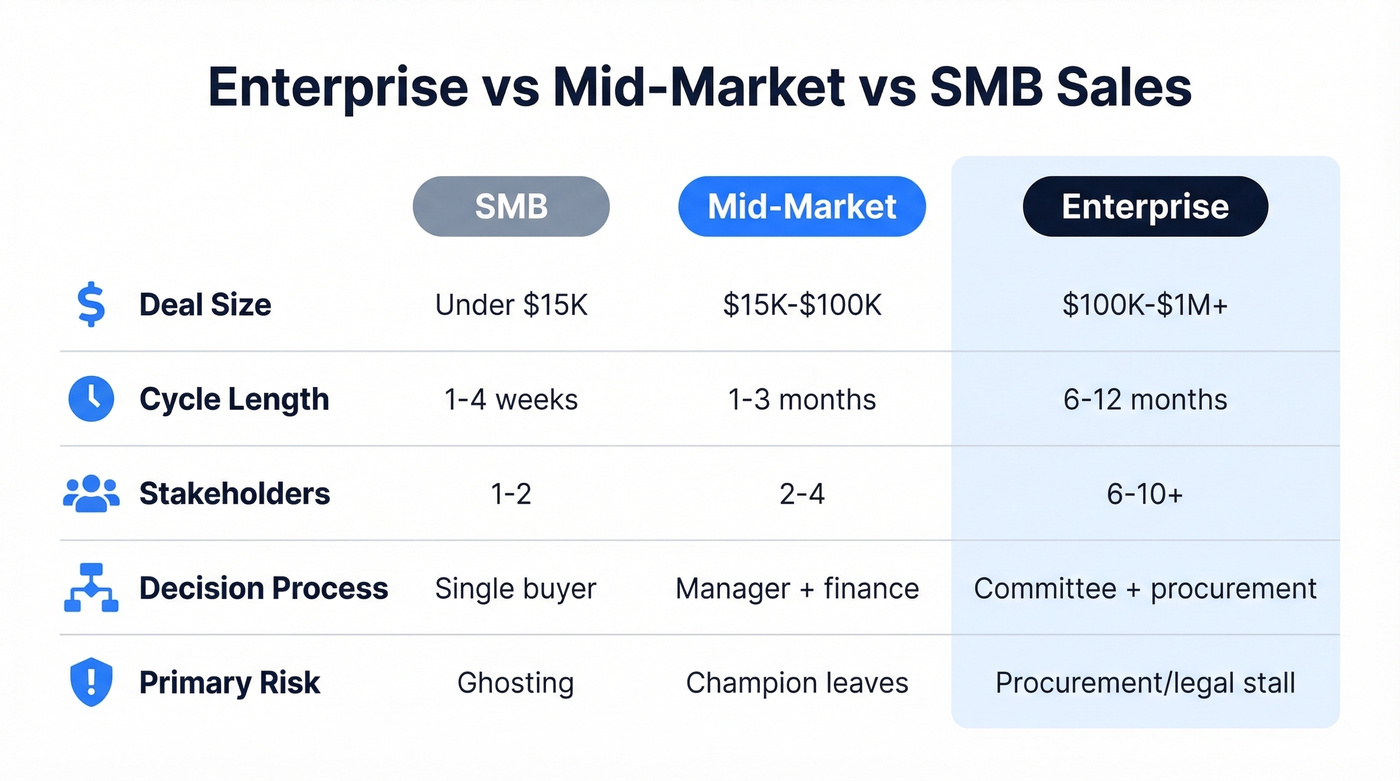
What separates enterprise from mid-market or SMB isn't just deal size. It's the buying process itself. A mid-market deal might involve a VP and a finance lead. An enterprise deal involves a buying committee, a procurement team, legal review, security audit, and sometimes a board-level sign-off. Gartner estimates that 67% of B2B buyers complete their research and internal meetings before they ever talk to a vendor, which means by the time you get a discovery call, they've already formed opinions about what they want and who they trust.
Here's how the segments break down:
| Enterprise | Mid-Market | SMB | |
|---|---|---|---|
| Deal size | $100K-$1M+ | $15K-$100K | Under $15K |
| Cycle length | 6-12 months | 1-3 months | 1-4 weeks |
| Stakeholders | 6-10+ | 2-4 | 1-2 |
| Decision process | Committee + procurement | Manager + finance | Single buyer |
| Primary risk | Procurement/legal stall | Champion leaves | Ghosting |
A note for founders and startup leaders: selling to the enterprise isn't right for every company. Longer cycles mean higher cash burn before revenue lands, and concentration risk is real - losing one enterprise customer can crater a quarter. If your average contract value is under $50K and your product sells itself in a demo, dominate mid-market first. Enterprise is a commitment, not an experiment.
The core skill shift when you move upmarket: you stop selling to a person and start selling to an organization. That means mapping power structures, building internal champions, and navigating processes that exist specifically to slow you down.
Key Metrics and Benchmarks
Two things matter most when selling to large organizations: how long deals take and how many people are involved. Both numbers are worse than you think.
Cycle length by company size:
| Company size | Avg. cycle |
|---|---|
| 1-10 employees | 38 days |
| 11-100 | 55 days |
| 101-1,000 | 83 days |
| 1,001-10,000 | 127 days |
| 10,001+ | 185 days |
Cycle length by deal size:
| Deal value | Avg. cycle |
|---|---|
| Under $1K | 25 days |
| $1K-$50K | 60-90 days |
| $50K-$500K | 120-180 days |
| $500K+ | 270 days |
Cycle length by industry:
| Industry | Avg. cycle |
|---|---|
| Retail | 70 days |
| Software | 90 days |
| Manufacturing | 130 days |
| Pharmaceuticals | 138 days |
58% of B2B professionals report that sales cycles have gotten longer over the past year. That trend isn't reversing.
Here's the number that should change how you manage your pipeline: opportunities that close within 50 days carry a 47% win rate. After 50 days, that drops to 20% or lower. Enterprise deals almost never close in 50 days, which means your qualification rigor has to be exceptional because you're investing months into deals with structurally lower win rates. Every deal in your pipeline that shouldn't be there is costing you six figures in opportunity cost.
The average buying committee runs 6.3 stakeholders. That's the average. We've seen enterprise deals with 10-15 people who can say no and only 1-2 who can say yes. This asymmetry is the defining feature of complex sales: blocking power is distributed widely, while approval power is concentrated at the top. If you're not mapping the full committee from the first week, you're building on sand.
What's Changed in 2026
Selling technology to large organizations isn't the same game it was three years ago. Four shifts are reshaping how top teams operate.
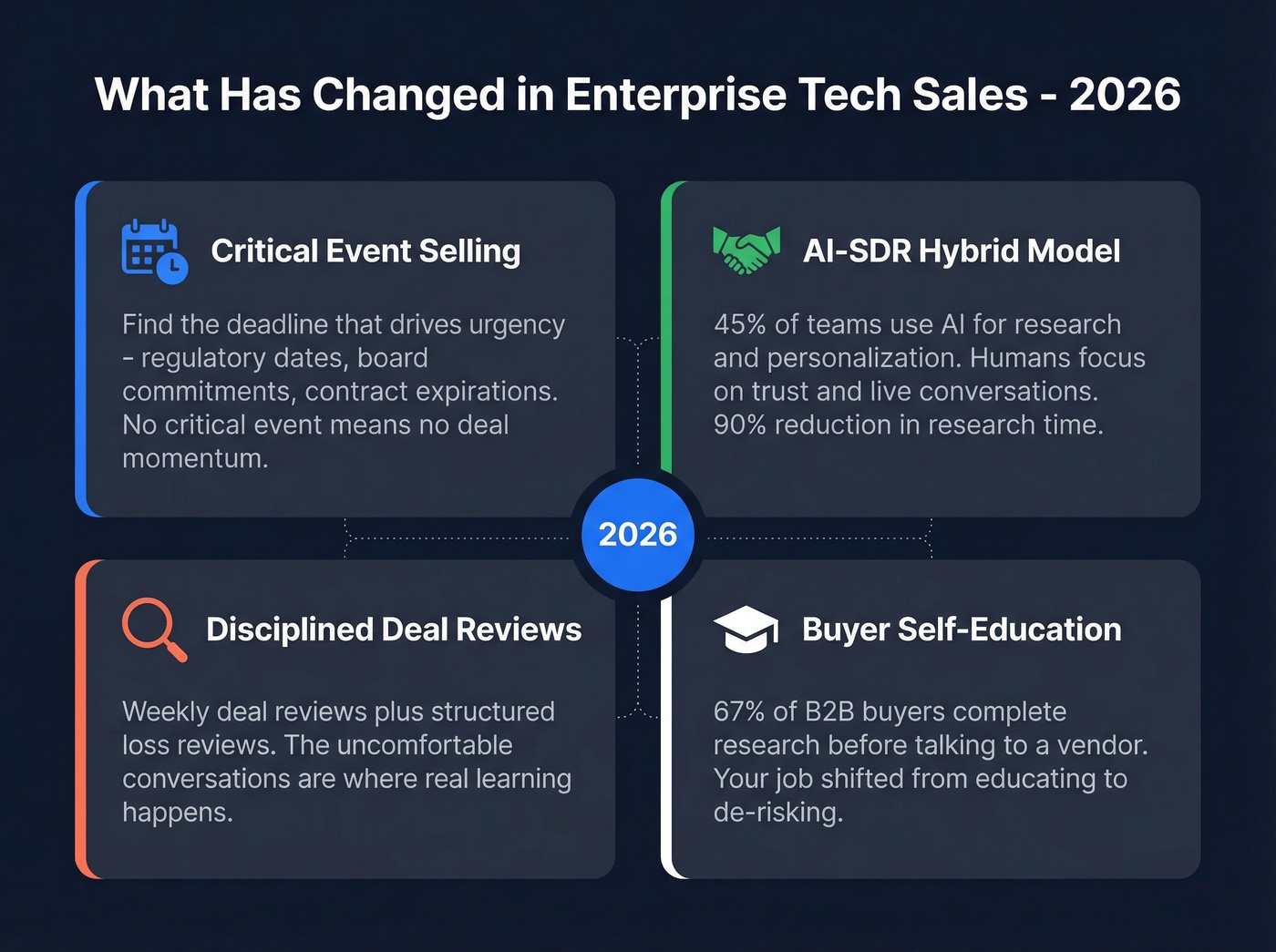
Critical event selling. The best enterprise reps don't just find pain - they find a deadline attached to it. A strategic accounts leader at Canva calls this the "critical event": the milestone that drives urgency and action. A regulatory deadline, a board commitment, a contract expiration. Without a critical event, enterprise deals drift. With one, you have a forcing function that keeps the buying committee moving.
The AI-SDR hybrid model. 45% of teams now run some version of an AI-SDR model, where AI handles initial research, personalization, and sequencing while human reps focus on live conversations and relationship building. Sellers using AI tools report a 90% reduction in research and personalization time. The model that's working: AI handles routine, humans build trust in pivotal moments.
Disciplined deal reviews. Top-performing orgs run weekly deal reviews and - critically - structured loss reviews. The loss review is where the real learning happens. Most teams skip it because it's uncomfortable. That's exactly why it matters.
Buyer self-education. Enterprise buyers arrive more informed and more skeptical than ever. Gartner's 67% figure tells the story: most of the buying committee's research and internal alignment happens before your SDR's email lands. The rep's job has shifted from "educating" to "de-risking" - helping the buyer justify the decision internally and navigate their own organization's approval process.
The Enterprise Sales Process
Prospecting and Discovery
Enterprise prospecting isn't about volume. It's about precision. You're targeting specific accounts, specific buying committees, and specific individuals within those committees. Multi-threading starts on day one.
The goal is to reach 6+ stakeholders across the organization before your first formal presentation - the economic buyer, the technical evaluator, the end users, the champion, and often someone in procurement or legal.
Referrals close in 20 days versus 60 days for cold outreach, so warm introductions through existing relationships compress timelines dramatically. When your deal already takes 6 months, a bounced email on day one costs you a week. This is where your data layer matters - you need verified emails and direct dials that actually land in the economic buyer's inbox and on their direct line, not a generic info@ address that routes to nobody.
Discovery isn't one call. It's a series of conversations across the buying committee, each designed to map the organization's pain, process, and power structure. You're building a deal map, not running a demo. If you want a tighter structure, use a discovery call framework and a bank of discovery questions that force clarity early.
Demo, POC, and Proposal
Enterprise demos aren't product walkthroughs. They're business case presentations tailored to each stakeholder's priorities. The VP of Engineering cares about integration complexity and uptime. The CFO cares about total cost of ownership and payback period. The end users care about whether this thing actually makes their day easier.
Customization is non-negotiable. A generic deck that works for mid-market will actively hurt you in enterprise. Build a mutual action plan (MAP) at this stage - a shared document that outlines every step from POC to go-live, with owners and dates on both sides. The MAP becomes your deal-management artifact for the rest of the cycle.
POCs in enterprise often run 2-4 weeks and involve real data, real integrations, and real users. Treat the POC as a mini-implementation, not a sandbox exercise. The buying committee is evaluating your team's competence as much as your product's capabilities. If your POC motion is messy, tighten it with a dedicated sales POC playbook.
Procurement, Legal, and Security
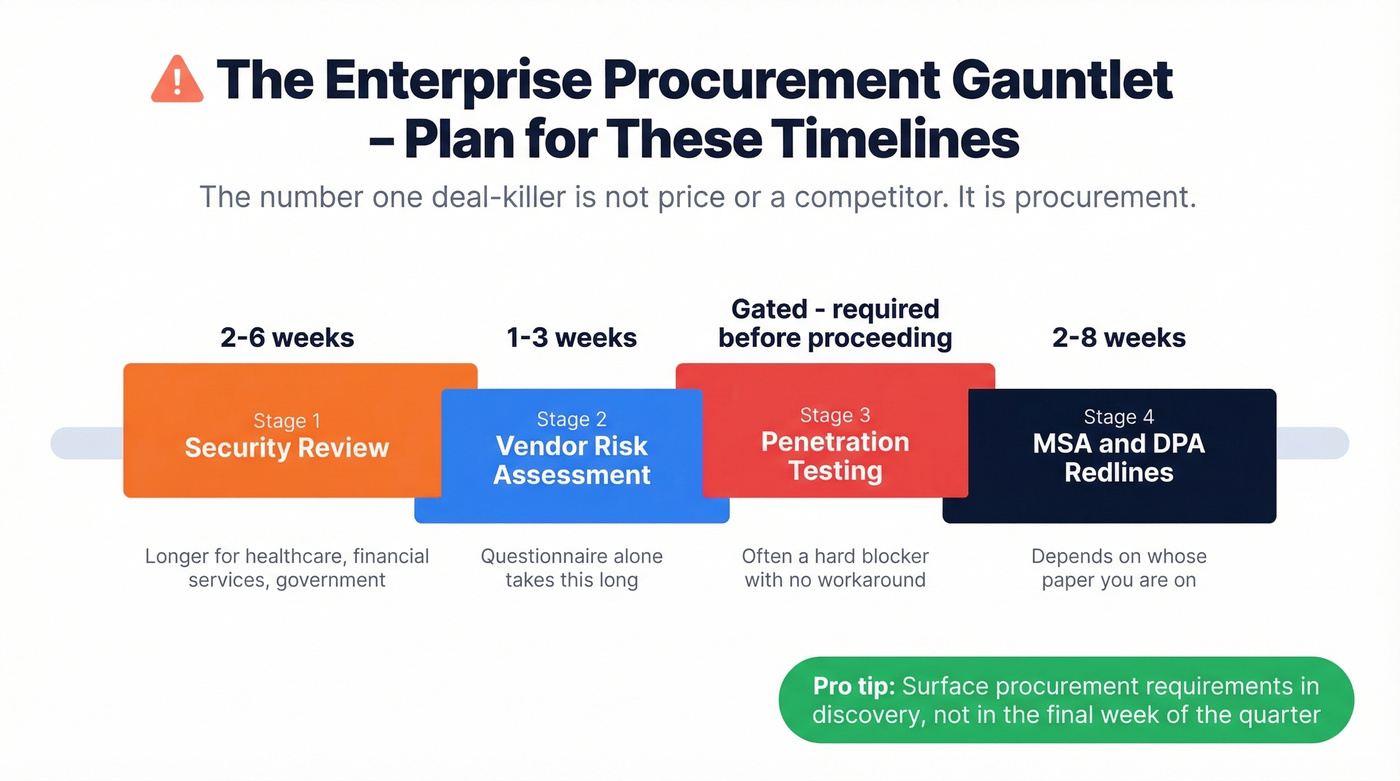
This is where enterprise deals go to die. Not in a dramatic loss - in a slow, bureaucratic stall that drains your quarter.
Here's a scenario we've seen play out more than once: a healthcare SaaS company (~25 employees) was closing a hospital system deal worth $500K ARR. The champion was bought in, the technical evaluation was done, the budget was approved. Then procurement required SOC 2 Type II, a third-party penetration test, and a full security questionnaire. The company had SOC 2 Type I but not Type II. The deal stalled for months.
SOC 2, designed by the AICPA, evaluates five Trust Services Criteria: Security, Availability, Processing Integrity, Confidentiality, and Privacy. Type I is a point-in-time snapshot. Type II - the gold standard for enterprise procurement - evaluates operating effectiveness over a sustained period. If you're selling into regulated industries without Type II, expect friction.
Plan for these timelines:
- Security review: 2-6 weeks (longer for healthcare, financial services, government)
- MSA and DPA redlines: 2-8 weeks depending on whether you're on their paper or yours
- Penetration testing: often gated - they won't proceed without it
- Vendor risk assessment: 1-3 weeks for the questionnaire alone
Your mutual action plan should account for every one of these steps with realistic timelines. The reps who close enterprise deals on time are the ones who surface procurement requirements in discovery, not in the final week of the quarter.

You just read that enterprise deals average 6.3 stakeholders and 185-day cycles. Every week spent chasing bad contact data is a week your deal drifts. Prospeo gives you 98% verified emails and 125M+ direct dials so you reach the full buying committee - not just the one person who replied to your sequence.
Stop losing six-figure deals to bad data. Map the entire committee today.
MEDDPICC - The Qualification Framework
MEDDPICC was created in 1996 by Dick Dunkel at PTC to consistently identify winnable deals. Three decades later, it's still the standard for enterprise sales qualification, and the consensus on r/sales is that it's the one framework worth actually internalizing rather than just checking boxes on.
| Element | What you're mapping | Conversation starter |
|---|---|---|
| Metrics | Quantified outcomes the buyer needs | "What does success look like in numbers?" |
| Economic Buyer | The person who signs the check | "Who has final budget authority?" |
| Decision Criteria | How they'll evaluate options | "What are your must-haves vs. nice-to-haves?" |
| Decision Process | Steps from eval to signature | "Walk me through how your org has bought software like this before." |
| Paper Process | Procurement, legal, security gates | "What does your procurement timeline typically look like?" |
| Identify Pain | The business problem driving urgency | "What happens if you don't solve this by Q3?" |
| Champion | Your internal advocate with power and influence | "Who else in the org is pushing for this?" |
| Competition | Rivals, status quo, and internal build | "What other approaches is the team considering?" |
A critical nuance: "Competition" doesn't just mean other vendors. It includes the status quo ("we'll keep doing it manually"), internal build ("engineering says they can build it"), and unrelated budget priorities ("we might spend that money on headcount instead"). The status quo wins more enterprise deals than any competitor.
Use MEDDPICC for enterprise deals exceeding 3 months with complex procurement. For shorter, simpler cycles, standard MEDDIC (without Paper Process and Competition) is sufficient. The Paper Process element alone justifies the upgrade - it forces you to map procurement before it ambushes you. If you want prompts that make this easier, pull from MEDDIC discovery questions and a full MEDDIC sales qualification breakdown.
Compensation - What You'll Earn
Enterprise tech sales has one of the highest earning potentials in sales, but the distribution is brutal.
| Role | Base | OTE | Top performers | Quota attainment |
|---|---|---|---|---|
| SDR/BDR | $60K | $85K | - | 57.3% |
| Mid-Market AE | $90K | $175K | - | 43.9% |
| Enterprise AE | $135K | $265K | $627K | 40.9% |
| Strategic AE | $150K | $300K | $705K | 47.0% |
| Sales Engineer | $145K | $200K | - | 56.8% |
The standard pay mix is 50/50 base versus variable. Commission rates typically fall between 5-20% of contract value, with SaaS deals averaging around 10% for standard contracts. Accelerators kick in above quota and can be dramatic - there's a paystub floating around Reddit showing $1M total comp on a $150K base after landing large deals with accelerators.
But look at the quota attainment column. 76.6% of sellers missed quota last year. Only 40.9% of enterprise AEs hit their number. OTE is a ceiling, not a floor - and for most reps, it's a ceiling they never touch.
If you're evaluating this career path, don't plan your life around OTE. Plan it around base plus 60-70% of variable. That's what the median rep actually takes home. (If you need to model earnings, start with a clean OTE in sales definition and formula.)
The Enterprise Sales Tech Stack
Enterprise reps don't need twenty tools. They need three things done well: a CRM that doesn't fight them, verified contact data for multi-threading, and conversation intelligence to coach off real calls. Everything else is optimization.
| Category | Tool | Pricing |
|---|---|---|
| CRM | Salesforce | $165-$330/user/mo (Enterprise to Unlimited) |
| CRM | HubSpot | Free-$150/user/mo+ |
| Engagement | Outreach | ~$100-200/user/mo |
| Engagement | Salesloft | ~$100-200/user/mo |
| Conversation Intel | Gong | ~$100-250/user/mo |
| Data & Prospecting | Prospeo | From ~$0.01/email |
| Data & Prospecting | ZoomInfo | $15-40K/yr |
| Data & Prospecting | Apollo | Free-~$99/user/mo |
| Scheduling | Chili Piper | From $45/mo |
| RevOps | LeanData | ~$30-$100K+/yr (enterprise) |

For the data and prospecting layer, enterprise deals require reaching 6+ stakeholders per account - the economic buyer, the technical evaluator, the champion, the procurement lead. Prospeo's 300M+ profiles, 98% email accuracy, and 7-day refresh cycle (the industry average is 6 weeks) keep data current through cycles that stretch 6-12 months. Credit-based pricing starts at roughly $0.01 per email with no contracts, which is a different universe from ZoomInfo's $15-40K/yr enterprise pricing.
Forrester analyst Peter Ostrow has noted that enablement strategies tend to over-focus on tool adoption rather than revenue outcomes - which is why you should audit your stack twice a year against actual pipeline metrics, not usage dashboards. If a tool isn't directly compressing your cycle or improving your win rate, cut it. To pressure-test your stack, track pipeline health and review common sales pipeline challenges that show up in enterprise motions.
With 67% of enterprise buyers researching before they talk to a vendor, timing is everything. Prospeo's 7-day data refresh and intent data across 15,000 topics let you reach decision-makers the moment they're in-market - not six weeks after your competitor already did.
Catch buying signals while the committee is still forming opinions.
Breaking Into the Field
The path into enterprise technology sales is well-worn, even if it isn't fast.
SDR/BDR (12-18 months). You're learning the fundamentals: prospecting, objection handling, pipeline generation. Median OTE is $85K. The goal is to hit pipeline targets consistently and demonstrate you can hold a strategic conversation, not just book meetings. Skip this stage if you already have 2+ years of quota-carrying sales experience - some companies will let you interview directly for an AE role with a strong track record. If you want to level up faster, focus on repeatable sales prospecting techniques and a tight 30-60-90 day plan.
Account Executive (2-3 years). You're closing mid-market deals in the $15K-$100K range. Median OTE jumps to $175K. This is where you learn to manage a full sales cycle, run demos, negotiate, and handle procurement for the first time. Most reps stay here longer than they expect.
Enterprise AE. Now you're selling wider, not harder. The skill shift is fundamental: mapping buying committees, building champions who sell internally on your behalf, managing procurement timelines, and running consultative discovery across multiple stakeholders. Median OTE hits $265K, with top performers clearing $627K.
What do enterprise sales leaders actually look for when hiring? Curiosity, grit, and a consultative mindset rank above product knowledge or industry experience. The Salesforce hiring philosophy - "hire for character, train for skill" - is widespread across enterprise tech. If you're transitioning from another field, lead with your ability to learn complex domains quickly and manage long-term relationships. Those skills transfer; product knowledge doesn't have to.
Mistakes That Kill Enterprise Deals
1. Selling features instead of business outcomes. Enterprise software failures cost $61B annually, and Gartner estimates 75% of ERP projects fail. Your buyers know this. They don't care about your feature list - they care about whether this investment will actually deliver ROI.
2. Single-threading. If your deal depends on one contact, your deal is dead. You need 6+ stakeholders mapped and engaged. When your champion goes on vacation, changes roles, or loses internal influence, you need other paths to power.
3. Ignoring procurement and legal timelines. Security reviews take 2-6 weeks. MSA redlines take 2-8 weeks. If you discover this in the last month of the quarter, you've already lost. Surface procurement requirements in discovery.
4. Overpromising on implementation. Enterprise buyers have been burned before. Promising a 30-day implementation when the real timeline is 90 days doesn't win you the deal - it loses you the renewal.
5. Generic outreach to enterprise buyers. A templated email that mentions the company name in the subject line isn't personalization. Enterprise buyers expect you to understand their industry, their specific challenges, and their competitive position. If you need a baseline to iterate from, start with proven sales follow-up templates.
6. No mutual action plan. Without a MAP, you're hoping the deal progresses. Hope isn't a strategy. Build the MAP after the first substantive meeting and update it weekly.
7. Bad contact data burning credibility. Bouncing emails and dead phone numbers signal you haven't done your homework. Your first impression with a C-suite buyer shouldn't be a delivery failure notification.
FAQ
How long does an enterprise tech sales cycle take?
Expect 185 days for companies with 10,000+ employees and up to 270 days for deals exceeding $500K. Deals closing within 50 days carry a 47% win rate, while those dragging past 50 days drop to 20%. Qualification rigor and mutual action plans are the primary levers for compressing timelines.
What's the average enterprise AE salary?
Median base is $135K with an OTE of $265K. Top performers clear $627K+. But only 40.9% of enterprise AEs hit quota, so plan finances around base plus 60-70% of variable as a realistic target.
What's the difference between MEDDIC and MEDDPICC?
MEDDPICC adds Paper Process (procurement, legal, and security navigation) and Competition (including status quo and internal build). Use MEDDPICC for deals exceeding 3 months with complex procurement gates. Standard MEDDIC works for shorter cycles where procurement isn't a major obstacle.
What prospecting tools do enterprise sales teams use?
Most teams combine a CRM (Salesforce or HubSpot), a verified data platform, and conversation intelligence like Gong. Engagement platforms like Outreach or Salesloft round out the stack for sequencing. For the data layer, accuracy matters more than database size - a bounced email to a CFO is worse than no email at all.