

How to Build Evergreen Cold Email Campaigns That Actually Work
You just finished building another 5,000-row spreadsheet. By the time you clean it, half the contacts have changed jobs. Next month, you do it all over again.
Most cold email campaigns fail because they're built backwards - copy first, targeting last. That's the hamster wheel most outbound teams live on, and it's the reason evergreen cold email campaigns exist. An evergreen campaign has three non-negotiable layers: a trigger-event source that feeds fresh leads automatically, deliverability infrastructure that keeps your domains alive, and a verification step that catches bad data before it enters the sequence.
What Makes a Campaign Evergreen?
An evergreen cold email campaign is one you launch once and run indefinitely. Fresh leads get added each week based on trigger events - not because someone manually built a list. The mindset change matters more than the mechanics: teams that reduce volume by 60-70% and focus on buying signals consistently see higher reply rates. Hyper-targeted lists outperform mass blasts by 2.76x.
The Trigger-Event System
Trigger events are the engine. Each one creates a timely, relevant reason to reach out.
| Trigger Event | Tool Pairing | Why It Works |
|---|---|---|
| Funding rounds | Crunchbase, Clay | Budget unlocked |
| Job postings | Job boards, scrapers | Active hiring = active buying |
| Tech stack changes | BuiltWith | Switching tools = open to pitching |
| New company formation | State filings, Clay | Greenfield - no incumbent |
| Social engagement | PhantomBuster | Warm context for outreach |
| Podcast guest lists | Manual + enrichment | Public signal of thought leadership |
| Competitor users | BuiltWith | Already bought the category |
Trigger-event targeting delivers 2.3x higher reply rates vs generic outreach. Signals and intent beat volume every single time.
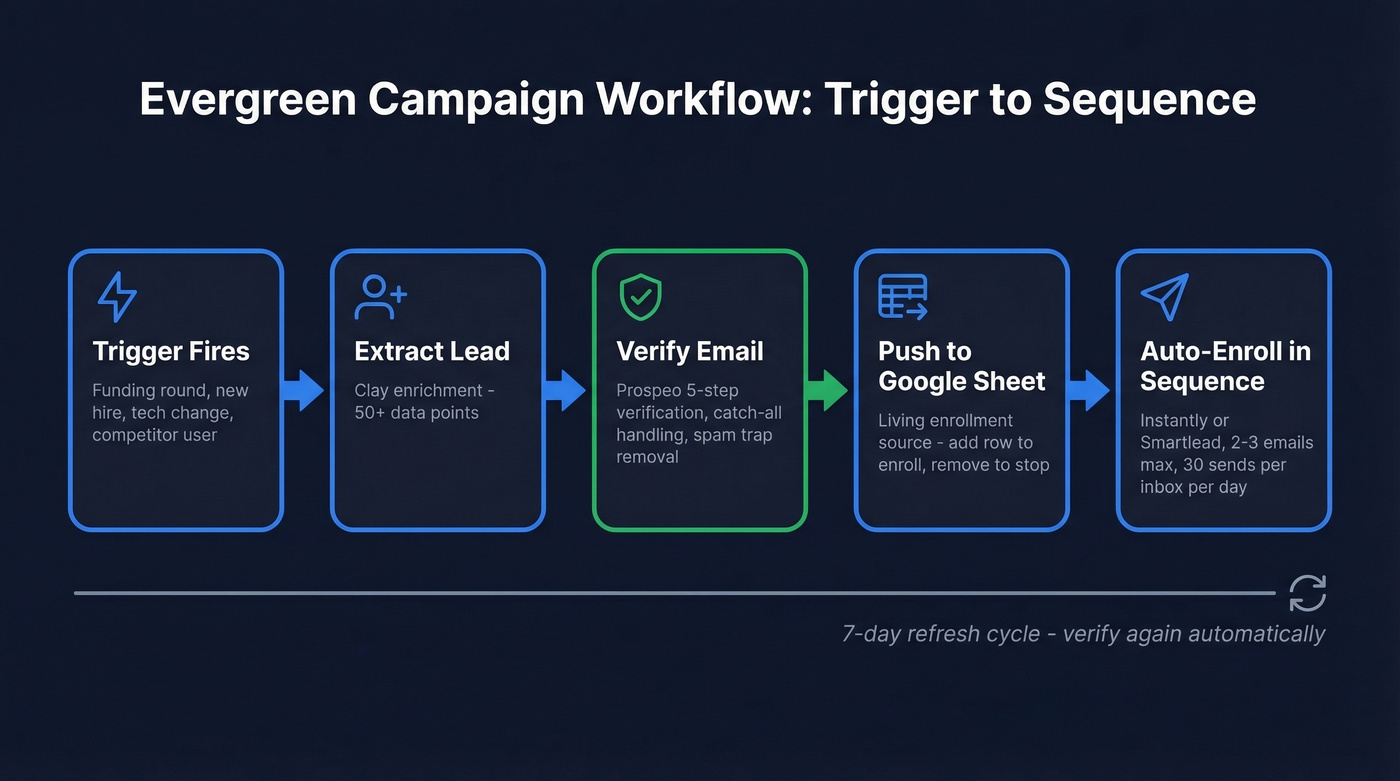
Here's the workflow: trigger fires -> extract lead -> verify email -> push to Google Sheet -> auto-enroll in sequence. Zapier or Make handles the connectors. Clay handles enrichment. The Google Sheet acts as a living enrollment source - add a row, the lead enters the sequence; remove a row, they stop. Before any lead enters your sequence, you verify it. Prospeo's 5-step verification process, including catch-all handling and spam-trap removal, keeps always-on systems clean where stale data would otherwise pile up fast on a 7-day refresh cycle.
Deliverability Infrastructure
If you're sending 30K emails a month and not getting results, the problem isn't your copy. It's your list and your infrastructure.
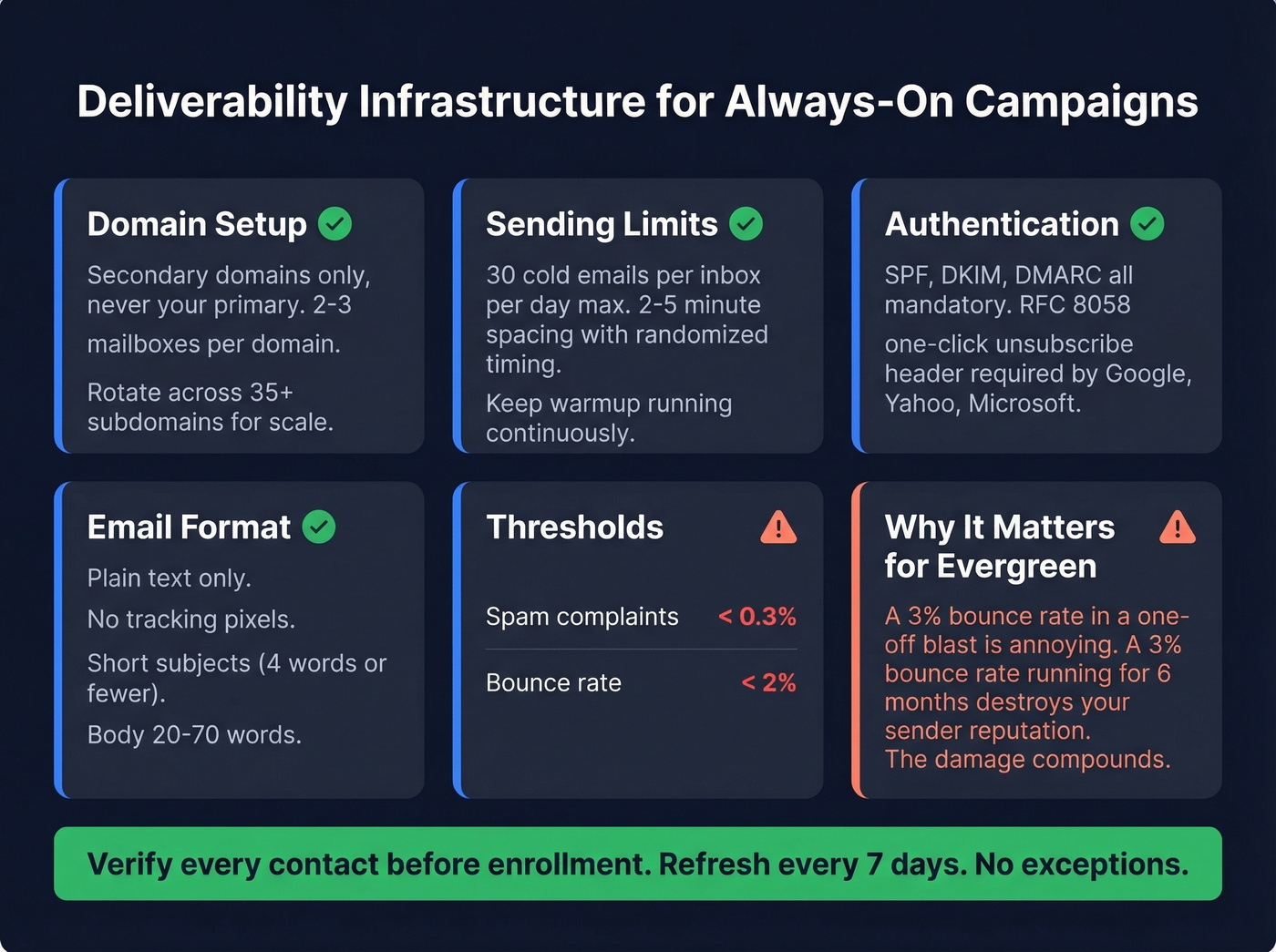
Domain and mailbox setup. Use secondary domains, never your primary. Run 2-3 mailboxes per domain and rotate them. Some agency operators set up 35+ subdomains and 70+ email accounts per client campaign - scale horizontally, not vertically.
Sending limits. Cap at 30 cold emails per inbox per day after warmup. Space sends 2-5 minutes apart with randomized timing. Keep warmup running continuously, even after you start cold sending. (If you need to sanity-check your caps, see email velocity.)
Authentication and compliance. SPF, DKIM, DMARC - all mandatory. RFC 8058 one-click unsubscribe headers are required by Google, Yahoo, and Microsoft. Plain text only, no tracking pixels, short subjects (four words or fewer), body 20-70 words. Spam complaints under 0.3%, bounces under 2%. If you want a deeper checklist, use this email deliverability guide and a dedicated email spam checker.
Here's the thing about always-on campaigns specifically: a 3% bounce rate in a one-off blast is annoying. A 3% bounce rate in a campaign running for six months destroys sender reputation. The damage compounds because you're sending from the same domains week after week. We've seen agencies lose entire domain portfolios from running unverified lists for just 60 days. That's why verification isn't optional for evergreen cold email campaigns - it's existential. The 6-week industry average refresh cycle is far too slow for systems that never stop sending. (More on bounce thresholds and fixes: email bounce rate.)
Sequence Structure
Two to three emails max. 80% of positive responses come from the first two emails. Space follow-ups 2-3 days apart. Keep them plain text, 20-70 words per body. 42% of all replies come from follow-ups, so don't skip them - just don't overdo them. If you need proven language, pull from these cold email follow-up templates.
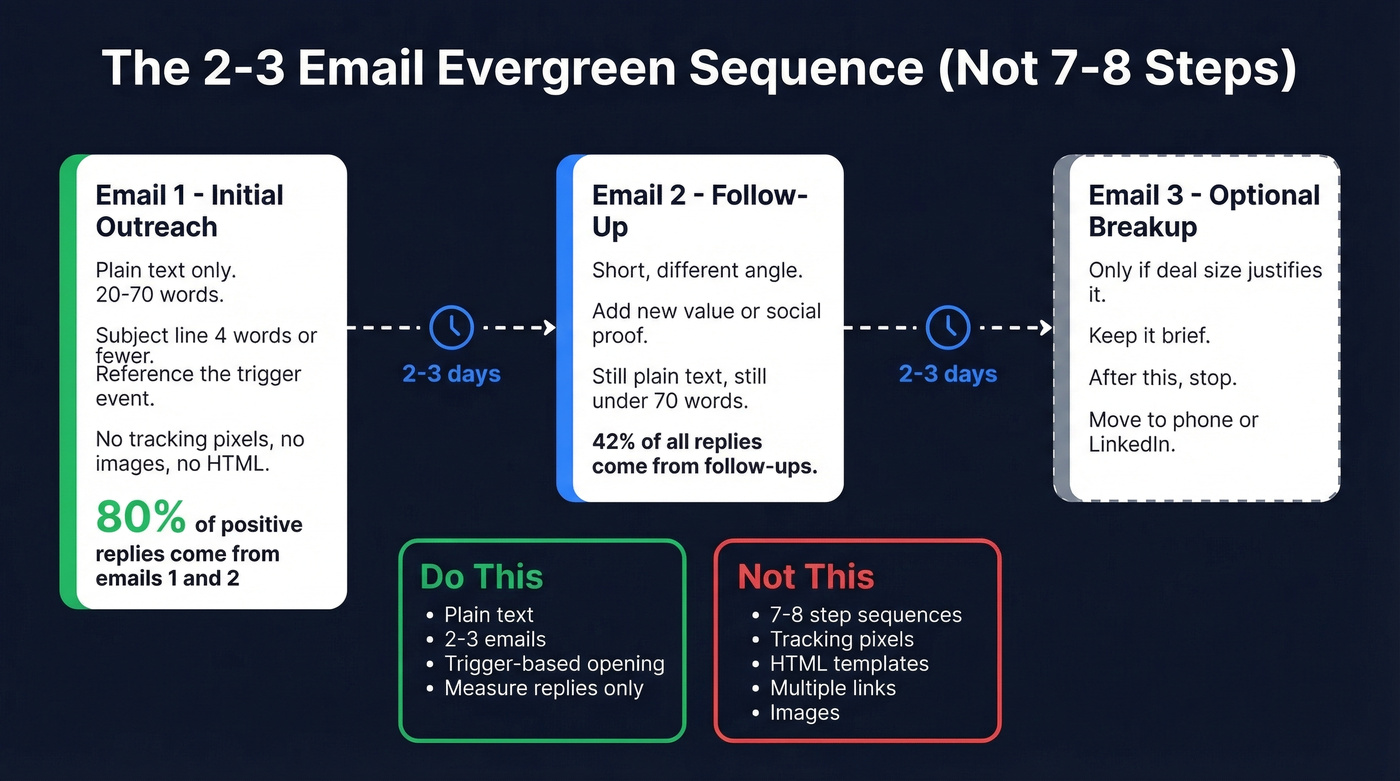
Skip this if you're running 7-8 step sequences. In 2026, those are burning domains for marginal returns. Tracking pixels tank deliverability and the data they return is garbage anyway. HTML templates, images, and multiple links belong in marketing emails, not cold outreach. (If you want the technical why, see email tracking pixels.)
Let's be honest: if your deal size sits below five figures, you probably don't need more than 2 emails and a phone call. The teams obsessing over 5-step sequences with A/B-tested subject lines are optimizing the wrong thing. Fix your targeting and your offer first. (For a full build, use this B2B cold email sequence framework.)

Evergreen campaigns compound bad data faster than any other outbound motion. A 3% bounce rate running for months will torch your domains. Prospeo's 5-step verification with catch-all handling, spam-trap removal, and a 7-day refresh cycle keeps your always-on sequences clean - automatically. 98% email accuracy at $0.01 per lead.
Stop rebuilding lists. Start running campaigns that never go stale.
When to Refresh Your Copy
Even the best perpetual outbound sequences go stale. Reply rates drift downward after 8-12 weeks as prospects in a given market start seeing similar messaging.
A sales development email refresh every quarter keeps your sequences performing without rebuilding the entire system. Review your opening line, value prop, and CTA - if reply rates have dropped 30%+ from baseline, it's time. The goal isn't to start over. It's to swap the copy layer while keeping your trigger-event engine and deliverability infrastructure intact. (If you need a copy baseline, start with email copywriting.)
What "Working" Looks Like
Average cold email open rate sits around 27.7%. Average reply rate: 3.43%. Roughly 17% of cold emails never reach the inbox. Conversion to deal runs 0.2-2%. Adding phone or social touches can boost results by 287%+ vs email alone.
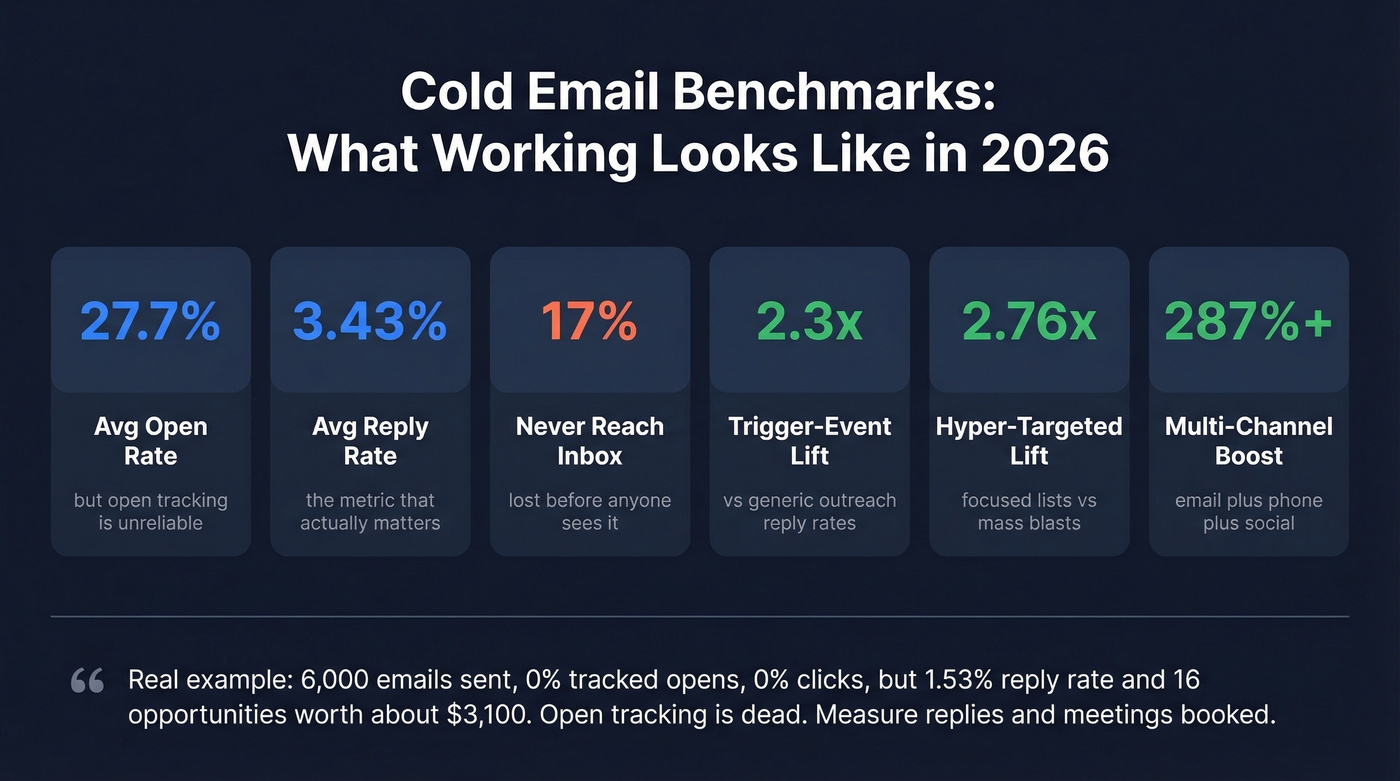
One real example from r/SaaS: a founder sent 6,000 cold emails in a month. Dashboard showed 0% tracked opens, 0% clicks - but a 1.53% reply rate and 16 opportunities worth ~$3.1K. That thread is a perfect case study for why open tracking is dead. In our experience, teams that measure replies and meetings booked - and nothing else - make better decisions about what's actually working. (To tighten your KPI set, use these funnel metrics.)
Tools and Pricing
| Category | Tool | Starting Price |
|---|---|---|
| Sending | Instantly | $47/mo |
| Sending | Smartlead | $39/mo |
| Sending | Saleshandy | $36/mo |
| Sending | Woodpecker | $29/mo |
| Sending | Quickmail | $49/mo |
| Verification | Prospeo | Free tier (75/mo), ~$0.01/email |
| Enrichment | Clay | ~$150-500/mo |
| Triggers | BuiltWith | ~$295/mo |
| Triggers | PhantomBuster | ~$69/mo |
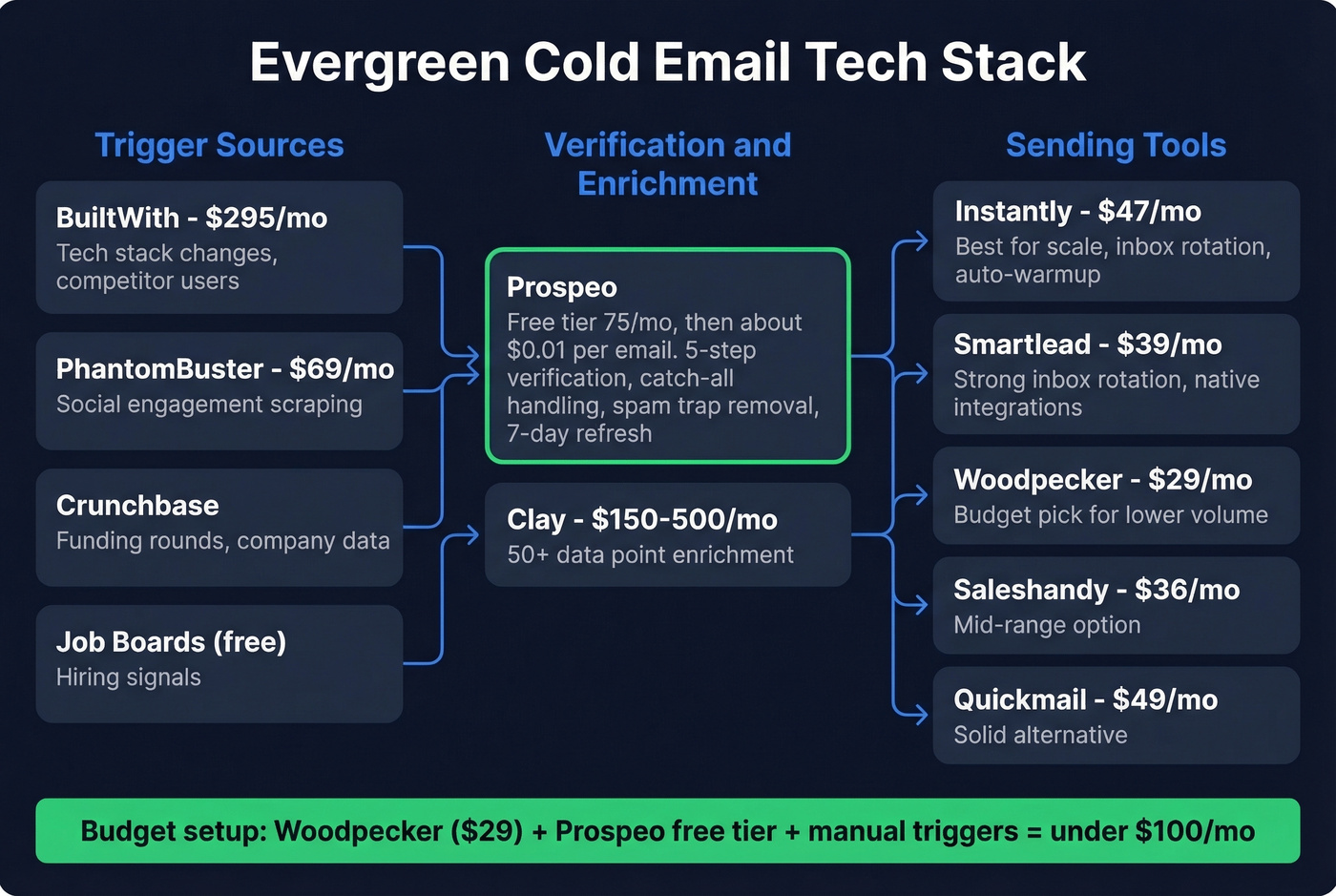
Instantly and Smartlead are the strongest picks for always-on campaigns because they support inbox rotation and auto-warmup natively - both critical for systems that never pause. Woodpecker works as a budget alternative at lower volume. Most of these platforms also let you duplicate a campaign in a few clicks, which makes it easy to spin up variations for different ICPs or verticals without starting from zero. Prospeo integrates natively with Instantly, Smartlead, and Clay, so verified contacts flow directly into your sending tool without manual CSV exports. (If you're comparing vendors, start with data enrichment services and SDR tools.)
How to Edit a Live Campaign
One of the biggest advantages of an evergreen setup is that you can edit a live email campaign while it's running. Need to swap a subject line, adjust follow-up timing, or update a CTA based on new data? Instantly, Smartlead, and Woodpecker all let you make changes mid-flight without unenrolling active prospects.
The key rule: never change the first email for leads already in the sequence. Edit the steps they haven't reached yet, and let in-progress contacts finish their current version. This lets you reuse email campaigns across quarters by iterating on what's already working rather than tearing everything down. (If you need a process for this, see sequence management.)
Compliance
Evergreen campaigns amplify compliance risk because they run indefinitely. Systemize opt-outs from day one.
For CAN-SPAM: accurate sender info, non-deceptive subjects, one-click unsubscribe, opt-outs honored within 10 business days, and a valid physical address. For GDPR: legitimate interest basis for relevant B2B contacts, clear sender identification, and an opt-out mechanism in every message. Build your suppression logic before you launch - not after your first complaint spike.
Evergreen doesn't mean set-and-forget. It means build once, maintain weekly, and stop rebuilding from scratch every month.
Your trigger-event engine is only as good as the data it feeds into your sequence. Prospeo enriches leads with 50+ data points at a 92% match rate, integrates natively with Instantly, Smartlead, Lemlist, Clay, Zapier, and Make - and refreshes every 7 days so your evergreen workflows never send to dead addresses.
Plug verified contacts into your evergreen sequences in one click.
FAQ
How often should I add new leads to an evergreen campaign?
Weekly is the sweet spot for most teams. Trigger-event sources like Crunchbase alerts or job-posting scrapers naturally batch on a 5-7 day cycle. Adding leads more frequently than daily creates verification bottlenecks; less than weekly lets your pipeline go cold between batches.
What's the biggest reason evergreen cold email campaigns fail?
Bad data quality, not bad copy. A 3%+ bounce rate compounding over months will destroy your sender reputation. Verify every contact before enrollment and keep bounce rates under 2%, even on always-on systems.
Can I run evergreen campaigns with a small budget?
Yes. A functional setup costs under $100/month: Woodpecker ($29/mo) for sending, Prospeo's free tier (75 verifications/month) for data quality, and manual trigger sourcing from free job boards. Scale tooling up as pipeline justifies the spend.
How many emails should an evergreen sequence include?
Two to three emails maximum. 80% of positive responses come from the first two touches. Longer sequences burn domains faster in always-on systems and deliver diminishing returns after step three.