

Executive Business Review Template: 7 Slides, 55 Minutes, Zero Gatekeeping
Every executive business review template worth using is gated behind a vendor's lead form or buried inside a platform you don't have. Half the results are actually QBR templates wearing an EBR label - and if you're prepping for a mock EBR interview, that distinction matters a lot.
Here's the complete template: seven slides, time allocations, metrics, and a follow-up email. One stat to anchor why this matters: Bain's research shows a 5% improvement in retention can lift profits 25-95%. EBRs are where that retention gets built.
Quick version: Use this 7-slide EBR structure: Welcome -> Strategic Updates -> Value Delivered -> Health & Sentiment -> Challenges -> Recommendations -> Next Steps. Total runtime: 55 minutes (leaving a 5-minute buffer in a 60-minute slot). Works for live customer EBRs and mock EBR interviews. Full slide-by-slide breakdown below.
EBR vs QBR: What's Actually Different
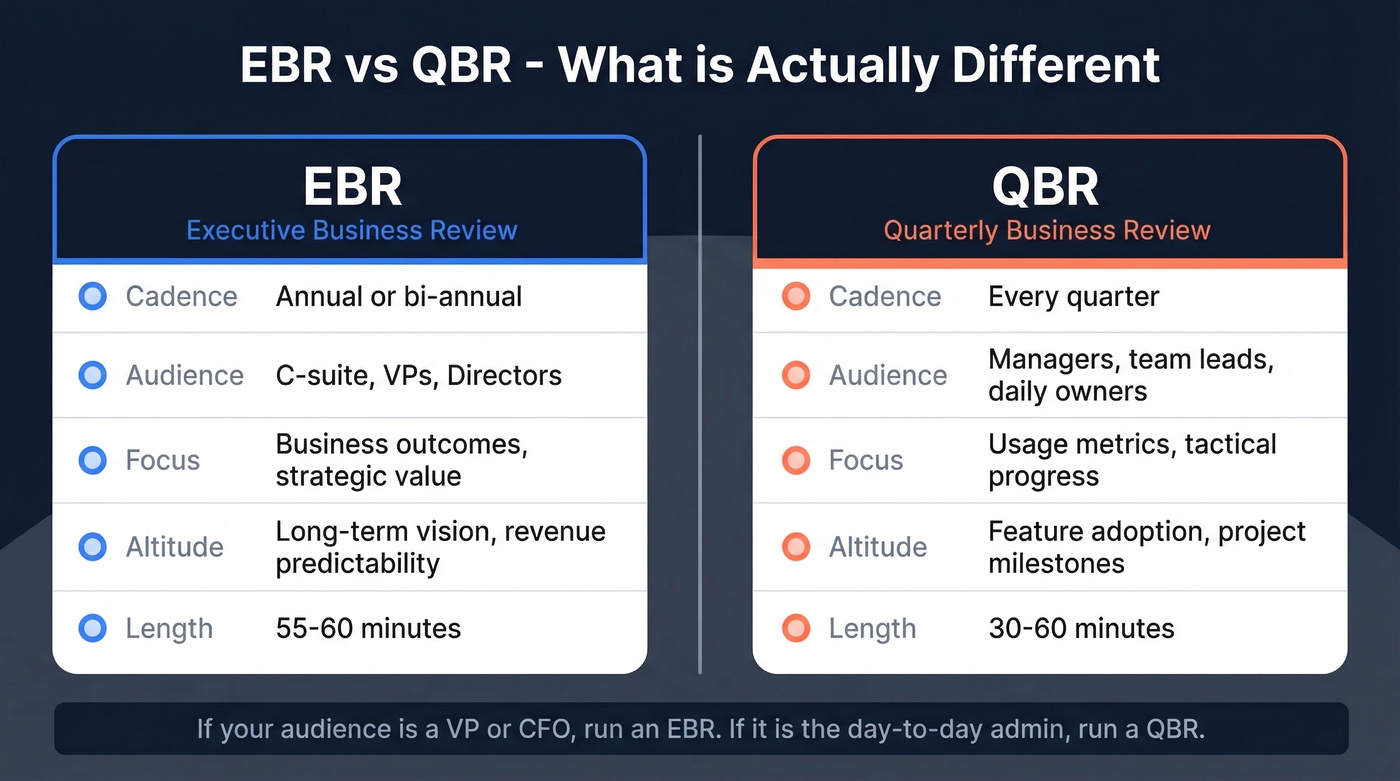
These get conflated constantly. On r/CustomerSuccess, people explicitly ask for "NOT a QBR template" - because the two meetings serve different audiences at different altitudes.
| Dimension | EBR | QBR |
|---|---|---|
| Cadence | Annual/bi-annual (or milestone-based) | Quarterly |
| Audience | C-suite, VPs, directors | Managers, team leads, day-to-day owners |
| Focus | Business outcomes, strategic value | Usage metrics, tactical progress |
| Altitude | Long-term vision, revenue predictability | Feature adoption, project milestones |
| Typical length | 55-60 min | 30-60 min |
If your audience is the VP of Operations or the CFO, you're running an EBR. If it's the day-to-day admin and their manager, that's a QBR - or possibly a monthly business review cadence where you check in on tactical progress more frequently. The slide structure changes accordingly, and so should your prep time. (If you want the full breakdown, see QBR vs EBR.)
The 7-Slide EBR Deck Breakdown
This structure adapts Gainsight's time-boxed EBR agenda and expands it into seven slides for cleaner transitions - separating "health/sentiment" from "challenges/risks" and ending with explicit next steps. The total is 55 minutes. You want that 5-minute buffer because execs always have a hard stop.
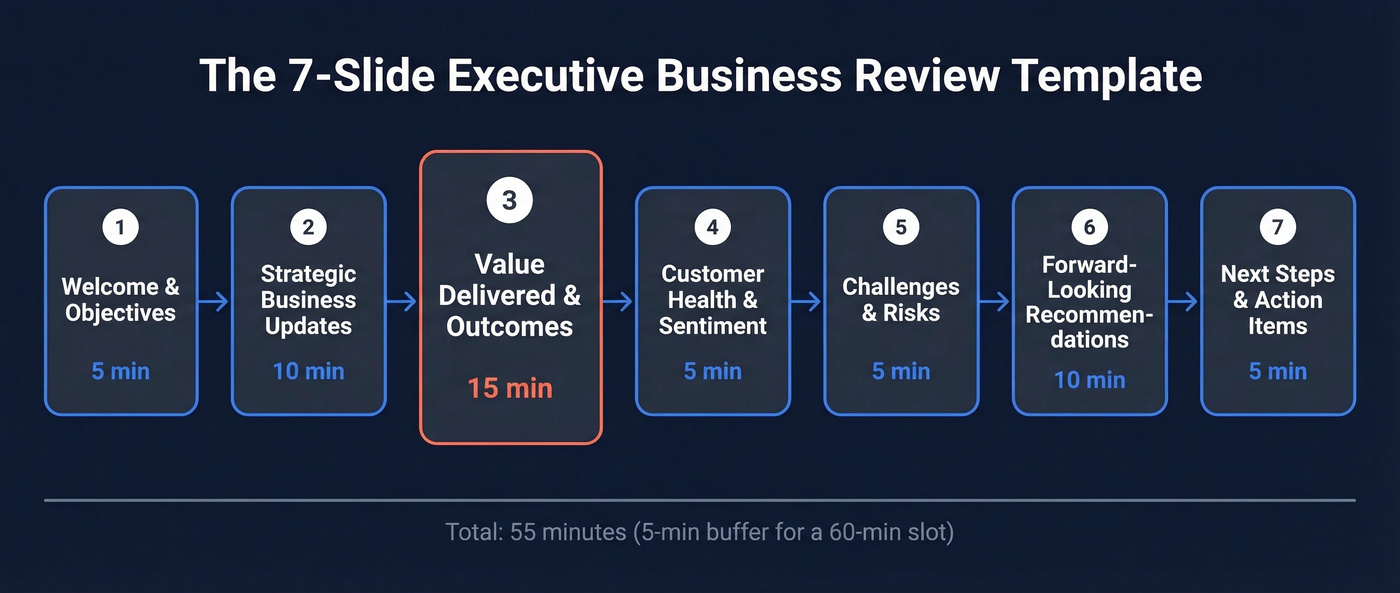
Slide 1 - Welcome & Objectives (5 min)
Set the frame. State the meeting purpose, confirm desired outcomes, and do quick introductions if there are new faces.
Your talking point: "We're here to align on [company]'s strategic priorities for the next 6-12 months and make sure our partnership is tracking toward those goals." Don't spend more than five minutes here. Execs lose patience with long preambles.
Slide 2 - Strategic Business Updates (10 min)
This is where you prove you've done your homework. Cover the customer's business context: industry shifts, org changes, recent earnings, new product launches. Reference their public announcements by name - nothing signals preparation like citing their most recent earnings call or a new market expansion they announced last month. This slide is about them, not you.
Slide 3 - Value Delivered & Outcomes (15 min)
The centerpiece of the deck. Present 3-5 KPIs showing ROI with before/after metrics and value realization milestones. Tie every metric to a business outcome the exec actually cares about: revenue gained, cost reduced, risk mitigated. (If you need a KPI shortlist, start with pipeline health and work backward from what the exec team cares about.)
"Your support ticket volume dropped 34% since implementation" is fine. "That 34% drop saved your team roughly 120 hours per quarter, which your ops lead valued at $45K annually" is better. This slide gets the most time because it's the reason the meeting exists. If you're looking for sales deck storytelling examples to model this slide after, the best ones always lead with dollar impact before showing the supporting data.
Slide 4 - Customer Health & Sentiment (5 min)
Pro tip: Show trajectory, not snapshots. An NPS of 42 means nothing in isolation. An NPS that climbed from 28 to 42 over two quarters tells a story execs can act on.
Present NPS/CSAT scores, adoption rates, support ticket trends, and your internal health score. If sentiment is trending down, don't bury it - surface it here so you can address it head-on in the next slide. (For retention context, it helps to understand churn analysis and how it shows up in leading indicators.)
Slide 5 - Challenges & Risks (5 min)
Never hide bad news. Present open issues, adoption blockers, and resource gaps honestly, but always pair each problem with a proposed path forward. Execs respect candor. They don't respect surprises at renewal time. (If you're tying this to commercial outcomes, align on your renewal rate definition and reporting window.)
Slide 6 - Forward-Looking Recommendations (10 min)
Frame this as "here's what we recommend," not "here's what we sell." Cover expansion opportunities, product roadmap alignment, and strategic initiatives. This is where EBRs drive revenue predictability: when you tie expansion recommendations to the exec's own stated goals, renewals and upsells stop feeling like sales motions and start feeling like strategic alignment. (If you need language for this, borrow from upsell vs cross-sell in SaaS.)
If there's a natural upsell, it should feel like a recommendation grounded in their goals - not a pitch shoehorned into a review.
Slide 7 - Next Steps & Action Items (5 min)
Assign owners, set deadlines, confirm the next meeting date, and document follow-up commitments. Every action item needs a name and a date. Vague next steps are the fastest way to make an EBR feel like wasted time.
Metrics to Include in Your EBR
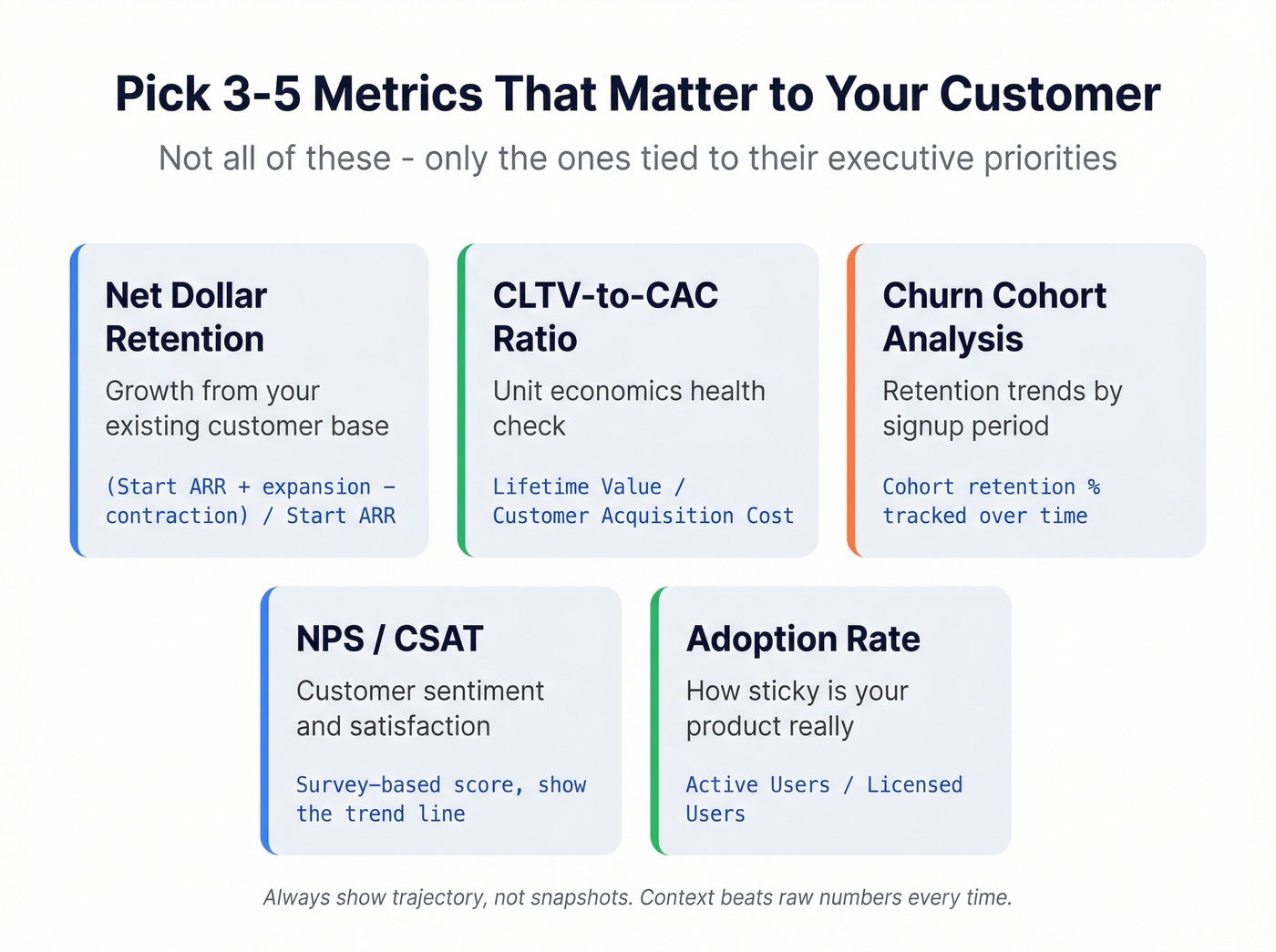
Pick 3-5 that matter to your customer's executive team - not all of these.
| Metric | What it shows | Formula |
|---|---|---|
| Net Dollar Retention | Growth from existing base | (Start ARR + expansion - contraction) / Start ARR |
| CLTV-to-CAC Ratio | Unit economics health | Lifetime value / CAC |
| Churn Cohort Analysis | Retention by signup period | Cohort retention % over time |
| NPS / CSAT | Customer sentiment | Survey-based score |
| Adoption Rate | Product stickiness | Active users / licensed users |
For a deeper dive on SaaS KPI definitions and formulas, Re-Cap's metric guide is a solid reference. Many of these same metrics also appear in a quarterly business report, but the EBR frames them around strategic impact rather than operational progress. (If you're pressure-testing your funnel math, use a funnel metrics checklist.)

Slide 3 only works if your pipeline data is accurate. Prospeo's 300M+ profiles with 98% verified emails give CSMs and account teams the contact data they need to prove expansion revenue and tie outreach results directly to executive-level outcomes.
Build the pipeline metrics your next EBR actually deserves.
5 EBR Mistakes That Kill Executive Trust
- No clear recommendation. If your EBR ends without a point of view, you've just presented a book report. Execs want to know what you think they should do next.
- Wrong altitude. Diving into feature-level usage stats with a C-suite audience is a fast way to lose the room. Save the weeds for QBRs.
- Hiding bad news. This erodes trust faster than the bad news itself. Bad news with a plan is leadership. Bad news at renewal is a crisis.
- Metrics without context. An NPS of 20 means nothing without a trend line, a benchmark, or a comparison. Always provide the "so what."
- Making it a monologue. EBRs are conversations, not presentations. If the exec hasn't spoken by slide 3, you're doing it wrong. We've sat through EBRs where the CSM talked for 45 straight minutes and then wondered why the exec didn't renew. Don't be that person. (If you're building the muscle here, sales communication frameworks help.)
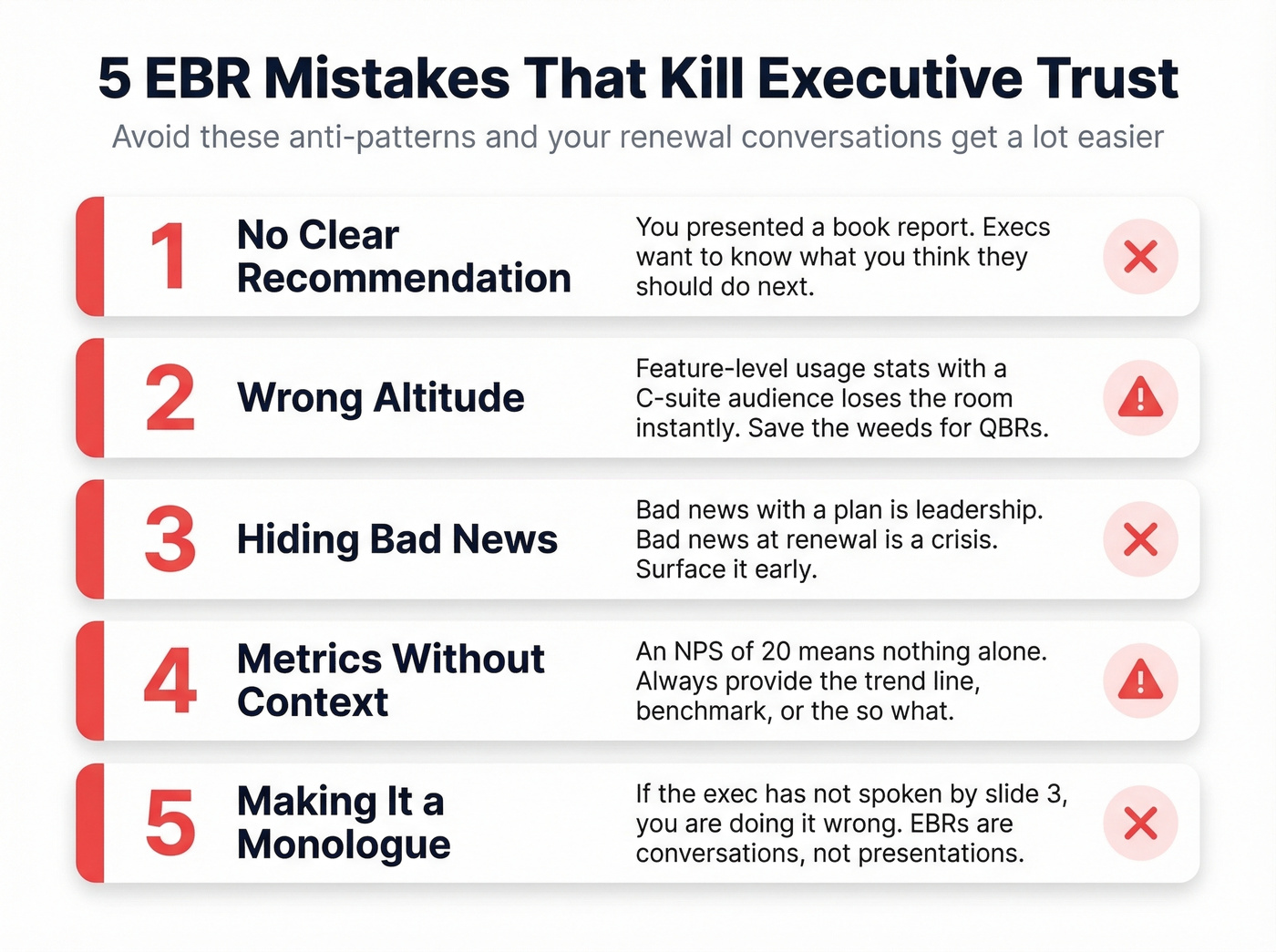
These anti-patterns draw from Dock's EBR guidance and Deb Liu's executive review mistakes - both worth reading in full.
How to Prepare: Timeline
4-6 weeks out: Schedule with executive assistants. Plan for a minimum of four weeks' notice - senior leaders' calendars fill fast. Prioritize accounts approaching renewal, showing churn signals, or with clear expansion potential.
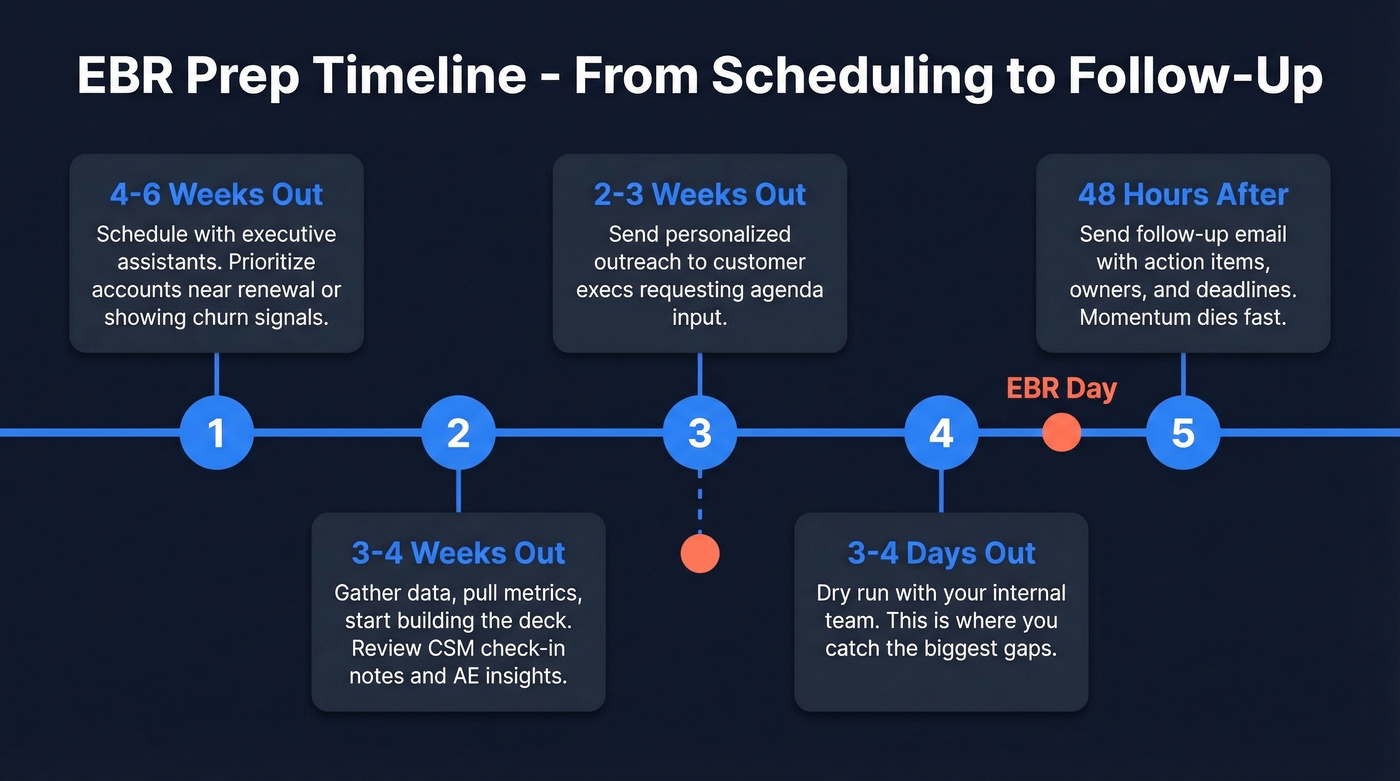
3-4 weeks out: Gather data, pull metrics, and start building the deck. Use insights from your CSM check-ins and sales one-on-one notes - the themes your AE surfaces in regular conversations often reveal the strategic priorities the exec cares about most. (If you're formalizing account selection, start with an ideal customer profile and segment from there.)
2-3 weeks out: Send personalized outreach to customer execs requesting agenda input. This improves attendance and engagement. Here's the thing: getting the VP's direct email for your EBR invite shouldn't take 30 minutes of guessing at formats. Prospeo lets you paste a company URL, filter by title, and grab verified emails - the free tier covers 75 lookups per month, which handles most EBR prep cycles. (If you're tightening outreach quality, use these sales prospecting techniques.)
3-4 days out: Dry run with your internal team. In our experience, the dry run is where most teams catch their biggest gaps - weak data points, missing context, and slides that don't hold up under questioning.
48 hours after: Send the follow-up email with action items, owners, and deadlines. (If you want a plug-and-play structure, use a sales meeting follow-up email template.)
Post-EBR Follow-Up Email
Send this within 48 hours. Momentum dies fast.
Subject: [Company] EBR Recap - Action Items & Next Steps
Hi [Name],
Thank you for making time for our executive review. Here's a summary of what we covered and what's next:
- Key outcome 1: [e.g., "Adoption rate up 22% QoQ, targeting 85% by Q3"]
- Key outcome 2: [e.g., "Agreed to pilot advanced analytics module"]
- Key outcome 3: [e.g., "Identified onboarding bottleneck for new team members"]
Action items:
- [Action] - Owner: [Name] - Due: [Date]
- [Action] - Owner: [Name] - Due: [Date]
Our next review is scheduled for [Date]. I'll send a calendar hold this week.
Best, [Your name]
Let's be honest: most teams over-invest in the EBR deck and under-invest in the follow-up. A mediocre deck with a sharp, timely follow-up email builds more trust than a beautiful presentation that disappears into the ether. The email is where accountability lives.
Your forward-looking recommendations slide falls flat without real buyer signals. Prospeo tracks 15,000 intent topics so you can walk into every EBR with data-backed expansion plays tied to your customer's strategic priorities - not guesswork.
Turn your EBR recommendations into revenue with intent data.
FAQ
How often should you run executive business reviews?
Bi-annually for strategic accounts, annually for growth accounts. Schedule your first EBR 3-6 months post-implementation, once initial value realization is clear. Don't run one before you have results to show - presenting an empty deck erodes credibility faster than skipping the meeting entirely.
Who should attend an EBR?
Customer side: contract signer, champion, and executive sponsor. Your side: CSM, AE or sales leader, and an executive sponsor. Bring product or engineering only when the agenda warrants it. Align with your AE beforehand - reviewing their one-on-one notes ensures you aren't blindsided by open commercial conversations.
What's the biggest mistake in executive business reviews?
Treating the EBR like a status update instead of a strategic conversation. If you leave the room without a clear recommendation and assigned next steps, you've wasted everyone's time - especially the exec's. Always end with a point of view on what should happen next.