

How to Write a Follow Back Email That Actually Gets a Reply
You sent the email. It was good - maybe even great. Three days later, you're refreshing your inbox like it owes you money, wondering if they even opened it.
Whether you're a student chasing a fee waiver, a sales rep working a pipeline, or a colleague nudging someone who's sitting on a deliverable, the follow back email is where most people freeze up. They either don't send one at all, or they send "just checking in" and hope for the best. Follow-ups aren't optional - they're where a huge chunk of replies actually come from. But there's a right way and a very wrong way to write one.
Three Rules Before You Write Anything
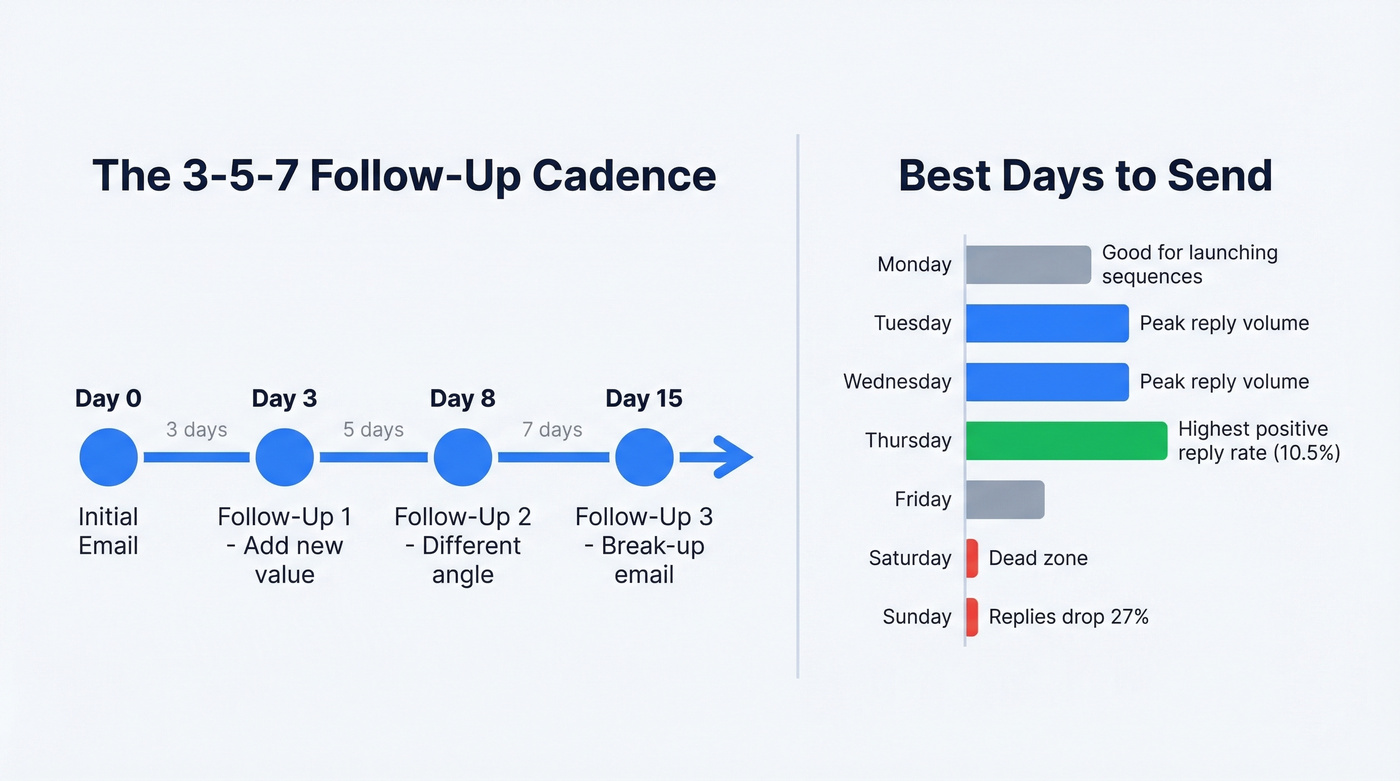
Timing: Wait 3 business days after your initial email, then follow the 3-5-7 cadence - follow up at 3 days, then 5 days later, then 7 days later. (If you want a deeper timing breakdown, see when to follow up on an email.)
Tone: Informal beats formal by 78% in positive reply rate. Stop writing like a lawyer drafting a contract. If you're rewriting stiff outreach, email copywriting frameworks help.
Content: Every follow-up must add new value. A stat, a resource, a question. "Just bumping this" was dead two years ago and it's still dead now. For alternatives to “just checking in,” use these professional follow-up phrases.
What 2026 Data Actually Says
Most guides throw around reply rates without telling you what those numbers mean in practice.
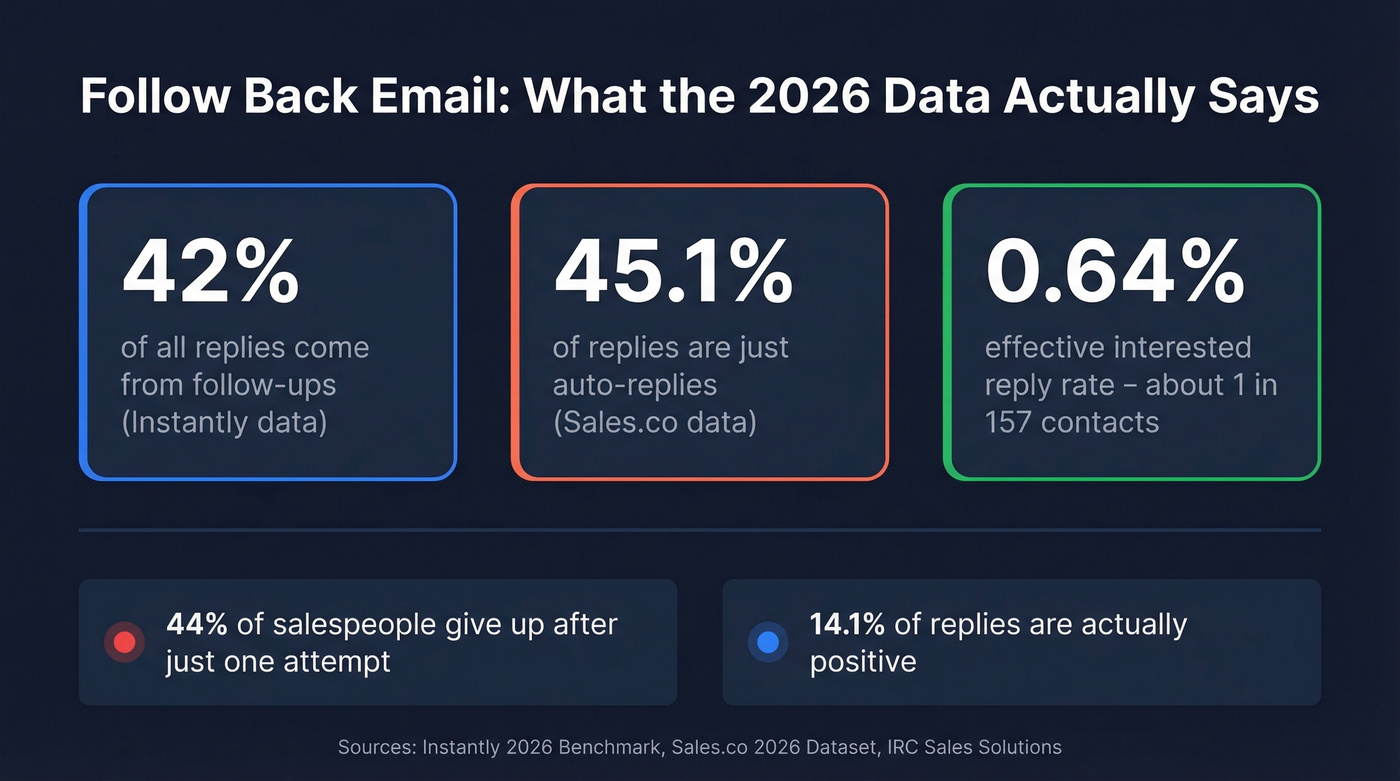
Instantly's 2026 benchmark report analyzed billions of cold email interactions. The average reply rate sits at 3.43%, with elite campaigns cracking 10%+. Their finding: 42% of all replies come from follow-ups, not the initial email. Sales.co's February 2026 dataset - 2M+ emails, 61,770 replies, across 100+ industries - tells a different story: 79.4% of replies come from the initial outreach, with follow-ups contributing 20.6%. The gap likely reflects different audience mixes and sequence lengths, but either way, skipping follow-ups means leaving responses on the table.
Here's the stat nobody talks about, though. Sales.co found that only 14.1% of replies are actually positive. A staggering 45.1% are auto-replies.
The effective "interested reply rate" across all contacts emailed is roughly 0.64%. That's about 1 in 157 contacts.
This isn't meant to depress you. It's meant to recalibrate expectations. IRC Sales Solutions found that 44% of salespeople give up after one attempt, while follow-ups generate anywhere from 20-42% of all replies depending on the dataset. Not following up is leaving money on the table. But you need to follow up well - and it helps to understand follow-up email reply rate benchmarks.
When to Send Your Follow-Up
Timing depends on context. A cold sales follow-up has different rules than a post-interview check-in. Here's the framework we use:
| Scenario | Wait Before First Follow-Up | Cadence | Total Touchpoints |
|---|---|---|---|
| Cold outreach (sales) | 3 business days | 3-5-7 days | 5-7 |
| After meeting/demo | 1 business day | 3-5 days | 2-3 |
| Job interview | Until stated deadline passes | 5-7 days | 2 max |
| Workplace/internal | 1-2 business days | 2-3 days | 2-3 |
| Networking/event | 1-2 business days | 5-7 days | 2-3 |
For cold outreach, the 3-5-7 rule is your baseline. Instantly's data supports 4-7 total touchpoints as the sweet spot - beyond 7, diminishing returns kick in hard unless each touch genuinely adds something new. If you're building full sequences, use a B2B cold email sequence structure.
Monday is a solid launch day for new sequences, but mid-week emails get the replies. Instantly's data points to Tuesday-Wednesday for peak reply volume. Thursday wins for the highest positive reply rate at 10.5%. Weekends are a dead zone - reply rates drop 27%. Front-load Tuesday through Thursday and skip Saturday entirely. (More send-time testing ideas: best time to send cold emails.)
One more signal worth watching: if your email tool shows opens but no reply, follow up sooner. They saw it and didn't act, which means your next touch needs a different angle.

If only 0.64% of contacts become interested replies, every bounced email is a wasted follow-up. Prospeo's 98% email accuracy and 7-day data refresh mean your follow back emails actually reach the person - not a dead inbox.
Stop following up with email addresses that don't exist anymore.
Follow Back Email Templates by Scenario
Every template below stays under 80 words. Instantly's benchmark data shows the best campaigns keep emails under 80 words.
After No Response (Cold Outreach)
Hi {{first_name}},
I'm locking in my calendar for next week and wanted to see if {{specific_day}} works for a quick call. We helped {{similar_company}} cut their {{metric}} by {{number}} last quarter - happy to share how.
If the timing's off, just say so. No hard feelings.
This scheduling-pressure angle comes from a r/sales thread where practitioners swear by it as their go-to. It works because it gives the recipient a reason to reply that isn't "please pay attention to me." The key: reference a specific result. "Added 10-15 warm leads in January" beats "we can help you grow" every time. For more options, compare these cold email follow-up templates.
After a Meeting or Demo
Instead of a full template, here's the checklist. Every post-meeting follow-up needs exactly three things:
- Recap their words, not your pitch. "You mentioned {{pain_point}} is the priority for Q3" proves you listened.
- Attach the thing you promised. The one-pager, the case study, the pricing sheet. No attachment = no reason to open.
- Propose a concrete next step with a name. "Want to loop in {{stakeholder}} for a 15-min follow-up Thursday?" beats "Let me know if you'd like to continue the conversation."
If you want a full structure, use a sales meeting follow-up email framework.
After a Job Interview
This one's tricky. You already sent the thank-you note. They said you'd hear back by Friday. It's now Wednesday of the following week. That anxiety is universal.
The rule: wait until the stated deadline passes. Then send one follow-up, not three.
Hi {{name}},
I really enjoyed our conversation about the {{role}} position. You'd mentioned a decision by {{date}} - I wanted to check in and see if there's anything else I can provide to help with next steps.
Either way, I appreciate the time.
Workplace / Internal Follow-Up
Here's what most people write, followed by what actually works:
❌ Before: "Per my last email, just wanted to circle back on this when you get a chance."
✅ After: "Hey {{name}} - are you able to get me the final {{deliverable}} by {{date}}? I need it to hit our {{deadline}} on time. Original request below for reference."
The difference is a deadline and a reason. "Per my last email" reads as passive-aggressive even when you don't mean it that way. Direct beats clever in internal comms.
After Networking or an Event
Hi {{name}},
We met at {{event}} - you mentioned your team's working on {{topic}}. I just came across {{resource}} that's directly relevant.
Would love to continue the conversation. Coffee or a quick call next week?
Reference the shared context. "We met at the SaaStr booth" is infinitely better than "It was great connecting."
The Break-Up Email
A well-written break-up email can pull replies from prospects who ignored everything else. HubSpot highlights a "Permission to close your file?" example that drove a 76% response rate in one sales process case study.
Hi {{first_name}},
I've reached out a few times and haven't heard back, so I'll assume the timing isn't right. I'm going to close out your file on my end.
If anything changes, I'm here. Just reply to this thread.
Short, gracious, no guilt trips. The consensus on r/sales is clear: the "I'm closing your file" framing consistently pulls replies from prospects who ignored everything else. Something about the finality triggers action.
Subject Lines That Get Opens
Your follow back email could be perfect, but it's worthless if it never gets opened. 47% of recipients decide to open based on the subject line alone. Even scarier: 69% mark emails as spam based on the subject line without reading the body.
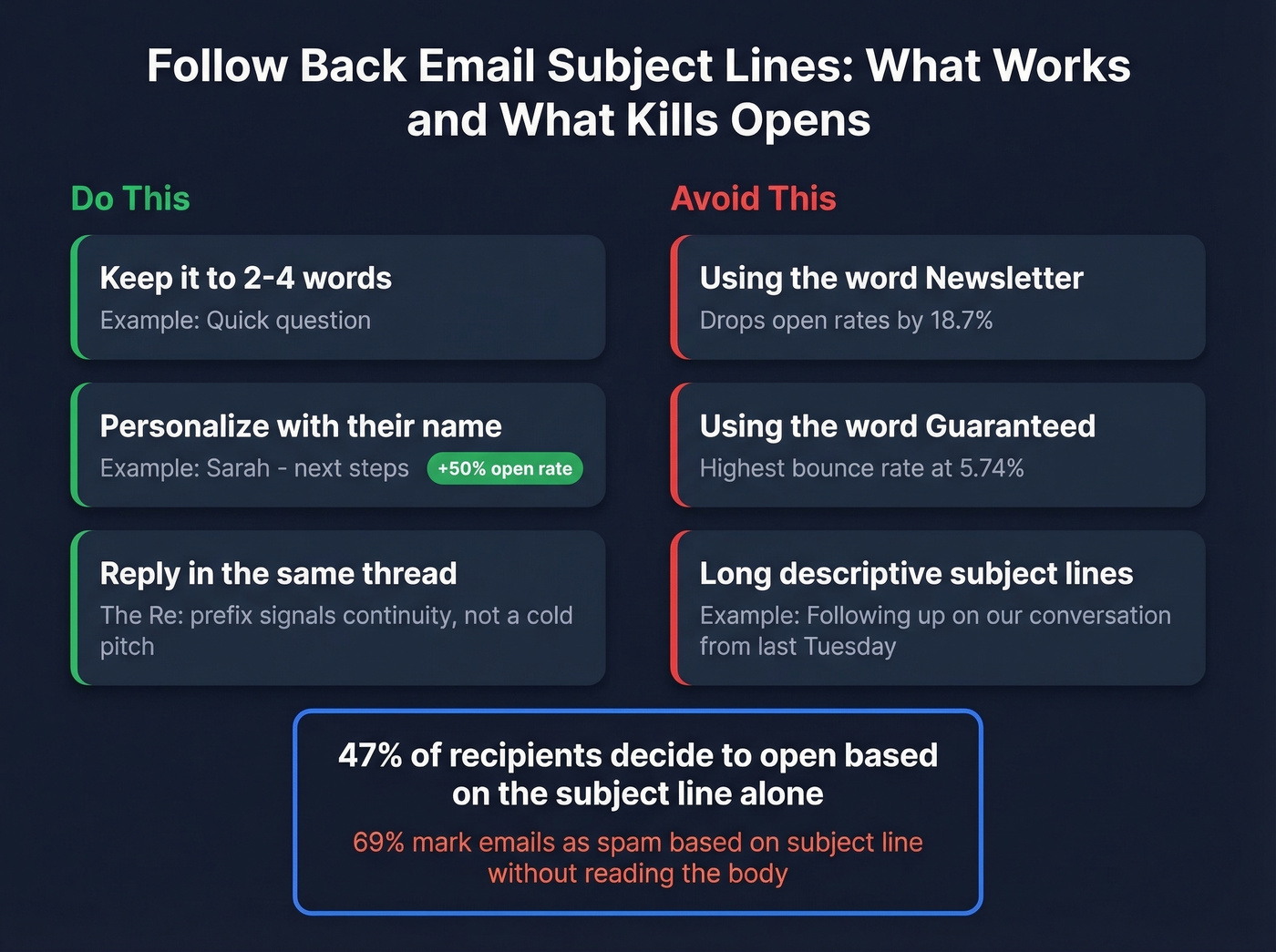
Keep it short. Two to four words outperform longer subject lines. "Quick question" or "{{name}} - next steps" beats "Following up on our conversation from last Tuesday." If you need ideas, pull from these email subject line examples.
Personalize. Personalized subject lines deliver 50% higher open rates, yet only 2% of emails include them. That's the easiest win in email.
Avoid trigger words. "Newsletter" drops open rates by 18.7%. "Guaranteed" has the highest bounce rates at 5.74%.
Reply in the same thread. For follow-ups, don't start a new email. Reply to your original so the "Re:" prefix appears naturally - it signals continuity, not a cold pitch.
5 Mistakes That Kill Your Follow-Ups
1. Sending "bump" with no new information. If the first email didn't convert, a content-identical nudge won't either. Each follow-up needs a new angle - a stat, a case study, a question they haven't considered.
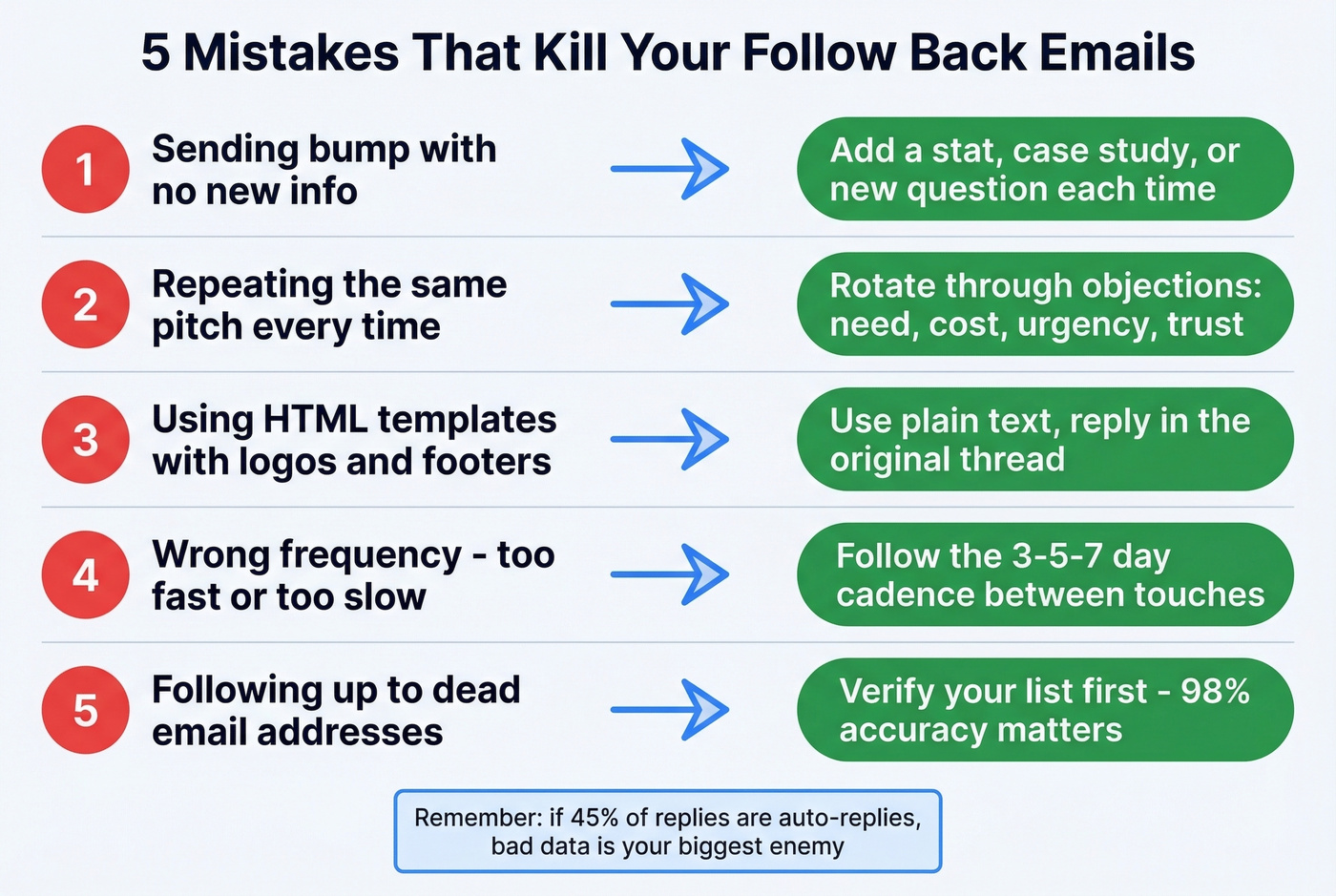
2. Not addressing different objections. People ignore emails for five reasons: no need, cost concerns, no urgency, don't want it, or don't trust you. Your follow-up sequence should rotate through these objections, not repeat the same pitch. (This is easier with a defined sales process optimization approach.)
3. Follow-ups that don't look real. HTML templates with logos and footers scream "mass email." Use plain text. Send as a reply to the original thread. Write like you're emailing one person, because you are.
4. Wrong frequency. Too fast and you're spam. Too slow and they've forgotten you. The 3-5-7 cadence exists for a reason.
5. Following up to dead email addresses. Look - if 45.1% of replies are auto-replies and you're sending to unverified addresses, you're burning your sender reputation on emails that'll never reach a human. Before you optimize your copy, verify your list. Prospeo's 5-step verification catches invalid addresses, spam traps, and honeypots before they tank your deliverability - 98% accuracy across 143M+ verified addresses, with a free tier of 75 verifications per month. If you're troubleshooting bounces, start with email bounce rate basics.

Verify Before You Follow Up
Let's be honest: most follow-up advice is backwards. People obsess over subject lines and templates while sending to lists full of dead addresses. You can nail the timing, write the perfect copy, and craft a genuinely valuable follow back email - none of it matters if the email bounces or hits a spam trap. Bad data doesn't just waste your time. It damages your domain reputation, which tanks deliverability for every email you send, including the ones going to valid addresses. If you’re trying to fix inboxing issues, use an email deliverability guide and work through it systematically.
We've seen teams go from 35% bounce rates to under 4% just by cleaning their lists before launching sequences. Fix the data first. Then worry about the copy.
Your follow-up templates are dialed in. Now make sure you're sending them to real decision-makers. Prospeo gives you 300M+ verified contacts with 30+ filters - buyer intent, job changes, tech stack - so every follow back email hits someone worth chasing.
Great follow-ups deserve great data. Start at $0.01 per email.
FAQ
How many follow-up emails should I send?
Four to seven total touchpoints is the sweet spot per 2026 benchmark data. Each must add new value - a fresh angle, a relevant case study, or a direct question. Two good follow-ups beat five lazy ones every time.
What's the best day to send a follow back email?
Tuesday and Wednesday drive the highest reply volume. Thursday wins for positive reply rate at 10.5%. Avoid weekends entirely - reply rates drop 27% compared to midweek sends.
How do I follow up without sounding pushy?
Keep it under 80 words, use an informal tone, and add something new each time. Always give them an easy out: "If the timing's off, no worries" disarms the pushiness instantly.
Should I verify emails before following up?
Always. Use a bulk verification tool before launching any sequence. Cleaning your list protects sender reputation and ensures follow-ups actually land in inboxes instead of bouncing into the void.