

Follow-Up Email Reply: How to Write One, How to Answer One
The cursor's blinking in the reply field and you've got nothing. Maybe you sent a proposal three days ago and the silence is deafening. Or maybe you're on the other side - a client followed up last Tuesday and you've been avoiding it because you don't have a good answer yet.
Every follow-up email reply comes down to the same problem: what do you actually say?
Most guides only cover the sending side. This one covers both.
What You Need (Quick Version)
- Writing a follow-up? Wait 3 business days, use a scheduling-based CTA, stay in the same thread.
- Replying to a follow-up you received? Acknowledge the delay briefly, answer the actual question, set a next step.
- Getting zero replies? The email address might be dead. Verify it before rewriting your message for the fifth time.
Why Follow-Ups Go Unanswered
Three reasons cover 90% of cases.
Inbox overload. Per HubSpot's email marketing data, 40% of consumers have 50+ unread emails in their inbox at any given time. Your follow-up isn't being ignored - it's buried under everything else.
Bad timing. You sent it Friday at 4pm, or Monday morning when they're triaging the weekend backlog. Timing alone can tank a perfectly good message. If you're trying to systematize this, it helps to follow a simple sequence management approach.
Wrong email address. People change jobs, companies restructure, and that contact you pulled six months ago may no longer exist. If your follow-ups consistently bounce or go unanswered, the address itself is the problem. Prospeo's real-time email verification catches invalid addresses with 98% accuracy before you waste another send. (If you need a quick diagnostic, see how to check if an email exists.)

Here's the stat that reframes everything: Belkins' analysis of 16.5 million cold emails found the highest reply rate - 8.4% - comes from a single well-crafted email. Each additional follow-up delivers lower returns. One great email beats five mediocre ones.
If you're building a repeatable outbound motion, a B2B cold email sequence beats improvising follow-ups on the fly.

Before you rewrite that follow-up for the fifth time, ask: is the address even valid? Prospeo verifies emails with 98% accuracy on a 7-day refresh cycle - so you're never following up into a void.
Stop crafting perfect follow-ups to dead inboxes.
How to Write a Follow-Up That Gets a Reply
The 5-Rule Framework
A single follow-up can lift reply rates by 22%. But only if the email earns the response. We've tested dozens of follow-up variations across outbound campaigns, and the ones that work share five traits:
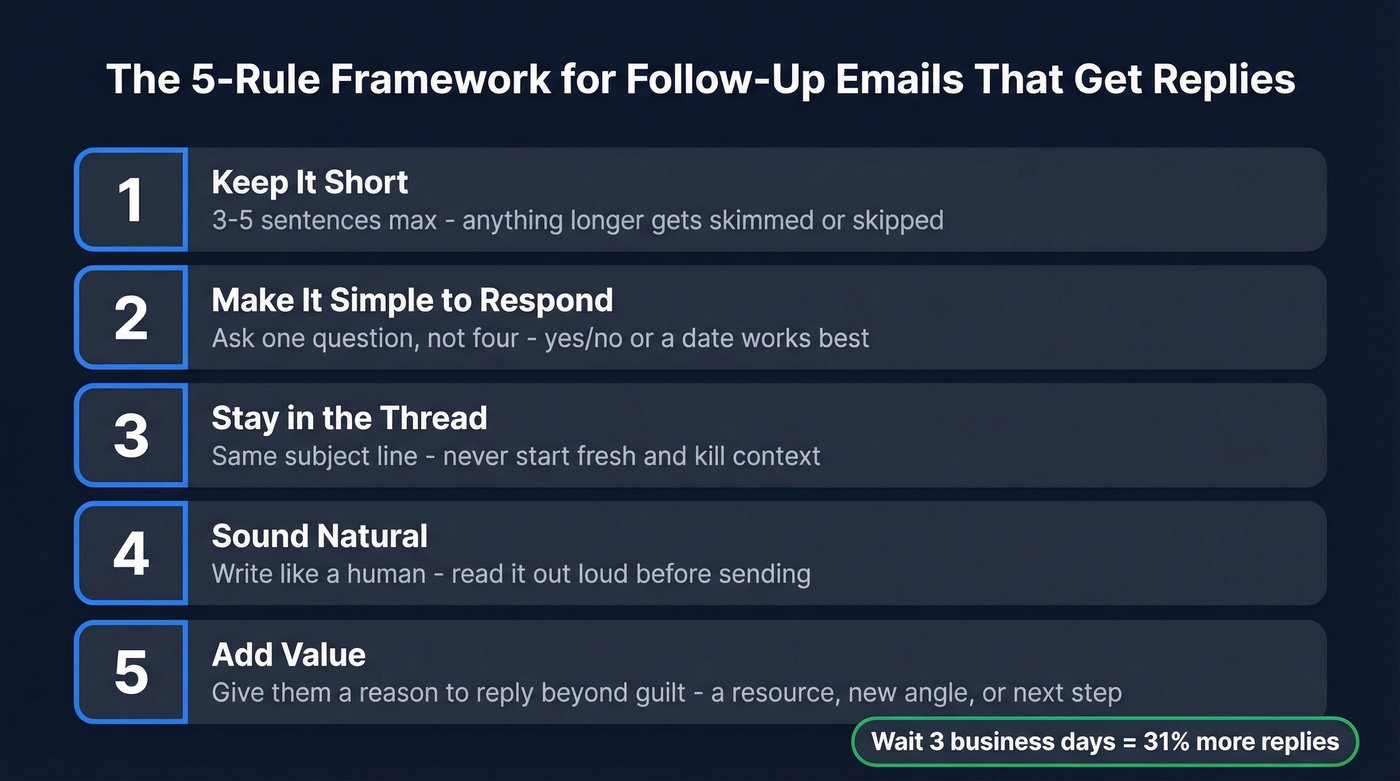
- Keep it short. Three to five sentences. Anything longer gets skimmed or skipped entirely. (More on structure in our email copywriting guide.)
- Make it simple to respond. Ask one question, not four. A yes/no or a date works best. If you want more options, pull from these sales follow-up templates.
- Stay in the thread. Reply with the same subject line - don't start fresh and kill context.
- Sound natural. Write like a human, not a template. Read it out loud before sending.
- Add value. Give them a reason to reply beyond guilt. A relevant resource, a new angle, a specific next step. (This is the core of personalized outreach.)
One more timing note: waiting three business days before following up yields 31% more replies than sending the next day. Patience pays. If you're optimizing send windows, see best time to send cold emails.
And per GlockApps, never put "follow-up" in the subject line. It adds zero value and makes the email easy to ignore. If you need ideas, use these email subject line examples.
Templates That Work
The scheduling CTA is our favorite format, and the consensus on r/sales backs this up. It works because it implies scarcity and gives the recipient a concrete thing to say yes or no to:
Hi [Name],
I'm finalizing my schedule for next week - does [Tuesday at 2pm] work for you? If not, happy to adjust.
[Your name]
In our experience, this scheduling-based approach outperforms vague "checking in" messages every time. It gives people a decision to make, not a chore to deal with. For more phrasing options, see email wording to schedule a meeting.
The proposal nudge lowers the bar for response by offering two easy outs:
Hi [Name],
Wanted to make sure the [proposal/document] came through okay. If you've had a chance to review, I'd love to get your thoughts - even a quick "looks good" or "need more time" helps me plan next steps.
Thanks, [Your name]
The job application follow-up is trickier because the power dynamic is lopsided. Keep it to two sentences and reference something specific from the interview or application - generic "just checking in" emails get deleted instantly:
Hi [Name],
Following up on my application for [role] - I've been thinking about [specific topic from interview/job description] and would love to continue the conversation. Is there a timeline for next steps?
[Your name]
Now, two phrases to ban from every follow-up: "just following up" and "kindly." The first sounds desperate. The second reads as condescending in professional English. Cut both. Always. (If you need alternatives, see how to say just checking in professionally.)
How to Reply to a Follow-Up You Received
This is the part nobody writes about. Every competitor guide assumes you're the sender. But half the anxiety around these situations comes from being on the receiving end - staring at an email that's four days old, wondering if it's too late to respond.
It's not.
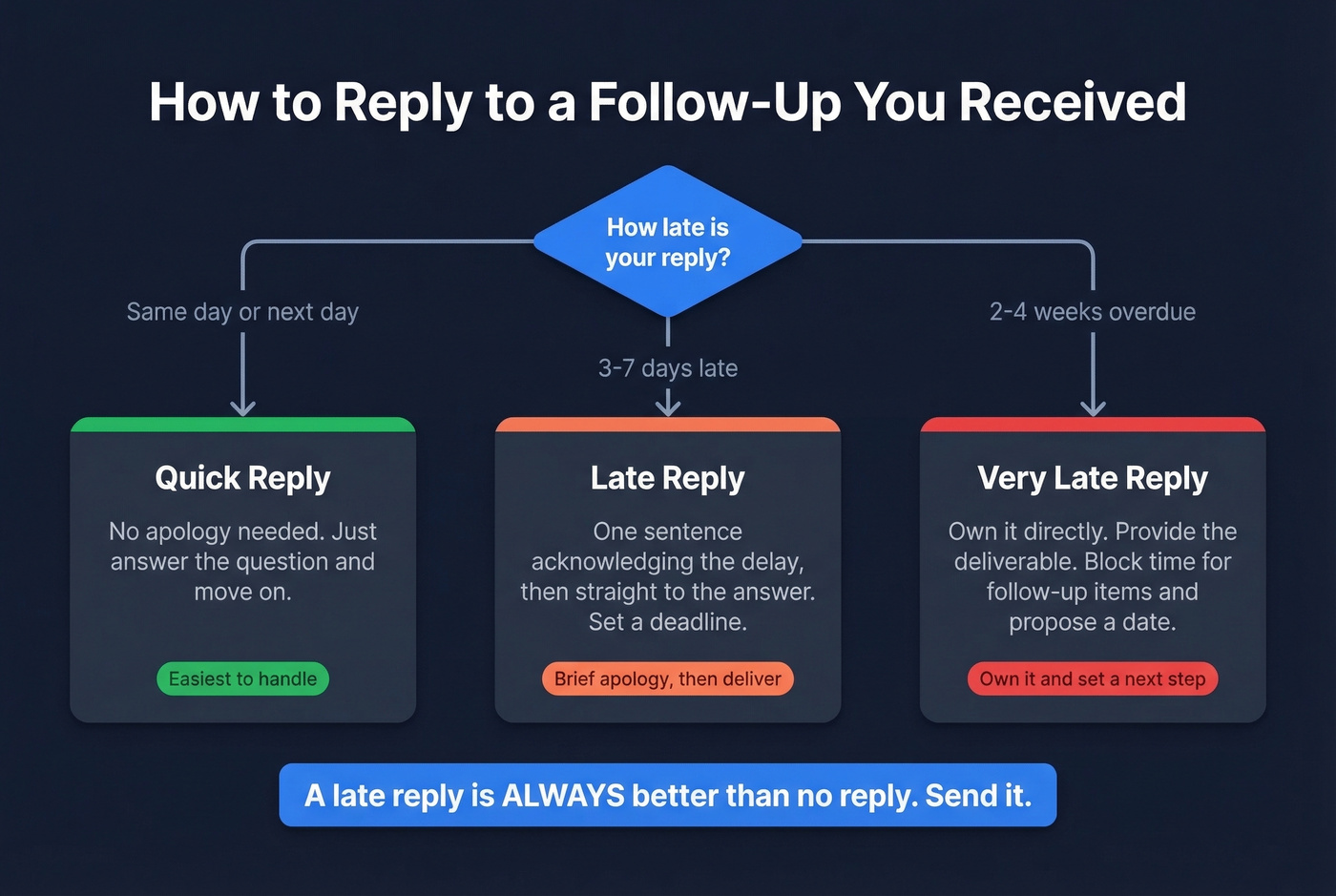
Quick Reply (Same Day or Next Day)
If you can respond within 24 hours, keep it tight. No apology needed.
Hi [Name],
Thanks for the nudge - here's [the answer/file/update]. Let me know if you need anything else.
[Your name]
Late Reply (Days or Weeks Overdue)
A brief apology beats a full explanation. Provide context, not excuses, and don't forget the action items from the original email.
For a 3-7 day delay, one sentence of acknowledgment, then straight to the answer:
Hi [Name],
Apologies for the delayed response - this slipped through during a busy week. [Answer their question or provide the deliverable.] Let me know if you need anything else by [date].
[Your name]
For replies that are 2-4 weeks overdue, own it and set a concrete next step:
Hi [Name],
I owe you an apology - this sat in my inbox far too long. [Answer/deliverable/update.] I've blocked time on [date] to handle any follow-up items. Does that timeline work on your end?
[Your name]
Look - we've seen people freeze over emails that are a week old, even a month old. The recipient almost never cares as much as you think they do. A late reply is always better than no reply. Send it.
When Someone Says "I'll Follow Up With You"
When someone promises a follow-up but doesn't give a timeline, set one yourself. This isn't pushy - it's coordinating:
Thanks - I look forward to your follow-up. I've marked my calendar for [date]. If I haven't heard back by then, I'll check in. Does that work for you?
Mistakes That Kill Your Reply Rate
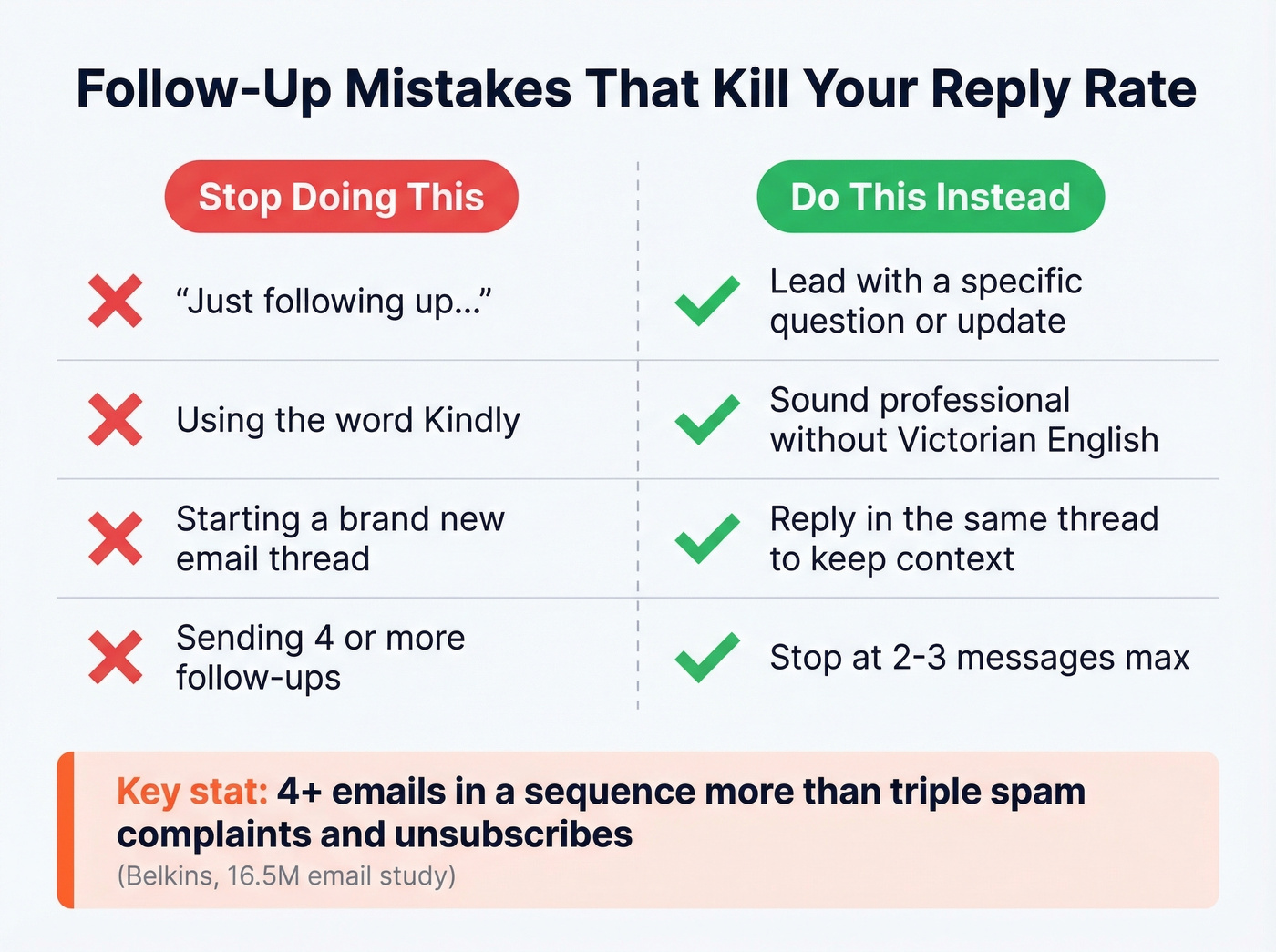
| Instead of... | Do this | Why |
|---|---|---|
| "Just following up" | Lead with a specific question or update | The phrase adds nothing and signals you have nothing new to say |
| "Kindly" | Sound professional without the Victorian English | Reddit threads consistently flag this word as condescending |
| Starting a new email thread | Reply in the same thread | Fresh threads kill context and make the recipient work harder |
| Sending 4+ follow-ups | Stop at 2-3 | Belkins' 16.5M-email study shows 4+ emails in a sequence more than triple unsubscribe and spam complaint rates |
Here's the thing most people miss: the obsession with "perfect copy" is a distraction from the fundamentals. Right person, right inbox, right moment. If you're sending beautifully written follow-ups to dead email addresses, you're polishing a message nobody will ever read. If deliverability is the real bottleneck, start with an email deliverability guide.
FAQ
How long should I wait before sending a follow-up email?
Three business days is the sweet spot - Atlassian's data shows this timing yields 31% more replies than following up sooner. For genuinely time-sensitive matters, 24-48 hours is acceptable. Don't follow up same-day unless there's a real deadline.
Is it too late to reply to a follow-up after a week?
No. A late reply is always better than silence. Acknowledge the delay in one sentence, then answer the question directly. Recipients care about the answer far more than the timeline.
What if my follow-up emails never get replies?
The problem is often the email address, not your writing. Prospeo verifies addresses in real time with 98% accuracy and offers a free tier of 75 credits per month, so you can confirm you're reaching a live inbox before rewriting your message again.
How many follow-ups should I send before giving up?
Cap it at two or three. Belkins' study of 16.5 million emails shows that sequences beyond three messages more than triple spam complaints and unsubscribes - diminishing returns hit hard after the second send.
The best follow-up email means nothing if it bounces. Prospeo's 5-step verification catches invalid addresses, spam traps, and catch-all domains before you hit send - at just $0.01 per email.
Fix your reply rate at the source: the email address itself.