

How to Follow Up After a Conversation (Without Sounding Desperate)
You're staring at a blank compose window, cursor blinking, trying to figure out how to follow up on a conversation without sounding like a robot or a stalker. Here's the reality: 55% of cold email replies come from follow-ups, not the initial send. Yet "just following up" is a shrug disguised as an email - it adds nothing, asks for everything, and gets ignored.
You've probably seen the stat that 48% of salespeople never follow up. It's unverified and likely inflated. But the underlying point holds: most people quit too early, and the ones who don't quit send lazy bumps instead of useful messages.
Here's what you actually need: a better opening phrase than "per our conversation," a template that matches your specific scenario (sales call, meeting, interview, or networking), and a timing rule - send within 24 hours for warm conversations, within 5 minutes for inbound leads.
Better Phrases Than "Per Our Conversation"
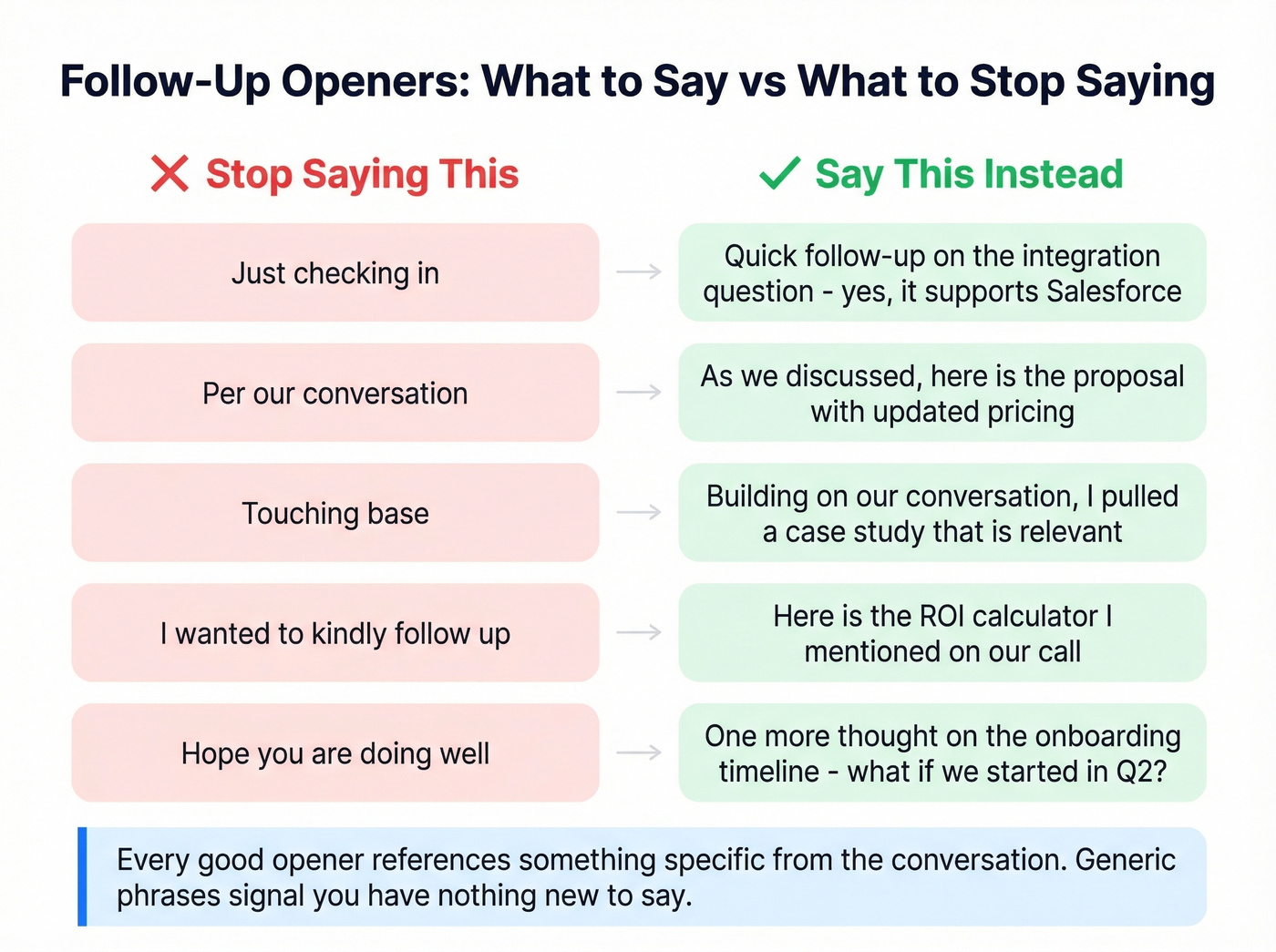
"Per our conversation" sounds like you're building a legal case. And if you've ever typed "I just wanted to kindly follow up" - the consensus on r/etiquette is that "kindly" reads as passive-aggressive in a work context.
| Phrase | When to use it | Example |
|---|---|---|
| As we discussed | Formal recap | "As we discussed, here's the proposal with updated pricing." |
| Building on our conversation | Adding new info | "Building on our conversation, I pulled a case study that's relevant." |
| Here's the [resource] I mentioned | Delivering a promise | "Here's the ROI calculator I mentioned on our call." |
| One more thought on [topic] | Re-engaging after silence | "One more thought on the onboarding timeline - what if we started in Q2?" |
| Quick follow-up on [specific item] | Action-oriented | "Quick follow-up on the integration question - yes, it supports Salesforce." |
| Circling back with [new value] | Adding fresh value | "Circling back with a benchmark report your team might find useful." |
Every phrase references something specific. Generic openers like "touching base" or "checking in" signal you have nothing to say. We've seen reps triple their reply rates just by switching from "checking in" to a value-add opener that references one detail from the call.
Email Templates by Scenario
After a Sales Call
Subject: Next steps for [specific goal] - following our [date] call
Hi [Name],
Great speaking with you about [specific challenge they mentioned]. To recap: you're looking to [goal], and the main blocker is [obstacle].
I've attached the [case study / ROI calculator / one-pager] I mentioned - the section on [relevant detail] maps closely to your situation.
Want to book a 30-minute demo so I can walk your team through the [specific feature]? [Calendar link]
The structure is deliberate: context, recap, value-add, one CTA. Don't stack three asks in one email. Send your follow-up as a reply to the original thread, not a new email - it preserves context and keeps the conversation in one place. If you want more plug-and-play options, use these sales follow-up templates.
After a Meeting
The best meeting follow-ups lead with action items, not pleasantries. People skim. Give them the table first.
| Action Item | Owner | Deadline |
|---|---|---|
| Finalize vendor shortlist | Sarah | Jan 17 |
| Share Q4 pipeline data | Marcus | Jan 15 |
| Schedule follow-up review | You | Jan 22 |
Subject: Recap & action items from our [project/topic] meeting
Hi team,
Thanks for a productive session - [Name]'s point about [specific insight] was especially useful. Above is where we landed. Let me know if I've missed anything.
Send this within 24 hours. Opening with specific appreciation isn't just polite - research from Workhuman shows employees who feel appreciated are 47% more likely to agree their leaders care about building a human workplace. Log the follow-up and action items in your CRM so nothing falls through the cracks.
After a Job Interview
80% of hiring managers say thank-you notes influence their decisions, yet only 24-57% of candidates bother sending one. This is the easiest edge you'll ever get.
Bad: "Thank you for your time. I'm very interested in the role and look forward to hearing from you."
Good: "Thank you for the conversation about the Senior PM role. Your description of the migration project resonated - I led a similar effort at [Company] that cut onboarding time by 40%. I'm excited about the opportunity and happy to provide any additional information."
The difference is one concrete detail. Referencing a specific accomplishment shows the hiring manager you were engaged, not just going through the motions. Send it within 24-48 hours.
After a Networking Event
This one doesn't need a full template. Three sentences: reference one specific detail from your conversation, deliver on anything you promised, and suggest a next step.
"Really enjoyed talking about the Series B fundraising scene at [event]. Here's that [article] I mentioned - [URL]. Would love to grab coffee next month if you're up for it."
That's it. It proves you were actually listening, not just collecting business cards. If you need a tighter intro, borrow from these sample elevator pitches.

The best follow-up email in the world won't matter if it bounces. Prospeo's 98% email accuracy and 7-day data refresh mean your carefully crafted conversation recaps actually land in the inbox - not the void.
Stop perfecting emails that bounce. Start with verified contacts.
When to Send and How Often
Let's be honest: timing matters more than copywriting. A mediocre email sent at the right moment beats a brilliant one sent two weeks late.
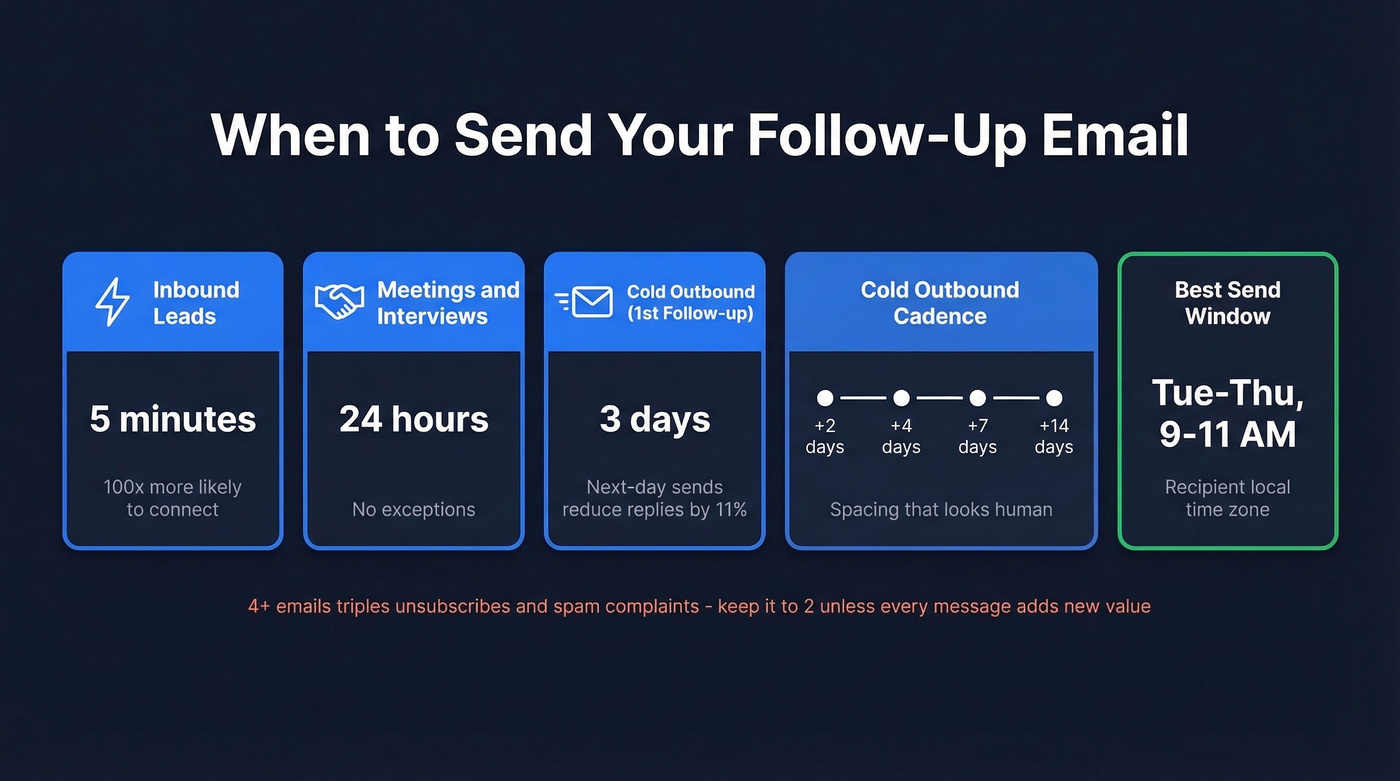
- Inbound leads: Contact within 5 minutes. You're 100x more likely to connect than if you wait an hour.
- Meetings and interviews: Within 24 hours, no exceptions.
- Cold outbound first follow-up: Wait at least 3 days. Next-day follow-ups reduce replies by 11%, while waiting three days produces a 31% increase.
- Cold outbound cadence: +2 days, +4 days, +7 days, +14 days after the initial send. This spacing looks human. Every-other-day sends look automated. (If you're building a full sequence, start with a B2B cold email sequence.)
- Best send window: Tuesday through Thursday, 9-11 AM in the recipient's local time zone. For more data, see the best time to send cold emails.
How many emails? A Belkins analysis of 16.5 million cold emails found the highest reply rate (8.4%) came from just one email, and performance declines with each subsequent send. Four or more triples unsubscribes and spam complaint risk. That said, an Overloop campaign to 1,792 prospects found 34% of replies came from the fourth email - because each message added genuinely new value.
The takeaway: if you're just bumping the thread, two emails is your ceiling. If every message brings something new to the table, you can push to four. If you want to automate the cadence without sounding robotic, consider AI sales follow-up workflows.
Subject Lines That Get Opened
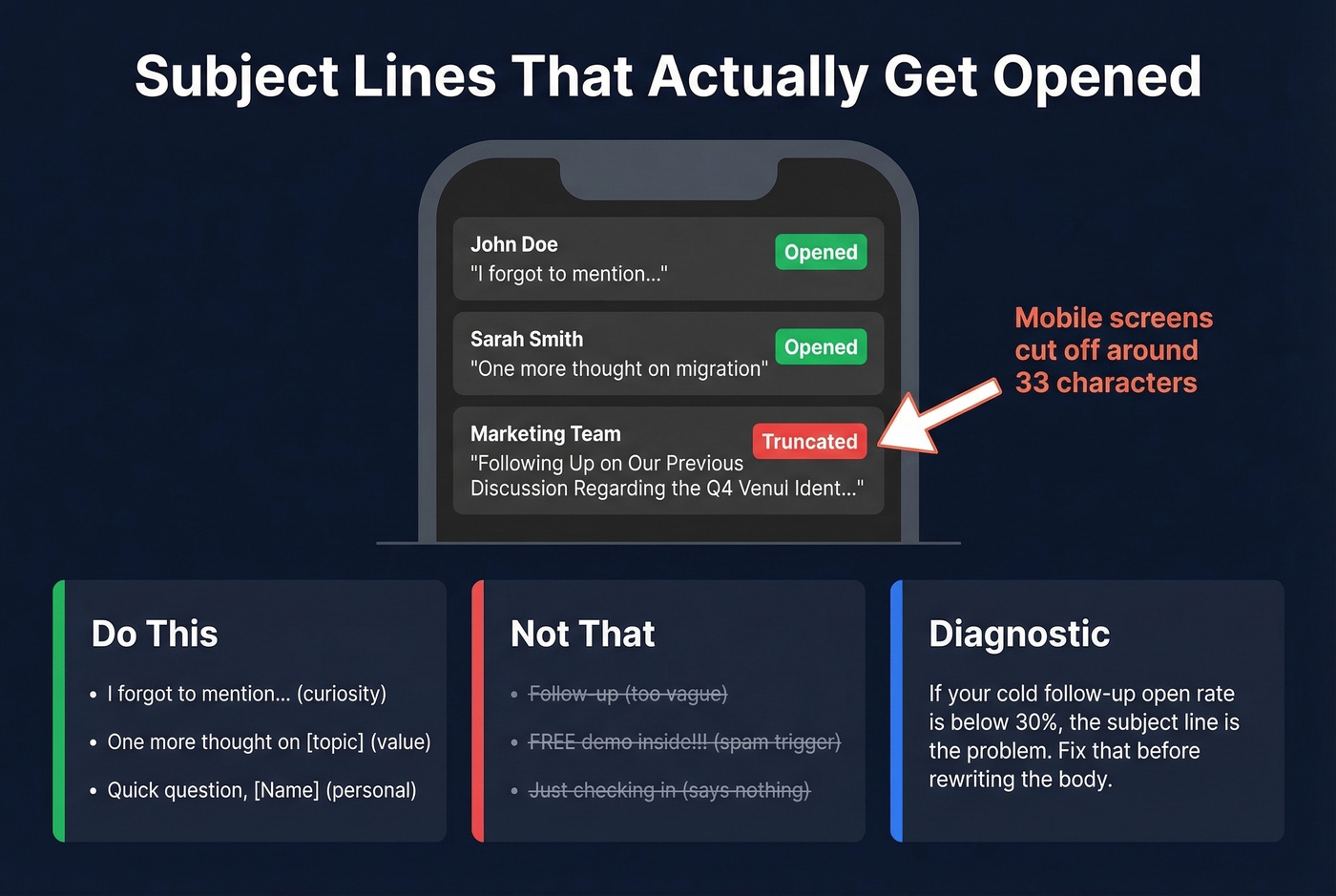
Mobile screens truncate subject lines around 33 characters. If your key information sits at character 40, nobody sees it.
Do this:
- "I forgot to mention..." - short, curiosity-driven, and it works
- "One more thought on [topic]" - specific and adds value
- "Quick question, [Name]" - personal and low-commitment
Not that:
- "Follow-up" or "Following up" - often gets ignored
- "FREE demo inside!!!" - spam trigger that'll land you in the junk folder
- "Just checking in" - says nothing, gets treated accordingly
Here's a diagnostic: if your cold follow-up open rate is below 30%, the subject line is the problem. Fix that before you rewrite the body. If you need more ideas, pull from these email subject line examples or use a subject line tester.
Mistakes That Kill Your Reply Rate
Bumping with no new info. "Just making sure you saw my last email" adds zero value. Every follow-up needs a new angle - a resource, a data point, a relevant question. Benchmarks show personalized follow-ups pull roughly 18% response rates versus 9% for generic templates.
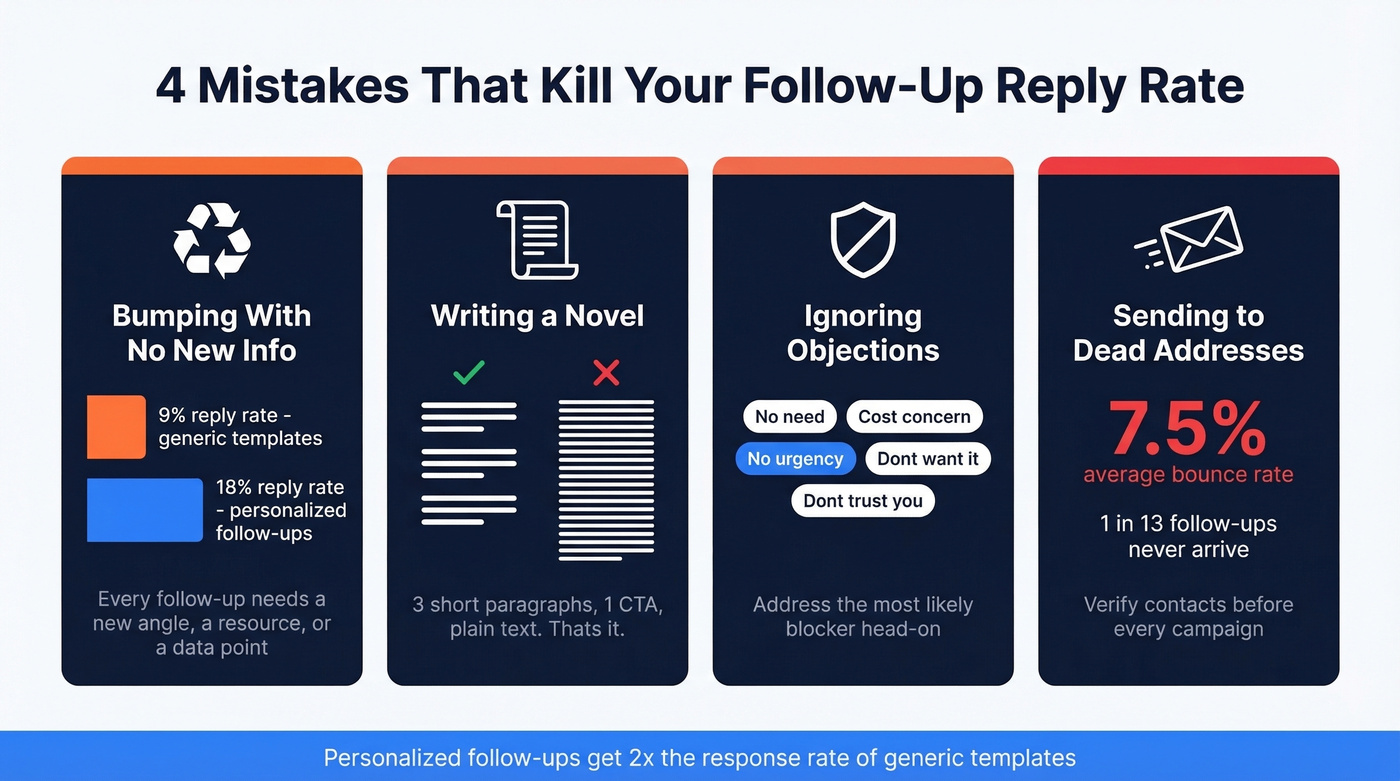
Writing a novel. If your prospect can't finish reading by the third paragraph, they won't. Keep it tight: three short paragraphs, one CTA, plain text formatting. Fancy HTML templates signal marketing blast, not personal outreach. If you want to tighten your copy, use this email copywriting framework.
Ignoring objections. Silence isn't always disinterest - it's often a specific blocker. GMass identifies five objection types: no need, cost concern, no urgency, don't want it, don't trust you. Your follow-up should address the most likely one head-on. For teams that sell to enterprise buyers, the blocker is almost always "no urgency" - so your follow-up needs to create it with a deadline, a competitive insight, or a cost-of-inaction stat.
Following up to a dead email address. Cold email benchmarks show a 7.5% average bounce rate, which means roughly 1 in 13 follow-ups never arrive. Your perfectly crafted message just vanishes into the void. Run your contacts through a verification tool before you send - Prospeo handles this with 98% accuracy and offers 75 free verifications per month, enough to clean a small pipeline before every campaign. To go deeper, see our email bounce rate benchmarks and this email deliverability guide.
You just nailed the timing, wrote a killer subject line, and referenced a specific detail from the call. Now you need the right email address. Prospeo gives you 143M+ verified emails so every follow-up reaches a real person.
Great follow-ups deserve accurate data. Get 75 free emails today.
FAQ
How soon should I follow up after a conversation?
Within 24 hours for meetings and interviews. For inbound leads, within 5 minutes - you're 100x more likely to connect than if you wait an hour. For cold outbound, wait 2-5 business days before your first follow-up to avoid looking automated.
How many follow-up emails is too many?
An analysis of 16.5 million cold emails found the highest reply rate (8.4%) came from just one email, and performance declines with each subsequent send. Four or more triples unsubscribes and spam complaint risk. If you go beyond two, each message must add genuinely new value - not just a thread bump.
How do I follow up without sounding pushy?
Lead with something useful - a resource, a recap, or a new insight relevant to their situation. Never send "just checking in" with no new information. If you have nothing to add, you don't have a reason to follow up yet. Skip the follow-up entirely until you do.