

The Follow-Up Email Format That Gets Replies (With 14 Templates)
A RevOps lead we work with ran the numbers on her team's outbound last quarter. First emails? Decent opens, mediocre replies. The second and third touches - formatted correctly, timed right, each adding something new - generated the bulk of total replies.
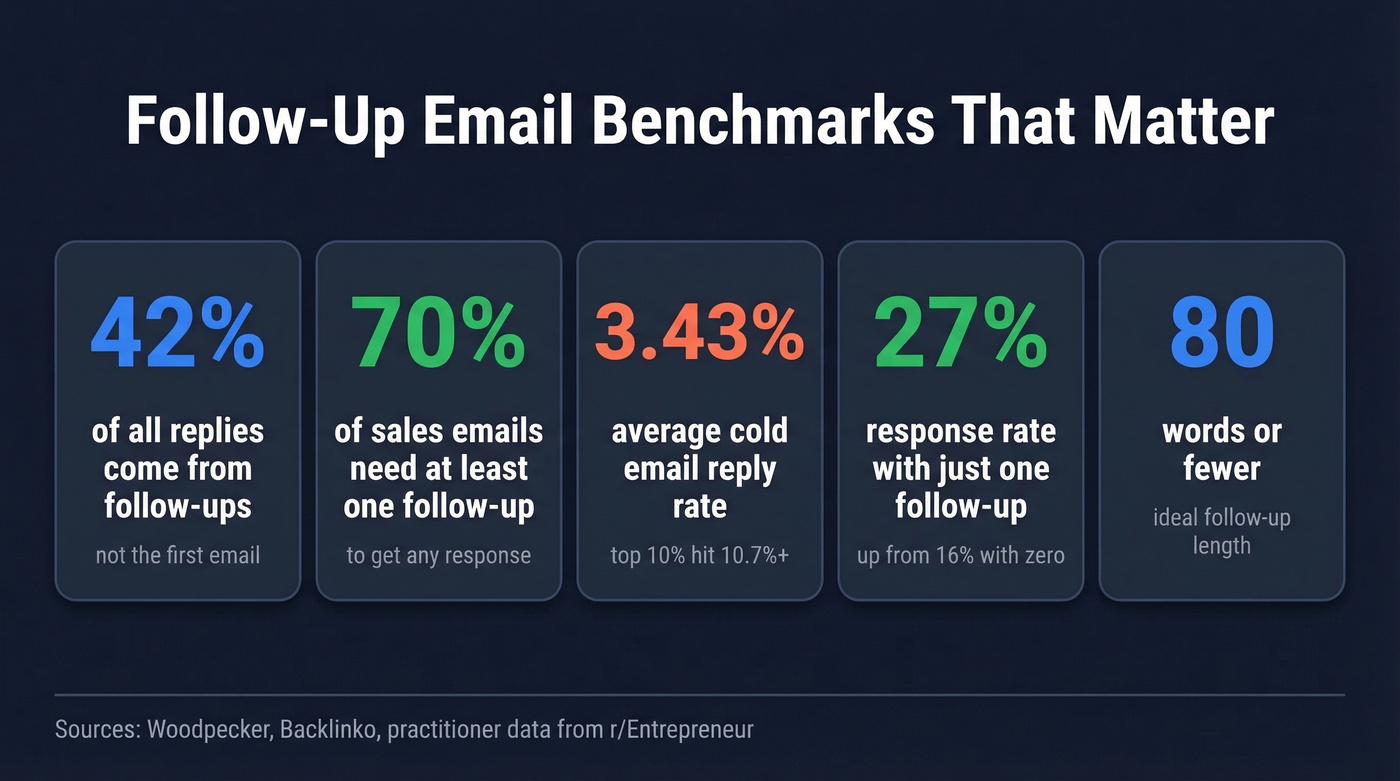
That tracks with what we've seen across dozens of campaigns: 42% of all replies come from follow-ups, not the first email. And 70% of sales emails need at least one follow-up to get any response at all.
The average cold email reply rate sits at 3.43%. The top 10% of senders hit 10.7%+. The gap isn't magic - it's follow-up email format, timing, and the discipline to add value with every touch.
The Format in 30 Seconds
If you're in a rush, here's the skeleton that works across sales, interviews, networking, and internal follow-ups:
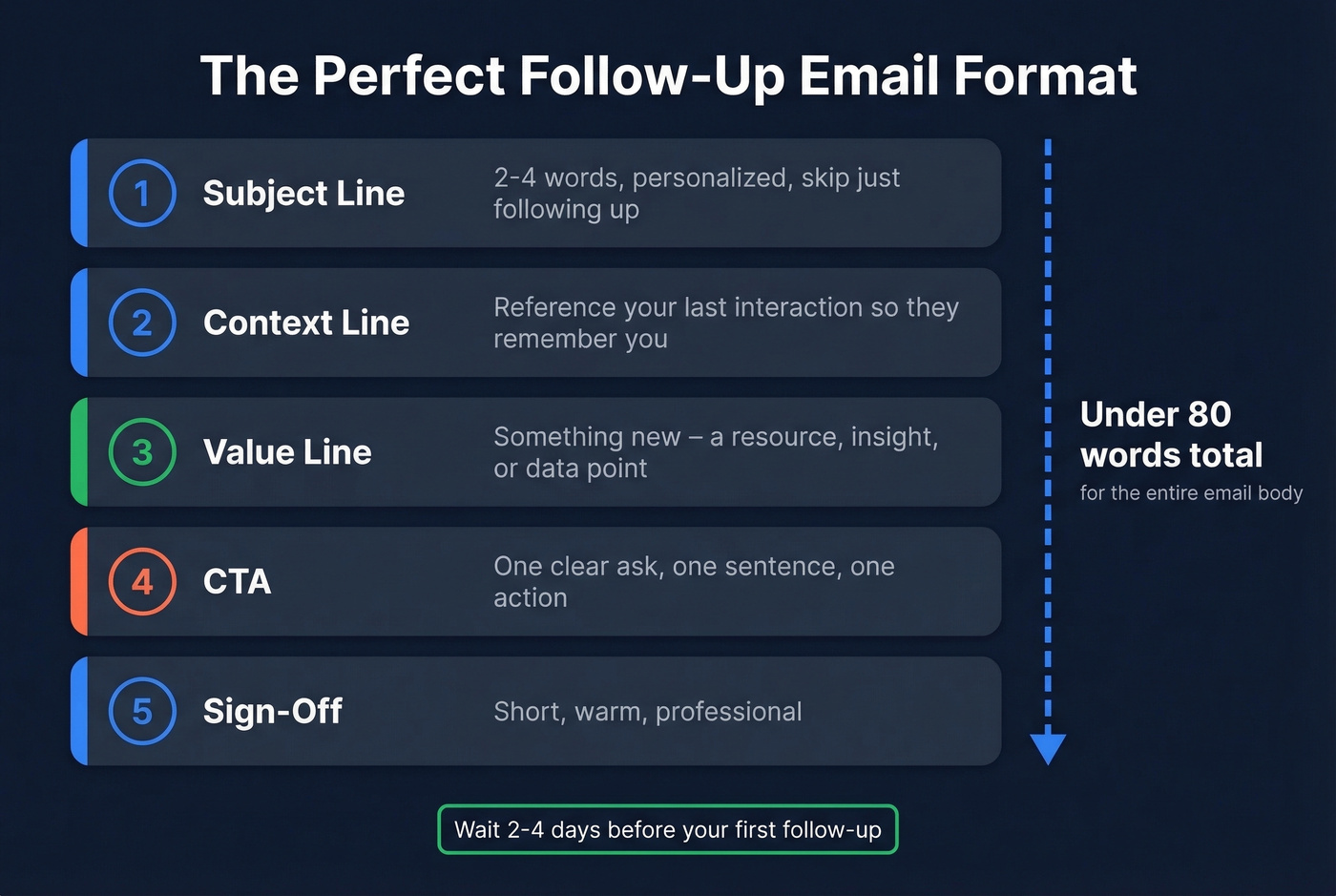
- Subject line - 2-4 words, personalized, no "just following up"
- Context line - why you're writing, referencing the last interaction
- Value line - something new: a resource, insight, or specific question
- CTA - one clear ask, one sentence
- Sign-off - short, warm, professional
Keep it under 80 words. Wait 2-4 days before your first follow-up. And never send one that doesn't contain something the recipient hasn't seen before.
Universal Structure That Works
Here's a follow-up after a cold outreach email to a VP of Marketing:
Subject: Quick question about Q3 campaigns
Hi Sarah,
I sent a note last Tuesday about how [Company] handles attribution for paid social. Wanted to share something relevant - we just published a breakdown of how three DTC brands cut their CAC by 30% using multi-touch models.
Would it be worth 15 minutes to see if any of those approaches fit your setup?
Best, James
Short. Let's label the parts.
Context line - "I sent a note last Tuesday about..." anchors the reader. They don't have to dig through their inbox to remember you. Value line - "we just published a breakdown..." is the new information. It's the reason this email exists. Without it, you're just bumping. CTA - "Would it be worth 15 minutes..." is one question, one action. Not two links and a calendar invite.
We call this The New Value Rule: each follow-up in your sequence must address a new objection or deliver a new piece of value. If you can't articulate what's new in this email versus the last one, don't send it. (If you want more copy-paste options, see our sales follow-up templates.)
One more formatting note that matters more than people think: send follow-ups as plain-text replies in the same thread. HTML-heavy emails with logos and banners signal mass outreach. A reply-in-thread email that looks like you typed it in two minutes signals a real human conversation.
Data-Backed Formatting Rules
How Long Should a Follow-Up Be?
Shorter than you think. An analysis of millions of outreach emails found that emails under 300 words consistently outperform longer ones on both opens and replies. But "under 300 words" is still generous for a follow-up. The best-performing cold campaigns keep emails under 80 words total. (More benchmarks: follow-up email reply rate.)
The most compelling evidence comes from a practitioner on r/Entrepreneur who documented cutting emails from 141 words to under 56 words - three short paragraphs max. Reply rate doubled from 3% to 6%. His total stack cost ~$420/month and generated 16 qualified leads monthly. That's not a marginal improvement. That's the difference between a campaign that justifies its cost and one that doesn't.
The practitioner's rule: Three paragraphs max. Only one paragraph should ever be more than one sentence. Everything else is a single line. This forces brevity and makes the email scannable on mobile.
A follow-up isn't a pitch deck. It's a nudge with a reason. (If you're building full sequences, start with a B2B cold email sequence.)
Subject Line Rules
47% of recipients decide whether to open based on the subject line alone. Even scarier: 69% mark emails as spam based on the subject line before reading a word of body copy. This isn't a minor formatting detail - it's the gate. (More examples: email subject lines examples.)
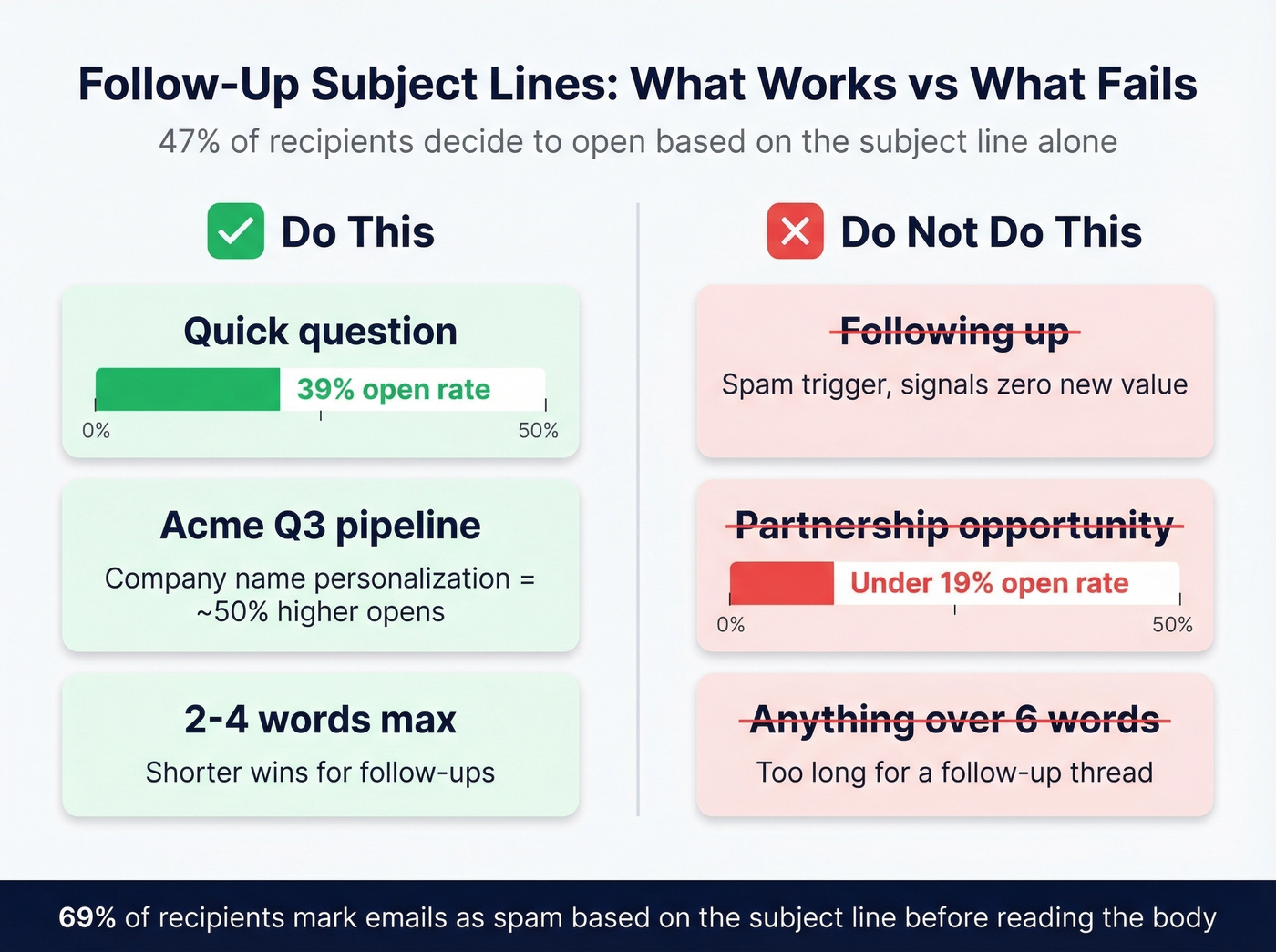
For follow-ups specifically, shorter wins. General email subject lines perform well at 61-70 characters, but follow-ups aren't general email - they're continuations of a conversation. Two to four words is the target. (You can also use these cold email subject line examples as a starting point.)
Do this:
- "Quick question" pulled 39% open rates in one practitioner's A/B testing
- Personalize when possible - subject lines with the recipient's name or company see roughly 50% higher open rates
- Use the company name naturally: "Acme's Q3 pipeline" beats "Following up on our conversation"
Don't do this:
- "Following up" or "Just following up" - spam magnets that signal zero new value
- "Partnership opportunity" - tested at under 19% opens in the same case study
- Anything over 6 words
The Exact Cadence
Timing matters more than most people realize. Next-day follow-ups actually reduce replies by 11%. Waiting three days increases replies by 31%. The instinct to follow up immediately feels proactive, but it reads as desperate. (For more timing data, see best time to send cold emails.)
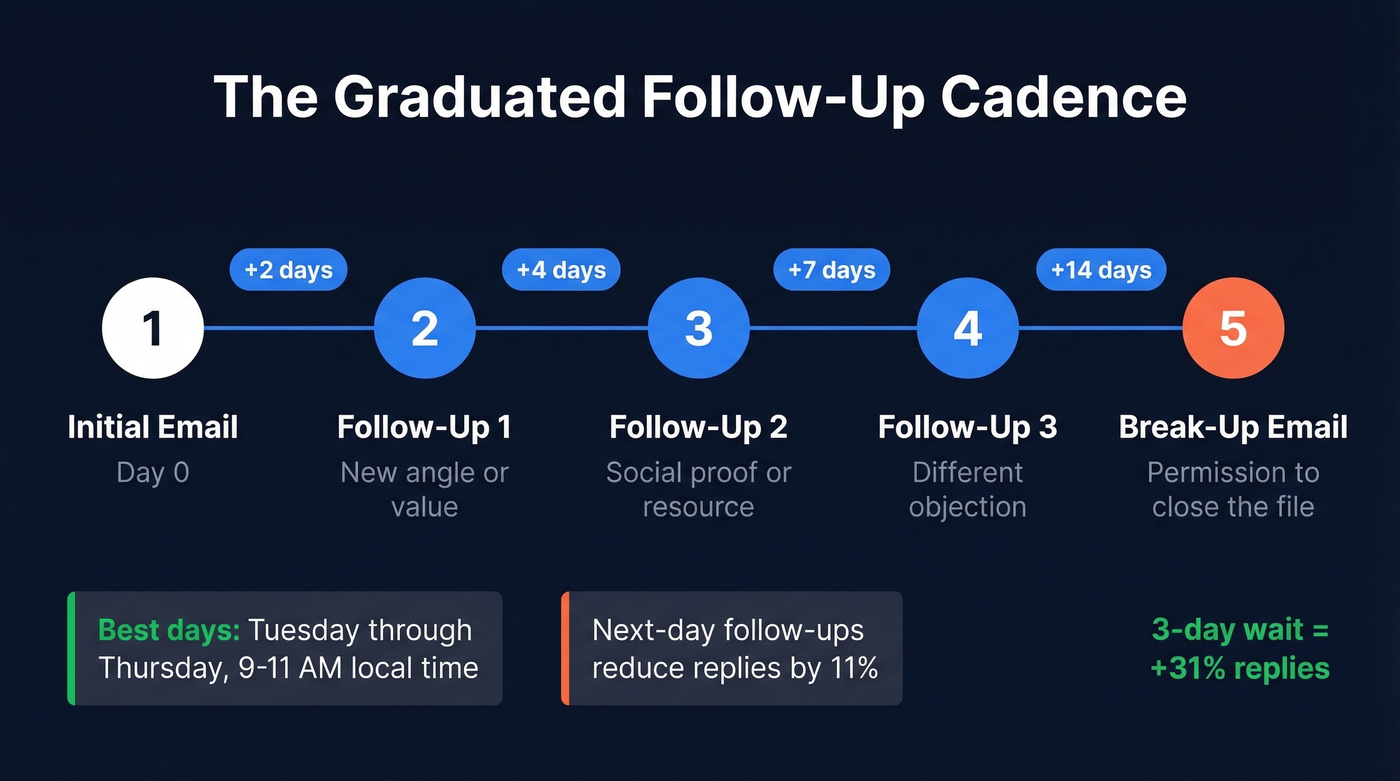
Here's the graduated cadence framework that spaces touches at increasing intervals:
| Touch | Days After Previous | Purpose |
|---|---|---|
| Email 1 | Day 0 | Initial outreach |
| Follow-up 1 | +2 days | New angle or value |
| Follow-up 2 | +4 days | Social proof or resource |
| Follow-up 3 | +7 days | Different objection |
| Follow-up 4 | +14 days | Break-up email |
The sweet spot is 4-7 touchpoints. Beyond 7, you hit diminishing returns unless each touch genuinely adds something new. Send Tuesday through Thursday, 9-11 AM in the recipient's local time zone. (If you're operationalizing this, use a sequence management process.)
One important distinction: this cadence applies to cold outreach. Inbound leads - someone who downloaded your whitepaper or requested a demo - expect faster response. For inbound, follow up within hours, not days.

A perfect follow-up email format means nothing if it bounces. Prospeo's 98% email accuracy and 7-day refresh cycle mean every follow-up in your sequence hits a real inbox - not a dead address that tanks your domain reputation.
Stop crafting follow-ups that bounce. Start with verified emails at $0.01 each.
14 Templates by Scenario
Copy-paste ready. Swap the bracketed details for your specifics.
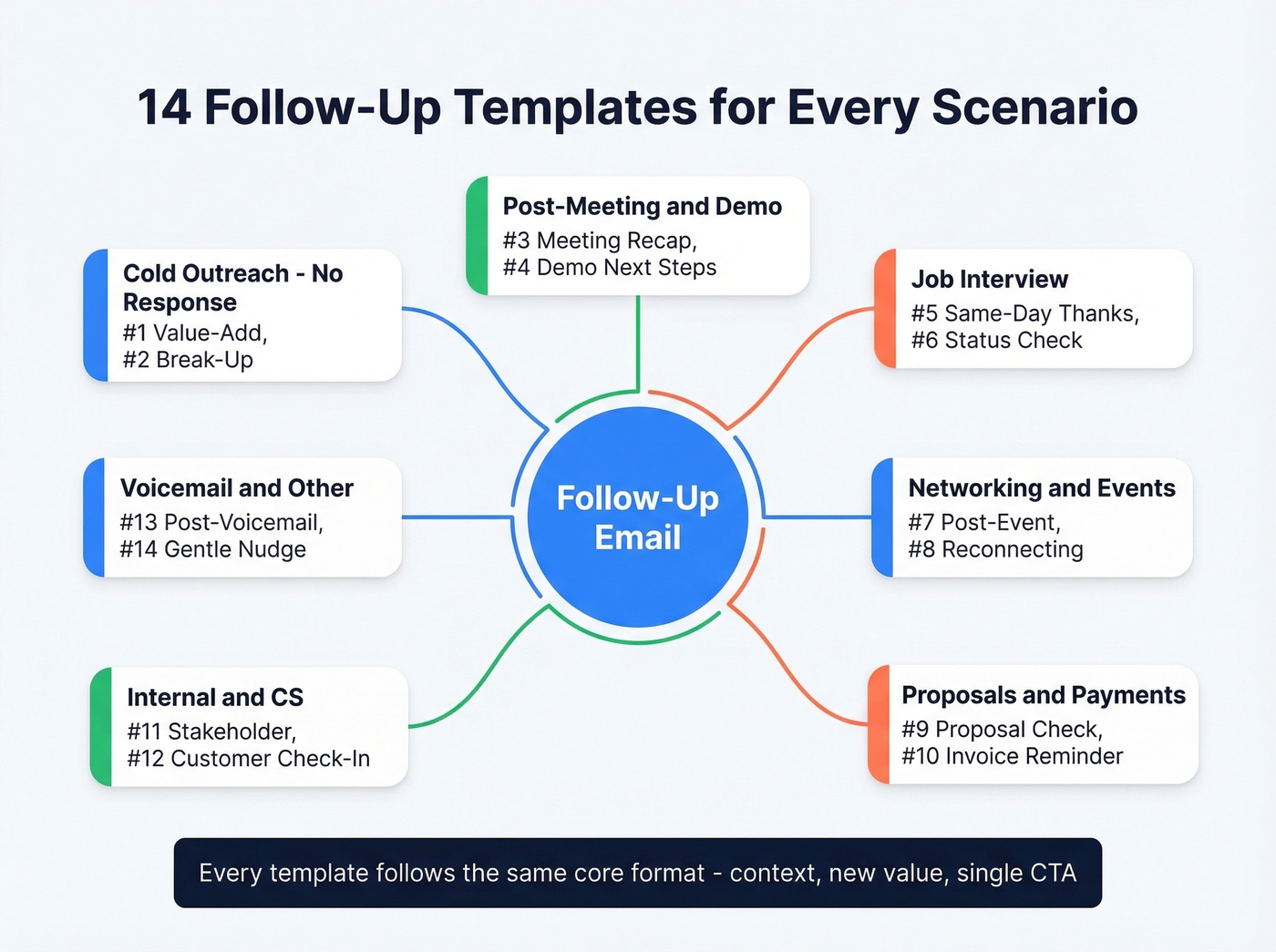
After No Response (Cold Outreach)
Template 1 - Value-Add Follow-Up:
Subject: [Company]'s [specific challenge]
Hi [Name],
Sent a note last week about [topic]. Since then, I came across [specific resource/data point] that's relevant to how [Company] handles [challenge].
Worth a 15-minute look?
Research from Woodpecker shows that campaigns with even one follow-up jump from 16% to 27% response rates. That single extra touch is the highest-leverage email you'll send.
Template 2 - Break-Up Email:
Subject: Should I close your file?
Hi [Name],
I've reached out a few times about [topic] and haven't heard back - totally fine. Want to make sure I'm not clogging your inbox.
Should I close this out, or is there a better time to revisit?
The "permission to close your file" pattern triggers loss aversion. Nobody likes having a decision made for them. Break-up emails frequently pull the highest reply rates in a sequence.
Post-Meeting and Post-Demo
Template 3 - Meeting Recap:
Subject: Next steps from today
Hi [Name],
Great conversation. Here's what I took away:
- [Key point 1 discussed]
- [Action item + owner]
- [Agreed timeline]
I'll send over [deliverable] by [date]. Let me know if I missed anything.
Template 4 - Post-Demo Next Steps:
Subject: [Product] + [Company] - next steps
Hi [Name],
Thanks for the time today. Based on what you shared about [specific pain point], I think [feature/solution] is the strongest fit.
I've attached [one-pager/case study]. Can we get [decision-maker] on a 20-minute call next week to walk through pricing?
After a Job Interview
Template 5 - Same-Day Thank-You:
Subject: Thanks, [Name] - excited about [role]
Hi [Name],
Really enjoyed our conversation today, especially your point about [specific thing they said]. That's exactly the kind of challenge I thrive on, given my experience with [relevant skill/project].
Looking forward to next steps.
Send this the same day or next business day. A hiring manager on Reddit who's conducted over 1,000 interviews shared the key: mirror back what they told you they need. Ask good questions during the interview, then use the answers in your follow-up to position yourself as the solution.
Template 6 - Status Check (2 Weeks Later):
Subject: Checking in on [role title]
Hi [Name],
Wanted to follow up on the [role] conversation from [date]. I'm still very interested and have been thinking about [specific challenge they mentioned] - happy to share some ideas if helpful.
Any update on timeline?
Networking and Conferences
Template 7 - Post-Event Connection:
Subject: Great meeting you at [Event]
Hi [Name],
Enjoyed our conversation about [specific topic] at [Event] yesterday. You mentioned [specific detail] - I just sent you [resource/intro/article] that's relevant.
Would love to continue the conversation. Coffee or a call next week?
Template 8 - Reconnecting With an Old Contact:
Subject: Been a while, [Name]
Hi [Name],
It's been [timeframe] since we [last interaction]. I saw [trigger - new role, company news, shared connection's post] and it reminded me of our conversation about [topic].
Would love to catch up. Free for 20 minutes this month?
Proposals, Invoices, and Payments
Template 9 - After Sending a Proposal:
Subject: Thoughts on the proposal?
Hi [Name],
Wanted to check in on the proposal I sent [date]. Happy to walk through any questions or adjust scope if needed.
What's the best next step on your end?
Template 10 - Payment Reminder:
Subject: Invoice #[number] - quick reminder
Hi [Name],
Friendly reminder that invoice #[number] for [amount] was due on [date]. I've reattached it for convenience.
Can you confirm this is in the queue?
For invoices, escalate gradually: first reminder at 3 days past due, second at 7 days, third at 14 days with a firmer tone and mention of late-payment terms.
Internal and Customer Success
Template 11 - Internal Stakeholder Follow-Up:
Subject: Need your input on [project]
Hi [Name],
Following up on [request] from [date]. We need [specific input] to keep [project] on track for [deadline].
Can you get back to me by [date]? If this isn't the right ask for you, let me know who I should loop in.
Template 12 - Customer Success Check-In:
Subject: How's [product/feature] working?
Hi [Name],
It's been [timeframe] since you started using [feature/product]. Are you seeing [expected outcome]?
If anything's off, I'd love to help troubleshoot. And if things are going well, I have a couple ideas to get even more out of your setup.
After Leaving a Voicemail
Template 13:
Subject: Just left you a voicemail
Hi [Name],
Left a quick voicemail about [topic]. Easier to reply here - [one-sentence value prop or question].
The Break-Up Email
Template 14 - Expanded Break-Up:
Subject: Closing the loop
Hi [Name],
I've sent a few notes about [topic] over the past [timeframe]. I don't want to be that person who won't take a hint.
I'll close this out on my end. If [topic] becomes a priority down the road, I'm easy to find.
For a lighter touch: "No worries if the timing's off - I'll be around." For a more direct tone: "I'll assume this isn't a priority right now and close this out."
Here's the thing about break-up emails: they're frequently the highest-performing email in any sequence. Something about giving people an exit makes them want to stay.
5 Mistakes That Kill Reply Rates
1. "Just checking in" with zero value. The single most common follow-up mistake. It tells the recipient you have nothing new to say but decided to email anyway. Every follow-up needs a reason to exist - a resource, a question, a new angle. If you can't name what's new, don't hit send. (Alternatives here: how to say just checking in professionally.)
2. Writing an essay. Emails over 300 words see measurably lower engagement. Follow-ups should be shorter than your initial outreach, not longer. Three short paragraphs, one sentence each where possible.
3. Wrong timing. Following up the next day feels eager. It reduces replies by 11%. Waiting 10+ days feels like you forgot. The 2-4 day window for your first follow-up is the sweet spot, then graduate the spacing. (More guidance: when should I follow up on an email.)
4. No clear CTA. "Let me know your thoughts" isn't a CTA. "Can we do 15 minutes Thursday at 2 PM?" is. One question, one action, one sentence. (More: email call to action.)
5. HTML formatting that screams mass email. Logos, banners, colored fonts, and embedded images all signal "this was sent to 500 people." Plain-text, reply-in-thread emails that look like you typed it on your phone consistently outperform designed templates. The consensus on r/sales backs this up - the threads about "should I use HTML or plain text" always land in the same place.
Verify Contacts Before You Follow Up
None of this formatting advice matters if your emails bounce. A follow-up sequence sent to invalid addresses doesn't just waste time - it damages your sender reputation and tanks deliverability for every email your domain sends afterward. High bounce rates can get your domain flagged fast. (Related: email bounce rate and the full email deliverability guide.)
Prospeo catches this before you hit send. With 98% email accuracy and a 7-day data refresh cycle, you're working with contacts that are current, not stale. Meritt dropped their bounce rate from 35% to under 4% after switching - and tripled their pipeline in the process.
Skip the $30k/year data platforms if your deal sizes are under five figures. But you absolutely need verified emails. A single bounced follow-up does more damage to your domain than ten unanswered ones.
You just built a 4-7 touch sequence with new value at every step. Now you need the right contacts to send it to. Prospeo gives you 300M+ profiles with 30+ filters - buyer intent, job changes, tech stack - so your follow-ups reach decision-makers, not gatekeepers.
Build the list your follow-up sequence deserves. 75 free emails to start.

Cheat Sheet: Format by Scenario
| Scenario | When to Send | Ideal Length | Subject Line Example |
|---|---|---|---|
| Cold follow-up | +2-4 days | <80 words | "Quick question" |
| Post-meeting | Same day | 80-120 words | "Next steps from today" |
| Post-interview | Same day | 60-100 words | "Thanks, [Name]" |
| Networking | 24-48 hours | <80 words | "Great meeting you" |
| Proposal check | +3-5 days | <60 words | "Thoughts on proposal?" |
| Invoice reminder | +3 days past due | <50 words | "Invoice #[X] reminder" |
| Break-up | +14 days | <60 words | "Closing the loop" |
FAQ
How many follow-up emails should I send?
Send 4-7 touchpoints for cold outreach. Beyond seven, diminishing returns kick in unless each touch delivers genuinely new value. For interviews or networking, two to three is the right number - more than that risks coming across as pushy.
Should I reply in the same thread or start a new one?
Reply in-thread for cold outreach and sales - it looks like a real conversation and keeps context visible. Start a new thread for interviews or formal contexts where the original subject line no longer fits the conversation's direction.
Is "just following up" really that bad?
Yes. It signals you have nothing new to offer and trains recipients to ignore you. Replace it with a specific reason: a resource, a question about their priorities, or a relevant data point. The subject line should communicate why this email is worth opening right now.
What's the best format for different scenarios?
The core structure stays the same - context line, value line, single CTA - but length and tone shift. Cold outreach stays under 80 words with new value upfront. Post-meeting recaps run 80-120 words to summarize action items. Interview thank-yous mirror back the interviewer's priorities. Use the cheat sheet above.
How do I make sure follow-ups reach the inbox?
Verify email addresses before sending. Bad data causes bounces that damage sender reputation and tank deliverability across your entire domain. Tools like Prospeo verify emails with 98% accuracy on a 7-day refresh cycle, and the free tier covers 75 verifications per month - enough to audit your active pipeline.