

How to Generate Quality Leads (A Playbook With Actual Numbers)
You send 500 leads to your sales team. Reps work 50 of them. Eight turn into meetings. One closes. That's a 0.2% close rate from your total lead volume - and your team just spent a month chasing 492 contacts who were never going to buy.
The problem isn't volume. It's that nobody scored, verified, or qualified those leads before they hit a rep's queue. We've watched this pattern play out across dozens of outbound teams, and the fix is always the same: better inputs, not more inputs. This playbook breaks down how to generate quality leads using actual numbers - scoring models, CPL benchmarks, channel ROI, funnel diagnostics - so you can stop padding dashboards and start closing.
What Makes a Lead Worth Pursuing
Four things separate a lead worth calling from one that wastes your Tuesday afternoon.
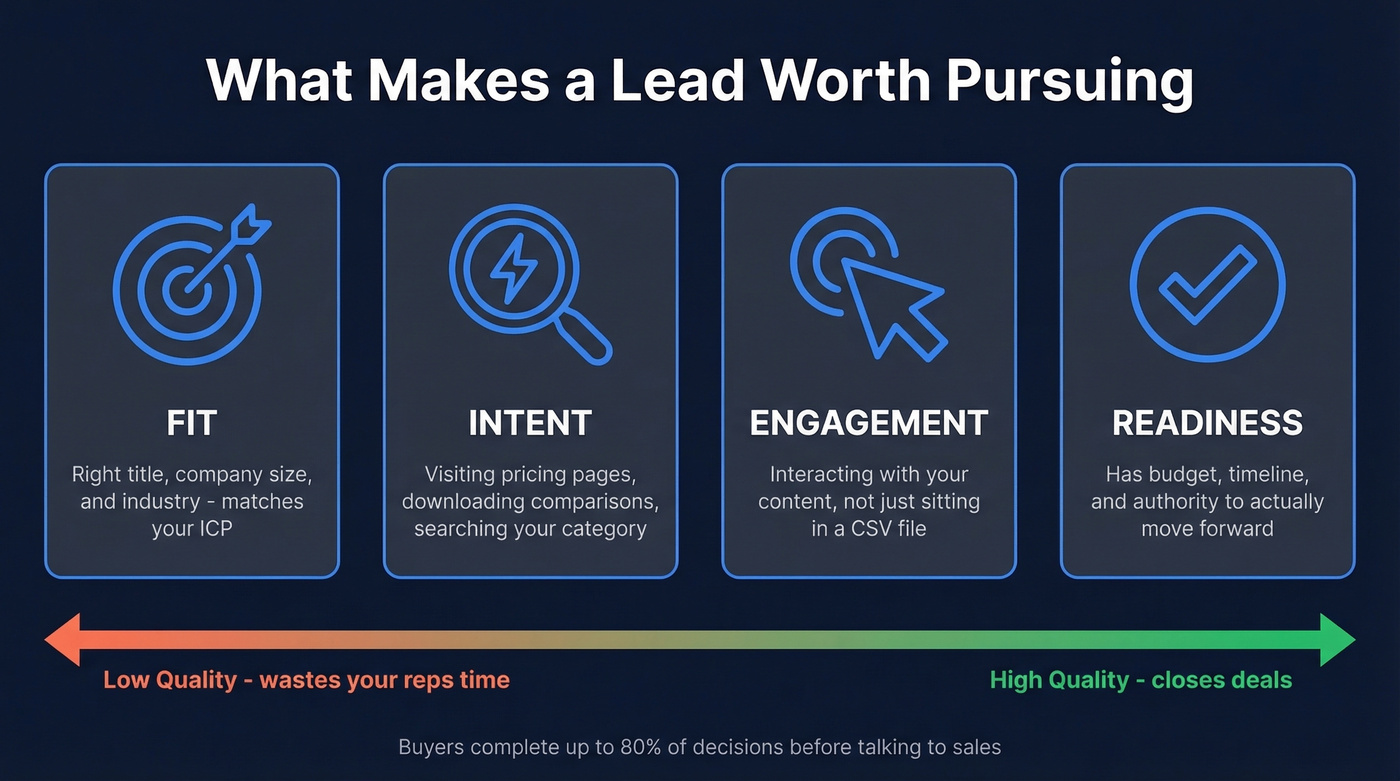
Fit means the lead matches your ICP - right title, right company size, right industry. Intent means they're showing buying signals: visiting pricing pages, downloading comparison guides, searching for your category. Engagement means they're interacting with your content, not just sitting in a CSV. Readiness means they have budget, timeline, and authority to move.
Buyers complete up to 80% of their decision-making before they ever talk to sales. If your team treats every inbound form fill as a hot lead, you're working contacts who haven't even decided they have a problem yet. The MQL/SQL distinction exists for a reason - an MQL shows interest, an SQL shows intent plus fit. Conflating the two is how pipelines get bloated with leads that never close.
Here's where the industry is shifting: in 2026, the smartest teams aren't just scoring individual leads - they're scoring accounts. Modern B2B purchases involve 6-10 stakeholders, so a single MQL from Acme Corp matters less than whether three people at Acme are all showing buying signals simultaneously. If you're still evaluating leads one contact at a time, you're running a 2022 playbook.
Mistakes That Kill Lead Quality
1. Chasing volume over intent. This is the most expensive mistake in B2B marketing. When you optimize for lead count instead of lead quality, your effective cost per qualified lead can jump from $40 to $300+ once you factor in wasted sales time on low-intent contacts. If you've ever run lead-form campaigns optimized for volume, you've seen the pattern: lots of submissions, weak intent, and a pile of dead-end follow-ups that demoralize your reps and inflate your CAC.
2. Treating all leads the same. A C-suite executive who requested a demo and a marketing intern who downloaded a whitepaper aren't the same lead. Without lead scoring, your reps can't tell the difference. They end up spending equal time on both - or worse, calling whoever came in most recently regardless of fit.
3. Generic follow-up that stops too soon. 44% of reps give up after one follow-up, while 80% of deals require five or more touches. That's not a "reps are lazy" problem - it's a systems problem. If your sequence is three generic emails and a "just checking in," you're losing deals to competitors who personalize by engagement history and persist through touch seven. (If you need copy, start with these sales follow-up templates.)
Build a Lead Scoring Model
Start by analyzing your last 10-20 closed-won deals with your sales team. What did those buyers have in common? Which pages did they visit? What titles did they hold? That pattern becomes your scoring model.
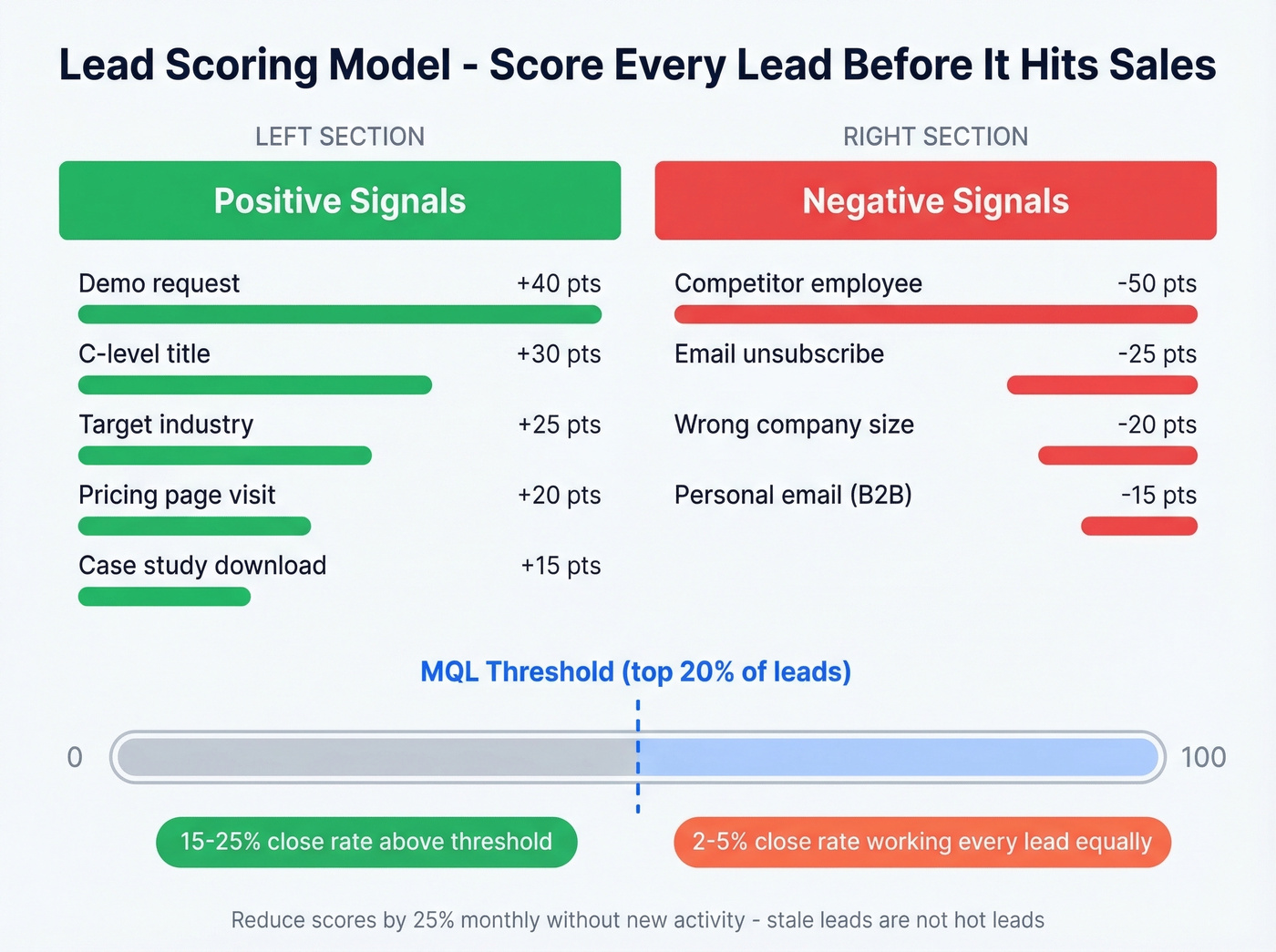
Keep it to 5-7 core criteria. Assign points based on how strongly each signal predicted a close in your historical data.
Positive Scoring
| Criteria | Points | Why It Matters |
|---|---|---|
| Demo request | +40 | Highest-intent action |
| C-level title | +30 | Decision-maker access |
| Target industry | +25 | ICP fit signal |
| Pricing page visit | +20 | Active evaluation |
| Case study download | +15 | Mid-funnel research |
Negative Scoring
| Criteria | Points | Why It Matters |
|---|---|---|
| Competitor employee | -50 | Not a buyer |
| Email unsubscribe | -25 | Disengaged |
| Wrong company size | -20 | Poor ICP fit |
| Personal email (B2B) | -15 | Low authority signal |
Set your MQL threshold at the top 20% of leads by score - typically 50-75 points on a 100-point scale. Teams that enforce this threshold see 15-25% conversion rates from qualified leads to closed deals, a massive improvement over the 2-5% most teams get when they work every lead equally.
One rule most teams skip: score decay. Reduce points by 25% monthly without new activity. A lead who was hot in January and silent through March isn't hot anymore. Decay keeps your pipeline honest.
Use Intent Data to Find In-Market Buyers
Intent data tells you who's actively researching your category - before they fill out a form.
First-party intent comes from your own properties: website visits, content downloads, email engagement. Third-party intent comes from aggregated signals across industry publications, review sites, and forums. Both matter, but they serve different purposes. First-party tells you who's already aware of you. Third-party tells you who's shopping your category but hasn't found you yet. (For a practical setup, see intent based segmentation.)
Not all intent signals carry equal weight. Demandbase's scoring framework assigns demo requests 50 points, pricing page visits 40, whitepaper downloads 30, and blog subscriptions just 5. That tiering prevents content engagement from inflating scores beyond what the behavior actually predicts. Use a similar hot/warm/cold threshold: 80+ points goes straight to sales, 40-79 enters a nurture sequence, below 40 stays in marketing's hands.
65% of marketers say intent signals improved their pipeline forecasting accuracy. You're not just finding one buyer - you're identifying an account that's in-market, then multi-threading into the buying committee. Prospeo tracks intent across 15,000 topics via Bombora and layers in job role and company growth signals, so you can see which decision-makers at a target account are reachable with verified contact data.

You just read how intent data identifies in-market buyers before they fill out a form. Prospeo tracks 15,000 intent topics via Bombora, layers in job role and company growth signals, and delivers 98% verified emails - so your reps only work leads that score above threshold.
Replace bloated pipelines with buyers who actually close.
What High-Quality Leads Actually Cost
Every guide tells you to "optimize your CPL." None of them tell you what a good CPL actually looks like. Here are the benchmarks from First Page Sage's report:
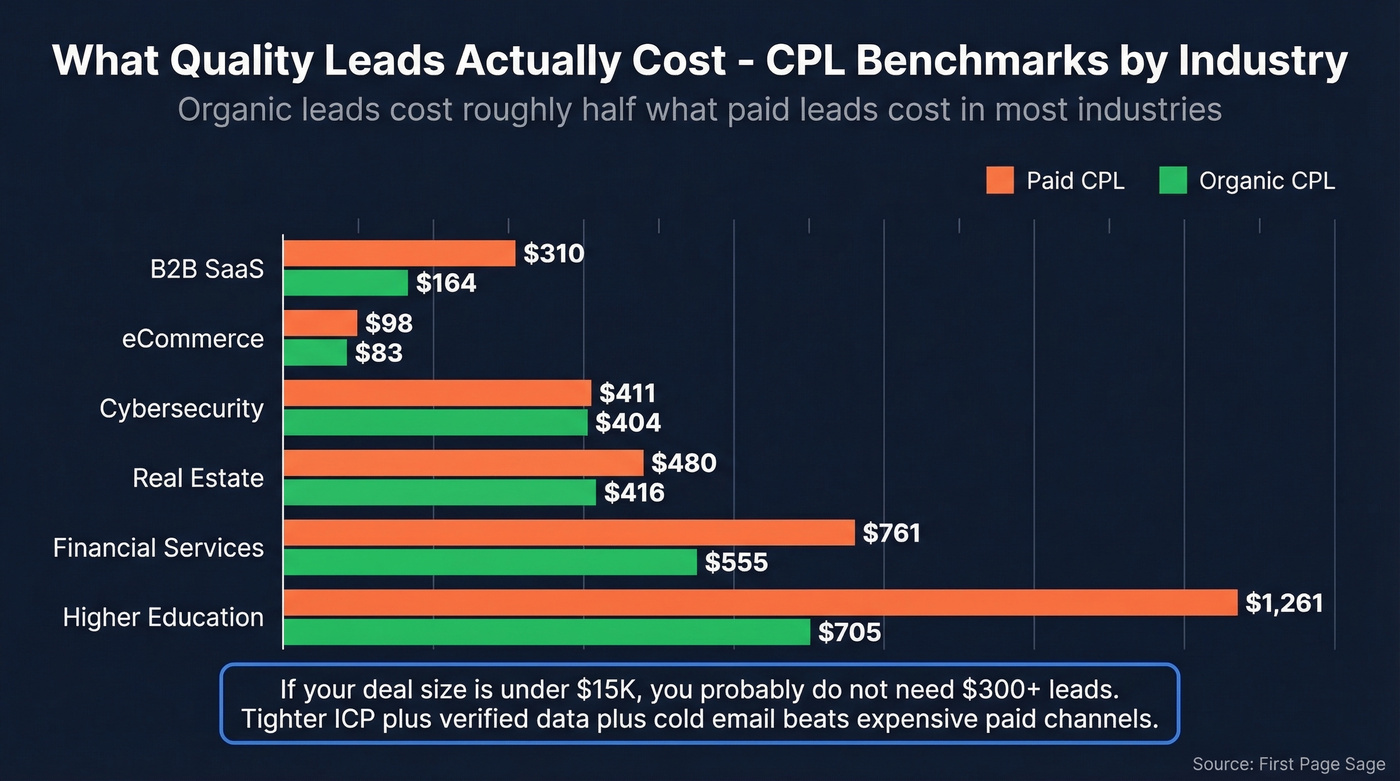
| Industry | Paid CPL | Organic CPL | Blended |
|---|---|---|---|
| B2B SaaS | $310 | $164 | $237 |
| eCommerce | $98 | $83 | $91 |
| Cybersecurity | $411 | $404 | $406 |
| Real Estate | $480 | $416 | $448 |
| Financial Services | $761 | $555 | $653 |
| Higher Education | $1,261 | $705 | $982 |
If you're paying $500/lead in B2B SaaS, you're paying about 2x the blended benchmark. And notice the gap between paid and organic CPL - in SaaS, organic leads cost roughly half what paid leads cost. That's not a rounding error. It's a strategic signal about where to invest long-term.
Let's be honest: if your average deal size is under $15K, you probably don't need $300+ leads at all. A tighter ICP definition, verified contact data, and a solid cold email sequence will outperform expensive paid channels every time. Save the big CPL budgets for enterprise deals where the math actually works.
Channel-by-Channel Playbook
SEO & Content Marketing
Organic leads are cheaper than paid leads across most industries and compound over time. A blog post that ranks today keeps generating leads next quarter without additional spend. The tradeoff is patience - you won't see meaningful pipeline from content for 3-6 months. For teams trying to attract high-quality leads on a limited budget, SEO is the highest-ROI long-term channel. (If you want a dedicated workflow, use this guide on SEO sales leads.)
One shift worth watching in 2026: AI-generated answers from ChatGPT, Perplexity, and Google's AI Overviews are changing how buyers discover solutions. Optimizing for these surfaces - sometimes called GEO - is becoming a real lead gen consideration. If your brand doesn't appear in AI-generated answers for your category, you're invisible to a growing segment of buyers who never scroll past the summary.
Paid Channels
Here's where most teams misallocate. The channel-by-channel data:
| Channel | Budget Share | MQL-to-SQL Rate | Key Metric |
|---|---|---|---|
| Google Ads | 35-45% | 7-12% | CPL $48.96 |
| LinkedIn Ads | 25-35% | 14-18% | Highest lead quality |
| Bing Ads | 15-20% | - | ROI 253% |
| Meta | 5-10% | - | Awareness only |
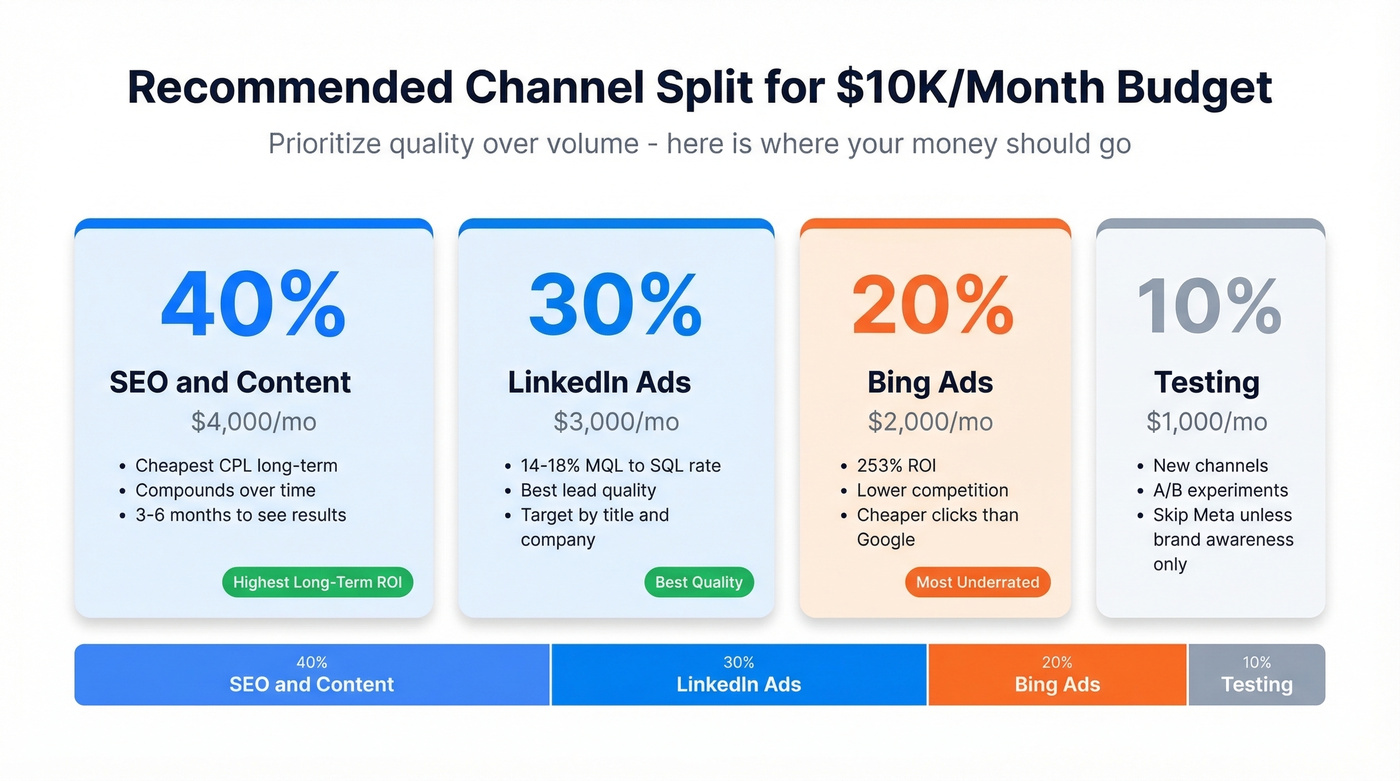
Bing Ads are the most underrated B2B channel right now. A 253% ROI with lower competition and cheaper clicks than Google. Most B2B marketers ignore Bing entirely because it feels like a second-tier platform. That's exactly why it works - your competitors aren't there.
LinkedIn has the highest MQL-to-SQL conversion at 14-18%, which makes sense - you're targeting by title, company size, and industry. Google captures higher volume at lower cost but converts to SQL at roughly half LinkedIn's rate. If your priority is higher-quality prospects over raw volume, LinkedIn deserves the larger share.
Our recommended split for a team spending $10K/month from scratch: 40% SEO/content, 30% LinkedIn Ads, 20% Bing Ads, 10% testing. Skip Meta unless you're running brand awareness plays with no pipeline expectations.
Cold Email as a Pipeline Engine
Cold email is still the fastest path to pipeline for outbound teams, but only if the mechanics are right. Keep emails to 85-120 words. Send 50-120 emails per domain per day - more than that and you're asking for deliverability problems. Run a four-touch sequence: Day 0 initial, Day 3 bump, Day 7 value drop, Day 12 breakup. (For structure, use a proven B2B cold email sequence.)
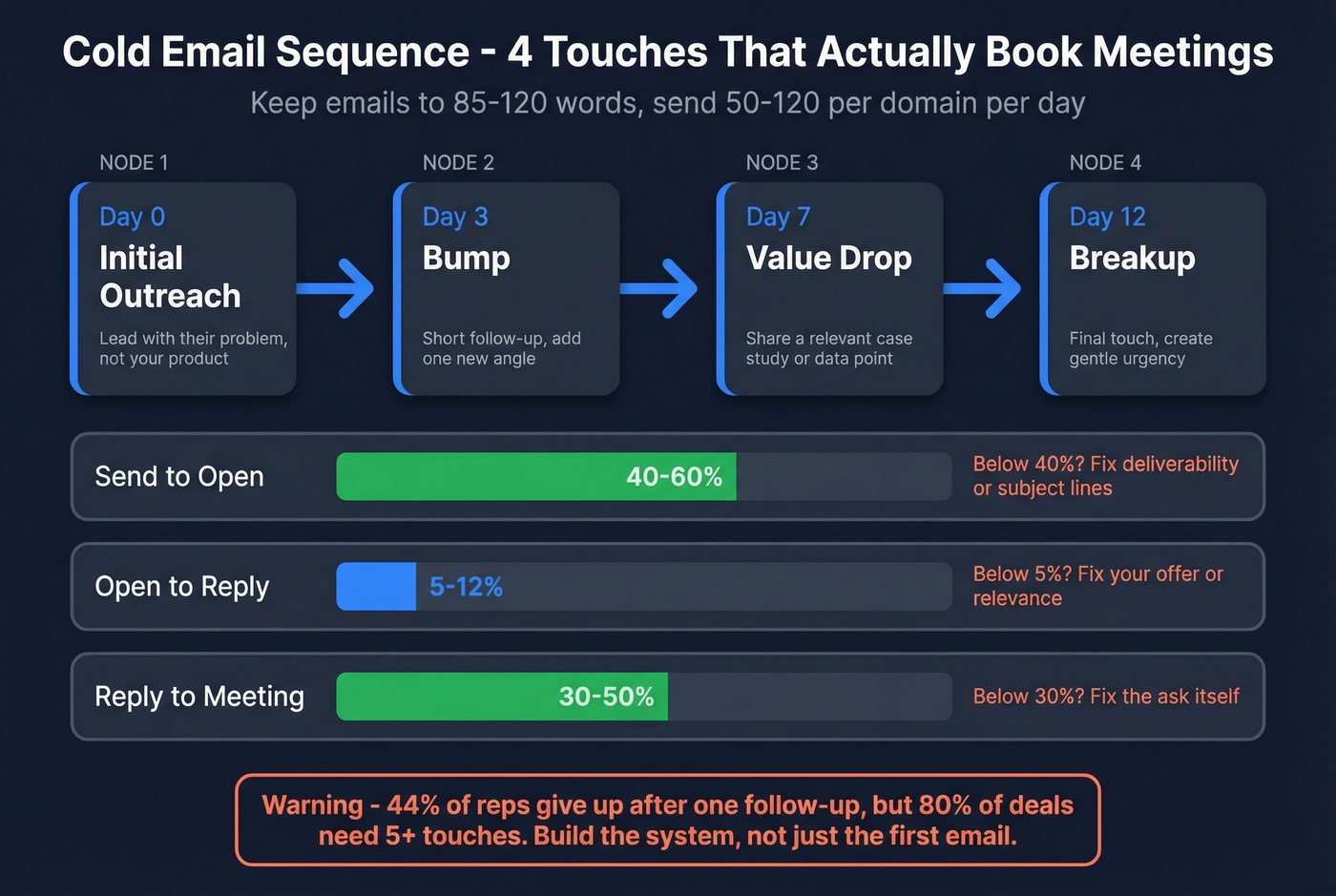
| Stage | Target Range | If Below, Fix... |
|---|---|---|
| Send to Open | 40-60% | Deliverability/subject |
| Open to Reply | 5-12% | Offer/relevance |
| Reply to Meeting | 30-50% | The ask |
Build your list with verified data from the start. Sending to bad addresses doesn't just waste time - it tanks your sender reputation and makes future campaigns harder. We've seen teams burn through three domains in a quarter because they skipped verification on their first list build. (If you're building lists, this how to generate an email list guide helps.)
Referrals & Events
Referrals are often the highest-quality leads in B2B. The challenge is that they don't scale linearly.
Webinars bridge the gap - use registration as lead capture, then qualify by attendance behavior. Someone who stayed for 45 minutes and asked a question during Q&A is a fundamentally different lead than someone who registered and never showed up. Score accordingly. Well-run webinars typically convert 20-40% of registrants into attendees, and 2-5% of attendees into qualified pipeline, so a 400-registrant webinar should yield 8-20 real opportunities if your targeting is right.
Clean Your Data First
You run a webinar. 200 people register. You load those contacts into your outreach sequence. Half the phone numbers bounce. A quarter of the emails are invalid. Your sender reputation takes a hit, and the leads who were actually interested never get your follow-up because your emails are landing in spam.
This happens constantly. And it's entirely preventable.
The thresholds are clear: keep your bounce rate under 2% - that's the safe zone. Above 5% and you're actively damaging your sender reputation. Hard bounces from invalid addresses must be removed immediately. Soft bounces from full inboxes or temporary server issues can retry, but flag any address that soft-bounces 2-3 times in a row. (More detail: email bounce rate.)
Prospeo's 5-step verification process - including catch-all handling, spam-trap removal, and honeypot filtering - runs on proprietary infrastructure rather than third-party providers. The 300M+ profile database refreshes every 7 days, compared to the 6-week industry average. That freshness gap matters: a contact who changed jobs three weeks ago is a bounced email at most providers but a current record with a weekly refresh cycle. Clean data is the prerequisite for every strategy in this guide - no scoring model or intent signal matters if your emails never arrive.
Real results: Meritt dropped their bounce rate from 35% to under 4% and tripled pipeline from $100K to $300K per week. Snyk - with 50 AEs prospecting 4-6 hours per week - cut bounce rates from 35-40% to under 5% and grew AE-sourced pipeline by 180%.
Your CPL benchmarks mean nothing if 35% of emails bounce. Prospeo's 5-step verification and 7-day data refresh cycle keep bounce rates under 4% - turning your $237 blended CPL into pipeline instead of wasted spend. At $0.01 per email, the math isn't even close.
Cut your effective cost per qualified lead by fixing the data layer first.
Measure What Matters
If you can't diagnose where your funnel breaks, you can't fix it. Here's the diagnostic framework we use for cold outreach:
- Open rate below 35%? Your deliverability or subject lines are broken. Check your sender reputation, warm your domain, and A/B test subjects before touching anything else. (Use these email subject lines examples to speed up testing.)
- Reply rate below 4%? Your offer isn't resonating. The email is reaching inboxes but nobody cares enough to respond. Rewrite your value prop and test different angles.
- Meeting conversion below 25%? Your ask is too big. Instead of "let's schedule a 30-minute demo," try "can I send a 2-minute video walkthrough?"
Your meeting-to-close target should sit at 15-30%. If you're below that, the problem isn't lead gen - it's your sales process. 67% of lost sales result from inadequate lead qualification, which means the leads that do get through need to be genuinely qualified before they hit a rep's calendar. (If you need a full funnel view, use an AIDA sales funnel framework.)
Here's the thing most teams get wrong: they optimize the top of the funnel obsessively and ignore everything below the meeting stage. The highest-leverage fix is usually in the middle - better scoring, cleaner data, tighter handoff context between marketing and sales. Teams that generate quality leads consistently don't just fill the top of the funnel. They instrument every stage so they know exactly where conversion drops off and why.
FAQ
What counts as a quality lead?
A quality lead matches your ICP on firmographic fit, shows behavioral intent like pricing page visits or demo requests, and has budget plus timeline to purchase. In practice, leads scoring 50+ on a 100-point model with both fit and engagement signals qualify. The MQL/SQL distinction matters - not every engaged contact is ready for sales.
What's a good cost per lead in 2026?
B2B SaaS averages $237 blended, eCommerce runs $91, and financial services hits $653. If your CPL exceeds 2x your industry average, audit your channel mix - you're likely over-indexed on paid acquisition when organic could cut costs in half.
How can I improve lead quality without increasing budget?
Build a scoring model so reps stop working junk - even a simple 5-criteria model cuts wasted effort dramatically. Verify contact data to eliminate bounces. Then layer intent signals to prioritize buyers actively researching your category over contacts who downloaded one ebook six months ago.
How do I start generating leads from scratch?
Define your ICP tightly - industry, company size, title, geography - then build a verified contact list. Run a four-touch cold email sequence to 50-100 contacts per day while publishing SEO content that compounds over 3-6 months. This two-track approach delivers pipeline immediately through outbound while building an organic engine that lowers your cost per lead over time.