

The Go-to-Market Process: An Operator's 8-Phase Playbook
90% of new product launches fail. Not because the product was bad - because the team confused having a strategy with having a process. A strategy tells you what you're bringing to market and why. A go-to-market process tells you how, when, and who - the sequenced phases, deliverables, and stage gates that actually get you from positioning deck to revenue. Companies with a documented GTM strategy are 3.4x more likely to succeed than those winging it, yet 72% still don't have a formal one.
That gap between "we have a plan" and "we have a process" is where launches die.
What You Need Before You Start
Three non-negotiables every GTM launch requires:
- A validated ICP - not a guess, not a persona doc from 2023, but a segment you've confirmed has the pain, budget, and urgency to buy. (Use an Ideal Customer Profile template if you need one.)
- A one-page positioning statement - if it doesn't fit on a Post-it, it's not clear enough. (If you're stuck, start with B2B brand positioning.)
- A verified prospect list - launching outbound with 30% bounce rates isn't a channel. It's a domain reputation fire. (See email bounce rate benchmarks and fixes.)
What Is a Go-to-Market Process?
Most guides conflate GTM strategy with GTM process. They're different things. Strategy is the what - which market, which segment, which positioning. Process is the how - the sequenced phases, deliverables, owners, and stage gates that turn strategy into execution.
Strategy decides you're launching a mid-market analytics product positioned against legacy BI tools. Process decides that PMM owns the positioning lock by week four, sales enablement has battle cards by week eight, and RevOps runs a 30/60/90-day review cadence post-launch. The distinction matters because 66% of new products fail within two years. Most of those had a strategy. What they lacked was a process rigorous enough to catch problems before launch day.
The 8 GTM Phases
Phase 1 - Market Research & Validation
This is where most failures start. No market need accounts for 35% of startup failures - more than running out of cash, more than getting outcompeted. The deliverable here is an ICP document with market sizing (TAM/SAM/SOM where relevant), validated through actual buyer conversations, not desk research alone. (If you need a refresher on sizing, use this addressable market guide.)
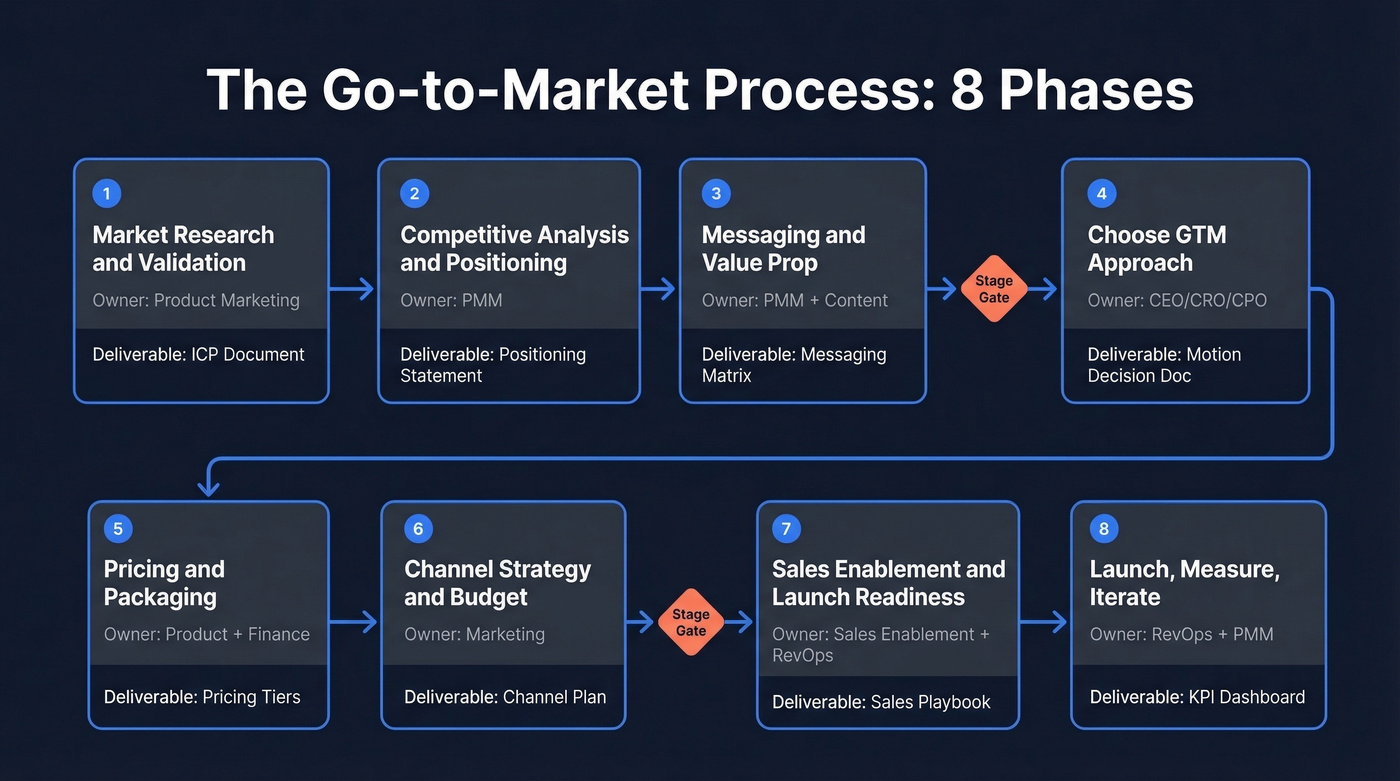
Owner: Product Marketing · Deliverable: ICP document with market sizing · Stage gate: Run ~20 discovery calls with target buyers confirming the pain exists and they'd pay to solve it. (A structured discovery questions list helps keep this consistent.)
Slack's early growth is a good reminder of why this phase matters. The team obsessed over how real teams communicated in practice, and that insight shaped both the product and the story around it. We've seen teams skip validation to "move fast" and end up moving fast toward failure. Twenty calls. That's the minimum.
Phase 2 - Competitive Analysis & Positioning
Your positioning statement should pass the Post-it test: if it doesn't fit on a sticky note, you haven't made the hard decisions yet.
Owner: PMM · Deliverable: One-sentence positioning statement + competitive landscape map. (If you want a system, use a competitive intelligence strategy framework.)
Feature-first positioning is one of the most common GTM mistakes. Nobody buys features. They buy outcomes. "AI-powered analytics platform" means nothing. "Cut your monthly reporting cycle from 5 days to 5 minutes" means everything.
To pressure-test your positioning, build a value map that forces you to articulate your advantage against each competitor:
| Buyer Problem | Your Solution | Competitor A | Competitor B |
|---|---|---|---|
| Monthly reporting takes 5+ days | Auto-generated dashboards, 5-minute refresh | Manual BI tool, 2-day turnaround | Analyst-dependent, 3-day turnaround |
| Can't segment by cohort in real time | Real-time cohort builder, no SQL | SQL-only cohort queries | Pre-built segments, no customization |
If you can't fill in the "Your Solution" column with something meaningfully different, you haven't finished Phase 2.
Phase 3 - Messaging & Value Proposition
B2B buying committees run 6-10 stakeholders. Your CFO cares about TCO. Your IT lead cares about integration and security. Your ops buyer cares about workflow disruption. One message doesn't fit all of them.
Owner: PMM + Content · Deliverable: Messaging matrix by persona/stakeholder.
Here's what that matrix looks like in practice:
| Stakeholder | Primary Concern | Your Proof Point | Language That Resonates |
|---|---|---|---|
| CFO | TCO and payback period | "Pays for itself in 4.2 months based on avg customer data" | ROI, cost avoidance, margin impact |
| IT Lead | Integration risk, security | "SOC 2 Type II, deploys in <48 hours, no custom code" | Compliance, API-first, zero migration risk |
| Ops Buyer | Workflow disruption | "Runs alongside existing stack - no rip-and-replace" | Gradual rollout, parallel workflows, training included |
Treat this as a targeting exercise, not a creative one. Every row should map to a real objection you've heard in discovery calls.
Phase 4 - Choose Your GTM Approach
Product-led, sales-led, or hybrid? This decision shapes everything downstream - pricing, channels, team structure, and metrics. 57% of deals today involve a product-led component, but that doesn't mean PLG is right for your launch.
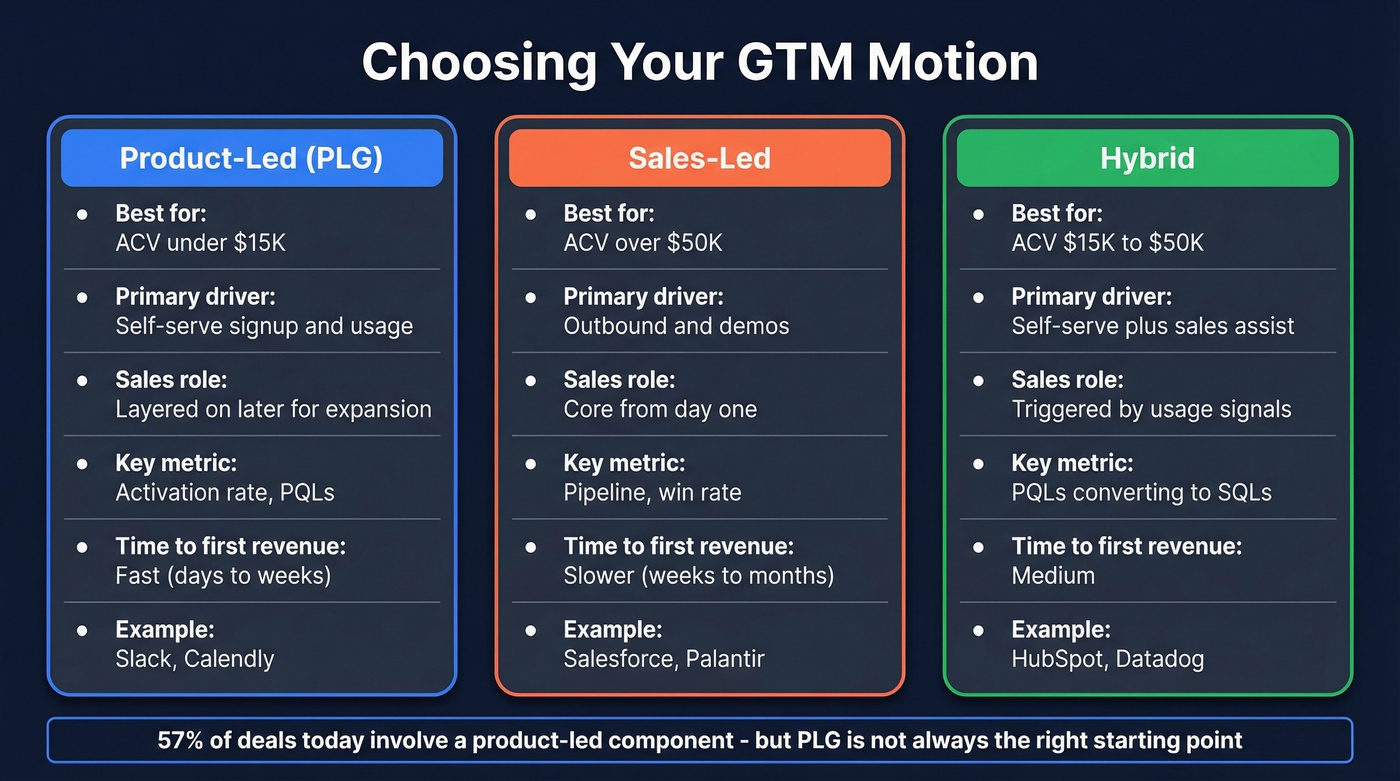
Owner: CEO/CRO/CPO · Deliverable: Motion decision document with rationale.
A common pattern: start with a self-serve product experience to drive adoption, then layer sales on top once usage signals show which accounts are ready for expansion. Other companies do the reverse - start sales-led to win early lighthouse customers, then add self-serve to scale. The motion isn't permanent. But you need to pick one to start, or you'll spread resources across two half-built engines.
Here's the thing: if your average deal size is under $15K, you almost certainly don't need a sales-led motion at launch. Start PLG, instrument your product for usage signals, and layer on sales when you see accounts hitting expansion triggers.
Phase 5 - Pricing & Packaging
Pricing and business model issues cause 19% of failures. That makes this phase a genuine stage gate, not an afterthought you finalize the week before launch.
Owner: Product + Finance · Deliverable: Pricing page, rate card, or packaging tiers.
Test pricing with real prospects before you publish it. The gap between "what customers say they'd pay" and "what they actually pay" is enormous - the only way to close it is to put a number in front of them and watch their reaction. Run a Van Westendorp price sensitivity test with 15-20 target buyers before you lock tiers.
Anchor your pricing against these unit economics benchmarks:
| Metric | Average | Top Performers |
|---|---|---|
| LTV:CAC ratio | 3:1 | 5:1+ |
| CAC payback period | 15 months | <12 months |
Companies with CAC payback under 12 months grow at 2x the rate of those around 15 months. If your pricing model can't support a 3:1 LTV:CAC ratio, the problem isn't your launch execution - it's your business model. (If you need to sanity-check inputs, start with cost to acquire customer.)
Phase 6 - Channel Strategy & Budget
Not every channel works for every launch. Here's what the data shows for 12-month ROI by channel:
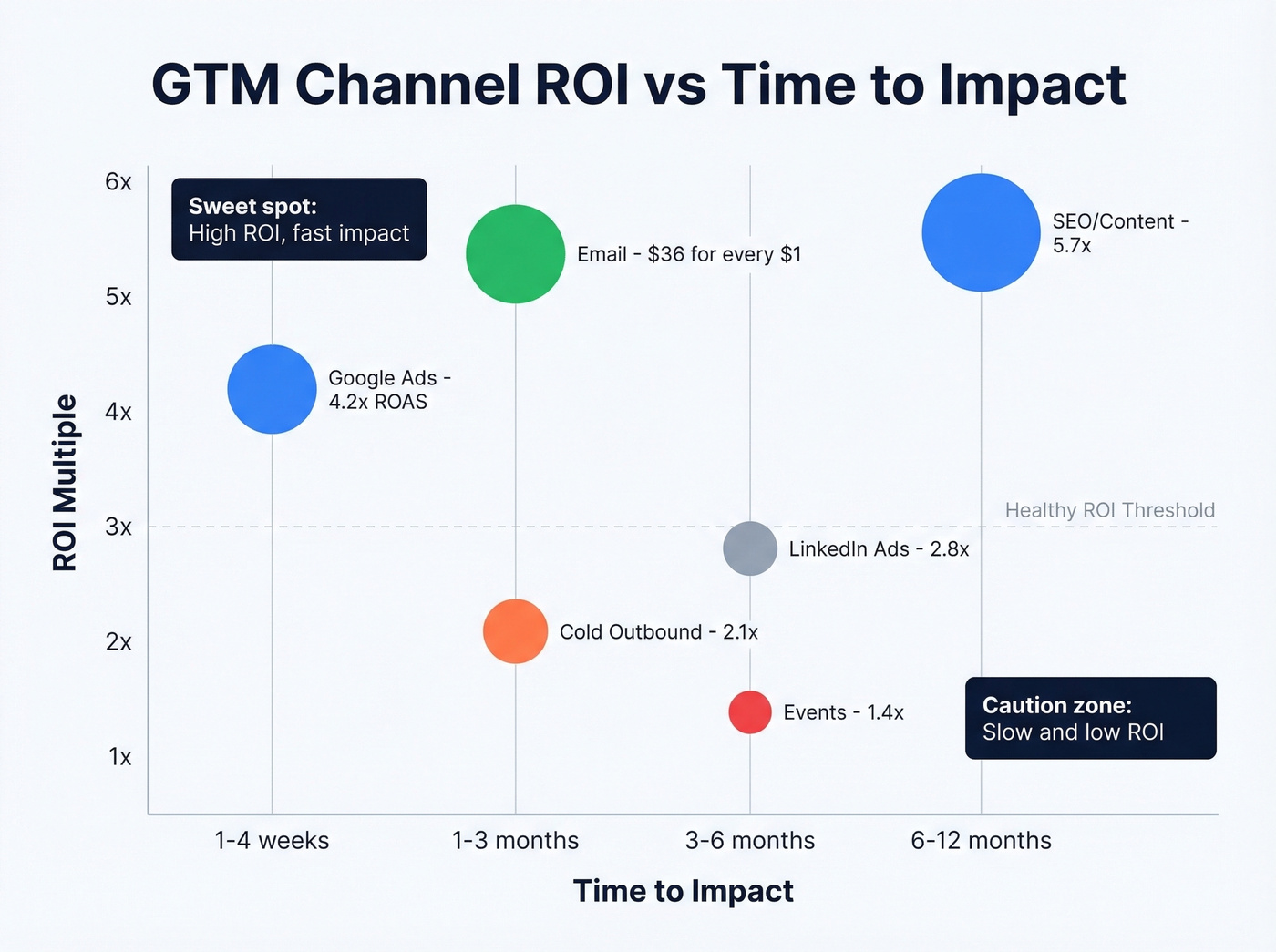
| Channel | ROI | Time to Impact |
|---|---|---|
| SEO / Content | 5.7x | 6-12 months |
| $36 : $1 | 1-3 months | |
| Google Ads | 4.2x ROAS | 1-4 weeks |
| LinkedIn Ads | 2.8x | 2-6 months |
| Cold outbound | 2.1x | 1-3 months |
| Events | 1.4x | 3-9 months |
For most B2B SaaS launches, start with email + Google Ads for quick wins, then layer in SEO/content for compounding returns. Events should come last unless you're in a relationship-heavy vertical like cybersecurity or financial services.
Budget benchmarks: Companies typically allocate 26% of revenue to marketing and sales during a GTM launch. The median Series A startup spends ~$420K on GTM. Here's a typical allocation:
| Category | % of GTM Budget |
|---|---|
| Paid ads | 28% |
| Sales team / enablement | 24% |
| Content / SEO | 18% |
| MarTech | 14% |
| Events / PR | 10% |
| Partnerships | 6% |
Your CAC will vary dramatically by industry. These benchmarks from FirstPageSage help you sanity-check your channel spend:
| Industry | Avg B2B CAC | Avg B2C CAC |
|---|---|---|
| SaaS | $273 | $166 |
| eCommerce | $84 | $68 |
| Cybersecurity | $429 | $73 |
| Financial Services | $644 | $392 |
| Healthcare | $357 | $221 |
If your blended CAC is 2x+ your industry average and your product isn't meaningfully differentiated, you have a positioning problem, not a channel problem. Go back to Phase 2.
Pick 1-3 channels to start. Defaulting to "all of them" is how you burn budget without learning what works.
Phase 7 - Sales Enablement & Launch Readiness
This is where process discipline either pays off or collapses. Inadequate sales enablement is a top-5 GTM failure mode, and it's entirely preventable.
Owner: Sales Enablement + RevOps · Deliverable: Sales playbook, battle cards, objection-handling guides, and a verified prospect list. (If you're building the stack, start with an SDR tool shortlist.)
Your SDRs can have the best playbook in the world, but if their prospect list bounces 30%+ on day one, the launch is dead on arrival. Data quality is a launch readiness gate, full stop. In our experience, teams that verify emails before launch - using a tool like Prospeo at 98% accuracy and roughly $0.01 per lead - avoid the sender reputation damage that quietly kills outbound channels in week two. One customer, Meritt, saw bounce rates drop from 35% to under 4% after switching to verified data, and their pipeline tripled from $100K to $300K per week.

Phase 8 - Launch, Measure, Iterate
Launch isn't the finish line. It's the starting gun for your measurement loop. Set a 30/60/90-day review cadence and track against these funnel benchmarks:
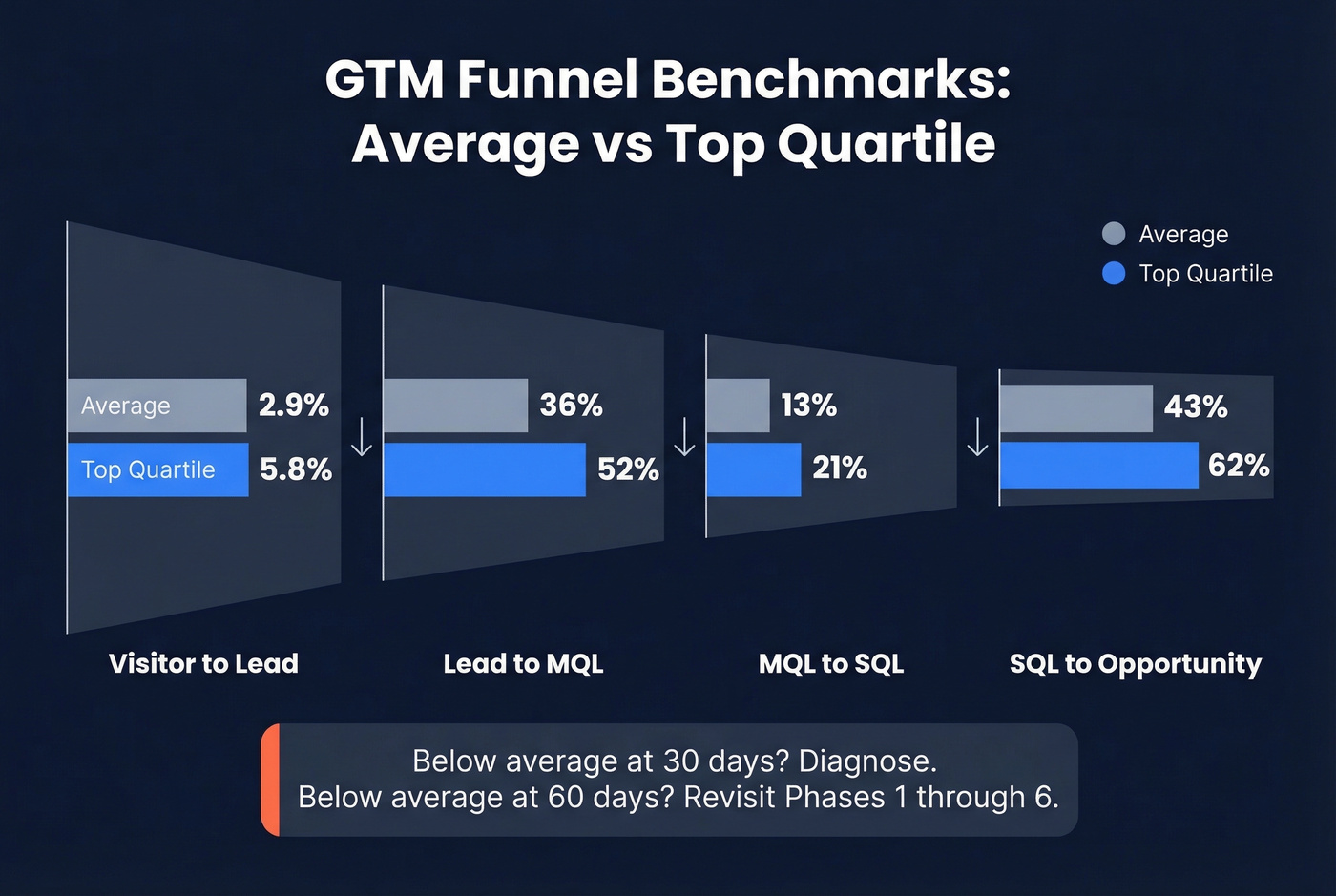
| Stage | Average | Top Quartile |
|---|---|---|
| Visitor to Lead | 2.9% | 5.8% |
| Lead to MQL | 36% | 52% |
| MQL to SQL | 13% | 21% |
| SQL to Opportunity | 43% | 62% |
Owner: RevOps + PMM · Deliverable: KPI dashboard with 30/60/90-day review schedule. (If you want a clean list of what to track, use funnel metrics.)
Beyond funnel metrics, track CSAT and NPS from day one. Conversion rates tell you if your GTM machine is working; satisfaction scores tell you if your product is delivering on the promises your GTM made. A launch with strong conversion but cratering NPS is a ticking time bomb.
Below average at the 30-day mark? Don't panic - diagnose. Below average at 60 days means something in Phases 1-6 needs revisiting. The launches that survive aren't the ones with the best day-one metrics. They're the ones with the fastest feedback loops.
How Long Does a GTM Launch Take?
| Launch Type | Timeline | Key Variable |
|---|---|---|
| Feature launch | 8-12 weeks | Positioning clarity |
| New product line | 12-20 weeks | Market validation |
| Enterprise category | 6-9 months | Stakeholder alignment |
These are realistic ranges for B2B SaaS. The biggest variable is always Phase 1. Product-market fit typically takes 18-24 months for B2B SaaS, so a 12-week launch timeline assumes you've already validated PMF and you're executing against a known market. If you haven't validated PMF, you're not running a go-to-market process - you're running an experiment. Call it what it is.

Phase 1 says validate with real buyers. Phase 3 says reach every stakeholder on the buying committee. Neither works if your prospect list bounces. Prospeo delivers 98% verified emails across 300M+ profiles - so your GTM launch hits real inboxes, not spam traps.
Don't let bad data kill your launch before it starts.
B2B vs. B2C: Where the Process Diverges
The eight phases apply to both B2B and B2C, but the execution looks dramatically different:
| Dimension | B2B | B2C |
|---|---|---|
| Stakeholders | 6-10 | 1 |
| Cycle length | 6-12 months | Minutes to days |
| Decision driver | ROI / TCO | Emotion / identity |
| Messaging focus | Outcomes | Lifestyle |
| Primary channels | Outbound / ABM / events | Paid social / retail |
| Pricing model | Contract / usage | Fixed / subscription |
| Post-sale | CS team / QBRs | Self-serve / community |
The biggest implication for process design: B2B requires a messaging matrix that addresses each stakeholder's concerns individually. B2C can often get away with a single emotional hook. If you're running a B2B launch and your messaging doesn't speak to the CFO, IT lead, and end user separately, you haven't finished Phase 3.
5 Mistakes That Kill GTM Launches
1. Skipping market validation. 35% of failures trace back to no market need. Twenty discovery calls before you write a positioning doc. That's the minimum.
2. Cross-functional silos. Sales, marketing, and product "aligned on paper" but operating with different definitions of MQL, different messaging, and different timelines. Alignment means shared deliverables, not shared Slack channels.
3. Feature-first positioning. "AI-powered" and "next-generation" aren't positioning. They're filler. Lead with the outcome your buyer gets, not the technology you built.
4. Launching with unverified data. Outbound without verified data isn't a channel - it's a domain reputation liability. Verify before you send. (If deliverability is already shaky, start with how to improve sender reputation.)
5. No metrics loop. Without a 30/60/90-day review cadence, you won't know the launch is failing until it's too late to fix. Neglecting iteration is how "promising launches" become quiet shutdowns.
Choosing the Right GTM Methodology
The eight phases above are framework-agnostic - they work whether you follow a product-led approach, an account-based methodology, or a channel-partner model. What changes between methodologies is where you invest the most time and budget.
A PLG methodology front-loads Phase 5 because the self-serve experience is the sales motion. An ABM methodology front-loads Phase 3 because personalized outreach to a small account list demands hyper-relevant value props. A channel-partner methodology front-loads Phase 6 because your partners' enablement determines your reach. Let's be honest - most teams don't pick a methodology so much as stumble into one based on who they hired first. That's fine, as long as you recognize it and adjust your phase weighting accordingly.
Pick the methodology that matches your product's complexity, your buyer's purchase behavior, and your team's current capabilities - then run the eight phases through that lens.
Your One-Page GTM Plan
If it doesn't fit on one page, you haven't made the hard decisions yet. Copy this template and fill it in before you start building launch assets:
| Field | Your Answer |
|---|---|
| ICP / Segment | |
| Core Pain / JTBD | |
| Value Proposition | |
| Positioning Statement | |
| Key Differentiators | |
| Pricing & Packaging | |
| Route-to-Market | PLG / Sales-led / Partner |
| Primary Channels (1-3) | |
| Activation Moment | |
| Key Launch Assets | |
| 30-Day KPIs | |
| 60-Day KPIs | |
| 90-Day KPIs |
Phase ownership by function:
| Phase | Owner | Support |
|---|---|---|
| 1-3 (Research through Messaging) | PMM | Product, Sales |
| 4 (Motion) | CEO / CRO | PMM, Product |
| 5 (Pricing) | Product + Finance | PMM |
| 6 (Channels) | CMO / Growth | RevOps |
| 7 (Enablement) | Sales Enablement | RevOps, PMM |
| 8 (Launch + Iterate) | RevOps | All functions |
The sequence matters. Lock positioning before you build assets. Build assets before you enable sales. Enable sales before you launch. Review after you launch. Every team that skips a step pays for it later - usually in wasted budget and missed pipeline targets.
You picked your GTM motion. You nailed positioning. Now you need to reach decision-makers without torching your domain. Prospeo's 7-day data refresh and 5-step verification keep bounce rates under 4% - exactly what teams like Snyk used to generate 200+ opportunities per month.
Execute your GTM process with data that actually connects you to buyers.
FAQ
What's the difference between a GTM strategy and a GTM process?
Strategy defines what you're launching, who you're targeting, and why the market needs it. Process is the sequenced execution - eight phases with deliverables, owners, timelines, and stage gates that turn strategy into revenue. Companies with a documented GTM strategy are 3.4x more likely to hit their launch targets.
How long does a go-to-market process take?
Feature launches typically take 8-12 weeks; new product lines run 12-20 weeks; enterprise category entries need 6-9 months. The biggest variable is market validation - rushing past Phase 1 is the #1 failure mode, and it's the phase most teams try to compress.
What tools do you need for a GTM launch?
At minimum: a CRM like HubSpot or Salesforce, a verified data source for outbound prospecting, marketing automation for nurture sequences, and a shared KPI dashboard. Everything else is optional until you've nailed the fundamentals.
How do I choose between PLG and sales-led?
Match the motion to deal size and buyer complexity. Products with average contract values under $15K and simple onboarding typically suit product-led growth. Higher-ACV products sold to multi-stakeholder buying committees usually require a sales-led or hybrid approach. Start with one, measure CAC through Phase 8, then layer on additional motions.