

Go-to-Market Strategy Examples With Real Numbers
A well-executed GTM strategy increases your chance of launch success by 50%. Yet 75% of high-tech marketers report significant dissatisfaction with their GTM outcomes. That's a brutal gap - the distance between "having a plan" and "having a plan that works" is where most companies stall. And when GTM goes wrong, ineffective execution can inflate your CAC by up to 35%.
The go-to-market strategy examples below close that gap with real metrics, not theory.
Quick version: Your GTM motion depends on your stage and ACV. Pre-PMF founders should start with founder-led outbound plus content. Companies at $1M-$10M ARR should layer PLG or inbound on top of scaled outbound. At $10M+ ARR, you're running multi-motion: PLG + sales-led + channel. The rest of this piece gives you 10 real examples with numbers, benchmarks to measure against, and the 7 failure patterns that kill most launches.
What Is a Go-to-Market Strategy?
A go-to-market strategy is the cross-functional plan for bringing a product to a specific market - covering who you're selling to, how you'll reach them, what you'll charge, and how you'll win against alternatives. It's not a marketing plan. Marketing is one component within it.
The distinction matters because teams that confuse GTM with marketing end up with great demand gen and no sales motion, or a killer sales deck and no pipeline to use it on. GTM sits above marketing, sales, product, and customer success. It aligns all four.
Three situations trigger a GTM plan: launching a new product, entering a new market, or repositioning an existing product against new competitors. If you're doing any of these without a documented GTM strategy, you're running on instinct - and 60% of startups fail within three years. Even a simple go-to-market plan can expose gaps in your thinking before you spend a dollar on execution.
GTM Frameworks Beyond the 4 Ps
A lot of GTM articles rehash the 4 Ps - product, price, place, promotion - and call it a framework. That's marketing 101, not a GTM plan. Here are three frameworks that actually help you make decisions.
GACCS Framework breaks GTM into five pillars: Goals, Audience, Creative, Channels, and Stakeholders. It's useful because it forces you to name the internal stakeholders who need to align before launch - the piece most plans skip entirely.
Kleppmann's 10 Questions for B2B is a diagnostic tool. It asks founders things like "What product changes are you willing to make based on market feedback?" and "How will you segment your first 100 customers?" Less a template, more a stress test for your assumptions.
ICP Tiering is the framework we've seen work best in practice. You segment your total addressable market into three tiers: Tier 1 is your perfect fit with the highest intent, Tier 2 is a good fit that needs education, and Tier 3 is a possible fit you deprioritize. Then you allocate budget and sales effort accordingly. Most teams skip this and treat every lead equally - which means they treat every lead poorly.
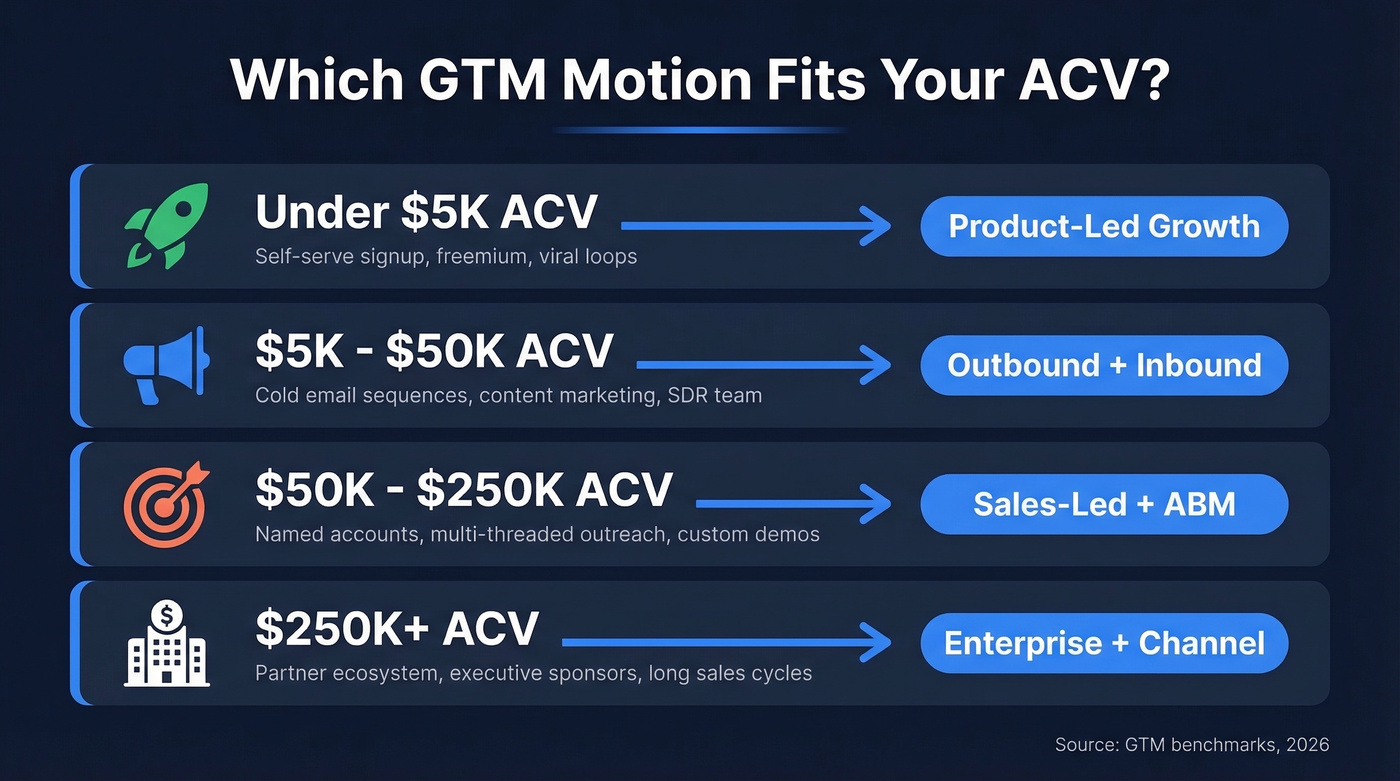
The motion you pick should match your ACV and sales complexity:
| ACV Range | Recommended Motion |
|---|---|
| Under $5k | Product-led growth |
| $5k-$50k | Outbound + inbound |
| $50k-$250k | Sales-led + ABM |
| $250k+ | Enterprise + channel |
How to Build a Go-to-Market Plan
Eight steps. Each one is a decision, not a deliverable.
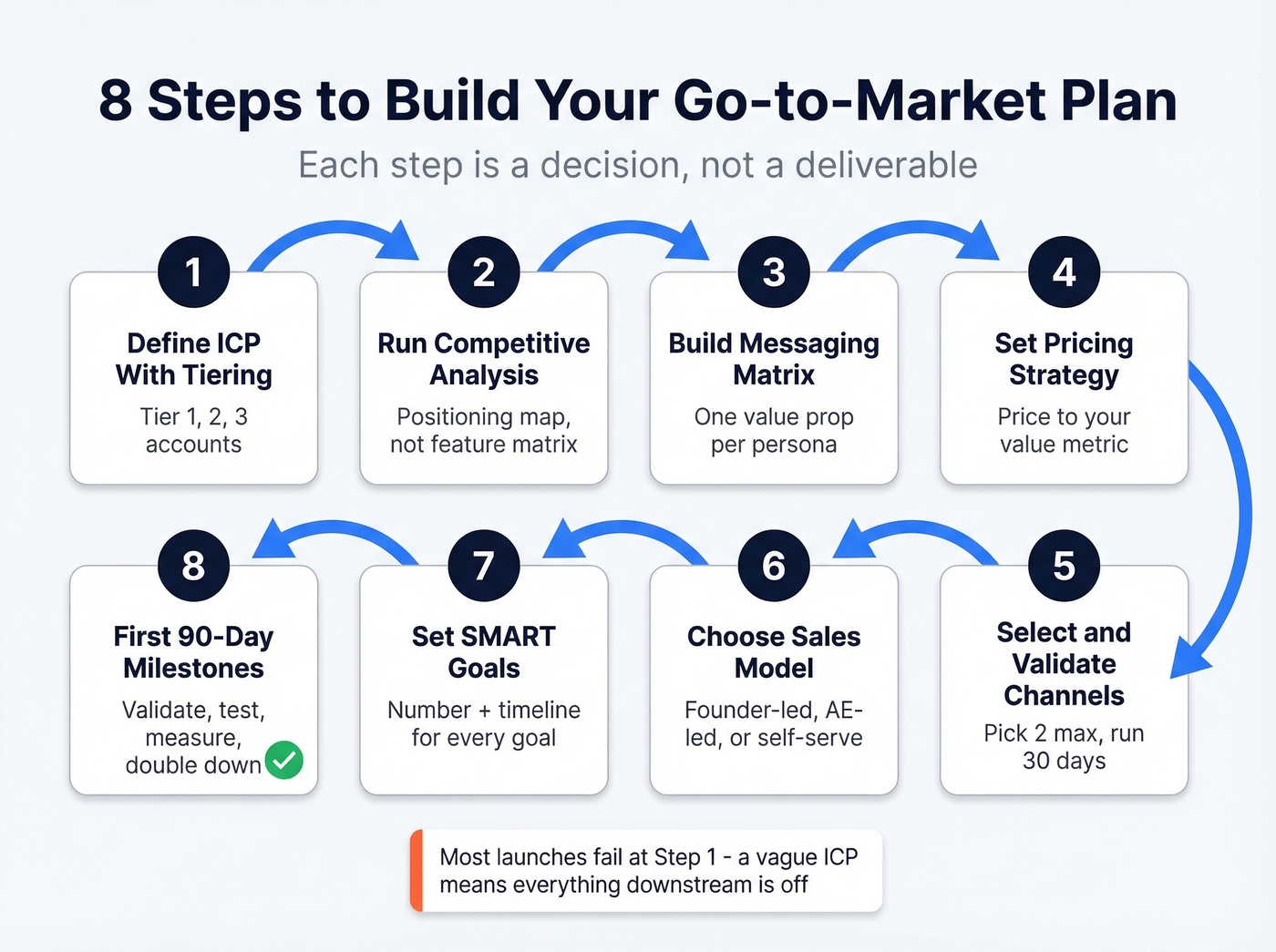
1. Define Your ICP With Tiering
Don't write "mid-market SaaS companies." Write "Series B-C B2B SaaS, 50-200 employees, using Salesforce, with an outbound sales team of 5+." Then tier your accounts into Tier 1 (perfect fit), Tier 2 (good fit), and Tier 3 (stretch). Put most of your effort into Tier 1.
2. Run Competitive Analysis
Not a feature matrix - a positioning map. Where do competitors win? Where do they lose? What do their customers complain about on G2 and in Reddit threads? That's where your wedge lives. (If you want a deeper process, build a lightweight competitive intelligence strategy you can update monthly.)
3. Build Your Messaging Matrix
One value prop per persona, not one for the whole company. Your CFO buyer cares about ROI. Your end-user cares about time saved. Map messages to personas, then test them in real conversations before you scale anything. (This is also where B2B brand positioning prevents "generic SaaS" messaging.)
4. Set Your Pricing Strategy
About one-third of companies now use hybrid pricing models - combining seat-based, usage-based, or outcome-based elements. AI-native companies are leading this shift. Don't default to per-seat pricing because it's familiar. Price to your value metric.
5. Select and Validate Channels
Pick two channels max. Run them for 30 days. Measure cost per qualified meeting, not impressions. If you're running outbound, data quality is the execution layer - bad emails burn domains and kill reply rates before your messaging even gets a chance. Prospeo verifies emails in real time at 98% accuracy with a 7-day refresh cycle, which is table stakes before sending a single cold sequence. (If deliverability is a recurring issue, use an email deliverability guide to diagnose the root cause.)
6. Choose Your Sales Model
Founder-led for pre-PMF. AE-led for $15k+ ACV. Self-serve for sub-$5k ACV. Mixing models too early is a common mistake - pick one, prove it, then layer. (For the outbound path, a repeatable B2B cold email sequence helps you test faster.)
7. Set SMART Goals
"Generate pipeline" isn't a goal. "Book 40 qualified meetings in 90 days from outbound to Tier 1 accounts" is. Tie every goal to a number and a timeline. (To keep targets realistic, compare against sales pipeline benchmarks.)
8. Define First-90-Day Milestones
Week 1-2: ICP validated through 20+ conversations. Week 3-4: messaging tested, first sequences live. Week 5-8: channel performance data in. Week 9-12: double down on what's working, kill what isn't. (If you're building this for a new team, a 30-60-90 day plan for sales reps keeps execution tight.)

Every GTM example above has one thing in common: they reached the right people with the right message. Your outbound motion dies if 35% of emails bounce. Prospeo's 98% email accuracy and 7-day data refresh keep your domain healthy and your sequences hitting real inboxes - so your GTM plan actually executes.
Stop letting bad data inflate your CAC by 35%.
10 Go-to-Market Strategy Examples With Metrics
Slack - Product-Led Growth
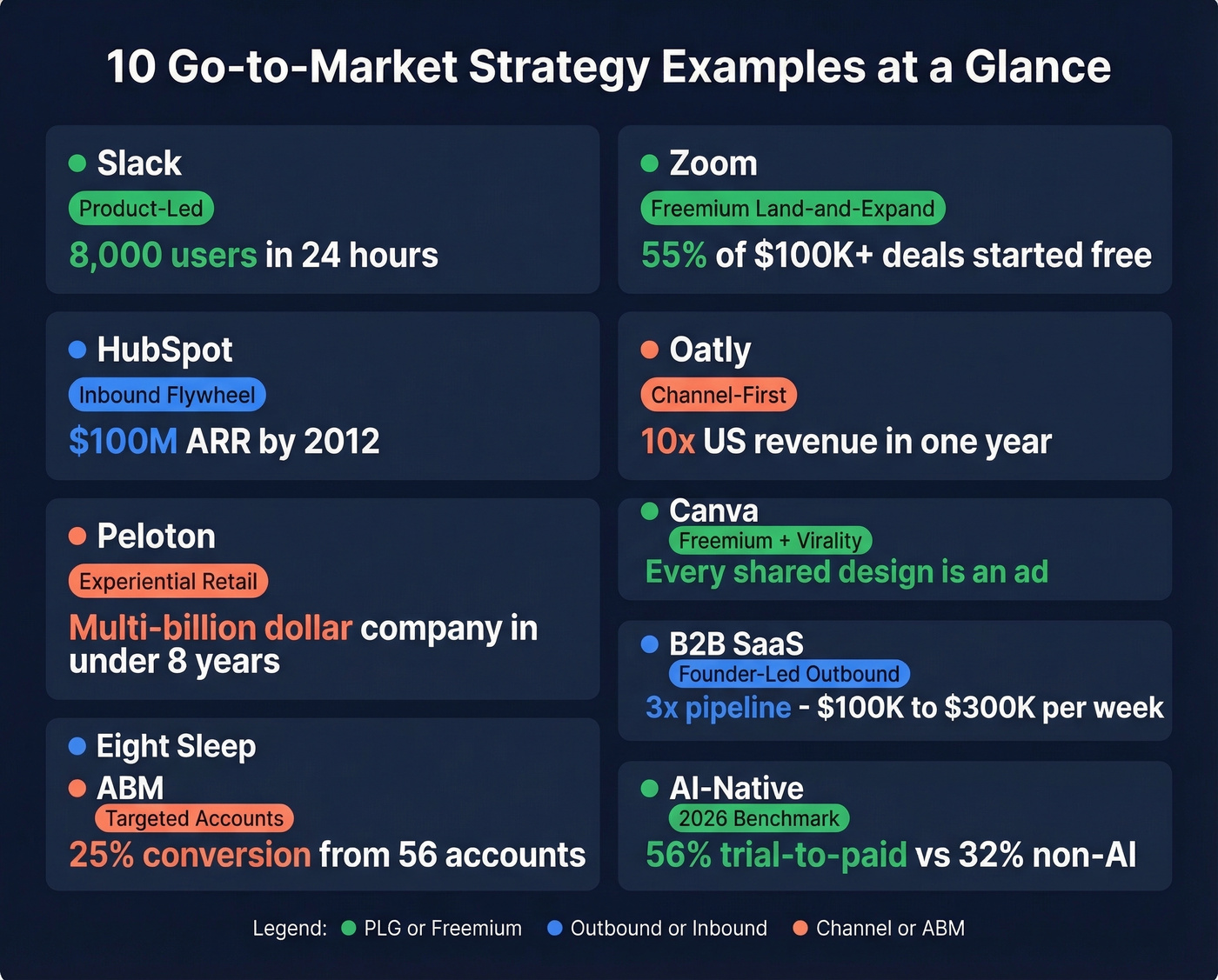
8,000 users within 24 hours. Slack didn't sell to executives - it sold to teams, and executives got the invoice later.
The GTM lever was freemium with natural network effects. Every person added to a Slack workspace made the product stickier for everyone already there. By the time a company's IT department noticed, half the org was already using it. This is a textbook product-led GTM play: if your product has natural network effects within a team, PLG isn't just a pricing strategy - it's your entire motion.
Zoom - Freemium Land-and-Expand
What if your biggest enterprise deals started with a single free user? Zoom's 10-K revealed that 55% of customers contributing over $100k in revenue started with at least one free host. Free users became internal champions, departments expanded, and enterprise deals followed.
Your free tier isn't a cost center. It's your top-of-funnel.
HubSpot - Inbound Flywheel
| What they did | What happened | Why it matters |
|---|---|---|
| Gave away a free CRM as the wedge product | Reached $100M ARR by 2012 | The free system of record created lock-in |
| Invented the term "inbound marketing" | Built an ecosystem of content, certification, and community | Category creation drove organic demand |
| Monetized marketing, sales, and service tools around the free core | Multi-product platform | Expansion revenue funded growth |
The lesson: if you're going inbound, you need to be willing to invest 12-18 months before the flywheel spins on its own. Most companies quit at month 6. (If you're pressure-testing your funnel, track the right funnel metrics from day one.)
Oatly - Channel-First Retail
Oatly didn't launch in grocery stores. They launched in specialty coffee shops, getting baristas to use and recommend the product. Revenue grew ten-fold between 2017 and 2018 in the US alone. Sometimes the best channel isn't where your end customer buys - it's where they discover. Coffee shops gave Oatly credibility that no ad campaign could replicate.
Peloton - Experiential Retail
Skip this playbook if your product costs under $500 or doesn't require a physical experience to sell.
Peloton opened its first store in a New Jersey mall and let people try the bike before buying. That physical experience - combined with a subscription content model - built a multi-billion-dollar company in under eight years. For high-consideration consumer products, removing the purchase barrier through experience is a GTM motion that still works.
Canva - Freemium + Virality
Every design shared was a Canva ad. That's the entire GTM thesis in one sentence.
Canva combined a generous free tier with built-in virality, making design accessible to non-designers. Adding features like background remover and brand kits gave free users reasons to upgrade without a sales pitch. If your product's output is shareable, build the sharing into the product itself.
Eight Sleep - Integration/Partner Launch
Eight Sleep partnered with IFTTT for a co-marketing campaign that drove 15,000 visitors to their site. For a hardware startup with limited marketing budget, using an existing platform's audience was a smart GTM shortcut. Partner launches work best when the partner's audience overlaps with your ICP and the integration creates genuine value - not just a logo swap.
Early-Stage B2B SaaS - Founder-Led Outbound
Here's the thing: founder-led outbound remains the fastest feedback loop for early-stage B2B companies, and it's the go-to-market strategy example B2B founders should study first. You learn what resonates, who responds, and where your ICP actually lives - all within weeks, not quarters. The consensus in RevOps communities on Reddit is consistent: pick one channel, prove it works, then scale. The founders who try three channels simultaneously almost always underperform those who go deep on one. (If you're building the motion, start with proven sales prospecting techniques.)

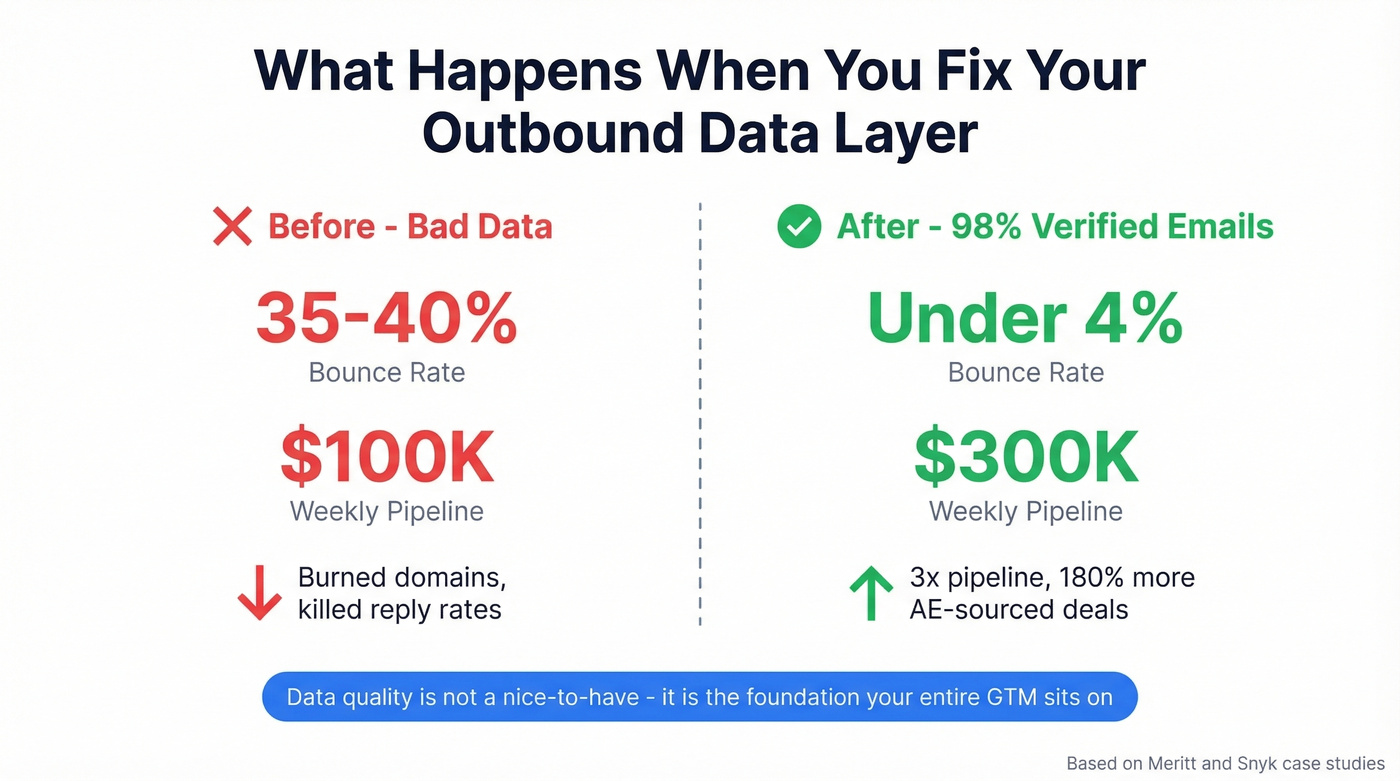
But outbound GTM fails when the data layer is broken. Meritt tripled pipeline from $100K to $300K per week after switching to a data source with 98% email accuracy, and their bounce rate dropped from 35% to under 4%. Snyk's 50-person AE team saw AE-sourced pipeline jump 180%, with bounce rates dropping from 35-40% to under 5%. When your outbound motion depends on reaching real people at real companies, data quality isn't a nice-to-have - it's the foundation your entire GTM sits on. (To quantify the damage, compare your numbers to email bounce rate benchmarks.)
ABM - Targeted Account Strategy
For high-ACV products with a small total addressable market, ABM is the right motion. One well-documented case shows a 25% account conversion rate from just 56 targeted accounts. The winning tactic was personalized direct mail: physical packages tailored to each account's pain points, followed by multi-threaded outreach to the buying committee. ABM works when you can name every company in your TAM and build custom plays for each. If your TAM is 500+ accounts, you need a hybrid approach. (If you're using packages, this is essentially direct mail for lead generation applied to ABM.)
AI-Native Company (2026 Benchmark)
AI-native companies are rewriting GTM benchmarks. ICONIQ's data shows AI-native companies convert free trials and proof-of-concepts to paid at 56%, compared to 32% for non-AI-native peers at the $100M+ ARR level. They also allocate more headcount to post-sales (31-34% vs. 23%), betting that retention and expansion drive more growth than net-new acquisition.
If your average deal is under $8k, you probably don't need a 10-person sales team - you need a product good enough to sell itself and data good enough to reach the right people. The AI-native companies proving this right now are spending less on acquisition and more on onboarding, faster time-to-value, and pricing models that capture usage growth.
2026 GTM Benchmarks
Numbers without context are useless. Here's what the best companies are hitting right now, so you know where the bar sits. Benchmarks below draw from ICONIQ's 2026 State of GTM report, ChartMogul's SaaS growth data, and OpenView's product-led growth index.
| Metric | Benchmark |
|---|---|
| Top-quartile ARR growth ($25M-$100M) | 93% YTD |
| AE quota attainment | 58% |
| AI adoption in GTM | ~70% moderate/full |
| Channel sales share | ~20% of revenue |
| Hybrid pricing adoption | ~33% of companies |
| Time to 1,000 subscribers (top performers) | 11 months |
| SaaS companies reaching $10M ARR after 10 years | 13% |
Two things jump out. First, AE quota attainment has been flat from 2024 to 2025 (59% to 58%). Nearly half of sales reps aren't hitting target - that's a structural problem, not a coaching problem.
Second, only 13% of SaaS companies reach $10M ARR after a decade. GTM isn't just about launching well. It's about sustaining growth through multiple motions over years. Top-quartile ARR growth hitting 93% (up from 78% in 2023) tells you the best companies are pulling away from the pack, and the gap between top and median performers is widening. Getting your GTM right has never mattered more.
How AI Changes GTM Execution
About 70% of companies now report moderate or full AI adoption in GTM workflows. But there's a massive gap between "we use ChatGPT to write emails" and actual AI-driven GTM.
Real AI GTM means connecting your data sources to detect real-time buying signals and orchestrate responses automatically - flagging an account showing intent, alerting the right rep, and triggering a personalized sequence, all without manual intervention. Sales teams waste roughly 70% of their time on administrative work. AI's real value isn't writing better copy. It's eliminating the busywork between signal and action. (If you're operationalizing this, start with identifying buying signals and a simple scoring model.)
The most useful framework we've seen breaks AI-led GTM into five phases:
- ICP mapping using behavioral and firmographic data
- Messaging matrix tested against real response data
- Dynamic segmentation that reprioritizes accounts weekly
- Predictive budget modeling that shifts spend toward what's converting
- Continuous feedback loop that feeds outcomes back into the model
Early playbooks built around this approach show 30% reductions in targeting costs and 25% improvements in response rates.
Let's be honest about the distinction that actually matters here: companies using AI as a productivity tool (meeting transcription, content drafts) versus companies using AI as an orchestration layer (signal detection, automated routing, dynamic prioritization). The first saves time. The second changes your GTM economics entirely.
7 Reasons GTM Strategies Fail
We've seen these patterns kill launches repeatedly. Every single one is avoidable.
1. Confusing GTM With Marketing
GTM is cross-functional. If only your marketing team owns the plan, you don't have a GTM strategy - you have a demand gen plan with no sales motion attached. Make GTM a joint deliverable across marketing, sales, product, and CS.
2. Targeting Too Broadly
"All mid-market companies" isn't an ICP. It's a wish. Tier your accounts and focus most of your resources on Tier 1 until you've saturated it.
3. Not Validating Channels Before Scaling Spend
Pouring $50k into paid ads before you've proven the channel converts is how startups burn runway. Run 30-day channel sprints with hard conversion targets before committing budget. We learned this the hard way watching teams blow through six figures on channels that never produced a single qualified meeting.
4. Wrong Sales Motion for Your ACV
Hiring a 5-person SDR team to sell a $2k/year product is a math problem that never works out. Match your sales model to your deal size.
5. Ignoring Retention
Net-new pipeline feels exciting. Churn feels like someone else's problem - until it eats your growth. Include retention and expansion metrics in your GTM scorecard from day one.
6. Scaling Before Product-Market Fit
Hiring 10 AEs when you haven't closed 10 deals yourself is the most expensive mistake in B2B. Stick with founder-led sales until you can articulate exactly why customers buy, in their words.
7. No Cross-Functional Alignment
Marketing generates leads that sales says are garbage. Sales closes deals that CS can't retain. Sound familiar? The fix: shared definitions of qualified pipeline, weekly GTM standups, and a single dashboard everyone trusts.
The companies in the go-to-market strategy examples above didn't succeed because they had better products. They succeeded because they matched the right motion to their market, measured what mattered, and iterated fast. Your GTM plan doesn't need to be perfect on day one - it needs to be specific enough to test and honest enough to update.
Building your ICP tiers is step one. Reaching Tier 1 accounts with verified direct dials is what closes deals. Prospeo gives you 30+ filters - buyer intent, technographics, headcount growth, funding - to build the exact segments your GTM plan demands, backed by 300M+ profiles and 125M+ verified mobiles.
Turn your ICP tiers into booked meetings this week.
FAQ
What's the difference between a GTM strategy and a marketing strategy?
A GTM strategy is the full cross-functional plan for bringing a product to market - covering pricing, sales model, channels, ICP, and messaging. Marketing is one component within it. You can have a great marketing strategy and still fail at GTM if your sales motion, pricing, or channel selection is wrong.
How long does it take to build a GTM plan?
Two to four weeks for a focused written plan. Validating your ICP, messaging, and channels through real conversations takes two to three months on top of that. Starting from a sample GTM plan and adapting it to your market is faster than building from scratch.
What's the best GTM approach for a B2B startup?
Founder-led outbound is the fastest path to first revenue for B2B startups with average deals above $5k. For sub-$5k ACV products, product-led growth with a free tier works better. Pick one motion, prove it, then layer a second.
How do you measure GTM success?
Track pipeline velocity, CAC payback period, win rate, time-to-first-10-customers, and channel-specific conversion rates weekly. By the time quarterly data tells you something's broken, you've already wasted three months. Top-quartile companies in 2026 hit 93% ARR growth - that's your benchmark.
What tools do you need to execute a GTM strategy?
At minimum: a CRM (HubSpot or Salesforce), a verified contact data source, an email sequencer, and analytics. Don't over-tool before you've validated your motion - three tools used well beat ten tools used poorly.