

How to Build a Go-to-Market Team That Doesn't Just Exist on Paper
42% of startups fail because there's no market need - not because the product was bad, but because the company never built a real go-to-market motion to validate the buyer, the problem, and the path to revenue. Meanwhile, 69% of B2B sales reps missed quota in 2025. The gap between "having a go-to-market team" and having one that actually drives revenue is enormous.
Your CEO just told you to build out the GTM function for a new product launch. You've got 90 days and a headcount budget of five. Here's what actually matters.
The Short Version
- A GTM team isn't the marketing department renamed. It's a cross-functional unit spanning Sales, Marketing, Product, RevOps, and Customer Success.
- The CEO should own GTM strategy. PMM executes it. RevOps operationalizes it.
- Your first GTM hire after founders: a Product Marketing Manager.
- Alignment comes from shared metrics and weekly rituals - not more Slack channels.
- None of it works if your contact data is garbage. Fix data quality before adding headcount.
What Is a Go-to-Market Team?
The M in GTM stands for Market, not Marketing. Marketing is one discipline inside a go-to-market team - the flour, not the cake.
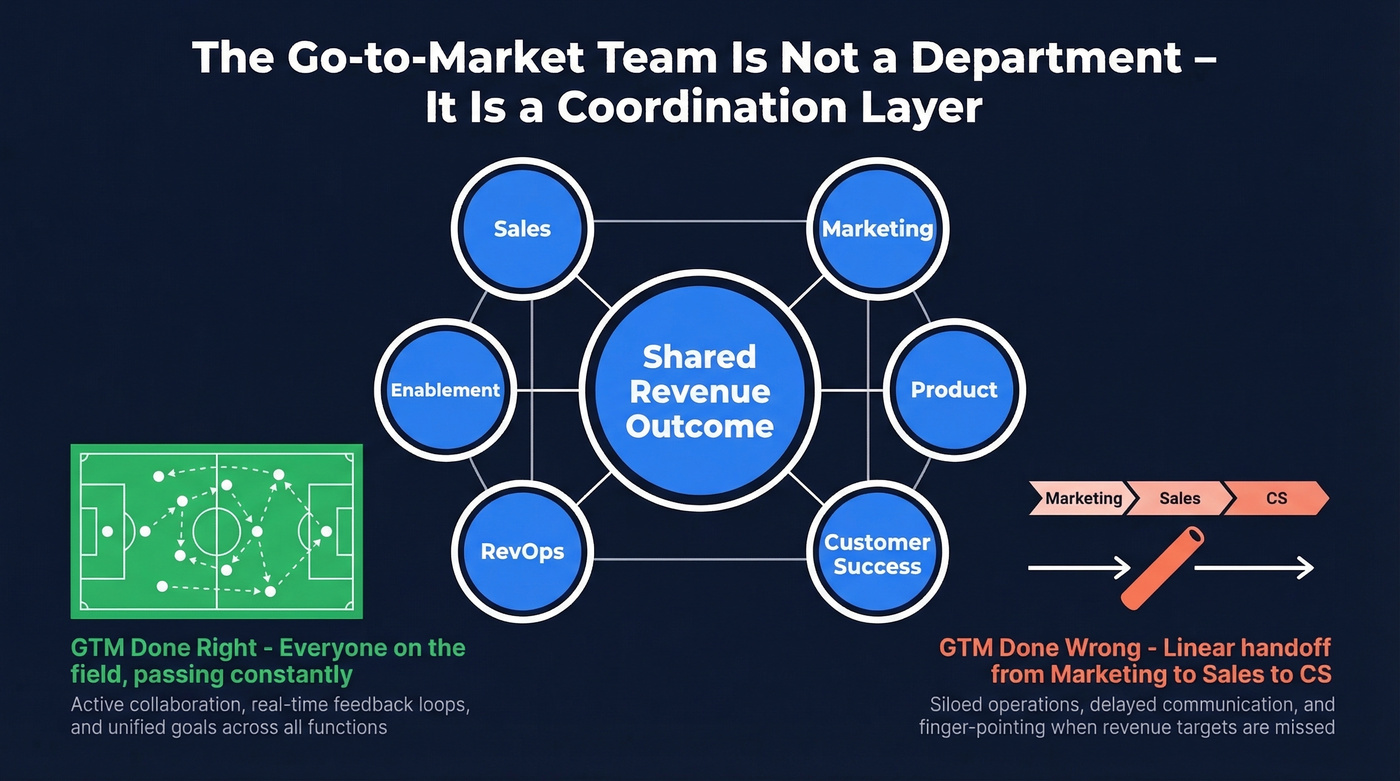
In practice, it's a cross-functional unit that includes Sales, Marketing, Product, RevOps, Customer Success, and Enablement - all aligned to a shared revenue outcome. It's not a department. It's a coordination layer that ensures every function pulls toward the same buyer and the same message.
Think of it as a soccer game, not a relay race. In a relay, marketing hands the baton to sales, who hands it to CS. In a go-to-market team, everyone's on the field at the same time, passing constantly. The moment you treat GTM as a linear handoff, you've already lost alignment.
We've seen finance teams on Reddit openly question whether "go-to-market" is just marketing with a new label - and they're not entirely wrong when the team isn't structured cross-functionally. The distinction between a GTM team and a GTM strategy matters: the strategy is the plan, the team is who executes it. Most companies have a strategy doc. Far fewer have a team actually structured to deliver it.
Who Owns GTM Strategy?
This is where most organizations get it wrong. A few years ago, 77% of companies said Marketing owned GTM. More recently, that dropped to 24%, and 43% now say the CEO owns it.
That shift makes sense. The CEO is the only person with authority to align incentives and compensation across Marketing, Sales, CS, and Product around a single strategy. When you delegate GTM ownership to Marketing alone, you get a marketing plan with a GTM label stapled to it. Sales ignores it. Product builds what they want. CS finds out about the launch on the same day as customers.
Here's the thing: the CEO doesn't need to run the weekly standup. They set direction and break ties. RevOps operationalizes the strategy - building the systems, dashboards, and processes that keep everyone honest. PMM executes it - translating positioning into messaging, enablement, and launch plans.
If your CEO won't directly own GTM, create a steering committee with a weekly cadence and give it decision-making authority, not just "alignment" status. Ghost syncs - meetings where people share updates but nobody decides anything - are one of the fastest ways to kill a GTM motion.
Core Roles and Responsibilities
| Role | Primary Responsibility |
|---|---|
| Product Marketing Manager | Positioning, messaging, launch execution |
| Product Manager | Feature roadmap, market requirements |
| Account Executive | Close deals, relay buyer objections |
| SDR/BDR | Pipeline generation, outbound prospecting |
| RevOps | Data, tools, process alignment |
| Sales Enablement | Training, content, competitive intel |
| Customer Success Manager | Retention, expansion, feedback loops |
| Demand Gen | Campaign execution, lead flow |
Those are the core roles. But the best GTM organizations also pull in people most org charts miss - Finance for pricing approvals and margin modeling, Legal for contracts and regulatory requirements, and delivery leads if you sell physical products. Partner and channel teams are another blind spot: if 30% of your revenue comes through partners, leaving them out of planning is leaving money on the table.
RevOps deserves special emphasis. It's the most underrated GTM hire. RevOps acts as the engine room - aligning data, tools, and processes across Sales, Marketing, and CS to create a single source of truth. Without RevOps, every function builds its own dashboards, defines "lead" differently, and blames the other team when pipeline stalls.
GTM Team Structure by Stage
The right structure depends entirely on where you are.
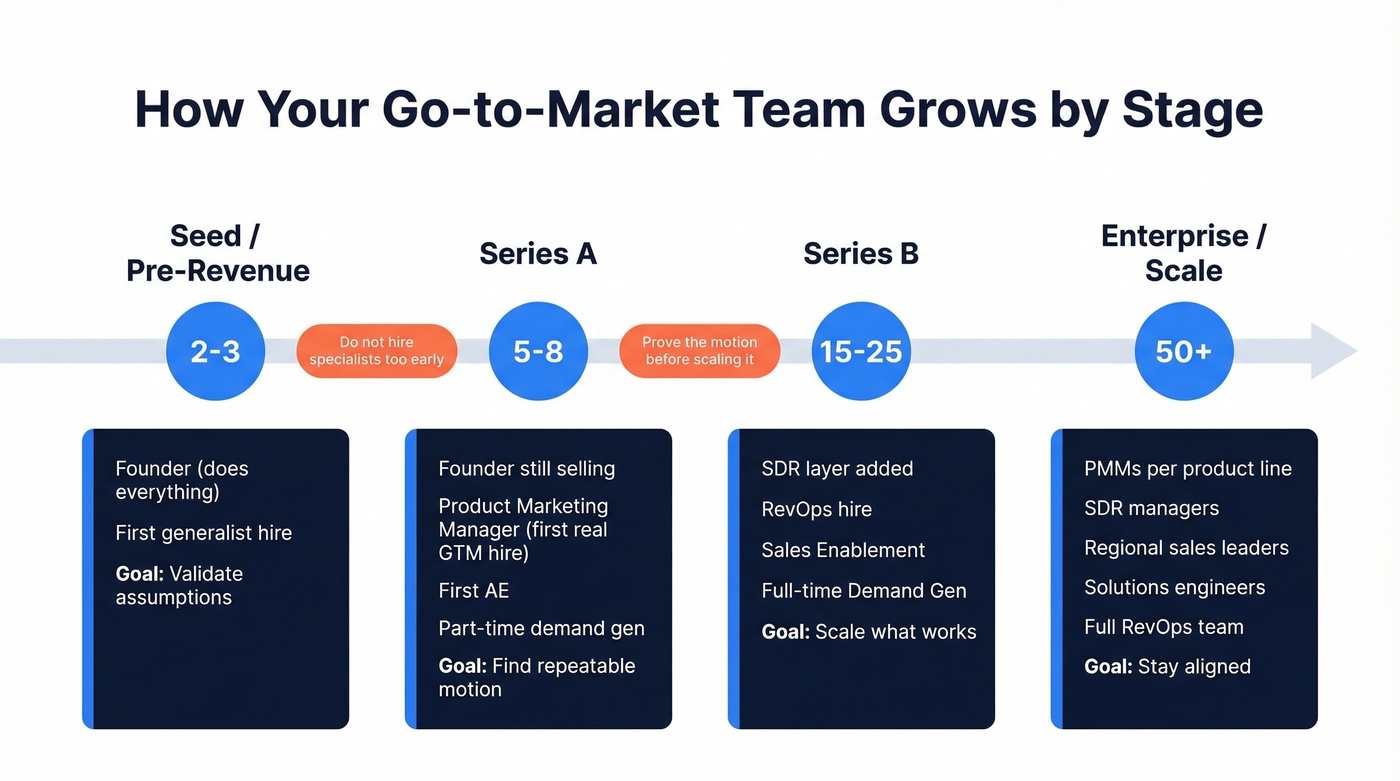
Seed / Pre-Revenue (2-3 people)
The founder is head of sales, marketing, and product simultaneously. GTM at this stage is about validating assumptions - running meaningful conversations with potential buyers and figuring out if anyone actually needs what you're building. Don't hire specialists. Hire people who can context-switch between writing a cold email and demoing the product in the same afternoon.
Series A (5-8 people)
The founder is still selling, but you bring on a Product Marketing Manager and your first AE. The PMM is your first real GTM hire - they bridge product, sales, and marketing before you can afford specialists in each. Add a part-time demand gen contractor if budget allows. The goal is finding a repeatable sales motion, not scaling one.
Series B (15-25 people)
Now you're scaling what works. Add an SDR layer to feed your AEs. Bring in RevOps to manage the growing tool stack. Sales Enablement starts making sense. Demand gen becomes full-time. The shift here is from exploration to repeatability - and it's where we've seen the most teams stumble by hiring too fast before the motion is proven.
Enterprise / Scale (50+ people)
Full GTM org with specialists in every function. Dedicated PMMs per product line. SDR managers. Regional sales leaders. Solutions engineers. A RevOps team, not just one person. The challenge isn't building the team - it's keeping it aligned.

You just read that bad data kills GTM alignment faster than bad hires. Prospeo gives your entire go-to-market team - SDRs, AEs, RevOps - a single source of verified contact data: 300M+ profiles, 98% email accuracy, 125M+ mobile numbers, refreshed every 7 days. No more teams blaming each other for stale lists.
Fix your data layer before you add another headcount.
PLG vs. Sales-Led Motions
Your go-to-market motion fundamentally changes who you hire.
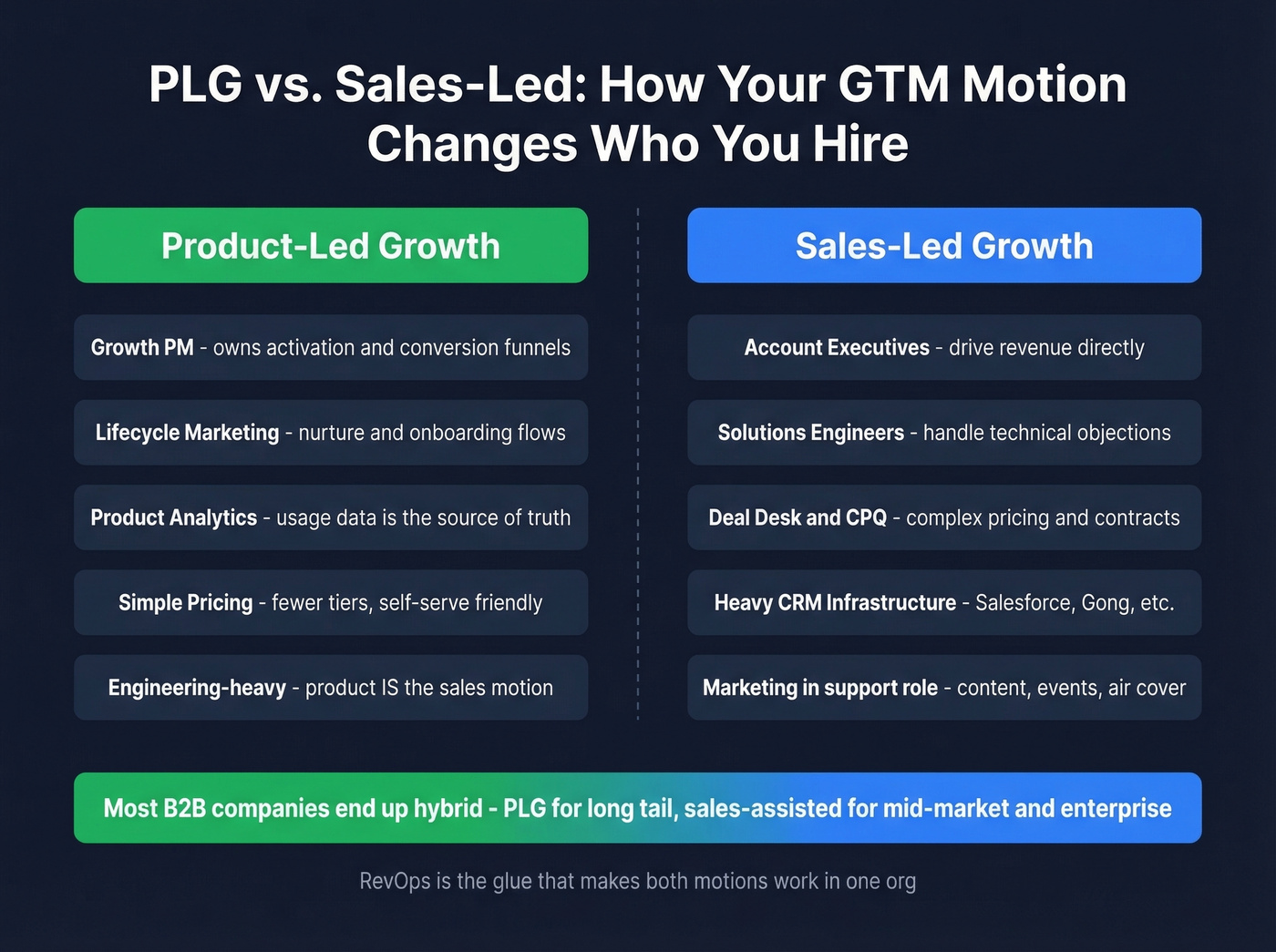
In a product-led growth model, you need a Growth PM who owns activation and conversion funnels. Lifecycle marketing becomes critical. Product analytics is a core competency. Pricing needs to be simple - fewer tiers, fewer add-ons - because self-serve can't handle complex permutations.
Sales-led growth looks completely different: deal desk, CPQ tooling, solutions engineering, heavy CRM infrastructure. The sales team drives revenue with marketing in a support role.
Most companies end up running a hybrid. PLG captures the long tail; a sales-assisted motion handles mid-market and enterprise. That's where RevOps earns its keep - creating shared systems that serve both motions without building two separate organizations.
The Operating Cadence
Alignment isn't a one-time workshop. It's a rhythm.
Weekly forecast reviews. Sales, Marketing, and RevOps in the same room. Not status updates - decision-making sessions. What deals are at risk? Where's pipeline thin? What campaigns need to shift?
Monthly funnel health checks. Full funnel, traffic to closed-won. Where are conversion rates dropping? Is the problem top-of-funnel volume or mid-funnel qualification? (If you need a framework, start with funnel metrics and a simple pipeline health scorecard.)
Quarterly GTM retrospectives. What worked? What didn't? What assumptions were wrong?
Most GTM misalignment isn't a strategy problem - it's a visibility problem. When persona research, competitive intel, and execution roadmaps live in different tools, nobody has the full picture. Shared dashboards beat more meetings every time. Give every function access to the same pipeline data, the same conversion metrics, the same revenue numbers. When everyone's looking at the same screen, alignment happens naturally.
KPIs and Benchmarks
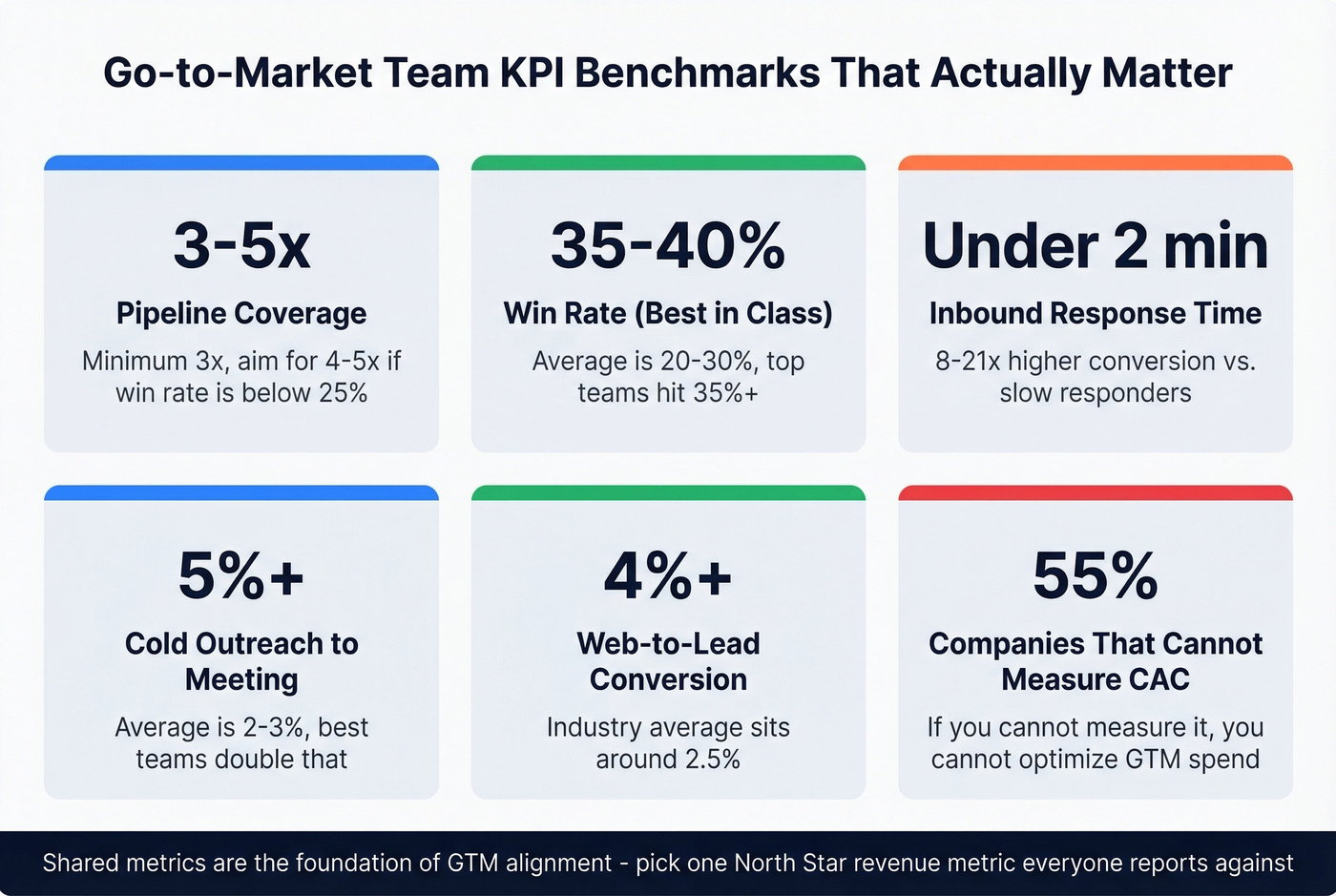
You can't manage a go-to-market team without shared metrics. Here are the benchmarks that matter:
| KPI | Benchmark | Best-in-Class |
|---|---|---|
| Pipeline coverage | 3x minimum | 4-5x when win rate is low |
| Win rate | 20-30% | 35-40%+ |
| Cold outreach to meeting | 2-3% | 5%+ |
| Warm outreach to meeting | 15-20% | 25%+ |
| Inbound response time | Under 5 min | Under 2 min |
| Web-to-lead conversion | 2.5% | 4%+ |
| Marketing spend (% of revenue) | 9.1% | Varies by stage |
Two numbers jump out. Responding to inbound leads in under five minutes yields 8-21x higher conversion rates. If your team takes hours to respond, you're burning pipeline. And 55% of companies don't even know their customer acquisition cost - if you can't measure CAC, you can't optimize GTM spend.
For B2B SaaS, expect CAC of $200-500 for SMB, $2,000-5,000 for mid-market, and $10,000-30,000+ for enterprise deals. Pipeline coverage ties everything together. If your win rate is below 25%, you need 4-5x coverage to hit targets. Most teams run at 2x and wonder why they miss quota.
Anti-Patterns That Kill Revenue
KPI chaos. Sales tracks bookings. Marketing tracks MQLs. CS tracks NPS. Nobody shares a North Star metric. Fix: pick one revenue metric everyone reports against.
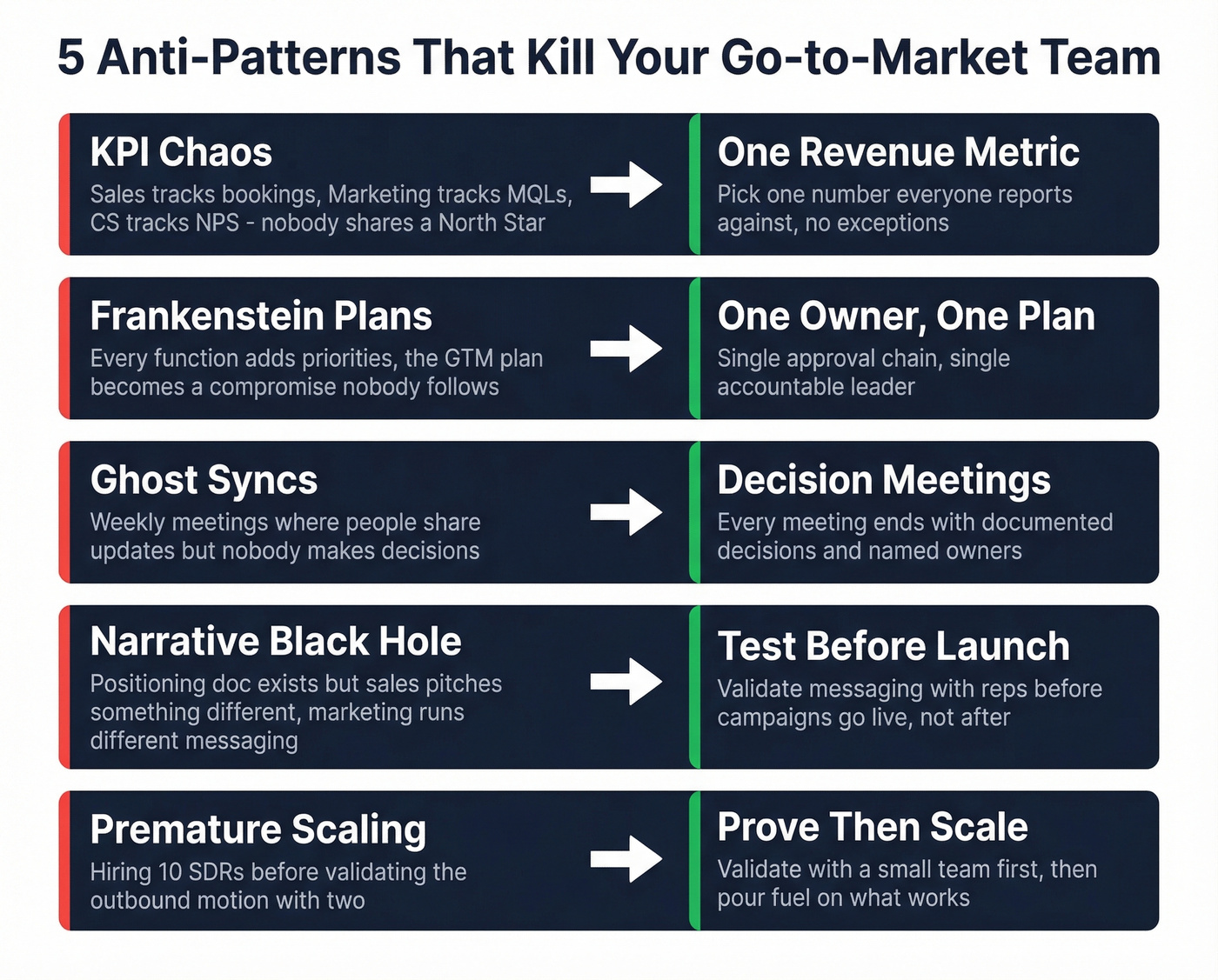
Frankenstein plans. Leadership bypasses the RACI, every function adds their priorities, and the GTM plan becomes a compromise artifact nobody follows. One owner, one plan, one approval chain.
Ghost syncs. Weekly meetings where people share updates but nobody makes decisions. Every meeting should end with documented decisions and owners.
Narrative black hole. The positioning doc exists, but nobody uses it. Sales pitches something different. Marketing runs campaigns on a different message. Test messaging with reps before launch, not after. (If you need a starting point, build a lightweight B2B brand positioning doc and keep it updated.)
No executive ownership. GTM is "everyone's job," which means it's nobody's job. The CEO owns it or explicitly delegates to a named leader with cross-functional authority.
Premature scaling. Hiring 10 SDRs before you've validated the outbound motion with two. 74% of high-growth startup failures involve premature scaling or misaligned product-market fit.
AI outreach on autopilot. Look - sending 10,000 AI-generated emails with zero personalization burns your domain and your brand. Automation without strategy is just faster failure. (If you're going to automate, start with a real AI cold email outreach workflow and guardrails.)
Bad data. When your bounce rate is 15% and half the phone numbers are dead, the problem isn't your SDRs - it's your data. Fix data quality at the source before blaming the team. (A basic email bounce rate audit will usually surface the root cause fast.)
GTM Tech Stack
Let's be honest: most teams don't need more tools. They need fewer tools, properly connected. Don't add anything until you have RevOps to manage it.
CRM. HubSpot works well for smaller teams; Salesforce is the standard as you scale. Budget $50-150/user/month depending on tier. If you're still evaluating, skim a few examples of a CRM to sanity-check fit.
Data and Enrichment. This is the foundation everything else runs on. Your SDRs need verified phone numbers. Marketing needs clean email lists. RevOps needs enriched CRM records that don't decay in two weeks. Prospeo handles all three - 300M+ professional profiles, 143M+ verified emails at 98% accuracy, and 125M+ verified mobile numbers, refreshed every seven days. Thirty-plus search filters let you slice by buyer intent, technographics, job changes, and funding stage. Credit-based pricing starts at roughly $0.01/email, with a free tier for getting started. (If you're comparing vendors, start with these data enrichment services.)

Sales Engagement. Instantly or Smartlead for cold outbound at scale, typically $30-100/month. Salesloft or Outreach for enterprise sequences at $100-150/user/month. If you're building the outbound motion from scratch, use a short list of sales prospecting techniques to avoid random activity.
Intent Data. Bombora, 6sense, or Demandbase for knowing who's in-market before you reach out. Enterprise pricing - expect $30-100k+/year for 6sense or Demandbase.
Collaboration. Slack. Free tier available, $7-13/user/month for paid plans.
Enablement. Highspot or Seismic for content management and training, $30-80/user/month.
In our experience, teams stack 15 tools and still miss quota because nobody connected them properly. Start with CRM + data + one sequencer. Add from there only when RevOps can integrate and maintain it.
Alignment Over Headcount
The biggest mistake isn't hiring the wrong people - it's assuming that headcount equals alignment. Five people pulling in the same direction will outperform fifty pulling in five different directions every single time, regardless of how impressive the org chart looks on paper. Build the coordination layer first. Hire into it second. And make sure every person on the go-to-market team can answer one question without hesitation: who are we selling to, and why should they care?
Scaling from Series A to Series B? Your SDRs need pipeline, your AEs need direct dials, and RevOps needs clean enrichment. Prospeo delivers 92% match rates on CRM enrichment, 30% mobile pickup rates, and integrates natively with HubSpot, Salesforce, Clay, and every sequencer your GTM stack runs on - all at $0.01 per email.
Stop scaling headcount on top of broken data. Start here.
FAQ
What's the difference between a GTM team and a marketing team?
A go-to-market team spans Sales, Marketing, Product, RevOps, and Customer Success - all aligned to a shared revenue outcome. Marketing is one function inside it. The defining characteristic is cross-functional coordination, not campaign execution.
Who should lead the go-to-market team?
The CEO sets strategy and breaks cross-functional ties - they're the only role with authority to align incentives across every department. RevOps operationalizes the plan day-to-day, and PMM executes positioning and launch plans.
What's the first GTM hire after founders?
A Product Marketing Manager. PMMs bridge product, sales, and marketing before you can afford specialists in each - handling positioning, the first sales deck, launch planning, and competitive intel. Hire one before SDRs or demand gen.
How do you fix bad data across a GTM org?
Start with a single enrichment platform that refreshes records frequently. A 7-day refresh cycle and 98% email accuracy eliminate the stale-data problem most teams face. Layer in CRM enrichment via API so RevOps maintains one clean source of truth.
How big should a go-to-market team be?
Seed stage: 2-3 people. Series A: 5-8. Series B: 15-25. Enterprise: 50+. Hire in sequence - PMM before SDRs, RevOps before Enablement - and only scale after validating a repeatable motion.