

Good Email Closing Lines: 60+ Examples That Actually Get Replies
"Best regards." You've typed it a thousand times. It's muscle memory - the email equivalent of a limp handshake. And somewhere in the back of your mind, you know the last line of your email carries disproportionate weight, but you default to autopilot anyway.
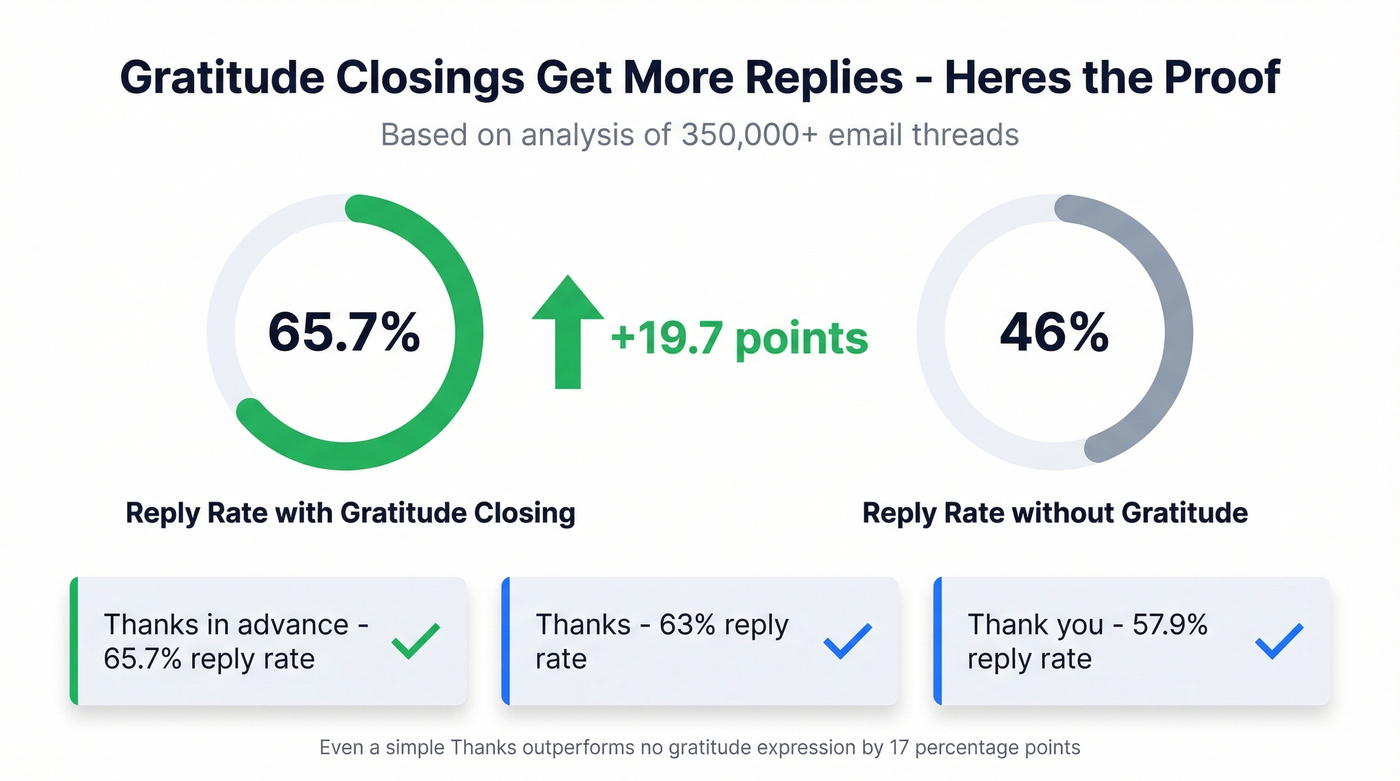
There's a reason that instinct nags at you. Psychologists call it the recency effect - people disproportionately remember whatever they encountered last. In email, that's your closing line. A study analyzing 350,000+ email threads found that gratitude-based closings hit a 65.7% response rate, compared to 46% for emails without any gratitude expression. Your closing isn't decoration. It's the last thing shaping whether someone replies or archives.
The short version: For professional emails, "Thanks" or "Best regards" - simple, warm, universally safe. For cold outreach, question-based CTAs ("Worth a conversation?") get 2x the replies of statement CTAs. For everything else, match formality to context, and remember that your closing line matters far more than your sign-off.
The 3 Parts of an Email Closing
Most guides lump everything after "looking forward to hearing from you" into one bucket. That's a mistake. An email closing has three distinct parts, and conflating them leads to weak endings.
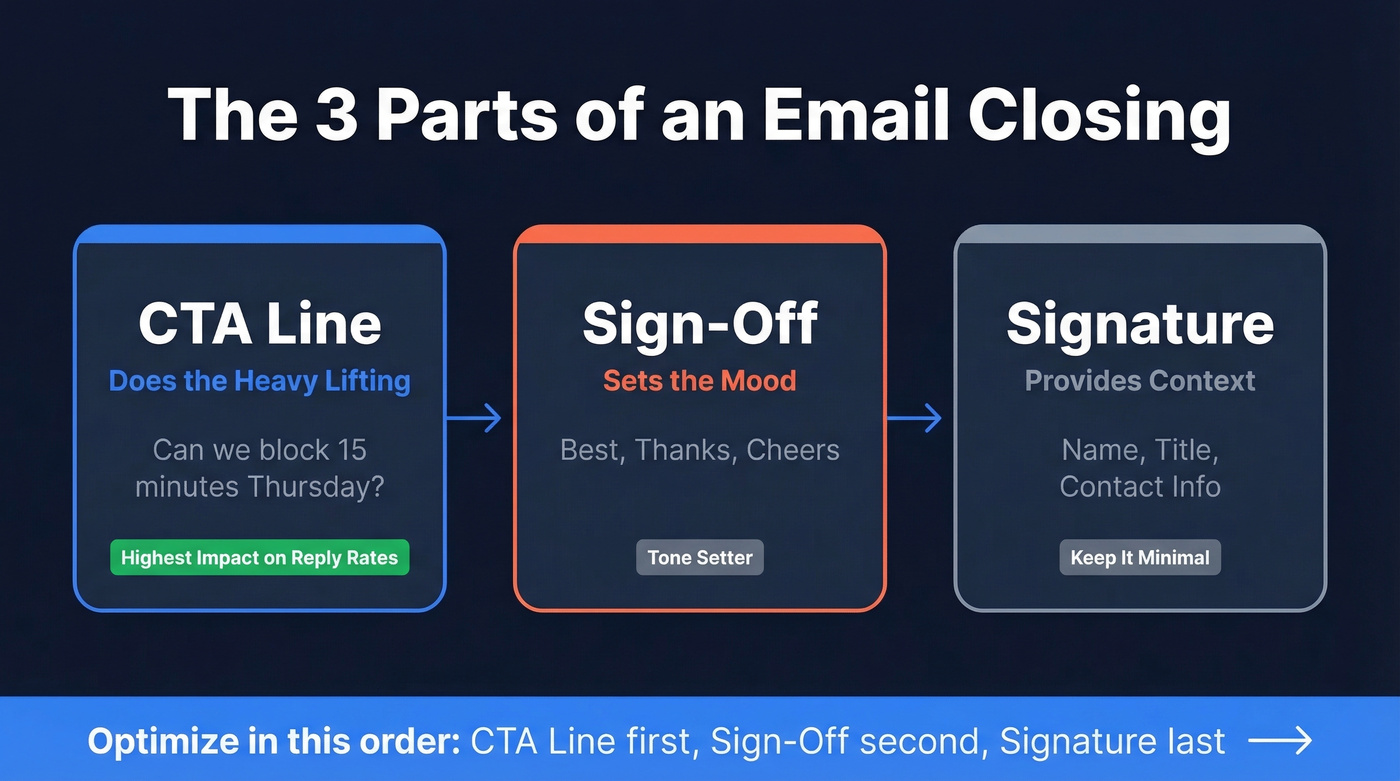
The CTA line is your final sentence - the one that drives action. "Can we block 15 minutes Thursday?" or "Worth a quick call?" This is where reply rates are won or lost. (If you want a deeper framework, see Email Call to Action.)
The sign-off is the farewell word or phrase. "Best," "Thanks," "Cheers." It sets tone but rarely determines whether someone responds. The signature is your name, title, and contact info. Keep it minimal - no inspirational quotes, no oversized logos, no five lines of legal disclaimers.
The CTA line does the heavy lifting. The sign-off sets the mood. The signature provides context. Optimize in that order.
Professional Email Endings for Every Formality Level
Not every email needs a clever CTA. Internal updates, vendor correspondence, client check-ins - these just need a sign-off that matches the relationship. Here's the full spectrum from boardroom to Slack-adjacent.
| Sign-Off | Formality | Best For |
|---|---|---|
| Sincerely | High | First contact, legal, exec comms |
| Respectfully | High | Government, academia, escalations |
| With appreciation | High | After someone's done you a favor |
| Best regards | Medium-high | Default professional - never wrong |
| Kind regards | Medium-high | Slightly warmer than "Best regards" |
| Warm regards | Medium | Client relationships with rapport |
| Best | Medium | Daily emails with known contacts |
| Thanks | Medium | When you've asked for something |
| Thank you | Medium | Slightly more formal than "Thanks" |
| Much appreciated | Medium | After intros, favors, referrals |
| Appreciate your time | Medium | After meetings or lengthy requests |
| Looking forward to it | Medium | When next steps are already set |
| Talk soon | Low-medium | Ongoing relationships |
| Until next time | Low-medium | Recurring meetings or check-ins |
| Cheers | Low-medium | Standard in the UK; reads casual in the US |
| All the best | Low-medium | Friendly but professional |
| Take care | Low | Warm sign-off for people you like |
| - [First name] | Low | Quick replies in existing threads |
Skip quotes in your signature (nobody reads them), include a sign-off in the first email of a thread but not necessarily every reply, and keep your signature block minimal - advice that Forbes' sign-off guide echoes.
One nuance that trips people up: "Cheers" is completely standard in the UK. In the US, it can read as affected - like you're performing worldliness. Know your audience.
Cold Email Closings That Get Replies
Here's where closing lines earn their keep. In cold outreach, your CTA line is the difference between a reply and the trash folder. (For end-to-end structure, see B2B Cold Email Sequence.)
In 2026, the cold emails getting replies are absurdly short - 40 to 60 words total. Your closing line might be 20% of the entire email. That makes it the highest-leverage sentence you write.
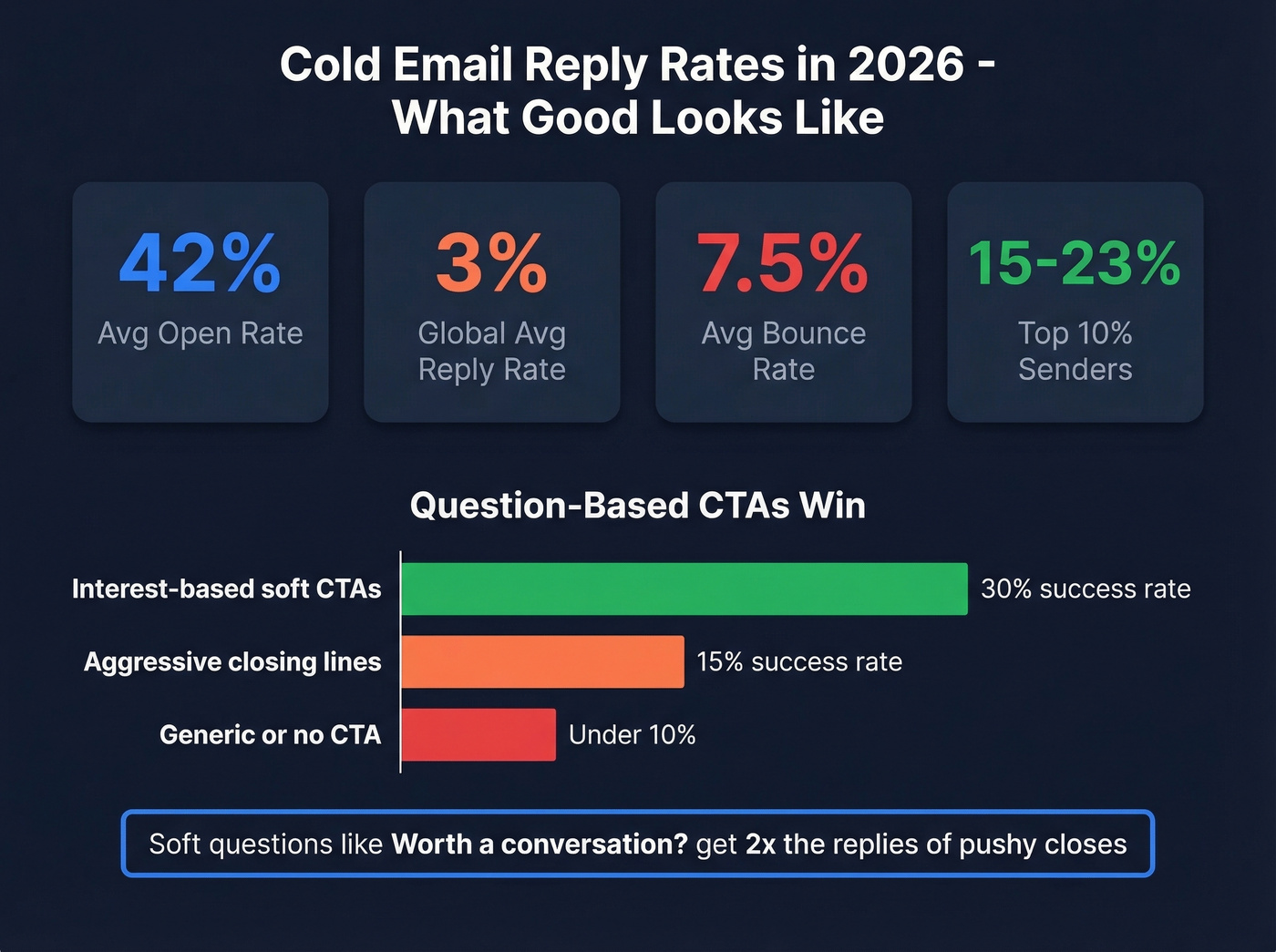
Average cold email reply rates run 7-10%, with top performers pushing past 20%. Across Smartlead's dataset of 14.3 billion cold email sends, the global average reply rate sits at 3%, with a 7.5% bounce rate. Smaller teams sending under 10K emails per month tend to see 5-10% reply rates - targeting and messaging matter more than volume. (More benchmarks: Cold Email Marketing.)
What "good" looks like in 2026: 42% open rate, 3% reply rate (global average), 7.5% bounce rate. Small teams: 5-10% replies. Top 10% of senders: 15-23% reply rates.
The closings that consistently outperform are question-based soft CTAs. Interest-based CTAs carry a 30% success rate - double what aggressive closing lines achieve. The consensus across r/copywriting and r/sales backs this up: low-commitment questions beat open-ended invitations every time.
Question-based CTAs (the winners):
- "Worth a conversation?"
- "Interested?"
- "Open to a quick call this week?"
- "Should I send more details?"
- "Would it help to see how [company] handled this?"
- "Can I send a 2-minute video walkthrough?"
- "Worth 15 minutes to explore?"
Soft permission CTAs:
- "Mind if I share a case study?"
- "OK if I follow up next week?"
- "Would it be helpful to loop in [relevant role]?"
- "Want me to send the short version?"
Curiosity-driven CTAs:
- "Curious how [competitor] solved this?"
- "Want to see the numbers?"
- "Interested in what changed?"
Seniority matters too. A study of 2,847 cold emails found directors reply at 17.8%, VPs at 11.3%, and C-suite executives at just 4.2%. Your closing line can't overcome a bad targeting decision - if you're blasting CEOs with generic asks, no CTA will save you. (If you’re tightening targeting, start with an Ideal Customer Profile.)
Here's the thing: most teams obsess over subject lines and opening hooks while treating the closing as an afterthought. That's backwards. In a 50-word email, your closing line is doing half the persuasion. If you're only going to optimize one thing this quarter, optimize your CTA line.
Of course, none of these closings matter if the email bounces. The global average bounce rate is 7.5%, and anything above 5% risks sender reputation damage. We've seen teams cut bounce rates from 10%+ to under 3% just by verifying before sending - Prospeo's real-time verification catches invalid addresses, spam traps, and honeypots with 98% accuracy across 143M+ verified emails. (Related: Email Bounce Rate and Email Deliverability Guide.)

Closings by Scenario
Hyper-personalized emails - ones referencing specific business challenges - hit an 18.3% reply rate versus 2.1% for generic pitches. That's an 8.7x lift. Your closing should match the context of the conversation, not be a one-size-fits-all afterthought. (More tactics: Personalized Outreach.)
After a Demo or Meeting
The worst thing you can do post-demo is send a generic "Let me know if you have questions!" That puts the burden on them and kills momentum. Assume the next step exists and make it specific. (Use this alongside a Product Demo Checklist.)
- "Would it help to loop in [colleague] for the next step?"
- "What would make the next conversation worth your time?"
- "Should I send a summary with next steps, or is [specific action] the priority?"
- "Want me to draft a proposal based on what we discussed?"
- "Can I set up a trial environment for your team?"
Follow-Up After No Response
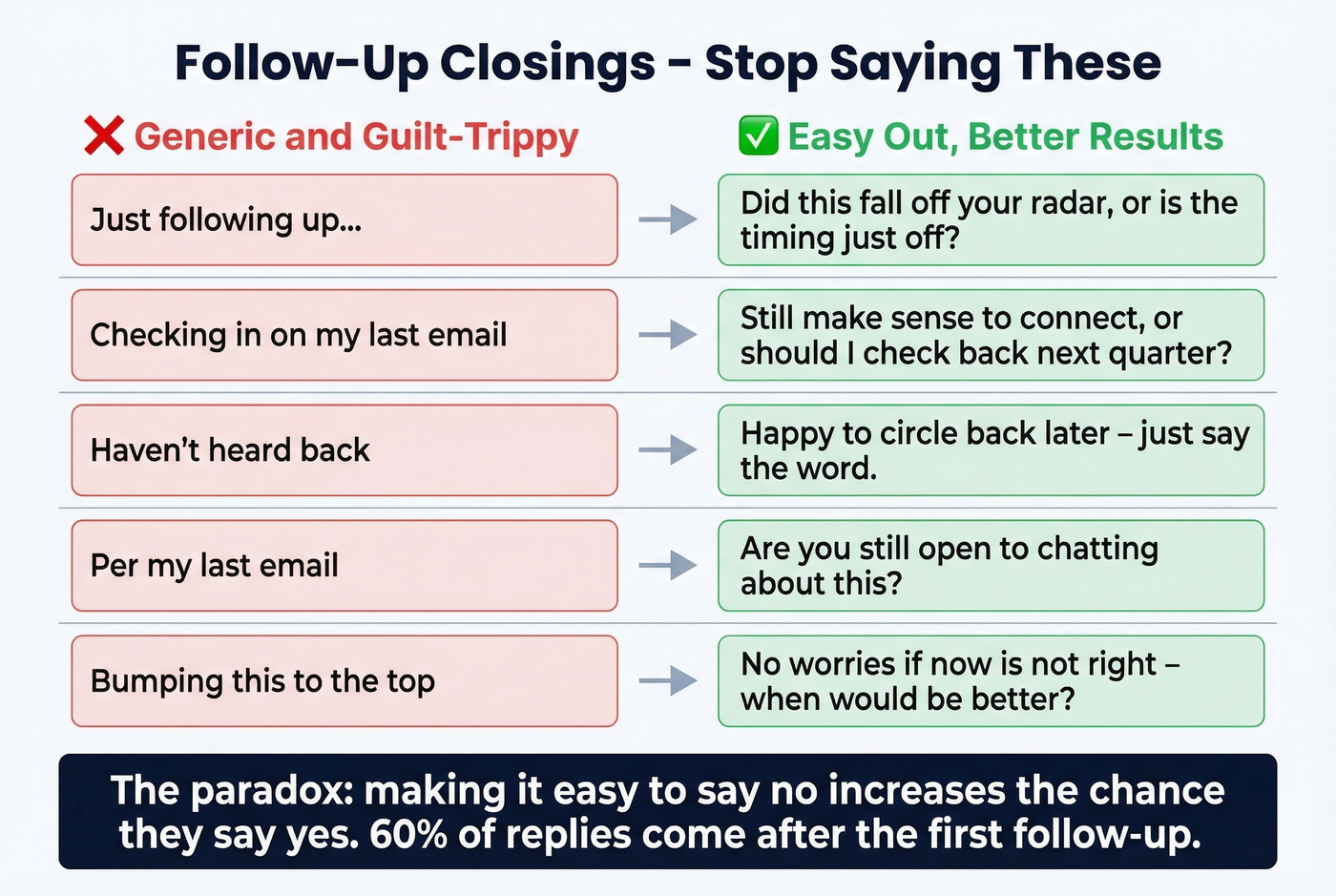
Most people don't ignore you out of malice - they're busy, your email got buried, or the timing was wrong. The best follow-up closings acknowledge this without guilt-tripping. About 60% of replies come after the first follow-up, so getting this right is worth the effort.
| Instead of... | Try... |
|---|---|
| "Just following up..." | "Did this fall off your radar, or is the timing just off?" |
| "Checking in on my last email" | "Still make sense to connect, or should I check back next quarter?" |
| "Haven't heard back" | "Happy to circle back later - just say the word." |
| "Per my last email" | "Are you still open to chatting about this?" |
| "Bumping this to the top" | "No worries if now's not right - when would be better?" |
The key: giving them an easy out. Paradoxically, making it easy to say no increases the chance they'll say yes.
Recruiting Outreach
- "Worth a 15-minute call to see if there's a fit?"
- "Even if the timing isn't right, I'd love to stay connected."
- "Curious enough to hear more?"
- "No pressure - want me to send the role details?"
- "Know anyone who'd be a fit, even if it's not you?"
Fundraising or Investor Ask
Investors get hundreds of pitches weekly. The lighter the ask, the better. Don't request a 60-minute meeting in your first email - ask for permission to send more information. "May I send you the short deck for your review?" works because it costs them nothing to say yes.
- "Would a 20-minute overview be worth your time this month?"
- "Happy to send a one-pager - interested?"
- "Can I share what our early metrics look like?"
Internal or Team Emails
- "Any flags before I move forward?"
- "Thoughts? I'll proceed Friday unless I hear otherwise."
- "Disagree with anything here? Speak now."
- "Green light, or should we discuss first?"
Apology or Escalation
- "What can I do to make this right?"
- "I want to fix this - what's the best next step from your side?"
- "Here's my plan to resolve this: [plan]. Work for you?"
Direct accountability beats vague regret every time.

A 7.5% bounce rate is the global average - and every bounced email is a perfectly crafted closing line that nobody ever reads. Prospeo's 5-step verification catches invalid addresses, spam traps, and honeypots before you hit send. 98% email accuracy across 143M+ verified contacts. Teams using Prospeo cut bounce rates from 10%+ to under 3%.
Stop perfecting closing lines that land in the void.
20 More Closings Worth Stealing
For the skimmers who want options without context - here's a rapid-fire list organized by energy level.
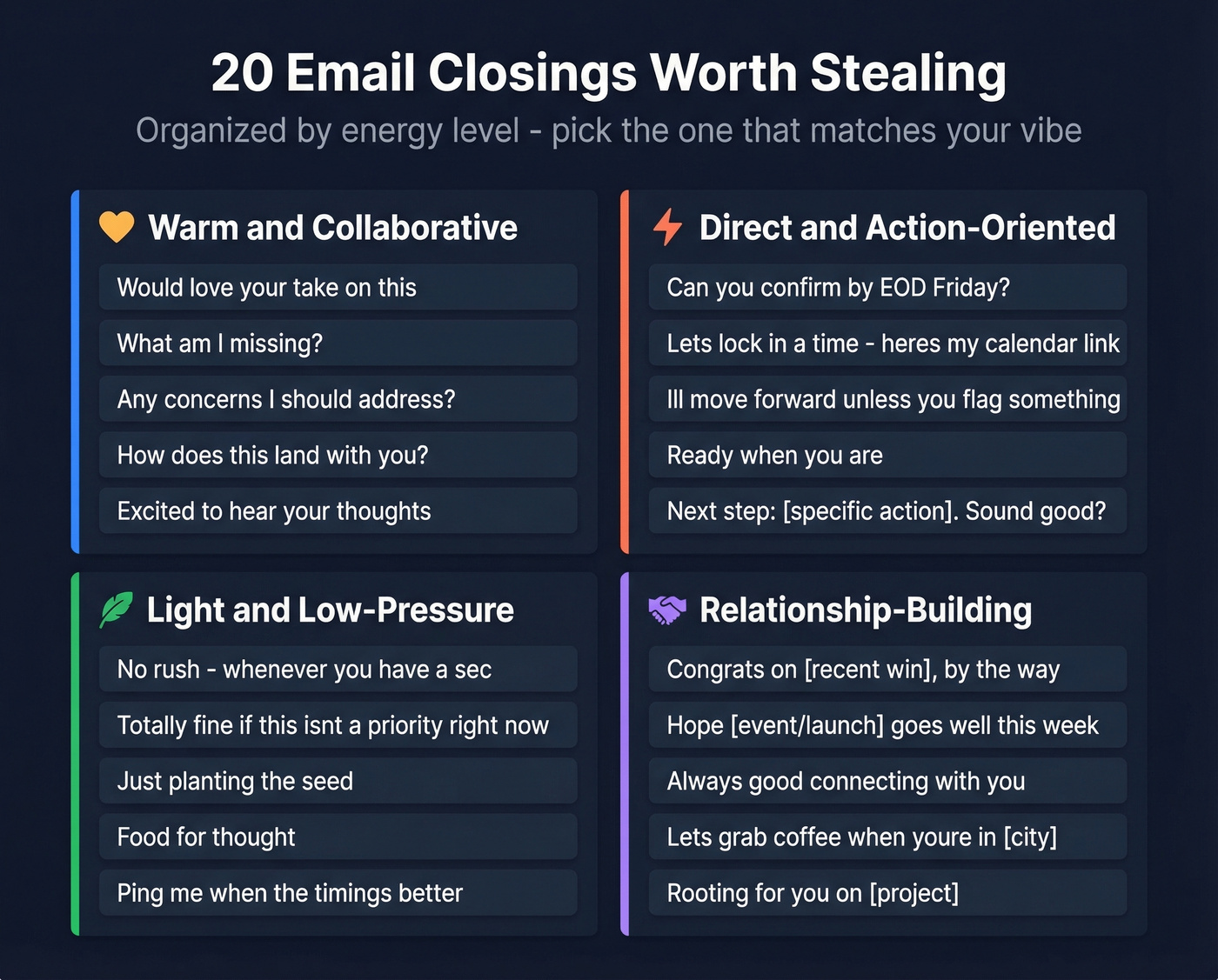
Warm and collaborative:
- "Would love your take on this."
- "What am I missing?"
- "Any concerns I should address?"
- "How does this land with you?"
- "Excited to hear your thoughts."
Direct and action-oriented:
- "Can you confirm by EOD Friday?"
- "Let's lock in a time - here's my calendar link."
- "I'll move forward unless you flag something."
- "Ready when you are."
- "Next step: [specific action]. Sound good?"
Light and low-pressure:
- "No rush - whenever you have a sec."
- "Totally fine if this isn't a priority right now."
- "Just planting the seed."
- "Food for thought."
- "Ping me when the timing's better."
Relationship-building:
- "Congrats on [recent win], by the way."
- "Hope [event/launch] goes well this week."
- "Always good connecting with you."
- "Let's grab coffee when you're in [city]."
- "Rooting for you on [project]."
Gratitude Closings and the Data Behind Them
The 350,000-thread study is worth revisiting. Emails ending with "thanks in advance" hit a 65.7% response rate. "Thanks" variations collectively landed around 62%, versus 46% for emails with no gratitude expression at all. That's a 36% relative lift just from saying thank you.
But "thanks in advance" is a double-edged phrase. It works when you've earned the ask - when the recipient already has context and a reason to help. When you haven't, it reads as presumptuous. You're thanking someone for something they haven't agreed to do yet.
The Reddit consensus mirrors this: simple "Thanks" is the safest default. It's warm without being assumptive. Save "thanks in advance" for situations where the ask is small and the relationship is established.
Closings to Avoid
| Sign-Off | Why It Fails |
|---|---|
| Thanks in advance | Presumptuous if the ask isn't earned |
| Hope that makes sense | Reads passive-aggressive |
| Yours truly | Feels insincere in business context |
| Have a blessed day | Religious overtones; alienating |
| Emoji sign-offs | Clarity and formality risk |
| No sign-off at all | Comes across as brusque |
| Good luck | Can sound condescending |
| Respectfully yours | Stiff outside formal contexts |
| Love / XOXO | Too personal for professional email |
Most of these aren't career-ending. But they create friction. In cold outreach, where you have zero relationship equity, even small friction kills replies.
International Email Etiquette
U.S. directness - short sentences, casual tone, first-name basis from email one - can read as rude or dismissive in many cultures. The safest framework for international emails: default to the highest level of formality until the other side signals otherwise.
Avoid idioms, slang, and humor. "Let's touch base" means nothing to a non-native English speaker. "Happy to jump on a call" conjures a bizarre mental image when taken literally. Skip emojis entirely - interpretation varies wildly across cultures. And mirror the recipient's style: if their emails open with "Dear Mr. [Last Name]" and close with "With kind regards," match that register.
"Best regards" remains one of the safest, most versatile closings across cultures. When in doubt, it's the right call.
How to A/B Test Your Closings
Don't guess which closing works. Test it.
Minimum sample: 500 emails per variant. Anything less and your results are noise. Track reply rate, not open rate - your closing line doesn't affect opens. It affects replies.
One variable at a time. Test the CTA line separately from the sign-off. Changing both at once tells you nothing. And test follow-up closings separately, since about 60% of replies come after the first follow-up. (If you’re also testing the top of the email, use these email subject lines.)
Start with clean data. If 10% of your list bounces, your test results are meaningless - you're measuring deliverability failures, not closing-line performance. Prospeo's bulk verification cleans lists before you send, so your A/B test actually measures what you think it's measuring. (More on list hygiene: How to Improve Sender Reputation.)
In our testing, the biggest A/B wins come from changing the CTA structure (question vs. statement), not from swapping sign-offs. "Worth a call?" vs. "Let me know if you'd like to chat" is a meaningful test. "Best" vs. "Best regards" is not.
Interest-based CTAs hit a 30% success rate - but only when they reach the right person. Prospeo gives you 300M+ professional profiles with 30+ filters including buyer intent, job changes, and technographics, so your carefully written closing line lands in front of decision-makers who actually care. At $0.01 per verified email, scaling great outreach costs almost nothing.
Find the prospects worth writing a great closing line for.
FAQ
Is "Best regards" outdated?
No - it's still one of the most universally safe professional sign-offs in 2026. Not exciting, but never wrong. Save your creativity for the CTA line, not the sign-off.
What closing lines work best for cold outreach?
Question-based CTAs outperform statement CTAs by 2x. "Worth a conversation?" and "Interested?" are top performers. Keep the entire email under 60 words and end with one clear, low-friction question - interest-based CTAs hit a 30% success rate.
How do I end an email when I need a reply fast?
Use direct, time-bound CTAs like "Can you confirm by EOD Friday?" or "Need your input before we move forward Thursday." Pair them with a medium-formality sign-off like "Thanks" or "Appreciate your time" to stay collaborative rather than demanding.
Does my closing line matter if emails aren't reaching the inbox?
It doesn't. That's the most overlooked problem in outreach. If your bounce rate exceeds 5%, your sender reputation degrades and providers can block you. Verify your list before you send - even a small cleanup pass can drop bounce rates from double digits to under 3%.