

GTM Engineer Skills That Actually Get You Hired in 2026
Every guide tells you to learn Python, SQL, JavaScript, CRM administration, and API management - as if those are equivalent skills with equal ROI. They're not. SQL pays off in week one. JavaScript is a nice-to-have you might never touch.
The role is exploding. LinkedIn had over 3,000 GTM engineer postings in January 2026 - more than double the mid-2025 count. And the scope is still messy: in GTM engineering circles, the consistent take is that anyone claiming the role is definitively scoped is usually selling something. That ambiguity is your opportunity, if you know which skills to stack first.
What You Need (Quick Version)
Business acumen first. One automation platform second - Clay. SQL third.
You don't need to code from scratch. Claude Code and Cursor handle implementation. 47% of GTM teams still have zero AI agents in production, and 53% of GTM leaders report little to no impact from their AI adoption. The bottleneck isn't technical wizardry - it's knowing which workflows actually drive pipeline versus which ones just look cool in a demo.
Skills That Actually Matter
Foundation Skills (Learn These First)
Start here: CRM mastery. If you can't navigate Salesforce or HubSpot at an admin level - objects, workflows, reporting - nothing else matters. Every automation you build terminates in the CRM.
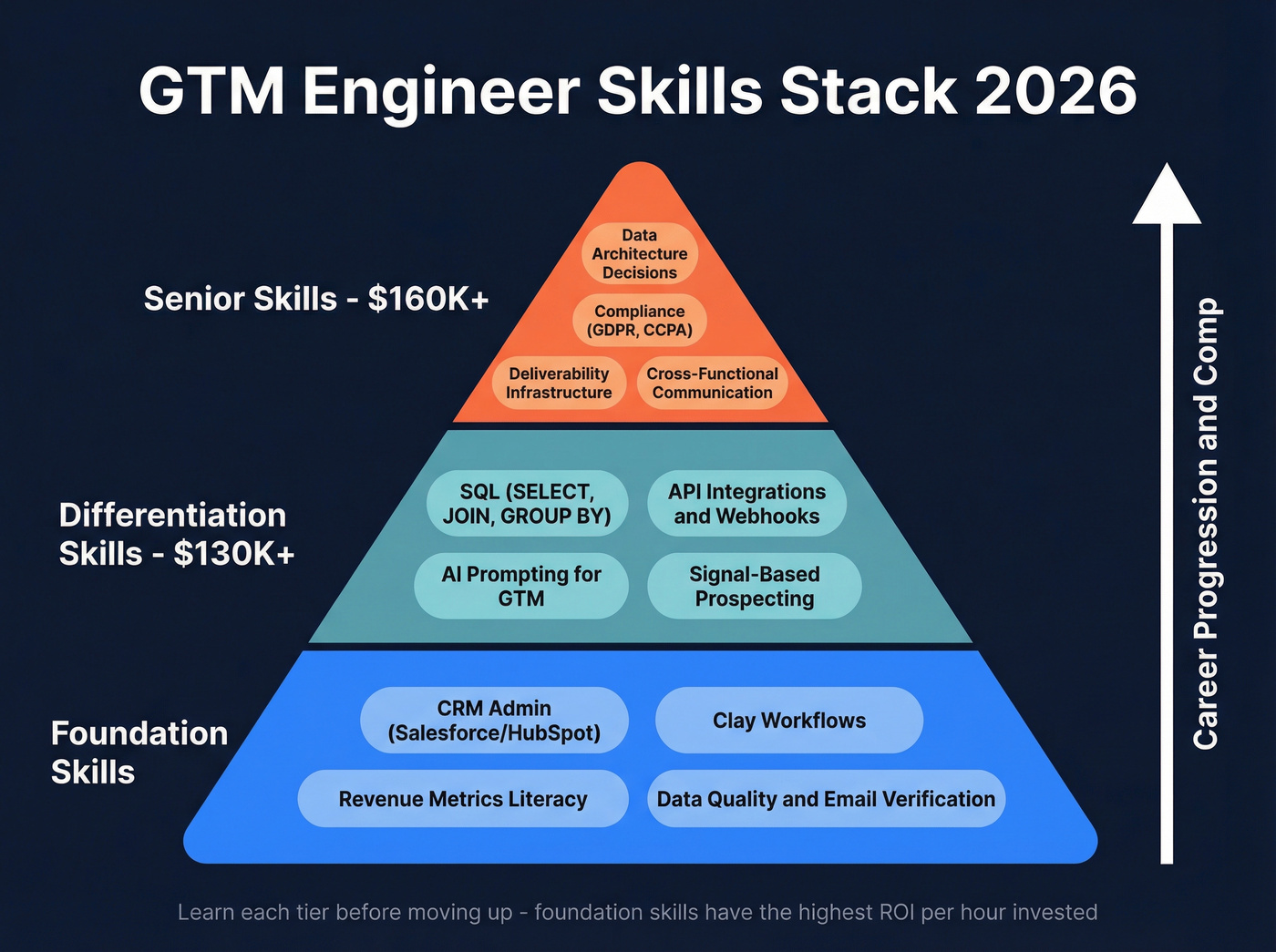
Then pick one automation platform. Clay is the default right now; they hit $100M ARR in two years for a reason. Free tier available, paid plans starting around $150/month. Make and n8n are strong alternatives. Learn one deeply before dabbling in the rest.
Revenue metrics literacy is non-negotiable. Pipeline math, conversion rates, attribution basics. A former SDR who understands these will outperform a software engineer who doesn't know what MQL means. (If you need a refresher, start with funnel metrics.)
The skill everyone skips: data quality. Everyone builds fancy enrichment workflows. Nobody talks about what happens when a big chunk of emails bounce because the underlying data is stale. Your enrichment pipeline is only as good as your verification layer - and we've seen more outbound programs break at this step than any other. Tools like Prospeo matter here because 98% email accuracy with a 7-day refresh cycle means leads hitting your CRM are actually reachable, not dead addresses torching your domain reputation. If you’re comparing vendors, see data enrichment services and lead enrichment.

One hiring manager's interview filter: "What have you built with AI tools?" If the answer is nothing, that's a hard no - not a training gap, a curiosity gap.
Differentiation Skills ($130K+ Tier)
SQL is the first technical skill that pays real dividends. You'll query CRM data, build segments, troubleshoot pipeline issues, and feed dashboards - all in week one. Learn SELECT, JOIN, WHERE, and GROUP BY. That covers 80% of what you'll actually use.
API integrations and webhooks come next. Most GTM engineering work is connecting systems: pushing data from Clay to your CRM, triggering sequences from intent signals, syncing enrichment results. You don't need to build APIs. You need to consume them confidently.
AI prompting for GTM workflows is where you get disproportionate returns. 91% of teams use general-purpose LLMs like ChatGPT and Claude combined with automation tools. The skill isn't "prompt engineering" as a buzzword - it's extracting structured output from messy inputs like call transcripts, job postings, and 10-Ks, then feeding that output into your pipeline so reps get context they'd never research themselves.
Signal-based prospecting rounds this tier out. Intent data, job changes, funding events, tech adoption signals - understanding how to detect and act on these separates workflow builders from pipeline builders. For a broader set of plays, see sales prospecting techniques and how to track sales triggers.
Senior-Level Competencies ($160K+)
Data architecture decisions define senior GTM engineers. Piping everything through Snowflake reduces token usage and AI costs, but introduces latency between your system of record and system of action. Knowing when that tradeoff is worth it - and articulating why to your VP of Revenue - is a senior skill.
Compliance and governance matter more than most guides admit. GDPR and CCPA constrain which enrichment sources you can use, how you store contact data, and what signals you can act on. Getting this wrong tanks deliverability, not just legal risk. (Related: is it illegal to buy email lists.)
Deliverability infrastructure - SPF, DKIM, DMARC, warm-up protocols, domain reputation management - is its own discipline. If your outbound infrastructure is broken, no amount of workflow sophistication matters. Full stop. If you’re fixing the basics, use the email deliverability guide and how to verify DKIM is working.
Cross-functional communication is what gets you promoted. Translating technical architecture into revenue impact for sales leadership is the skill no course teaches and no certification covers.
A Workflow That Uses Every Skill
Here's a signal-based outbound pipeline touching every tier:
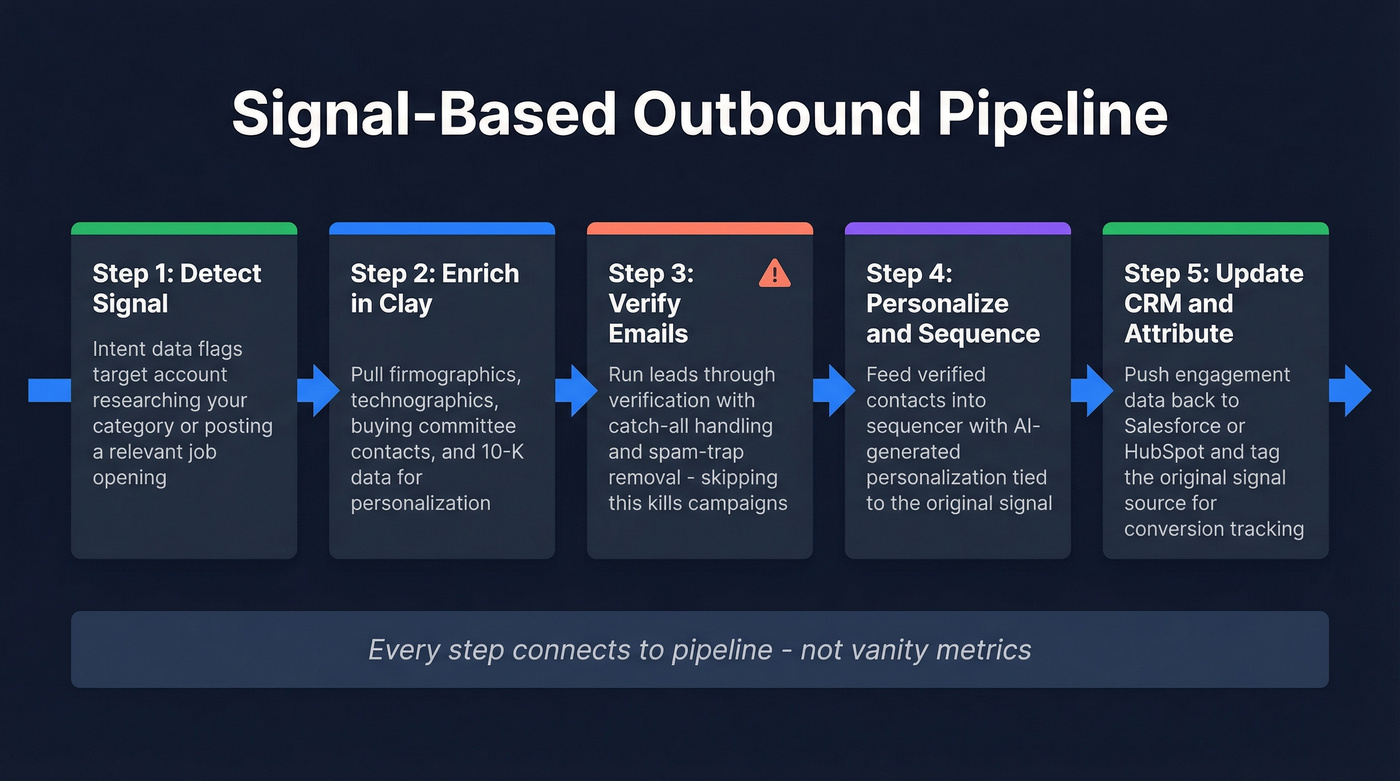
- Detect the signal. A target account researches your category through intent data or posts a relevant job opening. Your monitoring tool flags it.
- Enrich in Clay. Pull firmographics, technographics, and contact data for the buying committee. Layer in 10-K data for personalization.
- Verify before sequencing. Run enriched leads through email verification with catch-all handling and spam-trap removal so you're not torching your domain with high bounce rates. We've tested this step obsessively - skipping it is the single fastest way to kill a campaign.
- Personalize and sequence. Feed verified contacts into your sequencer with AI-generated personalization tied to the original signal.
- Update CRM and attribute. Push engagement data back to Salesforce or HubSpot. Tag the original signal source so you can measure which signals actually convert.
This workflow works because every step connects to pipeline, not because it looks impressive. Beware the "dopamine-hit workflow" - builds that feel cool but don't move revenue.

The article says it plainly: skipping email verification is the fastest way to kill a campaign. Prospeo's 5-step verification with catch-all handling, spam-trap removal, and 98% accuracy means every lead hitting your CRM is actually reachable - on a 7-day refresh cycle, not the 6-week industry average.
Build your GTM pipeline on data that won't torch your domain.
GTM Engineer vs RevOps
| Factor | GTM Engineer | RevOps |
|---|---|---|
| Focus | Automation + scale | Alignment + execution |
| Output | Systems (multiplier) | Insights (process) |
| Comp model | Outcome/variable-heavy | Base-heavy, stable |
| Org placement | Near Product/Data | Near Sales/Finance |
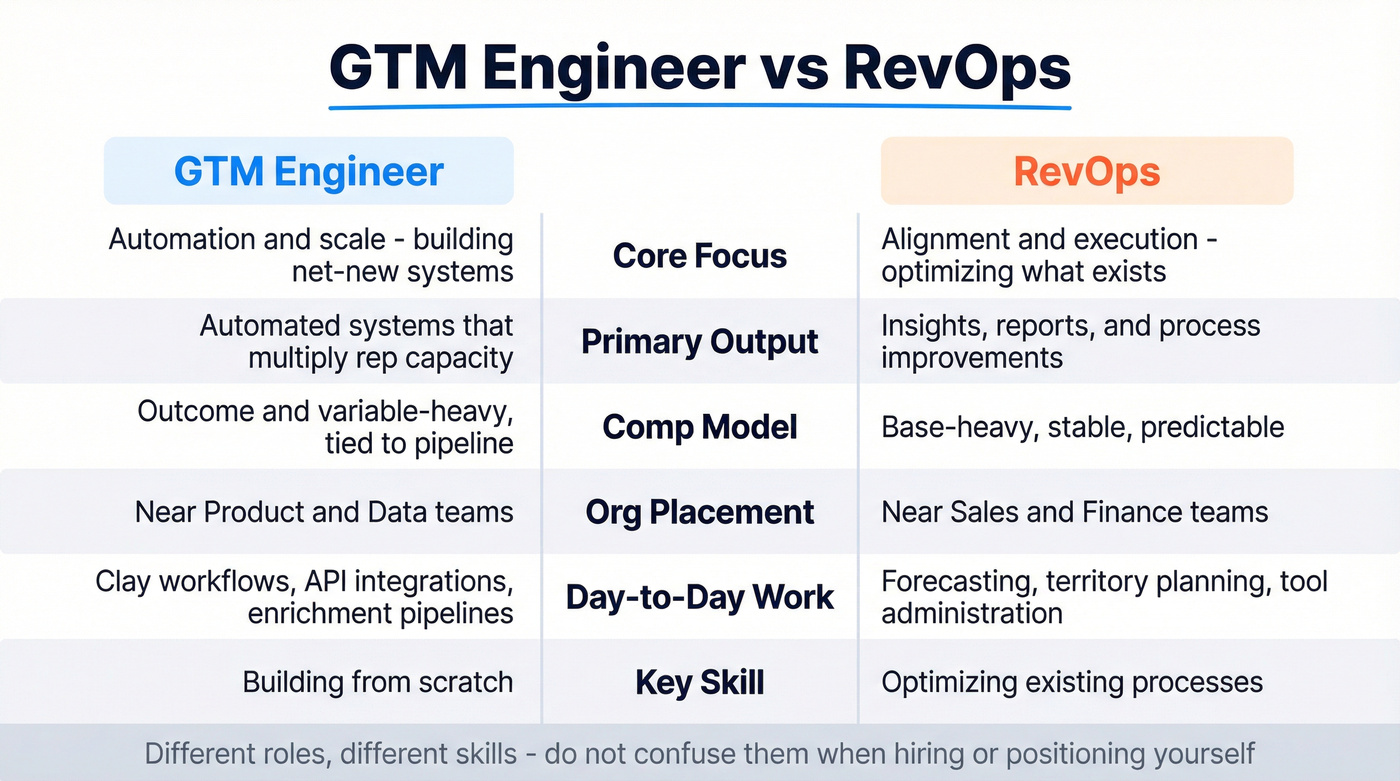
The Factors.ai framework nails it: RevOps optimizes what exists. GTM engineering builds systems from scratch. Don't confuse the two when hiring - or when positioning yourself. Nearly every B2B job description lists RevOps experience as a plus, but the day-to-day work is fundamentally different. (More context: RevOps Manager.)
What to Build to Prove Yourself
Portfolio projects beat certifications. Here's the thing: a single working enrichment pipeline that generates real meetings is worth more than every HubSpot certification combined.
Automated lead scoring + routing. Multi-source leads flow through enrichment, ICP scoring, and CRM handoff with assignment rules. This proves you can think end-to-end, not just build one node in a workflow. If you want a scoring rubric, use a lead scoring framework.
Intent-based prospecting workflow. Detect signals, enrich, verify, sequence. Basically the workflow above. Build it, run it, measure it, and put the results in your portfolio.
Revenue attribution dashboard. Connect ad spend, email engagement, and CRM pipeline data to answer "which channel actually drove this deal?" If you can build this and explain it to a non-technical VP, you'll stand out from 90% of applicants.
Salary Expectations
US-market ranges for 2026:
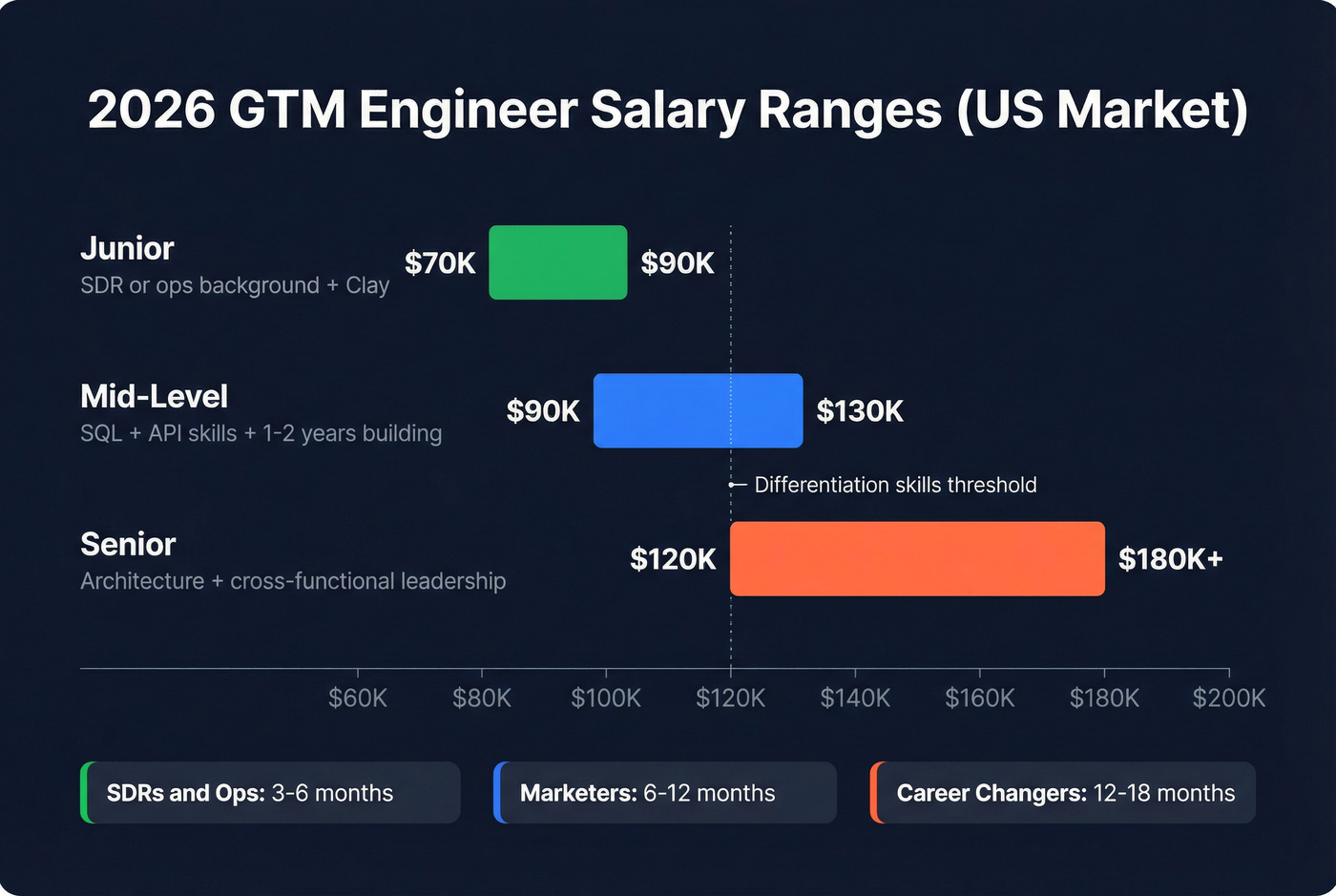
| Level | Base Salary | Notes |
|---|---|---|
| Junior | $70K-$90K | SDR/ops background + Clay |
| Mid | $90K-$130K | SQL + API + 1-2 yrs building |
| Senior | $120K-$180K+ | Architecture + cross-functional |
Comp often includes variable or outcome-based components, especially at the senior level. Transition timelines vary by background: SDRs and ops people typically ramp in 3-6 months, marketers in 6-12, and career-changers in 12-18.
How to Learn These Skills
- Clay University (free) - the best starting point. Hands-on workflows, not theory.
- Eric Nowoslawski's YouTube - AI-powered GTM workflows with real multi-tool campaigns.
- Matt Redler's Cold Email Handbook (free) - deliverability and outbound fundamentals.
- StackOptimise course - 7+ hours covering Clay, Smartlead, and Make.
The ethos that keeps coming up from practitioners and in GTM Slack communities: just start building. Pick a workflow, build it end-to-end, break it, fix it. That's the learning loop. Skip the "should I learn X or Y first?" paralysis and ship something.
GTM engineers who land $130K+ roles build signal-based workflows that move pipeline - not demos. Prospeo gives you 300M+ profiles, 30+ filters including intent data and technographics, and a Clay-ready enrichment API with a 92% match rate. At $0.01 per email, you can build portfolio-worthy pipelines without an enterprise budget.
Ship your first enrichment pipeline today with 75 free verified emails.
FAQ
Do I need to know how to code?
Not from scratch. In 2026, Claude Code and Cursor handle most implementation. You need to understand data structures, APIs, and logic - but writing Python from memory isn't the bar. The real skill is knowing what to build and speccing it clearly enough for AI tools to execute.
What's the fastest path into GTM engineering?
Start with CRM admin experience or an SDR/AE background, learn Clay, and build one end-to-end workflow from enrichment through outreach through CRM update. A working portfolio project that generates real meetings beats certifications every time.
Which tools should I learn first?
A CRM like Salesforce or HubSpot, Clay for enrichment and workflow building, and a verification tool like Prospeo to make sure your data is actually usable. Add Make or n8n for cross-platform automation once you're comfortable with the core stack.
How are GTM engineer skills different from RevOps skills?
GTM engineers build net-new automated systems - enrichment pipelines, signal-based outbound, AI-powered personalization. RevOps professionals optimize existing processes, manage reporting, and align cross-functional teams. There's overlap in CRM and data fluency, but the build-vs-optimize orientation is fundamentally different.