

GTM Marketing: The Data-Backed Guide to Building a Go-to-Market Strategy
You launched a product and nobody showed up. It happens more often than anyone admits - somewhere between 40% and 95% of new products fail to meet their targets, depending on the industry. IDC estimates that over 10% of all revenue gets lost in the go-to-market phase alone. Meanwhile, companies with a defined GTM launch process see 3x higher median revenue growth - 35% vs 9%, per PMA's State of GTM research.
The gap isn't product quality. It's GTM marketing execution. Most guides stop at definitions, which is why you've read three of them and still don't know what to actually do. This one covers frameworks, benchmarks, real examples, and the exact steps to build a go-to-market strategy that works - plus the tech stack and common mistakes that sink even solid plans.
The short answer: a GTM strategy is the cross-functional plan for getting one specific product to one specific market. It's not your marketing strategy. It's not your sales plan. It's the bridge between "we built something" and "people are buying it." Define your ICP, nail your value prop, pick your motion, choose 3-5 channels, set measurable KPIs, and execute for 90 days before changing anything.
Now let's get into the details.
What Is GTM Marketing?
A go-to-market strategy is the tactical, time-bound plan for launching a specific product into a specific market. It coordinates product, marketing, sales, and customer success around a single goal: get this thing in front of the right buyers and make them pay for it.
That sounds simple. It isn't - mostly because people confuse go-to-market efforts with their broader marketing strategy. Your CEO asks "what's our GTM?" in the all-hands and three people give three different answers. Sales thinks pipeline targets. Marketing thinks campaign plans. Product thinks the roadmap.
Let's settle it.
GTM Strategy vs. Marketing Strategy
| Dimension | GTM Strategy | Marketing Strategy |
|---|---|---|
| Timeline | 6-18 months | 2-5 years |
| Scope | One product or market | All products and markets |
| Focus | Launch execution | Brand building |
| Deliverables | Launch plan + KPIs | Marketing plan + budget |
| Owner | Cross-functional (PM, PMM, Sales) | CMO / Marketing team |
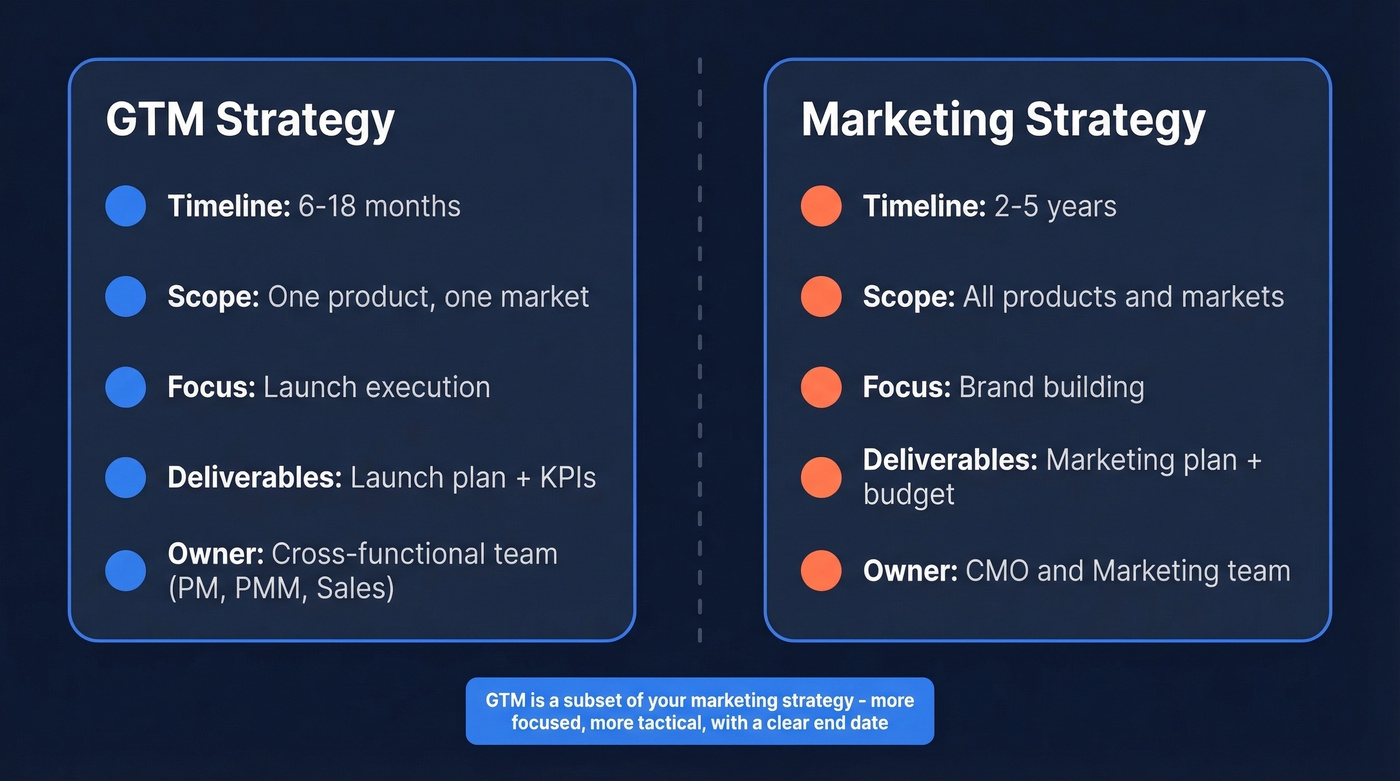
The GTM strategy is a subset of your marketing strategy. It's more crystallized, more execution-focused, and has a clear end date. Your marketing strategy covers long-term brand positioning across everything you sell. Your go-to-market plan answers one question: how do we get this specific product to this specific market in the next 6-18 months?
When Do You Need a Full GTM Strategy?
Not every situation demands a 30-page document. The Ansoff Growth Matrix is a useful filter here. If you're doing market penetration - selling an existing product to an existing market - a lighter refresh might suffice. But the further you move toward diversification (new product, new market), the more rigorous your plan needs to be.
You need a full go-to-market strategy when:
- You're launching a new product or major feature set
- You're entering a new geographic market or vertical
- You're repositioning an existing product against new competitors
- You're shifting your pricing model (perpetual licenses to SaaS, for instance)
- You're moving upmarket or downmarket in a meaningful way
If none of those apply, you probably need a campaign plan, not a GTM strategy. Know the difference - it saves weeks of unnecessary planning.
Core Components of a Go-to-Market Plan
A complete strategy has several core components. Miss one and the whole thing wobbles.
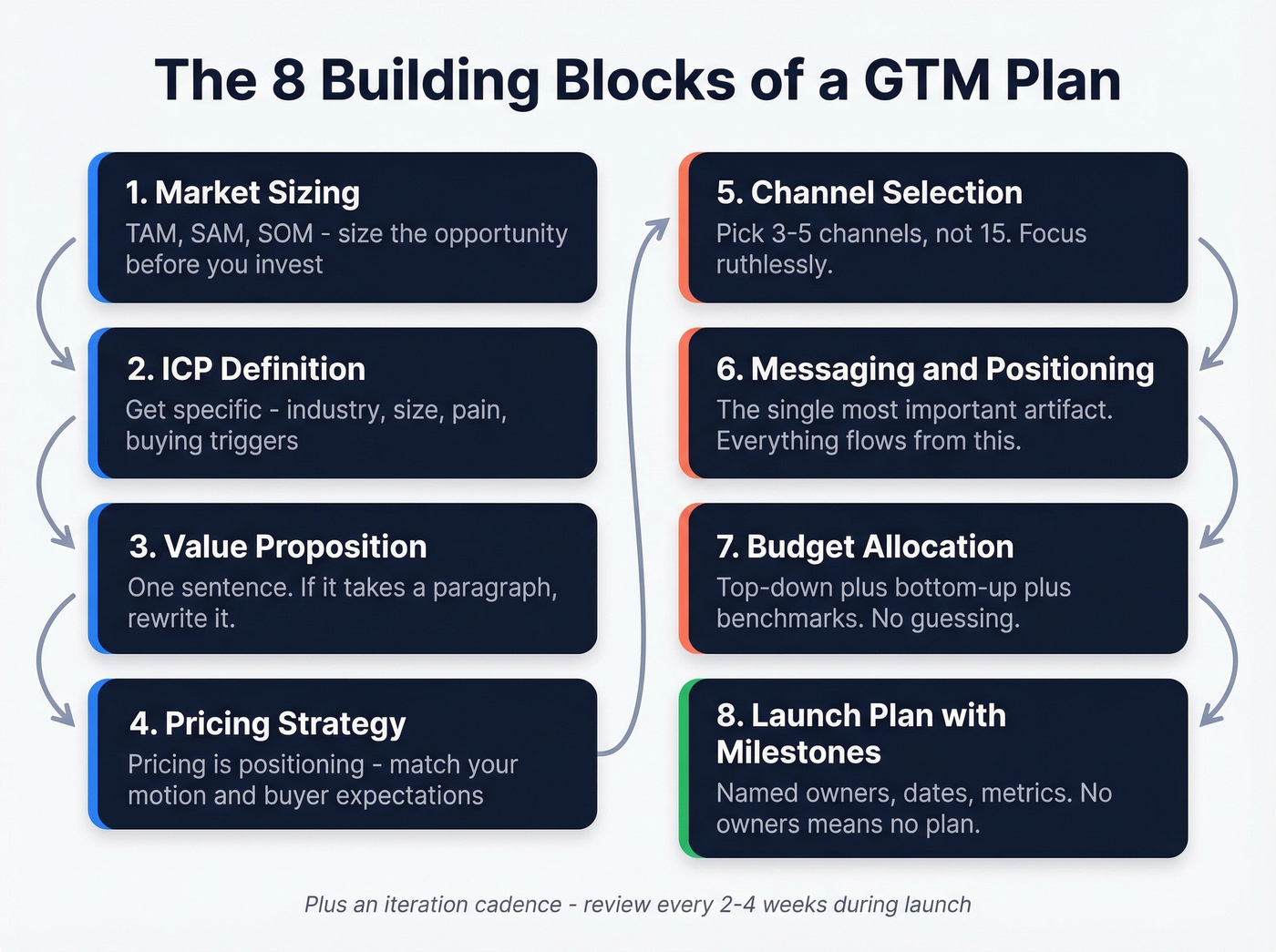
Market Sizing (TAM/SAM/SOM)
Before defining your ICP, size the opportunity. Your total addressable market tells you the ceiling; your serviceable obtainable market tells you whether the investment is worth making. If your SOM doesn't justify the launch cost, kill the project before it eats a quarter of your team's time. (If you want a deeper breakdown, see our guide to TAM, SAM, SOM.)
ICP Definition
Not "mid-market SaaS companies." Something like "Series B-C SaaS companies with 100-500 employees, selling to enterprise, with an outbound sales team of 5+ reps and a CRM they've outgrown." The tighter your ICP, the sharper every downstream decision becomes - from messaging to channel selection to pricing. If you need a starting point, use an ICP template and refine it with real sales calls.
Value Proposition
One sentence that explains why your target buyer should care. If it takes a paragraph, it's not ready. Test it with five prospects. If they don't immediately get it, rewrite. (This is also where B2B brand positioning work pays off.)
Pricing Strategy
Pricing is positioning. A $29/mo tool signals self-serve simplicity. A $100K ACV signals enterprise-grade. Your pricing has to match your motion and your buyer's expectations.
Channel Selection
Pick 3-5 channels, not 15. The average software company runs 10.5 GTM efforts - 5 core channels plus 5.5 experimental initiatives - but early-stage teams should focus ruthlessly. Outbound, content, and partnerships cover most B2B scenarios. If you're building outbound, start with proven sales prospecting techniques before adding more channels.
Messaging and Positioning
The positioning doc is the single most important artifact. It defines who you're for, what you do differently, and why it matters. Everything else - ads, sequences, landing pages - flows from this. A complete plan also produces a competitive analysis, customer journey map, KPI tracker, and sprint execution template. These aren't optional deliverables; they're the artifacts that keep cross-functional teams aligned. (For the competitive side, a lightweight competitive intelligence strategy helps.)
Budget Allocation
Budget your launch using three inputs: top-down allocation from leadership, bottom-up cost estimates from execution teams, and industry benchmarks for your stage and motion. Skipping this step is how teams end up six weeks into a launch with no money left for the channels that are actually working.
Launch Plan with Milestones
Owners, dates, and metrics for every phase. A plan without named owners is a wish list.
Iteration Cadence
Plan to review and adjust every 2-4 weeks during launch. Sprint execution meetings and a live KPI tracker keep the plan accountable. A go-to-market strategy isn't a document you write once. It's a system you run.
GTM Motions - Which One Fits?
The motion you choose determines everything: team structure, hiring plan, tech stack, and unit economics.
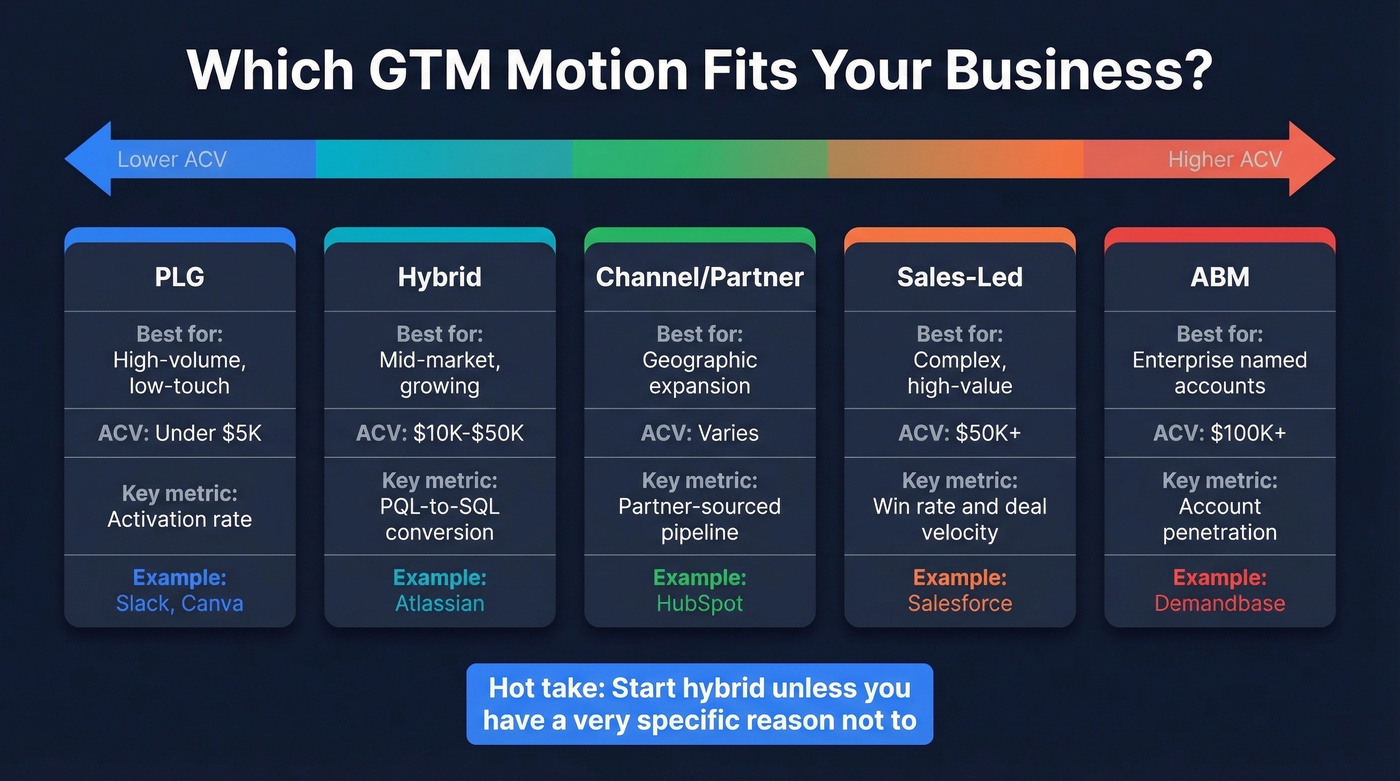
| Motion | Best For | ACV Range | Key Metric | Example |
|---|---|---|---|---|
| PLG | High-volume, low-touch | Under $5K | Activation rate | Slack, Canva |
| Sales-Led | Complex, high-value | $50K+ | Win rate, ACV | Salesforce |
| Hybrid | Mid-market, growing | $10K-$50K | PQL-to-SQL conversion | Atlassian |
| Channel/Partner | Geographic expansion | Varies | Partner-sourced pipe | HubSpot |
| ABM | Enterprise, named accounts | $100K+ | Account penetration | Demandbase |
Product-Led Growth (PLG)
Top-performing PLG companies hit 65%+ activation rates versus a 33% average. Best-in-class maintain net revenue retention above 120%. But here's the catch: if your product can't deliver an "aha moment" in the first session, PLG will underperform - and you'll burn cash on free users who never convert.
Sales-Led Growth
Direct sales still dominates enterprise software. If you're selling to buying committees of 5-10 people with $50K+ deal sizes, you need humans in the loop. The key metric shifts from activation to win rate and deal velocity. Sales-led isn't old-fashioned - it's appropriate for complex products where the buyer needs education, customization, or security review before signing.
Start Hybrid (Our Hot Take)
Look, pure motions are increasingly rare. Gartner found that in 57% of deals, the product itself leads the sales process - even in companies with large sales teams. Atlassian ran PLG for years before building a sales org to close larger accounts.
Our honest recommendation: start hybrid unless you have a very specific reason not to. Pure PLG leaves money on the table for deals above $10K ACV. Pure sales-led burns cash on deals that could close themselves. Let the product qualify, then let sales close. Most teams that insist on a "pure" motion are optimizing for ideological purity, not revenue.
Channel, ABM, and Other Motions
Channel sales work when you need geographic reach without building local teams - think ISV partnerships or reseller networks. ABM is the right motion when you're targeting a finite list of named accounts with deal sizes above $100K. Freemium is a PLG variant where the free tier serves as a permanent acquisition channel rather than a time-limited trial. Each of these can layer on top of your primary motion.

Your GTM motion lives or dies on ICP targeting. Prospeo's 30+ search filters - buyer intent, technographics, headcount growth, funding, job changes - let you build laser-focused prospect lists that match the tight ICP definitions this guide recommends. 300M+ profiles, 98% email accuracy, refreshed every 7 days.
Stop guessing which accounts to target. Start with data that's 7 days fresh.
Go-to-Market Strategy by Company Stage
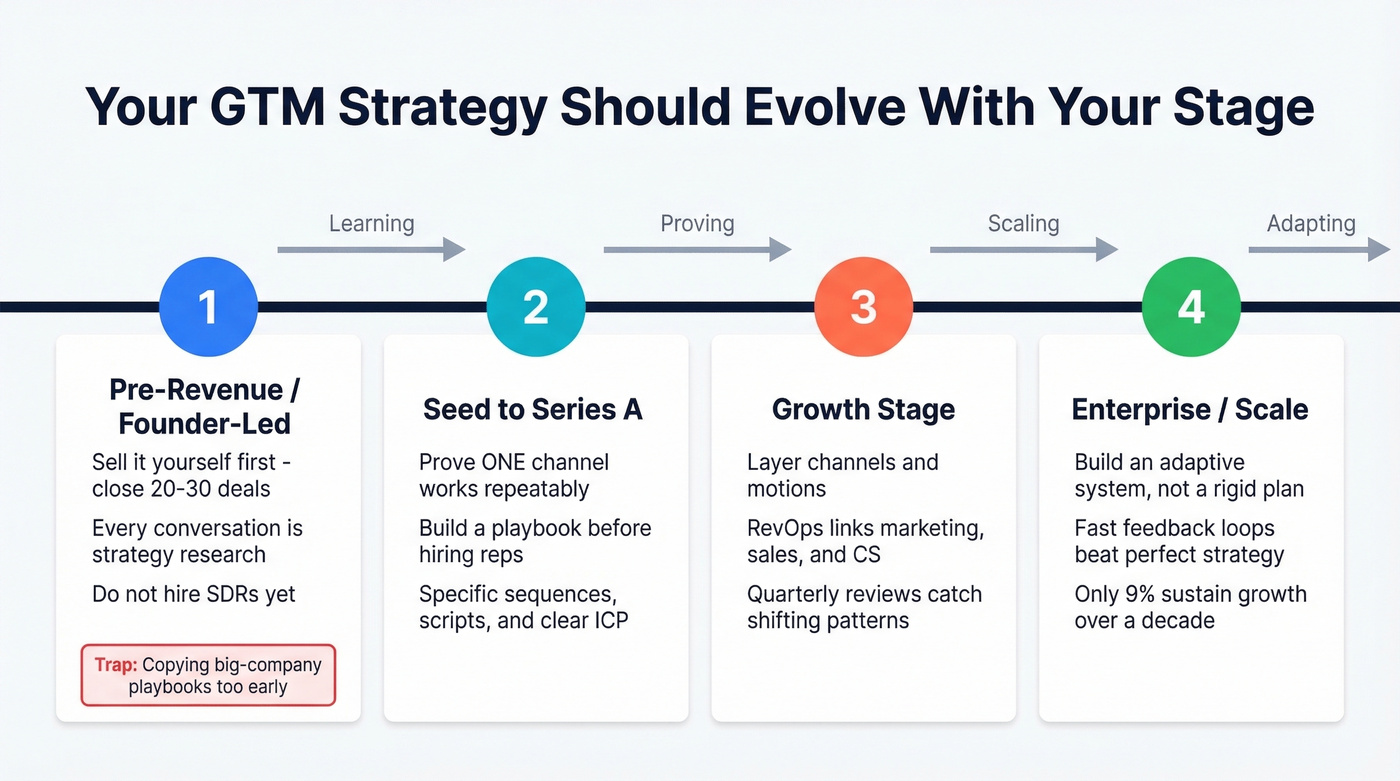
A seed-stage startup and a public company both need go-to-market strategies. They don't need the same one.
Pre-Revenue / Founder-Led
If you haven't closed 20-30 deals yourself, you don't have a strategy - you have a hypothesis. Founder-led sales isn't a stopgap; it's the most efficient way to learn your buyer's language, triggers, objections, and willingness to pay. Every conversation is strategy research. Don't hire an SDR to do this for you.
The early-stage failure pattern is almost always the same: founders copy big-company playbooks too early, hire sales before they understand their own market, and optimize for efficiency when they should be optimizing for learning.
Seed to Series A
Your job at this stage is proving one channel works repeatably. Not three channels. Not five. One. Get a single motion generating predictable pipeline before you diversify. Hire your first SDR or AE only after you have a playbook they can follow - specific sequences, objection-handling scripts, and a clear ICP they can prospect against. If you need a simple ramp plan, use a 30-60-90 day plan to keep execution tight.
Growth Stage
Now you can layer channels. This is where RevOps becomes the operational layer linking marketing, sales, and CS. Quarterly reviews catch shifting buyer patterns before they become revenue problems. The companies that scale successfully here treat their go-to-market approach as a system, not a document. Bain's research across 225 executives and 60 companies found that integrated systems with fast feedback loops consistently outperform siloed approaches.
Enterprise - Adaptive System
At scale, the risk isn't poor execution - it's rigidity. Bain's survey of 2,300 global companies found that only 9% achieved sustained 5.5%+ annual revenue and profit growth over a decade. The difference between Nokia and Samsung in 2006-2010 wasn't product quality. Samsung gained nearly 6 points of market share while Nokia fell 6 because Samsung's go-to-market system adapted faster. Enterprise GTM requires enablement infrastructure, RevOps-led reviews, and cross-functional alignment that most companies talk about but few actually build.
GTM Examples That Worked
Slack: $27.7B Exit, Built Bottom-Up
Slack didn't sell to IT departments. It sold to individual teams frustrated with email. The product spread bottom-up within organizations, with teams inviting colleagues and entire departments adopting organically. The freemium model let anyone start a workspace for free, and usage-based pricing converted teams naturally as they hit limits.
By 2019: 8 million daily active users, 3 million paid, and a Salesforce acquisition that validated the entire PLG playbook. The lesson is straightforward - if your product creates value that's visible to non-users through shared channels and searchable history, virality is built in.
Loom vs. Canva: Two Flavors of PLG
Loom and Canva both ran content-led PLG, but the mechanics were completely different. Every Loom video shared was a marketing touchpoint - recipients saw the interface and signed up. The product was the distribution channel. Canva built an engine around templates instead: every "free Instagram template" or "free resume template" search led to Canva, localization expanded the funnel globally, and educator and creator distribution channels turned users into evangelists.
Loom's growth was viral and peer-to-peer. Canva's was search-driven and intent-based. Both worked because the free tier removed friction and upgrades happened at natural usage thresholds, not when sales called. (If you're using video in outbound, see Loom video cold email.)
Superhuman - Manufactured Scarcity
Superhuman took the opposite approach: artificial scarcity. The waitlist created demand, and high-touch onboarding ensured every user hit the "aha moment." They used the now-famous PMF survey question - "How would you feel if you could no longer use Superhuman?" - to measure product-market fit quantitatively before scaling.
It's proof that PLG doesn't require a free tier. It requires a clear "aha moment" and the discipline to gate access until you can deliver it consistently.
Mutiny - ABM + Founder-Led Sales
Mutiny's ICP was razor-sharp: companies spending $100K+ on paid ads and content. Founder-led sales with personalized outreach mockups showing prospects what their website could look like with Mutiny converted at rates that generic outbound never touches. A masterclass in matching motion to ACV.
2026 Go-to-Market Benchmarks
Numbers keep you honest. Here's what's actually working right now, based on the latest data from 195 software companies surveyed in late 2025.
| Metric | 2024 | 2025 | Top Performers |
|---|---|---|---|
| Cold email reply rate (timeline hooks) | 6.8% | 5.8% | 10.01% |
| Cold email reply rate (problem hooks) | - | 4.39% | - |
| Cold email to meeting (timeline) | - | 2.34% | - |
| Cold email to meeting (problem) | - | 0.69% | - |
| PLG activation rate | - | 33% avg | 65%+ (top 10%) |
| Net revenue retention (PLG) | - | - | >120% |
| GTM efforts per company | - | 10.5 | - |
Cold email isn't dead, but lazy cold email is. The gap between timeline-based hooks at 10.01% reply rate and problem-based hooks at 4.39% is 2.3x. That's not a channel problem - it's a copywriting problem. Meeting rates show an even starker divide: 2.34% vs 0.69%.
The 2026 GTM efficiency trends point toward intent-based outbound, ABM with joint pipeline ownership, and answer-engine optimization as the channels gaining ground. Paid Meta for B2B pipeline generation is losing steam. The average company runs 10.5 go-to-market efforts, which is a lot of surface area to manage - and exactly why execution quality matters more than channel selection.
The Go-to-Market Tech Stack
Your strategy is only as good as the data powering it. If your SDRs are emailing invalid addresses and calling disconnected numbers, no amount of strategic planning saves you.
We've tested dozens of data tools over the years, and the pattern is always the same: teams overspend on data infrastructure and underspend on the sequences and messaging that actually convert. Prospeo covers 300M+ professional profiles, 143M+ verified emails at 98% accuracy, and 125M+ verified mobile numbers - refreshed on a 7-day cycle versus the 6-week industry average. Intent data across 15,000 Bombora topics is built in, so you're not bolting on a separate $30-100K+/year intent tool.

Here's what a realistic stack looks like at different stages:
| Layer | Startup Pick | Enterprise Pick | Cost Range |
|---|---|---|---|
| CRM | HubSpot (free) | Salesforce | Free-$300/user/mo |
| Outreach | Instantly / Smartlead | Salesloft / Outreach | $30-$97/user/mo |
| Intent Data | Built into Prospeo | 6sense / Demandbase | Included vs $30-100K+/yr |
| Enablement | - | Highspot / Seismic | $30-80K+/yr |
A startup stack can cost under $200/month. An enterprise stack easily runs $200K+/year. But the tools don't determine success - the strategy and execution do. We've seen teams with a $150/mo stack outperform teams spending $200K because they had a tighter ICP and better sequences. If you're evaluating vendors, start with a shortlist of data enrichment services and compare against your actual workflow. The consensus on r/SaaS is clear: tool overlap and stack bloat are real problems, with multiple tools evolving to do the same thing, meaning you're paying twice for the same capability.
Skip the enablement layer entirely if you're under $5M ARR. You don't need Highspot when a shared Google Drive and a weekly team sync will do.
Common Go-to-Market Mistakes
With release volume growing 27%+ per company, the surface area for mistakes is expanding. PMMs launch 10-16 products and features per year, spending 50+ hours per launch with 10+ stakeholders involved. Here are the five mistakes that sink the most launches.
1. No defined launch process. Companies with a structured process see 63% launch success versus 53% without one - and 3x higher median revenue growth. Yet nearly half of teams still wing it. 49% of PMMs say they can't collect customer research fast enough, which means half of all launches are flying partially blind.
2. Hiring sales before the founder has sold. If you can't close the deal yourself, an SDR won't magically figure it out. Founder-led sales isn't optional at the early stage - it's the strategy.
3. Copying enterprise playbooks at seed stage. Formal funnels, multi-channel attribution, and RevOps hires make sense at $10M ARR. At $500K ARR, they're overhead that slows you down. Fewer than 50 customers and deal sizes under $10K? You don't need ZoomInfo-level data infrastructure or a six-person RevOps team. You need 20 more conversations with buyers.
4. Bad data poisoning outbound. This is the silent killer. If your prospect list bounces 35% on the first sequence, your domain reputation tanks and every subsequent campaign suffers. One of our customers, Meritt, dropped their bounce rate from 35% to under 4% and tripled weekly pipeline from $100K to $300K just by switching to verified contact data. Real talk: if your bounce rate is above 5%, fix the data before you touch anything else. (Start with email bounce rate benchmarks and remediation.)
5. Stack bloat. If you're paying for three tools that all do contact enrichment, you don't have a stack problem - you have a decision-making problem. Audit quarterly. Cut what overlaps.
You don't need a 30-page strategy document. You need a one-page plan and the discipline to execute it for 90 days before changing anything. That's what GTM marketing really comes down to - focused execution, not more planning.
Channel selection matters, but even the best outbound channel fails with bad contact data. Teams using Prospeo book 26% more meetings than ZoomInfo users and 35% more than Apollo - because 98% email accuracy and 30% mobile pickup rates mean your GTM launch actually reaches real buyers. At $0.01 per email, your launch budget stretches further too.
Don't let bad data sink your go-to-market. Get verified contacts in minutes.
FAQ
What is GTM marketing?
GTM marketing is the cross-functional strategy for launching a specific product into a specific market, covering ICP definition, value proposition, pricing, channel selection, and success metrics. Unlike a general marketing strategy that spans 2-5 years, a go-to-market plan is tactical and time-bound - typically 6-18 months. You'll sometimes see it written as G2M, but the meaning is identical.
What's the difference between a GTM strategy and a marketing strategy?
A GTM strategy spans 6-18 months and focuses on launching one product or entering one market. A marketing strategy spans 2-5 years and covers brand building, positioning, and demand generation across all products. Think of go-to-market as a subset - the execution layer inside your broader marketing plan.
How long does it take to build a go-to-market strategy?
For a startup, a focused plan can be built in 1-2 weeks and refined over 90 days of execution. Enterprise strategies with cross-functional alignment and stakeholder buy-in typically take 4-8 weeks to formalize. The plan itself matters less than the iteration cadence after launch - review every 2-4 weeks.
What tools do you need for a GTM strategy?
At minimum: a CRM like HubSpot's free tier, a data platform with verified emails and direct dials, and an outreach tool like Instantly or Smartlead. A startup can run this stack for under $200/month. Intent data and enablement platforms become important as you scale past the first few reps.
What's the most common reason go-to-market strategies fail?
Lack of a defined launch process. Companies with a structured process see 63% launch success versus 53% without one, and 3x higher median revenue growth. The second most common failure is scaling too early - hiring sales, adding channels, and formalizing funnels before the founder has personally validated the motion with 20-30 closed deals.