

High Ticket Sales: The Data-Backed Guide for 2026
Your founder just asked you to close a $25,000 deal. You've got a list of 40 prospects, a CRM full of stale data, and a closing script you pulled from a blog written by someone who's never sold anything over $500. Meanwhile, 87% of your opportunities will face moderate-to-high buyer indecision before they ever reach the proposal stage.
The guru crowd will tell you it's all about "mindset." The skeptics will tell you high ticket sales is a scam term invented to sell courses. Both are partially right - and the real answer is backed by numbers, not platitudes. Browse any sales subreddit and you'll find heated debates about whether this is a real discipline or a marketing buzzword. I've watched reps with warm referrals outsell brilliant closers working cold lists - every single time. The skill set is real, the money is real, and the data below proves it.
The Short Version
Selling high-value products means any deal over $1,000 where trust, not tricks, drives the outcome. Your lead source matters more than your closing script - referrals convert at 25.56% while cold calling converts at 9.38%. And 80% of your success happens before the close, in qualification and data quality. If you remember nothing else from this guide, remember that.
What Counts as a High Ticket Sale?
It covers any transaction over $1,000 where the buyer needs genuine conviction before signing. Think SaaS contracts where HubSpot plans range from $15/month/seat up to $3,600+/month. Think management consulting engagements at $10K-$50K. Think luxury real estate, executive coaching, industrial equipment.
The economics are fundamentally different from selling a $29/month subscription. You're working fewer deals, but each one carries real revenue weight. A single lost opportunity at $25K hurts more than churning ten $200/month accounts. Sales cycles stretch from weeks to months, multiple stakeholders get involved - the end user, their manager, procurement, sometimes legal - and the relationship doesn't end at close. It deepens.
Here's the thing: two camps exist around this term. There are people who think it's a phrase invented by online gurus to sell $5,000 coaching programs. And there are people quietly earning $150K-$300K+ a year closing B2B deals, real estate, and enterprise software who've never used the phrase in a meeting. The term gets abused, but the skill set is lucrative. Let's focus on that.
Benchmarks That Actually Matter
Most guides on premium deal closing give you vibes. Here are numbers. The data below comes from a meta-analysis across 25 industries, measuring SQL-to-closed-deal conversion rates during sales calls.
Conversion by Deal Size
| Deal Size | Close Rate |
|---|---|
| $500-$10K | 25.73% |
| $10K-$50K | 21.81% |
| $50K-$100K | 20.24% |
| $100K-$500K | 16.89% |
| $500K-$1M | 14.92% |
| $1M-$5M | 11.27% |
| $5M-$10M | 9.09% |
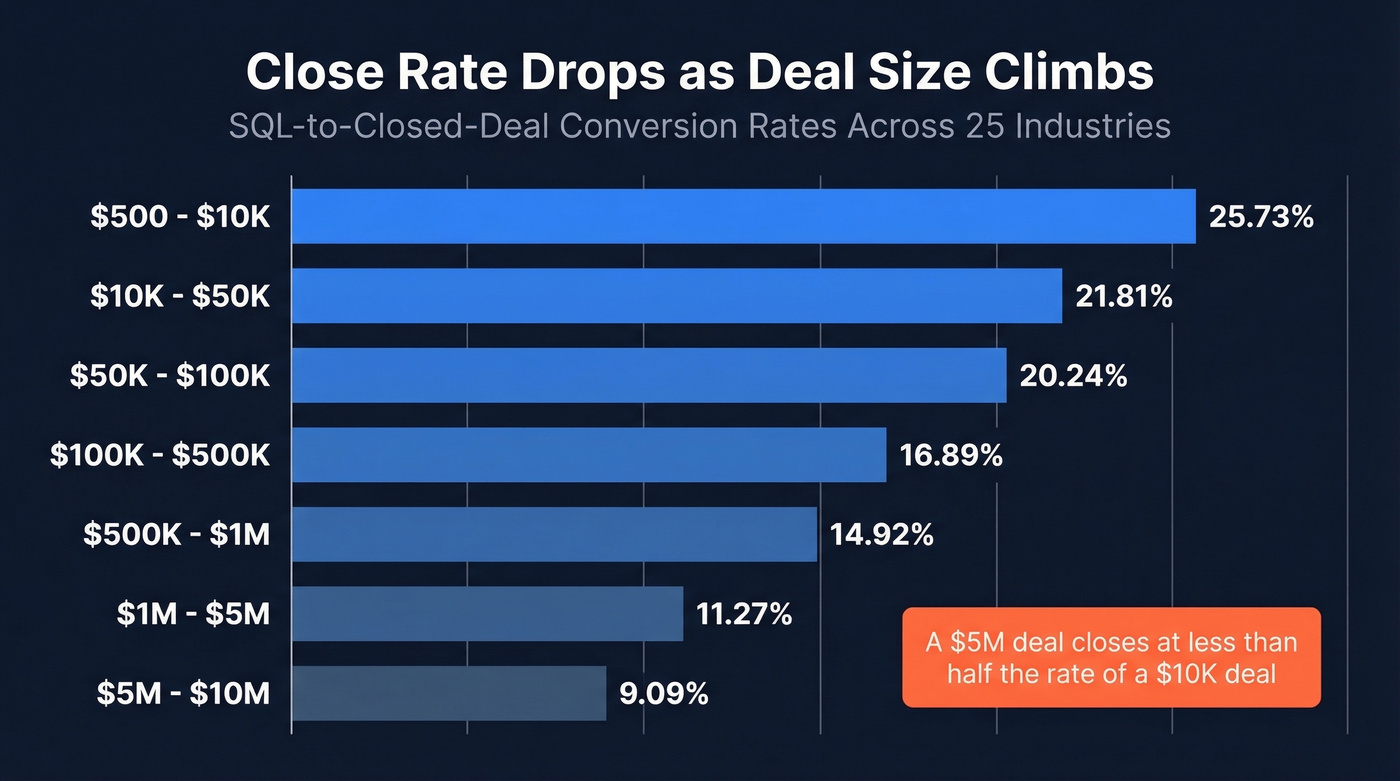
The pattern is obvious: as deal size climbs, close rates drop. A $50K deal converts at roughly 20%, while a $5M deal converts under 10%. This isn't because bigger deals have worse salespeople - it's because more stakeholders, longer timelines, and higher perceived risk compound at every stage.
Conversion by Channel
| Channel | Close Rate |
|---|---|
| Referral | 25.56% |
| Email marketing | 22.83% |
| SEO (inbound) | 21.22% |
| PPC | 15.73% |
| Trade shows | 13.59% |
| Social media | 11.56% |
| Cold calling | 9.38% |
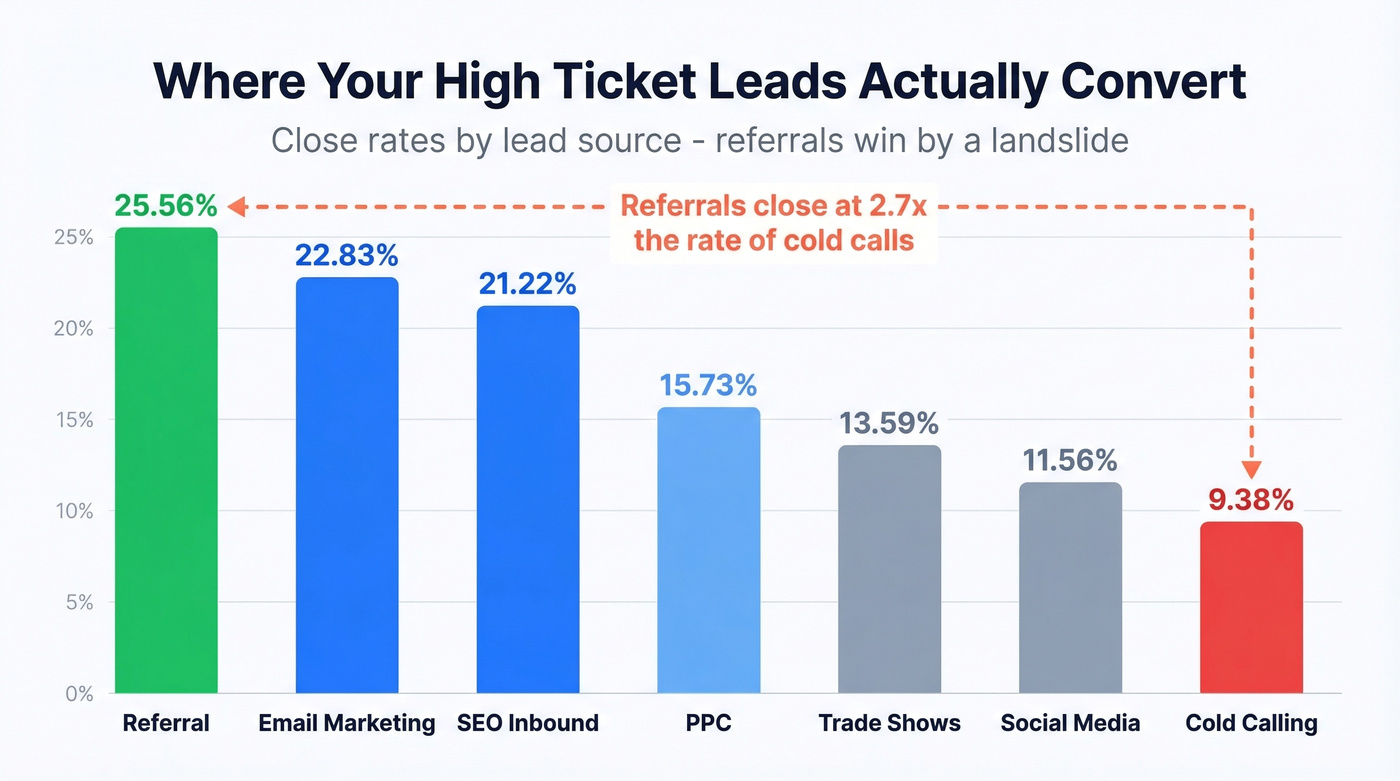
This table should change how you allocate your time. Referrals close at nearly 3x the rate of cold calls. Email marketing and SEO-driven inbound outperform paid channels by a wide margin. The average close rate across all industries sits at about 29%, but that number is meaningless without context - your channel mix and deal size determine your real baseline.
In our experience, channel selection is the highest-leverage decision you'll make when closing premium deals. A mediocre rep with a pipeline full of warm referrals will consistently outperform a polished closer grinding through cold lists.
Why High Value Deals Stall
Buyers are 60-80% through their decision process before they ever talk to you. By the time you're on a discovery call, they've already read your case studies, compared your pricing page to two competitors, and formed an opinion. You're not starting from zero. You're entering a conversation already in progress.
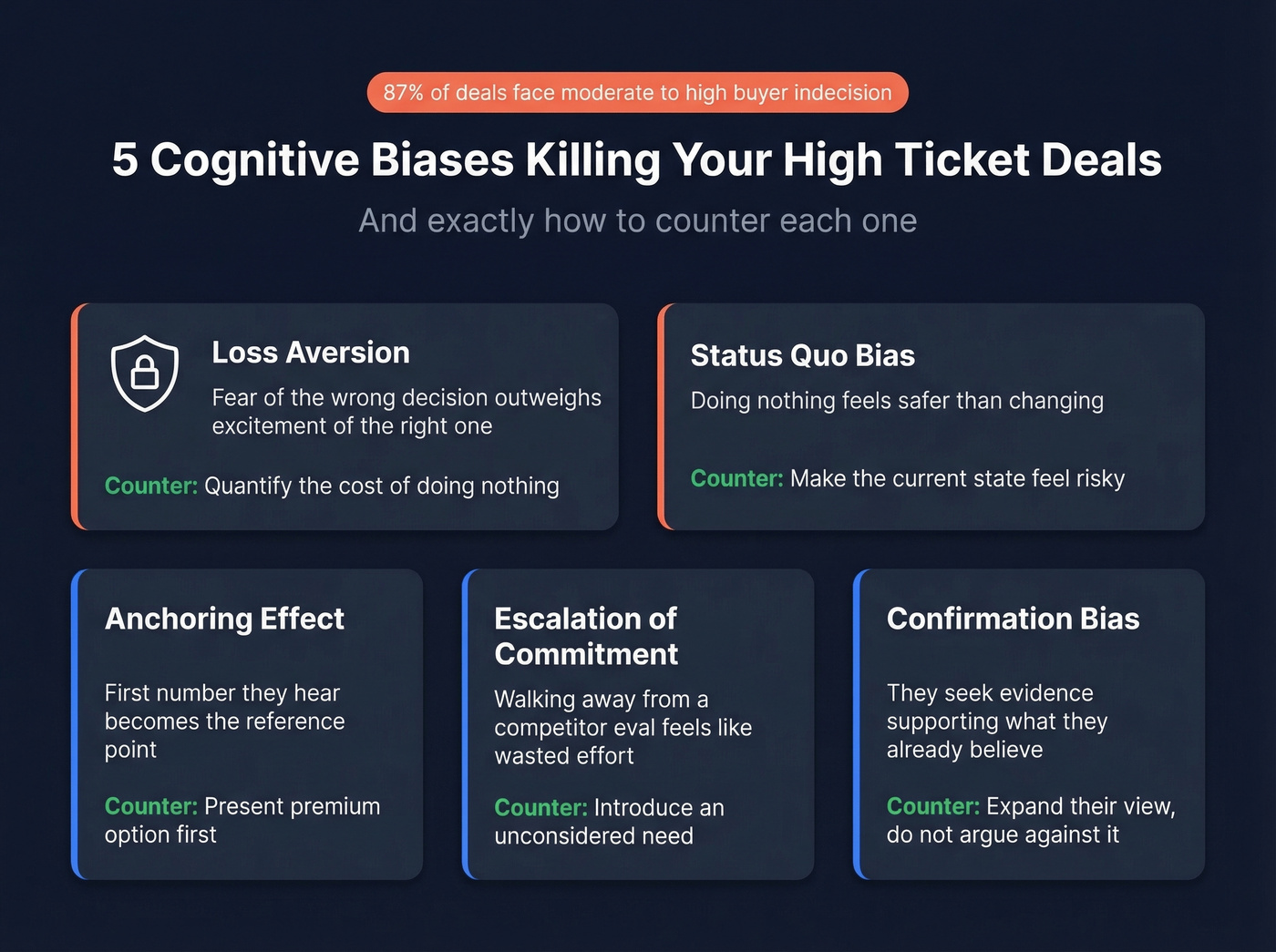
Roughly 60% of stalled B2B deals are caused by overwhelming choice or unclear next steps. But underneath that, five cognitive biases are quietly working against you:
Loss aversion - The fear of making the wrong $25K decision outweighs the excitement of making the right one. Quantify the cost of inaction: "Every month without this costs you roughly $X in lost pipeline."
Status quo bias - Doing nothing feels safer than changing. Make the status quo feel risky: "Your current process is leaving 30% of qualified leads untouched."
Anchoring effect - The first number they hear becomes the reference point. Present the premium option first, then show the mid-tier as the reasonable choice. A prospect who sees $50K before they see $25K perceives $25K as a bargain. (If you want to go deeper on this, see our guide to the anchoring effect.)
Escalation of commitment - They've already invested time in a competitor's evaluation. Walking away feels like wasting that effort. The fix is introducing an unconsidered need that reframes the entire evaluation - something their current vendor can't address.
Confirmation bias - They're looking for evidence that supports whatever they already believe. Don't argue against their existing view. Add new information that expands it: "You're right that X matters. Here's a dimension of X you haven't considered yet."
Every guide tells you to "build trust." Great. How? With what script? At what stage? By understanding these biases and designing your process to address them before they become objections. You're not a closer - you're a trusted advisor helping someone navigate a high-stakes decision. Partnership positioning is the antidote to the sleazy salesperson stereotype.
Funnel Architecture for Large Deals
The biggest myth in high ticket sales is that you need a "closer mindset." You need a qualification mindset. If you're closing at 15% but only feeding 20 leads per month into the top of your funnel, your problem isn't closing - it's pipeline. (If you're diagnosing leaks, start with these common sales pipeline challenges.)
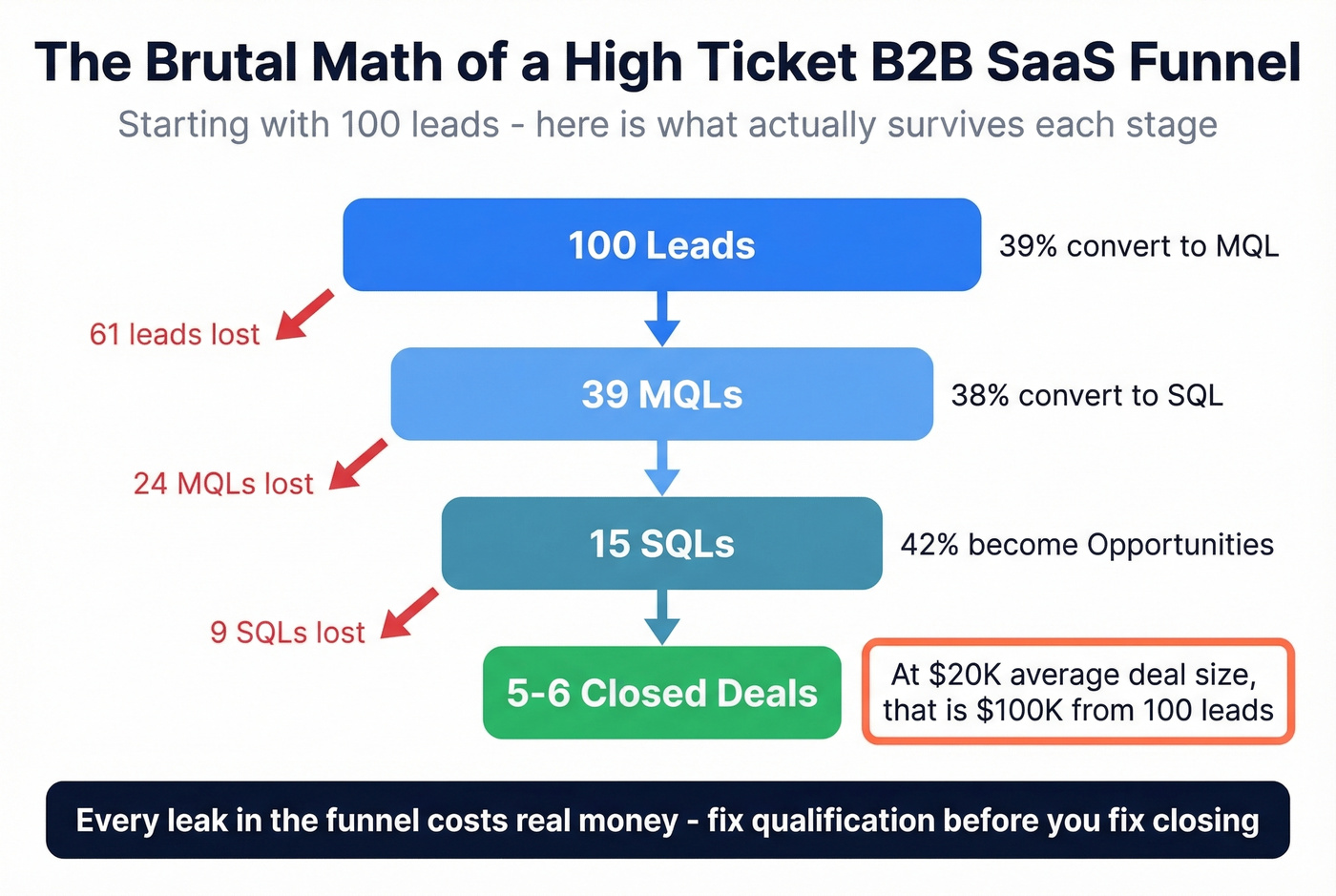
Here's what realistic stage-by-stage conversion looks like. FirstPageSage's benchmarks break it down by industry:
B2B SaaS:
- Lead to MQL: 39%
- MQL to SQL: 38%
- SQL to Opportunity: 42%
- SQL to Closed Won: 37%
Real Estate:
- Lead to MQL: 27%
- MQL to SQL: 33%
- SQL to Opportunity: 40%
- SQL to Closed Won: 53%
The math is brutal. In B2B SaaS, if you start with 100 leads, you'll get roughly 39 MQLs, 15 SQLs, and 5-6 closed deals. That means you need 100 leads to close 5 deals. If your average deal is $20K, that's $100K from 100 leads - and every leak in the funnel costs you real money.
The smartest operators use an ascension path model: a gateway offer that breaks even on the front end, then drives massive returns on the back end. SingleGrain documented one example where a $44.90 paid challenge generated 16X return through back-end premium offers. The gateway offer isn't about profit - it's about qualifying buyers and building trust before the big ask.

Referrals convert at 25.56%, cold calls at 9.38%. But even warm leads die when your contact data bounces. Prospeo delivers 98% email accuracy on 300M+ profiles - refreshed every 7 days, not 6 weeks - so every high ticket conversation starts with a real decision-maker, not a dead inbox.
Stop losing $25K deals to bounced emails and stale CRM data.
The Step-by-Step Sales Process
Here's the biggest contrarian take in this guide: 80% of high-ticket success happens before the close. The six steps below reflect that reality.
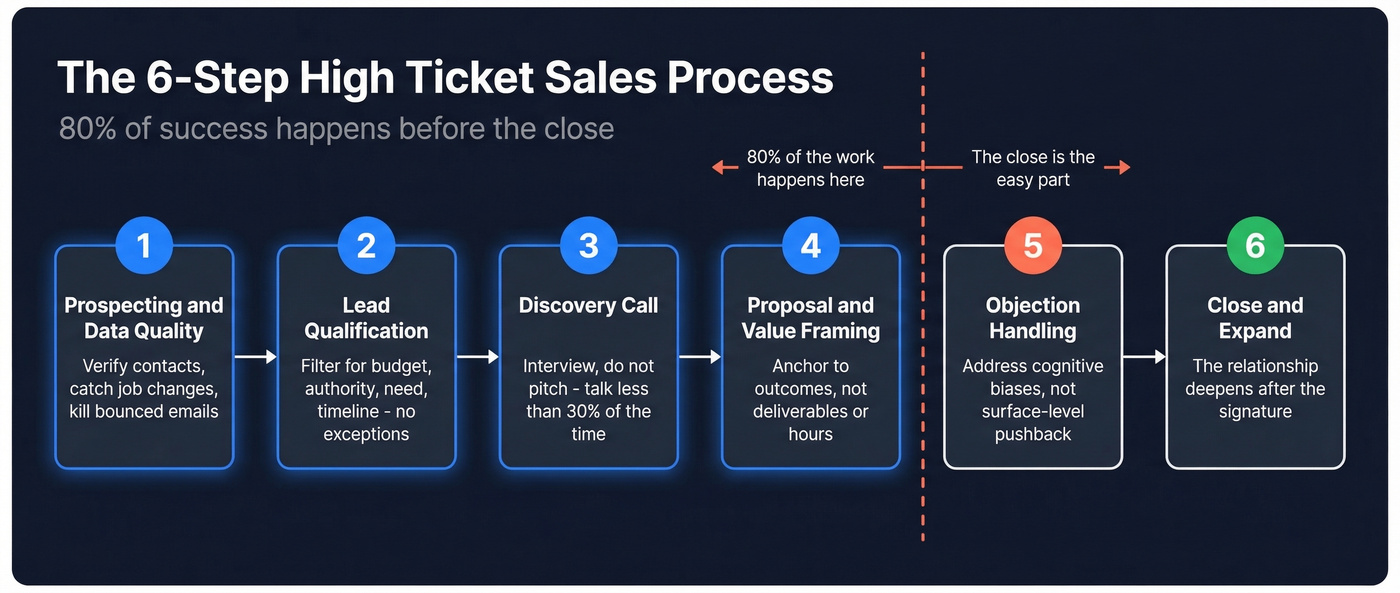
Prospecting and Data Quality
You just got off a discovery call with a VP of Operations at a mid-market SaaS company. The conversation went well - she's got budget, authority, and a clear pain point. You send the follow-up email. It bounces. You try the mobile number in your CRM. Disconnected. You check the company page and realize she left that role three months ago.
This scenario kills more pipeline than bad closing skills ever will. When you're targeting a small number of high-value decision-makers, one bad email wastes days of momentum. Tools like Prospeo with a 7-day data refresh cycle catch job changes within a week - not three months later when your follow-up bounces. With 98% email accuracy and 125M+ verified mobile numbers, you're working off live data instead of stale records. (If you're fixing this systematically, start with lead enrichment and a proper data enrichment workflow.)

Lead Qualification
Not every prospect deserves a discovery call. We've seen teams waste entire quarters chasing "interested" prospects who never had signing authority. Qualification means filtering for budget, authority, need, and timeline before you invest 30-60 minutes of selling time. Build a framework - BANT, MEDDIC, or your own variant - and enforce it ruthlessly. (If you're using MEDDIC, these MEDDIC discovery questions help standardize screening.)
If a prospect can't confirm budget range and decision timeline on a 10-minute screening call, they don't get a discovery slot. Period.
Discovery Call
The discovery call isn't a pitch. It's an interview. Here's what you need to walk away with:
- Current state: What's their existing process, and where does it break down?
- Desired future state: What does success look like in 6-12 months?
- The gap: What's the cost of the gap between those two states?
- Decision process: Who else is involved, and what's the approval chain?
- Previous solutions: What have they tried before, and why did it fail?
- Timeline: Is there a forcing function - a contract renewal, a board meeting, a fiscal year deadline?
The best discovery calls feel like a consultation, not a sales meeting. If you're talking more than 30% of the time, you're pitching, not discovering. (For a tighter structure, use a set of proven discovery questions.)
Proposal and Value Framing
Frame your proposal around the transformation, not the deliverables. A $30K consulting engagement isn't "120 hours of advisory." It's "$2M in pipeline acceleration over 6 months." Anchor the value to the outcome, and the price becomes a rounding error.
Include a clear implementation timeline, named stakeholders, and specific milestones. Vague proposals invite vague objections.
Objection Handling
Real talk: most objections aren't objections. They're expressions of the cognitive biases we covered earlier.
| What They Say | What's Actually Happening | How to Respond |
|---|---|---|
| "I need to think about it" | Status quo bias | "What specific questions would help you decide? Let's address them now." |
| "It's too expensive" | Loss aversion | "Compared to what? Let's look at the cost of the current approach." |
| "We're already working with someone" | Escalation of commitment | Introduce an unconsidered need their current vendor can't address. |
| "The timing isn't right" | Fear of change | "What would need to change for the timing to be right?" |
| "I need to talk to my team" | Unclear decision process | "Great - who should be in the next conversation, and what will they need to see?" |
Address the bias, not the surface-level words. Every objection is real to the person raising it - acknowledge it before you redirect. The larger the deal, the more likely you'll encounter multiple objections from different stakeholders, each rooted in a different bias.
Close and Follow-Up
The close should feel like a natural conclusion, not a pressure moment. If you've qualified well, discovered thoroughly, and framed value correctly, the close is just confirming next steps. Here's the timeline top performers follow:
- Within 1 hour: Send a recap email with agreed next steps and a clear call to action.
- Within 24 hours: Share the proposal or contract. Delays signal you're not serious.
- Day 3: Follow up if no response. Reference a specific point from the conversation - not a generic "just checking in."
- Day 7: Final follow-up with a deadline or new piece of value: a relevant case study, a competitive insight, a pricing expiration.
If you're not following up within 24 hours on a $10K+ opportunity, you're donating revenue to your competitor. (If you need copy you can send today, use these sales follow-up templates.)
Closing Techniques With Scripts
According to HubSpot's Sales Strategy Report, 75% of high-performing sales teams customize their closing strategy to the deal. Scripts are starting points, not straitjackets. Here are five techniques that work in premium contexts, each with an example line you can adapt.
The Assume Close - Act as if the decision is already made. Works best when buying signals are strong.
"When should we schedule onboarding?"
The If-Then Close - Remove the last barrier by making the commitment conditional on solving their concern.
"If we can meet your launch timeline, are you ready to finalize today?"
The Option Close - Reduce decision fatigue by narrowing choices to two options, both of which result in a sale.
"Would you prefer the quarterly or annual plan?"
The Scale Close - Surface hidden objections by asking for a commitment level, then addressing whatever's holding them back from a 10.
"On a scale of 1 to 10, how ready are we to finalize?"
The Direct Ask - Sometimes the simplest approach is the most effective. Don't dance around it.
"Are you ready to move forward today?"
The key with all five: read the room. An assume close on a first call feels presumptuous. A direct ask after three months of evaluation feels earned. Match the technique to the moment.
Mistakes That Kill Deals
Only 2 out of about 11 car dealerships followed up after a buyer visited in person. Two. The buyer was ready to spend $40K+ on a vehicle, and nine dealerships couldn't be bothered to send a follow-up email. That anecdote comes from a ZenBusiness study, and it maps perfectly to high-ticket B2B.
The five mistakes that kill the most deals:
Ignoring the customer. Not listening during discovery, talking over them, pushing your agenda instead of understanding theirs. Buyers spending five or six figures can smell a scripted pitch from a mile away.
Profiling by appearance. Judging a prospect's budget based on their title, company size, or how they showed up to the call. The scrappiest-looking startup founder might have $500K in funding earmarked for your solution.
Not knowing the product. If a buyer asks a technical question and you say "let me get back to you," you've lost credibility. Premium buyers expect expertise, not brochure-reading.
Denying objections are real. "That's not really a concern" is the fastest way to lose trust. Acknowledge it, then address it.
Not following up. The dealership data proves it - follow-up is the tiebreaker when choices are close. Set a reminder, send the email, make the call. This is the easiest problem to fix and the most expensive to ignore. (If you want the data behind this, see the importance of follow-up in sales.)
Hiring and Compensation
What Closers Earn
This is one of the few careers where you can earn $150K+ without a degree, a title, or a decade of experience.
- Entry-level (0-2 years, appointment setting or junior closing): $72K-$130K OTE
- Experienced closers (2-5 years, consistent quota attainment): $150K-$300K OTE
- Top performers (enterprise or specialists): $300K-$500K+
Typical commission structures run 10-20% of deal value, though this varies wildly by industry. Commission-only roles exist but are high-risk for both sides - the closer has no floor, and the company attracts mercenaries instead of builders. (If you're benchmarking comp, start with OTE in sales.)
Hiring Without Regret
If you're building a team focused on large deals, the most common mistakes are predictable. Don't overvalue confidence - the smoothest talker in the interview often turns into the most aggressive closer who burns leads. Review full call recordings, not highlight reels. Set clear KPIs from day one: close rate, show rate, revenue per call, and follow-up cadence.
Use a trial period of 2-4 weeks before committing. And here's the hot take most sales leaders don't want to hear: if your average contract value is under $10K, you probably don't need a dedicated closer. A well-built funnel with strong qualification and a competent AE will get you further than a $200K hire working a broken pipeline. A great closer can't fix a broken funnel - it just makes the problem more expensive.
Tools for Premium Sales Teams
You don't need 15 tools. You need three, and they need to work together.
CRM: HubSpot or Salesforce, depending on your team size and budget. HubSpot's free tier works for small teams; Salesforce typically runs $25-$330/user/month depending on edition. Your CRM is only as good as the data in it - which brings us to the second tool. (If you're comparing options, here are real examples of a CRM by use case and price.)
Verified data source: Prospeo handles contact data and CRM enrichment in one platform. 125M+ verified mobile numbers with a 30% pickup rate, native integrations with HubSpot, Salesforce, Smartlead, and Instantly. When you're targeting 50 decision-makers for a $25K deal, every bounced email and disconnected number costs you days. Free tier starts at 75 emails/month; paid plans run roughly $0.01/lead.
Scheduling: Calendly or a similar tool that eliminates the back-and-forth. For large deals, reducing friction between "interested" and "booked" is worth its weight in gold.
For teams that can afford a fourth tool, Gong adds call recording and conversation intelligence. It's particularly valuable when you're coaching closers or trying to understand why deals stall at specific stages. Skip it if your team is under five reps - the ROI doesn't kick in until you have enough call volume to spot patterns.
Your funnel math says you need 100 leads to close 5 high ticket deals. Prospeo's 30+ filters - buyer intent, funding, headcount growth - let you start with prospects already in-market. Layer in 125M+ verified mobile numbers with a 30% pickup rate to reach stakeholders directly.
Qualify faster and fill your high ticket pipeline for $0.01 per lead.
FAQ
Is high ticket sales a legitimate career?
Yes - closers in B2B SaaS, consulting, and real estate routinely earn $150K-$300K+ OTE. It requires product expertise, emotional intelligence, and months of relationship-building, not a 30-day course. The role is growing as companies shift toward fewer, larger deals with longer sales cycles.
How long does a typical sales cycle take?
Anywhere from 2 weeks to 6+ months depending on deal size and stakeholder count. A $10K consulting engagement might close in 2-4 weeks, while a $100K+ enterprise software deal often takes 3-6 months with legal review and procurement involved.
What's the difference between high ticket and enterprise sales?
Enterprise sales is a subset. All enterprise deals are high-ticket, but the category also includes coaching, consulting, luxury goods, and services sold to individuals. Enterprise specifically means selling to large organizations with complex buying committees.
How do I find decision-makers for large deals?
Use a B2B data platform with verified contact data and buyer intent signals. Prospeo's 30+ search filters let you target by job title, company size, funding stage, and in-market topics - then verify every email and phone number before outreach. When your target list is 50 people instead of 5,000, accuracy is everything.