

How Does ZoomInfo Work? The Outsider's Guide to What You're Actually Buying
You just got off a demo call. The rep showed you a slick search interface, rattled off "500 million profiles" and "AI-powered signals," then said the magic words: "I'll send over a custom quote." Now you're trying to figure out how ZoomInfo actually works - and what it'll cost. Here's the full picture, without the sales deck.
The Quick Version
What it is: A GTM intelligence platform combining a massive B2B contact database with AI workflows, intent signals, and CRM integrations. Think of it as a search engine for business contacts, plus automation on top. (If you're comparing vendors, start with our B2B contact database roundup.)
How it gets data: Five sources - public business info, ML crawling and analysis, data partners, a contributory network where users trade contacts for free access, and human research teams.
What it costs: $15,000-$45,000+/year depending on tier and add-ons. No monthly plans. Discounts of 30-65% are common if you negotiate hard.
Who it's actually for: Enterprise teams with 20+ reps and $30K+ budgets who need intent data, CRM enrichment, and automation in one platform.
If you're here because the pricing page said "Talk to Sales," you're not alone.
What Is ZoomInfo in 2026?
ZoomInfo positions itself as a GTM intelligence platform - not just a database, but a full go-to-market operating system. The product suite includes ZoomInfo Sales, Marketing, Operations, Talent, Copilot, GTM Workspace, GTM Studio, and DaaS.
The numbers are impressive at face value: 500M professional profiles, 174M verified email addresses, and 70M+ direct dials, serving 35,000+ customers worldwide. On G2, ZoomInfo Sales holds a 4.5/5 rating from 9,035 reviews, with 71% of those being five stars. That's the highlight reel. Let's look under the hood.
How ZoomInfo Collects Its Data
ZoomInfo's data pipeline runs on five sources, and understanding them explains both the platform's strengths and its blind spots.
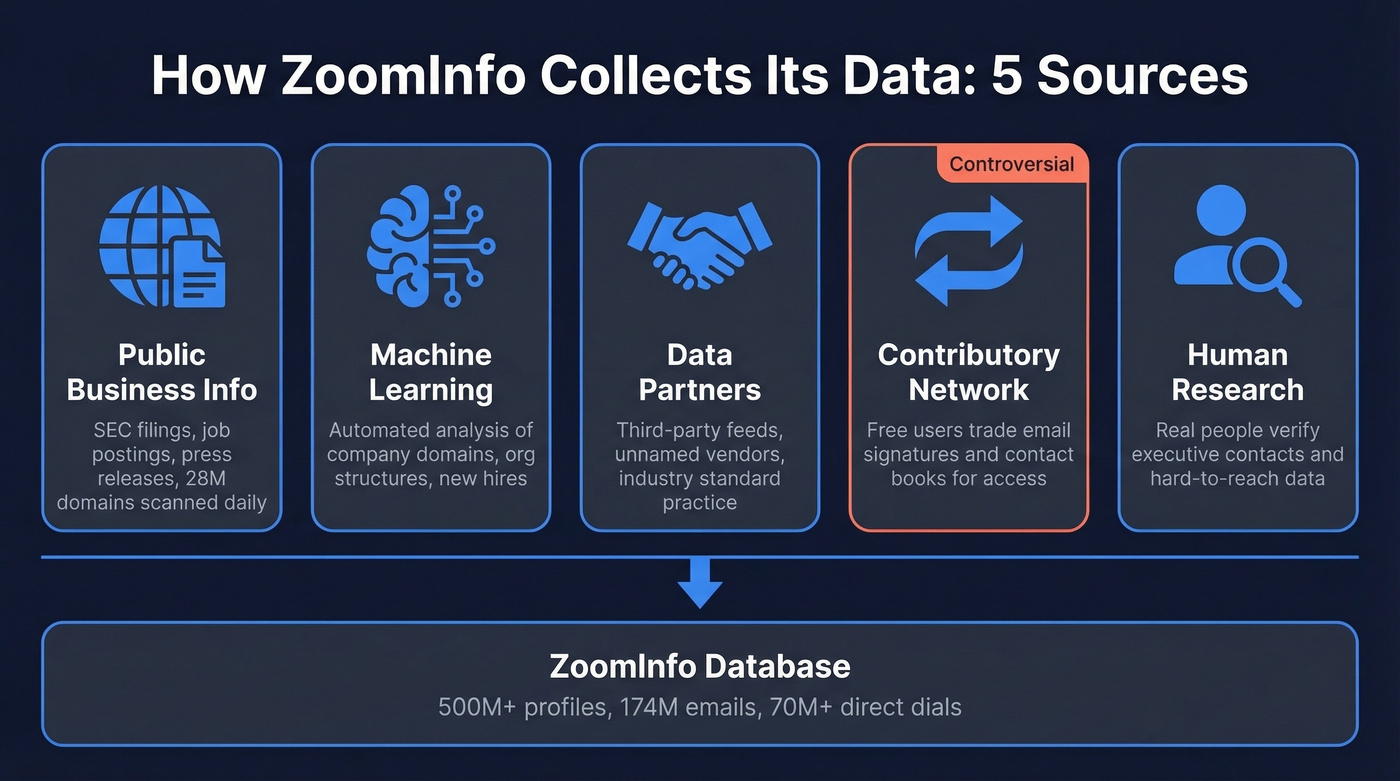
1. Public business information. Company websites, SEC filings, press releases, job postings - the kind of data anyone could find with enough time. ZoomInfo monitors 28 million website domains daily to catch changes.
2. Machine learning analysis. Automated ML systems analyze millions of company domains and other professional sources each day to infer org structures, identify new hires, and map reporting relationships.
3. Data partners. Third-party feeds supplement the proprietary data. ZoomInfo doesn't name these partners publicly, which is standard for the industry.
4. The contributory network (Lite/Community Edition). This is the controversial one. ZoomInfo Lite gives users free access in exchange for sharing professional contact details from email signature blocks and business contact books. Your contacts' data flows into ZoomInfo's database. It's legal, it's disclosed, and it's how they've built significant coverage - but your colleagues' email signatures are feeding the machine whether they know it or not.
5. Human research teams. Actual people verify and supplement the automated data, particularly for senior executives and hard-to-reach contacts.
ZoomInfo sends a notification to a person's business email address before or shortly after their data first appears. Whether people notice those emails is another question entirely.
Day-to-Day Usage Explained
Here's what happens when you log in - the part most articles skip.
You start with a search. Filters let you slice by title, industry, company size, location, technographics, and intent signals. Say you're looking for VP-level marketing leaders at SaaS companies with 200-1,000 employees using HubSpot. ZoomInfo gives you a list of matching contacts and accounts, and you can narrow it down further with intent filters before pushing the final list into your CRM and sales tools.
From there, you either export contacts to a CSV, push them into your CRM via native integrations, or use ZoomInfo workflows and signals to route accounts to the right reps and trigger follow-ups. The CRM sync is the real workhorse - most teams set up ongoing enrichment so new records get filled in automatically and existing records stay current. (If you're building this out, see our guide to CRM automation.)

The enrichment layer matters more than people realize. You're not just finding new contacts; you're cleaning and updating the thousands already sitting in your CRM. Job changes, new phone numbers, company moves - ZoomInfo catches these and pushes updates. But regardless of which platform you use for prospecting, verifying contact data before outreach is non-negotiable. We've seen teams burn sender reputation in weeks because they skipped verification. Prospeo runs real-time email verification with 98% accuracy, catching bounces, spam traps, and catch-all domains before they do damage. (More on tooling in our email verifier breakdown.)
ZoomInfo's AI Layer: Copilot and Workspace
Copilot is ZoomInfo's centerpiece AI feature in 2026. Here's what it actually does.
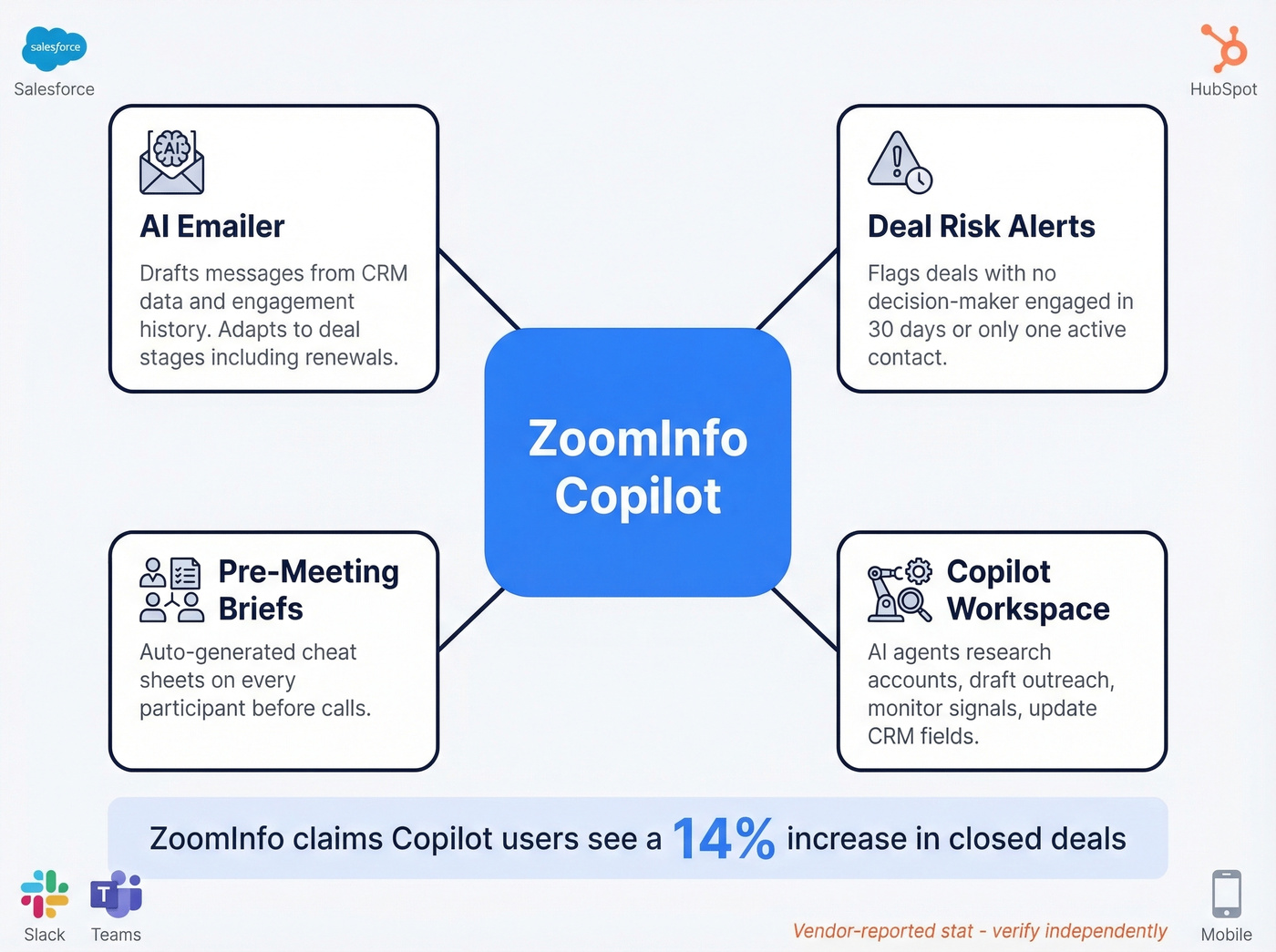
AI Emailer drafts messages using your CRM data, historical engagement patterns, and account insights. It adapts to deal stages, including renewals and upsells. The output still needs editing, but it's a meaningful time-saver for reps managing large books of business. (If you're evaluating similar tools, compare options in our AI email writer guide.)
Deal risk alerts flag opportunities where no decision-maker has been engaged in the first 30 days, or where the deal is single-threaded with only one active contact. Useful stuff.
Pre-meeting briefs generate participant overviews before calls - an auto-generated cheat sheet on everyone in the meeting.
Copilot Workspace consolidates all of this into a single execution layer where AI agents research accounts, generate follow-ups, monitor signals, draft outreach, and update CRM fields. Signals push into Salesforce and HubSpot and are available across Slack, Teams, mobile, and email - wherever your reps already work. Gartner predicts inbound search traffic will drop 25% by 2026 as AI answers replace clickthroughs, which partly explains why ZoomInfo is betting everything on outbound AI agents. (Related: our take on GTM AI.)
ZoomInfo says Copilot users see a 14% increase in closed deals. Take that with skepticism, but the direction is clear: AI features are becoming the justification for $35K+ contracts, not a bonus on top.

You're researching ZoomInfo because you need accurate B2B contact data. Before you sign a $15K+ annual contract, consider this: Prospeo delivers 98% email accuracy vs. ZoomInfo's 87%, refreshes data every 7 days instead of 6 weeks, and costs roughly $0.01 per email. No sales calls, no annual lock-in.
Get enterprise-grade data without the enterprise price tag.
Intent Data: Promise vs. Reality
Let's be honest - ZoomInfo's intent data is its most oversold feature.
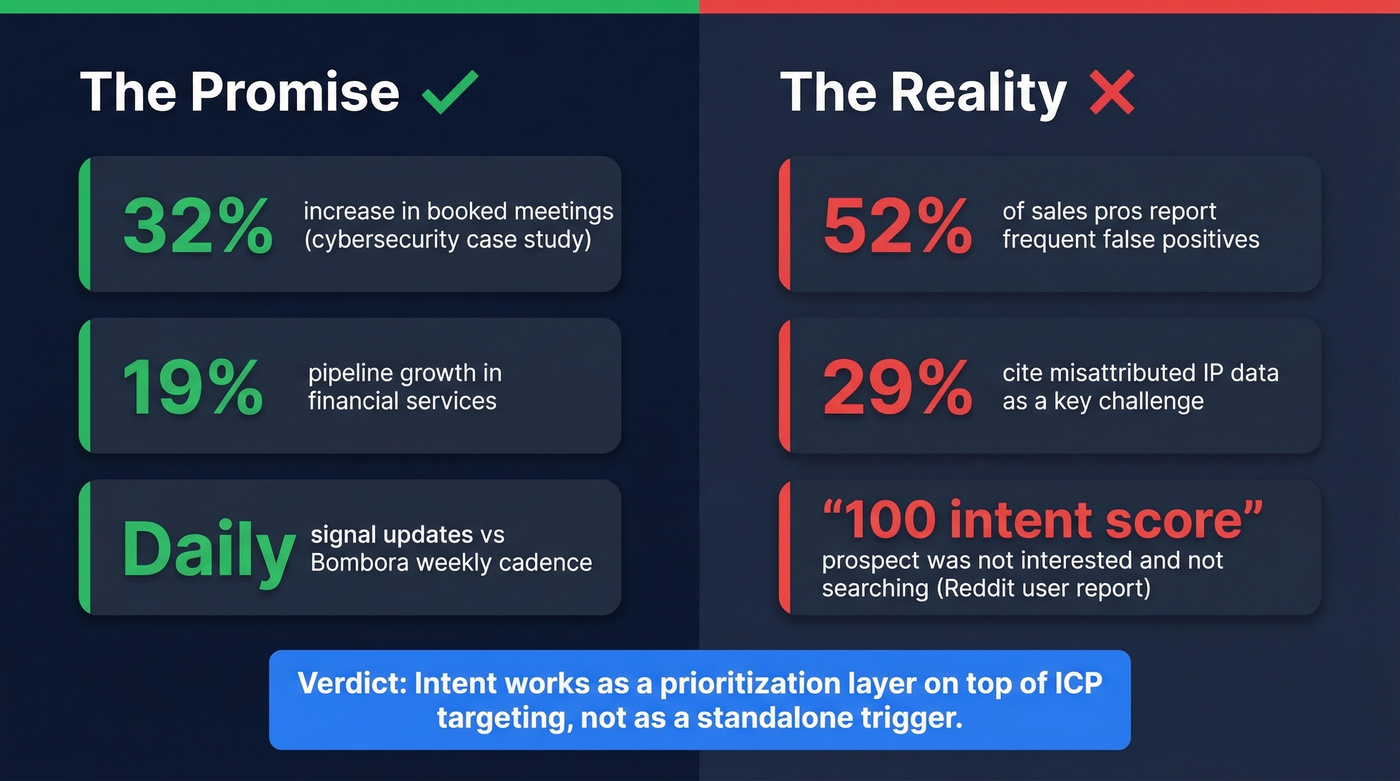
The system pulls from four sources: content consumption patterns, bidstream advertising data, IP-based web tracking that ZoomInfo brands as WebSights, and third-party review platforms. ZoomInfo updates intent signals daily, compared to Bombora's weekly cadence. (For a deeper framework, see contact-level intent data.)
Where it works: When validated against first-party data like your own website visits, demo requests, and content downloads, intent signals can be powerful. Case studies show a 32% increase in booked meetings for a cybersecurity firm and 19% pipeline growth in financial services - both using intent as a prioritization layer, not a standalone trigger.
Where it breaks: 52% of sales professionals report frequent false positives. 29% cite misattributed IP data as a key challenge - remote work and VPNs make IP-based tracking unreliable. One Reddit user reported calling prospects with a "100 intent score" and finding they weren't interested and weren't searching.
Our take: intent data works as a prioritization signal layered on top of solid ICP targeting. It doesn't work as a standalone prospecting trigger. If you're buying the Elite tier primarily for intent, pressure-test that decision hard before signing. (If you need help defining that target, use our Ideal Customer Profile guide.)
ZoomInfo Pricing in 2026
The fact that ZoomInfo still won't publish pricing tells you everything about their sales motion. But procurement data and community discussions give us a clear picture.
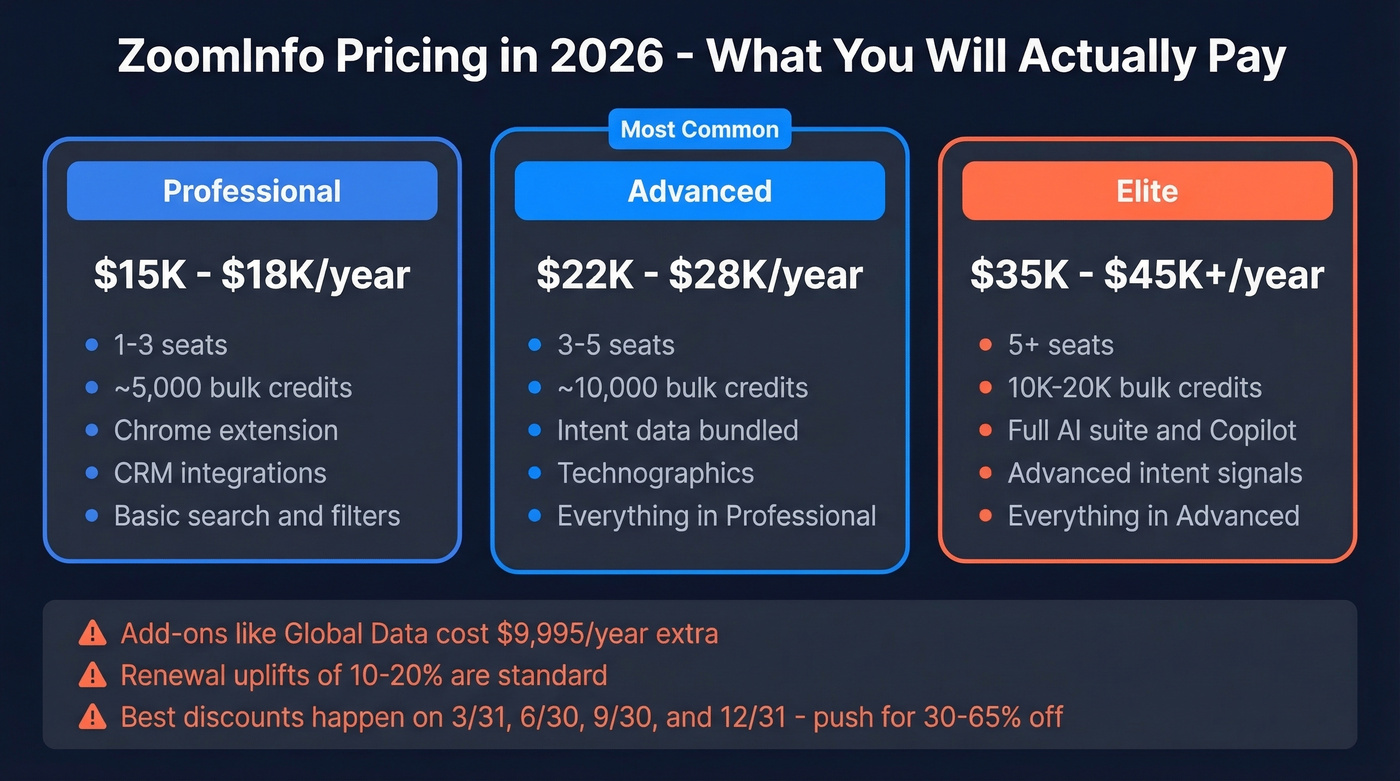
| Tier | Annual Cost | Seats | Bulk Credits | Key Additions |
|---|---|---|---|---|
| Professional | $15K-$18K | 1-3 | ~5,000 | Chrome extension, integrations |
| Advanced | $22K-$28K | 3-5 | ~10,000 | Intent and technographics commonly bundled |
| Elite | $35K-$45K+ | 5+ | 10K-20K | Full AI suite, advanced signals |
Add-ons stack up fast. Global Data runs $9,995/year. Additional users typically cost $1,500 each on Professional and $2,500 each on Advanced/Elite at list price.
Credit economics: Bulk credits cost $0.60 each at low volumes, dropping to ~$0.20 at 2.5M+ credits. The effective cost per contact lands around $1-3 depending on your tier and usage patterns. That "$2+ per contact" complaint you see on Reddit? Accurate for many teams.
Negotiation levers: Discounts of 30-65% are common, especially at end-of-quarter. The key dates are 3/31, 6/30, 9/30, and 12/31. Net-90 payment terms are possible if you push. Multi-year deals unlock deeper discounts but lock you in - and renewal uplifts of 10-20% are standard, so that "great deal" in year one gets expensive by year three. (If you want a structured way to negotiate, use interest-based negotiation.)
True Cost-Per-Reply Math
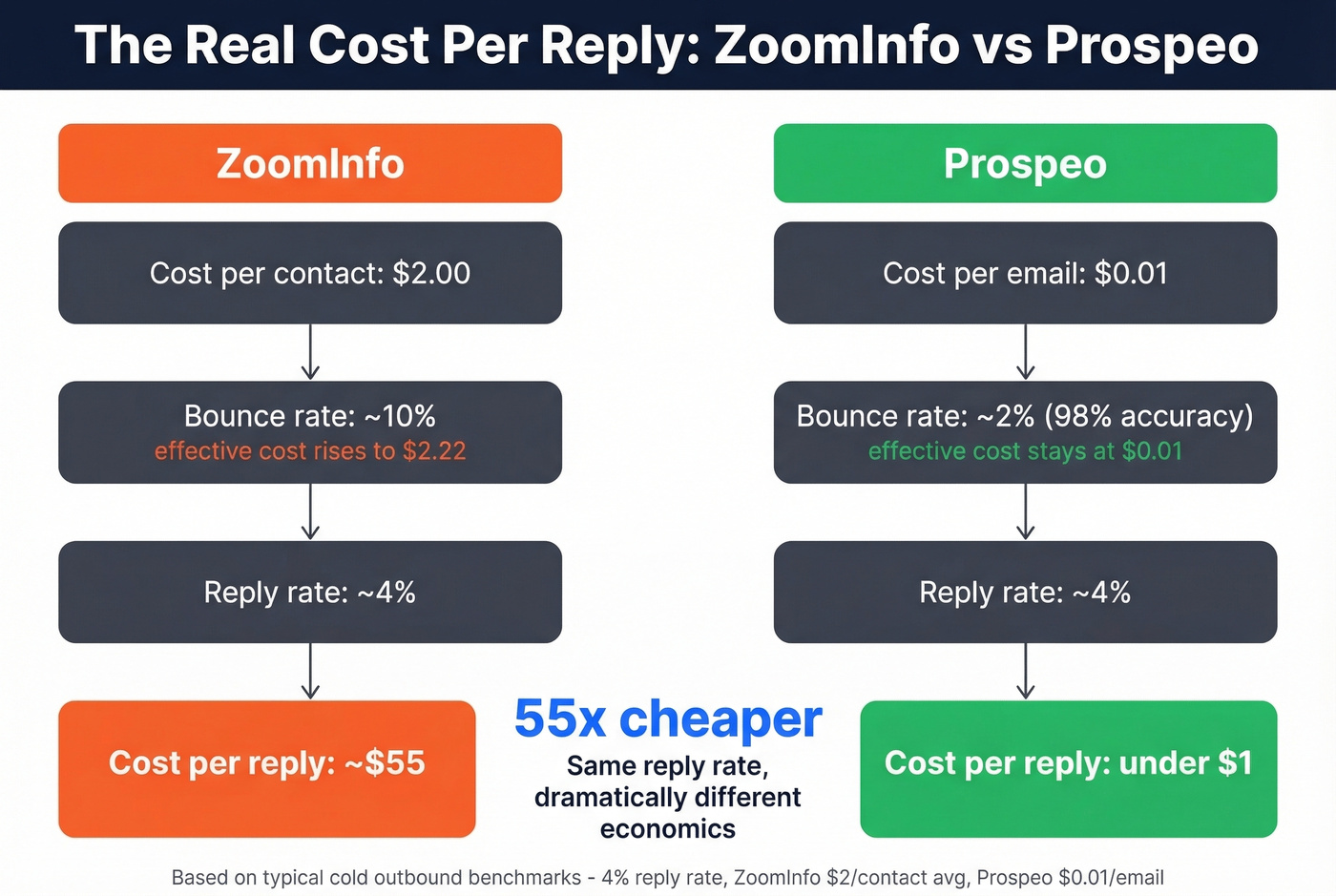
Here's a calculation we rarely see in other guides. Take your credit cost per contact ($1-3), multiply by your bounce rate (a common outbound benchmark is ~8-12%), then divide by your reply rate (typically 3-5% for cold outbound). On a $2/contact average with a 10% bounce rate and 4% reply rate, you're paying roughly $55 per reply. With Prospeo at ~$0.01/email and 98% email accuracy, that same reply costs under $1. (If you're troubleshooting bounces, start with check bounce.)
The math matters more than the feature list.
A 10-seat ZoomInfo contract with intent data and mobile numbers can easily run $40-60K/year. That's real money for a Series A company.
What Real Users Say
What people love:
- Contact information quality remains a top-rated theme on G2, with "ease of use" close behind
- Implementation averages about one month - fast for an enterprise tool
- The search interface is genuinely intuitive; reps get productive quickly
What people hate:
- "Outdated data" and "inaccurate contacts" are recurring G2 complaints across thousands of reviews
- Contract difficulty is a persistent theme: auto-renewals, cancellation friction, and surprise uplifts
- The Chrome extension has stability issues - one Reddit user reported it crashed a 32GB MacBook
The #1 complaint on Reddit? Phone numbers routing to general reception instead of the listed contact. When you're paying $2+ per contact, getting a switchboard operator is infuriating. Direct dial coverage looks great in the search results, but connect rates in practice run lower than you'd expect. The consensus on r/sales is that you should always verify a sample of numbers before committing to a full contract. (If your team is doing more calling, sharpen the basics with these phone sales skills.)
Privacy, Compliance, and the $29.55M Settlement
ZoomInfo settled a privacy class action for $29.55 million in Ramos v. ZoomInfo Technologies LLC, Case No. 1:21-cv-02032, N.D. Illinois. The settlement covered residents of California, Illinois, Indiana, and Nevada, with class periods ranging from January 2020 to March 2024. Final approval was granted November 13, 2024. ZoomInfo didn't admit wrongdoing.
On the compliance side, ZoomInfo lists ISO 27701 certification and is commonly described as holding ISO 27001 with annual TRUSTe/TrustArc validation. If you want your data removed, you can use their Privacy Center, email privacy@zoominfo.com, or call (833) 901-0859. (For a broader view, see our B2B compliance guide.)
The settlement doesn't mean ZoomInfo is doing anything illegal now. But your legal team will ask about it during procurement, and now you have the answer.
Is ZoomInfo Worth It?
Use ZoomInfo if:
- You have 20+ reps and a $30K+ annual budget for data
- You need intent signals, CRM enrichment, and automation in one platform
- Your GTM motion is complex enough to justify the feature breadth
- You have RevOps capacity to configure and maintain it (use this RevOps tech stack blueprint as a sanity check)
Skip ZoomInfo if:
- Your team is under 20 reps
- Your annual data budget is under $15K
- You primarily need verified contact data without the enterprise overhead
- You don't have someone dedicated to managing the platform
Here's a scenario we see constantly: a team signs a ZoomInfo contract, and six months in, half the direct dials go to reception. SDRs burn through credits faster than expected. The intent signals generate noise, not pipeline. And the renewal quote comes in 15% higher.
Now you know exactly how ZoomInfo works - the data pipeline, the AI layer, the pricing traps, and the real user experience. Whether it's the right fit depends entirely on your team size, budget, and tolerance for enterprise procurement cycles.
ZoomInfo's enrichment and intent features are powerful - but they come bundled into a $35K+ package. Prospeo gives you 300M+ profiles, 125M+ verified mobiles with 30% pickup rates, CRM enrichment at 92% match rate, and Bombora intent data across 15,000 topics. Teams using Prospeo book 26% more meetings than ZoomInfo users.
Stop overpaying for data that bounces. Switch to verified contacts.
Quick Alternatives Comparison
| Tool | Best For | Pricing | Contract |
|---|---|---|---|
| Apollo.io | All-in-one prospecting | Free tier, ~$49-99/mo | Monthly available |
| Cognism | European/global + GDPR workflows | ~$1K-3K/mo | Annual typical |
| Lusha | SMB simplicity | Free tier, ~$49/mo | Monthly available |
Apollo is the strongest all-in-one alternative - free tier, built-in sequencing, and a database of 275M+ contacts. It's the default for teams that want prospecting and outreach in one tool. Cognism is strong for EMEA data and GDPR workflows, with human-verified mobile numbers. Lusha is the simplest option for small teams that just need quick contact lookups without a learning curve.
FAQ
How does ZoomInfo get your phone number?
ZoomInfo combines public business records, ML analysis of company domains, data partner feeds, and its contributory network where Lite users share email signatures and contact books. Human research teams verify the automated data, particularly for senior-level contacts. The system monitors 28 million domains daily to catch changes.
Is ZoomInfo accurate?
It holds a 4.5/5 on G2 from 9,035 reviews, with "contact information" as a top-rated theme - but "outdated data" and "inaccurate contacts" are recurring complaints. Accuracy varies significantly by region; US data tends to be stronger than international. Always verify contacts before outreach regardless of source.
Is ZoomInfo legal?
Yes. ZoomInfo operates legally and provides opt-out methods through its Privacy Center. The company settled a $29.55M privacy class action in 2024 covering residents of California, Illinois, Indiana, and Nevada without admitting wrongdoing. It positions its governance around GDPR and CCPA alignment with ISO 27701 certification.