

How Marketing Can Help Sales: 7 Ways That Actually Move Pipeline
End of quarter. Marketing shows up with a deck: "We delivered 1,200 MQLs." Sales fires back: "Those leads are garbage - we booked 3 meetings." The VP of Revenue stares at the ceiling. This scene plays out every quarter, and the core problem is always the same: there's a black hole between "MQL" and "closed-won" where nobody knows what happened.
Understanding how marketing can help sales starts here: same stack, same fight. HubSpot + Salesforce, still no closed-loop visibility. Marketing can't prove influence, sales can't trace where leads came from, and leadership blames both.
Most alignment advice tells you to "communicate more." That's useless. Here's what actually works: operational handoffs, shared scoring, enforceable SLAs, and clean data. The fix is engineering, not vibes.
What You Need (Quick Version)
Three things separate aligned teams from dysfunctional ones:
- Shared definitions - what counts as a qualified lead, agreed by both sides
- An SLA with real deadlines - not a document that lives in a Google Doc nobody opens
- Clean data - verify emails and phones before CRM entry (see Email Bounce Rate benchmarks and fixes)
The payoff? SopRo's alignment roundup reports that aligned teams are 67% better at closing deals. A Pipeline360/Integrate survey found 80% of aligned teams reach their yearly goals.
The Alignment Gap in Numbers
An Influ2 study of 105 companies found that 53% have a broken hand-off - sales follows up with fewer than 35% of the prospects marketing already engaged. Only 11% of companies show both effective hand-off and high audience overlap, meaning in nearly nine out of ten organizations, marketing and sales are running separate playbooks against separate audiences.
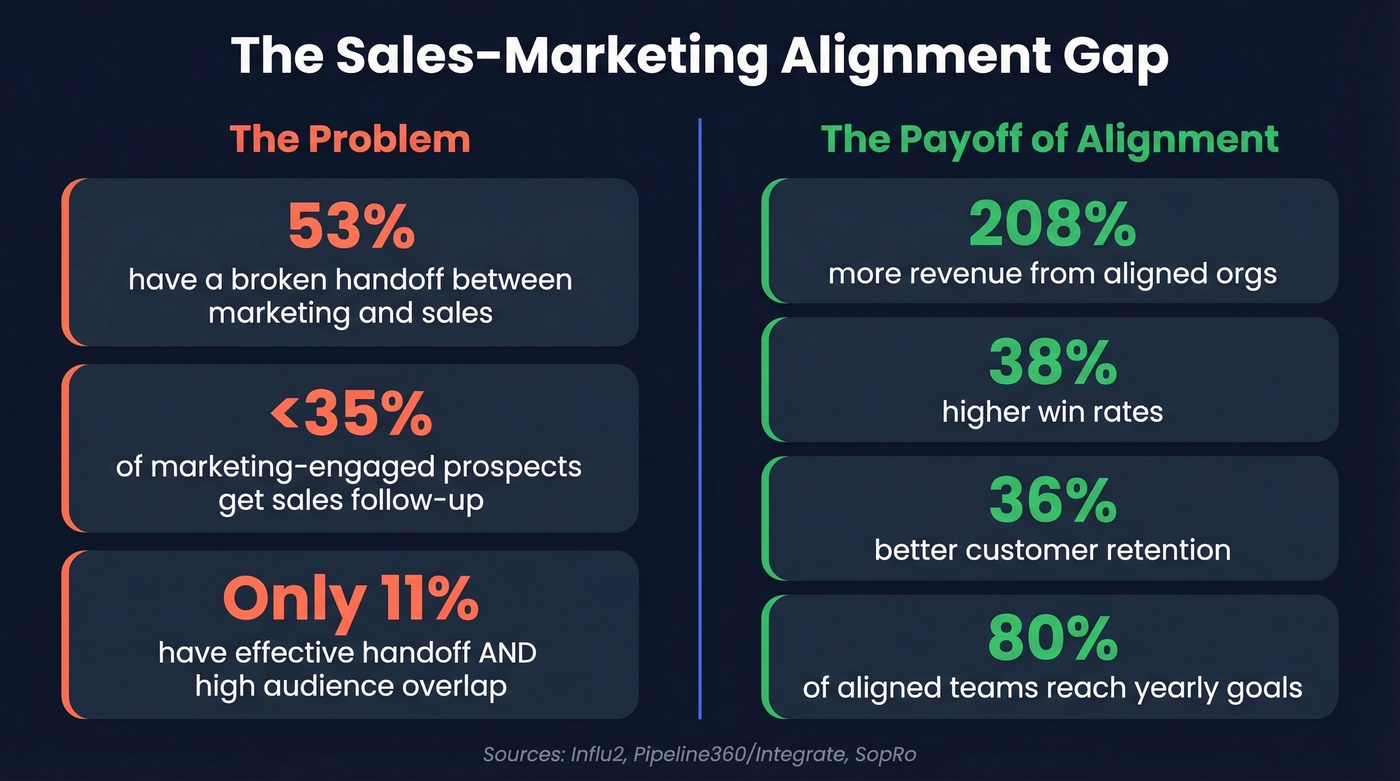
The revenue impact is brutal. Aligned organizations see up to 208% more revenue, 38% higher win rates, and 36% better retention. Among aligned teams using branded demand, 91% reached their target buying groups and 75% met their goals to a great or very great extent. This isn't a communication problem. It's an engineering problem.

The #1 reason MQLs die in the handoff? Bad contact data. Reps call wrong numbers, emails bounce, and marketing takes the blame. Prospeo delivers 98% verified emails and 125M+ direct dials - so every lead marketing passes actually connects to a real buyer.
Stop the blame game. Give sales leads that actually pick up.
7 Operational Plays to Bridge the Gap
1. Align on Revenue Targets, Not MQL Volume
The fastest way to break alignment is to give marketing a lead volume target and sales a revenue target. They'll optimize for different things and blame each other when the numbers don't connect.
The fix: tie marketing compensation to revenue outcomes. That could mean bonuses contingent on pipeline generated, or even a small commission on closed deals sourced from marketing campaigns. When both teams are measured on the same number, the arguments about lead quality versus quantity disappear.
Here's the thing: if your average deal size is under $15K, you probably don't need a complex attribution model. Just split the pipeline number 50/50 and hold both teams accountable. The argument over who gets credit is costing you more than the credit is worth.
2. Build a Lead Scoring Model Together
The single biggest source of "your leads suck" arguments is the absence of a shared scoring model. Build one together - marketing brings engagement data, sales brings deal pattern knowledge. If you need a deeper framework, start with a simple lead scoring rubric and iterate quarterly.
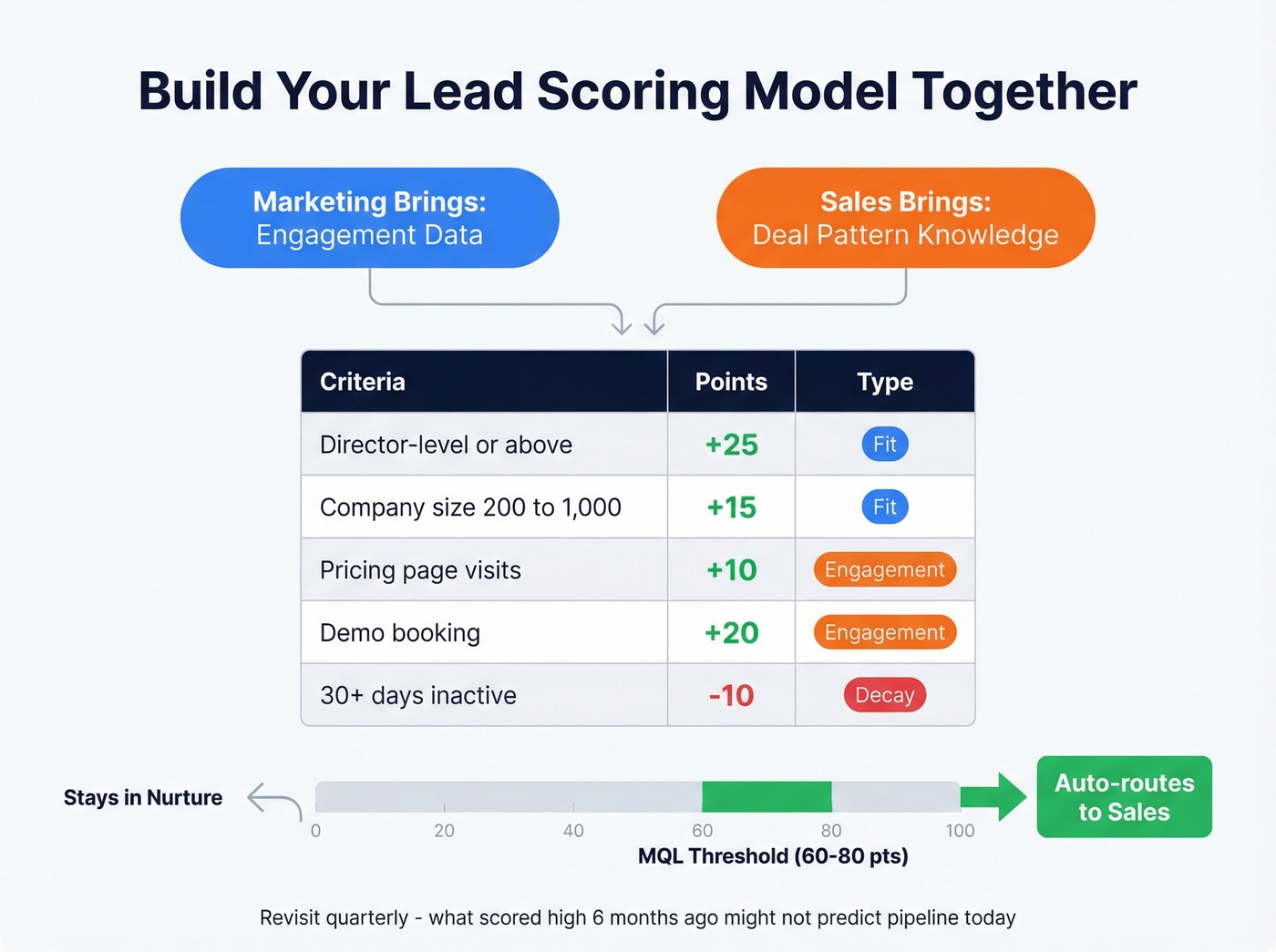
| Criteria | Points | Type |
|---|---|---|
| Director-level or above | +25 | Fit |
| Company size 200-1,000 | +15 | Fit |
| Pricing page visits | +10 | Engagement |
| Demo booking | +20 | Engagement |
| 30+ days inactive | -10 | Decay |
Set the MQL threshold at 60-80 points. When a lead crosses that line, it routes to sales automatically. No debate, no subjective judgment calls. Revisit the model quarterly - what scored high six months ago might not predict pipeline today.
3. Create an SLA With Real Deadlines
Only 11% of companies have jointly managed SLAs between sales and marketing. That's why the blame game persists. A real SLA looks like this:
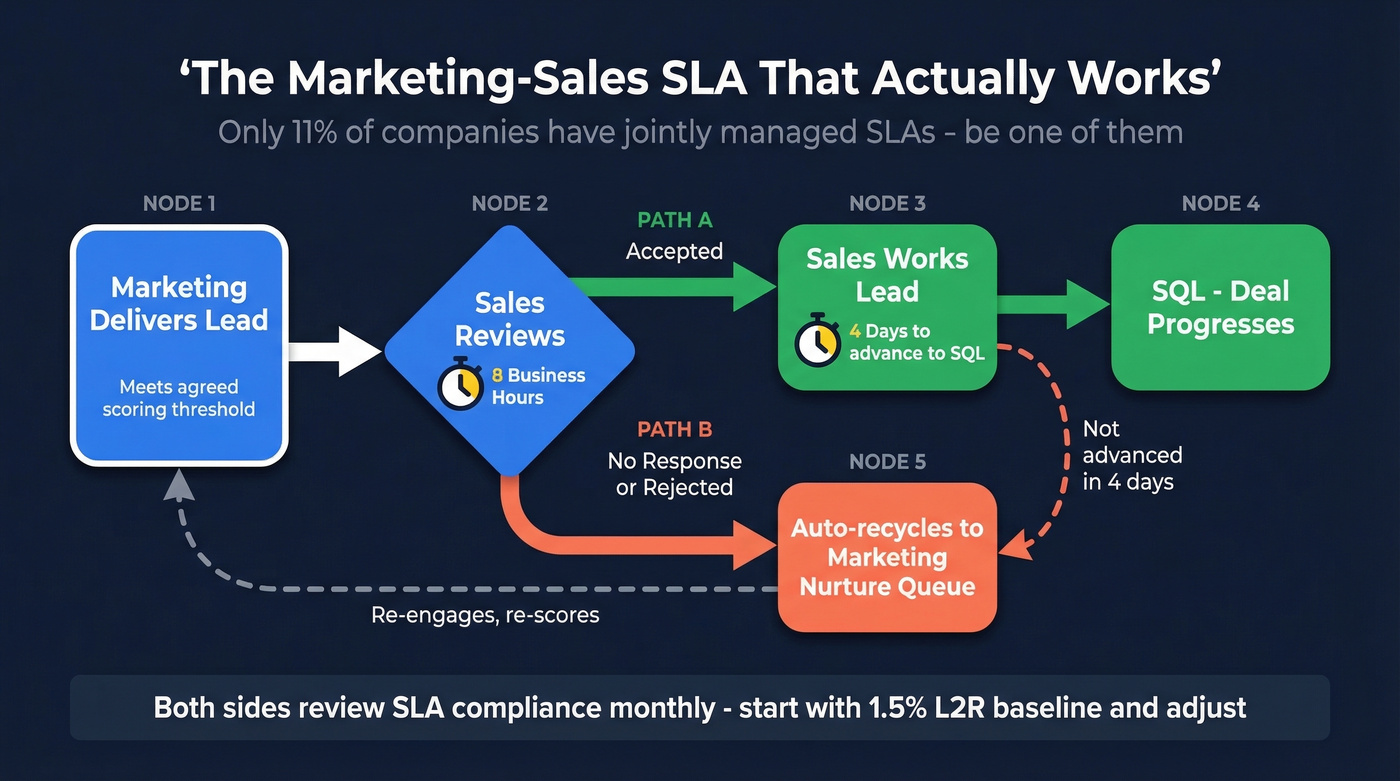
- Marketing delivers leads that meet the agreed scoring threshold
- Sales accepts or rejects each MQL within 8 business hours - if not, it auto-recycles to a nurture queue owned by marketing ops
- Sales advances accepted leads to SQL within 4 days or they revert to the nurture queue
- Both sides review SLA compliance monthly
If you don't have lead-to-revenue data yet, start with a 1.5% L2R conversion rate as your baseline and adjust from there. The SLA doesn't need to be perfect - it needs to exist and have consequences. (If you're building the ops layer, a lead generation workflow map helps.)
4. Produce Enablement Content Reps Actually Use
Reps spend up to 15 hours per week searching for content across disconnected tools. That's nearly two full days lost to findability, not selling. Aberdeen Research found that 42% of best-in-class companies use sales playbooks versus just 14% of laggards - consistent support from marketing in the form of ready-to-use assets eliminates this drag.
Marketing should prioritize three content types that reps actually pull into deals: competitor battle cards built around the competitors sales encounters most often, persona-specific case studies that aren't five versions of the same industry win, and messaging frameworks organized by funnel stage. (If you want a tighter system, build a lightweight marketing enablement program.)
Store playbooks in a single hub - Notion, Confluence, or your CRM's content library. Tag every asset by persona, funnel stage, and competitor. Give reps a Slack channel to request updates, and track usage through view counts and deal-attach rates. If reps aren't using your content, it's a relevance problem, not a training problem. The attach rate tells you which assets are dead weight.
5. Run Demand Gen to Warm the Market
Most marketing teams are stuck on the MQL hamster wheel - gate everything, capture emails, throw them over the wall. Demand gen works differently. It's ungated content designed to build awareness so that when prospects enter a buying cycle, your brand is already on the shortlist.
Cognism ran this experiment internally: a £5,000/month test budget for four months on ungated demand-gen plays, optimizing for consumption rather than conversions. The result was a 47% increase in high-intent demo requests over three months. That's how marketing supports sales without just taking orders - by warming the market before reps ever pick up the phone.
You've probably heard the "95:5 rule" - the idea that only 5% of buyers are in-market at any time, commonly attributed to Professor John Dawes at the Ehrenberg-Bass Institute. But 6sense analyzed 594 B2B companies and found roughly 40% of accounts show meaningful buying activity at any given time. The real problem isn't that buyers don't exist - it's the "Dead Zone" where accounts show intent but lose momentum internally. Run demand gen and lead gen together. Don't pick one. (For more, track lead generation trends that are reshaping budgets.)
6. Share Inbound Insights for Personalization
When marketing hands off a lead with nothing but a name and email, sales is flying blind.
The fix is sharing page-level attribution data, past disqualification reasons, and any intent signals the lead triggered. A rep who knows a prospect downloaded a competitor comparison guide and visited the pricing page twice has a completely different opening than one working off a cold list. Turning inbound insights into actionable context is what separates warm outreach from spray-and-pray. We've seen teams cut their first-call prep time in half just by surfacing this data in the CRM record automatically - no extra clicks, no digging through marketing dashboards. (This pairs well with personalized outreach systems.)
7. Fix the Data (The Silent Alignment Killer)
An SDR sits down Monday morning with 30 "hot leads" from marketing's latest campaign. Forty-five minutes later: 11 emails bounced, 8 phone numbers disconnected, 6 were the wrong person entirely. One meeting booked. The SDR blames marketing. Marketing blames the database. Nobody blames the actual problem - stale contact data.
If your bounce rate is above 5%, you don't have an alignment problem. You have a data problem. Prospeo handles this at the infrastructure level: 98% email accuracy, a 7-day data refresh cycle versus the six-week industry average, and an 83% enrichment match rate that fills in the gaps before leads hit your CRM. It also returns 50+ enrichment data points per contact and includes 125M+ verified mobile numbers with a 30% pickup rate when email isn't enough. If you're comparing vendors, start with these data enrichment services.
In our experience, the results speak for themselves. Snyk's team of 50 AEs cut their bounce rate from 35-40% to under 5%, increased AE-sourced pipeline 180%, and now generates 200+ new opportunities per month.
Even a perfect SLA and a brilliant scoring model fall apart when reps can't reach the people marketing sends them. Data quality is the foundation everything else sits on. (If you're diagnosing deliverability, use an email deliverability guide to find the root cause.)
What Sales Must Do in Return
Alignment isn't one-directional. Marketing can deliver perfect leads, but the system breaks if sales doesn't hold up its end.
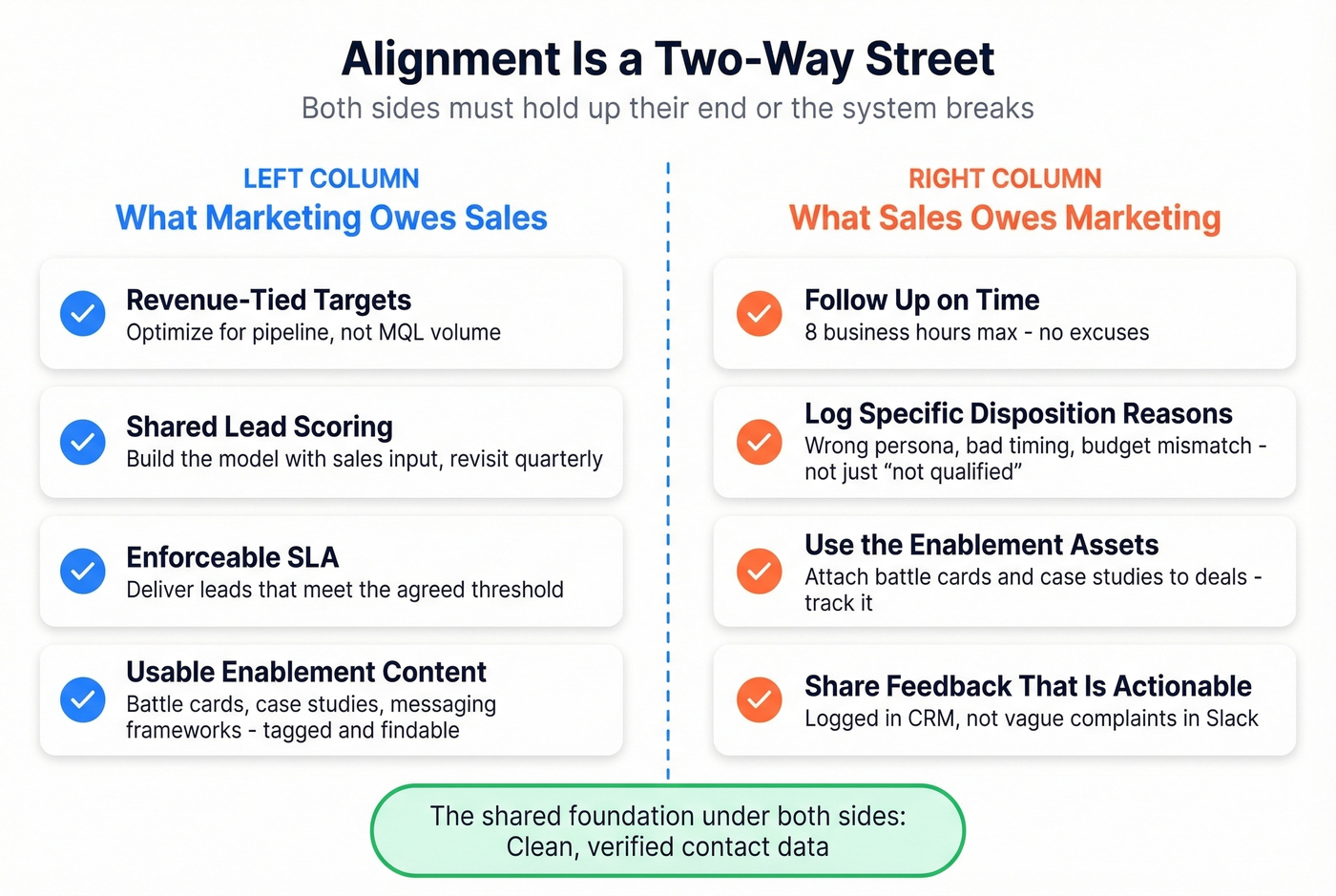
Follow up on time. If the SLA says 8 business hours, that means 8 business hours. Not "I'll get to it after my pipeline review." Speed-to-lead is the single highest-leverage variable in conversion, and every hour of delay drops contact rates measurably. If reps need structure, standardize sales follow-up templates.
Log disposition reasons. When sales rejects a lead, "not qualified" isn't feedback - it's a dead end. Require specific reasons: wrong persona, bad timing, already a customer, budget mismatch. This data is how marketing improves targeting. Without it, the next campaign repeats the same mistakes. The best feedback from sales to marketing is specific, logged, and actionable - not vague complaints in a Slack thread.
Use the enablement assets. If marketing built battle cards and case studies based on sales feedback, reps need to actually attach them to deals. Track it. If attach rates are low, the content needs work. If reps aren't even opening the hub, that's a management problem.
Your Weekly Alignment Checklist
- Weekly standup (15 min): Review MQL-to-SQL conversion, flag stuck leads, share rep feedback on lead quality. Keep it in Slack if calendars are packed.
- Monthly funnel review: Full pipeline audit from top to bottom. Check SLA compliance - what percentage of leads got follow-up within the agreed window? (Use pipeline health metrics to spot leaks fast.)
- Quarterly ICP refresh: Update the scoring model based on win/loss patterns. Kill criteria that aren't predicting revenue. Add new signals that are. A simple Ideal Customer Profile template makes this repeatable.
The cadence matters more than the format. A 15-minute standup that actually happens beats a 90-minute quarterly offsite that produces a deck nobody reads.
Let's be honest - these rituals feel like overhead until the first month you catch a broken hand-off before it costs you pipeline. Start Monday: pick one play from the seven above, draft the SLA, and audit your bounce rate. That's enough to shift the dynamic within a single quarter.
Your SLA means nothing if 35% of emails bounce. Meritt cut their bounce rate from 35% to under 4% with Prospeo and tripled pipeline from $100K to $300K/week. Clean data at $0.01/email - refreshed every 7 days, not every 6 weeks.
Align marketing and sales on data both teams trust.
FAQ
What's the fastest way to align sales and marketing?
Build a shared SLA with concrete deadlines - sales accepts or rejects MQLs within 8 business hours, advances to SQL within 4 days. This single document eliminates most blame-game arguments because both sides have measurable commitments. Start simple, then iterate quarterly based on conversion data.
How do you measure sales and marketing alignment?
Track three metrics: MQL-to-SQL conversion rate, lead-to-revenue conversion rate, and SLA compliance percentage. If your hand-off rate is below 35% - Influ2's threshold for "effective" - alignment is broken regardless of what your dashboards say. Review these numbers monthly.
How does data quality affect alignment?
Bad contact data is the silent alignment killer. If emails bounce and phones are disconnected, sales can't work marketing's leads and blames lead quality instead. Verifying contacts before CRM entry ensures leads are actually reachable when reps follow up, which is why we recommend baking verification into your enrichment workflow rather than treating it as an afterthought.
What content should marketing create for sales teams?
Prioritize three asset types: competitor battle cards updated monthly, persona-specific case studies mapped to your top verticals, and objection-handling frameworks organized by deal stage. Aberdeen Research found 42% of best-in-class companies use playbooks versus 14% of laggards - the gap is asset relevance, not volume.