

How to Build a Go-to-Market Strategy in 2026
You launched 72 hours ago. Three signups. Your Slack is quiet, your ad spend is bleeding, and the investor update is due Friday. The product isn't the problem - your go-to-market strategy is.
Stop copying enterprise playbooks built for 200-person sales orgs. Build a GTM motion that fits your stage, your budget, and your actual buyer. 70% of companies now run AI in their GTM workflows, CAC has climbed 60% over five years, and the channels that worked a few years ago are either saturated or significantly more expensive. The playbook needs a rewrite.
What a GTM Strategy Actually Is
A go-to-market strategy isn't a marketing plan with a fancier name. Marketing is one component. GTM is the entire system - positioning, sales motion, pricing, distribution, channel selection, and timing - working together to create what Vivaldi's framework calls a "Customer Gravity Map": a living document that identifies where buying energy concentrates.
The old model treated GTM like a relay race. Product hands off to marketing, marketing hands off to sales, sales hands off to customer success. That model is dead. Modern buyers research across multiple channels before your sales team even knows they exist, and B2B buying committees now run 6-10 stakeholders deep. Your GTM has to be an integrated architecture, not a sequence of handoffs.
If your pricing contradicts your positioning, or your sales motion doesn't match your buyer's procurement process, no amount of marketing spend fixes the problem. GTM is the architecture. Everything else is decoration.
Quick-Start Summary
Nine steps, one north-star metric: an LTV:CAC ratio of at least 3:1. If you can't hit that, your GTM has a structural problem - not a tactical one. Bookmark this and come back.
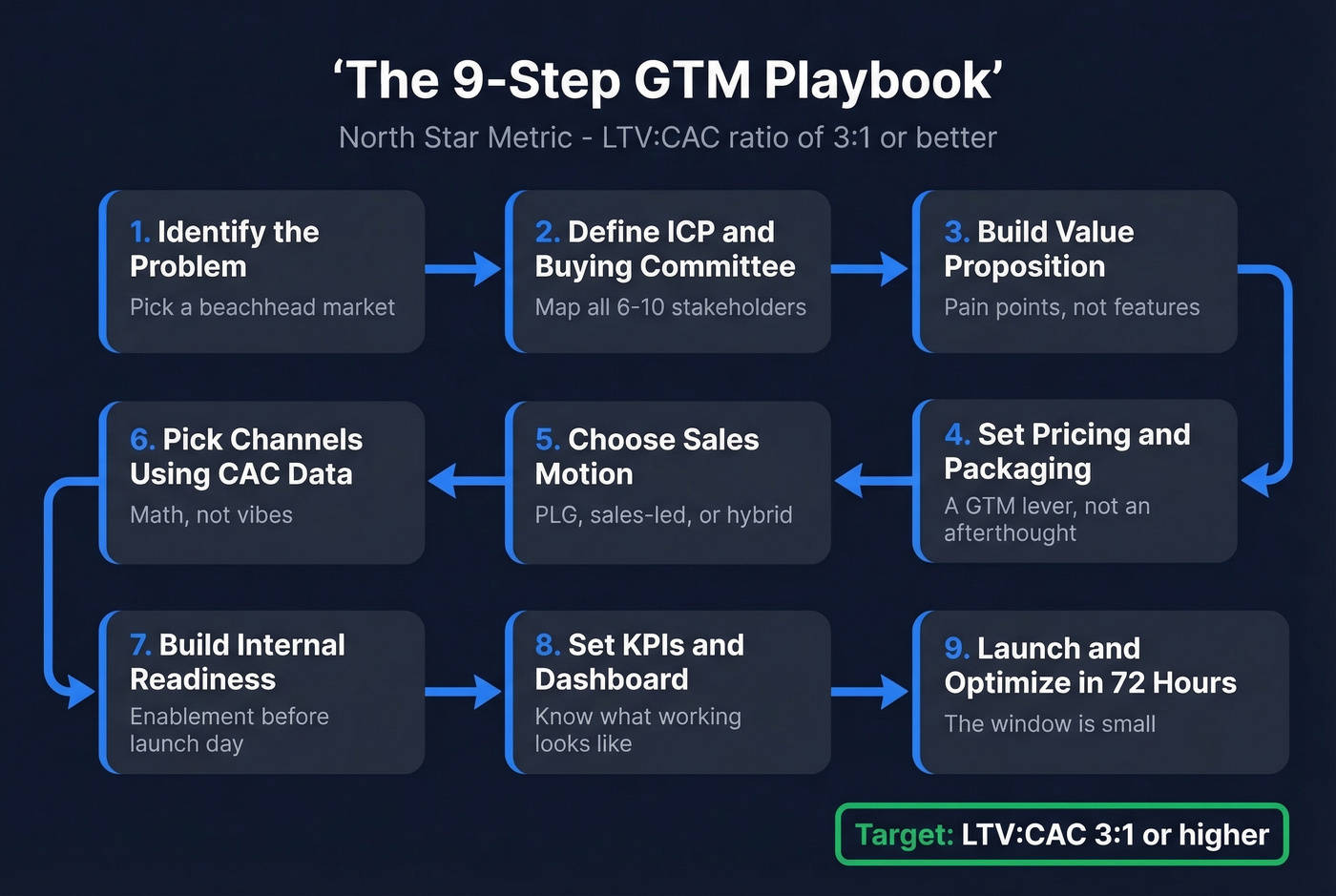
- Identify the problem - pick a beachhead market, not "all SMBs"
- Define your ICP and buying committee - who actually signs the check
- Build your value proposition - pain points, not feature lists
- Set pricing and packaging - this is a GTM lever, not an afterthought
- Choose your sales motion - PLG, sales-led, or hybrid
- Pick channels using CAC data - math, not vibes
- Build internal readiness - enablement before launch day
- Set KPIs and build your dashboard - know what "working" looks like
- Launch and optimize in the first 72 hours - the window is smaller than you think
9 Steps to Build Your GTM Plan
Step 1 - Identify the Problem
Every failed GTM we've seen starts the same way: the team builds a strategy around what the product does instead of what problem it solves for a specific buyer. "We help businesses communicate better" isn't a strategy. "We help 50-200 person remote engineering teams reduce Slack noise by 40%" is.
Pick a beachhead market - one segment narrow enough that you can dominate it before expanding. CAC is up 40-60% since 2023 in many channels, and broad targeting makes it worse because you're spreading budget across segments and winning none of them. Geoffrey Moore wrote about this decades ago. It's still the most common mistake founders make.
Step 2 - Define Your ICP and Buying Committee
B2B and B2C buying look nothing alike. In B2C, one person decides in minutes. In B2B, you're navigating 6-10 stakeholders across a 6-12 month cycle. The CFO cares about ROI. IT cares about security and integration. Ops cares about workflow disruption. Legal reviews the DPA. End users care about whether it actually makes their day easier.
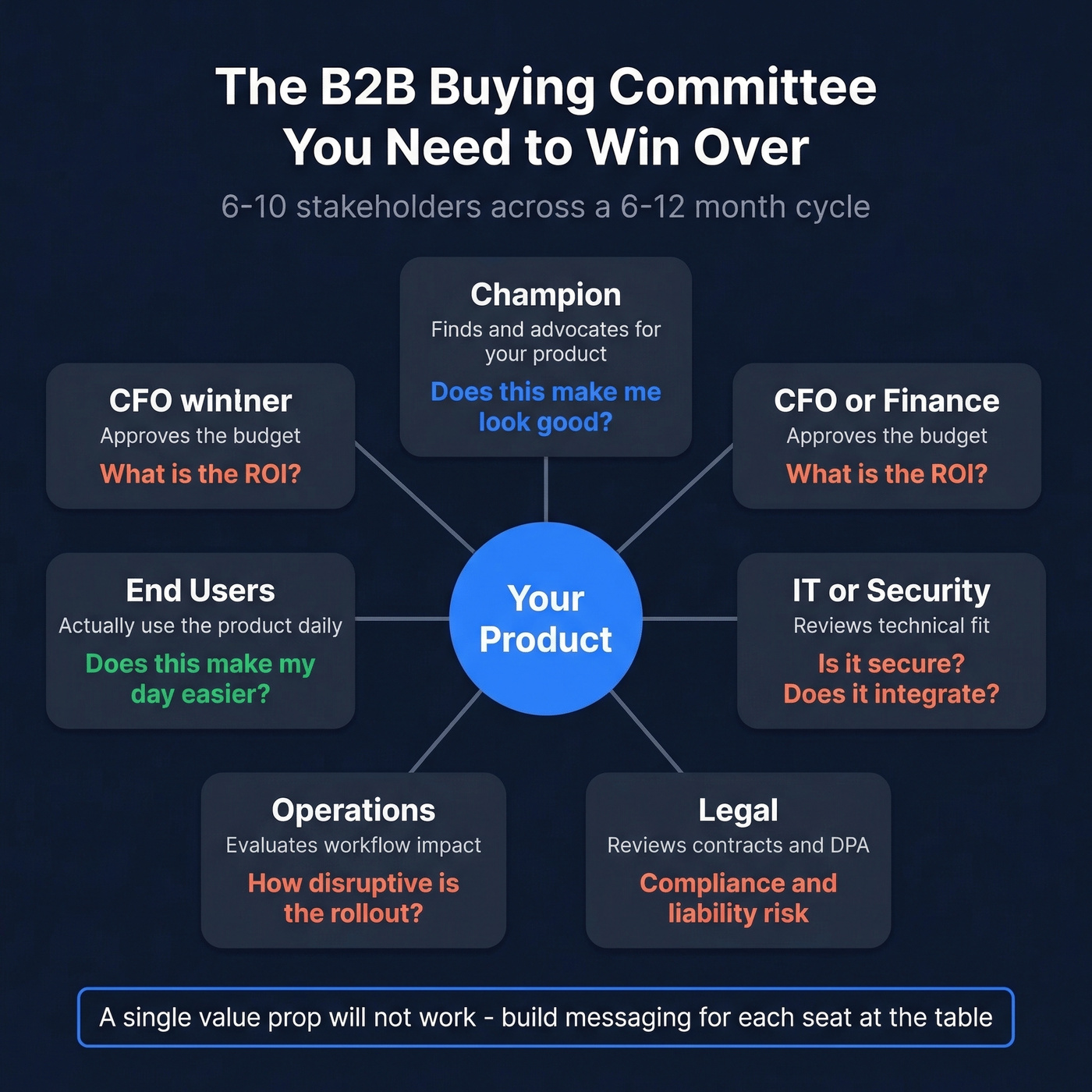
Your ICP document needs to map each of these stakeholders: their role in the decision, their objections, and the messaging that moves them. A single value prop won't work when the person evaluating your product isn't the person signing the contract. Build messaging for each seat at the table, not just the champion.
If you need a starting point, use an ICP document template and score prospects consistently.
Step 3 - Build Your Value Proposition
The most common messaging mistake is leading with features instead of pain points. "AI-powered analytics dashboard with real-time insights" tells the buyer nothing about why they should care. "Your team wastes 6 hours a week building reports that nobody reads - we cut that to 20 minutes" tells them everything.
Test your messaging before launch. Run it past 10-15 prospects in your ICP. If they can't repeat your value prop back to you in their own words, it's not clear enough. The best value propositions sound like something your buyer already says in internal meetings.
If you're tightening positioning, a clear B2B brand positioning framework helps you avoid feature-first messaging.
Step 4 - Set Pricing and Packaging
Pricing isn't something you figure out after the product is built. It's a GTM lever that shapes perception, conversion, and expansion revenue. Packaging strategy - how you bundle, tier, and present your offering - directly impacts whether a prospect can self-serve or needs a sales call.
Tiered pricing works for most B2B SaaS. Freemium works when the free tier creates genuine value and a natural upgrade trigger. Here's the thing most founders get wrong: underpricing backfires more often than overpricing. One founder priced 70% below competitors and watched conversion drop - buyers assumed the product was inferior. Price to signal the value you deliver, not to win on cost.
Step 5 - Choose Your Sales Motion
Product-led growth is not a shortcut. PLG works when your buyer can evaluate the product independently, the time-to-value is short, and the purchase doesn't require procurement approval. If you're selling into industries with six-month evaluation periods and mandatory security reviews, self-serve assumptions will fail.
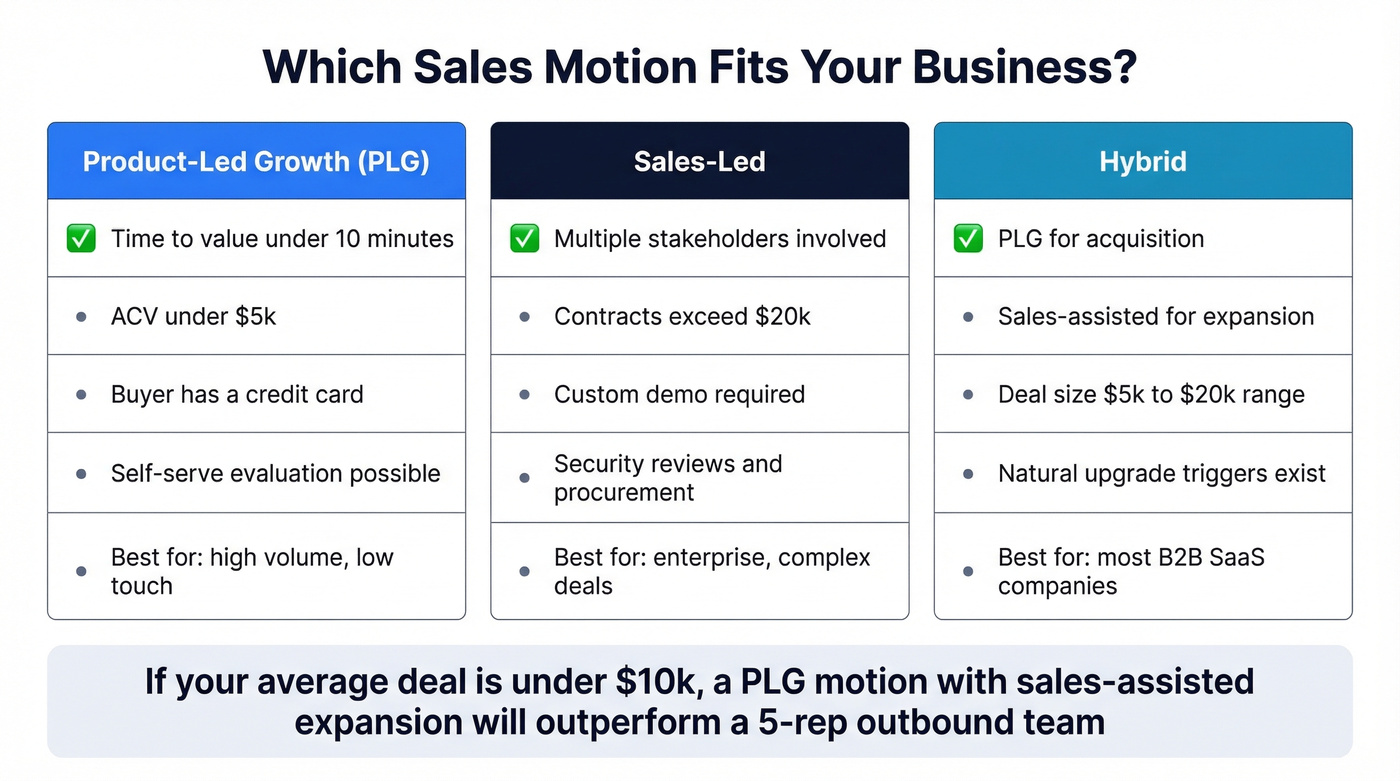
Use PLG if: your product delivers value in under 10 minutes, your ACV is under $5k, and your buyer has a credit card.
Use sales-led if: deals involve multiple stakeholders, contracts exceed $20k, or the buyer needs a custom demo to understand the product.
Use hybrid if: you want PLG for acquisition and sales-assisted for expansion - which is where most successful B2B SaaS companies land eventually.
If your average deal size sits below $10k, you probably don't need a full sales team at all. A well-built PLG motion with sales-assisted expansion will outperform a 5-rep outbound team every time at that price point. Save the headcount for when deal sizes justify it.
If you're building a sales-led motion, align it with proven B2B sales benchmarks and qualification.
Step 6 - Pick Channels Using CAC Data
This is where most GTM strategies fall apart. Teams pick channels based on what they've seen other companies do, not on what the math says. Founders on r/ycombinator regularly ask about "smarter routes" beyond the obvious channels - the answer is almost always: test with real money before committing. Let's look at the actual numbers.
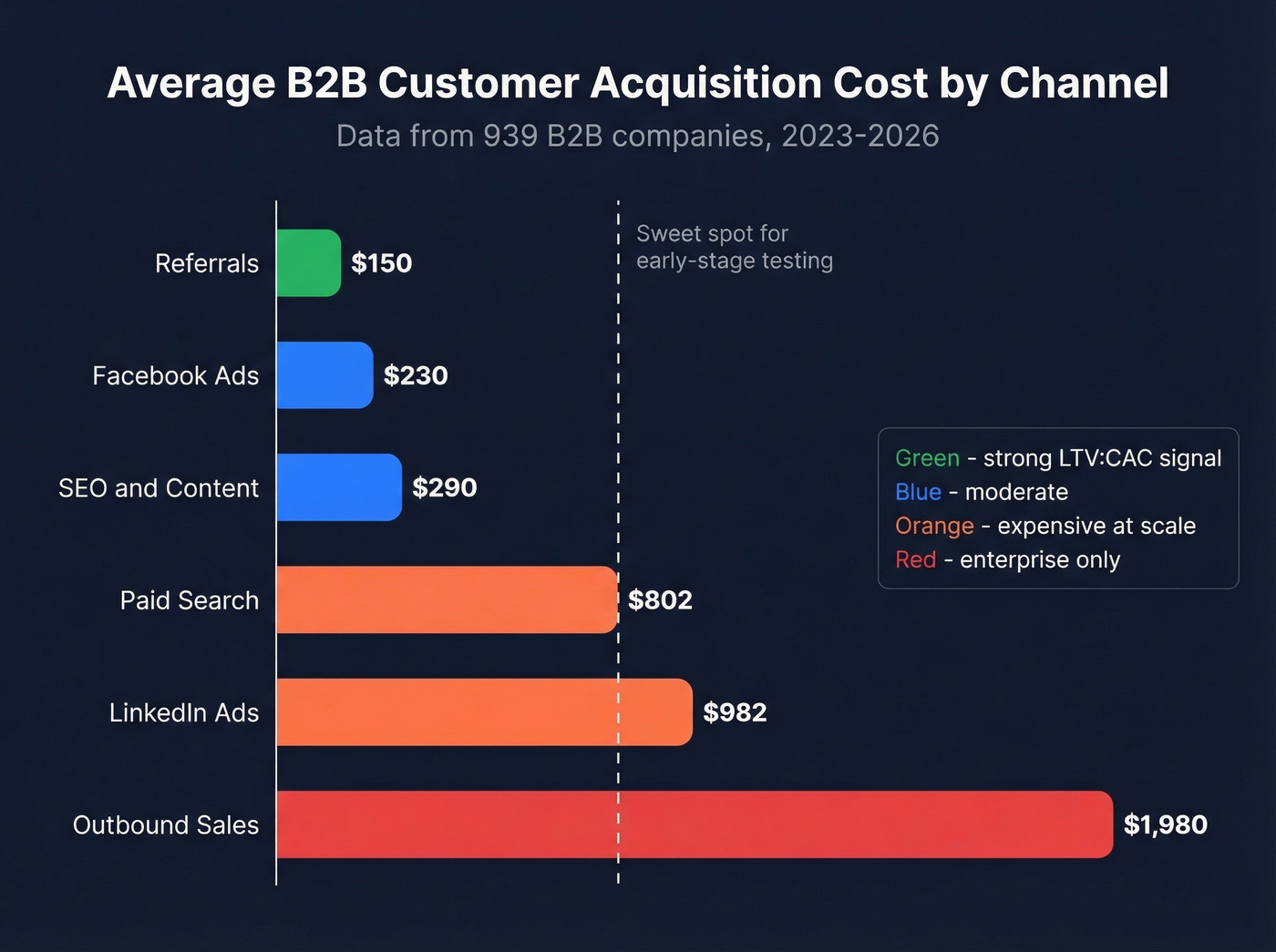
| Channel | Avg. B2B CAC | Best For | Risk |
|---|---|---|---|
| SEO / Content | $290 | Long-term compounding | Slow ramp (6-12 mo) |
| Referrals | $150 | Post-PMF growth | Needs happy users |
| Facebook Ads | $230 | Broad B2B awareness | Attribution issues |
| Paid Search | $802 | High-intent capture | Expensive at scale |
| LinkedIn Ads | $982 | B2B targeting | High CPL, slow payback |
| Outbound Sales | $1,980 | Enterprise, high ACV | Data quality dependent |
Data aggregated from Phoenix Strategy Group's channel benchmarks across 939 B2B companies.
Start with 2-3 channels. Successful B2B SaaS companies average 5 core channels plus roughly 5.5 experimental ones, but they didn't start there. In our experience, teams that skip the $500 channel test end up committing $10k to a channel that never works. Run a small test on each channel before committing real budget. If the CAC doesn't trend toward your 3:1 LTV:CAC target within the first 30-60 days, kill it and move on.
The LTV:CAC 3:1 rule isn't arbitrary. Below 3:1, you're spending too much to acquire customers relative to what they're worth. Above 5:1, you're underinvesting in growth. Use this ratio as your channel filter, not gut instinct.
If you want a deeper breakdown of CAC math, see our guide to cost to acquire customer.
Step 7 - Build Internal Readiness
The gap between "strategy approved" and "team ready to execute" kills more launches than bad positioning. Sales needs playbooks, objection-handling scripts, and competitive battle cards before day one. Partners need co-marketing assets. PR needs embargo timelines. Everyone needs a shared readiness tracker.
The most common cross-functional failure we see: marketing generates leads with one message, sales pitches a different value prop, and the buyer gets confused enough to stall the deal. Build verified prospect lists before your outbound team launches so reps start with signal, not guesses.
If you're formalizing enablement, build a lightweight marketing enablement system before launch.
- Sales playbooks and objection scripts complete
- Partner co-marketing assets delivered
- PR coordination and embargo schedule locked
- Prospect lists built and verified
- Shared readiness tracker visible to all teams
Step 8 - Set KPIs and Build Your Dashboard
"Revenue" isn't a KPI - it's an outcome. Here are the benchmarks that separate top-quartile GTM teams from the median, per ICONIQ's latest data:
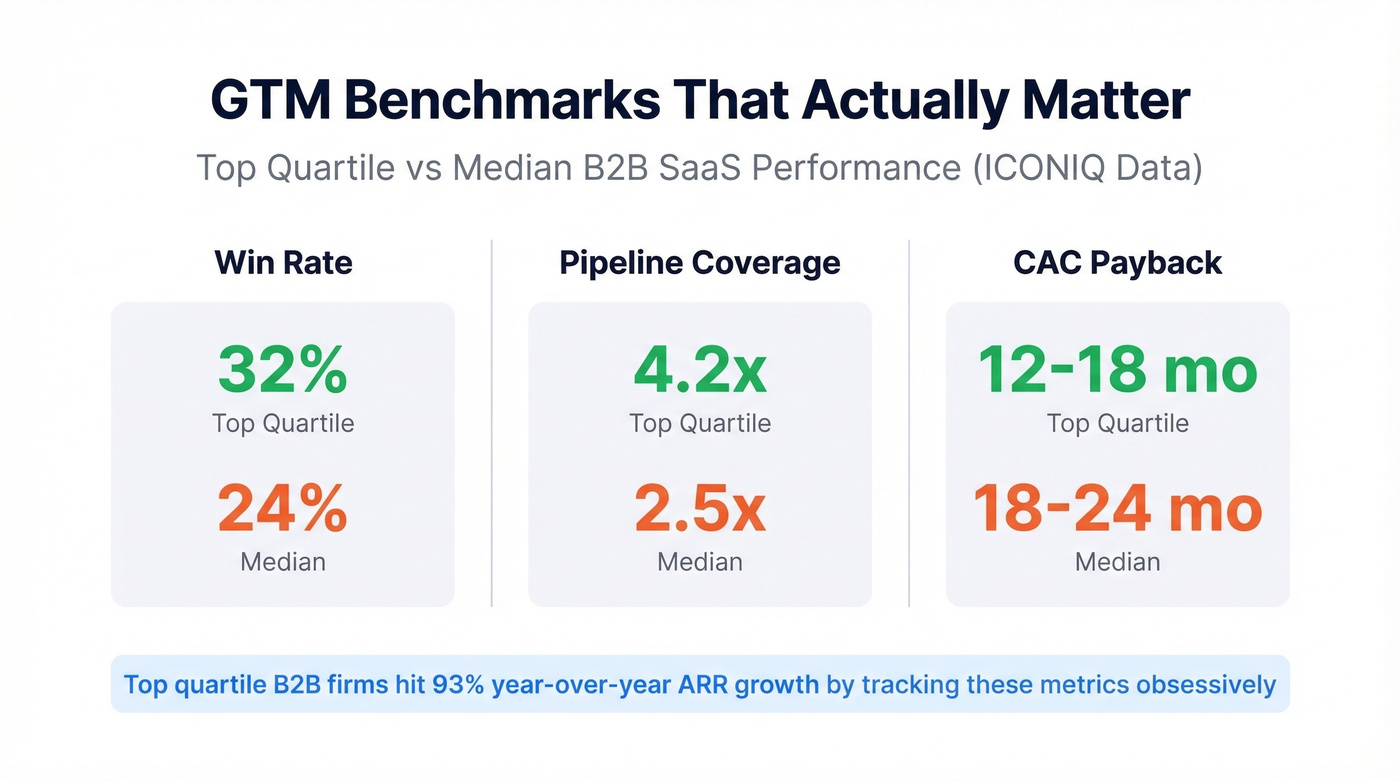
- Win rate: 32% (top quartile) vs. 24% (median)
- Pipeline coverage: 4.2x (top quartile) vs. 2.5x (median)
- CAC payback: 12-18 months (top quartile) vs. 18-24 months (median)
Top-quartile B2B firms hit 93% YoY ARR growth - and they get there by tracking these metrics obsessively, not by guessing. Build your dashboard before launch day, not after. If you're scrambling to set up tracking in week two, you've already lost the most valuable data window.
To pressure-test your funnel, track core funnel metrics alongside pipeline.
Step 9 - Launch and Optimize Fast
The first 72 hours after launch aren't a celebration - they're a diagnostic window. Set up real-time dashboards, run daily optimization stand-ups, and have contingency plans ready for the scenarios you don't want to think about.
Look, if engagement drops 40% below expectations in the first 48 hours, that's not a "give it time" situation. That's a signal to check your targeting, messaging, or channel mix immediately. Build contingency buffers into your timeline so you have room to pivot without panic.
Post-launch, shift focus to retention and activation. A 5% improvement in retention drives 25-95% more profit. Teams that obsess over acquisition and ignore activation end up refilling a leaky bucket indefinitely.
If you're seeing early churn, run a simple churn analysis before you scale spend.
Channel Economics Reference
CAC has risen 40-60% from 2023 to 2026 thanks to increased competition, privacy regulations, and attribution complexity. These numbers should inform every channel decision you make.
| Channel | Avg. B2B CAC | LTV:CAC Signal |
|---|---|---|
| Referrals | $150 | Strong (if post-PMF) |
| Facebook Ads | $230 | Moderate |
| SEO / Content | $290 | Strong (long-term) |
| Paid Search | $802 | Moderate to weak |
| LinkedIn Ads | $982 | Weak at scale |
| Outbound Sales | $1,980 | Strong if data is clean |
The 3:1 LTV:CAC target means if your average customer lifetime value is $6,000, you can afford $2,000 in acquisition cost. If your LTV is $3,000, outbound at $1,980 barely works - and only if your data quality is high enough to avoid waste.
If you're planning outbound, use a repeatable sales prospecting process so CAC doesn't spike from wasted touches.

Step 6 says pick channels using CAC data, not vibes. Outbound only works when your emails actually reach real buyers. Prospeo delivers 98% email accuracy with a 7-day refresh cycle - so your GTM launch hits live inboxes, not dead ends. At $0.01 per email, your CAC stays low enough to hit that 3:1 LTV ratio.
Stop bleeding ad spend on bad data. Start your GTM on verified contacts.
B2B vs. B2C - Two Different Playbooks
These aren't variations of the same strategy. They're fundamentally different GTM architectures.
| Dimension | B2B | B2C |
|---|---|---|
| Decision-makers | 6-10 stakeholders | 1 individual |
| Sales cycle | 6-12 months | Minutes to days |
| Buying driver | ROI, risk reduction | Emotion, convenience |
| Pricing | Negotiable, custom | Fixed, transparent |
| Top channels | Email, outbound, webinars, case studies | Social, video, influencers, reviews |
B2B GTM requires content that addresses multiple stakeholders - the champion needs a business case, the CFO needs an ROI model, IT needs a security whitepaper, and legal needs a DPA. B2C GTM requires emotional resonance and frictionless purchase flows. If you're building a B2B strategy using B2C tactics (or vice versa), you'll burn budget fast. Asana's GTM guide breaks down these distinctions well for teams just starting to formalize their approach.
If you're sizing the opportunity before choosing channels, start with your addressable market (TAM/SAM/SOM).
7 GTM Mistakes That Kill Launches
Confusing GTM with Marketing
GTM includes positioning, sales motion, pricing, distribution, and timing. Marketing is one channel within that system. Teams that treat GTM as "the marketing plan for launch week" take longer to reach product-market fit because they're optimizing one lever while ignoring five others.
Targeting Too Broadly
"All SMBs" isn't a segment. Pick one beachhead market and dominate it. Companies that try to serve multiple segments simultaneously see CAC inflate fast, because generic messaging converts nobody well enough to generate word-of-mouth.
Skipping Channel Validation
The channel that worked for your competitor won't necessarily work for you. Run small-budget tests before committing. We've watched founders pour $20k into a channel based on a competitor's case study, only to discover their buyer doesn't hang out there. Early channel success doesn't always scale - measure CAC at 2x and 5x volume before doubling down.
Neglecting Pricing Strategy
Pricing signals value. Underpricing can reduce conversion because buyers equate low price with low quality. Test pricing with real prospects the same way you test messaging - never rely on internal opinions alone.
Ignoring Your Sales Motion
Self-serve assumptions fail in procurement-heavy industries. If your buyer needs six months and a security review to purchase, PLG alone won't close deals. Companies that mismatch their sales motion to their buyer's procurement process see win rates drop sharply. Match the motion to how your buyer actually buys.
Focusing Only on Acquisition
One team we know acquired aggressively and lost half their customers within three months - a net negative after accounting for CAC. Retention and activation aren't post-launch problems. They're GTM problems. Build onboarding and activation into your strategy from day one, or watch your LTV:CAC ratio collapse.
Scaling Before Product-Market Fit
Spending your seed round on growth while the product has usability issues leads to churn, negative reviews, and stalled momentum. Growth amplifies whatever you already have. If what you have is a broken onboarding flow, growth amplifies that too.
Real GTM Example - $0 to $10K
Here's a case from a founder who shared their numbers on Reddit. They built a marketing app and hit $10k in revenue. Not life-changing money, but the channel lessons are worth studying.
Their top acquisition channel? AI directories - specifically TAAFT. Other directories scraped TAAFT's listings, creating a distribution flywheel they didn't have to maintain. Email marketing drove consistent conversions with a roughly 25% open rate on automated sequences. Influencers found the tool organically through directory listings and made videos without being paid.
What didn't work: Google Ads. The founder admitted their landing page was weak, and paid search punished them for it. The lesson isn't "Google Ads don't work" - it's that paid channels amplify whatever your landing page already does. If the page doesn't convert organic traffic, it won't convert paid traffic either.
If you're building outbound alongside content, use proven sales follow-up sequences to convert interest into meetings.
Their next phase focused on retention and product activation rate - the exact metrics that separate sustainable growth from a leaky bucket. This is the pattern we see repeatedly: the first GTM motion gets you to revenue, but the second iteration focused on keeping customers gets you to a real business.
GTM Strategy Checklist
Print this. Tape it to your monitor.
- Define beachhead market - one segment, not three
- Validate ICP with 10+ customer interviews
- Map buying committee (roles, objections, messaging per stakeholder)
- Build value proposition around pain points, not features
- Test messaging with 10-15 ICP prospects before launch
- Set pricing tiers and test willingness-to-pay
- Choose sales motion (PLG / sales-led / hybrid)
- Run $500 channel test before committing budget
- Calculate LTV:CAC ratio for each channel
- Build prospect list with verified data
- Complete sales playbooks and objection scripts
- Set up real-time dashboard before launch day
- Define contingency plans for underperformance scenarios
- Schedule daily stand-ups for first 72 hours post-launch
- Plan retention and activation metrics from day one
You mapped your ICP and buying committee in Steps 1-2. Now you need their direct contact data. Prospeo's 300M+ profiles with 30+ filters - buyer intent, technographics, headcount growth, funding - let you build hyper-targeted lists that match your beachhead market exactly.
Turn your ICP document into a pipeline of real decision-makers today.
Go-to-Market Strategy FAQ
How long does it take to build a go-to-market strategy?
Expect 4-12 weeks for a first version. Research and ICP validation take 2-3 weeks; channel testing and messaging experiments add another 2-9 weeks. Don't launch until you've tested at least one channel with real spend - a $500 test beats a month of theorizing.
Is a GTM strategy different for startups vs. enterprise?
Fundamentally different. Startups should focus on one beachhead market and 2-3 channels with the lowest CAC. Enterprise GTM involves 6-12 month sales cycles, buying committees of 6-10 stakeholders, and heavier investment in enablement, content, and partner ecosystems.
When should you pivot your GTM?
When CAC exceeds your 3:1 LTV:CAC target for two consecutive quarters, or when you've lost more than 30% of customers within 90 days. Both signal a structural problem, not a tactical one that more budget can fix.
What tools do you need for outbound GTM?
A CRM like HubSpot (free tier to $800+/mo) or Salesforce ($25-$300/user/mo), a B2B data platform like Prospeo for verified contact data at 98% email accuracy, and a sequencing tool such as Instantly ($30-$97/mo), Lemlist ($39-$99/mo), or Smartlead ($39-$94/mo). Get the foundation right with these three before adding intent data or ABM platforms.