

How to Create an Ideal Customer Profile That Actually Drives Revenue
Most companies have an ideal customer profile. It lives in a Google Doc, gets referenced once during onboarding, and then collects dust while reps prospect whoever they feel like.
Here's the thing: knowing how to create an ideal customer profile is table stakes. The hard part is making it operational so it actually shapes pipeline. We've watched teams spend weeks crafting a beautiful ICP document only to ignore it the moment quota pressure hits. That gap between having an ICP and using one is where revenue leaks.
Quick version: An ICP defines the company-level traits of your best customers. Build yours by analyzing top accounts across firmographic, technographic, and behavioral dimensions, then translate that profile into filtered search criteria on a data platform so you can prospect immediately.
What Is an Ideal Customer Profile?
An ideal customer profile describes the company - not the person - most likely to buy your product, stick around, and expand. It's defined by firmographic traits like industry, headcount, and revenue; technographic signals like the tools they run; and behavioral indicators like hiring patterns, funding events, and buying intent.
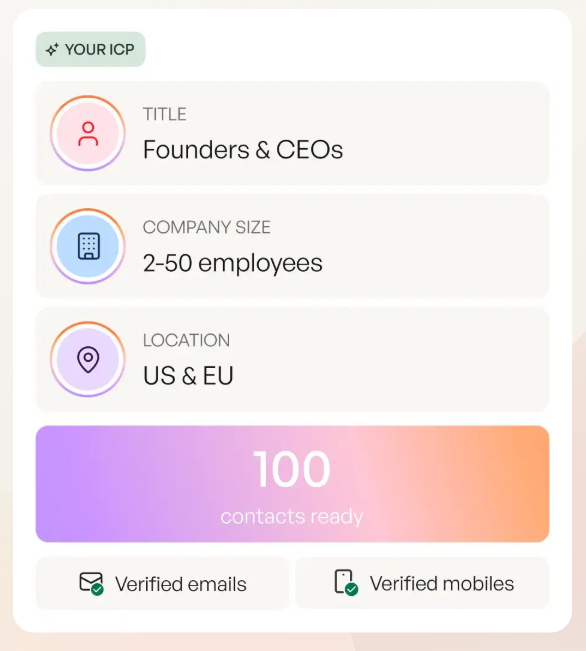
Don't confuse an ICP with a buyer persona. Your ICP says "mid-market logistics companies in EMEA with $10M+ revenue running SAP." Your buyer persona says "VP of Operations, 10 years experience, cares about warehouse throughput." The ICP comes first - it tells you which companies to target. Personas tell you which people inside those companies to reach. Cognism's ICP guide breaks this distinction down well.
How to Build an ICP Step by Step
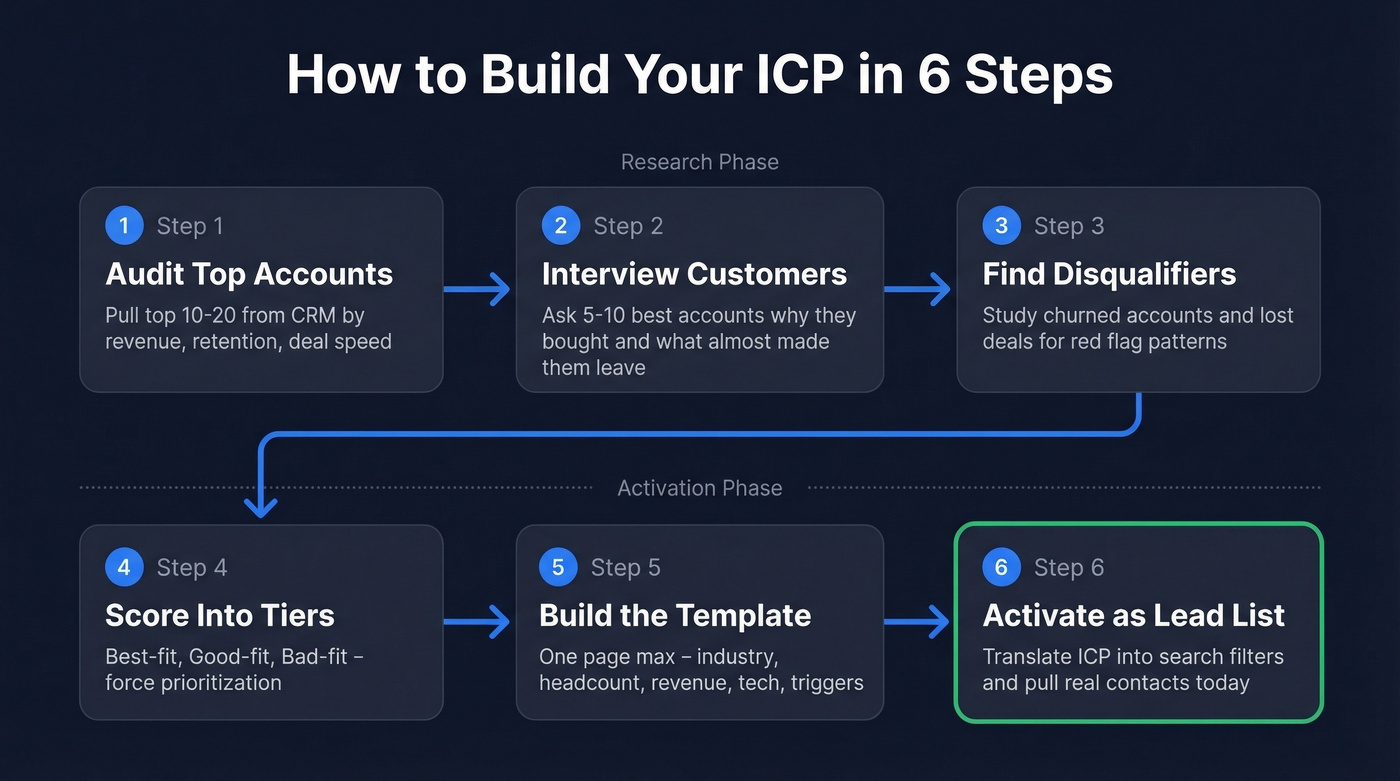
Audit Your Best Customers
Start with your CRM, not your assumptions. Pull your top 10-20 accounts ranked by revenue, retention, and deal velocity, then look for patterns across industry, company size, tech stack, funding stage, and geography.
If you need a repeatable way to do this, borrow a lead scoring approach so you can compare accounts consistently.
You'll almost always find clusters. Maybe your fastest-closing deals are mid-market SaaS companies in North America with 50-300 employees. Maybe your highest-LTV accounts all use Salesforce. These patterns are your ICP's foundation. HG Insights' ICP guide walks through this analysis in detail.
Validate With Customer Interviews
Data shows you what your best customers look like. Interviews tell you why they bought.
Talk to 5-10 of your top accounts and ask what triggered their search, what alternatives they considered, and what almost made them churn. Focus on "super-users" - the accounts with the highest engagement - because they reveal buying triggers your CRM can't capture. This step is what separates ICPs built on correlation from ICPs built on causation.
If you want to systematize those triggers, use a simple framework for identifying buying signals.
Identify Disqualifying Traits
Who you say no to matters as much as who you say yes to. Look at churned accounts and lost deals for negative signals: industries with 12-month procurement cycles when your sales cycle targets 30 days, companies below a revenue threshold that can't afford your product, or missing tech dependencies your integration requires.
Write these down explicitly as a "skip if" list. It saves reps hours of wasted outreach every week.
This is also where a lightweight churn analysis can reveal patterns you’ll miss in win-only data.
Score Accounts Into Tiers
Not every ICP-fit account is equal. We use a three-tier system that forces prioritization:
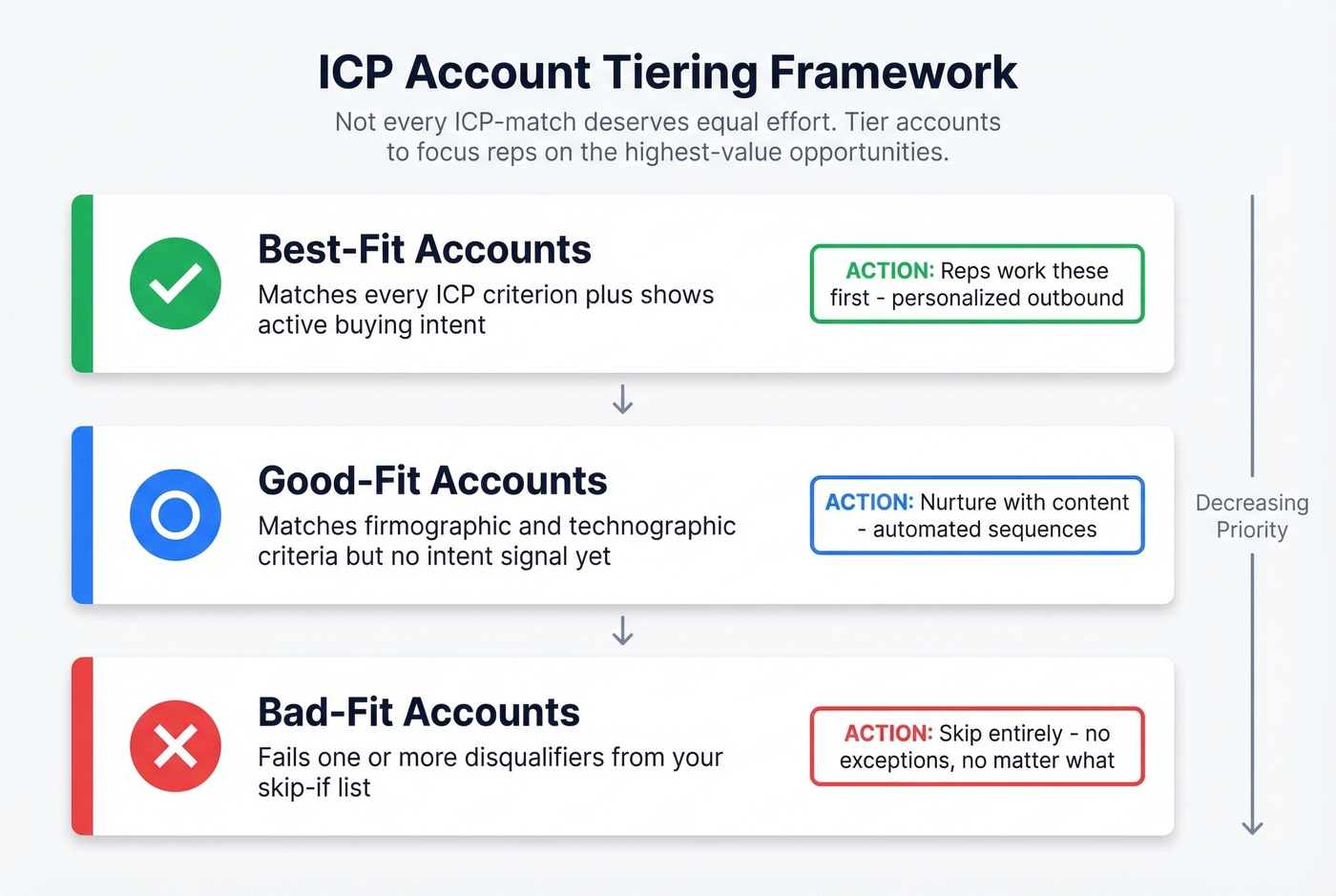
- Best-fit: Matches every ICP criterion plus shows active buying intent. Reps work these first.
- Good-fit: Matches firmographic and technographic criteria but no intent signal yet. Nurture with content.
- Bad-fit: Fails one or more disqualifiers. Skip entirely - no exceptions.
This tiering framework, which ZoomInfo's ICP methodology also advocates, prevents the classic mistake of treating all ICP-matching accounts as equally urgent. In our experience, teams that tier their ICP see faster deal cycles because reps stop spreading effort across low-priority accounts.
If you’re running this inside outbound, tie tiers to your sales prospecting techniques so reps know exactly what to do next.
Build the ICP Template
Copy this template and fill it in today:
| ICP Dimension | Your Criteria |
|---|---|
| Industry | e.g., B2B SaaS, FinTech |
| Headcount | e.g., 50-500 |
| Revenue | e.g., $5M-$50M ARR |
| Tech Stack | e.g., Uses HubSpot or Salesforce |
| Geography | e.g., North America, UK |
| Funding Stage | e.g., Series A+ |
| Buying Triggers | e.g., New VP of Sales hire, recent funding round |
| Disqualifiers | e.g., Government, sub-$1M revenue, no CRM |
Keep it on one page. If your ICP document is longer than a single screen, it's too complex for reps to actually use.
For a ready-to-copy version with scoring, see our ICP template.
Activate Your ICP as a Lead List
An ICP that stays in a document is just a strategy exercise. It becomes valuable the moment you translate it into search filters on a data platform and pull real companies and contacts.
Prospeo's 30+ database filters map directly to ICP dimensions - industry, headcount range, revenue, technographics via Wappalyzer and live job posting signals, funding, and headcount growth. Layer Bombora intent data across 15,000 topics to find companies that match your profile and are actively researching your category right now. That's the difference between a cold list and a warm one.

Export to your CRM or sequencer and start prospecting the same day. If you’re evaluating options, compare providers in our guide to the best sales prospecting databases.

You just built your ICP template. Now activate it. Prospeo's 30+ search filters - industry, headcount, revenue, tech stack, funding, and Bombora intent data across 15,000 topics - map directly to every ICP dimension you defined. Pull verified contacts at 98% email accuracy for ~$0.01 each.
Stop letting your ICP collect dust in a Google Doc.
Your ICP tiers are only as good as the data behind them. Prospeo refreshes 300M+ profiles every 7 days - not every 6 weeks like competitors. Layer technographic filters, headcount growth signals, and buyer intent to find best-fit accounts that are actively in-market today.
Find companies that match your ICP and are buying right now.
ICP Template Example
Let's make this concrete. Here's what the template looks like filled out for a B2B SaaS company selling sales engagement software:
| Dimension | Criteria |
|---|---|
| Industry | B2B SaaS, FinTech |
| Headcount | 50-500 employees |
| Revenue | $5M-$50M ARR |
| Tech Stack | Salesforce or HubSpot CRM |
| Geography | US, Canada, UK |
| Funding | Series A or later |
| Buying Triggers | VP Sales hired in last 90 days, headcount growth >20% |
| Disqualifiers | Government, pre-revenue, no CRM |
| Tier | Best-fit if intent signal present; Good-fit otherwise |
DemandScience's template guide has additional examples across different verticals if you need inspiration for your specific market.
Common ICP Mistakes
Too broad. "Technology companies in North America" isn't an ICP - it's a TAM slide. Narrow until it feels uncomfortable; you can always expand later. (If you need a refresher on sizing, start with addressable market.)
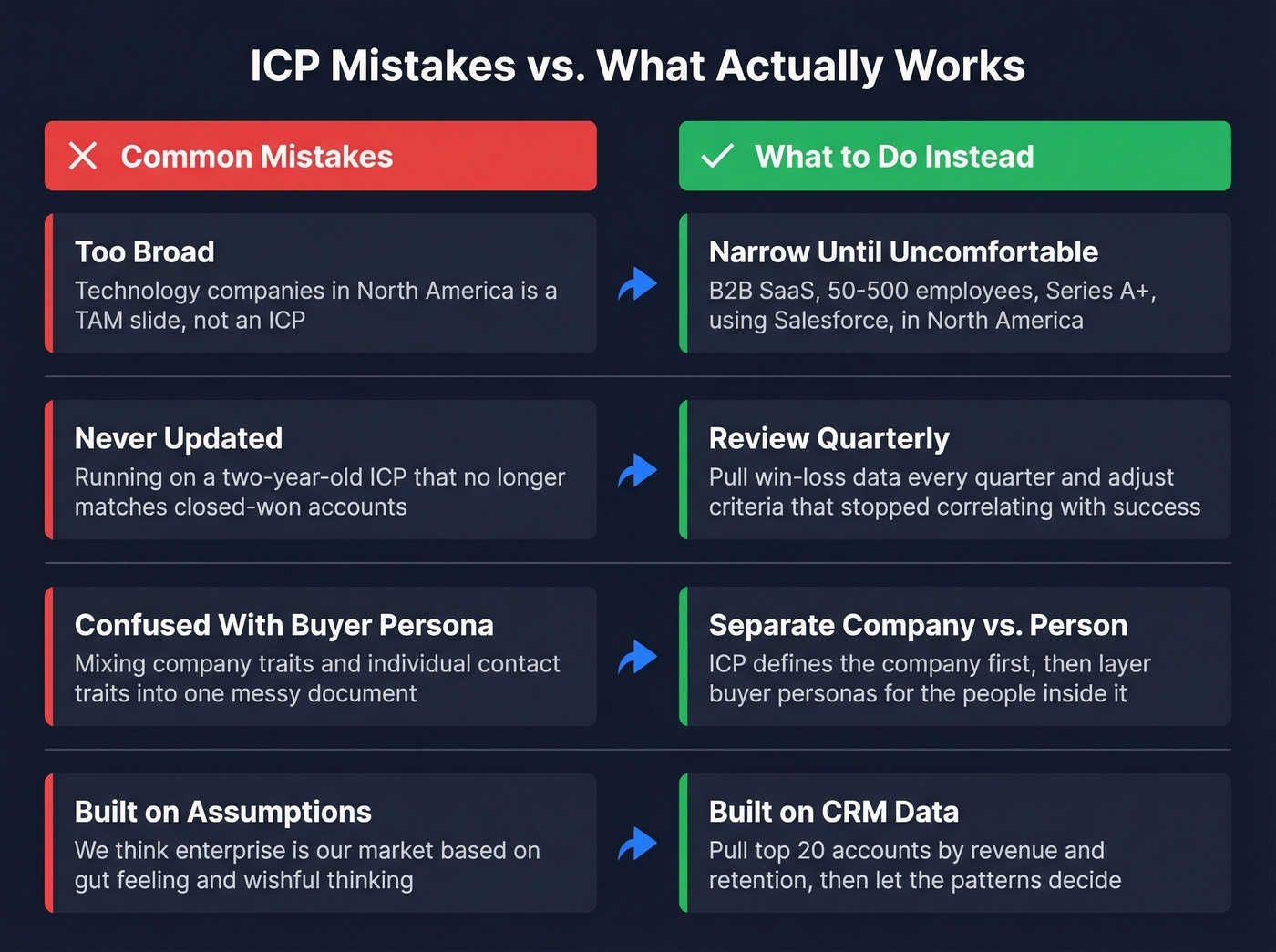
Never updated. Your best-fit customer shifts as your product evolves. Review quarterly against win/loss data. We've seen teams running on two-year-old ICPs that no longer match their actual closed-won accounts, and the pipeline impact is brutal.
Confused with buyer persona. The ICP is the company; the persona is the person. Mixing them creates a Frankenstein document that helps nobody.
Built on assumptions. "We think enterprise is our market" is a hypothesis, not an ICP. Pull CRM data and let the numbers decide.
One strong opinion here: if your average deal size is under $15k, you probably don't need a complex multi-segment ICP. One tight profile, ruthlessly enforced, will outperform three loose ones every time.
Putting Your ICP to Work
An ICP should shape every prospecting decision your team makes - outbound sequences, ad targeting, ABM account lists, and lead scoring models. Tie each tier to a specific action: best-fit accounts get personalized outbound, good-fit accounts enter automated nurture, and bad-fit accounts get disqualified before a rep ever touches them.
If you’re building this into your motion, align it with account-based selling so targeting and execution stay consistent.
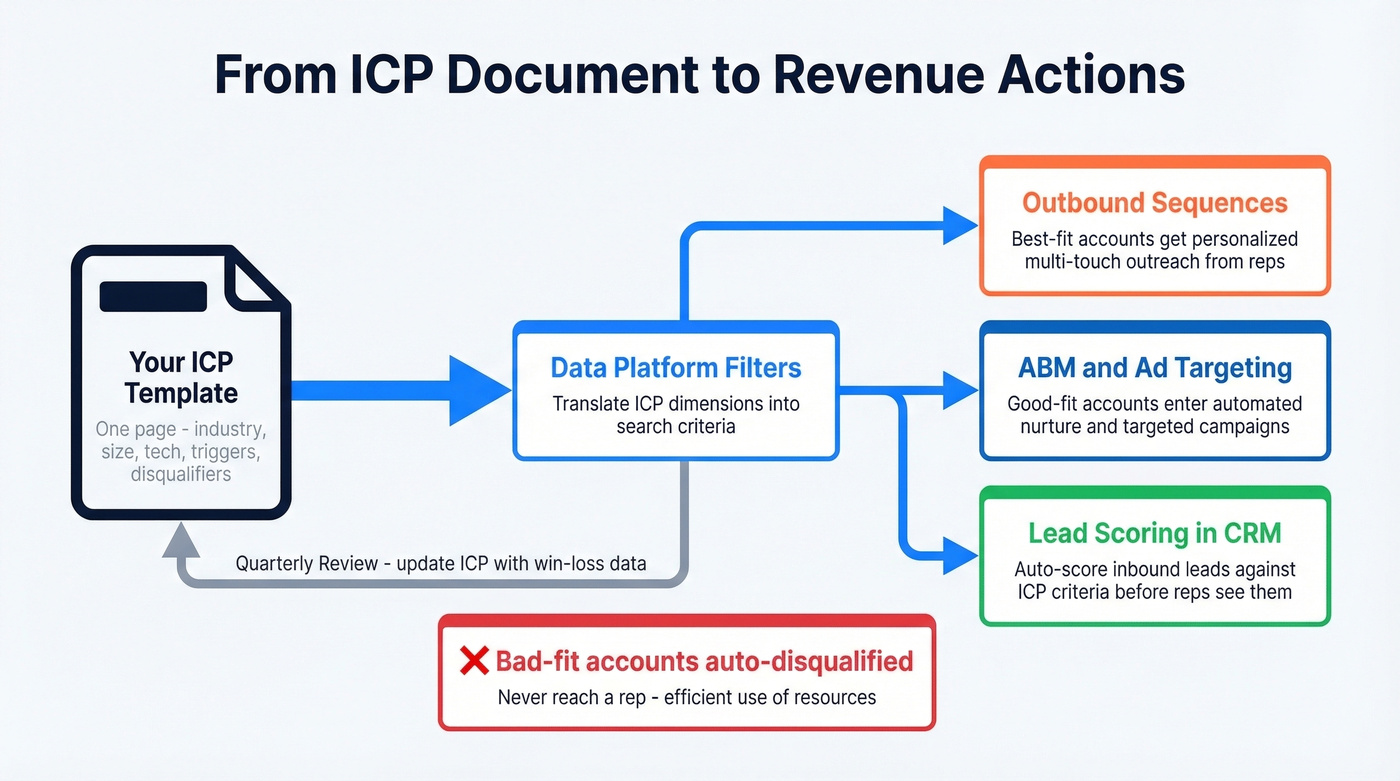
The consensus on r/sales is pretty clear on this: the teams that treat their ICP as operational infrastructure - not a strategy deck - are the ones that consistently hit quota. Review it quarterly when you analyze win/loss data, and keep the document where reps actually work. Pin it in Slack, embed it in your CRM. Don't bury it in Confluence where it'll never get opened again.
If you haven't taken the time to create your ideal customer profile yet, the steps above give you everything you need to go from blank page to activated lead list in a single afternoon.
FAQ
What's the difference between an ICP and a buyer persona?
An ICP defines the ideal company - firmographics, tech stack, revenue range, and industry. A buyer persona defines the individual contact within that company, including job title, pain points, and goals. Build the ICP first to identify target accounts, then layer personas on top to determine who to reach within those accounts.
How often should you update your ICP?
Review quarterly at minimum. As your product evolves and you close deals in new segments, the traits that predict success shift. Pull win/loss data each quarter and adjust any criteria that no longer correlate with high retention or fast deal velocity.
What tools help you find leads matching your ICP?
Prospeo lets you translate ICP dimensions directly into 30+ search filters - industry, headcount, revenue, tech stack, funding, and Bombora intent data across 15,000 topics - then export verified contacts to your CRM. Other platforms like ZoomInfo and Apollo offer similar filtering, though at higher price points and with less frequent data refreshes.
How many ICPs should a company have?
Most companies need one to three. Start with a single ICP based on your highest-value segment. Only add a second when you have enough closed-won data in a distinct segment to validate it. More than three usually means you haven't narrowed enough.
Can I build an ICP without a large customer base?
Yes. If you're early-stage with limited data, interview your first five to ten customers, research competitors' case studies for patterns, and build a hypothesis-driven ICP. The framework is the same - you're just leaning more on qualitative signals until you have enough closed-won data to validate statistically.