

How to Cross Sell Without Sounding Like a Used-Car Salesman
A VP of Sales we know announced a company-wide cross-sell initiative. A few weeks later, the team had plenty of "attempts" logged and almost nothing to show for it. That's not a strategy - that's a rounding error. And it's more common than anyone admits: up to 90% of cross-selling programs fail, per Gartner research.
It's the same frustration an AM on r/sales described - wanting to introduce other services without sounding "too salesy." The problem isn't lazy reps. It's bad playbooks.
You've read ten articles that all say "build trust first." You know that already. What you actually need is the email, the question, the formula. Let's get into it.
Cross-selling in 30 seconds: Segment accounts by revenue and growth potential. Ask discovery questions - don't pitch. Time outreach to trigger events. Keep emails under 100 words. Measure attach rate, not just "did we try."
Cross-Selling vs. Upselling
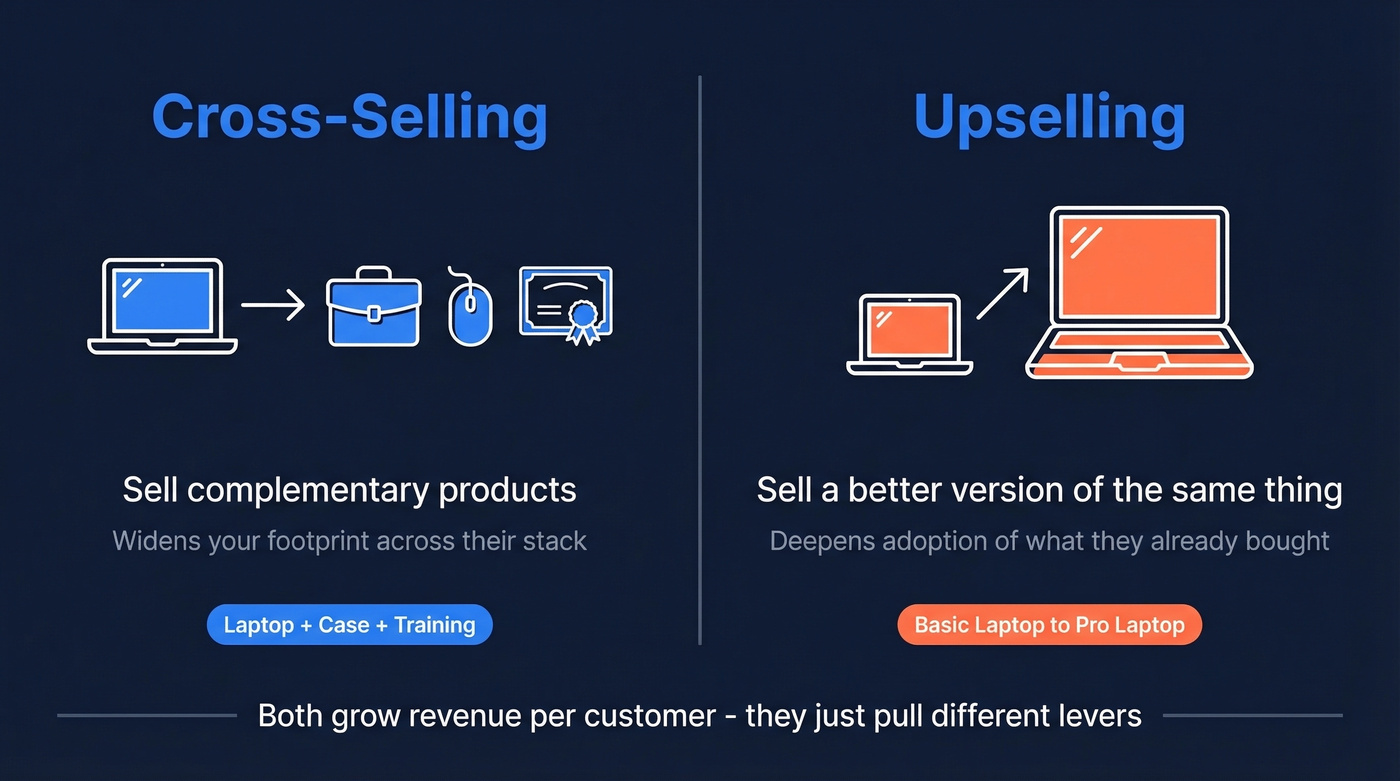
Upselling sells a better version of the same product - the faster laptop, the higher tier. Cross-selling sells a complementary product - the laptop case, the training package. Both grow revenue per customer, but they pull different levers. Upselling deepens adoption of what they already bought. Cross-selling widens your footprint across their stack.
If you want a deeper breakdown, see upselling vs. cross-sell mechanics and when each works.
Why Cross-Selling Matters in 2026
Net-new B2B sales dropped 19-30% in 2023, and the recovery has been slow. Per Salesforce research, 84% of reps missed quota that year. Meanwhile, the probability of selling to an existing customer runs 60-70%. For a new prospect? It's 5-20%.
If you’re pressure-testing the numbers, keep a running list of sales statistics and benchmarks by motion.
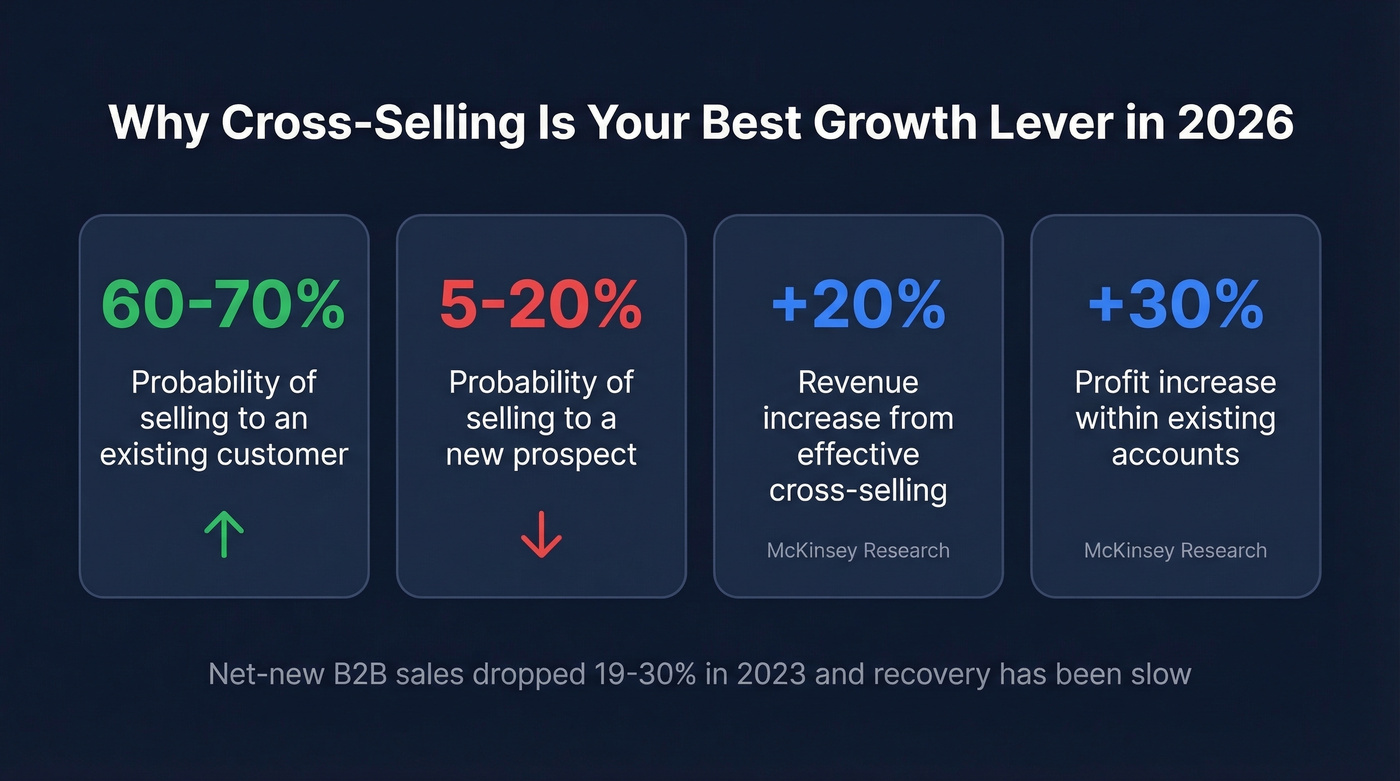
McKinsey research shows effective cross-selling can increase revenue by 20% and profits by 30% within existing accounts. If you're not expanding the accounts you already have, you're shrinking.
For more context on what actually works (and what backfires), see Cross Selling B2B.
How to Cross Sell in 5 Steps
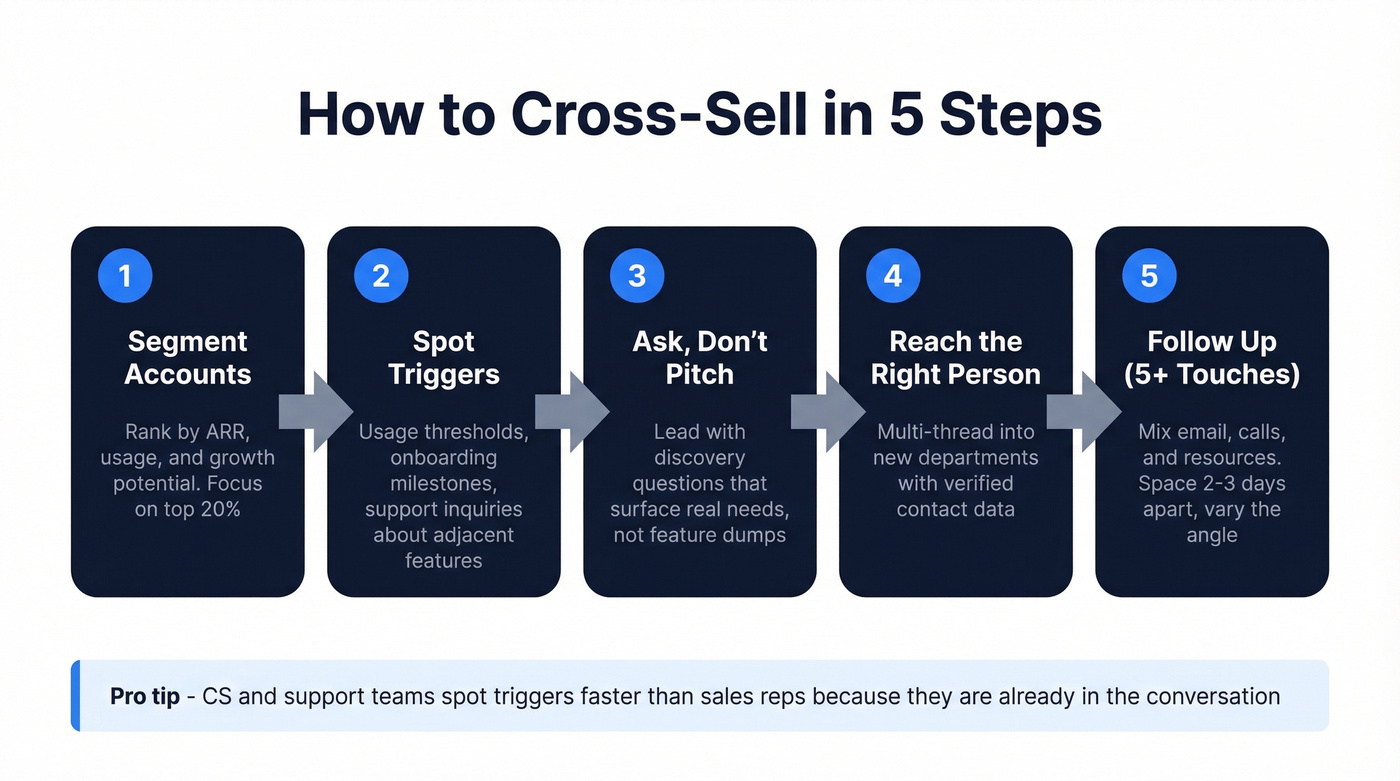
1. Segment accounts by ARR and growth potential
You can't sell complementary products to 70 accounts with the same playbook. Rank your book by current ARR, product usage, and expansion potential, then focus your first wave on the top 20%. As one CSM managing roughly 70 accounts noted on r/CustomerSuccess, the challenge isn't knowing expansion matters - it's knowing where to start.
This is also where a simple account plan keeps expansion focused instead of random.
2. Identify trigger events
Don't guess when to reach out. The best triggers are usage thresholds (they've hit 80% of a feature limit), onboarding completion, and support inquiries about adjacent features. Life-stage triggers work too - insurance agents offer additional products when clients turn 26 or 65. For ecommerce, 24-72 hours post-purchase is the sweet spot.
Here's the thing: CS and support teams are often better positioned to spot these triggers than sales reps, because they're already in the conversation. We've seen teams double their expansion pipeline just by giving CSMs a simple Slack workflow to flag trigger events to AEs in real time.
If you’re building this into a repeatable motion, map it into your sales process stages so triggers have clear next steps.
3. Ask discovery questions, not pitches
This is where most expansion plays die. Reps lead with a product dump instead of a question. Try these:
- "How are you currently handling [adjacent problem] alongside this solution?"
- "What challenges are you still facing after implementing [product they bought]?"
- "If you could solve one more thing with your current stack, what would it be?"
Feature lists don't surface needs. Questions do.
If you want more options, pull from these good discovery questions and adapt them to adjacent use cases.
4. Reach the right stakeholder
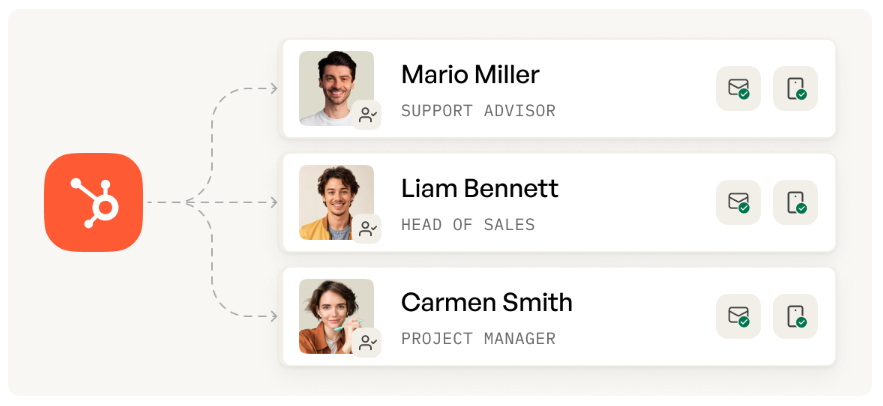
Selling into an existing account often means reaching someone different from your day-to-day contact. The person who bought your analytics tool isn't the person who'd buy your data integration product. You need verified contact data for that new stakeholder - tools like Prospeo's email finder deliver 98% accuracy on a 7-day refresh cycle, so you're not guessing at formats or pinging dead addresses when you multi-thread into a new department.
This is where account intelligence helps you identify who actually owns the adjacent problem.
5. Follow up persistently
The average prospect needs 5 touches to engage. Executives? Closer to 9. One email isn't a campaign - it's a suggestion that got ignored.
Build a 5-touch sequence minimum, mixing email, a quick call, and a relevant resource share. Space them 2-3 business days apart and vary the angle each time - a case study, a data point, a direct question about their workflow.
If you need structure, build the sequence around auto follow-up rules so reps don’t “wing it” after touch #2.

Cross-selling means multi-threading into departments you've never touched. Prospeo gives you 98% accurate emails and 125M+ verified mobiles across 300M+ profiles - refreshed every 7 days. Stop guessing at email formats when you're expanding into a new buying center.
Reach the right stakeholder on the first try, not the fifth.
Cross-Sell Email Framework
The average cross-sell email is way too long. One practitioner on r/sales described a 325-word draft and knew it was a problem - too much "secret sauce" that should be saved for a meeting. Keep cross-sell emails under 100 words and follow this structure:
- Reference something specific about their account ("Your team hit 500 active users last month - congrats").
- Ask about a related challenge ("Are you running into [adjacent problem] yet?").
- Offer to share how others solved it ("Happy to walk through how [similar company] handled this in 15 minutes").
A good question gets a reply. A feature list gets archived.
To tighten the copy even more, borrow patterns from inbound sales email templates.
5 Mistakes That Kill Cross-Sells
Choice overload. Offering three complementary products at once confuses the buyer. Pick one. The right one.
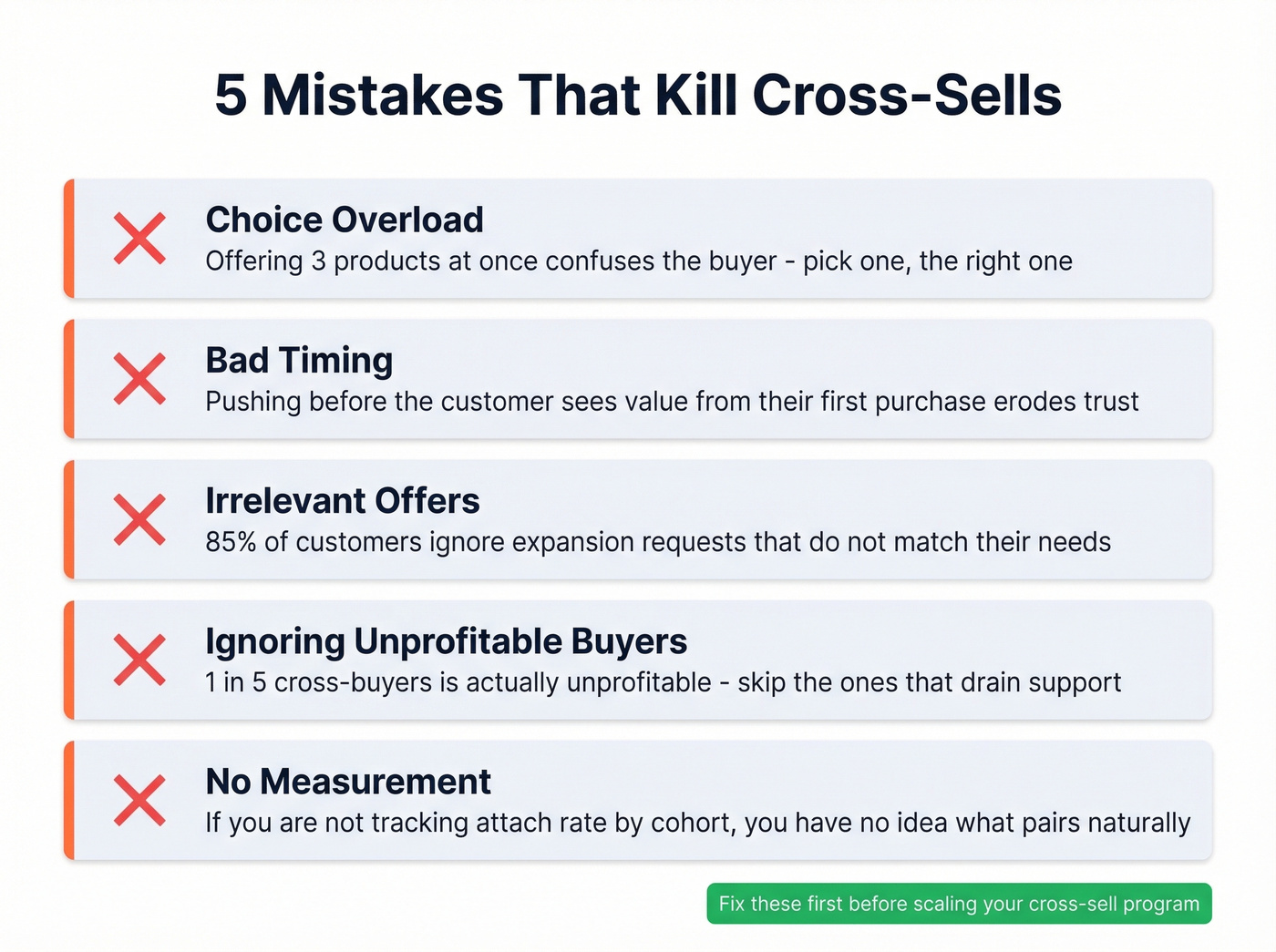
Bad timing. Pushing a complementary offer before the customer has seen value from their first purchase erodes trust fast. Wait for a milestone - a successful onboarding, a usage spike, a positive CSAT score.
Irrelevant offers. 85% of customers won't respond to expansion requests that don't match their needs. You can't personalize outreach if your CRM has the wrong person in the wrong role. Keep contact data fresh so your message hits the right inbox.
If this keeps happening, it’s usually a pipeline hygiene problem, not a rep problem.
Ignoring unprofitable buyers. HBR research found one in five cross-buyers is actually unprofitable - service demanders, revenue reversers, promotion maximizers. Not every account is worth expanding. Skip the ones that drain more support hours than they generate in revenue.
No measurement. If you're not tracking attach rate and conversion rate by cohort, you have no idea which products pair naturally and which ones you're forcing.
How to Measure Cross-Sell Success
Two formulas matter.
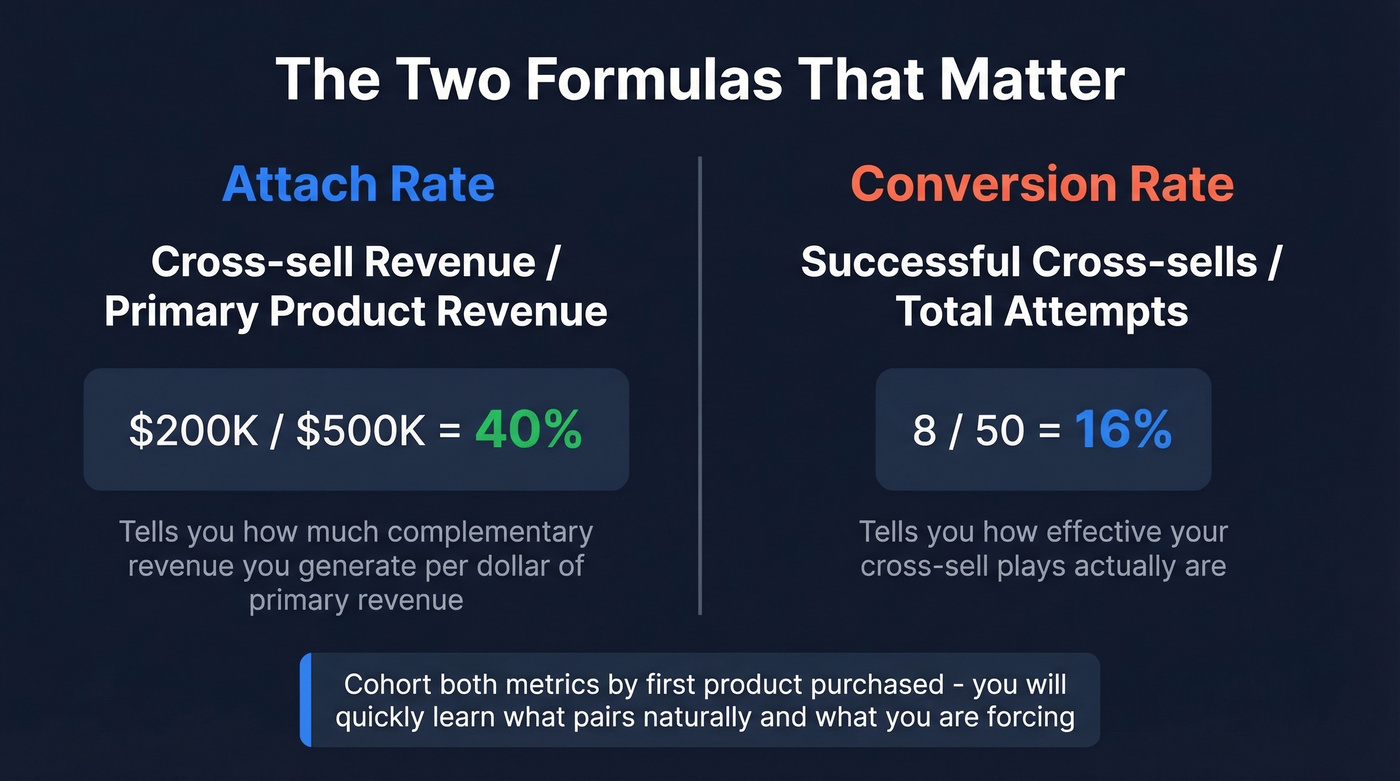
Attach rate = cross-sell revenue / primary product revenue. Sell $500K of Product A and cross-sell $200K of Product B, and your attach rate is 40%.
Cross-sell conversion rate = successful cross-sells / total attempts. Fifty plays, eight closes - that's 16%.
Cohort both metrics by first product purchased. You'll quickly learn what pairs naturally and what you're forcing. In our experience, teams that track these monthly instead of quarterly catch bad pairings before they waste a full quarter of rep time.
If you want to benchmark the rest of the funnel around these plays, use B2B conversion rates by stage.
Real Results
Tushy ran a post-purchase cross-sell on their thank-you page. A 2% conversion rate generated $191,786 in monthly incremental revenue. A furniture retailer added a conditioning kit as an in-cart offer and saw AOV jump 4.6%, producing $180,000 in additional monthly revenue within 41 days.
These are ecommerce examples, but the mechanics transfer directly. An in-cart cross-sell is the B2B equivalent of a post-onboarding expansion play - the customer just experienced value, and you're offering something that extends it.
If your average deal size is under $10K, you probably don't need a complex tech stack for this. You need a spreadsheet of your top 20 accounts, three good discovery questions, and verified contact data for the right stakeholder. Start there.
Bad contact data kills cross-sell plays before they start. 85% of buyers ignore irrelevant outreach - and nothing's more irrelevant than an email to someone who left the company six months ago. Prospeo's 7-day refresh cycle and 92% enrichment match rate keep your account data current so every expansion touch lands.
Stop cross-selling into outdated CRM records. Fix your data at $0.01 per email.
FAQ
What's the difference between cross-selling and upselling?
Cross-selling offers a complementary product (laptop to case). Upselling offers a better version of the same thing (laptop to faster laptop). Both increase revenue per customer, but cross-selling expands product adoption while upselling deepens it.
When's the best time to cross-sell?
Within 24-72 hours post-purchase for ecommerce. For B2B, after the customer has hit a measurable milestone - typically post-onboarding or at a usage threshold like 80% feature adoption. Don't pitch before they've seen value from the first purchase.
How do you cross-sell without being pushy?
Ask discovery questions instead of pitching features. Reference something specific about their account, then ask about a related challenge. If the need isn't there, don't force it - a bad cross-sell attempt costs more trust than it's worth.
What's a good cross-sell conversion rate?
There's no universal benchmark, but B2B teams we've talked to typically see 10-20% on well-targeted plays. Anything below 5% usually signals a timing or relevance problem. Track by cohort and first product purchased to find your natural pairings.