

How to Do Cold Outreach That Actually Gets Replies
A SaaS founder posted on r/SaaS last year: 2,000 cold emails sent, 6 replies, zero customers. "Cold outreach is basically dead," he wrote. The post blew up because it hit a nerve. But the data tells a different story - a study of 16.5 million cold emails across 93 industries found an average reply rate of 5.8%. That's not dead. That's a channel with a higher execution bar than most teams clear.
If your product has zero market validation, outbound won't fix that. But if you've got product-market fit and need pipeline, this system works. The difference between 0.3% and 5.8% isn't luck. It's process.
The short version: Cold outreach works when you nail three things in order: clean, verified prospect data, proper email infrastructure, and short, value-first messaging across multiple channels. This guide gives you the exact system.
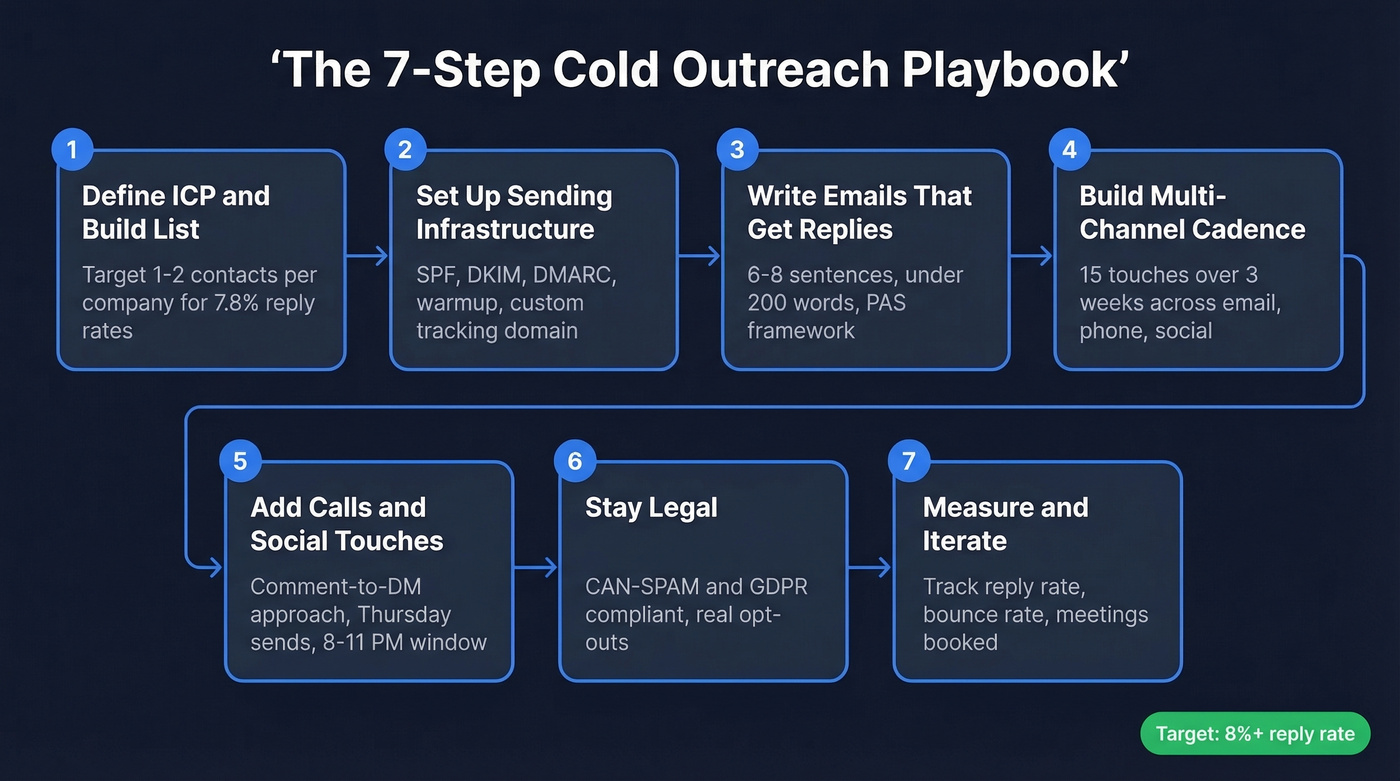
The 7-Step Cold Outreach Playbook
Seven steps, in order of priority. Whether you're launching your first outbound motion or optimizing an existing one, this sequence applies.
1. Define Your ICP and Build a Clean List
List quality matters more than copy. Full stop.
The 16.5M-email dataset proves it: teams emailing 1-2 contacts per company hit a 7.8% reply rate, while those blasting 10+ contacts at the same company dropped to 3.8%. Spray-and-pray doesn't just underperform - it actively damages your domain reputation.
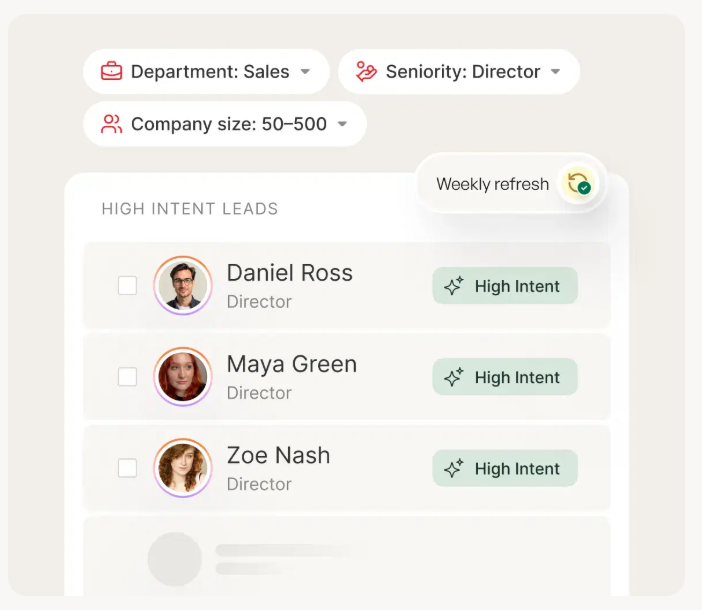
Your ICP definition should include target role (title and seniority), company size, industry, and ideally intent signals like recent funding or hiring surges. The tighter your list, the higher your reply rate. That's not theory - it's math. We've seen this firsthand: one of our customers, Meritt, saw their bounce rate drop from 35% to under 4% after switching to Prospeo for verified contact data, and their pipeline tripled from $100K to $300K per week. Clean data compounds fast.
If you want a faster starting point, use an ICP scoring rubric before you pull leads.
2. Set Up Your Sending Infrastructure
Before you write a single email, your technical foundation needs to be airtight:
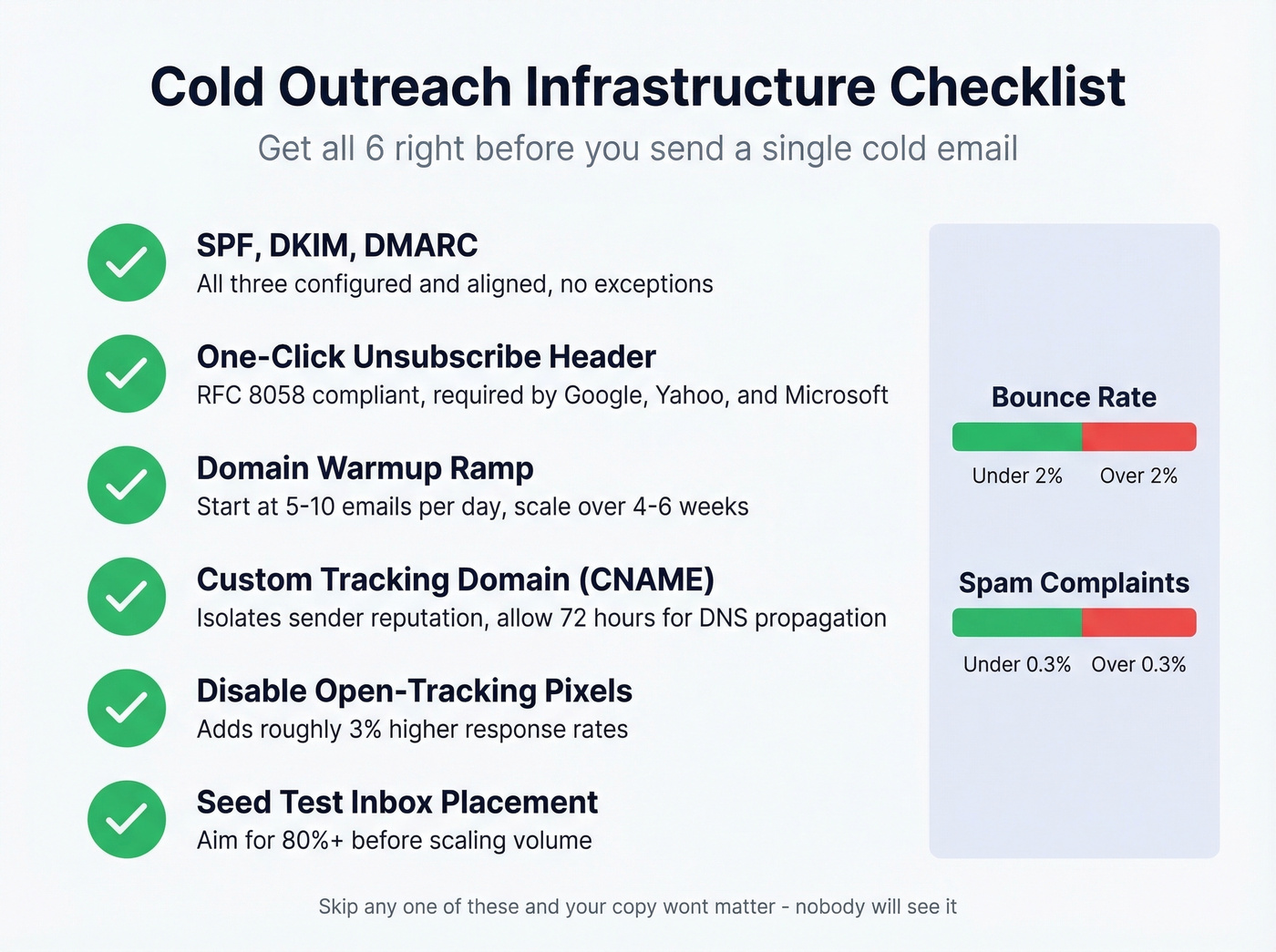
- SPF, DKIM, and DMARC - all three configured and aligned. Non-negotiable.
- RFC 8058 one-click unsubscribe header (List-Unsubscribe + List-Unsubscribe-Post). Google and Yahoo enforce this now, and Microsoft has joined with similar bulk-sender requirements.
- Warmup ramp - start new domains at 5-10 emails per day, scale over 4-6 weeks. Patience here saves you months of recovery later. (If you need options, see warmup tools.)
- Bounce rate under 2%, spam complaints under 0.3%. These are the thresholds that keep you out of the spam folder. If you're troubleshooting, start with bounce rate benchmarks and fixes.
- Custom tracking domain (CNAME) - isolates your sender reputation from shared tracking infrastructure. DNS propagation takes up to 72 hours, so set this up early. (More detail: tracking domain.)
- Turn off open-tracking pixels. The same dataset found this alone produced ~3% higher response rates. Open rates are vanity metrics - reply rate is what pays the bills. If you want the technical why, read about tracking pixels.
Aim for 80%+ inbox placement on seed tests before scaling volume. Get all six items right and you'll land in primary inboxes. Skip any one and your copy won't matter because nobody will see it.
3. Write Emails That Get Replies
The best-performing cold emails in the dataset were 6-8 sentences, under 200 words, hitting a 6.9% reply rate. Longer emails performed worse across the board.

This guide proves list quality is the #1 driver of cold outreach results. Prospeo gives you 300M+ profiles with 98% verified email accuracy, 30+ filters for ICP targeting, and a 7-day data refresh cycle - so every email you send lands.
Stop sending cold emails to dead inboxes. Start with data that connects.
Use the PAS framework - Problem, Agitate, Solve. Name a specific problem your prospect likely has, make the cost of inaction feel real, then offer a concrete, low-friction solution. The key word is specific. "I help companies grow revenue" is noise. "I'll audit your top 3 landing pages and send you a Loom with fixes" is an offer worth replying to. (For more structure, see email copywriting.)
Here's a template that follows this structure:
Hi {{first_name}},
{{Company}} is scaling the sales team - but I'm guessing outbound reply rates haven't scaled with it.
We help B2B teams like yours cut bounce rates below 4% and triple pipeline within 90 days.
Worth a quick conversation?
Notice the soft CTA. "Worth a quick conversation?" outperforms "Let me book 15 minutes on your calendar" because it lowers the commitment threshold. Practitioners on r/copywriting consistently confirm this: soft asks win. If you want more options, pull from these follow-up templates.
4. Build a Multi-Channel Cadence
Email-only outreach is outdated. Platform data shows it now takes an average of 4.81 touches to engage a prospect - up 17% since 2021. For cold comms, expect closer to 7 touches.
The KISS framework (Keep It Simple Sequencing), from outbound coach Jason Bay, lays out a clean structure: 15 touches over 3 weeks - 6 emails, 6 phone calls, 3 social touches. Rotate one topic per week so you're not hammering the same message. We've tested dozens of cadence structures, and KISS is the closest to a universal starting point. If you need a blueprint, build it as a B2B cold email sequence.
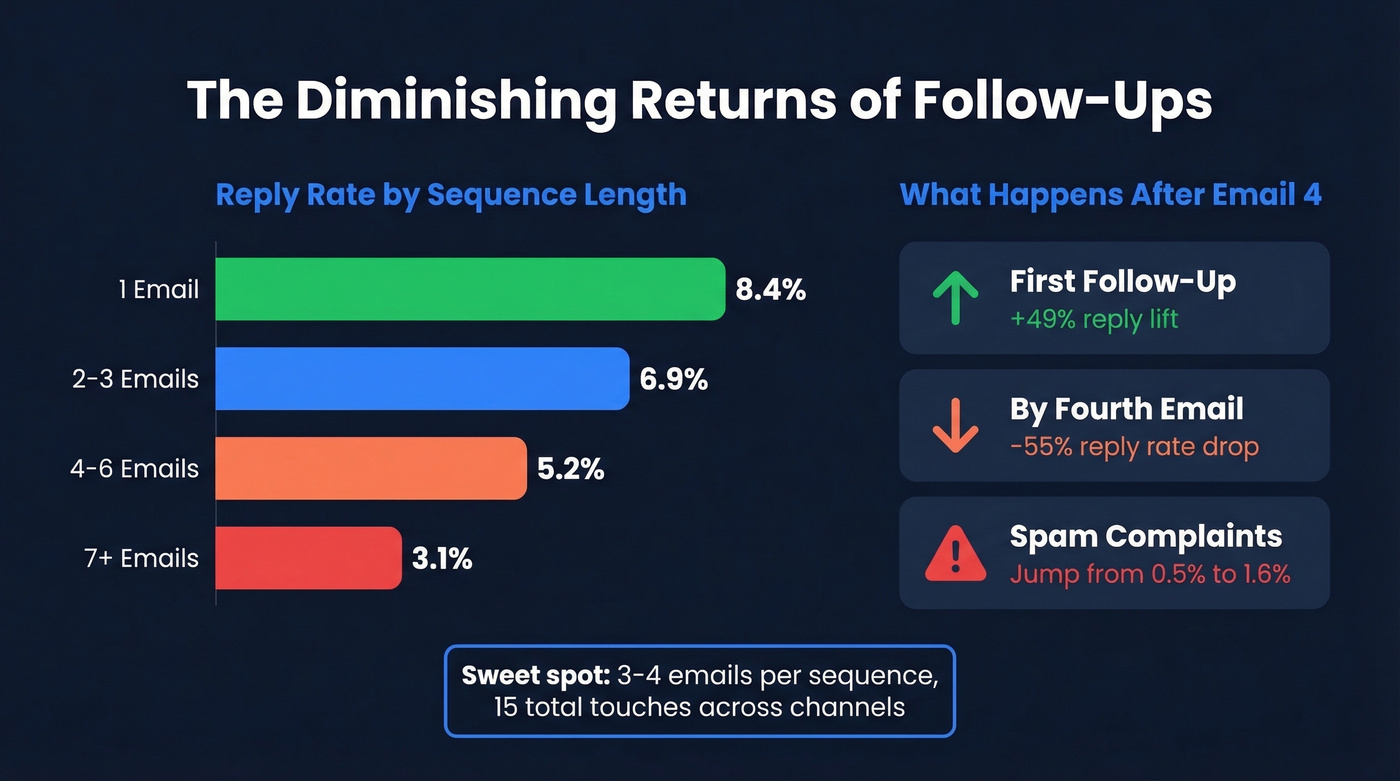
Here's the thing, though: most teams over-sequence. One-email sequences actually hit 8.4% reply rates in the dataset - the highest of any sequence length. A single, perfectly targeted email can outperform a bloated 7-step drip. The lesson isn't "send one email." It's that quality per touch matters more than touch count.
Follow-ups have a shelf life. The first one can lift replies by 49%. But by the fourth email, response rates drop 55%, and spam complaints jump from 0.5% to 1.6%. Following up 7+ times isn't persistence - it's domain damage. Three to four emails per sequence is the sweet spot, and after roughly 15 total touches across channels, pause and re-approach next quarter.
5. Add Cold Calls and Social Touches
Phone isn't a standalone channel for most teams - it's a cadence multiplier. A well-timed call after an email converts better than either channel alone. If you want a repeatable approach, use a cold calling system.
For social, the comment-to-DM approach works best. Comment on a prospect's post with a genuine insight - not "Great post!" but something that adds to the conversation. Two days later, send a DM referencing that comment. This warms the contact before the ask. Pitching in connection requests is a fast way to get ignored. If you want to go deeper, follow a personalized outreach workflow.
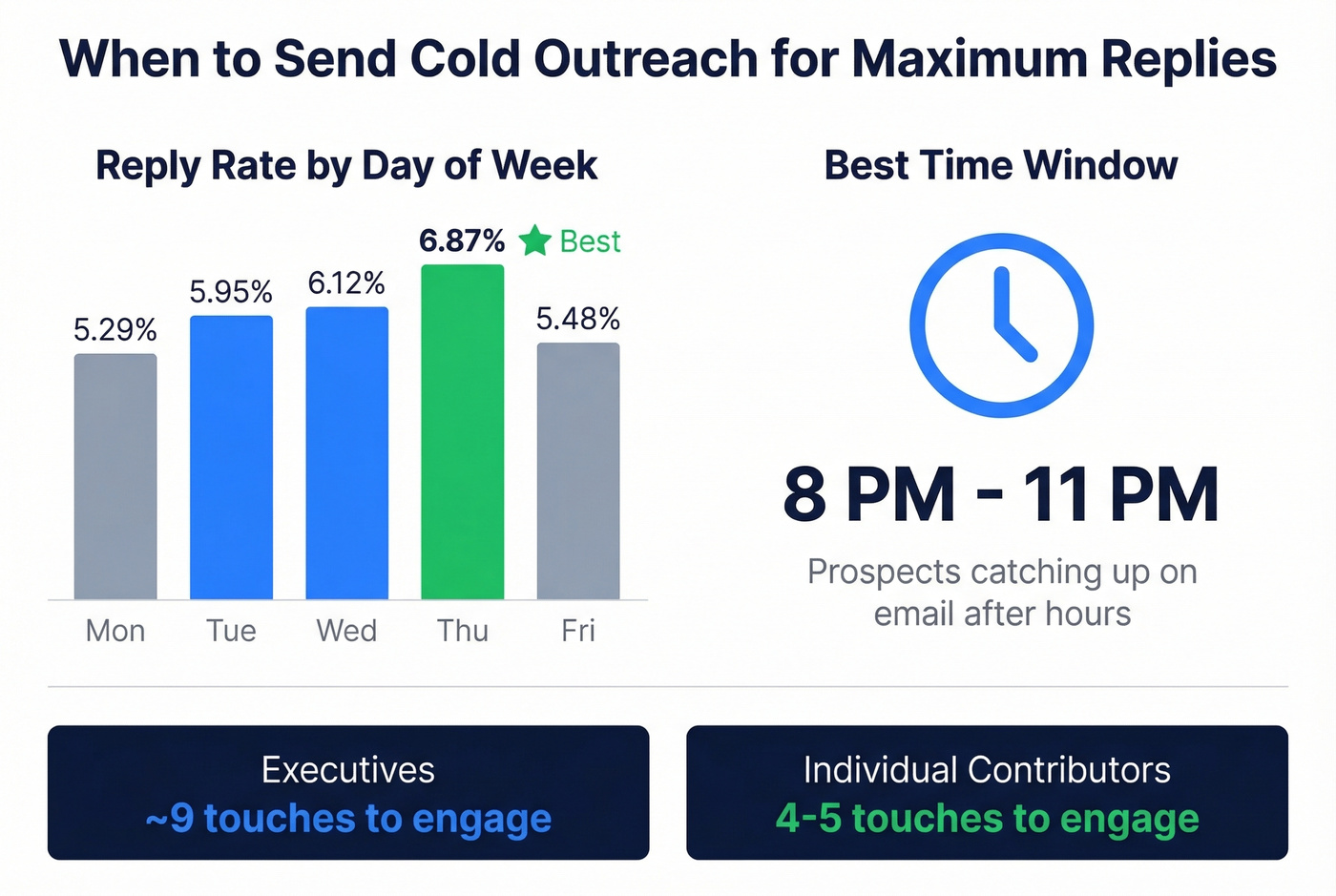
Timing matters more than people think. Thursday is the best day for cold outreach at a 6.87% reply rate, while Monday lags at 5.29%. The 8-11 PM window produces the highest replies, likely because prospects are catching up on email after hours. Executives typically require around 9 touches to engage, versus 4-5 for individual contributors, so budget your cadence accordingly. (More data: best time to send cold emails.)
6. Stay Legal
Cold email is legal. Here's what compliance looks like.
CAN-SPAM (US): Accurate From name, reply-to, and domain. No deceptive subject lines - skip the fake "Re:" tricks. Include a working unsubscribe mechanism and honor opt-outs within 10 business days. Include a valid physical mailing address.
GDPR (EU/UK): Document a legitimate interest basis for B2B outreach relevant to the recipient's role. Explain who you are and how you obtained their data. Provide a clear opt-out in every message and include your physical address.
Neither framework bans cold email. They ban bad cold email. There's a difference.
7. Measure and Iterate
Track three metrics: reply rate, bounce rate, and meeting-booked rate. A 5.8% reply rate is average - aim for 8%+ as your benchmark for a strong campaign. If bounces creep above 2%, your list quality needs work. If replies are fine but meetings are low, your CTA or qualification is off. (To tighten qualification, use lead scoring.)
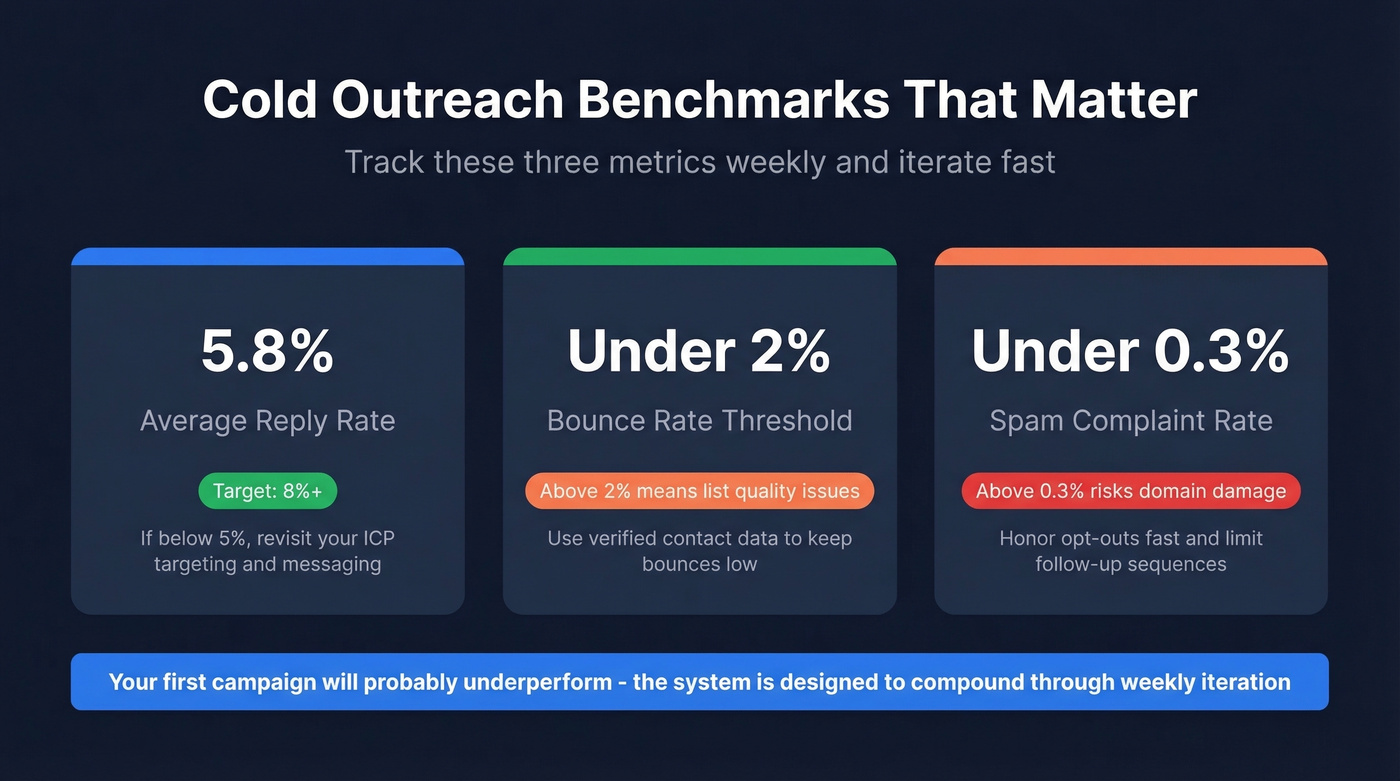
A/B test subject lines and CTAs in batches of 200+. Review cadence performance weekly. The teams that win at cold outreach aren't the ones with the best first draft - they're the ones that iterate fastest. Let's be honest: your first campaign will probably underperform. That's fine. The system is designed to compound.
Meritt tripled their pipeline from $100K to $300K/week and cut bounce rates from 35% to under 4% with Prospeo's verified contact data. When your outreach cadence runs on clean data, every touch - email, call, social - actually reaches a real buyer.
Clean data turns cold outreach into booked meetings. See it yourself.
Cold Outreach FAQ
Is cold outreach still effective in 2026?
Yes. Across 16.5 million cold emails, the average reply rate was 5.8% and 1-email sequences hit 8.4%. The channel works - the execution bar is just higher than it was three years ago.
How many follow-ups should I send?
Three to four emails per sequence. The first follow-up boosts replies by up to 49%, but by the fourth email, response rates drop 55% and spam complaints triple. More isn't persistence - it's domain damage.
What tools do I need?
Four categories: a data provider for verified contacts, a sequencing tool for automated cadences, a CRM for pipeline tracking, and a verification layer to keep bounces under 2%. Prospeo handles data and verification with 98% email accuracy and native integrations with Instantly, Smartlead, and Lemlist. Pair it with your sequencer and CRM of choice.
What's the best day and time to send cold emails?
Thursday delivers the highest reply rate at 6.87%, while Monday is weakest at 5.29%. The 8-11 PM window outperforms morning sends. Test these benchmarks against your own ICP - B2B buyers in different time zones and industries will shift the curve.