

How to Do Inside Sales: The Operational Playbook for 2026
You're 60 calls into the day. Your connect rate is hovering around 4%. The pipeline review is tomorrow, and you've got nothing new to show.
The problem isn't effort - it's that nobody taught you how to do inside sales as an actual system. It's not a job title. It's an execution framework, and most reps are running it without the blueprint.
Here's what to implement this week: a 7-stage pipeline with exit criteria for every stage, a multi-channel cadence with a breakup email, and a KPI dashboard tracking connect rate and speed-to-lead - the two metrics that predict everything else.
Inside Sales vs. Outside Sales
Inside sales is remote, consultative selling - phone, email, and video - where reps manage the full cycle from prospecting through close without meeting buyers in person. It's not telemarketing and it's not field sales.
The distinction usually comes down to complexity, cycle length, and cost structure. Inside sales is built for faster cycles and lower cost per interaction; outside sales is built for longer, higher-stakes deals where in-person time matters.
| Inside Sales | Outside Sales | Telemarketing | |
|---|---|---|---|
| Cost per touch | ~$50 | ~$308/visit | Pennies (scripted, high-volume) |
| ACV sweet spot | $5K-$50K | $50K-$500K+ | Transactional offers |
| Ramp time | 3-4 months | 6-9 months | Fast onboarding |
| Touches per day | 40-60 | 3-5 meetings | 100+ |
Inside sales wins on economics. You cover more ground at a fraction of the cost, which is why it's the default motion for SaaS, mid-market, and high-velocity B2B teams.
The 7-Stage Pipeline
Without defined stages and exit criteria, your pipeline is just a list of names at various levels of "maybe." This framework gives every deal a clear location and a clear next action. About 34% of revenue teams report sales cycles of 1-2 quarters, so you need structure that holds up over months, not days.
2. Qualification. Exit criteria: BANT confirmed - Budget, Authority, Need, Timeline. If you can't confirm at least three of four, the deal stays here. This is where SDRs hand off to AEs.
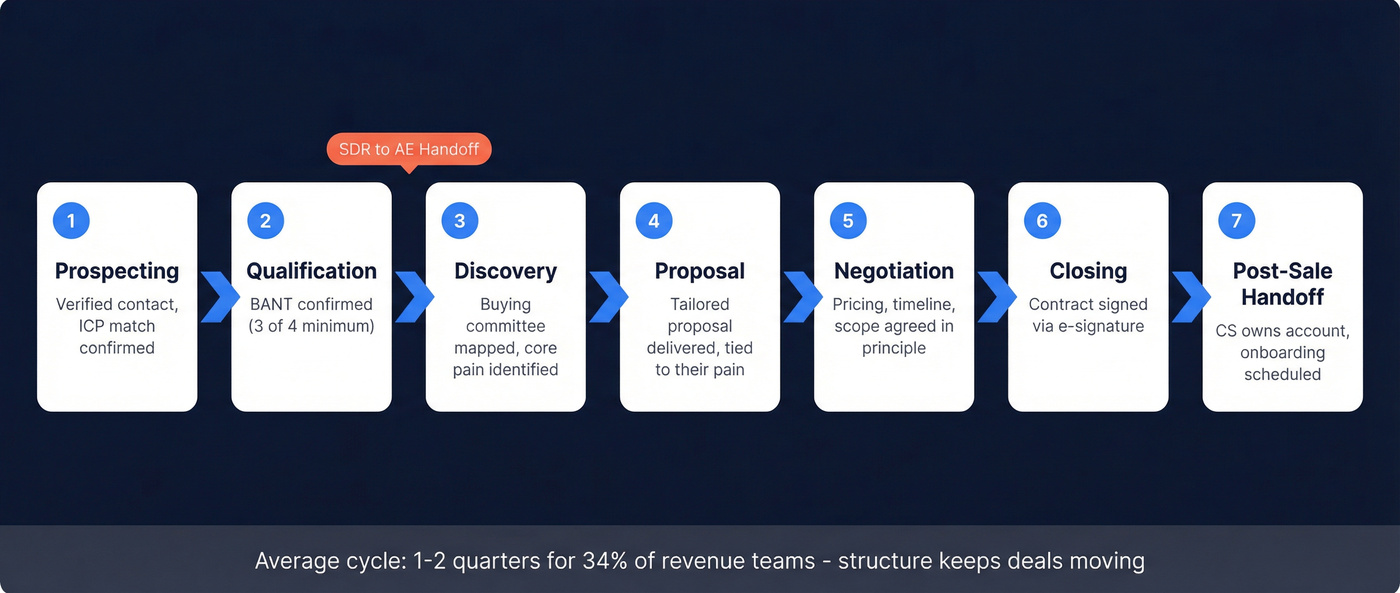
3. Discovery. Don't pitch yet. Ask questions, document pain, and identify who else needs to sign off. Exit criteria: you've mapped the buying committee and identified the core business problem. (If you need a tighter question set, use a discovery framework.)
4. Proposal/Solution. Exit criteria: prospect has received a tailored proposal tied to their specific pain points. Generic decks die here.
5. Negotiation. This is where deals stall if you skipped discovery. Pricing, timeline, and scope all need to be on the table with terms agreed in principle before you move forward. (This is also where anchor strategy matters.)
6. Closing. Exit criteria: signed contract. Use e-signature tools - don't let a PDF sitting in someone's inbox kill momentum.
7. Post-Sale & Handoff. Customer success has the account, onboarding is scheduled, CRM is updated. This stage protects renewals.
The SDR/AE handoff happens after Stage 2. If your SDRs are booking meetings without confirming qualification, your AEs are wasting cycles on dead ends.
Structuring Your Daily Schedule
Meaningful conversations beat raw call volume. We've seen reps make 100 dials a day and book fewer meetings than someone making 40 targeted calls with proper research.
One new rep on r/sales mentioned a 60-70 calls/day expectation for a first inside sales role - and without a system, that kind of volume feels brutal. Structure your day around energy and prospect availability instead of just hitting a number.
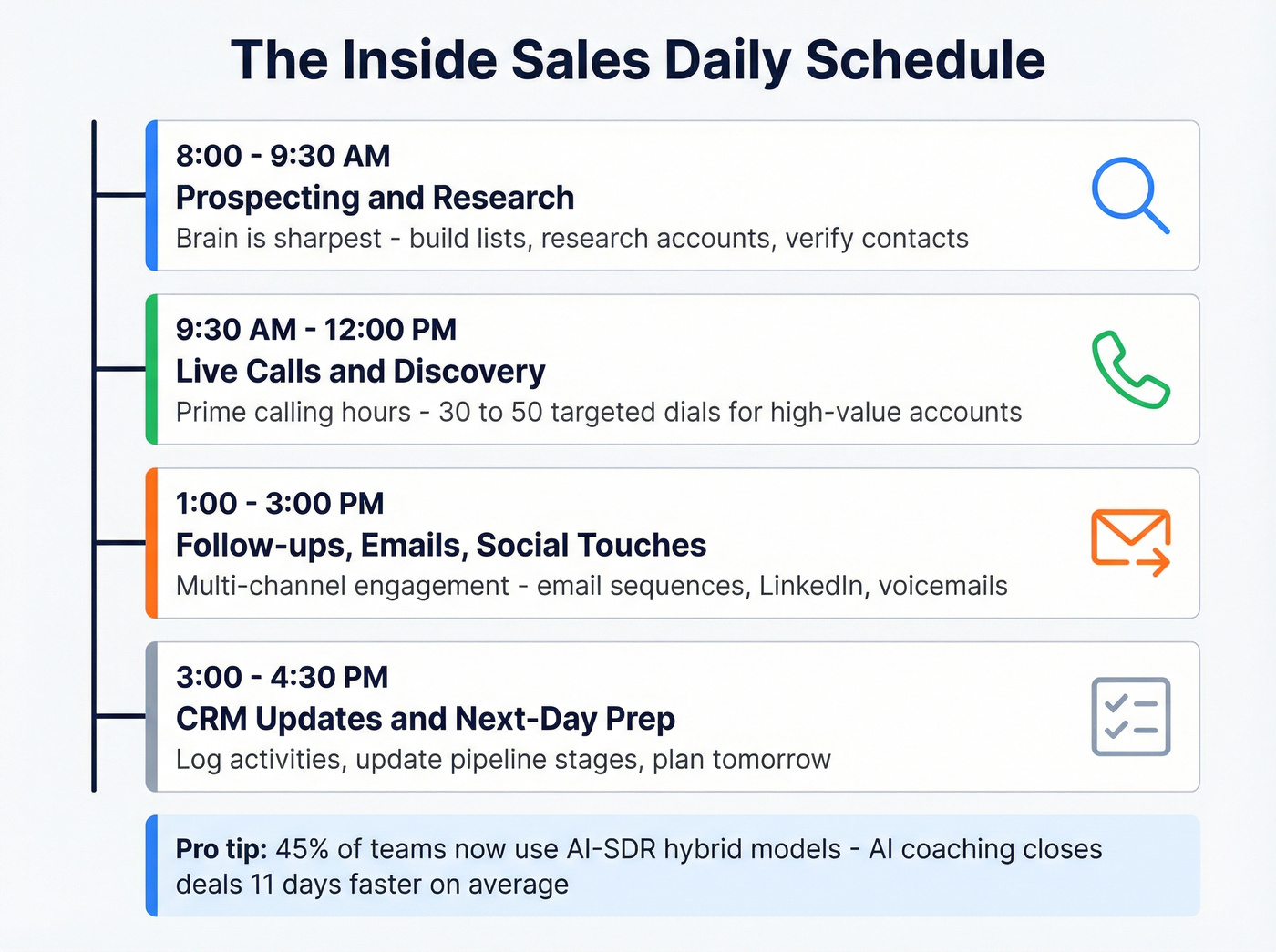
Spend your first 90 minutes on prospecting and research while your brain is sharpest. From 9:30 to noon, get on the phones for live calls and discovery. After lunch, shift to follow-ups, emails, and social touches until 3:00. Close out the day with CRM updates and next-day prep.
For high-value accounts, 30-50 calls per day is the right range. High-volume transactional sales can push 80-100. But if you're dialing 100 times and connecting twice, the problem isn't volume - it's your list. (Use proven sales prospecting techniques to tighten targeting.)
Here's the thing: 45% of teams now run a hybrid AI-SDR model, and AI coaching tools are closing deals 11 days faster on average with a 10-percentage-point win rate lift on $50K+ deals. If you're not at least testing AI-assisted call coaching in 2026, you're leaving money on the table.

Your call volume means nothing if you're dialing wrong numbers. Prospeo gives inside sales reps 125M+ verified mobile numbers with a 30% pickup rate - that's 3x the industry average. Stop burning hours on dead contacts and start filling your pipeline with real conversations.
Turn 40 targeted dials into more meetings than 100 blind calls.
Copy/Paste Cadences
Two cadences cover 90% of scenarios. Buyers engage across roughly 10 channels, so don't skip touches. (If you want ready-to-send language, pull from these follow-up templates.)
Inbound Cadence - 8-12 Touches
| Day | Channel | Action |
|---|---|---|
| 1 | Call | Respond to demo request |
| 2 | Recap + relevant resource | |
| 3 | Social | Connect request |
| 4 | Customer proof/case study | |
| 6 | Call | Direct question + voicemail |
| 8 | Value summary + offer call | |
| 10 | Breakup email |
Cold Outbound Cadence - 6-8 Touches
| Day | Channel | Action |
|---|---|---|
| 1 | Problem-based opener | |
| 3 | Call | Reference the email |
| 5 | Social | Engage with their content |
| 8 | New angle + social proof | |
| 12 | Call | Final direct attempt |
| 15 | Breakup with value |
The breakup email isn't giving up. It's a clean way to force a yes/no and reopen conversations that would otherwise die in silence.
Call Flow: Opener to Next Step
You've got about 30 seconds before a prospect decides to keep listening or hang up. Don't waste it on "How are you today?"
Problem-based opener: "Hi [Name], I work with [similar companies] who were struggling with [specific problem]. Is that something your team's dealing with right now?" Then stop talking. Let the silence work - the biggest mistake reps make is asking a question and then answering it themselves.
Discovery questions that open deals:
- "Walk me through how you're handling [process] today."
- "What happens when that breaks?"
- "Who else would need to weigh in on changing this?"
Book the next meeting before you hang up. "Can we get 30 minutes on Thursday to walk through how we'd solve this?" A call without a next step is a wasted call. (If you need a tighter close, use these steps to close patterns.)
KPIs and Benchmarks
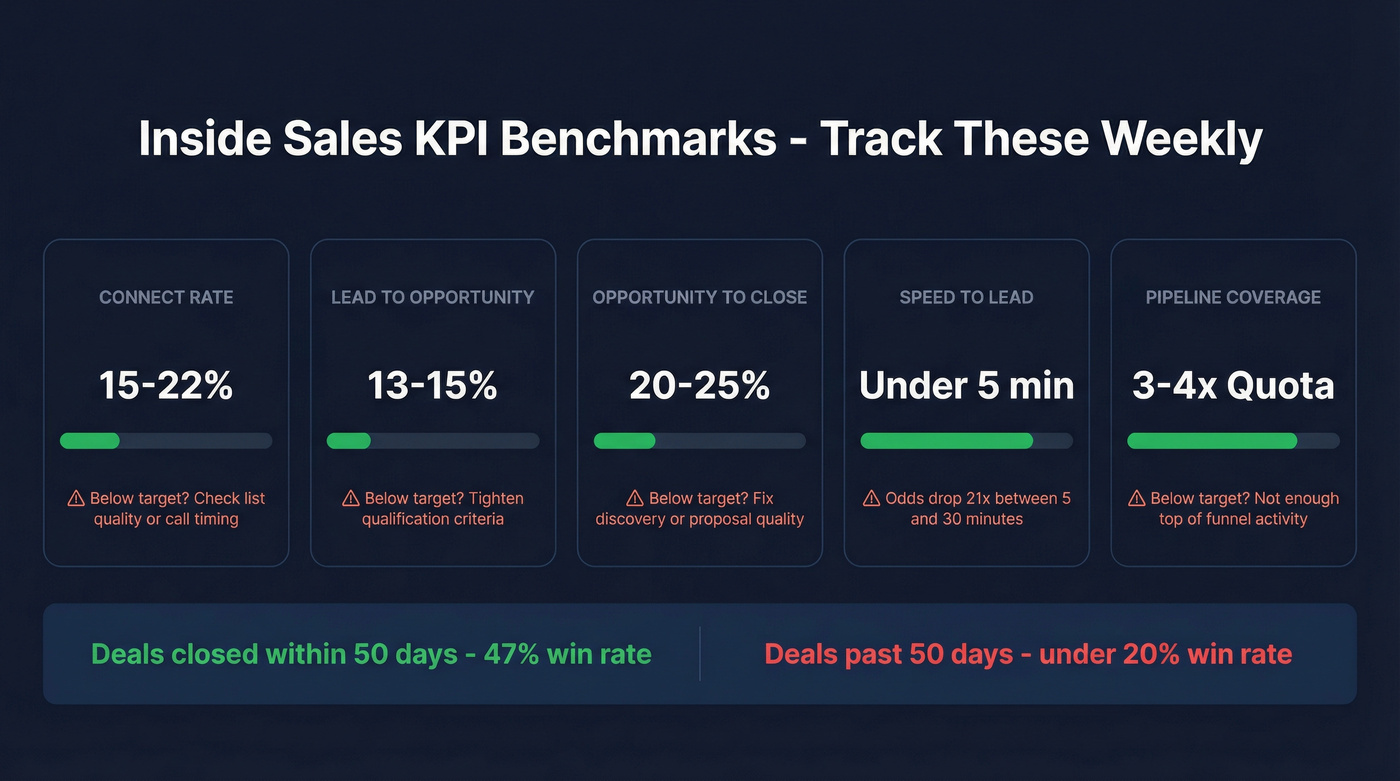
Track these weekly. If a number is off, the diagnostic column tells you where to look.
| Metric | Benchmark | If Below |
|---|---|---|
| Connect rate | 15-22% | List quality or timing |
| Lead to opportunity | 13-15% | Qualification gaps |
| Opportunity to close | 20-25% | Discovery or proposal issues |
| Speed-to-lead | Under 5 min | Odds drop 21x between 5 and 30 minutes |
| Pipeline coverage | 3-4x quota | Not enough top-of-funnel |
Deals closed within 50 days show a 47% win rate. After 50 days, that drops to 20% or lower.
In our experience, the single fastest fix for a struggling pipeline is speed-to-lead. Respond in under five minutes and you'll beat teams that take hours - the average B2B lead response time is a staggering 42 hours. That gap is your advantage. (To operationalize this, track funnel metrics weekly.)
Let's be honest about connect rates: if yours is under 3%, the problem isn't your script. It's stale data. One customer, GreyScout, cut their bounce rate from 38% to under 4% after switching to verified contacts and saw pipeline jump 140%. (If you're diagnosing email issues too, start with email bounce rate.)
Mistakes That Kill Deals
Pitching before discovery. You don't know their problem yet. Leading with questions keeps you out of "premature pitch mode" and forces real conversation.
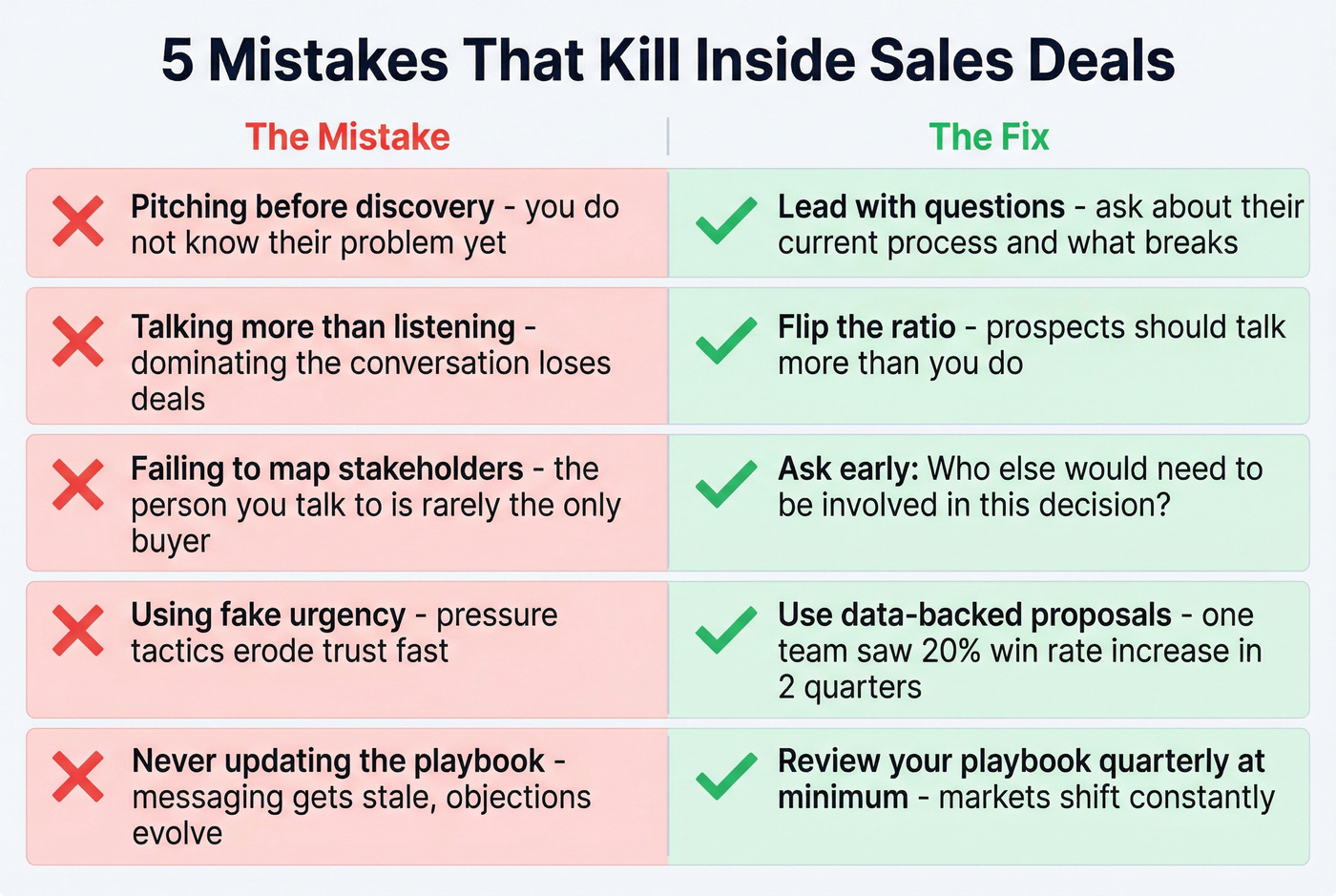
Talking more than listening. If you're dominating the conversation, you're losing deals. Flip the ratio.
Failing to map stakeholders. The person you're talking to is rarely the only decision-maker. Ask early: "Who else would need to be involved?" Skip this and you'll get ghosted after the "great meeting" that went nowhere because someone you never spoke to vetoed the deal. (This is where team selling discipline pays off.)
Fake urgency. One sales leader saw a 20% win rate increase over two quarters after replacing urgency-based CTAs with data-backed proposals. Trust sells. Pressure doesn't.
Not updating the playbook. Markets shift, messaging gets stale, objections evolve. Review your playbook quarterly at minimum. (If you're building a system, align it with sales execution principles.)
Learning how to do inside sales well isn't about memorizing scripts - it's about building a repeatable system where every stage, cadence, and metric feeds the next. Nail the process, and the numbers follow.
If your connect rate is below 15%, the diagnostic says list quality. Prospeo refreshes 300M+ profiles every 7 days - not every 6 weeks like competitors. At $0.01 per verified email, you fix your entire pipeline's data quality for less than one bad meeting costs you.
Bad data is the most expensive thing in your inside sales stack.
FAQ
How many calls should an inside sales rep make per day?
30-50 for high-value B2B accounts, 80-100 for high-volume transactional sales. Quality beats raw dials - 40 targeted calls with research consistently outperform 100 blind dials in meetings booked.
What's the difference between inside sales and telemarketing?
Telemarketing is scripted, high-volume outreach focused on transactional offers. Inside sales is multi-touch, consultative selling where reps manage the full cycle remotely using phone, email, video, and social channels.
How long does it take to ramp a new rep?
Best-in-class inside sales teams hit full productivity by month four. Outside sales ramp times are closer to 6-9 months. Structured onboarding with recorded call libraries and shadowing cuts ramp time significantly.
What tools do inside sales teams need?
A CRM like HubSpot or Salesforce ($0-$100/seat/month), a sales engagement platform like Outreach or Salesloft ($50-$150/seat/month), a dialer, and a verified data provider like Prospeo for clean contact data at roughly $0.01 per email.
What's a good connect rate for B2B inside sales?
15-22% is the benchmark for B2B direct dials. Below 3% signals a data quality or call-timing problem, not a script problem. Switching to a provider with verified mobile numbers can lift connect rates immediately.