

How to Drive Revenue with Intent Data: The Activation Playbook
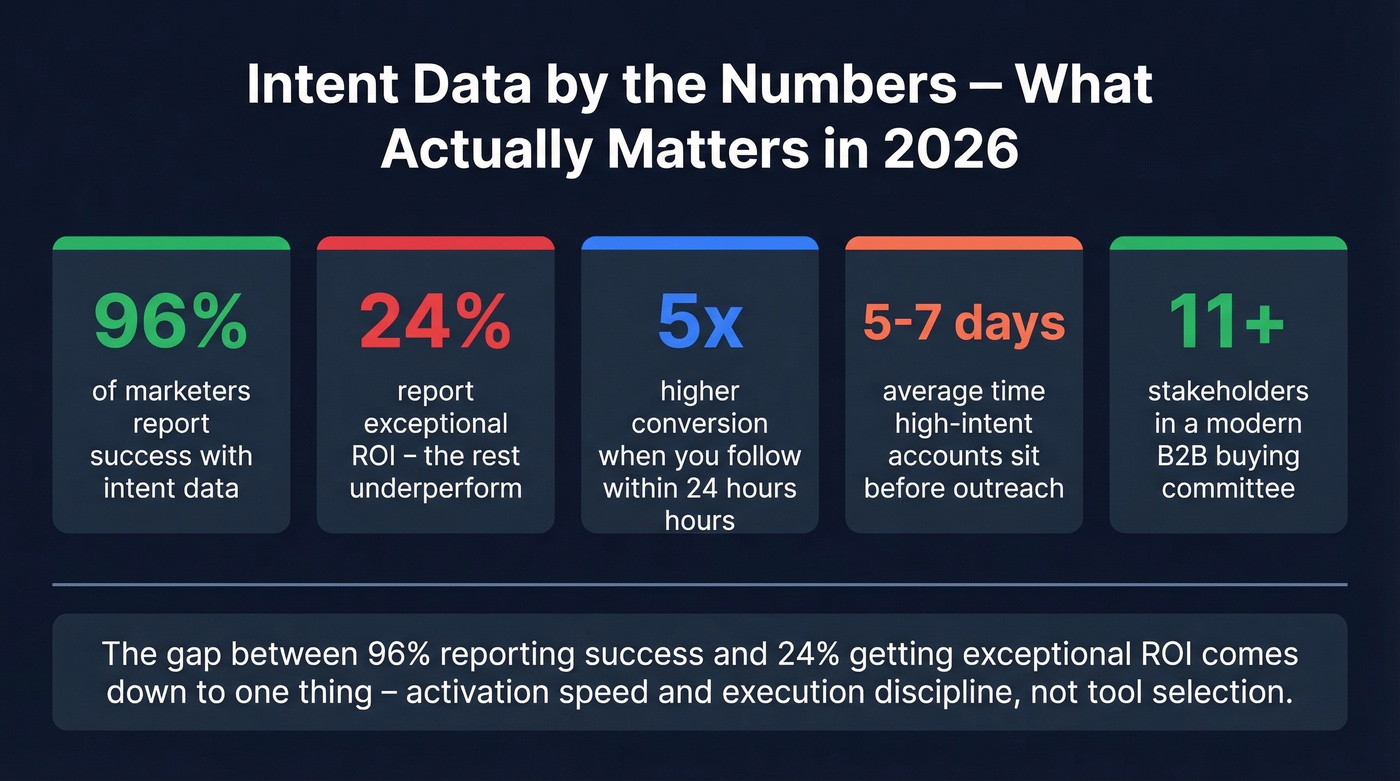
A sales leader with 20+ years of experience put it bluntly on r/sales: "90% of the intent triggers are useless." He's not wrong - at least not about how most teams run intent programs. Nearly 60% of B2B organizations now use intent data, and 69% say it's a top prioritization tool. Yet only 24% report exceptional ROI.
The gap between "account is surging" and "rep is on the phone" is where revenue dies. Here's how to close it.
What Separates Working Programs from Dashboard Graveyards
Three things:
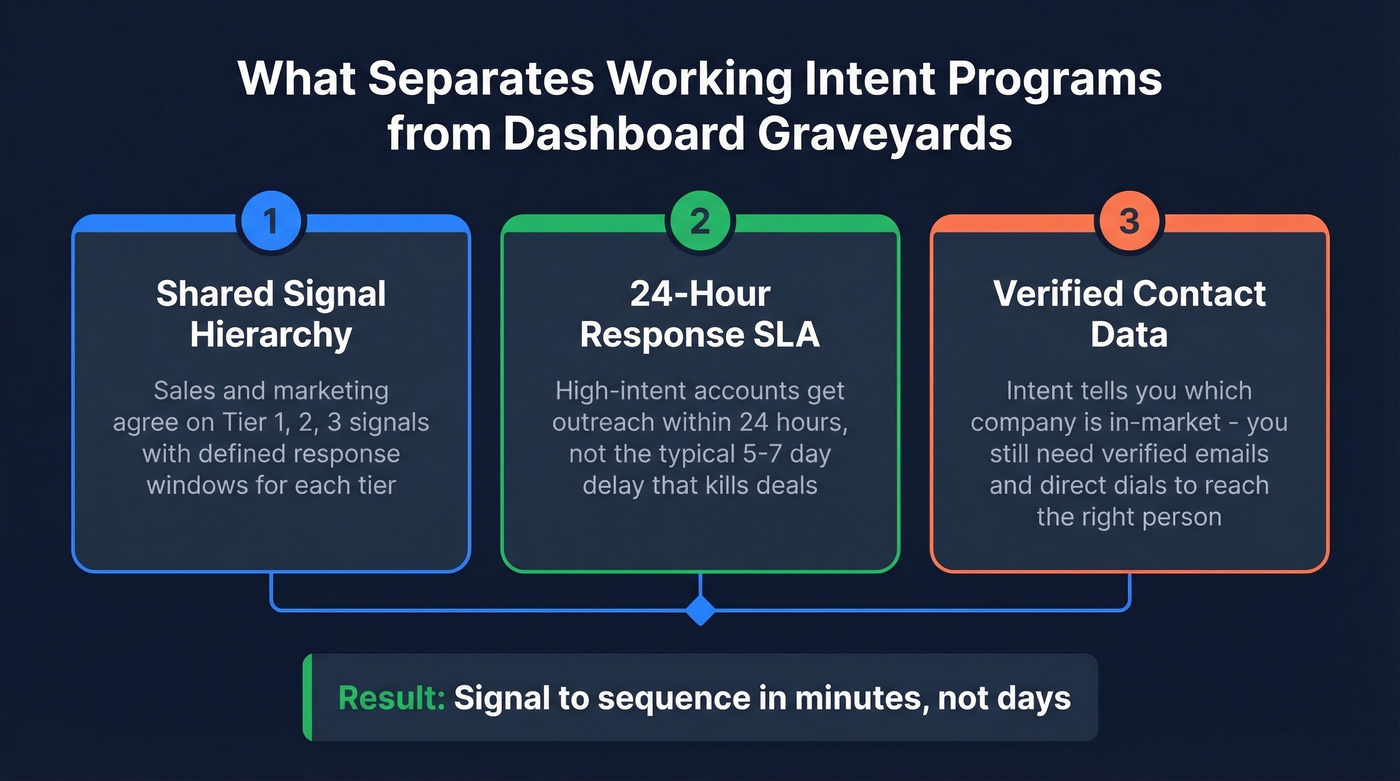
- A signal hierarchy your sales and marketing teams agree on. Tier 1, Tier 2, Tier 3 - with defined response windows for each. (If you need a system for this, start with buyer intent signals.)
- A 24-hour SLA for high-intent accounts. High-intent accounts often sit for 5-7 days before anyone reaches out. That's how you lose deals to faster competitors.
- Verified contact data so you can actually reach people at surging accounts. Intent tells you which company is in-market. You still need verified emails and direct dials to reach the right person there - use a verified contact database (or compare options in best B2B databases).
Why Most Intent Programs Fail
We've watched dozens of teams implement intent data. Three root causes show up every time.
No shared signal interpretation. Marketing thinks a topic surge means "ready for a nurture sequence." Sales thinks it means "ready for a cold call." Without a shared playbook, signals just create confusion. Up to 70% of the buyer journey happens in the "dark funnel" - anonymous research across review sites, communities, and peer conversations that your first-party analytics never see. Third-party intent data from providers like Bombora helps surface those signals, but only if your team agrees on what to do with them.
No buying-stage mapping. Teams treat every spike the same. A company browsing "what is ABM" isn't in the same place as one comparing your product to a competitor on G2. Lumping them together guarantees wasted outreach. (If you're running ABM, align this with your account based marketing benchmarks.)
No response playbook. High-intent accounts sit in dashboards for 5-7 days before anyone acts. By then, a faster competitor has already booked the meeting. On r/b2bmarketing, one poster noted that decision-makers get 200+ cold emails a day - speed and relevance are the only things that cut through. (This is where automate sales signals pays for itself.)
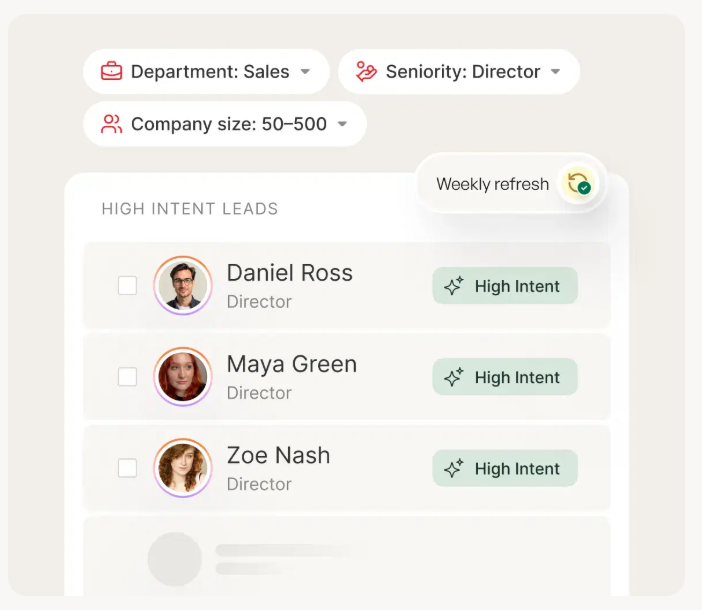

Most intent programs die in the gap between "surging account" and "verified contact in a sequence." Prospeo eliminates that gap - 15,000 Bombora intent topics layered with 300M+ profiles, 98% email accuracy, and 125M+ direct dials, all refreshed every 7 days. No contracts, ~$0.01/email.
Stop watching high-intent accounts cool off while you hunt for contact data.
The Intent Data Revenue Playbook
Build a Signal Hierarchy
Not all intent signals deserve the same response:
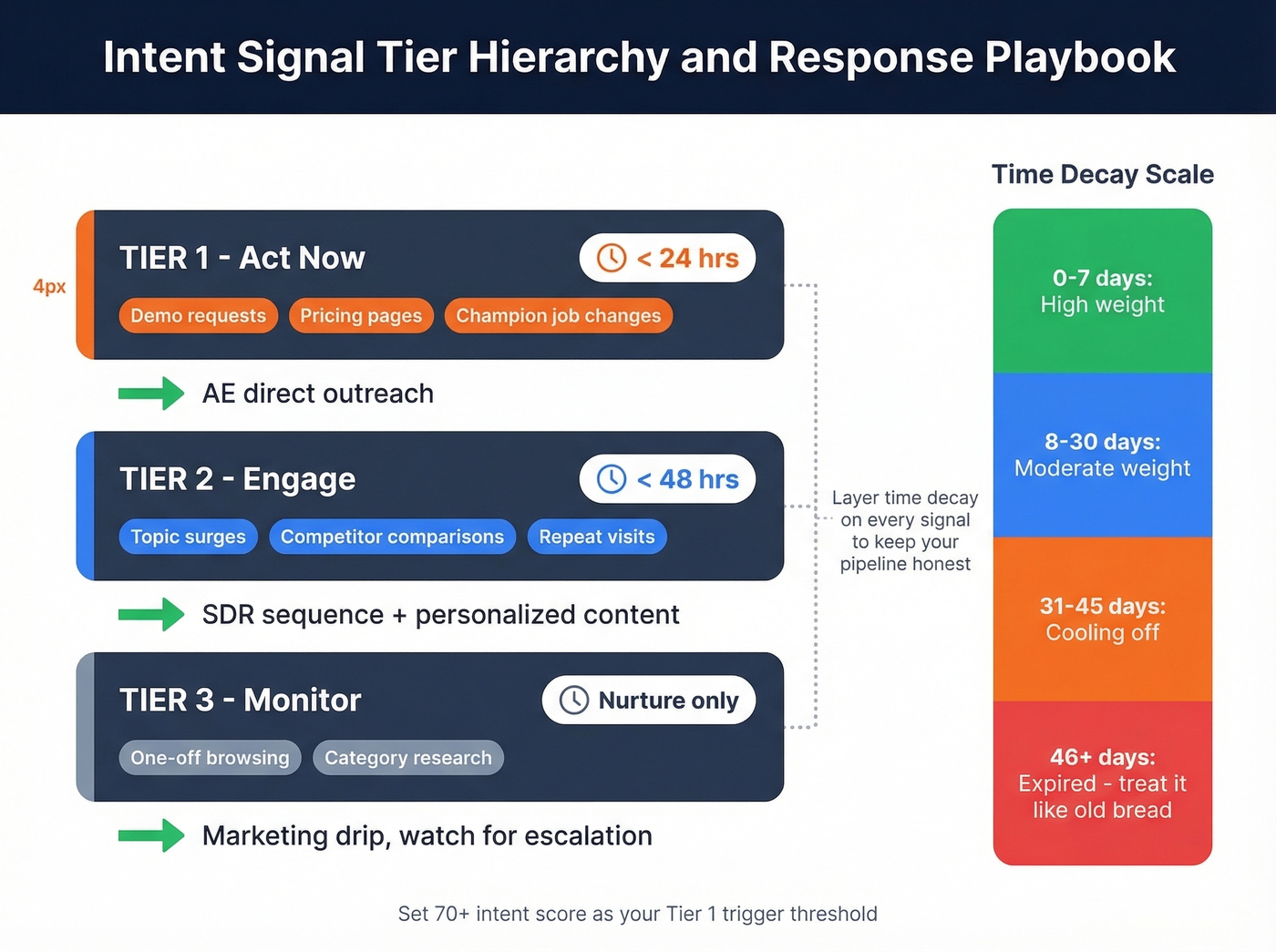
| Tier | Signal Examples | Response Window | Action |
|---|---|---|---|
| Tier 1 | Demo requests, pricing pages, champion job changes | Within 24 hrs | Direct outreach, AE-owned |
| Tier 2 | Topic surges, competitor comparisons, repeat visits | Within 48 hrs | SDR sequence + personalized content |
| Tier 3 | One-off browsing, general category research | Nurture only | Marketing drip; monitor for escalation |
A common threshold on many platforms is a 70+ intent score - set that as your Tier 1 trigger. Layer in time-decay to keep your pipeline honest: 0-7 days carry high weight, 8-30 days moderate, 31-45 days cooling. Anything past 46 days? Expired. Treat it like old bread.
Set a 24-Hour Response SLA
Follow-up within 24 hours increases conversion by 5x. In our experience, the 24-hour window matters more than which platform you pick. If you want to turn buying signals into closed deals, this is the single highest-leverage change you can make.
The mechanics aren't complicated. Flag Tier 1 accounts in your CRM automatically. Push Slack alerts to the owning AE. Auto-enroll surging accounts into sequences in Outreach, SalesLoft, or HubSpot. If a rep has to manually check a dashboard to discover a surging account, you've already lost the speed advantage. (If your CRM workflows are messy, start with CRM automation software.)
Fix the Contact Data Gap
Here's the thing: intent data tells you who's in-market. It doesn't give you verified emails or direct dials. And that gap is where most programs quietly die.
You identify a surging account. You know the VP of Engineering is your buyer persona. But you don't have a verified email or mobile number. So the signal sits there while someone manually hunts for contact info - or worse, sends to an unverified address that bounces. Modern buying committees average 11+ stakeholders, which means you're not just finding one contact. You're building a multi-threaded outreach plan across an entire account, and every hour you spend hunting for data is an hour your competitor spends selling. (To reduce bounce risk, pair this with data enrichment and an email verifier.)
Prospeo closes this gap by combining 15,000 Bombora intent topics with 300M+ professional profiles, 143M+ verified emails at 98% accuracy, and 125M+ mobile numbers - all on a 7-day refresh cycle. You go from "surging account" to "verified contact in a sequence" in minutes, not days.
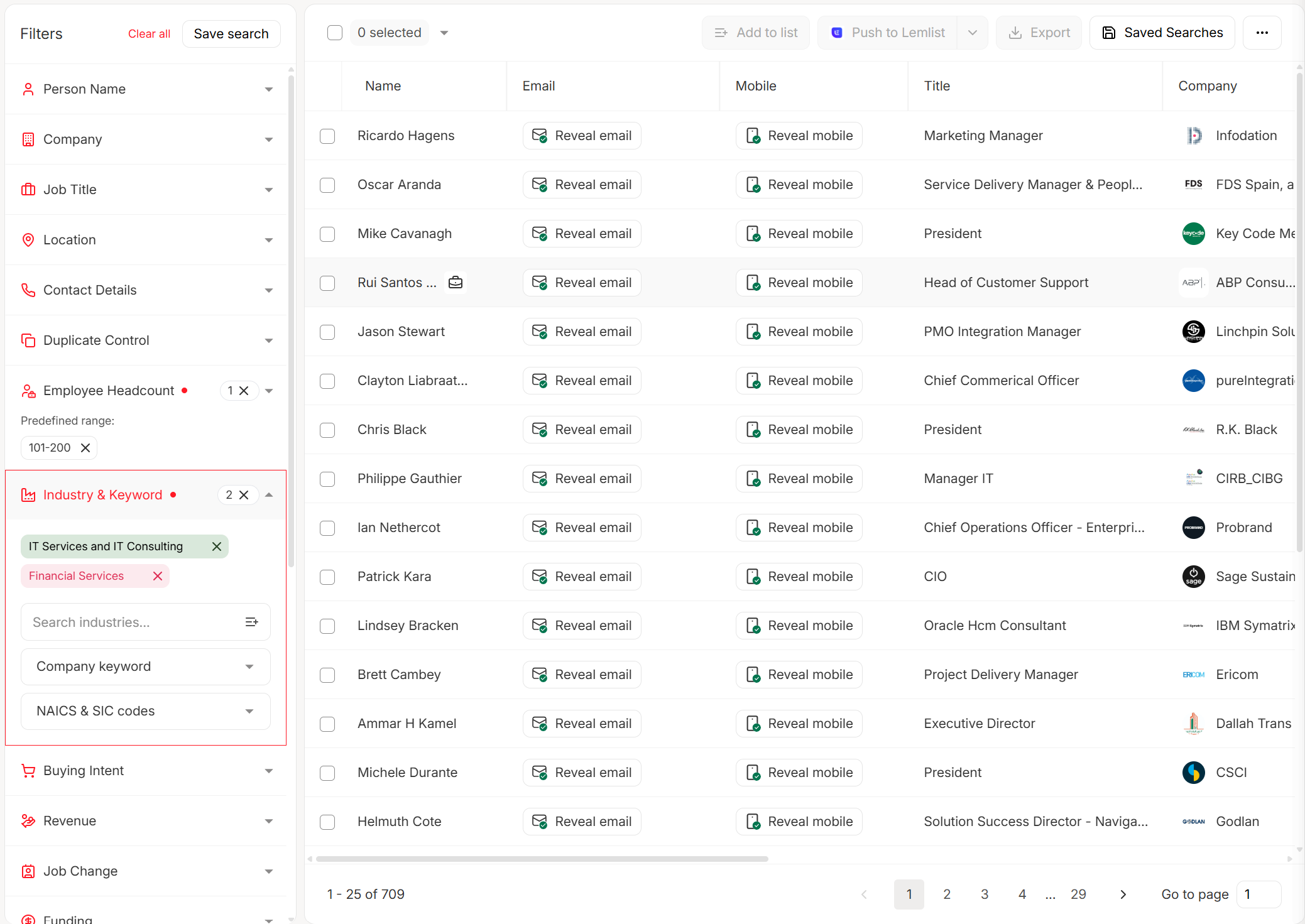
Your 24-hour SLA means nothing if your reps spend that time searching for emails. Prospeo gives you intent signals and verified contact data in one platform - so you go from buying signal to personalized sequence in minutes. Teams using Prospeo book 35% more meetings than Apollo users.
Close the activation gap before your competitor books the meeting.
What Intent Data Actually Costs
| Tool | Annual Cost Range |
|---|---|
| Prospeo (intent + contacts) | Free tier available; ~$0.01/email |
| ZoomInfo Streaming Intent | $7,200-$36,000/year |
| G2 Buyer Intent | $10,000-$87,000+/year |
| Bombora | $25,000-$80,000/year |
| 6sense | $35,000-$150,000+/year |
| Demandbase | $40,000-$120,000/year |
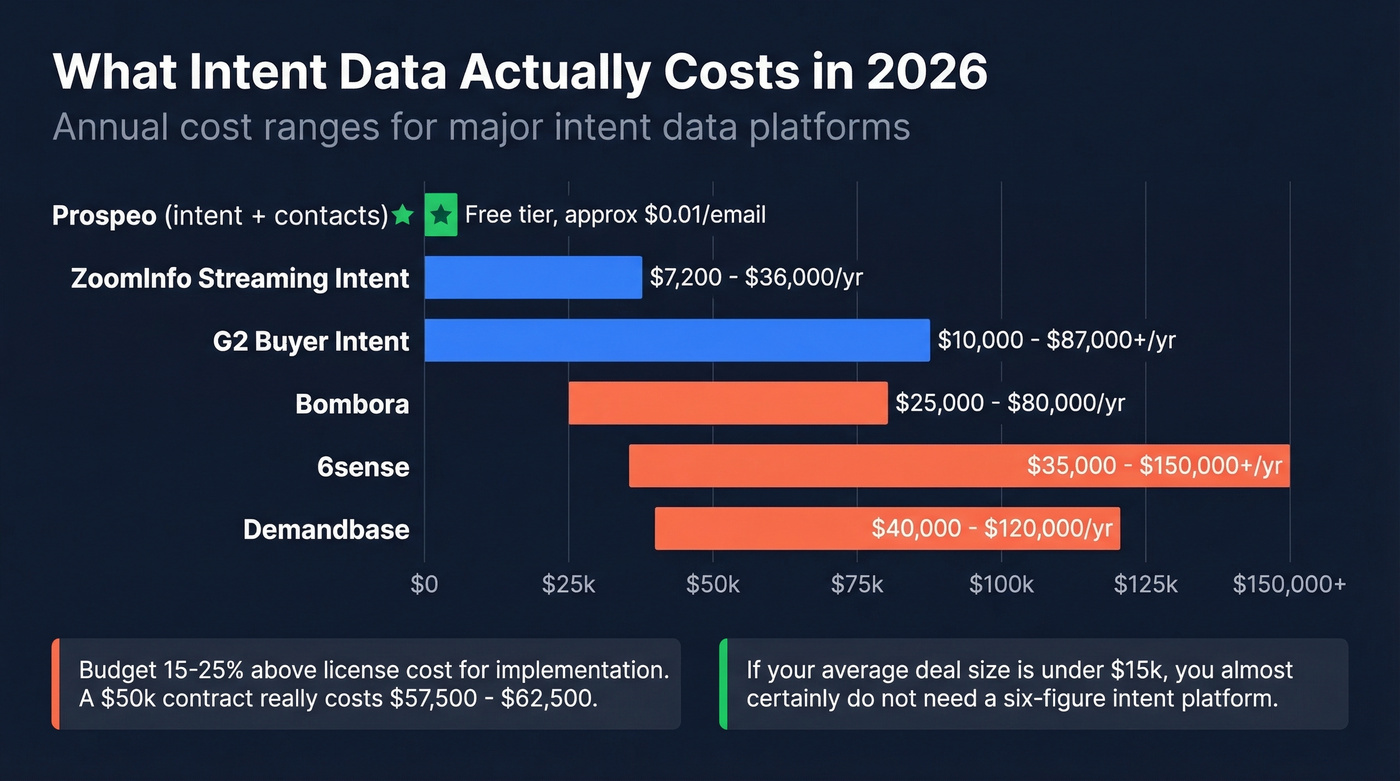
Budget 15-25% above the license cost for implementation and integration. A $50,000 Bombora contract really costs $57,500-$62,500.
Let's be honest: if your average deal size is under $15k, you almost certainly don't need a six-figure intent platform. A self-serve tool with intent signals and verified contacts will outperform an enterprise suite that sits half-configured for months. We've seen it happen repeatedly - a team on $200/month tooling outperforming a team on $100k/year because they had the activation playbook dialed in. (If you want more ways to fill the top of funnel, steal from these pipeline generation ideas.)
ROI formula: (incremental pipeline from intent-sourced accounts x your win rate) - (platform cost + 20% overhead). Baseline conversion runs about 22% Lead-to-MQL and 15% MQL-to-SQL. A well-activated intent program can double your MQL-to-SQL rate - on 1,000 leads, that's 33 extra SQLs entering your pipeline from the same top-of-funnel volume. (If handoffs are the bottleneck, fix your MQL to SQL handoff.)
Choosing the Right Stack
The Forrester Wave Q1 2025 named Intentsify, 6sense, Bombora, Informa TechTarget, and Demandbase as leaders. These are enterprise-grade platforms built for organizations with dedicated RevOps teams and six-figure budgets. (If you're evaluating intent vendors specifically, see contact-level intent data.)
The intent data market sits at roughly $4.5B in 2026 and is projected to hit $20.89B by 2035. But the biggest lever isn't picking the perfect platform - it's building the activation playbook that turns signals into pipeline. Skip the enterprise platforms entirely if you don't have a RevOps team to configure and maintain them. Execution discipline beats tool sophistication every time.
FAQ
Does intent data actually work for outbound sales?
Yes - when paired with an activation playbook. 96% of marketers using intent data report success, yet only 24% report exceptional ROI. The difference is operational: signal tiers, 24-hour SLAs, and verified contacts separate top performers from the rest.
What's the cheapest way to start with buyer intent signals?
Self-serve platforms with free tiers let you test intent signals without committing $25,000+ upfront. Enterprise-only platforms like ZoomInfo start at $7,200/year, with Bombora and 6sense at $25,000+. If you're testing the waters, start small, prove the playbook works, then scale your tooling investment.
How fast should you act on an intent signal?
Within 24 hours for Tier 1 signals - follow-up in that window increases conversion by 5x. High-intent accounts often sit 5-7 days before outreach, which is exactly why most intent programs underperform. Treat response speed as a non-negotiable metric, not a nice-to-have.