

How to End an Email to Get a Response (2026 Guide)
You typed "Best," hit send, and got silence. Again. Cold emails sit in the 1-5% response rate range, so every element has to earn its keep - including the last two lines. Knowing how to end an email to get a response comes down to two things: the right sign-off and a specific ask.
Across 350,000+ email threads, the baseline response rate was 47.5%. Swap in a gratitude-based closing and you can push that to 65.7%. The fix takes five seconds.
What the Data Says About Sign-Offs
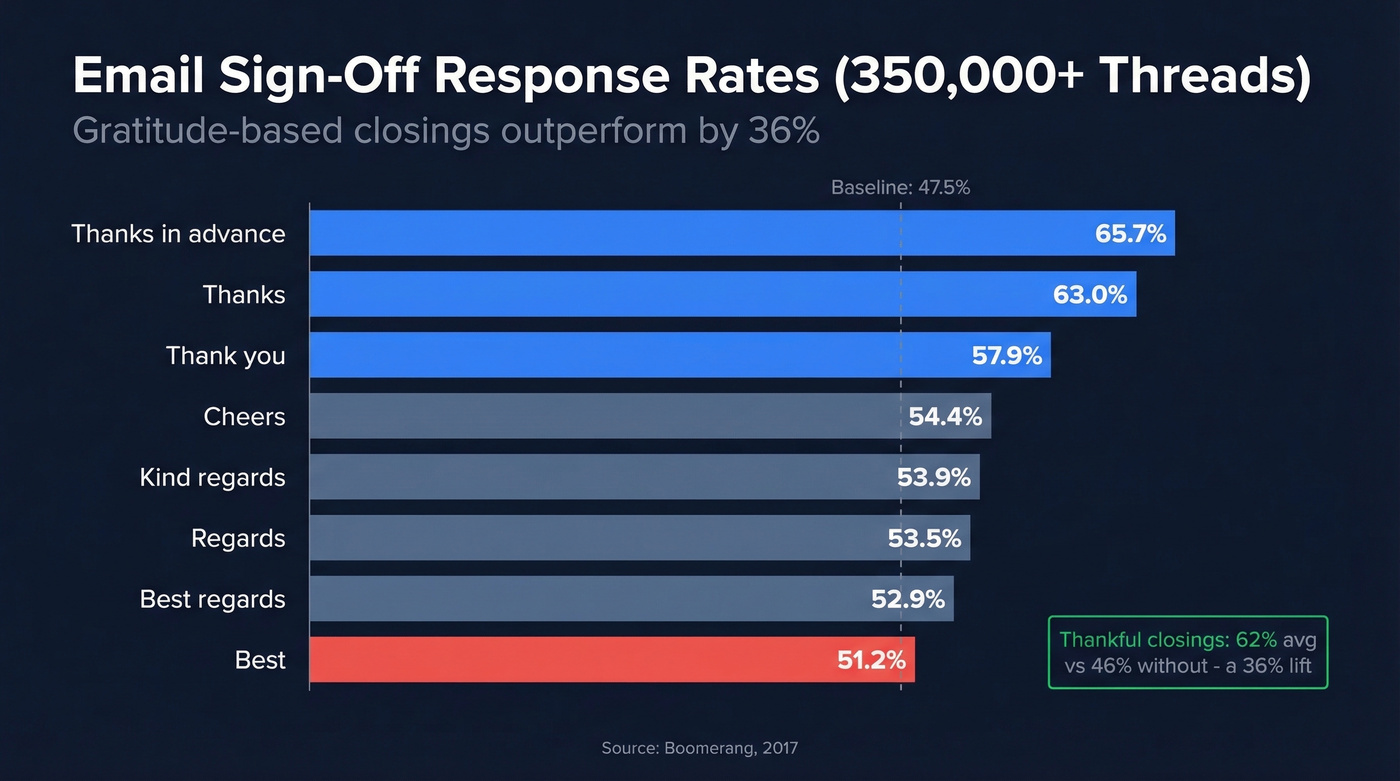
Boomerang analyzed those 350,000+ threads from 20+ online communities, filtering for emails that contained a question mark so they weren't counting messages that didn't warrant a reply. Here's the full ranking:
| Sign-Off | Response Rate |
|---|---|
| Thanks in advance | 65.7% |
| Thanks | 63.0% |
| Thank you | 57.9% |
| Cheers | 54.4% |
| Kind regards | 53.9% |
| Regards | 53.5% |
| Best regards | 52.9% |
| Best | 51.2% |
Emails with a thankful closing hit a 62% response rate vs. 46% without - a 36% relative lift. "Best," the default sign-off for most professionals, came in dead last among popular options.
Why does gratitude work? A 2010 study by Grant & Gino found in a controlled experiment that a simple "Thank you so much!" made recipients more than twice as likely to help. It's not manipulation - it's human wiring. We're more inclined to act when someone acknowledges the effort upfront.
The Reddit consensus backs this up. On r/ExecutiveAssistants, one popular thread was titled "ways to close an email other than Best" - people are actively hunting for alternatives because "Best" feels generic and forgettable.
The CTA Is the Real Closing
Your sign-off is the garnish. The CTA - the sentence right before it - is the meal.
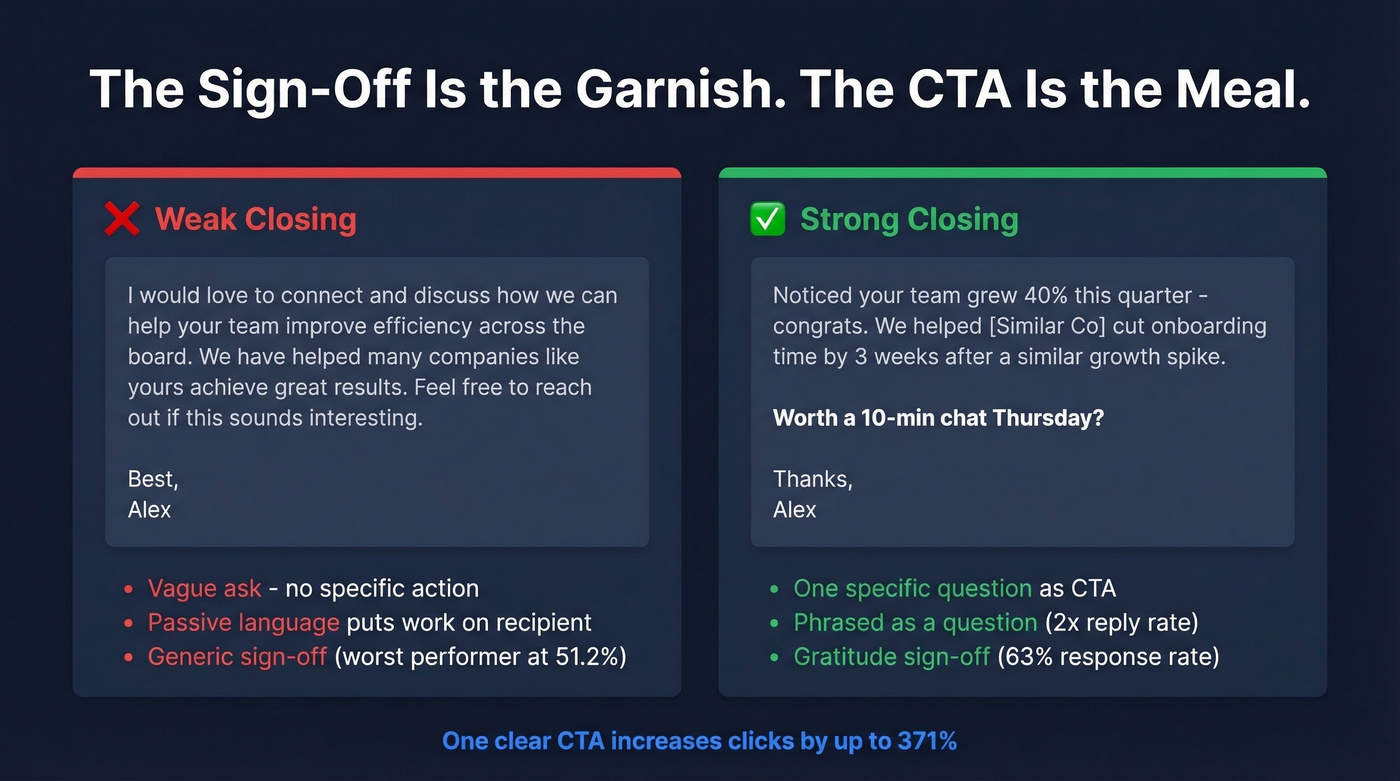
One clear CTA per email can increase click-through by up to 371% compared to multiple asks. Phrasing that CTA as a question doubles reply rates versus a statement. That's why the best email sign-off for response isn't really about the sign-off at all - it's about the ask that precedes it.
Bad: "Let me know your thoughts."
Good: "Would a 15-minute call on Tuesday work?"
Skip the calendar link in your first cold email. It presumes interest before you've earned it. Save it for the reply.
In our experience, the sign-off change alone rarely moves the needle - it's the CTA rewrite that does the heavy lifting. And the specificity of your CTA should match your recipient's seniority. Gong's analysis of 30,000+ prospecting emails found that individual-based personalization more than doubles reply rates for non-managerial contacts, but only lifts about 50% for directors and above. For executives, company-based personalization triples reply rates. Industry-specific personalization correlates with an 88% increase across the board.
So if you're emailing an IC, reference something about them. If you're emailing a VP, reference something about their company. Then close with a specific ask and a "Thanks." If you want more frameworks, borrow from proven sales prospecting techniques and keep the personalization tight.
Here's the thing most guides won't say: they obsess over sign-offs because they're easy to change. But a perfectly worded "Thanks in advance" on a rambling 300-word cold email still gets ignored. Teams that consistently book meetings keep their cold emails between 40 and 60 words with a soft CTA - and that discipline matters more than any sign-off.
Closing Lines for Every Situation
Not every email is cold outreach. Use this as a quick reference:
| Situation | Sign-Off | CTA Example |
|---|---|---|
| Cold outreach | Thanks | "Worth a 10-min chat Thursday?" |
| Job application | Kind regards | "When works to discuss?" |
| Internal request | Thanks! | "Can you send by Friday EOD?" |
| Follow-up | Thanks again | "Does next week work?" |
| Re-engagement | Thanks | "Saw [company news] - still relevant?" |
| Customer email | Best regards | "Want me to set that up?" |
Your first follow-up increases B2B response rates by 50%. But add something new each time - a relevant stat, a case study, a different angle - so the follow-up earns attention rather than just nagging. If you need examples, start with these sales follow-up templates or dedicated cold email follow-up templates.
A cultural note: "Kind regards" and "Best regards" are safe across US and UK contexts. "Sincerely" reads formal - fine for job applications, stiff for sales. "Cheers" works if you're writing to someone in the UK or Australia, but it can feel forced in American corporate email.

You just learned that gratitude-based closings lift reply rates by 36%. But here's the uncomfortable truth: 15% of emails in the average B2B list never reach an inbox at all. Prospeo's 5-step verification with catch-all handling and spam-trap removal delivers 98% email accuracy - so your perfectly crafted CTA and 'Thanks in advance' actually land where they're supposed to.
Fix your list before you fix your sign-off. 75 free verifications, no card required.
Five Closing Mistakes That Kill Replies
Passive close. "Feel free to reach out" puts all the work on the recipient. They won't.
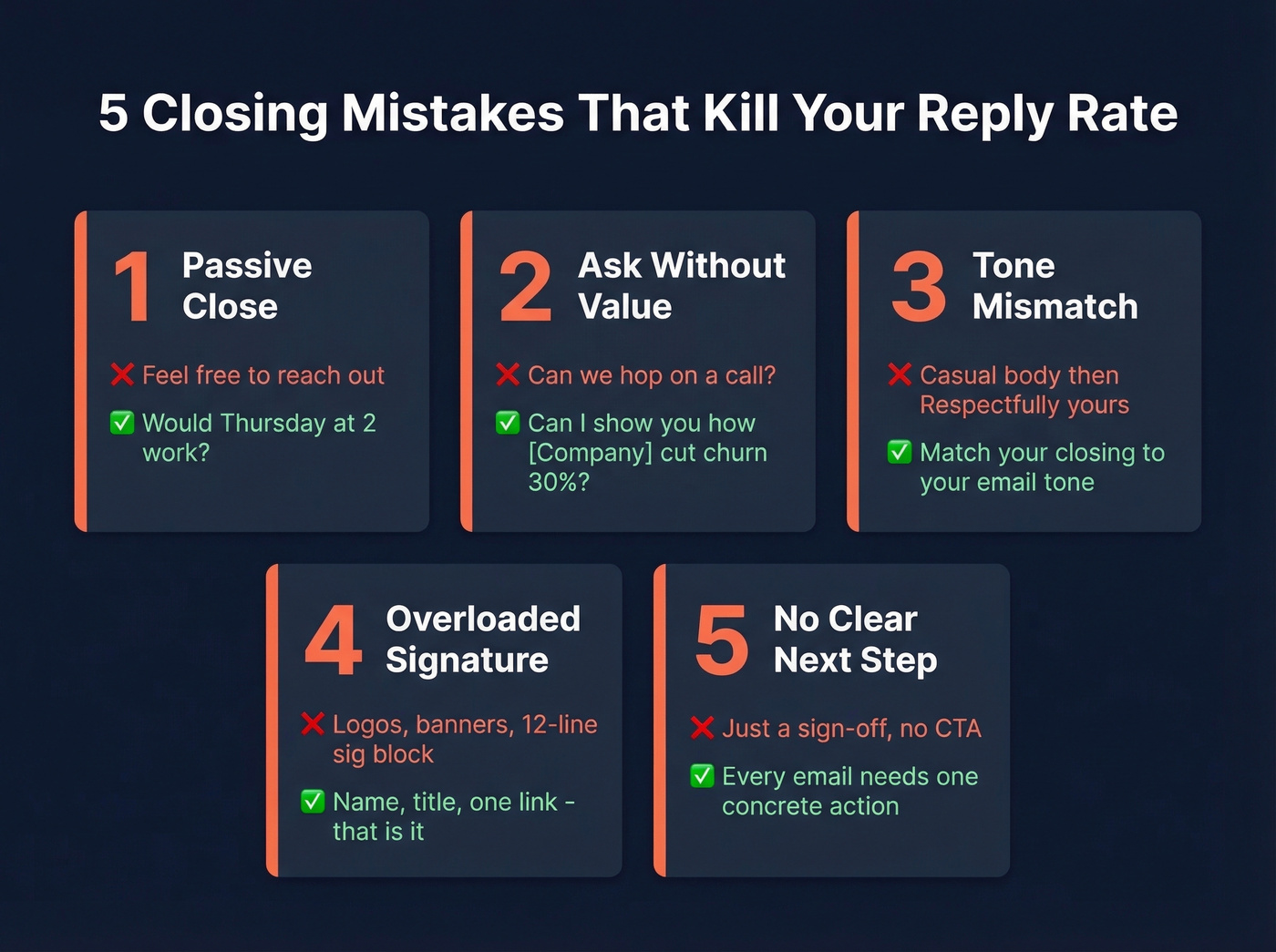
Ask without value. "Can we hop on a call?" gives them no reason to say yes. Lead with what they get from the call (here’s a deeper guide on how to add value in sales).
Tone mismatch. A casual email body followed by "Respectfully yours" creates cognitive dissonance. Match your closing to your tone throughout.
Overloaded signature. Logos, banners, social icons, and a 12-line signature block scream "marketing email." Keep it to name, title, one link. That's it.
No clear next step. Ending with just a sign-off and no CTA is like ending a sales call without booking the next meeting - you did all the work and walked away empty-handed. Every closing line needs a concrete action the recipient can take. (If you want rules + examples, see email copywriting.)
Skipping the sign-off entirely is trending, but it reads as curt in cold outreach where you haven't built rapport yet.
One more from the cold email trenches on Reddit: "Just bumping this up" is the worst follow-up line in existence. If you don't have something new to add, don't send it.
Fix Your Data Before Your Sign-Off
Let's be honest: none of this matters if your email never arrives. Bounce rates above 2% actively damage your sender reputation, pushing future emails to spam. We've seen teams rewrite every template, optimize every subject line, and still get crickets - because 15% of their list was bouncing.
Prospeo runs a 5-step verification process with catch-all handling, spam-trap removal, and honeypot filtering, delivering 98% email accuracy. Before you launch that next campaign with your freshly optimized closings, upload your list and verify it. The free tier covers 75 emails a month - enough to test whether bad data is your real bottleneck. If you’re troubleshooting, start with email bounce rate and then work through a full email deliverability guide.
Gong's data says company-level personalization triples reply rates for executives. Prospeo's database of 300M+ profiles with 30+ filters - including buyer intent, technographics, and headcount growth - gives you the context to write CTAs that reference what actually matters to your prospect. At $0.01 per verified email, bad data stops being the reason your closings fall flat.
Stop perfecting sign-offs on emails sent to the wrong people.
How to A/B Test Your Closing
Don't take the data at face value - run your own test. Most guides stop at "use Thanks." Here's how to actually prove what works for your audience.
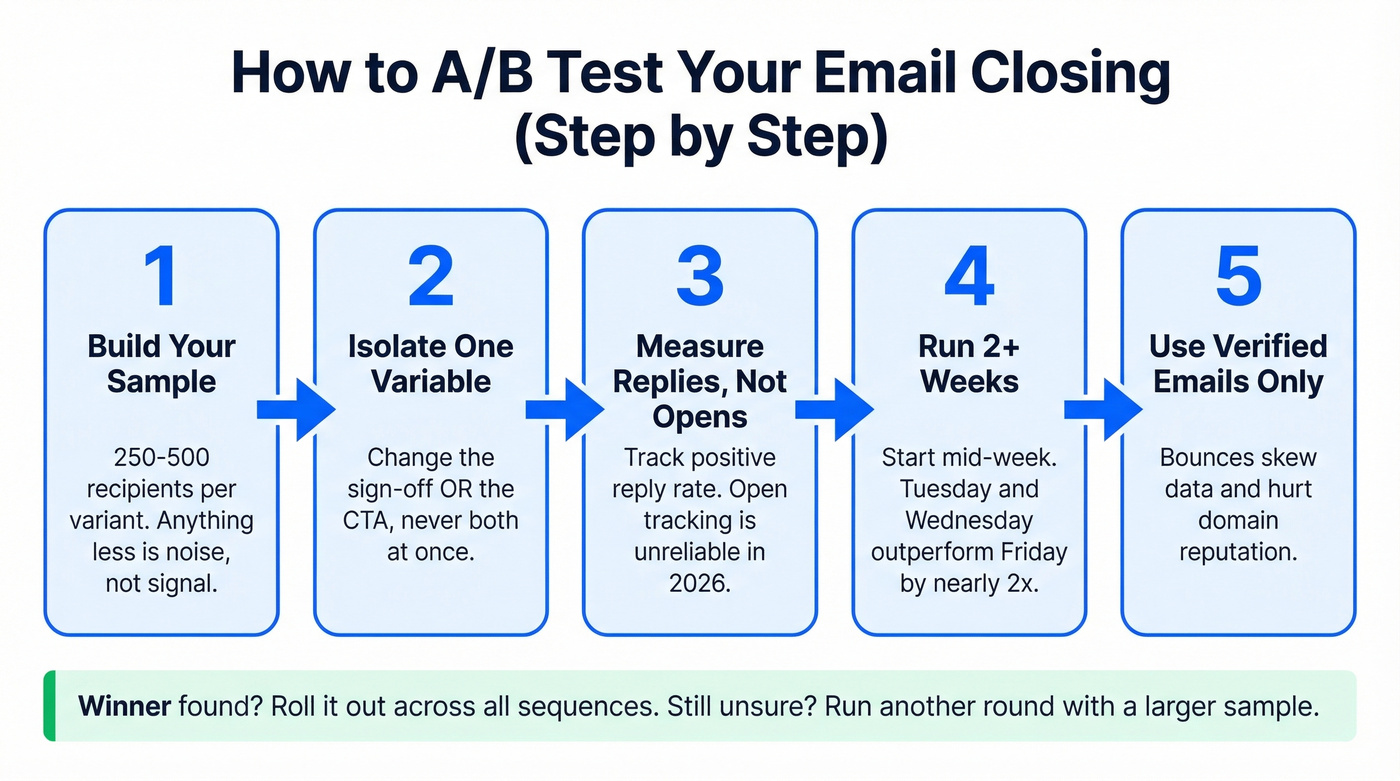
Sample size: You need 250-500 recipients per variant. Anything less and your results are noise, not signal.
Isolate one variable. Change the sign-off OR the CTA, not both. If you change both, you won't know which one moved the number.
Measure positive reply rate, not opens. Open tracking is unreliable in 2026 with Apple Mail Privacy Protection and similar features stripping pixels.
Run for 2+ weeks. Tuesday and Wednesday outperform Friday, where reply rates can drop by nearly half. A one-week test that starts on Thursday will mislead you. (For timing benchmarks, see best time to send cold emails.)
Use verified addresses only. Bounces skew your data and hurt your domain reputation - which defeats the entire purpose of the test. If you’re cleaning lists, this spam trap removal guide helps.
Once you've identified which closing consistently wins, roll it out across your sequences. If you're still figuring out how to end an email to get a response from a specific audience, A/B testing removes the guesswork entirely.
FAQ
What's the best way to end an email to get a response?
Use a gratitude-based sign-off like "Thanks" or "Thanks in advance" - they pull a 36% higher response rate than non-thankful closings across 350,000+ email threads. Pair it with a single, specific question as your CTA. "Would Tuesday at 2 work?" beats "Let me know your thoughts" every time.
Is "Best" a good email sign-off?
It's the most popular sign-off in professional email, and it's also the worst performer - 51.2% response rate in Boomerang's study. Switch to "Thanks" at 63%. It's a one-word change that delivers a measurable lift.
Should I include a CTA in every email?
Yes - one specific CTA per email. A single CTA increases click-through by up to 371% compared to multiple asks. Phrase it as a question rather than a statement to double your reply rate.
How do I make sure my emails actually reach the inbox?
Verify your list before sending. Bounce rates above 2% damage sender reputation and push future messages to spam. Tools like Prospeo's email verification run a 5-step process with catch-all handling and spam-trap removal - the free tier covers 75 verifications per month, which is enough to audit a sample of your list.