

How to Find High-Quality Leads: The Operational Playbook With Real Numbers
A RevOps lead we know ran a 10,000-lead outbound campaign last quarter. The SDR team burned through 500 leads a week, booked 11 meetings in a month, and three of those were with companies that could never afford the product. The problem wasn't effort - it was system design.
Knowing how to find high-quality leads matters more than raw volume. Modern buyers require 70+ touchpoints across six channels before they're ready to buy, and 67% of sales teams say poor lead qualification is the top reason deals die. More leads won't fix that. A better system will.
What You Need (Quick Version)
The system has five parts. Skip any one and the rest fall apart:
- ICP definition - tighter than "companies with 50+ employees"
- Lead scoring - with actual point values, not gut feel
- Channel selection - using conversion benchmarks, not instinct
- Data verification - verify before you outreach, or watch your bounce rate eat your domain reputation
- Nurture workflow - because 56% of leads aren't ready to buy yet
That's the skeleton. Let's put muscle on it.
What Makes a Lead "High-Quality"
Most teams conflate "lead" with "anyone who filled out a form." That's how you end up with 5,000 MQLs and 12 customers.
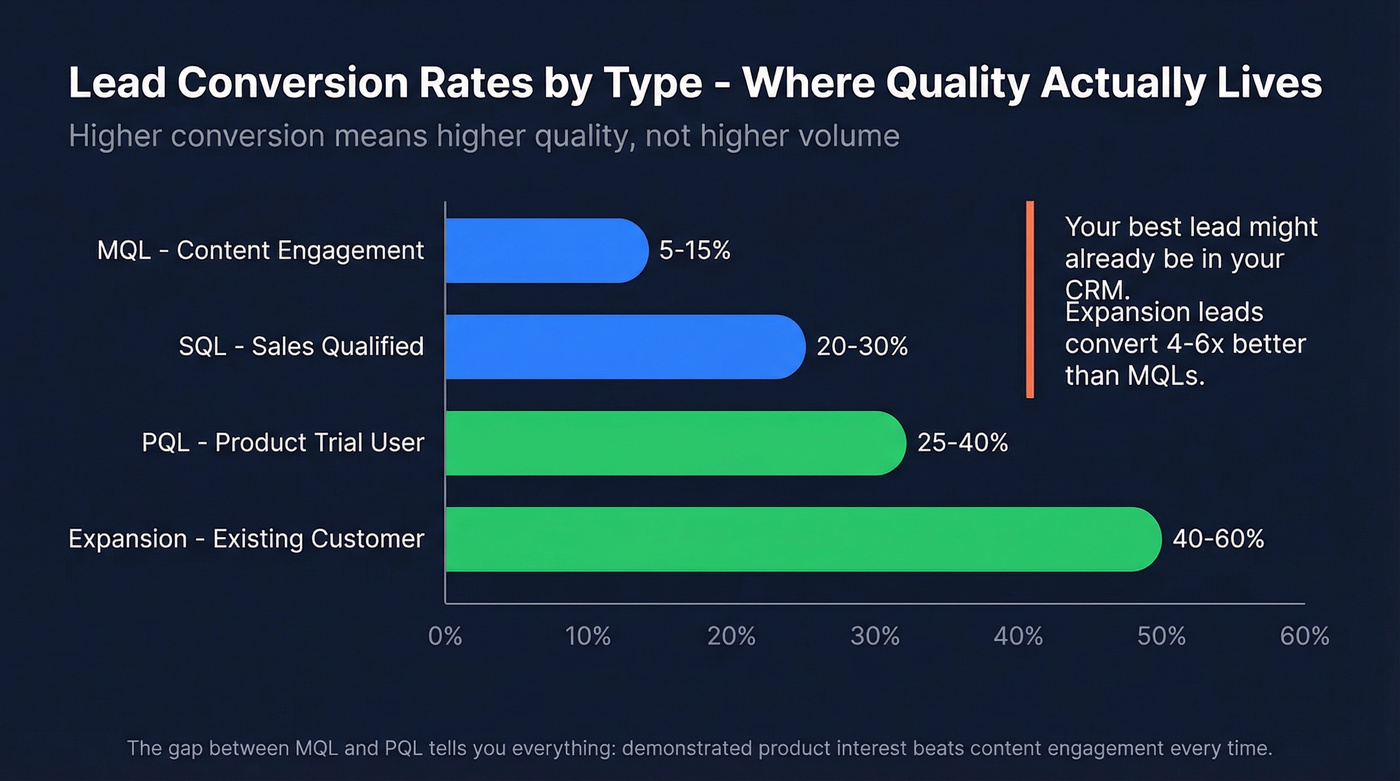
A high-quality lead matches your ICP, shows buying intent, and has the budget and authority to close. Everything else is noise. Here's how different lead types actually convert:
| Lead Type | Definition | Typical Conversion |
|---|---|---|
| MQL | Engaged with content | 5-15% advance to SQL |
| SQL | Sales-qualified | 20-30% to customer |
| PQL | Used product (trial) | 25-40% to customer |
| Expansion | Existing customer | 40-60% to upsell |
The gap between MQL and PQL conversion rates tells you something important: demonstrated product interest beats content engagement every time. If you can get prospects into a trial or demo, do that before you try to nurture them through a 12-email drip.
That expansion row deserves attention too. McKinsey's data shows retaining a customer costs less than one-third of acquiring a new one, and existing customers generate 10% more revenue on average. The highest-quality "lead" might already be in your CRM.
Your ICP isn't your TAM. Your total addressable market includes every possible buyer. Your ICP is the highest-value subset - the accounts most likely to buy, renew, and expand. Targeting your TAM is how you end up with a bloated pipeline full of deals that stall at stage 2.
Define Your ICP Before Anything Else
The average B2B buying committee involves five decision makers. If your ICP is vague, your reps are guessing which five people to reach - and usually engaging only half the committee, which is a common cause of stalled deals.
Most ICP exercises stop at firmographics. Company size, industry, revenue range. That's table stakes. A real ICP includes four attribute buckets:
- Firmographics - industry, headcount, revenue, geography
- Technographics - what tools they use (if you're selling to Salesforce shops, you need to know that)
- Business situation - funding stage, growth rate, hiring velocity, recent leadership changes
- Psychographics - how they buy, what they value, how risk-averse the org is
Rank your sub-segments by ease of selling, strategic fit, and growth potential. Your best ICP segment isn't always the biggest - it's the one where you win fastest and retain longest. We've seen teams double their win rate just by narrowing from three ICP segments to one. This single step does more to surface qualified prospects than any tool or tactic downstream.
Don't skip the disqualifiers. Document the accounts you can't sell to: wrong tech stack, too small, regulated industries you can't serve. Negative criteria save more rep time than positive criteria.
If you want a starting point, use an Ideal Customer Profile Template with a scoring rubric.
Choose Channels Using Data, Not Instinct
Every team has a favorite channel. Usually it's whatever worked at the last company. The benchmarks tell a different story:
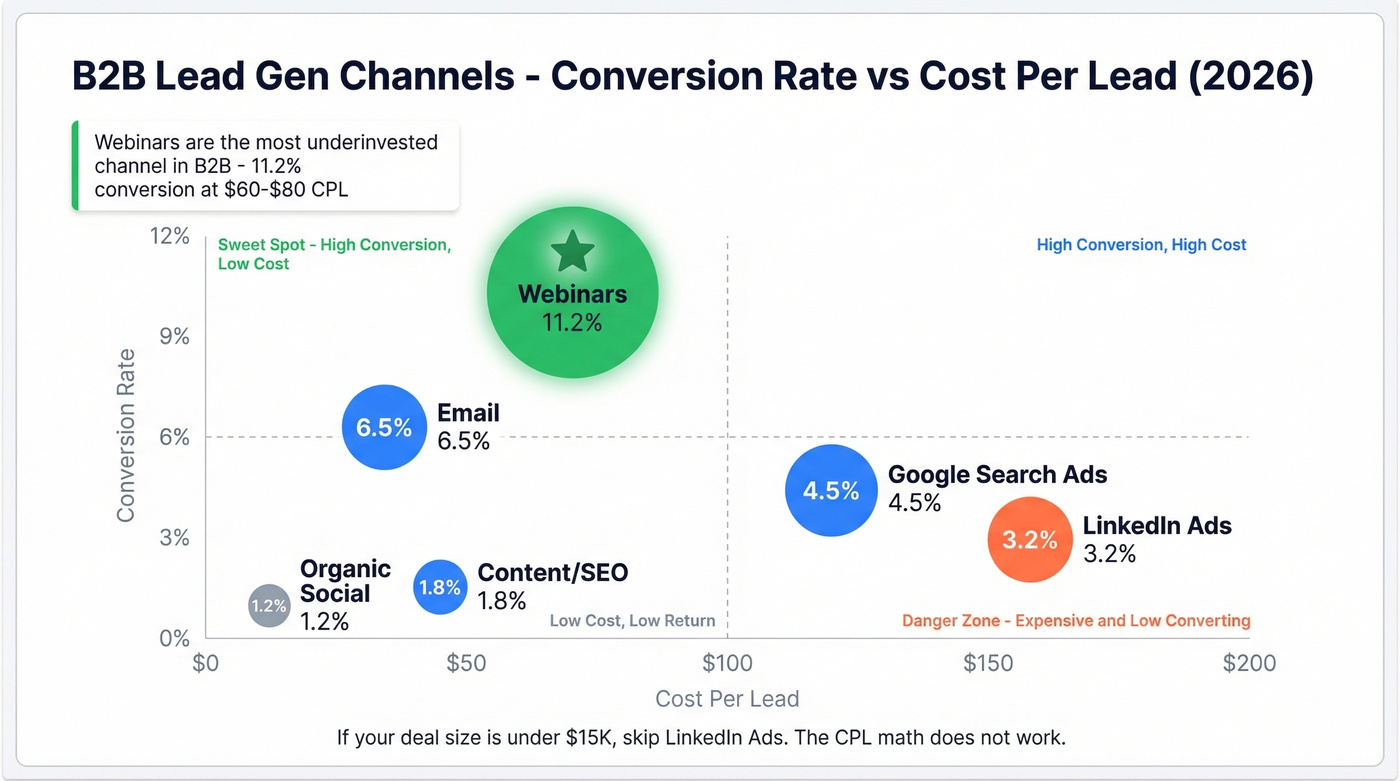
| Channel | Avg Conversion Rate | Cost Per Lead |
|---|---|---|
| Webinars | 11.2% | $60-$80 |
| 6.5% | $30-$45 | |
| Google Search Ads | 4.5% | $90-$150 |
| LinkedIn Ads | 3.2% | $120-$200 |
| Content/SEO | 1.8% | $30-$60 |
| Organic Social | 1.2% | $5-$20 (labor only) |
Source: LeadCrafters 2026 benchmarks
Look at webinars. An 11.2% conversion rate at $60-$80 CPL is the best ratio on this list by a wide margin, and it's the most underinvested channel in B2B. Most teams treat webinars as a quarterly event. The ones generating quality leads consistently run them biweekly with tight, specific topics - "How to reduce Salesforce data decay" beats "2026 Sales Trends" every time.
Email remains the workhorse for outbound because the CPL is unbeatable. But that 6.5% conversion rate assumes clean data and targeted lists. Send to a purchased list and you'll see 0.5% - plus a wrecked sender reputation.
If you're scaling outbound, it helps to standardize your sales prospecting techniques so channel tests are comparable.
One tactical detail most teams overlook: forms with 3 fields convert 27% better than 5-field forms. Cut the fields your sales team doesn't actually use. Name, email, company - that's enough to score and route. Everything else can be enriched after capture.
Here's the thing: if your average deal size is under $15K, you probably don't need LinkedIn Ads at all. The CPL math doesn't work. Put that budget into biweekly webinars and outbound email with verified data, and you'll generate more pipeline per dollar.
Build a Lead Scoring System
Without scoring, every lead gets the same treatment. Your SDRs waste time on tire-kickers while in-market buyers sit in a queue. Lead scoring improves conversion rates by 20%+ - and the model doesn't need to be complicated.
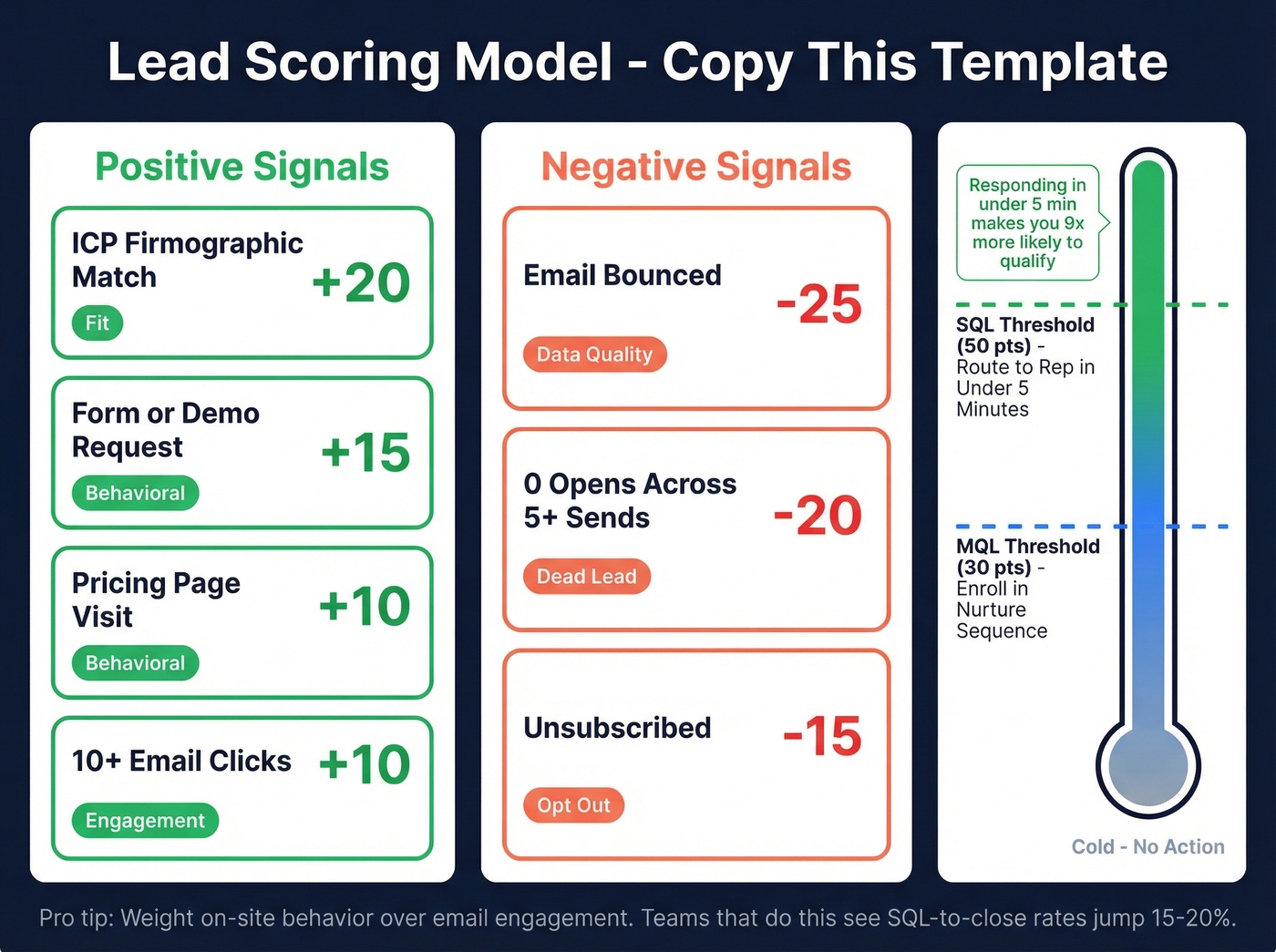
Starting template with real point values:
| Signal | Points | Type |
|---|---|---|
| Pricing page visit | +10 | Behavioral |
| Form/demo request | +15 | Behavioral |
| 10+ email clicks | +10 | Engagement |
| ICP firmographic match | +20 | Fit |
| Email bounced | -25 | Negative |
| Unsubscribed | -15 | Negative |
| 0 opens across 5+ sends | -20 | Negative |
Set your MQL threshold at 30 points and your SQL threshold at 50. Leads that hit MQL get enrolled in nurture sequences. Leads that hit SQL get routed to a rep within five minutes - because responding that fast makes you 9x more likely to qualify them.
For reference, strong micro-conversion benchmarks to measure against: landing page conversion of 2-5%, form completion of 25-40%, and SQL qualification rate of 50-70%. (More benchmarks: average B2B lead conversion rate.)
One critical note: email open rates are unreliable since Apple's Mail Privacy Protection changes. Weight your scoring toward on-site behavior - pricing page visits, feature page depth, form submissions. These signals are harder to fake and more predictive of intent. In our experience, teams that shift scoring weight from email engagement to on-site behavior see their SQL-to-close rate jump 15-20%.
If you want to go deeper, build your model around buying signals and keep the scoring logic documented.

Your lead scoring model is only as good as the data feeding it. Bad emails mean negative points, wasted SDR time, and a damaged domain. Prospeo's 98% email accuracy and 7-day data refresh cycle mean every lead that hits your scoring threshold is actually reachable.
Stop scoring leads you can't even contact. Start with verified data.
Use Intent Data to Find Buyers
Intent data identifies accounts actively researching solutions in your category before they ever fill out a form. First-party intent comes from your own properties - pricing page visits, demo requests, content downloads. Third-party intent comes from publisher networks, review sites, and content syndication platforms that track topic consumption across the web.
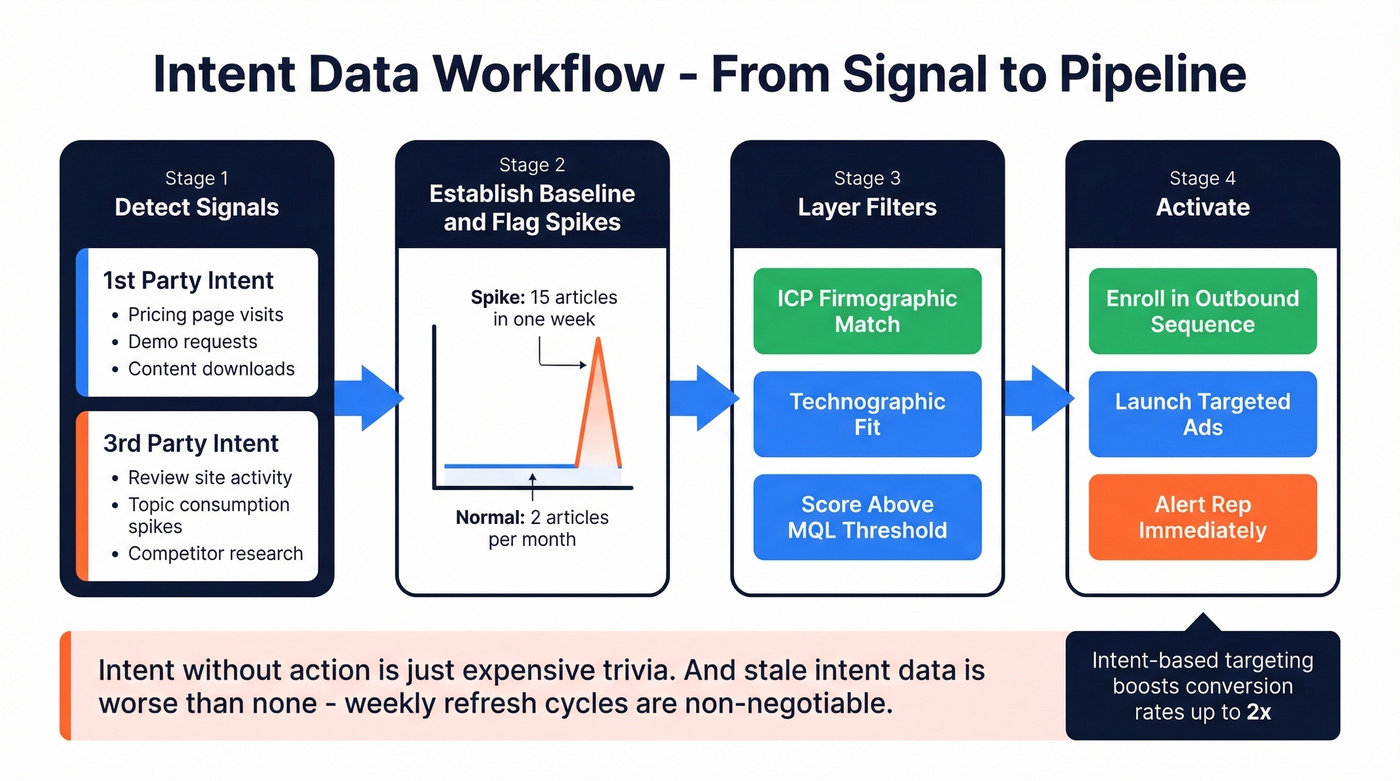
Here's how it works in practice: vendors establish a baseline of normal content consumption for each account, then flag topic spikes. When a company that normally reads two articles a month about "CRM migration" suddenly reads fifteen in a week, that's a signal worth acting on.
Intent-based targeting can boost conversion rates up to 2x. But the activation step matters more than the data itself. Combine intent signals with firmographic and technographic filters, then trigger workflows - enroll surging accounts in outbound sequences, launch targeted ads, alert reps. Intent without action is just expensive trivia.
If you're operationalizing this, intent based segmentation helps you turn spikes into repeatable plays.
With 71% of B2B companies now running ABM programs, your competitors are already using intent and account-level targeting. If you aren't layering intent signals into your prospecting, you're showing up late to conversations that started without you.
The challenges are real, though. Signal noise means not every spike indicates buying intent, and data freshness matters enormously - stale intent data is worse than no intent data because it creates false urgency. Weekly refresh cycles are non-negotiable.
Verified Data: The Invisible Multiplier
Skip this section if you enjoy watching your domain reputation crater in real time.
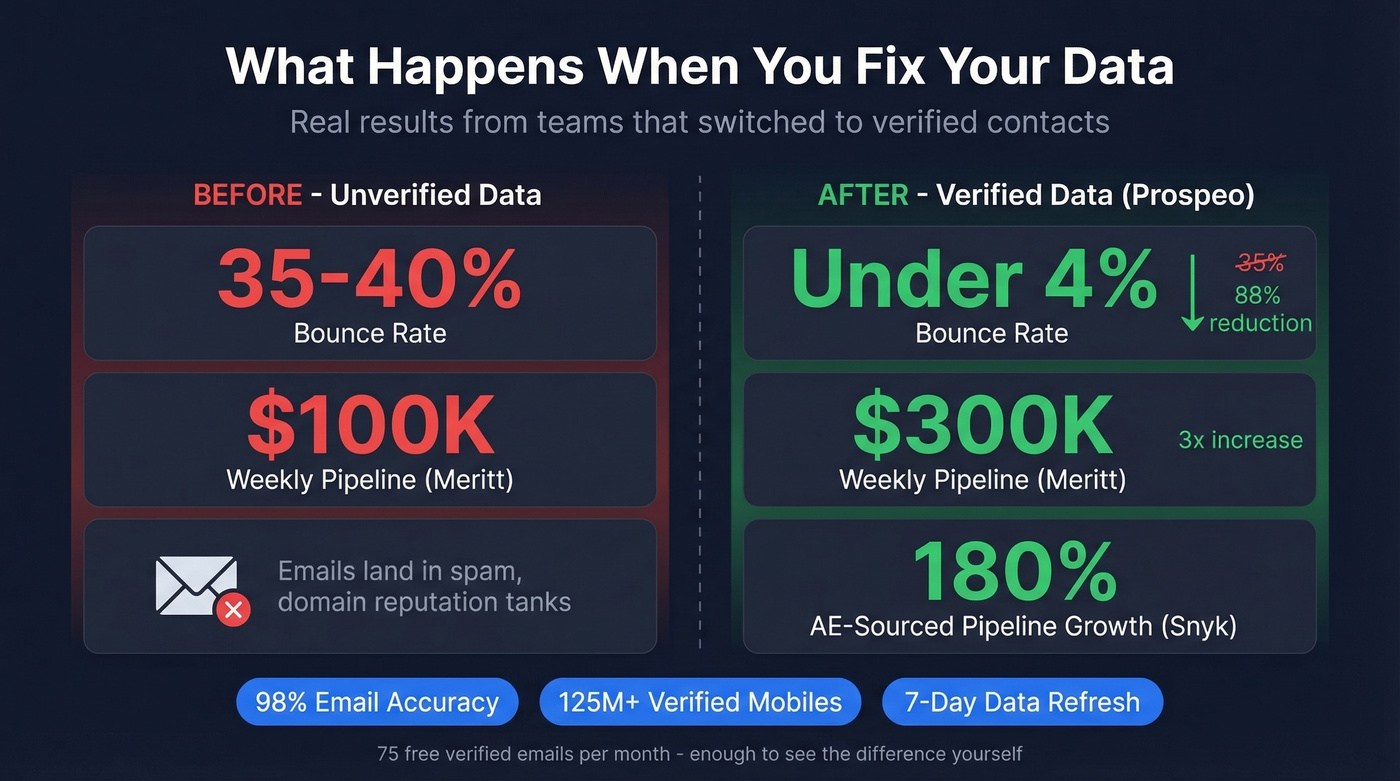
You've built the ICP, scored the leads, identified intent signals - then you send 2,000 emails and 400 bounce. Your domain reputation drops. Your next campaign lands in spam. The leads that were ready to buy never see your message. We've watched this exact scenario play out with three different clients in the past year, and it's always the same root cause: unverified contact data.
The 56% of leads that aren't ready to buy deserve nurturing. The ones that are ready deserve clean data so your outreach actually reaches them. Every tactic in this guide works better with verified contacts, and every tactic breaks without them.
Prospeo delivers 98% email accuracy, 125M+ verified mobile numbers with a 30% pickup rate, and refreshes data every 7 days versus the 6-week industry average. The free tier gives you 75 verified emails per month - enough to test the difference yourself.
If you're comparing vendors, start with a shortlist of data enrichment services and prioritize verification accuracy over raw database size.
The proof shows up in pipeline numbers. Meritt switched and their bounce rate dropped from 35% to under 4% while pipeline tripled from $100K to $300K per week. Snyk's 50-person AE team saw bounce rates fall from 40% to under 5% and AE-sourced pipeline jump 180%. That's not a marginal improvement - it's a different business.
Nurture the 56% Who Aren't Ready
More than half your leads aren't ready to buy at initial capture. That doesn't make them bad leads - it makes them future pipeline.
Effective nurture means multi-channel follow-up with escalating value:
- Share a relevant case study within 48 hours of capture
- Send a benchmark report or data asset in week two
- Deliver a personalized video for high-value accounts in week three
- Layer retargeting ads throughout the sequence
- Phone call for accounts that hit MQL threshold
If you need a baseline sequence, use proven sales follow-up templates and then personalize by segment.
The operational reality is frustrating: 47% of enterprise GTM teams struggle to deliver a strong customer experience for leads. If you can solve just the timing piece - responding to intent signals within minutes instead of days - you're already ahead of nearly half the market. A well-designed nurture workflow is one of the most reliable ways to convert prospects who buy on their own timeline, and it's where most of the compounding value in lead generation actually lives.
The Lead Gen Tech Stack
You don't need 14 tools. You need four categories covered, and you need them talking to each other.
| Category | Tool | Pricing |
|---|---|---|
| Enrichment & Verification | Prospeo | Free tier; ~$0.01/lead |
| Enrichment & Verification | ZoomInfo | $15K-$40K+/yr |
| Enrichment & Verification | Apollo | Free tier; $49-$99/user/mo |
| Enrichment & Verification | Cognism | $1K-$3K/mo |
| Intent Data | Bombora | $25K-$50K+/yr |
| Intent Data | 6sense | $30K-$100K+/yr |
| Intent Data | Demandbase | $30K-$100K+/yr |
| Marketing Automation | HubSpot Marketing Hub | $15-$3,600/mo |
| Marketing Automation | Salesforce MCAE | $25-$500/user/mo |
| CRM | HubSpot CRM | Free tier; paid from ~$15/mo |
| CRM | Salesforce | $25-$500/user/mo |
| CRM | monday CRM | Free tier; paid from ~$12/user/mo |
For teams that don't need a $40K/year ZoomInfo contract, Prospeo is the obvious starting point - 98% email accuracy at roughly $0.01 per lead, a 92% API match rate, and native integrations with Salesforce, HubSpot, Smartlead, Instantly, Lemlist, Clay, Zapier, and Make.
If you're evaluating options, compare sales prospecting databases by match rate, refresh cycle, and verification methodology.
Operational KPIs to target once your stack is running:
- Intent activation: 5-10 meetings booked per 100 surging accounts in 30 days
- MQL-to-SQL rate: 25-35%
- Enrichment rate: 80%+ for key fields (industry, revenue, company size)
If you're hitting those numbers, your system is working. If you're not, the problem is usually upstream - ICP definition or data quality, not the tools themselves.
Five Mistakes That Kill Lead Quality
Buying lead lists. The fastest way to destroy your domain reputation. Purchased lists have stale data, no consent, and conversion rates that round to zero. Build your own lists with opt-in capture and verified data. (If you're unsure about compliance, see: Is It Illegal to Buy Email Lists?.)
No lead scoring. Without scoring, every lead looks the same. Your best reps waste time on contacts who downloaded a whitepaper once in 2023. Even a basic point model beats no model. (More detail: lead scoring.)
Single-channel dependency. If all your leads come from one channel, you're one algorithm change away from zero pipeline. The 70+ touchpoints reality means you need at least three channels working together.
Weak lead magnets. "10 Tips for Growth" PDFs attract everyone and convert no one. Targeted templates, calculators, and mini-guides that solve a specific problem for your ICP convert dramatically better - and they're how you capture qualified prospects instead of collecting junk contacts.
No follow-up system. Most leads need nurturing, not one email and a prayer. If you don't have automated sequences with escalation logic, you're leaving pipeline on the table - and your competitors are picking it up.
The article says it: tighter ICP definition beats raw volume every time. Prospeo gives you 30+ search filters - buyer intent, technographics, headcount growth, funding, job changes - so you build lists that match your exact ICP, not your TAM. At $0.01 per email, the CPL math finally works.
Filter 300M+ profiles down to your highest-value prospects in minutes.
FAQ
What's the difference between MQL and SQL?
An MQL shows interest through content engagement but hasn't been vetted by sales. An SQL has been qualified through scoring or direct conversation and is ready for a sales pitch. Typical MQL-to-SQL advancement runs 5-15%, which is why scoring matters - it separates real buying signals from casual browsing.
How many leads should convert to customers?
A lead-to-customer rate above 20% is excellent, 10-20% is average, and below 5% signals a qualification problem. Before generating more volume, fix your ICP targeting and scoring model.
What's the fastest way to improve lead quality?
Tighten your ICP definition and add negative scoring criteria - disqualifiers that remove bad-fit accounts before reps ever touch them. Then verify your contact data before every campaign. These two steps alone outperform any single tool purchase.
Is cold calling still effective for B2B?
Average cold call success rate is 2.3%; high-performing teams hit 5-11%. Cold calling works best layered with intent data - calling accounts already researching your category dramatically improves connect and conversion rates versus dialing blind.