

How to Follow Up on an Email Without Being Annoying
You sent a thoughtful email on Tuesday. It's Friday. Nothing.
Here's the math: 392.5 billion emails cross the internet every day in 2026. The average office worker receives 121 business emails daily, which means between your first message and a follow-up three days later, roughly 363 new messages have buried yours. Your email didn't fail. It drowned.
80% of sales require five or more follow-ups, yet 44% of salespeople quit after one attempt. That gap between persistence and reality is where deals die. Let's close it.
The Short Version
- Wait 3-5 days for cold, 2-3 days for warm, then follow up with new value. Never send "just checking in" - it tells the recipient you've got nothing new to say. (If you need options, see these sales follow-up templates.)
- Use the 3-part structure: context, new value, single clear ask. Keep it under 100 words.
- Verify your contact list before any sequence. Bounced emails silently destroy your sender reputation, and no amount of good copy fixes that.
Why People Don't Reply
The average office worker is drowning in 121 emails a day, and most messages get a quick glance before being archived or ignored. Your email is competing against calendar invites, Slack notifications, internal requests, and 40 other cold pitches that landed the same morning.
When someone doesn't reply, it usually maps to one of five objections: they don't see the need, they don't think it's worth the cost, there's no urgency, they don't want what you're selling, or they don't trust you yet. Most of the time, though? They just forgot. They opened your email between meetings, meant to respond later, and never did.
No reply doesn't mean no. It means not yet, or not enough. Your follow-up isn't an interruption - it's a second chance to earn attention with something worth their time.
When to Send a Follow-Up
Follow up too fast and you seem desperate. Wait too long and the conversation goes cold. We've found the sweet spot depends entirely on context.
| Scenario | First Follow-Up | Second Follow-Up | Max Attempts |
|---|---|---|---|
| Cold outreach | 3-5 days | 7 days | 4-7 |
| Warm lead | 2-3 days | 5 days | 3-5 |
| Post-meeting | 24 hours | 3-5 days | 2-3 |
| Job application | 5-7 days | 10-14 days | 2 |
| Networking | 3-5 days | 7-10 days | 2-3 |
| Invoice/payment | 2-3 days | 5 days | 3 |
| Internal request | 24-48 hours | 3 days | 2 |
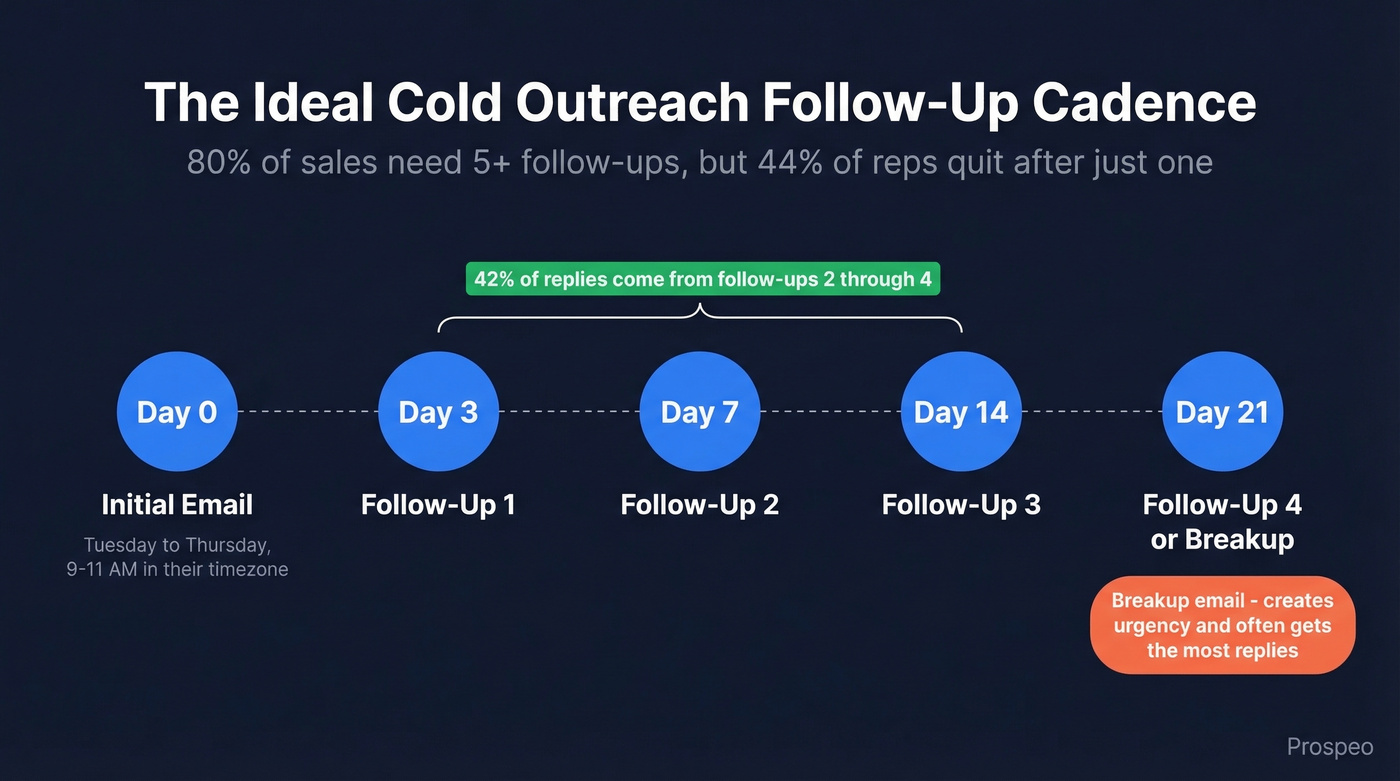
For cold outreach, an escalating interval works best: Day 0, Day 3, Day 7, Day 14, Day 21. 42% of replies come from follow-ups 2-4, so the first silence is expected, not a signal to stop.
Best send windows: Tuesday through Thursday, 9-11 AM in the recipient's timezone. (More timing data here: best time to send cold emails.)
Writing Follow-Ups That Get Replies
First decision: thread or new email? Reply to the same thread for your first few follow-ups so the recipient has context. If you've sent multiple unanswered messages, start a new thread with a fresh subject line - the original one is mentally closed.
Here's a stat worth internalizing: 47% of people open emails based on the subject line alone, and 69% mark emails as spam based on the subject line. Your subject line is doing more work than your body copy. Stop using lines that trigger an instant delete. (If you want more ideas, browse these email subject line examples.)
| Don't Use | Use Instead |
|---|---|
| "Just checking in" | "Quick question about [project]" |
| "Following up" | "[Name] - one more thought on [topic]" |
| "Touching base" | "Idea for [specific challenge]" |
| "Circling back" | "Referred by [connection]" |
| "Bumping this up" | "The [metric] - here's proof" |
| "Hope you're doing well" | "30 seconds - [specific ask]" |
HBR's guidance boils down to one principle: state the purpose using keywords. Military-style clarity beats cleverness every time.
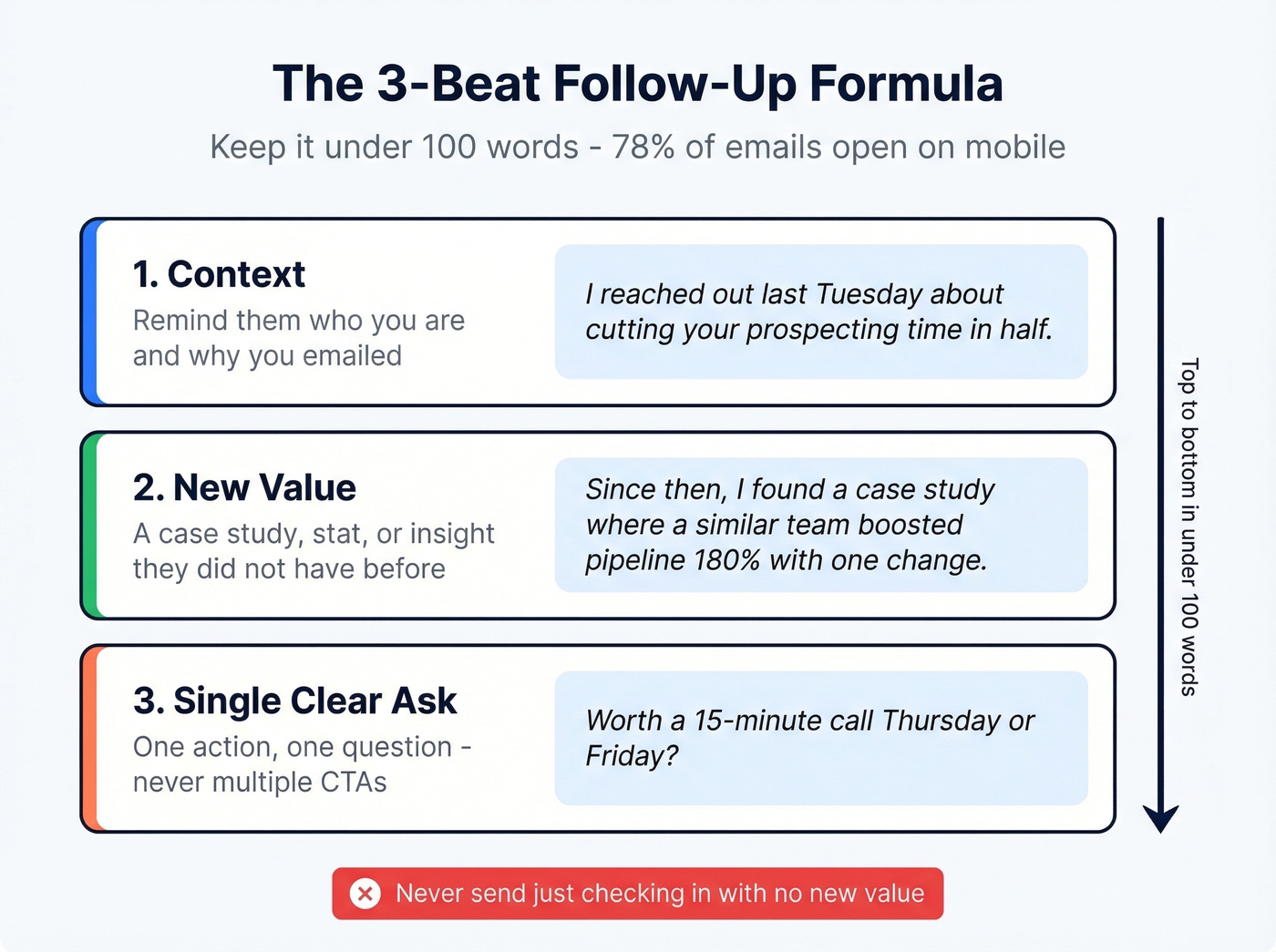
Every follow-up body should hit three beats: context (remind them who you are and why you emailed), new value (a case study, a stat, a relevant insight they didn't have before), and a single clear ask. Keep the whole thing under 100 words. 78% of emails open on mobile, and 75% of people delete emails that aren't optimized for mobile. Short wins.

A perfect follow-up sequence means nothing if your emails bounce. Bounced messages destroy sender reputation and kill deliverability for every future campaign. Prospeo's 5-step verification delivers 98% email accuracy - so your carefully crafted follow-ups actually land in inboxes, not spam folders.
Stop writing follow-ups that bounce. Verify first, send second.
Templates for Every Situation
You don't need 57 templates. You need a handful of proven structures you can adapt. (For more, see cold email follow-up templates.)
Cold and Warm Outreach
No response - cold:
Subject: The [metric] I mentioned - here's proof
Hi [Name], I shared how we helped [similar company] cut [problem] by [X%]. Here's the 2-min case study: [link]. Worth a 15-minute call this week?
Timing: Day 3-5.
No response - warm:
Subject: [Name] - one more thought on [topic]
Hey [Name], after our chat at [event], I dug into [challenge you mentioned]. Found something relevant - [one-line insight]. Can I send the full breakdown?
Timing: Day 2-3.
Breakup email:
Subject: Should I close your file?
[Name], I've reached out a few times without hearing back - totally fine. If the timing's off, I'll stop here. If anything changes, reply to this thread and I'll pick right back up.
Timing: Final touch, Day 21-30. In our experience, breakup emails often generate more replies than any mid-sequence message because they create a sense of finality that prompts action.
Professional Situations
Post-meeting:
Subject: Next steps from [day]'s call
[Name], great conversation. As discussed, I'm sending [deliverable]. Next step on our end is [action]. Does [date/time] work for a follow-up?
Timing: Within 24 hours. (More examples: sales meeting follow-up email.)
Job application:
Subject: Following up on [role] - [your name]
Hi [Name], I applied for the [role] on [date] and wanted to reiterate my interest. My experience in [skill] maps directly to [requirement from listing]. Happy to share more context.
Timing: Day 5-7.
Networking:
Subject: [Topic from conversation] - as promised
[Name], great meeting you at [event]. You mentioned [challenge] - here's the [resource] I promised. Let me know if it's useful.
Timing: Day 3-5.
Transactional
Invoice/payment:
Subject: Invoice #[number] - quick reminder
Hi [Name], invoice #[number] for [amount] was due on [date]. If already processed, disregard. Otherwise, can you confirm the expected payment date?
Timing: Day 2-3 after due date.
Internal request:
Subject: [Project] - need your input by [date]
Hey [Name], following up on the [deliverable] I sent [day]. I need your sign-off by [date] to keep [project] on track. Any blockers I can help clear?
Timing: 24-48 hours.
Five Mistakes That Kill Reply Rates
1. "Just checking in" with no new value. Every follow-up needs to earn its place in someone's inbox. If you can't articulate what's new since your last email, you aren't ready to send. (Alternatives here: how to say just checking in professionally.)
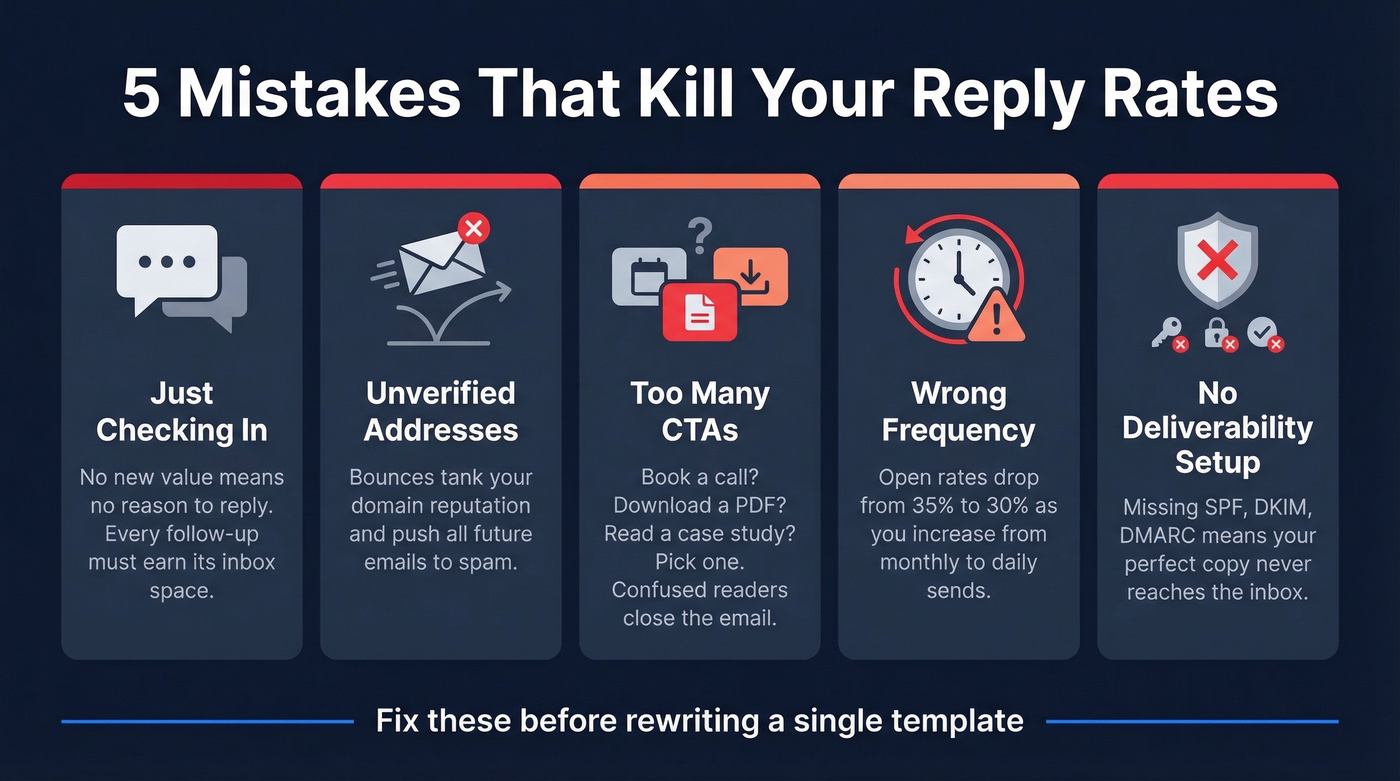
2. Sending to unverified addresses. You've crafted the perfect follow-up - and it bounces. Or worse, it hits a spam trap and tanks your domain reputation for every future email. Verify addresses before they enter your sequence. Prospeo's real-time verification catches invalid addresses, spam traps, and honeypots with 98% accuracy across 143M+ verified emails. The free tier gives you 75 verifications per month - enough to test the workflow before committing. (Benchmarks + fixes: email bounce rate.)
3. Too many CTAs. "Would you like to book a call, download our whitepaper, or check out our case study?" Pick one. A confused reader doesn't click - they close. (Rules and examples: email call to action.)
4. Wrong frequency. Too fast feels aggressive. Too slow loses momentum. MailerLite's analysis of 12 billion emails shows open rates drop from 35% to 30% as frequency increases from monthly to daily. For cold outreach, 3-7 day gaps between touches hit the sweet spot.
5. Ignoring deliverability. No SPF/DKIM authentication, tracking pixels that trigger spam filters, sending from your primary domain - these are silent killers. Your follow-up copy could be perfect and still never reach the inbox. (Full checklist: email deliverability guide.)
Why Your Follow-Up Never Arrives
Look, here's the thing most follow-up guides won't tell you: your email copy probably isn't the problem. Your infrastructure is. Before you spend another hour perfecting your message, make sure the email actually lands.
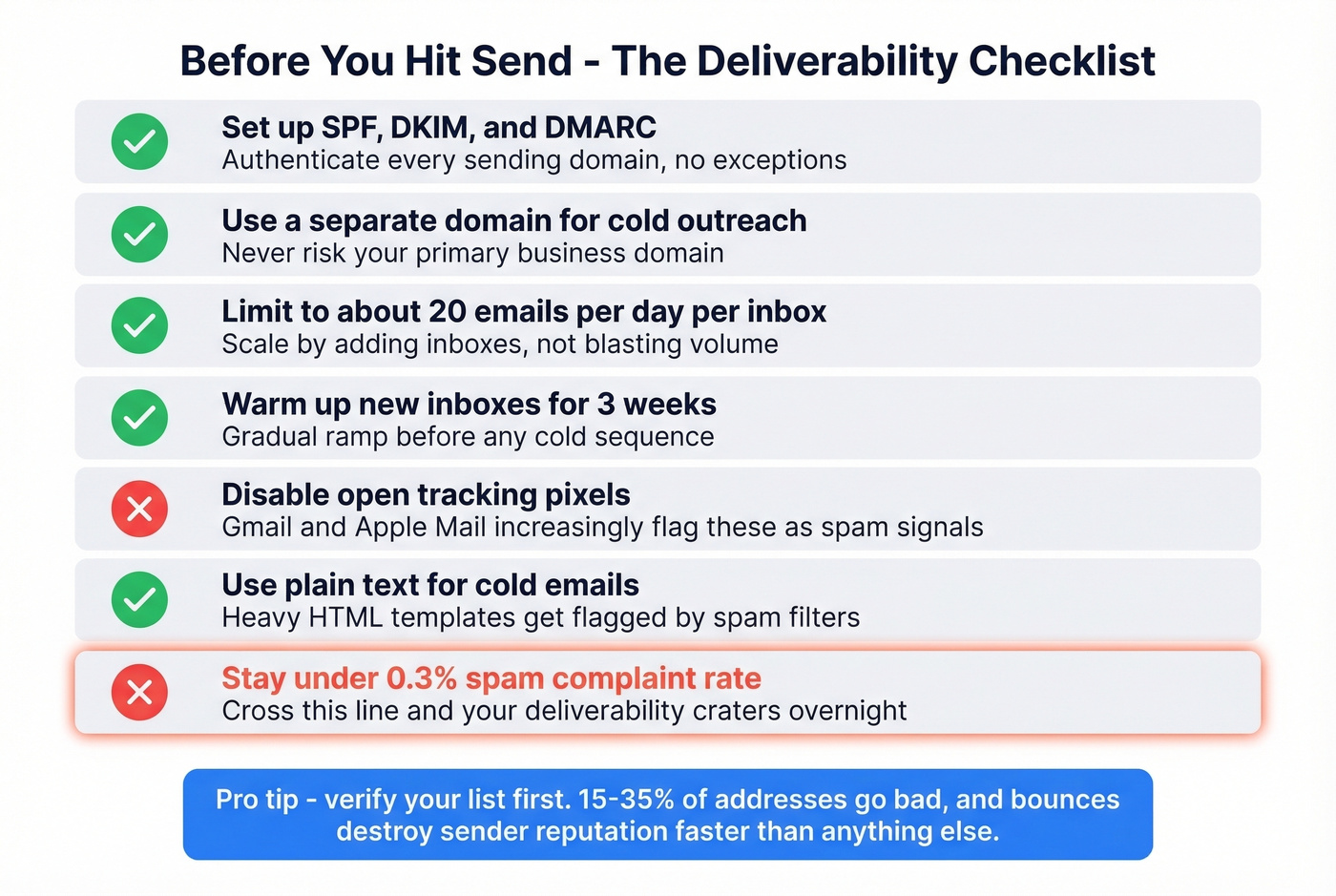
The technical checklist is non-negotiable:
- SPF, DKIM, and DMARC authentication on every sending domain. (If you’re troubleshooting, start with SPF record examples.)
- Separate domains for cold outreach. Never send cold emails from your primary business domain.
- ~20 emails/day per inbox, max. Scale by adding inboxes, not blasting from one. (More on limits: email velocity.)
- 3 weeks of warmup before launching any cold sequence.
- Disable open tracking. Tracking pixels are increasingly flagged by Gmail and Apple Mail.
- Use plain-text formatting for cold outreach. Heavy HTML templates get flagged.
- Stay under Google's 0.3% spam complaint threshold. Cross it and your deliverability craters.

The problem nobody talks about: if 15-35% of your list has bad addresses, bounces tank your domain reputation and push even your valid follow-ups to spam. The best copy in the world can't save a dead address. We've seen teams go from 35-40% bounce rates to under 5% just by adding a verification step before their sequences launch - one customer, Snyk, had 50 AEs prospecting and saw AE-sourced pipeline jump 180% after cleaning their data. That single change often does more for reply rates than rewriting every template in the playbook.
You need 5+ follow-ups to close a deal, but you also need the right contact. Prospeo gives you verified emails and direct dials for 300M+ professionals - refreshed every 7 days - so your sequences reach real decision-makers, not outdated addresses.
Find verified emails for $0.01 each and make every follow-up count.
When to Stop
Remember: 80% of sales require five or more follow-ups, but 44% of reps quit after one. For warm contacts, 2-3 follow-ups is the ceiling. For cold outreach, 4-7 touches is the range where sequences generate 3x the reply rate compared to shorter ones. Beyond that, you're burning goodwill.
Don't follow up after a clear "no" or explicit rejection, before a timeframe the recipient specifically asked for ("reach out next quarter" means next quarter), or during major holidays when inboxes are either abandoned or triaged ruthlessly.
If someone's opening your emails but not replying after follow-up #3, switch channels. A phone call, a short video message, or a warm intro through a mutual connection often breaks through where email can't. The breakup email is your final play - it creates urgency and gives the prospect a clean way to re-engage later. The consensus on r/sales is pretty consistent here: if you've exhausted email, a well-timed cold call converts better than follow-up #8 ever will. Skip the channel if it isn't working. A/B test subject lines and send times across sequences to find what resonates with your specific audience.
FAQ
How many follow-up emails should I send?
Two to three for warm contacts, four to seven for cold outreach. Sequences with 4-7 steps generate roughly 3x the reply rate of shorter ones. Always include a breakup email as your final touch - it often generates more replies than any mid-sequence message.
Should I reply to the same thread or start a new one?
Reply to the same thread for your first few follow-ups so the recipient has full context without digging. Start a new thread with a fresh subject line after multiple unanswered messages - the original thread is mentally closed, and a new subject gives you a second first impression.
What if my email was opened but never answered?
An open without a reply usually means your message wasn't compelling enough to act on. Send a follow-up that adds new value - a relevant case study, a specific data point, or a reframed ask. Also confirm you're reaching a valid, active address so your messages land in the primary inbox rather than spam.
How long should a follow-up email be?
Under 100 words. With 78% of emails opening on mobile, anything longer gets skimmed or deleted. Lead with your new value, end with one clear ask, and cut everything else.
Is it rude to follow up after no response?
No - it's expected. Professionals understand that emails get buried when 121 land in the average inbox every day. A well-timed follow-up signals professionalism, not desperation. The only rude one is a message that offers nothing new and demands a response.