

How to Generate Sales - Not Just Leads
You don't have a lead problem. You have a sales problem. 85% of B2B marketers say lead generation is their #1 challenge, but most of them are misdiagnosing the issue. They're generating leads just fine - they're failing to convert those leads into revenue. If you want to learn how to generate sales consistently, you need to fix the entire funnel, not just the top.
A thread on r/Entrepreneur nailed it: the lead generation tips you find online are mostly outdated, and what actually works is "clarity, relevance, and reduced friction." Every listicle giving you "32 ways to generate leads" stops at the top of the funnel and leaves you to figure out the rest. This is the full system - verified data in, structured cadence through the middle, trust-based closing at the end, and retention that compounds.
Where to Start Based on Your Situation
- If you have zero pipeline - Reactivate past customers and build a referral system. Lowest CAC, fastest path to revenue. Don't start with cold outreach.
- If you have leads but no meetings - Your data quality or cadence structure is the bottleneck. Bounced emails and dead phone numbers silently kill outbound before your messaging gets a chance.
- If you have meetings but no deals - Fix qualification and closing. You're talking to the wrong people or leading with price instead of value.
You don't need 32 tactics. You need 3-4 channels executed with discipline and a system that converts leads into revenue.
Full-Funnel Conversion Benchmarks
Most teams only track top-of-funnel metrics. That's like measuring how many people walk into a store without tracking how many buy something.
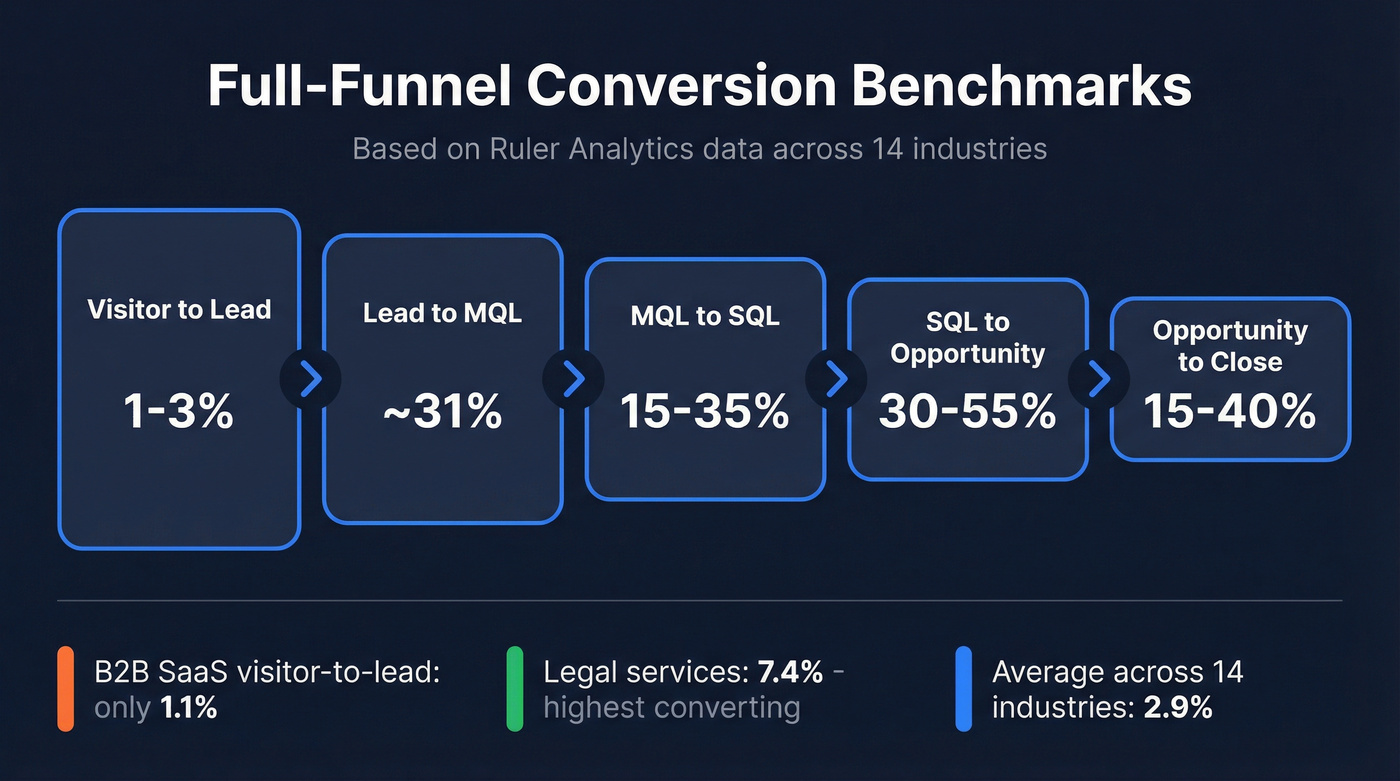
Here's what the full cascade looks like, using Ruler Analytics' benchmark data across 14 industries plus SaaS funnel and channel datasets we've compiled from multiple sources:
| Funnel Stage | Conversion Range |
|---|---|
| Visitor → Lead | 1-3% |
| Lead → MQL | ~31% |
| MQL → SQL | 15-35% |
| SQL → Opportunity | 30-55% |
| Opportunity → Close | 15-40% |
The average visitor-to-qualified-lead rate across all industries is 2.9%, but that number hides massive variation. B2B SaaS sits at just 1.1%, while legal services hit 7.4%.
Channel matters just as much as industry. Referrals convert leads to MQLs at 56%. SEO hits 41%. PPC sits at 29%. Executive events reach 54%, but they're hard to scale - small audiences, high cost per attendee. When you break it down by channel in SaaS specifically, SEO drives a 51% MQL-to-SQL rate and 36% opportunity-to-close rate, while paid search drops to 26% and 22% respectively.
For SaaS teams with a product-led motion, the conversion math looks different entirely. Free trial-to-paid conversion averages 18-29%, freemium-to-paid sits at just 3.4%, and CRM-specific trials convert around 29%. If you're running PLG alongside outbound, these benchmarks matter more than the traditional funnel numbers.
Here's our hot take: if your deal size is under $10K annually, you probably don't need a complex multi-channel outbound engine. Referrals, content, and a clean product-led funnel will outperform a bloated SDR team every time. Save the enterprise playbook for enterprise deals.
These numbers are your diagnostic tool. If your MQL-to-SQL rate is below 15%, you've got a qualification problem. If your opportunity-to-close rate is under 15%, your reps need help with closing, not more leads. Pouring more leads into a broken funnel doesn't increase revenue. It generates waste.
Top-of-Funnel Lead Sources
Referrals: Best Channel, Period
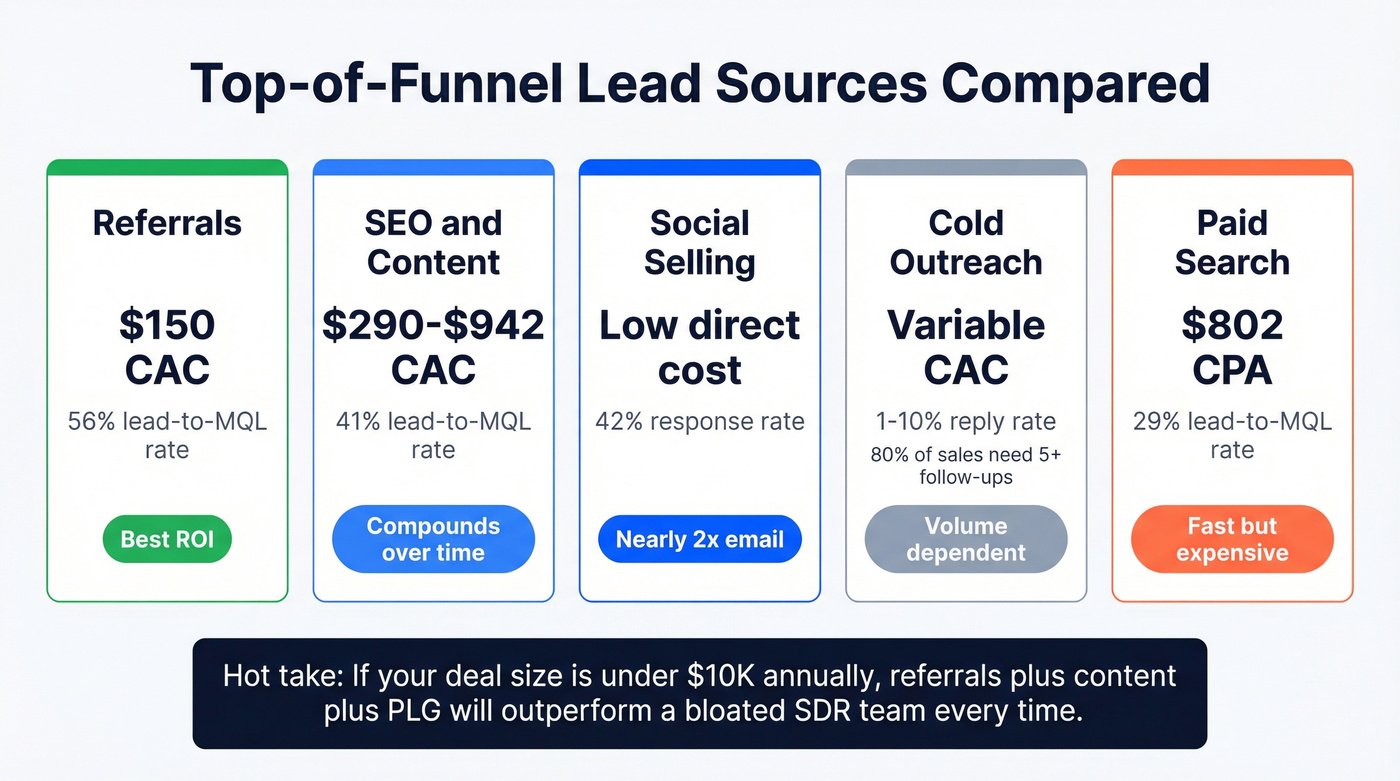
At $150 average CAC and a 56% lead-to-MQL rate, referrals are the most efficient channel that exists. Build a system - ask every happy customer for one introduction per quarter, formalize it with a simple incentive structure, and track it like any other channel. Most teams treat referrals as something that "just happens." It doesn't. You engineer it.
Content and SEO
SEO acquisition costs run $480-$942 per customer initially, dropping to roughly $290 long-term as content compounds. Nearly two out of three buyers now prefer engaging salespeople later in the buying journey, up 17 percentage points year-over-year. Content fills the gap between awareness and that first sales conversation.
If you want a more structured approach, start with a B2B sales funnel template and map each stage to one owner and one KPI.
Social Selling Outperforms Email
Imagine a prospect who's never heard of you. Would you rather land in their inbox alongside 47 other cold emails, or show up in their feed with a thoughtful comment on their latest post? Social channels deliver a 42% response rate as a sales channel - nearly double email. The key is treating it as a selling channel, not a broadcasting channel. Comment on prospects' posts, share relevant insights, and build relationships before you pitch.
Cold Outreach (Email + Phone)
Cold email reply rates range from 1-10% depending on targeting, copy, and list quality. Cold call connect rates are typically in the low single digits. The math only works at volume - and 80% of sales require 5+ follow-ups, but 44% of reps quit after one.
Outbound only works if your data is clean. Skip to the next section if that sentence made you nervous.
If you’re rebuilding your outbound motion, use these sales prospecting techniques to keep targeting tight and repeatable.
Skip Paid If You're Budget-Constrained
Paid search averages $802 CPA - the fastest path to pipeline, but expensive to sustain. If your budget is tight, you'll burn through it before you get enough volume to learn what's working. Layer retargeting on top of organic channels rather than relying on paid as your primary engine.
Data Quality: The Multiplier Nobody Talks About
Here's a scenario we see constantly: your SDR team sent 2,000 cold emails last week. 400 bounced. 50 got replies. Three booked meetings. Everyone blames the messaging. Nobody checks the data.
Bad data doesn't just waste rep time - it actively damages your domain reputation and deliverability. High bounce rates tank your sender score, which means even your emails to valid addresses start landing in spam. Dead phone numbers burn through call blocks with zero connects. Your reps lose confidence and start cherry-picking instead of working the full list.
If you’re seeing this, start by tracking your email bounce rate and fixing deliverability before you scale volume.

We've watched teams waste entire quarters on bad data before diagnosing the problem. Meritt is the counter-example - they went from $100K to $300K/week in pipeline after switching to Prospeo, with bounce rates dropping from 35% to under 4%. The database covers 300M+ professional profiles with 98% email accuracy and 125M+ verified mobile numbers delivering a 30% pickup rate. Every record refreshes on a 7-day cycle; the industry average is six weeks, which means most databases are already stale by the time you use them.
Before you launch any outbound sequence, verify your list. It's the single highest-leverage fix in the entire funnel. If you need options, compare data enrichment services and pick one that matches your workflow.

Your funnel benchmarks mean nothing if 20% of your emails bounce. Prospeo's 300M+ profiles with 98% email accuracy and 125M+ verified mobiles eliminate the data quality bottleneck that silently kills conversion rates at every stage.
Clean data is the highest-leverage fix in your entire sales funnel.
Meritt tripled pipeline from $100K to $300K/week after switching to verified data. With 30+ filters - buyer intent, technographics, job changes, headcount growth - you target the right accounts instead of spraying bad lists.
Stop blaming messaging when the real problem is stale data refreshed every 6 weeks.
Mid-Funnel: Converting Qualified Leads
Qualify Before You Sell
200 webinar leads. Marketing celebrated. Sales called them all. 80% were unqualified - wrong title, wrong company size, no budget, no timeline. Two weeks of SDR time, gone.
Use BANT to qualify fast: Can they pay for this? Are you talking to a decision-maker? Do they have a problem you solve? Are they buying this quarter or "exploring"?
If you want a more modern alternative to BANT, use a lead scoring model to prioritize accounts that actually convert.
The conversion differences are stark. MQLs convert to SQLs at just 5-15%. SQLs convert to customers at 20-30%. PQLs - product-qualified leads who've actually used your product - convert at 25-40%. Teams using AI to prioritize and qualify leads have pushed conversion rates from 1.8% to 3.0% in as little as 12 weeks. Qualification isn't a bottleneck. It's a filter that saves your closers from wasting time on deals that were never real.
The Follow-Up System That Books Meetings
Most reps don't have a follow-up problem. They have a follow-up system problem. We've tested dozens of cadence structures, and the 8-12 touchpoints over 17-21 days across 3+ channels window consistently outperforms both shorter and longer sequences.
If you need copy you can deploy fast, keep a swipe file of sales follow-up templates and iterate from there.
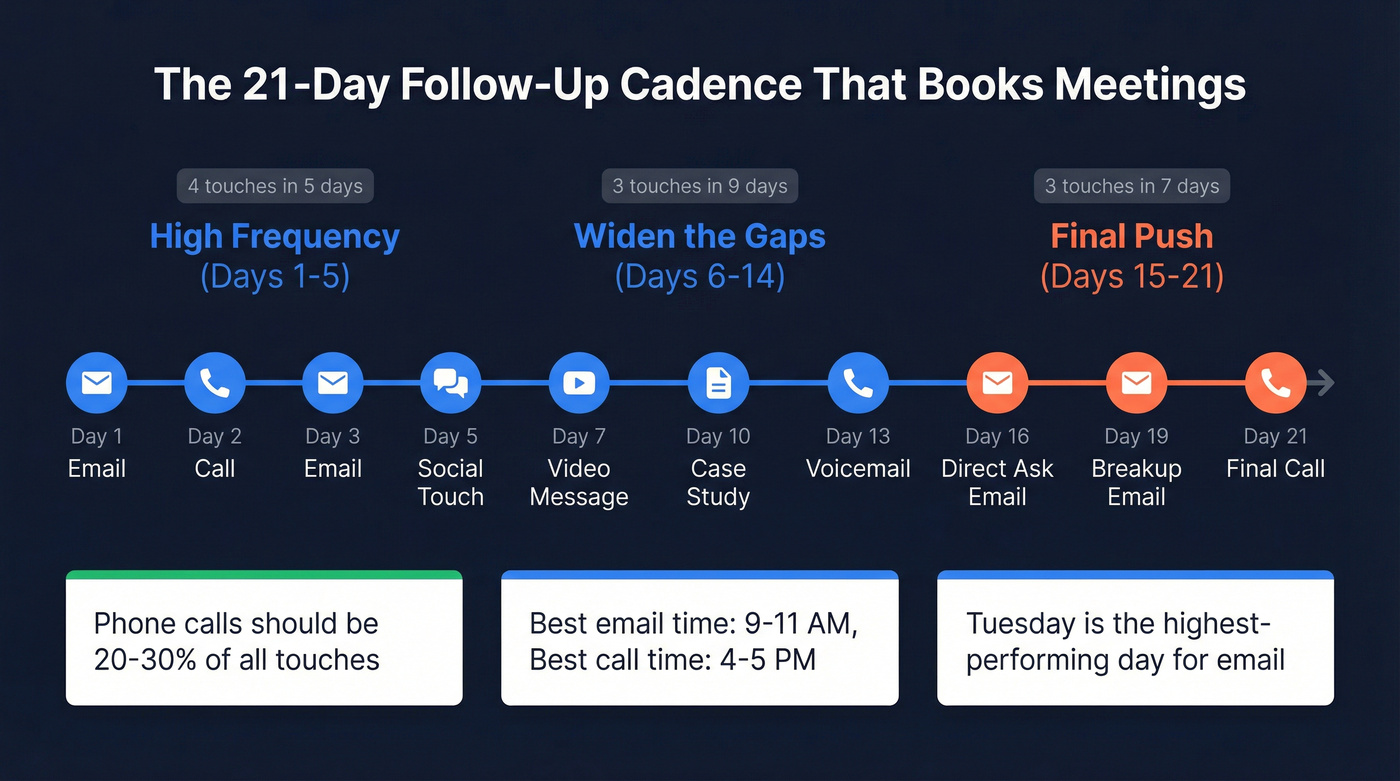
Build your cadence like this:
- Days 1-5: High frequency. Email day 1, call day 2, email day 3, social touch day 5.
- Days 6-14: Widen gaps to 3+ days. Mix in a voicemail, a video message, a relevant case study.
- Days 15-21: Final sequence. Direct ask or breakup email. Phone call as the closer.
Phone calls should make up 20-30% of your touches - they're disproportionately effective despite being the channel reps avoid most. Best timing windows: emails between 9-11 AM, calls between 4-5 PM, and Tuesday consistently outperforms other days for email engagement.
To keep this consistent across reps, document your sequence management rules (touch limits, channel mix, and exit criteria).
Bottom-of-Funnel: How to Close
Let's be honest - most closing advice is manipulation dressed up as strategy. Fake scarcity, exaggerated social proof, aggressive urgency. These tactics don't close deals. They push prospects to "no decision," which is the worst outcome in B2B sales because it wastes months of pipeline time with zero revenue.
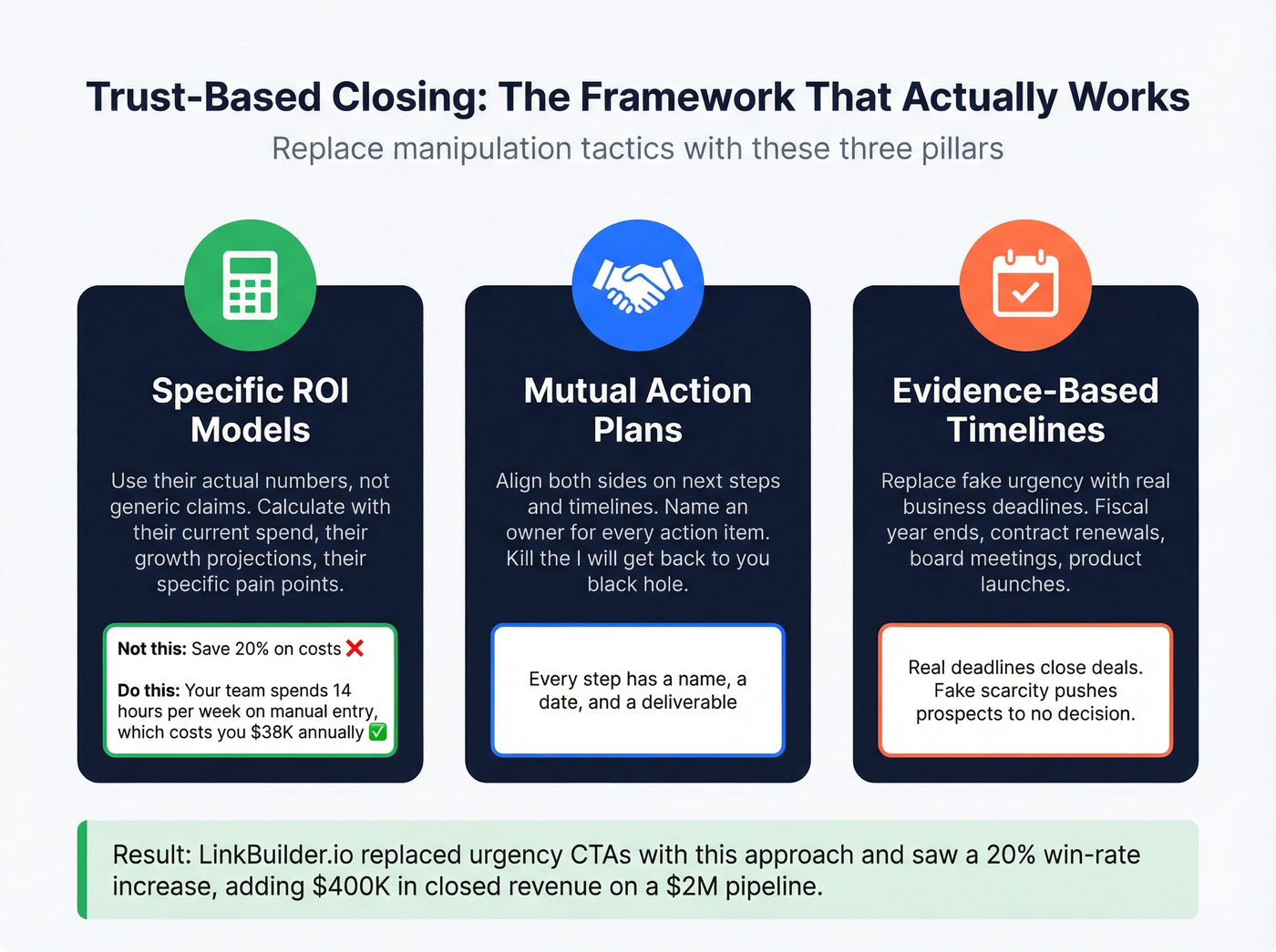
What actually works is trust-based selling. A Head of Sales at LinkBuilder.io replaced urgency CTAs with data-backed proposals and tailored value maps and saw a 20% win-rate increase over two quarters. On a $2M pipeline, that's $400K in additional closed revenue.
If you want a step-by-step framework, use these steps to close a sale to standardize late-stage execution.
Build your closing process around three elements. First, ROI models that quantify the buyer's specific pain - not generic "save 20% on costs" claims, but calculations using their actual numbers, their current spend, their projected growth. Second, mutual action plans that align both sides on next steps and timelines, with named owners for every action item; this eliminates the "I'll get back to you" black hole. Third, evidence-based timelines that replace artificial urgency with real business deadlines - fiscal year ends, contract renewals, board meetings, product launches.
The most common closing mistakes aren't about technique - they're about process. Talking to the wrong stakeholders. Over-emphasizing price instead of value. Talking more than listening. If your opportunity-to-close rate is below 15%, audit your last 20 lost deals. The pattern will be obvious.
Retention: Revenue You're Already Sitting On
The median SaaS company runs a net revenue retention of 106%, meaning existing customers generate more revenue each year even before new logos. Top performers hit 120%+. Expansion ARR accounts for 40% of total new ARR - and for companies above £50M ARR, expansion exceeds 50%.
Retaining a customer costs less than one-third of acquiring a new one. Yet most sales teams treat retention as someone else's problem.
If you want to make retention measurable, start with churn analysis and tie it back to expansion and renewal plays.
When your pipeline is empty, the fastest path to revenue isn't cold outreach - it's reactivation. Past customers who churned, prospects who went dark, deals that stalled. These people already know you. A structured reactivation campaign with updated data and a fresh value proposition converts faster and cheaper than any cold channel. For context, SMB acquisition runs $1K-$4K, mid-market $4K-$15K, and enterprise $15K-$50K. Reactivation undercuts all of those.
Cost to Generate Sales by Channel
| Channel | Avg CAC | Conversion Quality | Time to Results |
|---|---|---|---|
| Referrals | ~$150 | Highest (56% L→MQL) | 1-3 months |
| SEO/Content | $480-$942 | High (41% L→MQL) | 6-12 months |
| Paid Search | ~$802 | Moderate (29% L→MQL) | Immediate |
| Outbound Sales | ~$1,980 | High (with clean data) | 1-3 months |
The median SaaS CAC is $2 to acquire $1 of new ARR, with an average payback period of 23 months. That's a long time to wait for ROI, which is why channel mix matters so much.
Prioritize referrals and SEO for long-term efficiency. Use outbound for predictable, controllable short-term pipeline. Reserve paid channels for demand capture and retargeting, not primary acquisition. And regardless of channel, the math only works if your data is clean - a $1,980 outbound CAC assumes your emails actually reach inboxes and your phone numbers actually connect.
To pressure-test your funnel, track funnel metrics and review them weekly with sales + marketing together.
FAQ
How do you generate sales without ads?
Prioritize referrals at $150 average CAC, reactivate past customers who already know your product, and launch structured cold outreach with verified contact data. Content and SEO build compounding pipeline long-term but won't save this quarter. For immediate results without ad spend, direct outreach to a clean, verified list consistently outperforms every other no-budget channel.
What's a good conversion rate for sales?
Visitor-to-lead runs 1-3%, lead-to-MQL averages 31%, MQL-to-SQL hits 15-35%, and opportunity-to-close ranges from 15-40%. B2B SaaS visitor-to-lead averages just 1.1%. Use these as diagnostic benchmarks - if any stage falls significantly below range, that's where your funnel is broken and where you should focus first.
How many follow-ups does it take to close a deal?
Expect 8-12 touchpoints over 17-21 days across 3+ channels. 80% of sales require 5+ follow-ups, but 44% of reps quit after one - that gap is where most pipeline dies. A structured cadence with verified contact data and bounce rates under 5% separates teams that close from teams that chase ghosts through broken sequences.
What tools help generate sales leads with clean data?
Prospeo's B2B database covers 300M+ profiles with 98% email accuracy and a 7-day refresh cycle, making it a strong starting point for outbound teams. Pair it with a CRM like HubSpot or Salesforce for pipeline tracking, and a sequencing tool like Smartlead or Instantly for automated cadences. Clean data is the foundation - without it, even the best tools underperform.
How do you restart pipeline when sales stall?
Audit your funnel benchmarks stage by stage to find the exact bottleneck. If leads are plentiful but meetings are scarce, your data quality or cadence needs work. When meetings happen but deals don't close, revisit qualification criteria and your closing process. Often the fastest fix is reactivating stalled deals with a fresh value angle rather than chasing entirely new prospects.