

How to Get Sales Leads: The Practitioner's Playbook for 2026
A RevOps lead we work with exported 5,000 contacts from a popular database last quarter, loaded them into a sending tool, and watched the domain burn in three days. Bounce rate: 38%. The contacts looked fine on paper - right titles, right industries, right company sizes. The emails just weren't real.
That's the gap nobody talks about in most guides on how to get sales leads. They'll hand you "10 strategies" and a list of tools, but they skip the part where bad data torpedoes everything downstream. We're not going to skip that part. Whether you're trying to find prospects for the first time or overhaul a broken pipeline, this guide covers real benchmarks, real channel economics, and a stack that holds up when you press send.
What You Need (Quick Version)
- Define your ICP before touching any tool. If you can't describe your best customer in two sentences, you're not ready to prospect. Use an ideal customer profile template if you need structure.
- Pick 2-3 channels and execute consistently. Not 32. Not "omnichannel everything." Two or three, done well.
- Fix your data quality first. Bad emails kill deliverability, burn domains, and waste every dollar you spend on sequences and content. Start with an email deliverability baseline.
What's Changed in Sales Lead Generation
Cold email still works. But the margin for error has collapsed.
One practitioner documented sending 217,000 cold emails over the course of a year. Reply rates started at 2.1% - respectable. After about 150,000 sends, domains started burning and replies dropped to 0.7%. That's not a gradual decline. That's a cliff.
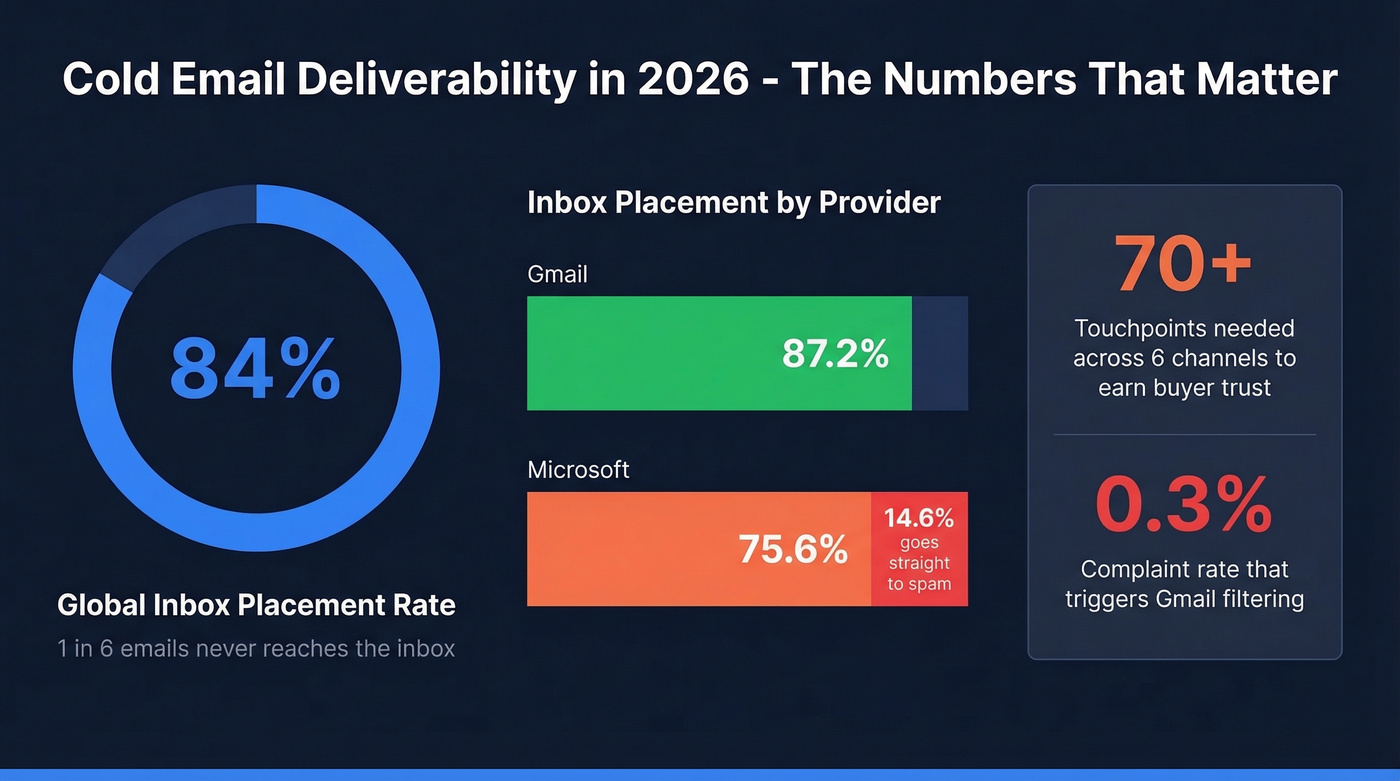
Global inbox placement sits at 84%, which means one in six emails never reaches the inbox. Microsoft is the toughest gatekeeper - only 75.6% inbox placement, with 14.6% going straight to spam. Gmail fares better at 87.2%, but complaint rates above 0.3% trigger rapid filtering.
Meanwhile, Belkins reports it now takes 70+ touchpoints across six channels to earn a modern buyer's trust. That's not a typo.
Here's the thing: none of this means prospecting is harder. It means sloppy lead gen is harder. Teams with verified data, tight ICPs, and disciplined multi-channel execution are booking more meetings than ever. If your average deal size clears $15K, the ROI on getting this right is enormous. If you're selling lower-ticket products, nail one channel before adding complexity. The gap between good and bad outbound has never been wider.
Define Your ICP First
Every lead gen failure we've seen traces back to the same root cause: the team skipped ICP definition and went straight to exporting contacts.
Belkins has a useful framework called competency mapping. Break your market into sub-segments and rank each one on three axes: ease of selling, strategic fit, and growth potential. A segment might be easy to sell into but have zero expansion revenue. Another might be hard to close but worth 10x in lifetime value. You need to know which is which before you build a single list.
Once you've picked your segments, map the buying committee. Cap it at five key players - more than that and you're spreading personalization too thin. A CFO cares about cost reduction. A VP Marketing cares about pipeline attribution. Same product, different angle.
The practical rule from practitioners on r/sales is to filter your ICP down to roughly 1,000 contacts before you export anything. That keeps verification costs manageable and forces you to be specific. If you can't narrow below 1,000, your ICP isn't defined - it's a wish list. This step is the single best way to find sales leads that actually convert.
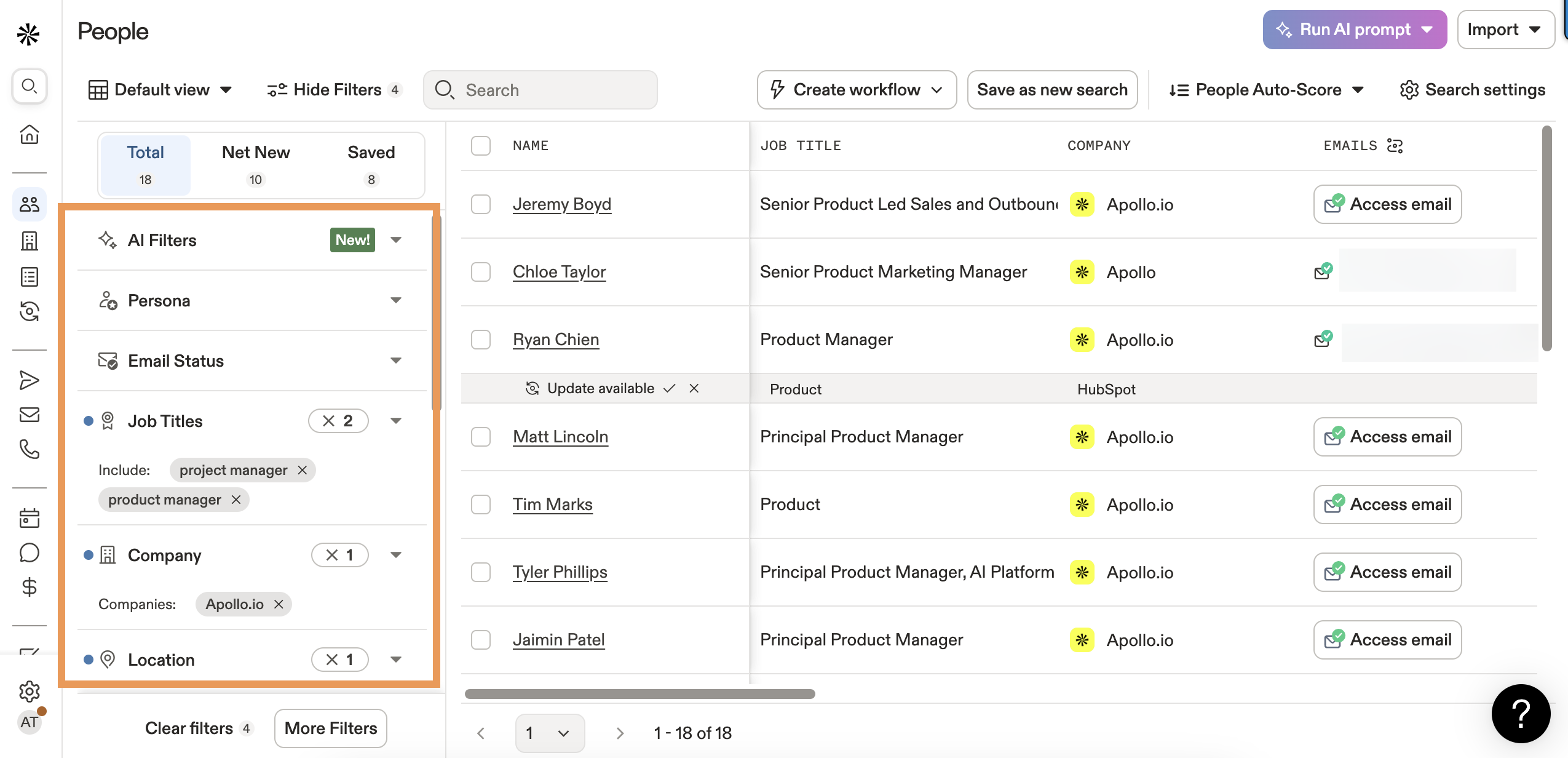
A platform with 30+ search filters - including buyer intent signals across 15,000 Bombora topics, technographics, job changes, department headcount, headcount growth, and funding data - makes this executable, not theoretical. Layer those signals to build lists that match your competency map, not just job titles. (If you want a deeper system, see sales prospecting techniques.)
Choose Your Channels
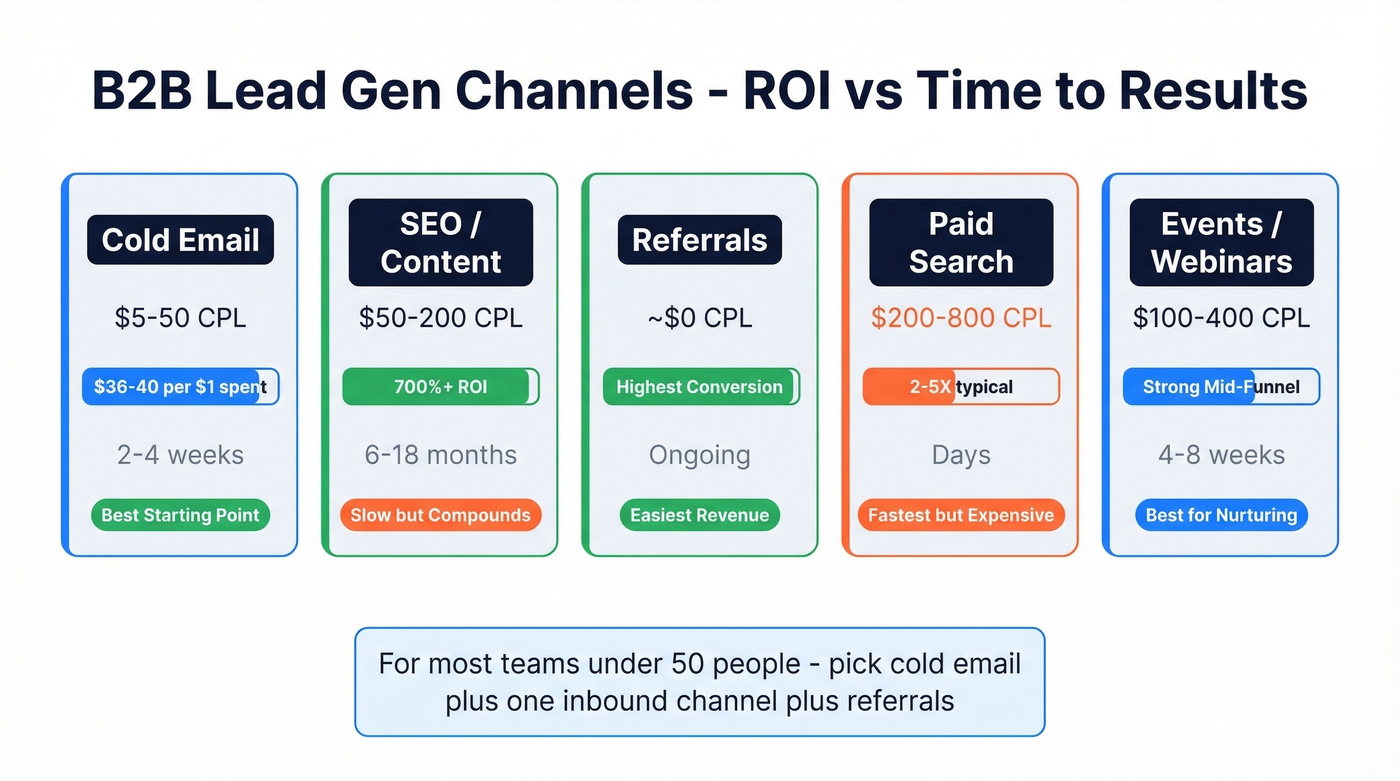
Not all channels deliver equal returns, and the ROI differences are massive.
| Channel | CPL Range | ROI | Time to Results | Difficulty |
|---|---|---|---|---|
| Cold email | $5-50 | $36-40 per $1 | 2-4 weeks | Medium |
| SEO/content | $50-200 | 700%+ | 6-18 months | High |
| Referrals | ~$0 | Highest conversion | Ongoing | Low |
| Paid search | $200-800 | 2-5X typical | Days | Medium |
| Events/webinars | $100-400 | Strong mid-funnel | 4-8 weeks | Medium |
Email marketing returns $36-40 for every $1 spent, making it the highest-ROI channel by a wide margin. SEO and content marketing often exceed 700% ROI, but the payoff window is 6-18 months. Paid search is the fastest channel - you can generate demo requests within days - but demo CPLs run $600-$800.
The average B2B cost per lead across all channels is roughly $200. Marketing-sourced pipeline should contribute 30-60% of total revenue targets. Below 30%, you're over-relying on outbound. Above 60%, your sales team isn't prospecting enough.
Pick two or three channels that match your timeline and budget. For most teams under 50 people, that's cold email plus one inbound channel plus referrals.

The article above shows the average cold email bounce rate sits at 7.5% - and that's enough to torch your domain. Prospeo's 5-step verification delivers 98% email accuracy with a 7-day data refresh cycle. Teams using Prospeo cut bounce rates from 35-40% to under 5% and book 26% more meetings than ZoomInfo users.
Fix your data before you fix your sequences.
Ways to Find Sales Leads Now
Cold Email That Gets Replies
Average B2B cold email open rate: 27.7%. Response rate: 5.1%. Bounce rate: 7.5%. A 2-email sequence drives the highest response rate at 6.9%, and reply rates jump roughly 49% after a single follow-up.
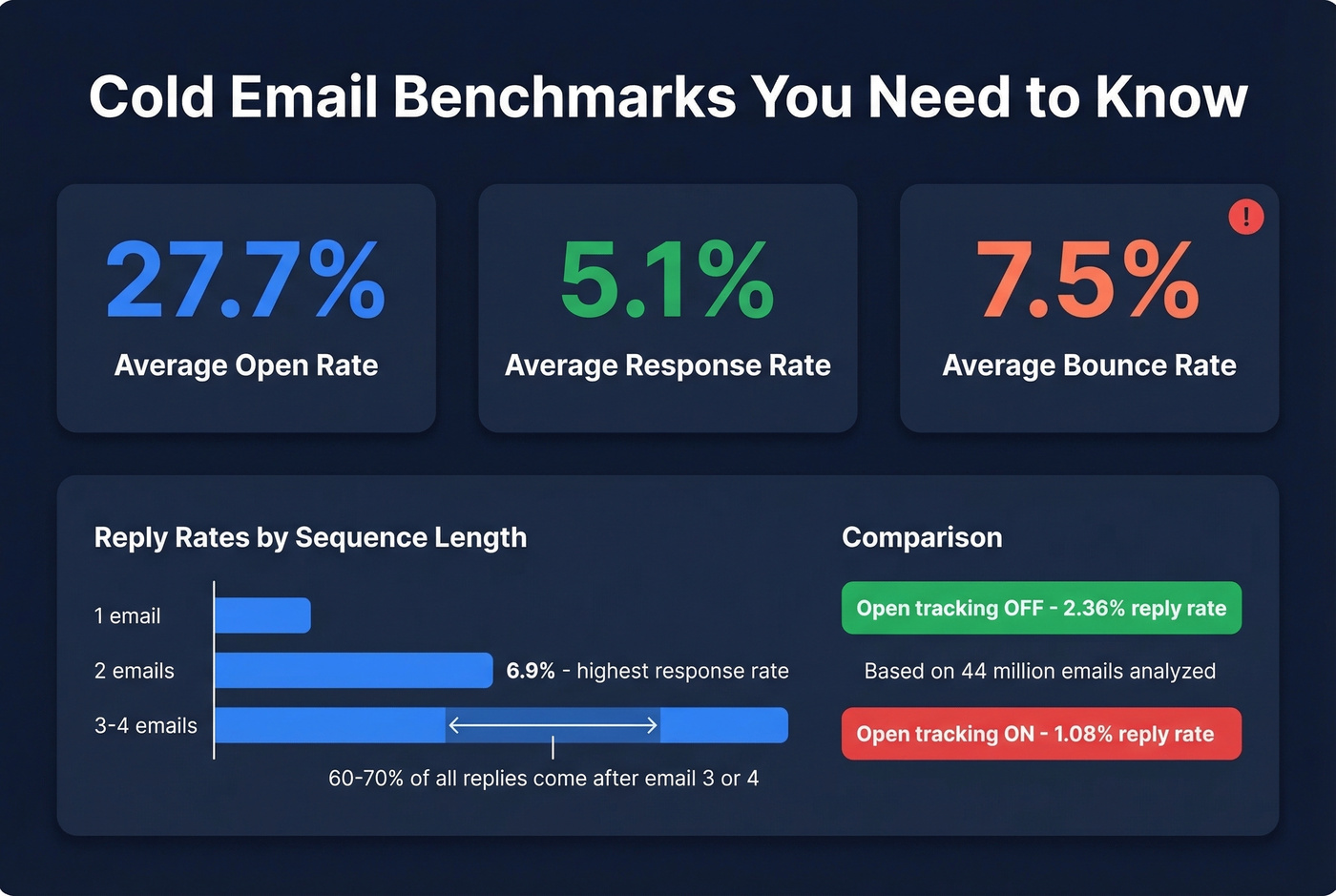
The critical insight most teams miss: 60-70% of replies come after email #3 or #4. If you're sending one email and moving on, you're leaving the majority of your responses on the table.
Here's a template that works as a starting point:
Subject: [Company] + [pain point]
Hi [Name], noticed [Company] just [trigger event - new hire, funding round, tech adoption]. We helped [similar company] [specific result]. Worth a quick look?
- [Your name]
Keep it to one screen. Use soft CTAs. Personalize on context - mentioning someone's company stage or industry beats {first_name} merge tags every time. And disable open tracking: an analysis of 44 million emails found reply rates of 2.36% with tracking off versus 1.08% with it on. Open pixels hurt deliverability. (If you need more options, use these cold email follow-up templates.)
Before you send a single email, verify your list. With the average cold email bounce rate sitting at 7.5%, unverified lists will tank your sender reputation before you get to email #3. If you're troubleshooting, start with email bounce rate benchmarks and fixes.
Social Selling and Buying Signals
One practitioner documented a complete pivot from cold email to buying-signal engagement. After 90 days: 12% reply rate (up from 0.7% on cold email) and 34 meetings booked versus 8-12 per month previously.
The approach was straightforward: monitor competitor mentions, job changes, funding announcements, and hiring signals, then engage with prospects already showing intent before sending a single outreach message. It doesn't scale to 1,000 touches a day like cold email, but 50 warm conversations beat 500 cold bounces. For teams wondering how to generate leads without burning domains, this is the answer. To operationalize this, build a process for identifying buying signals.
Multi-channel outreach - email plus social plus one polite call - drives 3X better reply rates than single-channel. If you're only doing email, you're competing with everyone else who's only doing email. Adding even one extra touchpoint separates you from the noise.
Content, SEO, and Inbound
Inbound is a compounding asset, but set your expectations correctly. Website conversion rates vary wildly by industry:
| Industry | Avg Conversion Rate |
|---|---|
| Legal Services | 7.4% |
| Staffing & Recruiting | 2.9% |
| Manufacturing | 2.2% |
| IT & Managed Services | 1.5% |
| B2B SaaS | 1.1% |
Even Salesforce converts less than 5% of its traffic into qualified leads. SEO ROI often exceeds 700%, but it takes 6-18 months to compound. Start now, but don't wait for inbound to fill your pipeline. If you want a dedicated playbook, see SEO sales leads.
Referrals, Events, and Partnerships
Referrals remain the highest-converting channel in B2B. Period.
If you're not systematically asking happy customers for introductions, you're leaving the easiest revenue on the table. Build a referral ask into your post-onboarding workflow - it takes five minutes to set up and pays dividends indefinitely.
Webinars and events work best for mid-funnel acceleration. They don't generate cold leads efficiently, but they move existing prospects toward a decision. Co-marketing partnerships - shared webinars, joint content, audience swaps - let you reach adjacent ICPs without building the audience from scratch.
Paid Ads
Paid search is the fastest channel but carries the highest CPL. Demo request CPLs run $600-$800 in competitive B2B categories. Deploy it for retargeting warm visitors and capturing high-intent keywords - not for cold awareness. If your budget is tight, skip this and spend on email infrastructure and data quality first. Paid can wait.
Build Your Outbound Stack
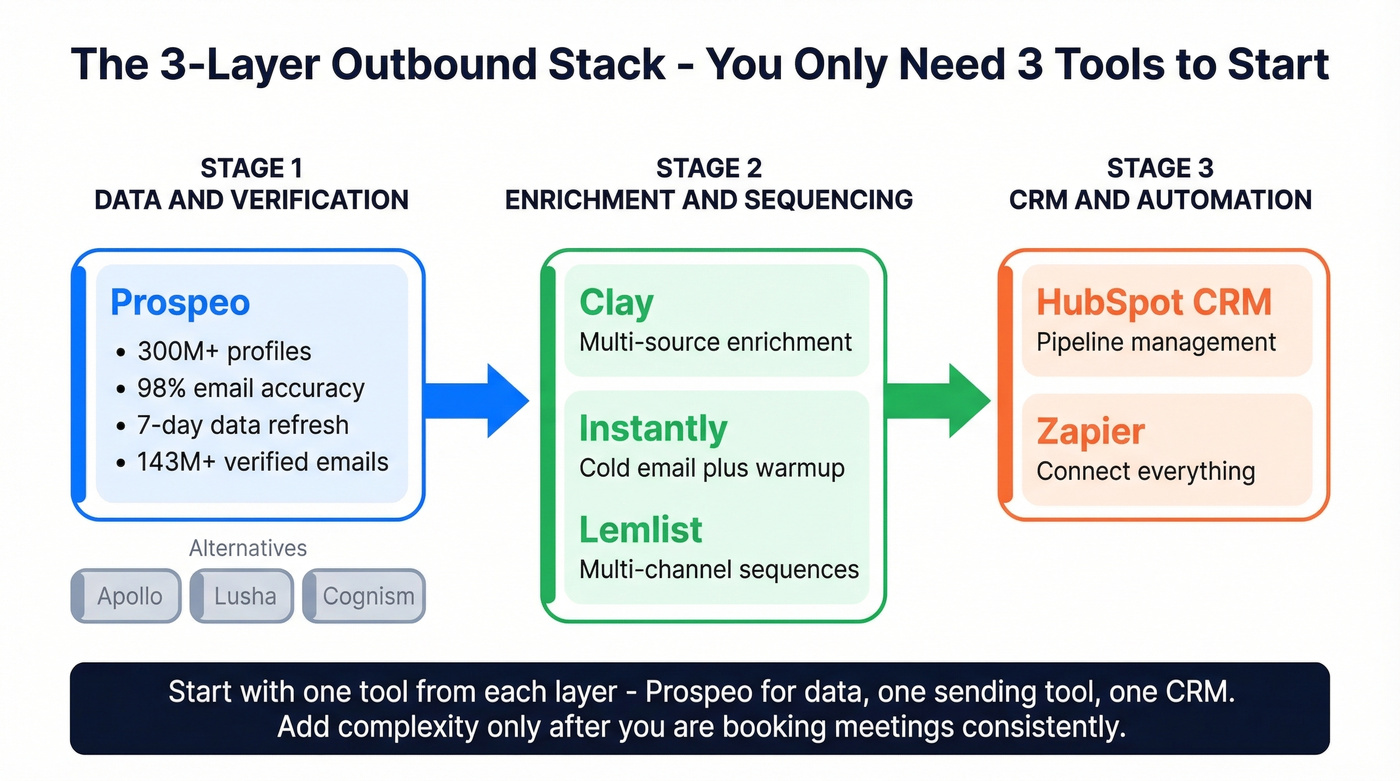
You don't need 15 tools. You need three to start, and you need them to work together.
| Tool | Category | Starting Price | Best For |
|---|---|---|---|
| Prospeo | Data & Verification | Free; ~$0.01/email | Verified emails, dials, ICP lists |
| Apollo | Prospecting Database | Free; $49/user/mo | Discovery + list building |
| Clay | Enrichment | Free 100 credits; $149/mo | Multi-source enrichment |
| Lusha | Contact Data | Free 5 credits; $29/user/mo | Quick lookups |
| Cognism | Enterprise Data | ~EUR10K-30K/yr | European markets, GDPR |
| Instantly | Sending | ~$30-$40/mo | Cold email + warmup |
| Lemlist | Sending + Sequences | ~$50-$70/user/mo | Multi-channel sequences |
| HubSpot CRM | CRM | Free; ~$15-$20/user/mo | Pipeline management |
| Zapier | Automation | Free; $19.99/mo | Connecting tools |
Prospeo is the data foundation. 300M+ professional profiles, 143M+ verified emails, 98% email accuracy, and 125M+ verified mobile numbers with a 30% pickup rate across all regions. The 7-day data refresh cycle matters more than most teams realize - the industry average is six weeks, meaning competitors serve you contacts who changed jobs last month. Meritt tripled their pipeline from $100K to $300K per week after switching. Snyk's 50 AEs reduced bounce rates from 35-40% to under 5% and generated 200+ new opportunities monthly. Self-serve, no contracts, roughly $0.01 per email.

You just read that 30+ filters, intent signals, and tight ICP definition separate pipeline builders from list pullers. Prospeo gives you exactly that - 300M+ profiles filtered by buyer intent across 15,000 Bombora topics, technographics, job changes, funding, and headcount growth. All starting at $0.01 per verified email, no contract required.
Build the list your ICP definition actually describes.
Apollo is solid for discovery and initial list building. 275M+ contacts, a generous free tier, and a built-in sequencer make it the default starting point for many SMB teams. The catch: Apollo's data is user-contributed and not independently verified. We've seen bounce rates north of 20% on raw Apollo exports, and the built-in dialer runs on Twilio VoIP numbers that get flagged as spam more often than local numbers. Use it for discovery, then verify externally before sending.
Clay is the best enrichment layer available right now. Its waterfall approach pulls from dozens of data sources and cross-references them, dramatically improving match rates. It's expensive - $149/mo at the starter tier, and credits burn fast on complex workflows - but for teams running sophisticated outbound, it's worth it. For a step-by-step workflow, see Clay list building.
Lusha works for quick one-off lookups. The free tier gives you 5 credits per month; Pro starts at $29/user/mo. Good for individual reps who need a phone number right now, but not built for scale. Cognism is the play for European markets with strong GDPR compliance and human-verified diamond data, though enterprise pricing puts it out of reach for smaller teams. Instantly handles cold email sending and warmup at ~$30-$40/mo. Lemlist adds multi-channel sequences at ~$50-$70/user/mo. HubSpot CRM's free tier manages your pipeline until you're past 10 reps. Zapier connects everything without code.
Score and Qualify Your Leads
Generating leads is half the battle. The other half is knowing which ones to call first.
Most teams use three categories. MQLs show engagement signals - downloaded content, attended a webinar, visited pricing pages. SQLs meet your ICP criteria and have expressed buying intent. PQLs have used your product and hit activation thresholds.
Build a simple scoring model across three dimensions:
| Criteria | Point Range | What to Measure |
|---|---|---|
| Firmographic Fit | 0-30 pts | Right industry, company size, geography, tech stack |
| Engagement Signals | 0-40 pts | Email opens, pricing page visits, content downloads, webinar attendance |
| Intent Data | 0-30 pts | Actively researching your category, competitor mentions, relevant job postings |
| SQL Threshold | 70+ pts | Route to sales immediately |
A lead that scores 70+ gets called today. A lead that only matches firmographics goes into a nurture sequence until engagement or intent signals push it over the threshold. If you want a full framework, use this lead scoring guide.
The benchmark to aim for: 50%+ MQL-to-SQL conversion. If you're below that, your qualification criteria are too loose or your follow-up is too slow. Highspot's research found 47% of enterprise GTM teams struggle to deliver a strong lead experience, and 41% can't provide timely, personalized engagement. The five-minute follow-up rule exists for a reason - leads go cold fast, and the team that responds first wins disproportionately.
Mistakes That Kill Your Pipeline
Five mistakes we see repeatedly:
Trusting unverified data. Bounce rates of 35-40% destroy sender reputation in days. Verify every email before it enters a sequence.
No follow-up strategy. 60-70% of replies come after email #3 or #4. Build a minimum 3-4 touch sequence.
Skipping ICP definition. Exporting 5,000 contacts that vaguely match your market isn't targeting. Filter to ~1,000 contacts per ICP slice and iterate weekly.
Using open and click tracking. The data from 44 million emails is clear - reply rates more than double with tracking off. Disable open tracking and measure replies instead. (If you want the technical why, read about email tracking pixels.)
Spreading across too many channels. Doing five channels poorly doesn't beat doing two channels well. Pick two or three, execute consistently for 90 days, then evaluate.

Benchmarks - What Good Looks Like
Pin these numbers somewhere your team can see them:
| Metric | Benchmark |
|---|---|
| Cold email open rate | 27.7% |
| Cold email reply rate | 5.1% |
| Bounce rate target | <5% |
| Deliverability target | 95%+ |
| Avg B2B CPL | ~$200 |
| Demo request CPL | $600-$800 |
| Email ROI | $36-$40 per $1 |
| MQL-to-SQL conversion | 50%+ |
ISP inbox placement varies significantly. Gmail delivers 87.2% to inbox. Microsoft only 75.6%. Yahoo sits at 86.0%. If your ICP skews toward enterprise (Microsoft-heavy), deliverability hygiene matters even more.
Website conversion rates range from 1.1% for B2B SaaS to 7.4% for legal services. If you're converting above 3% in SaaS, you're outperforming most of the market. Below 1%? Look at your landing pages before blaming your traffic sources.
FAQ
What is a sales lead?
A sales lead is a person or company that matches your ideal customer profile or has shown interest in your product. Leads range from cold (no prior interaction) to warm (engaged with content) to hot (actively evaluating solutions and ready for a conversation).
How much does lead generation cost?
The average B2B cost per lead is roughly $200 across all channels. Demo request CPLs run $600-$800 in competitive categories. Email marketing returns $36-$40 per $1 spent, and verified email data costs as little as $0.01 per contact.
How do you get sales leads consistently?
Combine two or three channels executed well: a verified contact list targeting a tightly defined ICP, disciplined cold email sequences, and one inbound channel like content or paid search. Teams that prospect every week outperform those running sporadic blitzes - consistency beats volume.
How many leads should a salesperson generate per month?
Work backward from your revenue target. If you close 5% of qualified leads at $10K average deal size, you need about 20 qualified leads per month per rep to hit a $1M annual quota. The math changes with your close rate and deal size, but the framework stays the same.
Is cold email still effective in 2026?
Yes, but only with verified data and disciplined execution. Reply rates sit at 5.1%, and teams using multi-channel outreach see 3X better results. The biggest killer isn't the channel - it's bad data and poor deliverability making the channel look broken when it's really a data quality problem.