

How to Identify Warm Leads: The Complete System for 2026
Your SDR flagged 50 "warm leads" from last week's webinar. Three emails bounce. Two phone numbers are disconnected. One person left the company in January. That's not a warm lead list - it's a waste of everyone's morning.
Knowing how to identify warm leads separates teams that convert at 8-15% from those stuck at the 1-3% cold outbound average. The difference isn't luck. It's a system built on three things: a signal taxonomy, a scoring model, and verified contact data. The average B2B conversion rate is 2.9% across 100M+ data points - a proper warm-lead system makes that average irrelevant. (If you want the benchmark breakdown, see average B2B lead conversion rate.)
Three Categories of Warm Signals
Not all warmth looks the same. We break signals into three buckets based on proximity and timing.
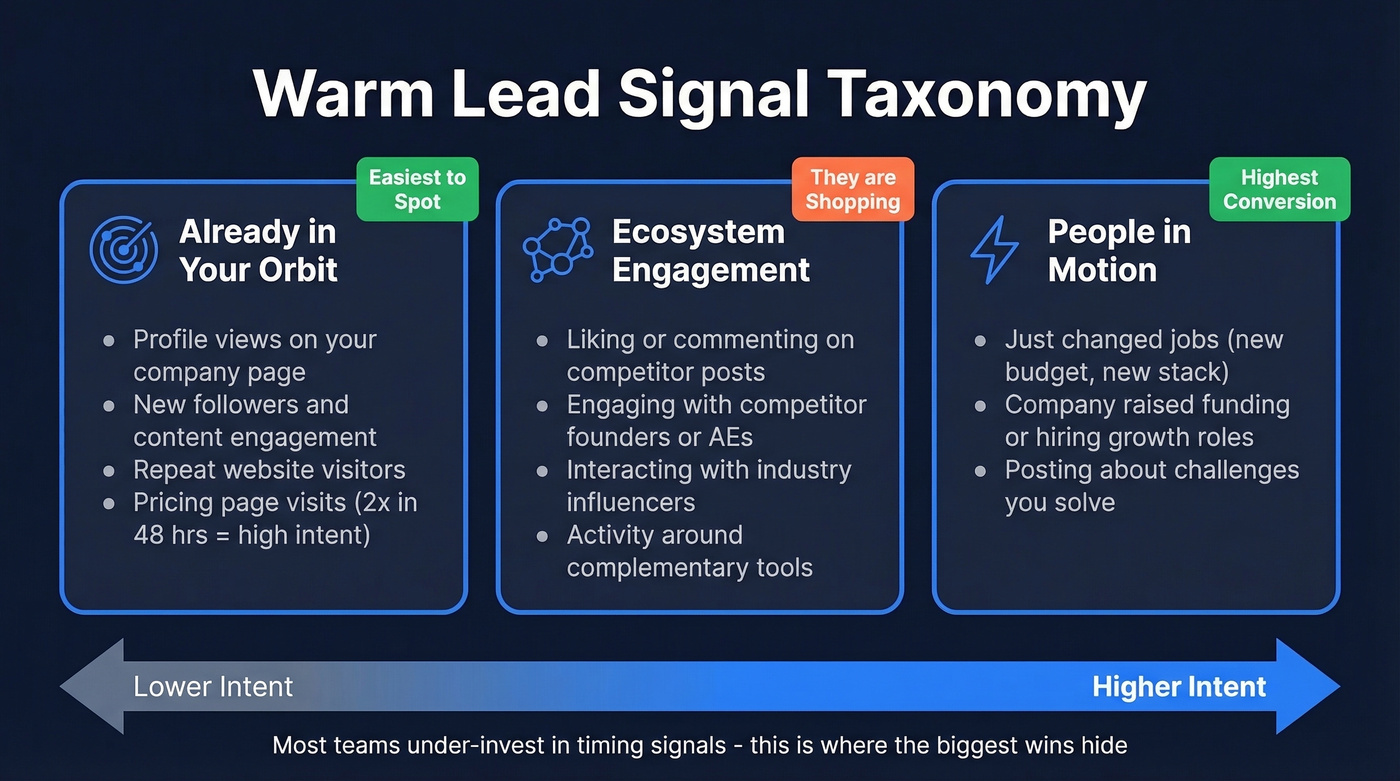
Already in Your Orbit
These are the easiest to spot because they're interacting directly with your brand. Profile visitors who've viewed your company page or team members' profiles, new followers, people engaging with your content through likes, comments, and shares, and repeat website visitors hitting high-intent pages like pricing or integrations - all of these count. If someone visited your pricing page twice in 48 hours, they're not browsing casually.
Ecosystem Engagement
These prospects haven't touched your brand yet, but they're circling your category. Look for people liking or commenting on competitors' posts, engaging with competitor founders or AEs, interacting with industry influencers, and showing activity around complementary tools. They're shopping. They just haven't found you yet.
People in Motion
Timing signals are the most underrated warm indicators. A practitioner on r/sales put it well: "Volume doesn't win anymore. You need better timing."
- Just changed jobs (new role = new budget, new vendor evaluations)
- Company raised a funding round or is hiring growth roles
- Posting actively about challenges your product solves
Here's the thing: a VP of Sales who started three weeks ago is actively building their stack. That's a fundamentally different conversation than cold-calling someone who's been in-seat for two years. We've seen the highest conversion rates from this category, and it's where most teams under-invest. (For more on trigger-based outreach, see how to track sales triggers.)
Build a Lead Scoring System
Signals tell you who's warm. Scoring tells you who's warmest. (If you need a deeper walkthrough, use this lead scoring guide.)
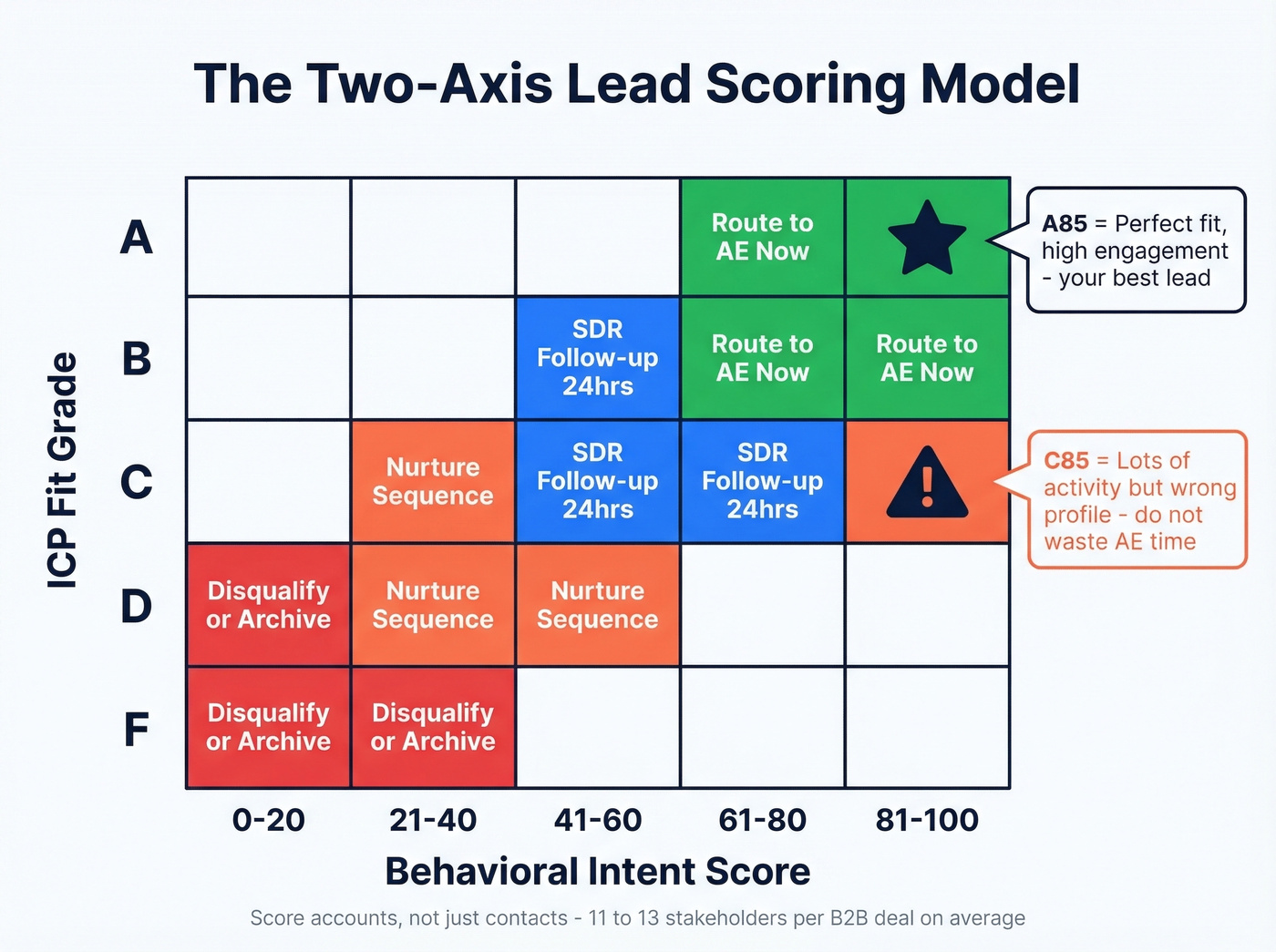
The best systems use two axes: a letter grade (A-F) for ICP fit and a numeric score (0-100) for behavioral intent. An A85 lead - perfect fit, high engagement - gets routed differently than a C85, which is the wrong profile with lots of activity. Most teams only score behavior and waste cycles on engaged-but-bad-fit leads. (To standardize fit, start with an Ideal Customer Profile Template.)
Positive Signals
| Signal | Points |
|---|---|
| Demo/contact form fill | +15 |
| Return visit within 48 hrs | +12 |
| Pricing page view | +10 |
| 10+ email clicks | +10 |
| Case study view | +8 |
Negative Signals
| Signal | Points |
|---|---|
| Competitor domain | -50 |
| Email bounce | -25 |
| Unsubscribe | -25 |
| Personal email (B2B context) | -20 |
Start with 5-7 core criteria that drive most conversions. You can layer in more signals later, but a bloated model from day one creates more noise than clarity.
One critical rule: stop scoring email opens. Apple's Mail Privacy Protection renders open data unreliable. Shift weight to on-site behavior and higher-confidence actions like pricing page visits and return frequency. (If you're still tracking opens, review email tracking pixels and what they can/can’t tell you.)
Thresholds and Routing
| Grade + Score | Action |
|---|---|
| A + 70+ | Route to AE immediately |
| B + 50-69 | SDR follow-up within 24 hrs |
| C or below + under 30 | Nurture sequence |
Set your MQL threshold to capture the top ~20% of leads by score - typically 50-75 points on a 100-point scale. This keeps your pipeline focused without starving your AEs.
Add time-based decay: -5 points per week of inactivity. Without it, warm leads go cold in your queue. You'll have "hot" leads sitting there from six months ago who've long since bought from a competitor.
B2B decisions involve 11-13 stakeholders on average, each consuming 4-5 pieces of content before a purchase. Score at the account level, not just the contact level. If three people from the same company are engaging, that account is warmer than any individual score suggests. Teams that nail account-level scoring see 15-25% conversion rates from qualified leads to closed deals. (For a full playbook, see account-based selling best practices.)
Use Intent Data to Spot Warm Leads Early
Scoring captures behavior after someone engages with you. Intent data catches them before they do - while they're still researching your category elsewhere. (This pairs well with intent based segmentation.)
First-party intent is behavior on your owned properties: pricing page views, product milestone completions, email clicks, return visit frequency. This is the highest-fidelity signal you have.
Third-party intent tracks off-site research - G2 and Capterra comparisons, publisher network activity, content syndication engagement. 68% of B2B marketers are ramping up investment in this category. But let's be honest: third-party intent is often a blunt instrument. It tells you a company is researching, not which person. Layer it with person-level verification to avoid chasing the wrong contact.
Hybrid intent combines both. Your on-site engagement data layered with Bombora surge signals or similar third-party feeds. This is where the real power lives.
Not all intent is equal. Pricing and integration page visits are high-intent. Careers pages and blog visits are low-intent. Intent also has a shelf life - a surge signal from three weeks ago is background noise, not a buying signal. Set your alerts accordingly. In our experience, spending about 5 minutes qualifying each account can raise reply rates from ~2% to 8-12%. (If you need more ways to source early-stage demand, see free lead generation tools.)
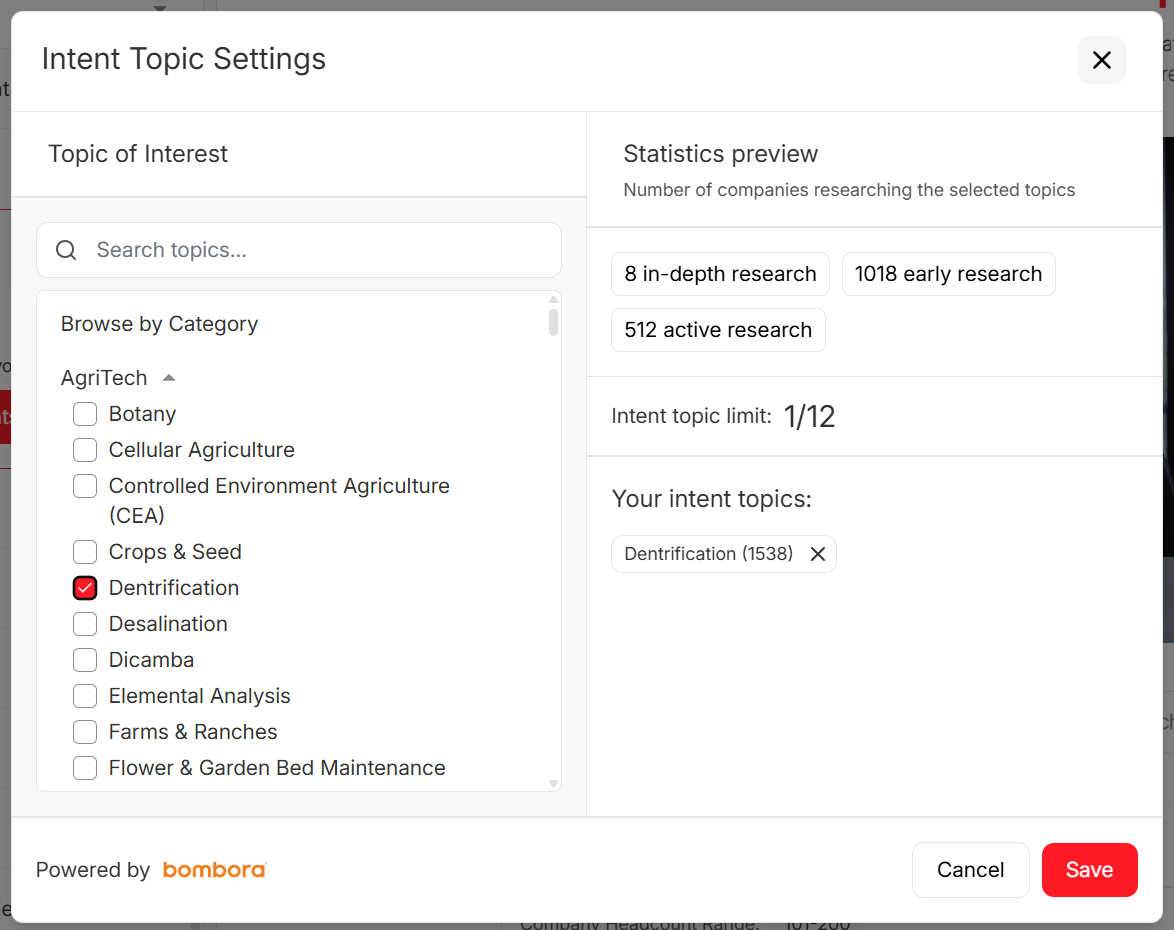

You just built a signal taxonomy and scoring model. Now you need the intent data to fuel it. Prospeo tracks 15,000 buyer intent topics via Bombora, layered with job change alerts, funding signals, and 30+ search filters - so you catch warm leads before they ever hit your website. 98% email accuracy means your outreach actually lands.
Turn intent signals into verified contacts in one search.
Qualifying Warm Leads With a Framework
Scoring tells you WHO to call first. A framework tells you WHETHER to keep calling.
| Framework | Best For | Core Focus |
|---|---|---|
| BANT | SMB, high-volume | Budget, authority, need, timeline |
| CHAMP | Consultative sales | Challenges first, then authority |
| MEDDIC | Enterprise, high-ACV | Decision process, metrics, champion |
BANT works for quick triage in high-volume SMB motions, but it's too shallow for enterprise deals. CHAMP flips the script by leading with the buyer's challenges - better for consultative selling. MEDDIC adds process risk controls that matter when deal cycles stretch past 90 days; it forces you to map decision-makers, identify a champion, and quantify the economic impact before you invest AE time. (If you run MEDDIC, keep a bank of MEDDIC discovery questions.)
Pick one. Train your team on it. The worst framework is the one nobody uses consistently.
Five Mistakes That Kill Warm Leads
1. Acting on Stale Data
Your "warm lead" changed jobs two months ago. The email bounces. The phone rings to a confused stranger. Fix: verify before every outreach push. A 7-day data refresh cycle is the standard to aim for - the industry average is six weeks, which means most teams are working with contacts who may have already moved on. (If bounces are a recurring issue, track your email bounce rate.)

2. Scoring Email Opens
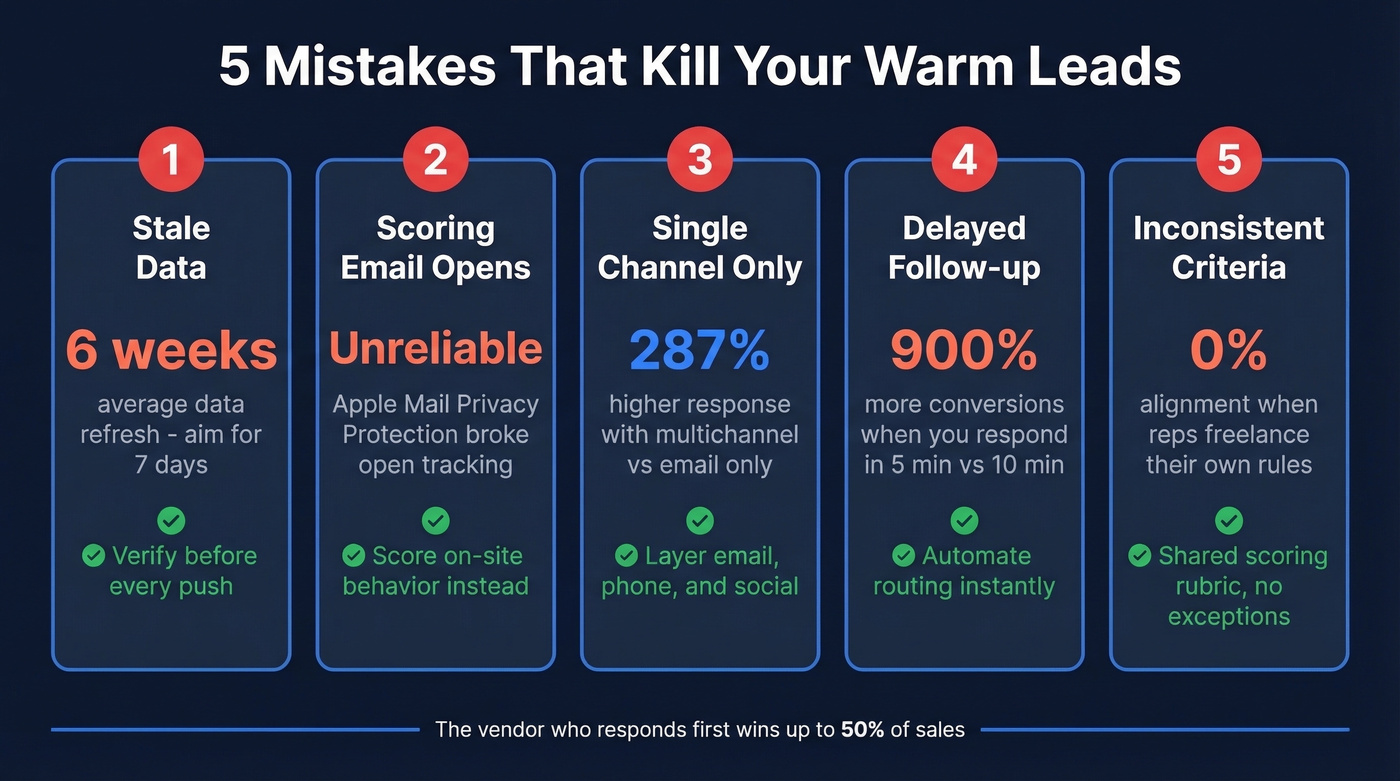
Apple MPP inflates open rates to meaninglessness. Shift scoring weight entirely to on-site behavior - page visits, form fills, return frequency.
3. Single-Channel Outreach
Most teams default to email-only sequences. Multichannel cadences see 287% higher response rates than single-channel strategies. Layer email, phone, and social touches into every warm-lead sequence. (Need copy you can deploy fast? Use these sales follow-up templates.)
4. Delayed Follow-Up
The vendor who responds first wins up to 50% of sales. Contacting leads within 5 minutes yields 900% more conversions than waiting 10 minutes, and 79% of leads never convert due to poor nurturing. Automate routing so high-score leads hit an AE's queue instantly, not after the morning standup. Speed beats perfection every time. (To operationalize this, map your lead generation workflow.)
5. Inconsistent Criteria Between Reps
One rep calls everyone who downloads a whitepaper. Another only calls demo requests. The fix is simple but non-negotiable: a shared scoring rubric that every rep uses, no exceptions, no freelancing.
Tools for Tracking Warm Leads
| Tool | Category | Starting Price |
|---|---|---|
| Prospeo | Data Verification + Intent | Free / ~$0.01/email |
| RB2B | Visitor ID | Free / $79-$495/mo |
| Leadfeeder | Visitor ID | Free / EUR99/mo |
| HubSpot | CRM Scoring | Free CRM / $20+/mo paid |
| Salesforce | CRM Scoring | $25-$300/user/mo |
| 6sense | Enterprise Intent | ~$50K+/yr |
| Demandbase | Enterprise Intent | ~$18K-$50K+/yr |
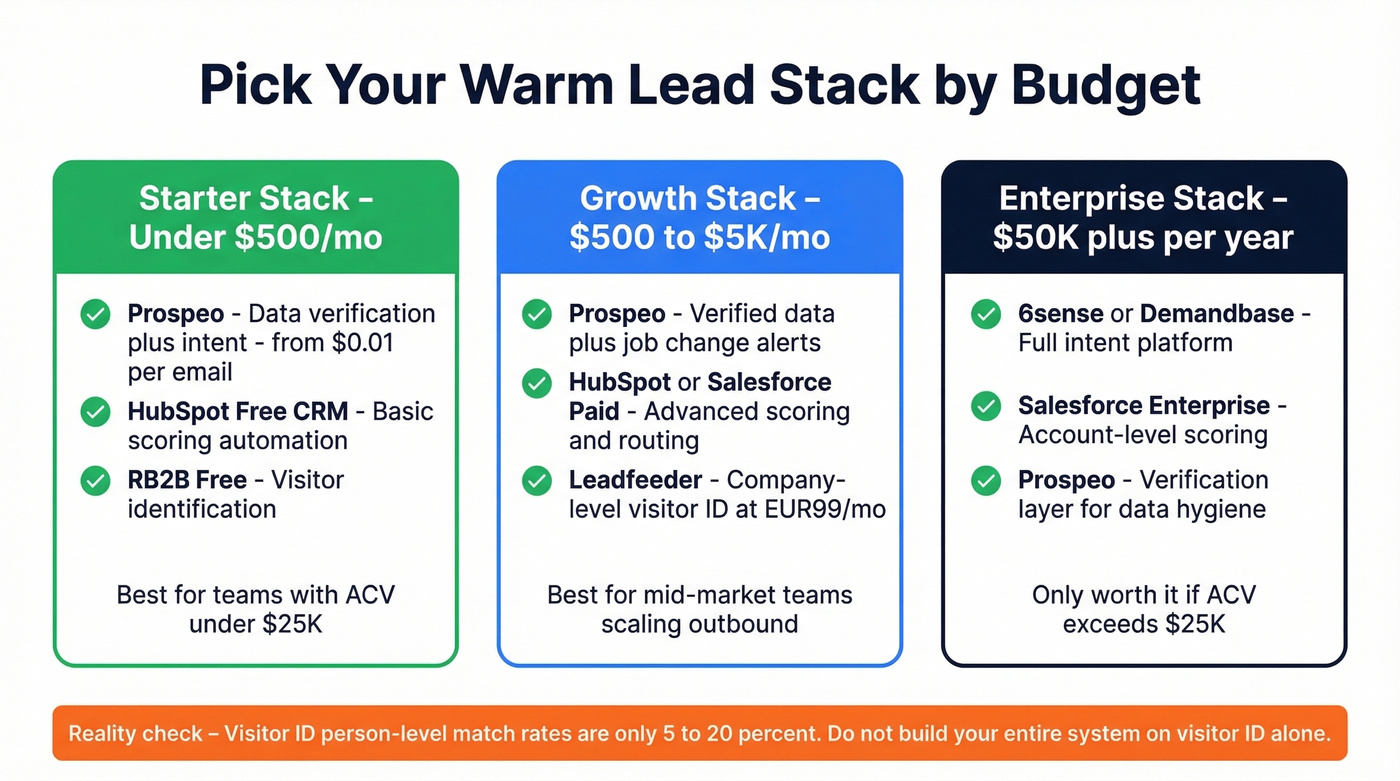
A reality check on visitor identification: company-level match rates run 30-65%, and person-level drops to 5-20%. With 60%+ of knowledge workers remote or hybrid, IP-based matching has gotten less reliable. Don't build your entire system on visitor ID alone.
Skip 6sense and Demandbase if your ACV is under $25K - the ROI math won't work. For most teams, the stack that actually delivers is a CRM with basic scoring automation, an intent data source, and a verification layer that ensures your outreach lands. You don't need a $50K enterprise platform to start surfacing warm pipeline. You need accurate data and a scoring rubric your team follows. (If you're evaluating your stack, start with these SDR tools.)
Stale data is the #1 warm lead killer. Prospeo refreshes all 300M+ profiles every 7 days - not the 6-week industry average. Combine that with 125M+ verified mobile numbers (30% pickup rate) and job change tracking, and your warm leads stay warm from signal to conversation. Plans start at $0.01 per email.
Stop letting warm leads go cold in a stale database.
FAQ
What's the difference between a warm lead and a hot lead?
A warm lead shows interest signals - content engagement, repeat site visits, competitor research - but hasn't requested a conversation. A hot lead has taken direct action like a demo request, pricing inquiry, or inbound call. Route hot leads to AEs immediately; nurture warm leads with multichannel sequences.
How many scoring signals should I start with?
Five to seven core criteria: ICP fit, pricing page visits, return frequency, demo requests, and account-level engagement. Teams that over-engineer scoring from day one create noise. Begin simple, then add signals as you gather conversion data.
How often should I refresh my lead data?
Every 7 days minimum. The industry average is 6 weeks, which means your prospect may have changed jobs since you last checked. Most competitors lag at 4-6 weeks on refresh cycles, so look for tools that match the 7-day standard.