

How to Increase Sales: The Data-Backed Playbook for 2026
Your team made 500 calls last week. Three meetings booked. One showed up. If you're trying to figure out how to increase sales, the instinct is to add more - more reps, more tools, more sequences, more "strategies" pulled from a blog post. The data says the opposite: stop adding and start subtracting waste. McKinsey found that reps who target 40% fewer accounts but spend 2.5x more time per target see 18% higher win rates and 35% faster deal cycles. Meanwhile, 72% of buyers flat-out ignore generic outreach.
The problem isn't effort. It's misdirected effort - bad data, weak follow-up, and activity metrics that reward noise over outcomes.
What You Need (Quick Version)
- Benchmark your funnel against your industry (table below). You can't fix what you haven't measured.
- Audit your contact data quality. If your bounce rate is above 2%, fix that before touching anything else.
- Implement a 5-7 touch follow-up cadence. 44% of reps quit after one attempt. That's not a strategy - it's quitting.
Now let's build the system behind those three moves.
Funnel Benchmarks by Industry
Most teams have no idea whether their conversion rates are good, bad, or catastrophic. They optimize blindly. The table below draws from FirstPageSage's multi-year benchmark report covering data from 2017-2026, supplemented with MQL-to-SQL ranges from Data-Mania's 2026 analysis.
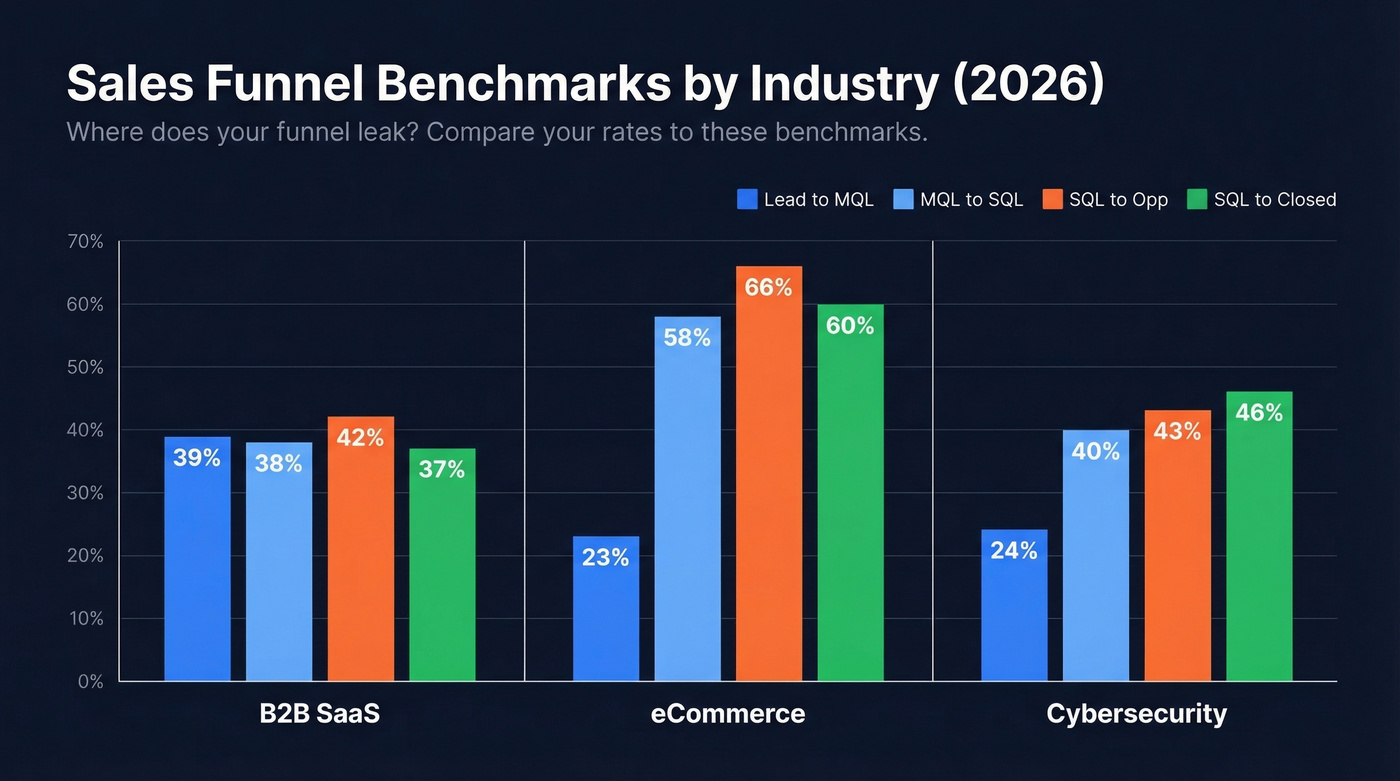
| Industry | Lead to MQL | MQL to SQL | SQL to Opp | SQL to Closed |
|---|---|---|---|---|
| B2B SaaS | 39% | 38% | 42% | 37% |
| eCommerce | 23% | 58% | 66% | 60% |
| Cybersecurity | 24% | 40% | 43% | 46% |
If your MQL-to-SQL rate is 8% and you're in B2B SaaS, you're leaking pipeline. The benchmark is 38%. That gap represents real revenue sitting on the table.
For top-of-funnel context, Ruler Analytics analyzed 100M+ data points and found the average qualified-lead conversion rate across 14 industries is just 2.9% - broken into 1.7% from forms and 1.2% from calls. If you're above it, you're doing something right. Below it, and your lead sources need work before your sales process does.
One more split worth noting: B2C and D2C companies convert MQLs to SQLs at 18-22%, while B2B teams run 13-15%. The gap isn't surprising - B2B deals involve more stakeholders and longer evaluation cycles - but it means B2B teams need to be far more disciplined about which leads they pursue.
Six Strategies That Drive Revenue
1. Fix Your Data Before Your Process
None of the strategies below matter if your reps are emailing dead addresses and calling disconnected numbers. Bad data is the invisible sales killer.
Look at what happened with Meritt, an outbound agency running a 35% email bounce rate. Pipeline sat at $100K/week. After switching to verified contact data and getting bounce rates under 4%, their pipeline tripled to $300K/week. Connect rate 3x'd to 20-25%. Snyk saw similar results - 50 AEs cut bounce rates from 35-40% to under 5%, and AE-sourced pipeline jumped 180%.

Industry best practice says keep your bounce rate under 2% and spam complaint rate below 0.01%. Every bounced email chips away at your sender reputation, which means even your good emails start landing in spam. Paying roughly $0.01 per verified email is nothing compared to the cost of a tanked domain that takes months to rehabilitate. Prospeo's B2B database handles this at the source - 300M+ professional profiles with emails verified at 98% accuracy on a 7-day refresh cycle, so you start clean instead of scrubbing dirty lists after the fact.
2. Optimize Each Funnel Stage
Once your data is clean, work the funnel stage by stage. One high-impact tactic per stage:
Awareness: Tighten your ICP. Check the funnel benchmarks table - if your Lead-to-MQL rate is below 23%, your targeting is the problem, not your volume. (If you need a scoring rubric, use an Ideal Customer Profile template.)
Interest: Implement behavioral lead scoring. Companies using behavioral scoring see conversion boosts of up to 40% because they're routing effort toward prospects who are actually engaged. AI-powered scoring tools can automate this entirely, analyzing dozens of behavioral signals that no human could track manually. (More on lead scoring setups.)
Decision: Speed kills - in a good way. Contacting an inbound lead within the first hour makes them 53% more likely to convert than leads contacted even an hour later. Most teams take 24-48 hours. That delay is costing you deals every single day, and it's one of the easiest things to fix.
Action: Offer self-serve demos and make pricing transparent - 67% of customers prefer self-service over talking to a rep anyway.
Don't optimize the whole funnel at once. Find the stage with the steepest drop-off relative to your industry benchmark and fix that one first. If you want a stage-by-stage diagnostic, map it to an AIDA sales funnel.
3. Master the Follow-Up
44% of salespeople give up after a single follow-up. Meanwhile, research consistently converges on 5-7 touchpoints as the minimum before most prospects make a buying decision. And 63% of people who request information won't purchase for at least three months. Most reps are quitting right when persistence would start paying off.
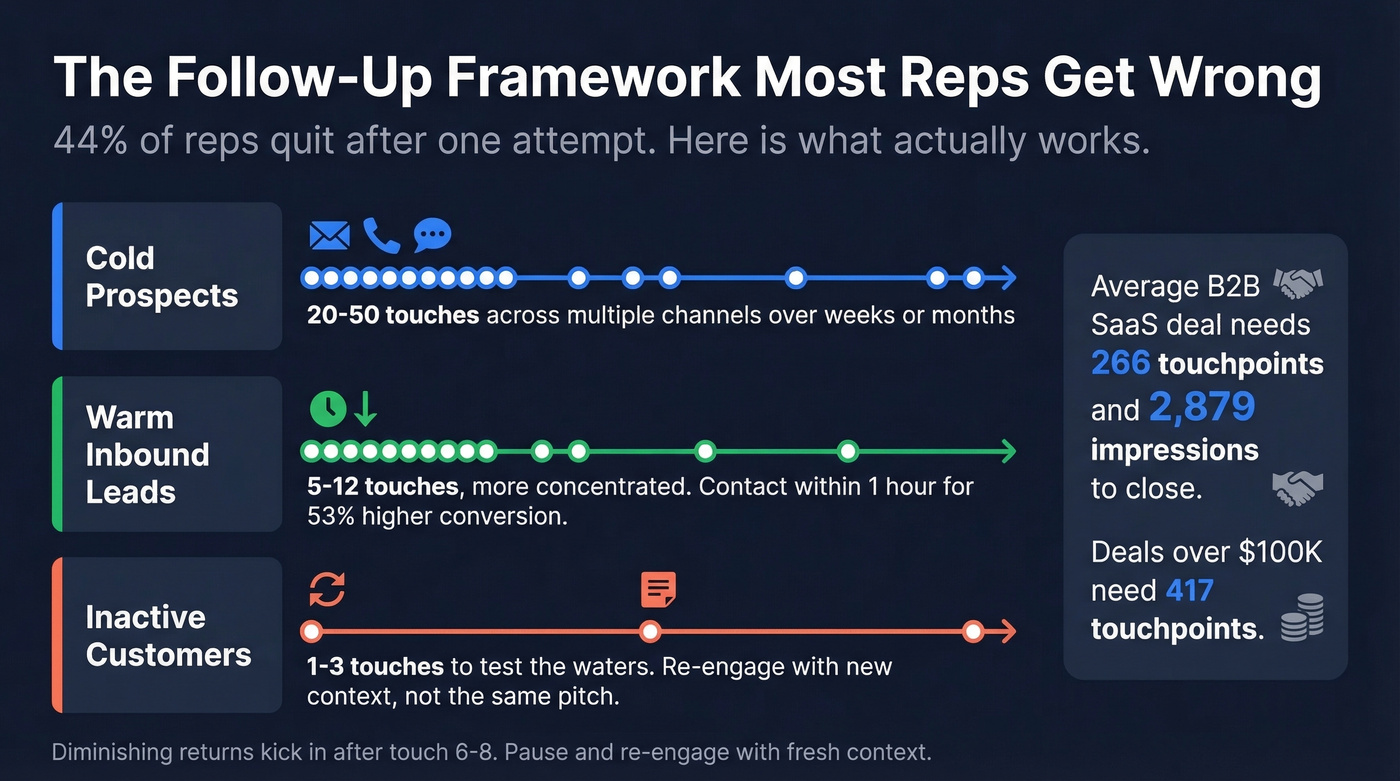
But "more touches" isn't the whole story. HockeyStack's touchpoint data paints a striking picture for B2B SaaS: the average deal requires 266 touchpoints and 2,879 impressions to close. Deals over $100K? That jumps to 417 touchpoints and roughly 5,500 impressions.
For practical cadence planning, segment by prospect type:
- Cold prospects: 20-50 touches across multiple channels over weeks or months (use these sales follow-up templates to speed up testing)
- Warm inbound leads: 5-12 touches, more concentrated
- Inactive customers: 1-3 touches to test the waters
Diminishing returns kick in after the 6th-8th touch for most sequences. After that, pause and re-engage later with new context rather than hammering the same message. And before you build a 7-touch cadence, verify you're reaching real people - Prospeo's Chrome extension lets you pull verified emails and direct dials from any website or professional profile in one click, so every touch in your sequence actually lands. (If you're building sequences at scale, see sequence management.)
4. Sell More to Existing Customers
Acquiring a new customer costs 5x more than retaining an existing one. Cross-selling alone can boost revenue up to 30%. Personalized product recommendations drive a 35% sales lift. Twilio found that 80% of businesses report personalization increases customer spending by 34% - and that lift is even easier to capture with existing customers who already trust you. Yet most sales teams pour 90% of their energy into new logos.
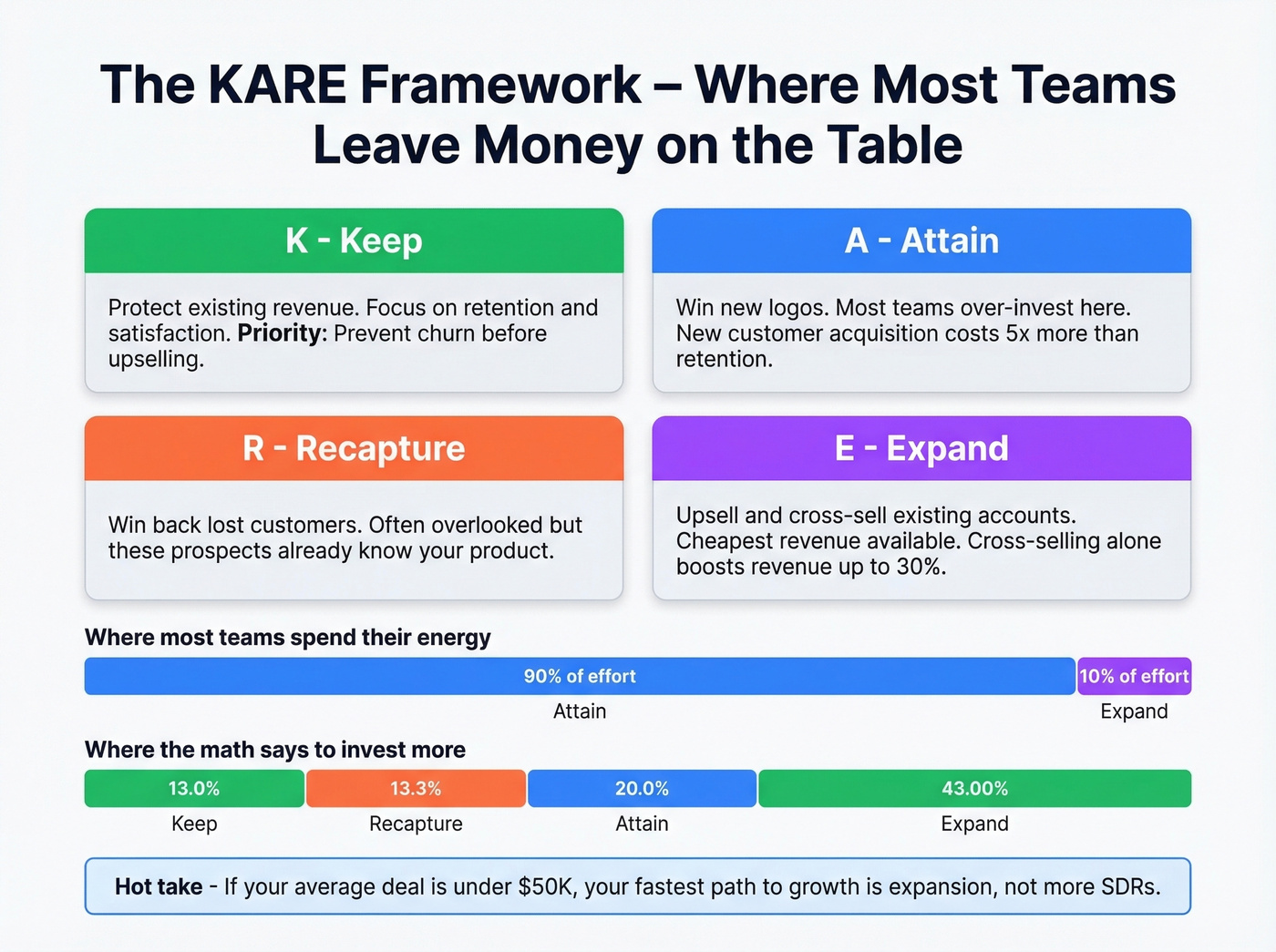
Here's my hot take: if your average deal size is under $50K, your fastest path to revenue growth isn't a bigger SDR team - it's a dedicated expansion motion targeting your happiest customers. The math overwhelmingly favors it, and almost nobody does it well. (If you need the definitions and when to use each, see cross-selling vs up-selling.)
Use upselling when the customer has already seen ROI from your core product and there's a natural expansion path - more seats, higher tier, additional modules.
Use cross-selling when you have complementary products that solve adjacent problems. The customer doesn't need to be a power user; they just need the adjacent pain point.
Skip both when the customer is at risk of churning. Trying to sell more to someone who's unhappy accelerates the exit. Fix the relationship first. (Run a quick churn analysis before pushing expansion.)
The Sandler KARE model provides a useful framework: categorize every account as Keep (protect revenue), Attain (new logos), Recapture (win-backs), or Expand (upsell/cross-sell). Most teams over-index on Attain and ignore Expand entirely, leaving the cheapest revenue on the table.
5. Personalize Everything
This isn't optional anymore. 80% of consumers say they're more likely to buy from companies that personalize their experience. Personalized emails see 14% higher open rates and 10% higher click-through rates. Segmented campaigns outperform non-segmented by 14.31% in open rates.
The flip side is equally telling: emails sent to large, untargeted lists get 67% fewer replies than smaller, targeted groups. Volume without relevance is just noise - and it trains your prospects to ignore you. (If you want a system, use a personalized outreach framework.)
Here's the thing: personalization doesn't mean "Hi {First_Name}." It means referencing a prospect's specific tech stack, recent funding round, or a job posting that signals they're hiring for the problem you solve. The data to do this exists. The question is whether your tools surface it before the rep hits send. Among the most effective ways to close a deal, deep personalization consistently outperforms discounts, urgency tactics, and flashy demos.
6. Shift to Outcome Metrics
Most sales orgs still measure activity: calls made, emails sent, meetings booked. Activity-based compensation plans drive 43% more spam complaints. You're literally incentivizing reps to annoy prospects.
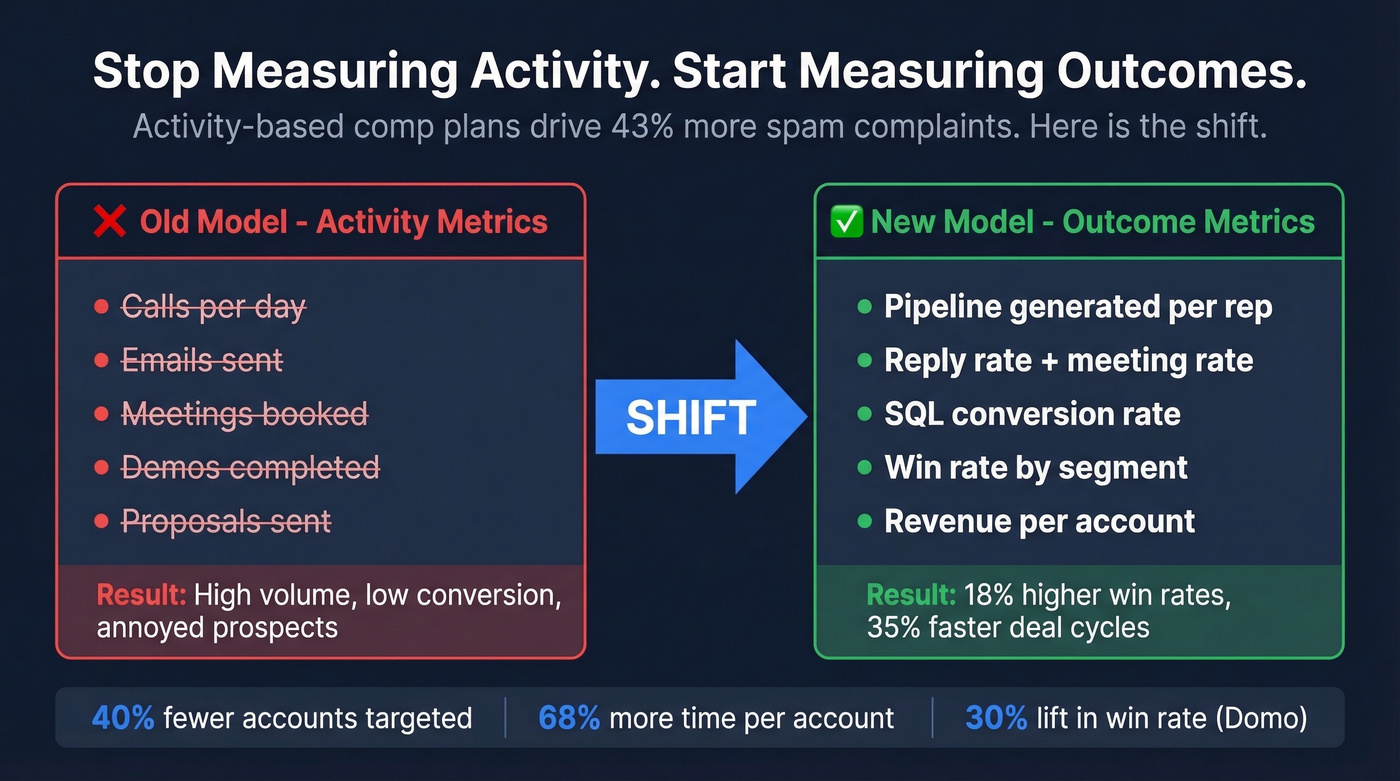
The shift looks like this:
| Old Model (Activity) | New Model (Outcome) |
|---|---|
| Calls per day | Pipeline generated per rep |
| Emails sent | Reply rate + meeting rate |
| Meetings booked | SQL conversion rate |
| Demos completed | Win rate by segment |
| Proposals sent | Revenue per account |
Remember the McKinsey finding from the top of this article - 40% fewer accounts, 18% higher win rates. That's what outcome-based selling looks like in practice. Top sellers spend 68% more time per account than average performers. Domo saw a 30% lift in win rate after shifting to outcome-based KPIs. McKinsey's research on sales automation shows that redirecting non-selling activities can free 20-25% of rep capacity while delivering 10-15% efficiency improvements and up to 10% sales uplift. (To operationalize this, track pipeline health instead of vanity activity.)
The transition isn't painless. Reps who've been rewarded for volume will resist. Managers who've managed by spreadsheet will feel exposed. But the data is unambiguous: fewer, better-targeted interactions beat high-volume spray-and-pray every time.

You just saw what happens when bounce rates drop from 35% to under 4% - pipeline triples. Prospeo's 300M+ profiles are verified at 98% accuracy on a 7-day refresh cycle, so every call and email in your cadence reaches a real person. At $0.01 per email, fixing your data costs less than a single wasted rep hour.
Stop optimizing a funnel built on bad data. Fix the foundation first.
Coaching Beats One-Off Training
Training is a one-time event. Coaching is ongoing. The difference in outcomes is massive.
Sandler's B/A/T coaching model breaks rep development into three dimensions: Behavior (right activities?), Attitude (belief in the process?), and Technique (skill execution?). Most managers only coach technique - they listen to a call, give feedback on objection handling, and move on. But if the rep's attitude is "cold calling doesn't work," no amount of technique coaching will fix their pipeline. (If you're building a repeatable program, use sales training tips that stick.)
AI-powered conversation intelligence tools are changing this equation. They can analyze every call recording to surface objection patterns, talk-to-listen ratios, and coaching opportunities automatically - replacing the need for managers to listen to every call manually. Pair that with individual rep scorecards tracking all three B/A/T dimensions, and you've got a real diagnostic system instead of gut feel. Without it, you fall into one of four management traps: micromanagement, laissez-faire, over-metrics, or "I am the closer" syndrome.
B2B vs B2C: Where Strategies Diverge
Everything above applies broadly, but execution differs significantly.
| Dimension | B2B | B2C |
|---|---|---|
| Sales cycle | Weeks to months | Minutes to days |
| Decision-makers | Multiple stakeholders | 1-2 people |
| Avg deal value | Higher | Lower |
| Primary channels | Email, webinars | Social, ecommerce |
| Messaging style | ROI, logic, proof | Emotion, urgency |
| Key metric | Pipeline velocity | Cart conversion |
Enterprise B2B sales live in a world of six- and seven-figure contracts, consensus buying, and proof-of-concept requirements. The channels that work - email, webinars, professional networks - reward depth and expertise. A single B2B deal can require 20-50 touches across multiple stakeholders before anyone signs. (If you're selling into complex orgs, see enterprise B2B sales.)
B2C is a different animal. Decisions are faster, more emotionally driven, and influenced by social proof, influencer marketing, and promotional incentives. The MQL-to-SQL conversion rate runs 18-22% for B2C/D2C versus 13-15% for B2B, reflecting shorter evaluation cycles and fewer gatekeepers.
The practical implication: B2B teams should invest disproportionately in multi-threaded outreach and longer nurture cadences, while B2C teams should invest in reducing friction at checkout and building emotional resonance through social channels. Trying to apply B2C tactics to B2B selling - or vice versa - is one of the most common strategic mistakes we've seen teams make.
Sales Pitfalls to Avoid
Giving up after one follow-up. 44% of reps do this. With 5-7 touches as the baseline and enterprise deals requiring 200+ touchpoints, one-and-done is barely trying.
Running on bad data. A 10% bounce rate doesn't just waste rep time - it destroys your domain reputation. Once major email providers flag your domain, even your good emails land in spam. Recovery takes months. (If you need a remediation plan, start with email deliverability.)
Ignoring compliance. GDPR fines run up to EUR 20M or 4% of global annual revenue, whichever is higher. Regulators are actively enforcing, and "we didn't know" isn't a defense.
Rewarding activity over outcomes. Activity-based comp plans drive 43% more spam complaints. You're paying reps to annoy your total addressable market. That's not a sales strategy - it's a reputation destruction strategy.
Tool sprawl without integration. Industry surveys find that 37% of employees report using too many tools, and 36% say working across different systems disrupts productivity. Every tool that doesn't integrate with your CRM and sequencer is friction, not an advantage.
Let's be honest about what separates teams that scale from teams that stall: it's not which tactics they pick, it's which mistakes they stop making. Buying unverified lead lists, blasting identical templates to thousands of contacts, optimizing for vanity metrics like "emails sent per day" - these are the habits that quietly kill growth.
The 90-Day Sales Improvement Framework
Don't try to fix everything at once. A phased approach builds on itself.
Month 1 - Measure. Audit your funnel against the industry benchmarks in this article. Identify your biggest conversion drop-off. Baseline your data quality metrics: bounce rate, reply rate, and deliverability score. If you don't know these numbers, that's your first problem. (If you want a structured ramp plan, adapt a 30-60-90 day plan for sales reps.)
Month 2 - Optimize. Fix the weakest funnel stage first. Clean your contact data - switch to a verified data source if your bounce rate is above 2%. Implement behavioral lead scoring to prioritize engaged prospects. Build a 5-7 touch follow-up cadence with channel variety across email, phone, social, and video.
Month 3 - Scale. Double down on your highest-converting channel. Launch or expand upsell and cross-sell motions using the KARE framework. Start a referral program - your happiest customers are your cheapest acquisition channel. Transition at least two KPIs from activity-based to outcome-based, and watch how rep behavior shifts.
In our experience, the teams that see the biggest lifts aren't the ones with the most sophisticated tech stack. They're the ones that diagnose accurately, fix the foundation first, and resist the urge to add complexity before the basics are working. That's the real answer to how to increase sales - subtract waste before you add anything new.
Your 5-7 touch cadence only works if every touch actually lands. Prospeo gives you verified emails, direct dials with 30% pickup rates, and 30+ filters to target the accounts that match your ICP - so you're not burning sequences on prospects who were never reachable.
Make every touchpoint count with contacts that actually connect.
FAQ
What's the fastest way to boost revenue?
Benchmark your conversion rates against your industry, identify the stage with the steepest drop-off, and focus all effort there. For most teams, that's either lead quality or follow-up consistency. Fixing the foundation beats adding new strategies every time.
How many follow-ups does it take to close a sale?
Research converges on 5-7 touchpoints for most deals. B2B SaaS deals average 266 touchpoints across all channels, and deals over $100K require roughly 417. Yet 44% of salespeople give up after one follow-up.
What's a good sales conversion rate?
The average qualified-lead conversion rate across 14 industries is 2.9%. B2B SaaS converts 37% of SQLs to closed deals, while eCommerce closes 60%. Use the benchmarks in this article as your baseline.
How do I improve B2B sales specifically?
Focus on data quality, multi-threaded outreach to buying committees, and longer nurture cadences. B2B deals involve multiple stakeholders and require 20-50+ touches for cold prospects. Starting with verified contact data at 98% accuracy prevents dead addresses from tanking your domain and wasting every rep-hour downstream.
Does personalization actually drive more deals?
Yes. Personalized emails see 14% higher open rates and 10% higher click-through rates. Segmented campaigns outperform non-segmented by 14.31% in open rates. Generic outreach is leaving money on the table.