

How to Increase Sales Conversion Rate: Benchmarks, Diagnostics, and Tactics for 2026
It's Monday morning. The VP of Sales pulls the pipeline report, and the numbers don't add up - 3x more activity than last quarter, same revenue. Reps are busier than ever, but deals aren't closing. Salesforce research shows 84% of reps missed quota last year, and throwing more activity at a broken funnel won't fix that.
Most "boost conversions" guides obsess over button colors and landing page tweaks. This one doesn't. We're talking about your sales funnel - the handoffs, the data, the speed, the qualification rigor that separates teams closing at 30% from teams stuck at 15%. With 80% of B2B interactions happening digitally and 67% of buyers preferring self-service over speaking to a rep, the selling environment is fundamentally different than it was even two years ago.
If You Only Do Three Things
- Fix your data quality. If more than 2% of your emails bounce, your deliverability is tanking and reps are wasting hours on dead contacts. Tools with 98% email accuracy and weekly data refresh cycles solve this at the source.
- Respond to leads within 5 minutes. Conversion rates are 8x higher in the first five minutes versus waiting even an hour. Only 0.1% of inbound leads actually get engaged that fast.
- Track stage-by-stage funnel metrics. One overall conversion rate tells you nothing. Five stage-specific rates tell you exactly where deals die.
Everything below builds on these three fundamentals.
The Formula (and Why It's Not Enough)
The basic conversion rate formula is simple:
(Number of Sales / Number of Qualified Leads) x 100
So if you close 20 deals from 200 qualified opportunities, that's a 10% conversion rate. Easy math. But measuring one overall number is like checking your fuel gauge when the engine is misfiring - a 10% close rate could mean your top-of-funnel is strong but your proposals are weak, or it could mean qualification is so tight that only great deals make it through while you're starving the pipeline. You need stage-by-stage micro-conversions to diagnose what's actually broken.
Benchmarks by Industry
Most guides throw out a single "average conversion rate" and call it a day. That's useless. A cybersecurity company and an eCommerce brand operate in completely different universes.
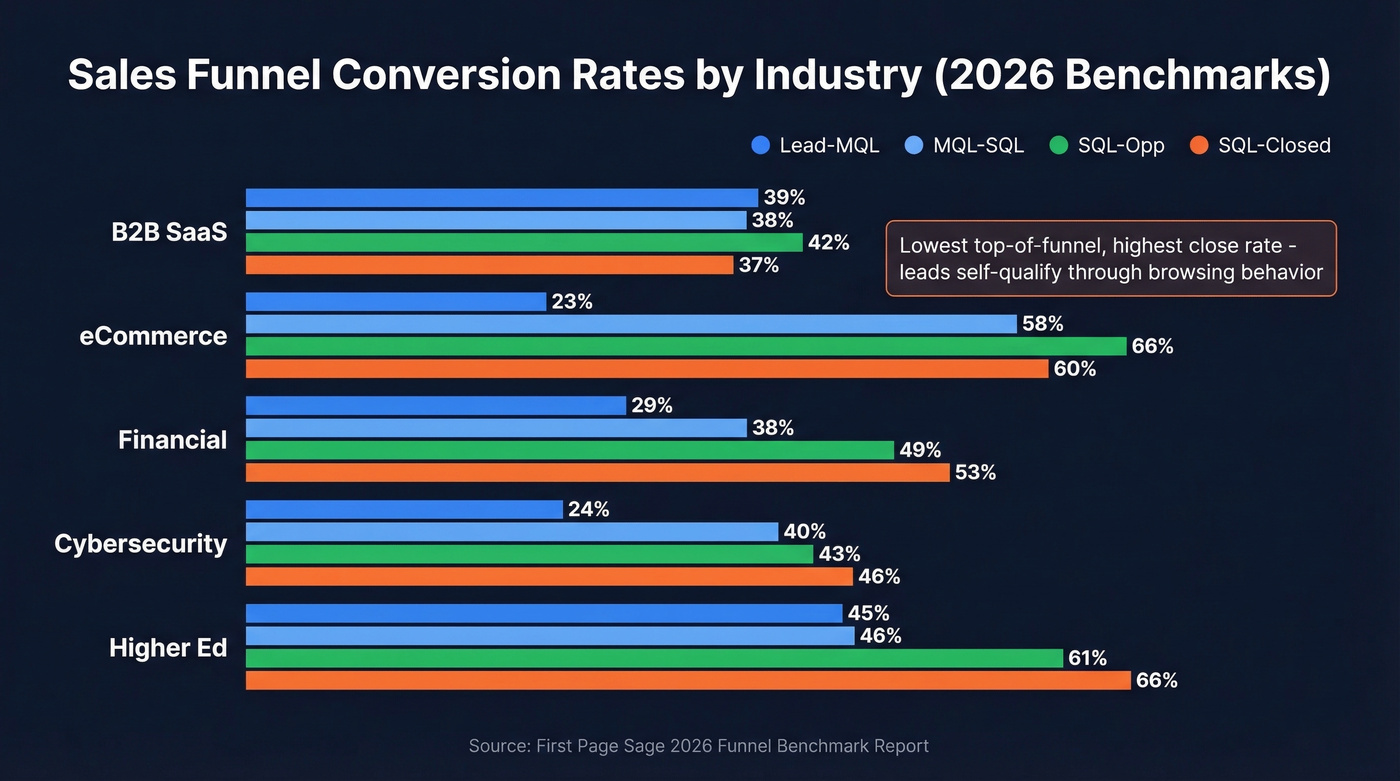
Conversion Rates by Industry and Funnel Stage
| Industry | Lead-MQL | MQL-SQL | SQL-Opp | SQL-Closed |
|---|---|---|---|---|
| B2B SaaS | 39% | 38% | 42% | 37% |
| eCommerce | 23% | 58% | 66% | 60% |
| Financial | 29% | 38% | 49% | 53% |
| Cybersecurity | 24% | 40% | 43% | 46% |
| Higher Ed | 45% | 46% | 61% | 66% |
Data from First Page Sage's 2026 funnel benchmark report, based on internal and anonymized client data gathered between 2017-2025.
Notice how eCommerce has the lowest Lead-MQL rate but the highest SQL-Closed rate. That's because eCommerce leads self-qualify through browsing behavior - by the time they're an SQL, they're practically buyers. B2B SaaS is the opposite: wide top-of-funnel, heavy attrition through qualification.
SaaS deserves a deeper look, because deal size changes everything.
B2B SaaS - SMB vs Enterprise
| Stage | SMB/Mid-Market | Enterprise ($1B+ ARR) |
|---|---|---|
| Visitor-Lead | 1.4% | 0.7% |
| MQL-SQL | 39% | 31% |
| SQL-Opp | 42% | 36% |
| Opp-Close | 39% | 31% |
Digital Bloom's compilation of 40+ benchmark studies.
Enterprise deals convert at lower rates at every stage. Longer cycles, more stakeholders, more procurement friction. If you're selling to $1B+ companies and your Opp-Close rate is 31%, you're right on benchmark. If it's 20%, you've got a closing problem.
Lead Source Matters Too
| Channel | Visitor-Lead | MQL-SQL |
|---|---|---|
| SEO | 2.1% | 51% |
| PPC | 0.7% | 26% |
Ruler Analytics, 100M data points. Average website-to-qualified-lead rate across 14 industries: 2.9%.
Organic traffic isn't just cheaper; it's dramatically higher quality. SEO-sourced leads convert to SQL at nearly double the rate of paid leads. If your marketing budget is heavily weighted toward PPC, this table should make you uncomfortable.

Bad data is the #1 silent killer of sales conversion rates. Snyk's 50 AEs went from 35% bounce rates to under 5% - and pipeline jumped 180% - after switching to Prospeo's 98% accurate, weekly-refreshed emails. At $0.01 per email, fixing your data costs less than one lost deal.
Stop losing deals to bad contact data. Start converting.
Where Deals Actually Leak
The biggest drop-off in most B2B funnels happens at MQL-SQL - MarketJoy's data benchmarks it at just 15%. That's where marketing says "this lead is ready" and sales says "no it isn't."
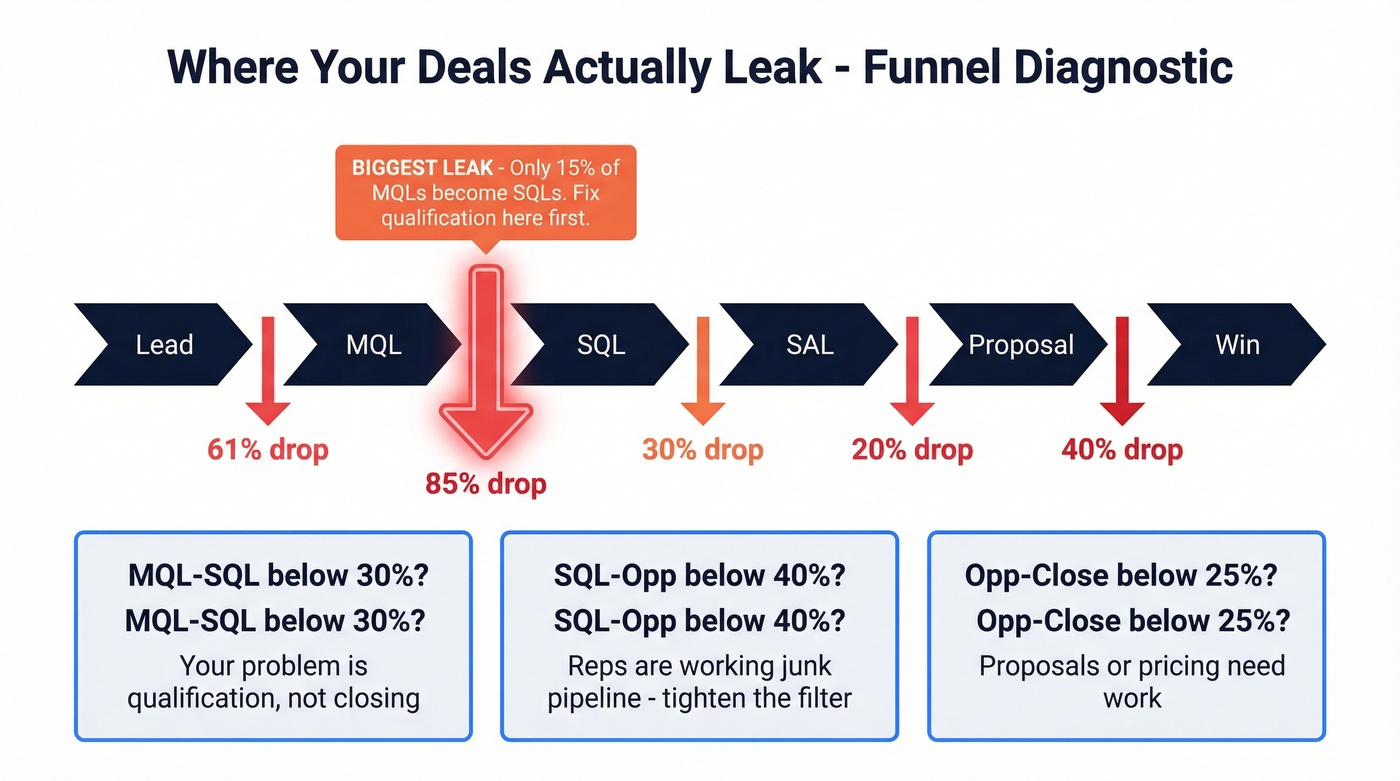
If your MQL-SQL rate is below 30%, your problem isn't closing. It's qualification.
Winning by Design's micro-conversion model breaks this down further: MQL-SQL-SAL (sales-accepted lead)-Proposal-Win. The SAL stage is the one most teams skip - it's where a rep confirms the prospect has a real problem they can solve, not just budget and authority. Skipping it means reps waste cycles on deals that were never going to close.
Here's the thing: we've seen teams obsess over their close rate while ignoring the fact that 70% of their "qualified" pipeline was junk that should've been disqualified two stages earlier. Fix the filter, and the close rate fixes itself. That single change often drives more improvement than any downstream tactic.
10 Tactics to Maximize Conversions
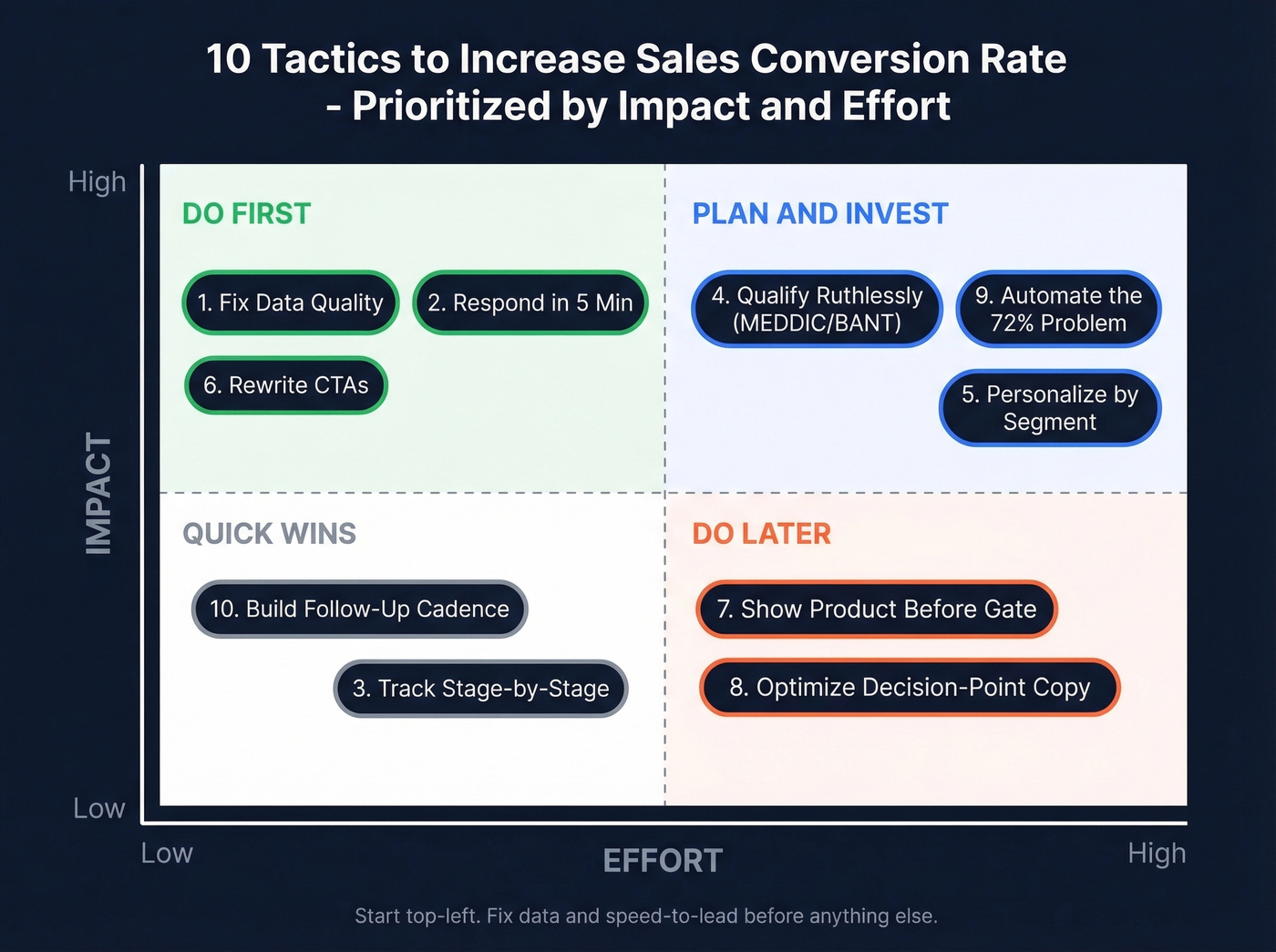
1. Fix Your Data Before Your Process
Nothing else on this list matters if your reps can't reach prospects. When email bounce rates exceed 2%, deliverability craters - your domain reputation takes the hit, and even good emails start landing in spam.
If you need a deeper diagnostic, start with email bounce rate benchmarks and then work through an email deliverability guide to fix root causes (not symptoms).
In our experience, bounce rates above 5% are the single biggest silent killer of outbound campaigns. Snyk had 50 AEs prospecting 4-6 hours per week with a 35-40% bounce rate. After switching to a verified email source with 98% accuracy and a 7-day refresh cycle, bounces dropped under 5%, AE-sourced pipeline jumped 180%, and they generated 200+ new opportunities per month. Meritt saw similar results - pipeline tripled from $100K to $300K per week once they stopped feeding reps bad data.
2. Respond in 5 Minutes
An InsideSales study across 55M sales activities found conversion rates are 8x higher when reps engage within 5 minutes. Yet 57% of first call attempts happen after more than a week. Up to 50% of sales go to the first vendor to respond.
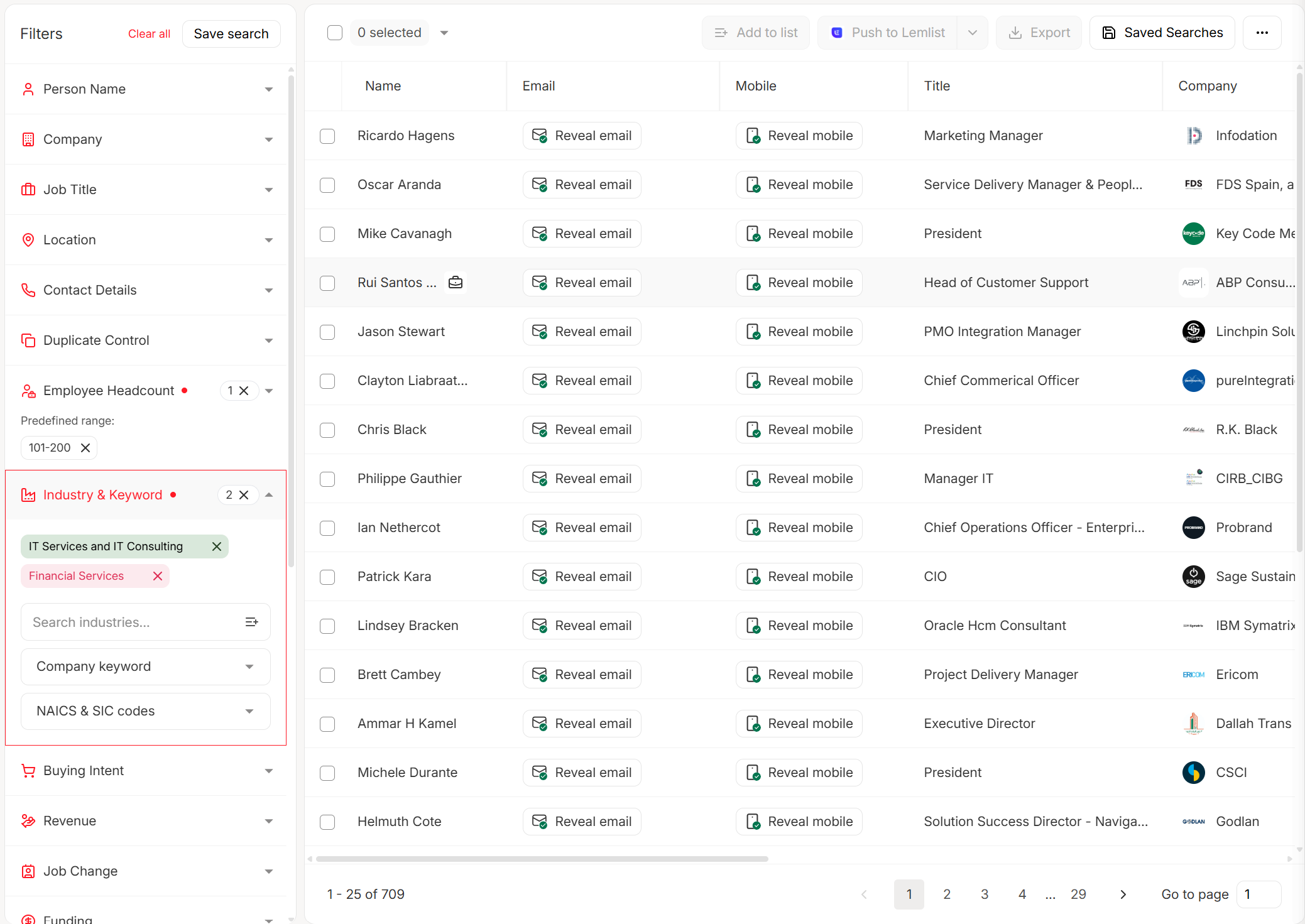
Speed only works if the number is right. Verified mobile databases with high pickup rates turn that speed advantage into actual conversations instead of voicemails. If your connect rate is below 15%, the data is the bottleneck, not the reps.
3. Track Stage-by-Stage, Not Just Overall
Stop measuring one number. Start measuring five.
Use the micro-conversion framework - Lead-MQL-SQL-SAL-Proposal-Win - and benchmark each stage against the tables above. When you know your MQL-SQL rate is 18% against a 38% benchmark, you know exactly where to focus. No guessing, no gut feelings, just math.
If you want a clean reporting setup, build this into your funnel metrics dashboard and review it as part of pipeline health.
4. Qualify Ruthlessly
MarketJoy worked with a cybersecurity client that increased MQL-SQL by 38% in six months using tighter qualification criteria. The frameworks are well-established - MEDDIC for enterprise, BANT for transactional deals. The problem isn't knowing about them; it's actually enforcing them when reps are desperate to keep deals in the pipeline.
If your average deal value sits below $10K, you probably don't need MEDDIC. A simple three-question disqualification checklist - budget confirmed? timeline under 90 days? decision-maker identified? - will do more for your close rate than any elaborate framework. Let's be honest: most teams overcomplicate qualification because it feels more rigorous. It isn't. Simple and enforced beats complex and ignored every time.
5. Personalize Outreach by Segment
Segmented campaigns have 14.31% higher open rates than non-segmented blasts, per Mailchimp data. HubSpot's research shows emails sent to large, untargeted lists get 67% fewer replies.
The math is clear: smaller, tighter segments outperform spray-and-pray every time. Build segments by industry, company size, tech stack, and buying intent - then write messaging that speaks to each group's specific pain. Skip this if your list is under 500 contacts; at that size, you should be writing individual emails anyway.
To operationalize this, start with an Ideal Customer Profile and layer in intent based segmentation.
6. Rewrite Your CTAs
Going changed their CTA from "Sign up for free" to "Trial for free" and saw a 104% increase in premium trial starts. One word. 104% lift.
This isn't an isolated case. One Reddit user documented a conversion jump from 2.4% to 4.2% after rewriting their sales video's core hook - proof that messaging changes compound. Your CTA copy is the highest-leverage, lowest-effort change you can make right now. Test it this week.
If you want more examples, borrow patterns from high-performing email call to action copy.
7. Show the Product Before the Gate
Localizer redesigned their homepage to preview the product before requiring account creation and saw an 81% conversion uplift. GrantMe clarified their "Book a Call" page and got a 56% lift.
The pattern is consistent: reduce friction before the commitment point. Let prospects see what they're getting. If your demo requires a 30-minute sales call before anyone sees the product, you're losing buyers who just want to poke around first.
8. Optimize Copy at Decision Points
Comodo rewrote their landing page with pain-driven copy and simplified messaging - 17.5% conversion uplift. World of Wonder used AI-driven optimization to boost their streaming conversion rate by nearly 20%, reaching 29.7%. Clear value propositions and urgency-driven copy work hardest at the moment of decision, not buried in a footer three scrolls down.
9. Automate the 72% Problem
Reps spend just 28% of their time actually selling. The other 72% goes to data entry, CRM updates, account research, and admin. That's infuriating, and it's fixable.
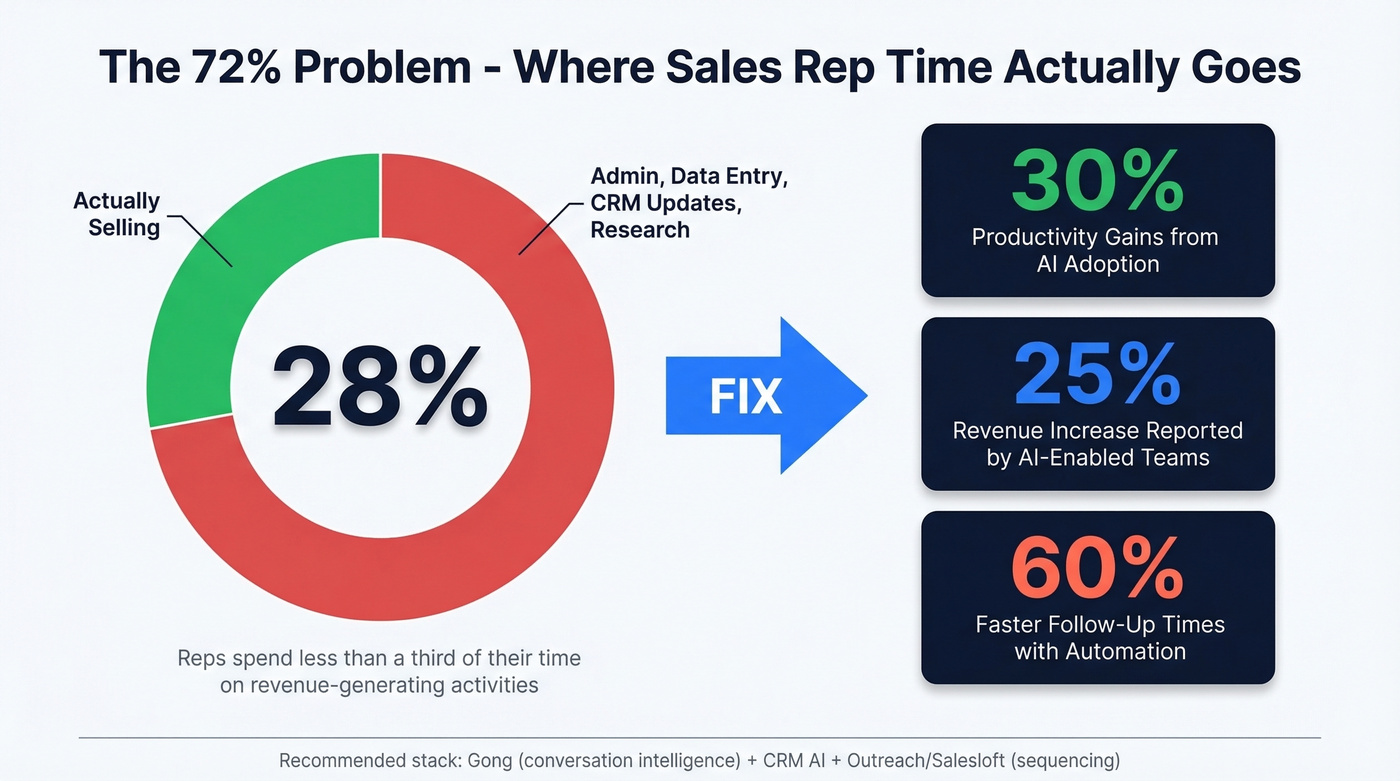
AI adopters report 30% productivity gains, 25% revenue increases, and 60% faster follow-up times. The stack that matters: Gong for conversation intelligence, Salesforce Einstein or HubSpot for CRM AI, and Outreach or Salesloft for sequencing. Freeing reps from admin work is one of the most reliable ways to lift close rates across the entire team.
If you're evaluating options, start with a ranked list of SDR tools and then map them into sales process optimization.
10. Build a Follow-Up Cadence
Most reps stop after one or two follow-ups. Most B2B deals require 5-12 touchpoints. That gap is where revenue goes to die.
Build a structured cadence - Day 1 for initial outreach, Day 3 for a value-add follow-up, Day 7 for a different angle or channel - and automate the reminders so reps don't have to think about it. For enterprise cycles, extend to Day 14 and 21. The consensus on r/sales is that persistence without being annoying is the hardest skill to teach, but a good cadence tool makes it systematic instead of relying on individual discipline.
If you need copy you can deploy today, use these follow-up templates.
Conversion Killers to Avoid
These process failures quietly drain your pipeline:
- Slow replies that miss the buying window entirely
- Unclear lead ownership after the first response - handoff delays kill momentum
- Treating silent leads as dead. Silence rarely means rejection; it means you haven't earned a response yet
- No qualification process, so every lead gets the same treatment regardless of fit
- No pipeline stage tracking - you can't fix what you can't measure
- No clear conversion event. If there's no defined next step like a demo, call, or trial, reps improvise and prospects drift
What a 1% Lift Is Worth
Let's make this concrete. Say you've got 500 qualified opportunities per year at a $25K average deal size and a 20% close rate.
| Scenario | Close Rate | Revenue | Gain |
|---|---|---|---|
| Baseline | 20% | $2.50M | - |
| +2 points | 22% | $2.75M | +$250K |
| +5 points | 25% | $3.13M | +$625K |
We've run this math with dozens of teams, and the reaction is always the same - why didn't we fix this sooner? Typical experimentation programs deliver a 5-7% relative improvement, which on a 20% baseline means moving to 21-21.4%. Even that smaller shift generates $125K-$175K in new revenue.
This is the cheapest revenue you'll ever generate. No new headcount, no new ad spend. Just better execution on the pipeline you already have. That's the real answer to how to increase sales conversion rate - not more leads, but more from the leads you have.
Speed-to-lead means nothing if you're dialing dead numbers. Prospeo's 125M+ verified mobile numbers deliver a 30% pickup rate - nearly 3x the industry average. Pair that with 30+ filters for buyer intent, job changes, and technographics to reach the right person, fast.
Turn your 5-minute response time into actual conversations.
FAQ
What is a good sales conversion rate?
B2B SaaS averages about 2.7% lead-to-customer overall, while eCommerce SQL-Closed runs around 60%. Enterprise deals convert 8-10 percentage points lower than SMB at every stage. Use the benchmark tables above to find your specific industry and deal-size comparison point - a single "good" number doesn't exist.
How do you calculate sales conversion rate?
Divide the number of closed deals by the number of qualified leads, then multiply by 100. Track this at every funnel stage - Lead-MQL, MQL-SQL, SQL-Opp, Opp-Close - not just as one overall number. Stage-level metrics reveal exactly where your pipeline leaks.
What's the fastest way to improve conversion rate?
Fix data quality and speed-to-lead first. If your emails bounce above 2% or your average response time exceeds 5 minutes, those are your biggest gains. Teams like Snyk cut bounces from 40% to under 5% and saw pipeline jump 180% just by switching to a verified data source.
How many follow-ups should a sales rep send?
Most B2B deals require 5-12 touchpoints before closing. Reps who stop after one or two attempts leave the bulk of potential revenue on the table. Build a structured Day 1/3/7 cadence at minimum, then extend to Day 14 and 21 for enterprise cycles.
Does lead source affect conversion rates?
SEO-sourced leads convert to SQL at 51% versus just 26% for PPC, per Ruler Analytics data across 100M data points. Organic traffic delivers nearly double the qualification rate at a fraction of the cost - making channel mix one of the highest-leverage decisions for pipeline quality.