

How to Prospect in B2B Sales: Step-by-Step Playbook for 2026
You're a week into a new sales role. No lead queue. No territory handoff. Just a login to a CRM with 14 stale accounts and a manager who says "go prospect."
Figuring out how to prospect in B2B sales isn't complicated - it's unforgiving when you skip steps. Bad data, weak targeting, single-channel outreach - any one of those will tank your results before your messaging even matters.
We've built and broken enough outbound engines to know what actually moves pipeline and what's noise dressed up as strategy. Here's the whole process, step by step, with real benchmarks and templates you can steal.
The 60-Second Version
Define your ICP before touching any tool. Build a verified list of 500-1,000 contacts. Run a multichannel cadence - email, calls, and social - over 17-21 days with 8-12 touches. Aim for a 5%+ reply rate and keep your bounce rate under 2%. Your minimum stack: Prospeo for verified contact data, Instantly or Smartlead for sequencing, HubSpot free CRM. Total cost under $100/month. Add complexity later, after you've proven the fundamentals work.
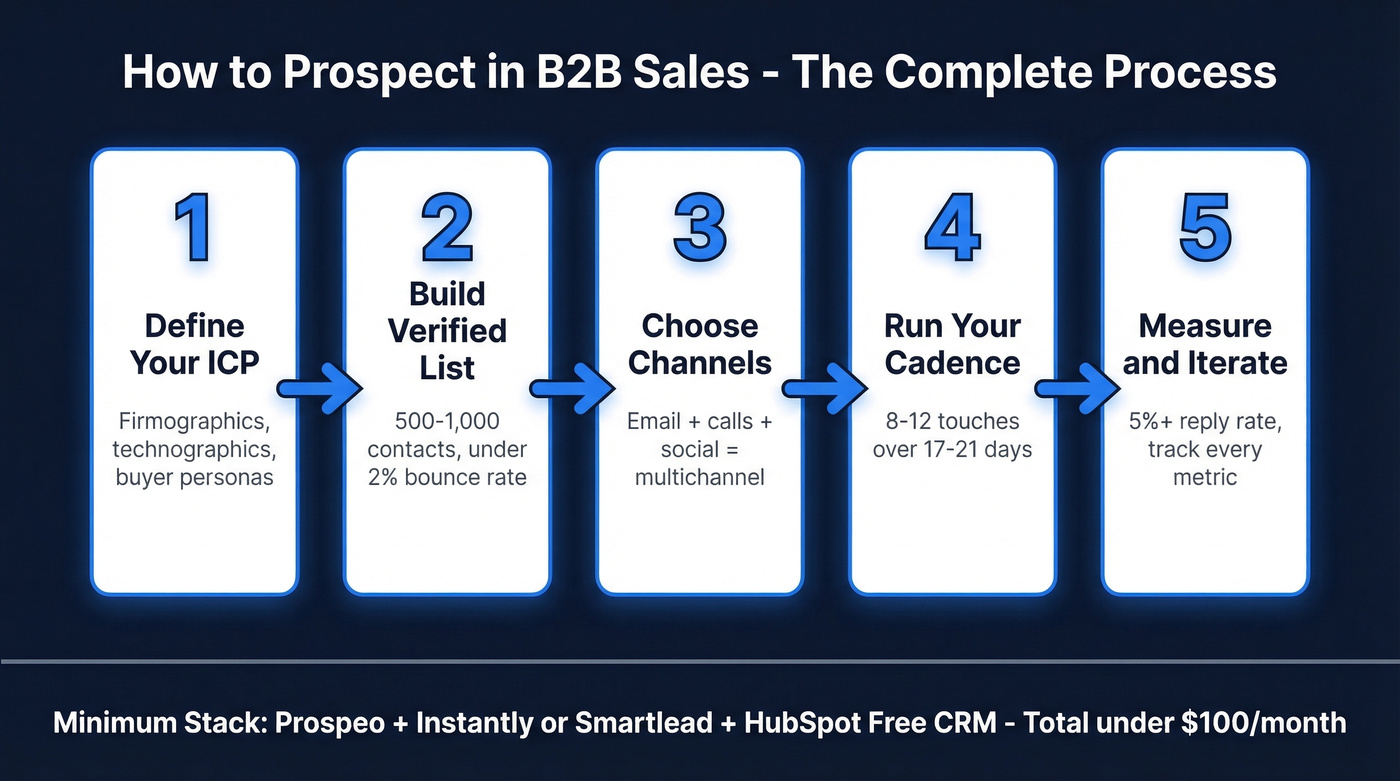
What B2B Prospecting Actually Is
Prospecting and lead generation aren't the same thing, even though people use the terms interchangeably. Prospecting is outbound, owned by sales - you're actively finding and reaching out to potential buyers through cold email, cold calls, and social touches. Lead generation is inbound, owned by marketing - webinar signups, content downloads, demo requests that flow into your CRM.
The distinction matters because prospecting puts you in control. If marketing's webinar pipeline dries up in Q3, your outbound engine keeps running. This is especially relevant for SDRs building their own pipeline by identifying the right accounts, finding the right contacts, and running a structured outreach sequence until they get a conversation or a clear "no."
If you want more tactics beyond the basics, start with these sales prospecting techniques.
Define Your ICP First
Skipping ICP definition is the single most expensive mistake in outbound. Emails sent to large, untargeted lists receive 67% fewer replies than smaller, targeted groups. That's not a marginal difference - it's the gap between a working pipeline and a burned domain.
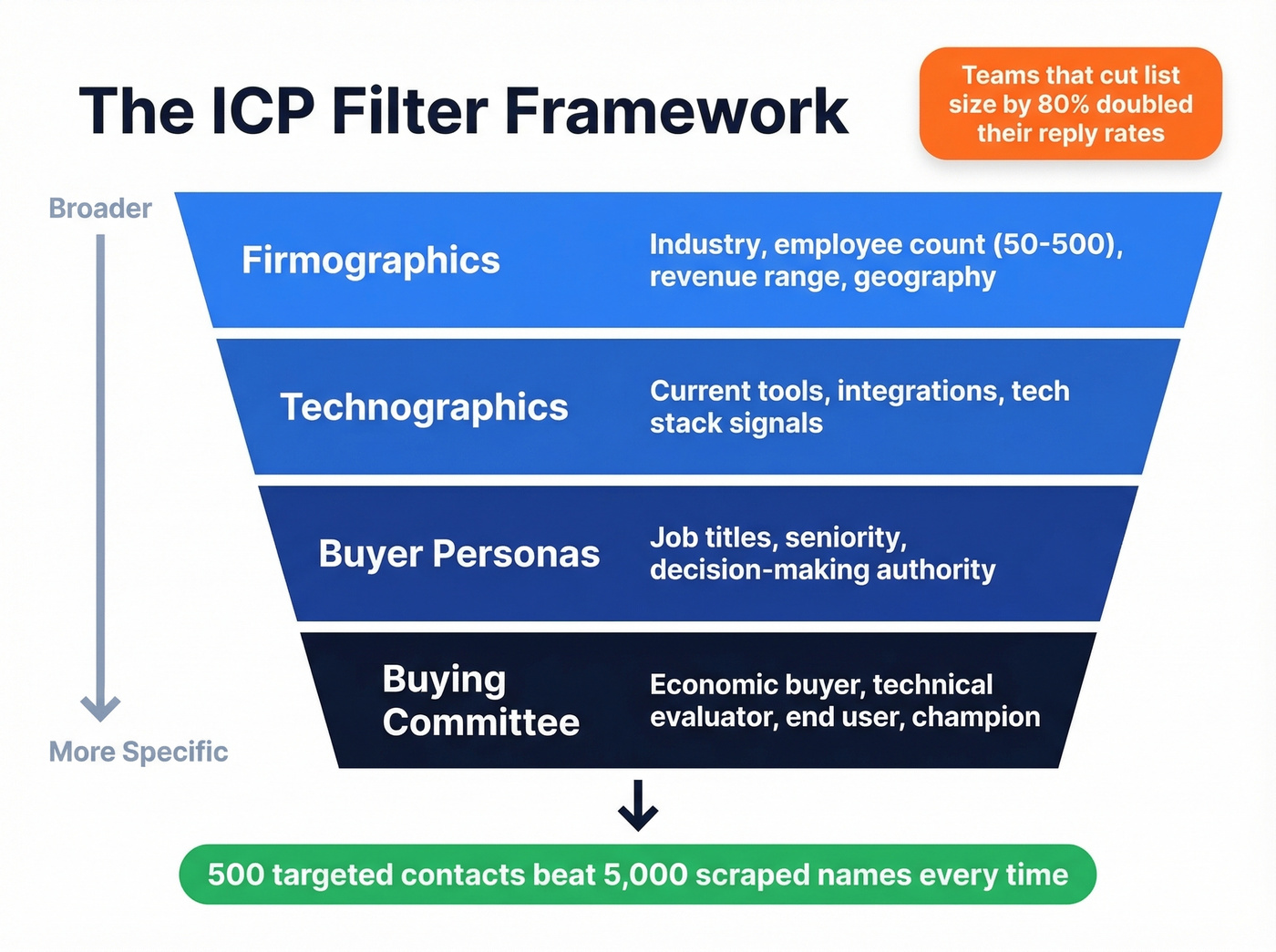
Your ICP isn't a vague persona doc. It's a layered filter:
- Firmographics: Industry, employee count, revenue range, geography. If you sell to mid-market SaaS companies in North America with 50-500 employees, that's your first filter. (More on firmographic filters.)
- Technographics: What tools do they already use? If your product replaces or integrates with Salesforce, target Salesforce shops. (See firmographic and technographic data.)
- Buyer personas: Job titles and seniority levels. Who signs the contract? Who champions internally? Who blocks deals?
- Buying committee: For deals above five figures, you're selling to a committee, not a person. Map the hierarchy - economic buyer, technical evaluator, end user, internal champion.
The tighter your ICP, the smaller your list - and that's the point. A list of 500 well-targeted contacts will outperform a list of 5,000 scraped names every single time. We've seen teams cut their list size by 80% and double their reply rates just by getting specific about who they're actually selling to. Precision beats volume at every stage of the process, from first touch to closed deal.
For enterprise deals with $50K+ ACV, extend your ICP into account-based prospecting. That means coordinating outreach across multiple stakeholders at the same company - hitting the VP of Engineering, the CTO, and the DevOps lead simultaneously with tailored messages. ABP is slower to set up but dramatically increases deal velocity once you're inside the account.
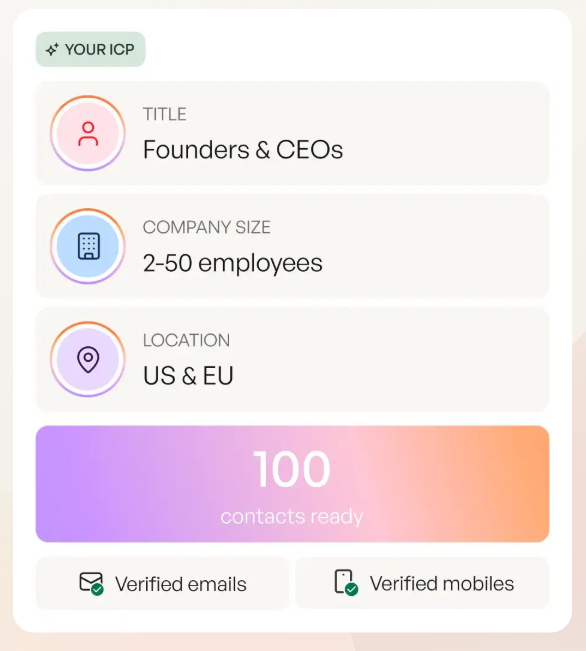
Build a Verified Prospect List
Here's where most reps blow it. They pull a list from Apollo or ZoomInfo, dump it into a sequencer, and start blasting. Two days later, 15-20% of those emails bounce, their domain reputation craters, and they're wondering why Gmail is routing them to spam.
Apollo's database covers 275M+ contacts, and it's powerful for building initial lists. But bounce rates of 15-20% are common on unverified Apollo exports. The consensus on r/sales is blunt: Apollo is great for search and sequencing, but you can't trust the data without independent verification - and you should use at least two verifiers before you send a single email.
Your target is a bounce rate under 2%. Anything above that and you're actively damaging your sender reputation - the thing that determines whether your emails land in inboxes or spam folders for months to come. (If you need the full playbook, use this email deliverability guide.)
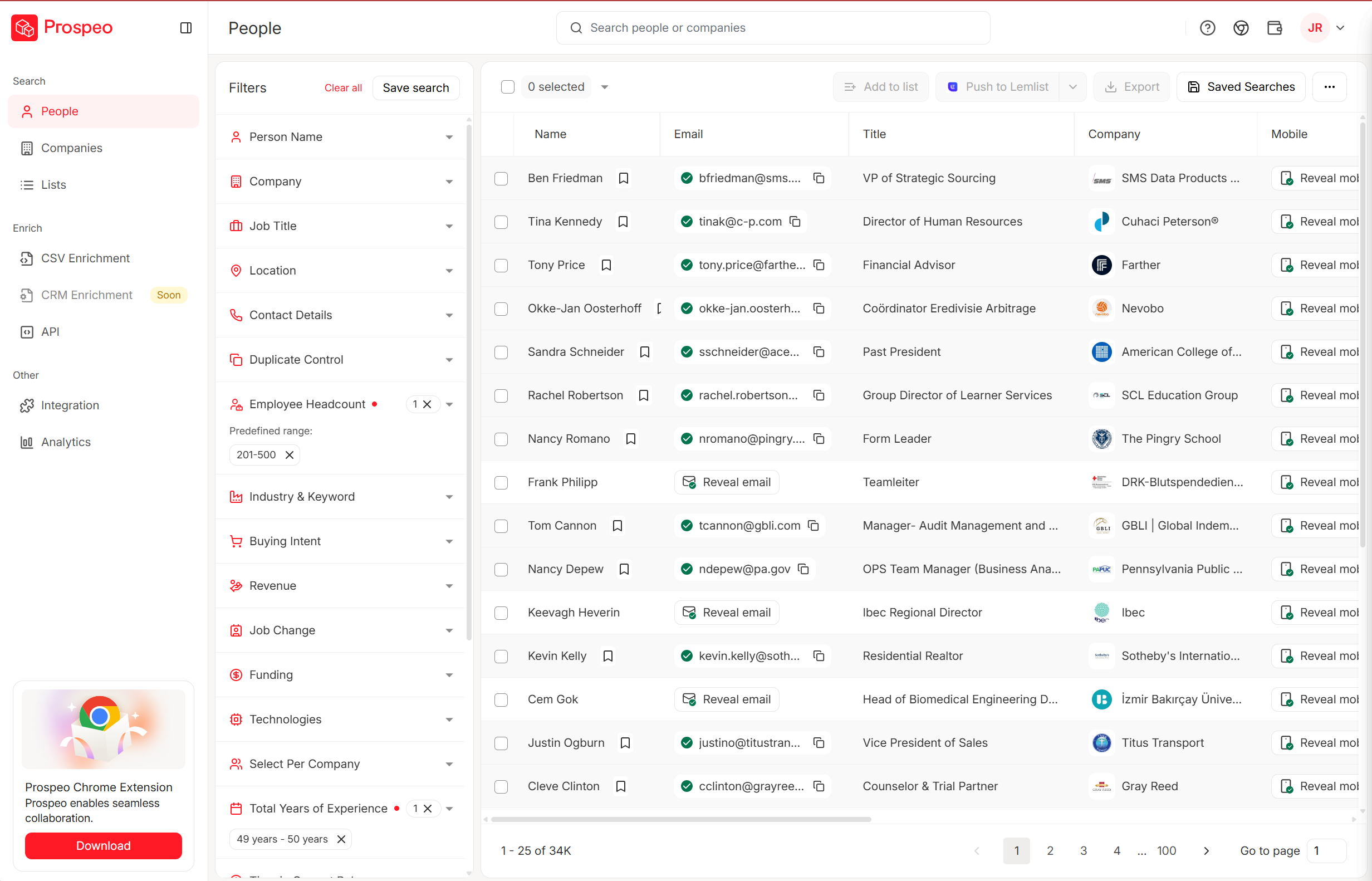
Prospeo solves this at the source. You're pulling from 300M+ professional profiles with 143M+ verified emails, 98% email accuracy, and a 7-day data refresh cycle. The Chrome extension lets you prospect from any website or company page and get verified contact data in one click. One customer, Meritt, went from a 35% bounce rate to under 4% after switching - and tripled their pipeline from $100K to $300K per week.
Prospecting Across Channels
Not all channels convert equally, and the cost differences are massive.
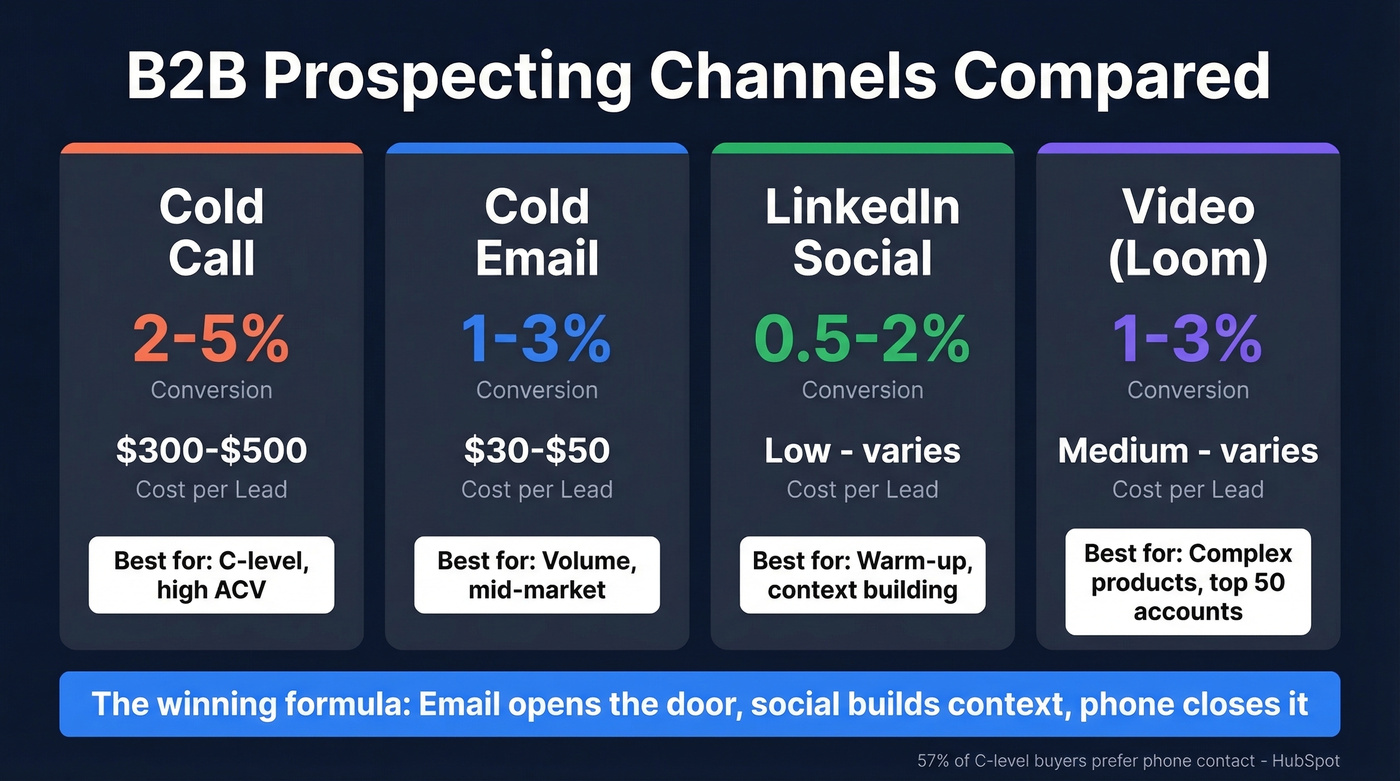
| Channel | Conversion | Cost/Lead | Best For |
|---|---|---|---|
| Cold call | 2-5% | $300-$500 | C-level, high-ACV |
| Cold email | 1-3% | $30-$50 | Volume, mid-market |
| Social (LinkedIn) | 0.5-2% | Varies | Warm-up, context |
| Video (Loom) | 1-3% | Varies | Complex products |
57% of C-level buyers prefer phone contact, which makes calling the conversion touch - the channel that actually books meetings. Email is your volume play: cheaper per lead, scalable, and great for opening doors. LinkedIn outreach delivers roughly double the response rate of cold email alone, but works best as a warm-up layer rather than a standalone channel.
Video prospecting is the emerging wildcard. A 60-second Loom walking through a prospect's website or dashboard with a specific observation cuts through inbox noise in a way text can't. It doesn't scale for thousands of prospects, but for your top 50 accounts, a personalized video outperforms every other touch type. (If you're testing this, use a Loom video cold email workflow.)
LinkedIn InMail gets a 46% lift in acceptance rates when you mention at least one commonality - shared connections, same school, mutual group. That means your social touches should be doing research work, not just "Hey, saw your profile."
The right answer for almost every team is multichannel. Email opens the door, social builds context, and the phone closes it.

Your prospecting cadence is only as good as the data behind it. Prospeo gives you 300M+ profiles with 98% email accuracy, 125M+ verified mobiles, and a 7-day refresh cycle - so every touch in your sequence reaches a real person. Meritt tripled their pipeline from $100K to $300K/week after switching.
Build your first verified prospect list in under 5 minutes.
Build Your Prospecting Cadence
A cadence is a structured sequence of touches across channels, spaced out over a defined period. Without one, you're winging it - and winging it means inconsistency, which means missed pipeline. (For examples you can copy, see these sales follow-up templates.)
Sprint Cadence (7 Touches / 10 Days)
Use this for time-sensitive opportunities or smaller prospect lists:
- Day 1: Intro email - short, relevant, one clear CTA
- Day 2: Connection request on social with a personalized note
- Day 3: Phone call + voicemail if no answer
- Day 5: Value-focused email (case study, relevant insight)
- Day 7: Social message referencing your email
- Day 9: Follow-up call
- Day 10: Break-up email ("Last note from me - here if you need X")
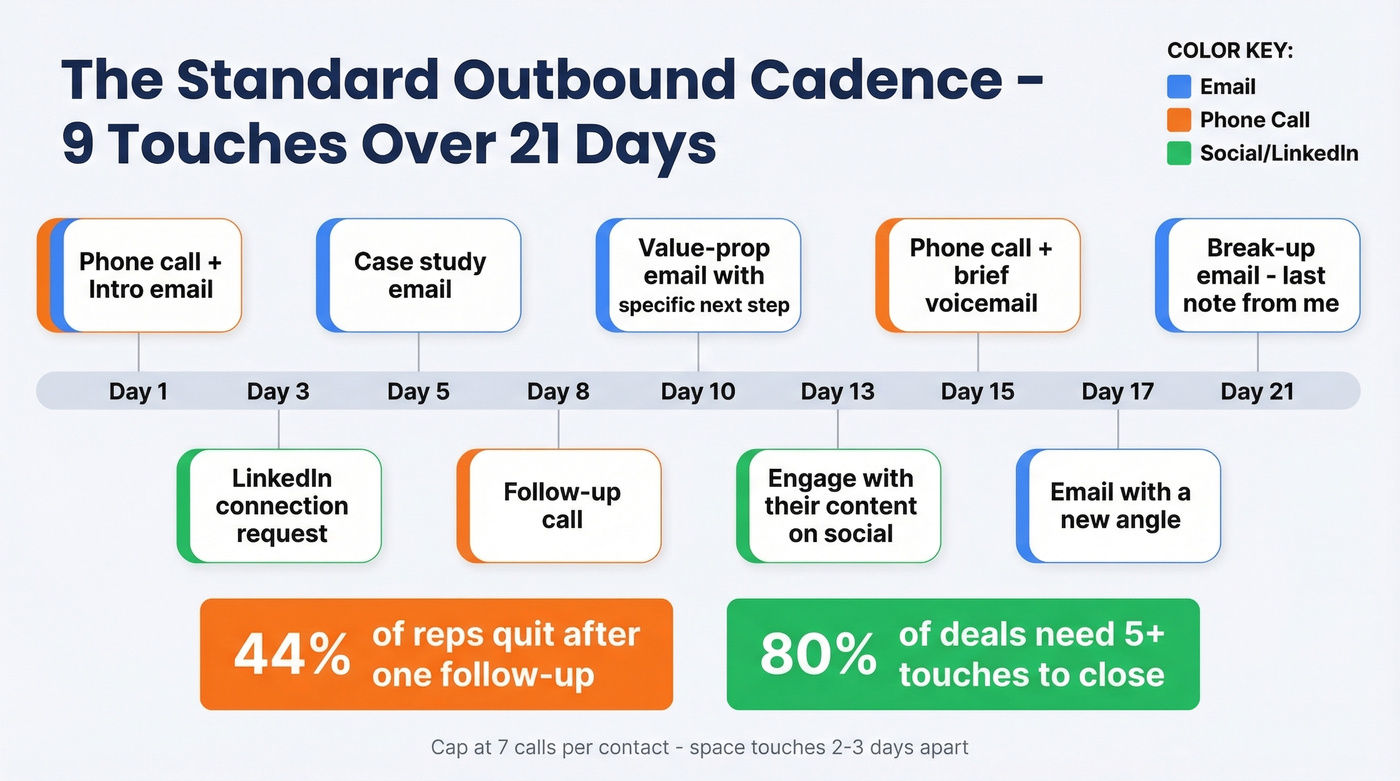
Standard Cadence (8-12 Touches / 17-21 Days)
This is the workhorse for most outbound teams. Space touches 2-3 days apart:
Day 1 - Phone call + intro email. Day 3 - Social connection request. Day 5 - Email with case study. Day 8 - Follow-up call. Day 10 - Value-prop email with a specific next step. Day 13 - Social engagement on their content. Day 15 - Phone call + brief voicemail. Day 17 - Follow-up email with a new angle. Day 21 - Break-up email.
Cap at 7 calls per contact total - beyond that, you're burning goodwill without gaining signal. Most teams should start here. (If you want a full system, build a cold calling system.)
Timing and Persistence
Emails perform best between 9-11 AM in the prospect's time zone. Calls convert better at 4-5 PM - people are wrapping up their day and more likely to pick up. (More data here: best time to send cold emails.)
The persistence stats are striking: 44% of reps quit after one follow-up, but 80% of deals require five or more touches. And 43% of buyers who eventually take meetings say it's perfectly fine to be contacted five or more times. You're not being annoying - you're being professional. The reps who give up after touch two are leaving pipeline on the table for the reps who don't.
Write Messages That Get Replies
Your first sentence needs to prove you know who you're writing to. Lead with the prospect's role or industry challenge - not your product, not your company name, not "I hope this finds you well."
Here's a cold email framework that books meetings:
Subject: [Company] + [specific challenge]

Hi [Name], [Role] teams at [industry] companies usually
struggle with [specific pain point].

We helped [similar company] [specific result - number + timeframe].

Worth a 15-min call this week?
Three sentences. That's it.
Let's be honest about something most guides won't say: stop obsessing over personalization and start obsessing over verification. Personalization on bad data is premium gas in a car with no engine. A beautifully crafted email that bounces does exactly nothing for your pipeline. Yes, advanced personalization - referencing a prospect's recent content, a company announcement, or a specific tech stack detail - can double cold email response rates. But that only matters if the email actually arrives.
For cold calls, the same principle applies: qualify first, don't pitch. "Are you still running outbound through [tool]?" beats "I'd love to tell you about our platform." The call should feel like a conversation, not a script reading.
Benchmarks That Actually Matter
You can't improve what you don't measure. Here's what the data says:
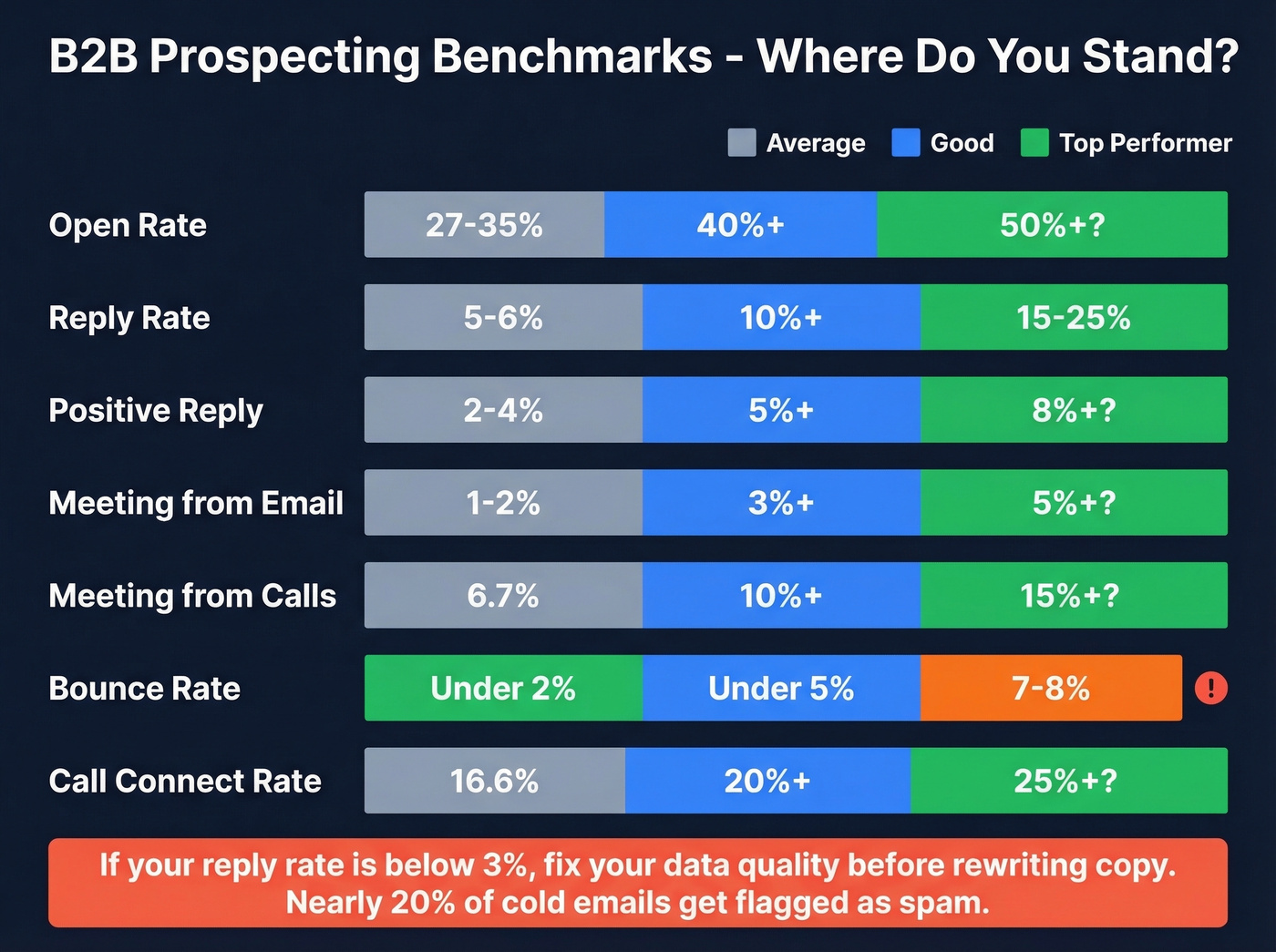
| Metric | Average | Good | Top Performer |
|---|---|---|---|
| Open rate | 27-35% | 40%+ | 50%+ |
| Reply rate | 5-6% | 10%+ | 15-25% |
| Positive reply | 2-4% | 5%+ | 8%+ |
| Meeting from email | 1-2% | 3%+ | 5%+ |
| Meeting from calls | 6.7% | 10%+ | 15%+ |
| Bounce rate | 7-8% | Under 5% | Under 2% |
| Call connect rate | 16.6% | 20%+ | 25%+ |
The average cold email response rate is 5.1%, and almost 20% of cold emails get flagged as spam. That spam number is the one that should scare you - it means one in five emails never reaches a human being.
If your reply rate is below 3%, don't rewrite your copy first. Check your data quality and deliverability. Clean data is the foundation everything else sits on - fix that before you touch a single subject line. (Start with email bounce rate basics and fixes.)
Your Prospecting Tool Stack
You don't need ten tools. You need the right three to five, matched to your budget. (If you're comparing options, see our roundup of SDR tools.)
| Tool | Category | Starting Price | Best For |
|---|---|---|---|
| Prospeo | Verified data | Free (75 emails/mo) | Accuracy at any scale |
| Apollo | Database + sequencing | Free tier / ~$49/user/mo | Search + initial lists |
| ZoomInfo | Enterprise data | ~$15K/yr | Large teams, full platform |
| Cognism | EMEA data | ~$15K/yr | European prospecting |
| Clay | Enrichment workflows | $149/mo | Waterfall enrichment |
| Instantly | Email sequencing | $47/mo | Cold email at volume |
| Smartlead | Email sequencing | ~$39/mo | Multi-inbox management |
| Lemlist | Email + social sequencing | ~$59/user/mo | Multichannel sequences |
| Outreach | Enterprise sequencing | ~$100-$160/user/mo | Full-cycle sales teams |
| Salesloft | Enterprise sequencing | ~$125-$200/user/mo | Enterprise workflows |
| HubSpot CRM | CRM | Free / Starter $15/seat/mo | Startups, SMBs |
| Pipedrive | CRM | $19/seat/mo | Pipeline-focused teams |
| Salesforce | CRM | $25/user/mo+ | Enterprise |
| Bombora | Intent data | ~$25K/yr | In-market buyer signals |
| 6sense | Intent + ABM | ~$50K/yr | Account-based programs |
Starter Stack (Under $100/mo)
Prospeo's free tier gives you 75 verified emails per month plus 100 Chrome extension credits. Pair it with Instantly ($47/mo) for sequencing and HubSpot's free CRM. This gets a solo founder or early-stage SDR fully operational - verified data, automated sequences, and a place to track it all.
Growth Stack ($100-$300/mo)
Add Clay ($149/mo) for waterfall enrichment - pulling data from multiple sources and layering it. Run sequences through Instantly or Lemlist. Move to Pipedrive ($19/seat/mo) or HubSpot Starter for better reporting. (If you're evaluating vendors, start with data enrichment services.)
Enterprise Stack ($15K+/yr)
ZoomInfo or Cognism for data. Outreach or Salesloft for sequencing. Salesforce for CRM. Layer Bombora or 6sense for intent signals - knowing which accounts are actively researching your category before you reach out.
Here's the thing: if your average deal size is under $10K, you almost certainly don't need an enterprise stack. A $15K/year data contract needs to source two deals just to break even after tooling and labor costs. Most teams under 50 reps will build more pipeline with a $100/month stack and disciplined execution than with a six-figure tech budget and sloppy targeting. Skip the enterprise tools until your deal size justifies them.
Mistakes That Kill Your Pipeline
Spraying untargeted lists. That 67% reply-rate penalty for untargeted sends is real. Smaller, tighter lists win every time.
Skipping email verification. A 35% bounce rate doesn't just waste sends - it torches your domain reputation for months. Verify every email before it enters a sequence. I watched a team at a Series B startup burn through three domains in two months because nobody bothered to verify a purchased list. They spent more time recovering sender reputation than they would've spent verifying the data upfront.
Giving up after one follow-up. 44% of reps do this. 80% of deals need five or more touches. The math is obvious.
Ignoring deliverability. Don't use open or click trackers - they kill your deliverability. Warm up new domains for 2-3 weeks before sending outbound. Cap daily sends at 30-50 per mailbox. If your connect rate is suspiciously low, check whether your dialer routes calls through VoIP numbers that get flagged as spam before anyone picks up. (Related: email velocity.)
Running single-channel outreach. Email alone caps your conversion. Calls alone don't scale. Social alone is too slow. Combine all three.
Ignoring GDPR. Fines run up to EUR20M or 4% of global annual revenue. If you're prospecting into the EU, you need compliant data sources and clear opt-out processes. This isn't optional.
How AI Changes B2B Prospecting in 2026
Early AI adoption in sales is showing 30%+ improvement in win rates, per Bain's research. Sellers currently spend roughly 25% of their time actually selling - the rest goes to research, data entry, admin, and internal meetings. AI stands to double that selling time by handling the surrounding work.
You can't AI your way out of a broken process, though. Bolting an AI tool onto bad workflows gives you a faster broken process. And the biggest blocker for AI adoption in sales is data cleanliness - if your CRM is full of duplicates, outdated titles, and unverified emails, AI tools will just amplify the mess.
Intent data is where AI gets genuinely useful right now. Tools like Bombora track 15,000+ topics to identify which accounts are actively researching solutions in your category. Layering intent signals on top of your ICP filters means you're reaching out to companies that are already in-market, not just companies that fit your firmographic profile. The teams getting real results from AI in 2026 fixed their data first, then layered intelligence on top.
FAQ
How many touchpoints does it take to book a B2B meeting?
Eight touchpoints is a strong baseline, and most outbound teams run 8-12 touches spread across 17-21 days using multiple channels. 80% of deals require five or more follow-ups, but 44% of reps quit after just one. Structured, respectful persistence is the single biggest differentiator between reps who hit quota and reps who don't.
What's a good cold email reply rate?
The average cold email reply rate is 5-6%. Good is 10%+. Top performers hit 15-25%. If you're below 3%, check your data quality and deliverability before rewriting copy - bad data is the more likely culprit than bad messaging.
Is cold calling still effective in 2026?
Yes. 6.7% of cold calls result in a booked meeting, and 57% of C-level buyers prefer phone contact over email. Use calling as the conversion touch after email and social have built context. Calls work best at 4-5 PM in the prospect's time zone.
What tools do I need to start B2B prospecting?
Three: a verified data source, an email sequencer like Instantly or Smartlead, and a CRM like HubSpot free. Total cost under $100/month. Add enrichment tools like Clay and intent data providers later as you scale past your first 1,000 prospects.
How do I avoid getting flagged as spam?
Keep your bounce rate under 2% and spam complaints under 0.01%. Verify every email before sending. Don't use open or click trackers in cold outreach. Warm up new domains for 2-3 weeks before launching sequences, and cap daily sends at 30-50 per mailbox.
You just mapped your ICP with firmographics, technographics, and buyer personas. Now turn those filters into a live prospect list. Prospeo's 30+ search filters - including buyer intent, tech stack, job changes, and headcount growth - match your exact ICP criteria. At $0.01 per email, a verified list of 1,000 contacts costs less than your morning coffee run.
Skip the bounce rate disaster. Start with verified data from day one.